University of South Carolina
Scholar Commons
Theses and Dissertations
1-1-2013
The Parasitic Oligarchy? The Elites in Trinidad and
Tobago
Alison Mc Letchie University of South Carolina
Follow this and additional works at:https://scholarcommons.sc.edu/etd Part of theSociology Commons
This Open Access Dissertation is brought to you by Scholar Commons. It has been accepted for inclusion in Theses and Dissertations by an authorized administrator of Scholar Commons. For more information, please [email protected].
Recommended Citation
Mc Letchie, A.(2013).The Parasitic Oligarchy? The Elites in Trinidad and Tobago.(Doctoral dissertation). Retrieved from
T
HEP
ARASITICO
LIGARCHY?
T
HEE
LITES INT
RINIDAD ANDT
OBAGOby
Alison Mc Letchie
Bachelor of Science
South Carolina State University, 2000
Master of Arts
University of South Carolina, 2003
Submitted in Partial Fulfillment of the Requirements
For the Degree of Doctor of Philosophy in
Sociology
College of Arts and Sciences
University of South Carolina
2013
Accepted by:
Jimy Sanders, Major Professor
Patrick Nolan, Committee Member
Shelley Smith, Committee Member
Ann Kingsolver, Committee Member
ii
iii DEDICATION
This dissertation is dedicated to my large, unruly, loud, cantankerous, nosey
family, including Henrietta Baptiste who I miss dearly, each of has showered me with
iv
ACKNOWLEDGEMENTS
I would like to express my deepest gratitude to my committee members, Jimy
Sanders, Patrick Nolan, Shelley Smith and Ann Kingsolver, for their guidance and
patience. I especially want to recognize the best chair in the world, ever – Jimy Sanders
– who worked tirelessly with me.
Thanks also to all my family and friends who supported me every step of the way.
In particular my personal Hercules, who suffered through more than 12 labors and time
v ABSTRACT
The existence of an elite class within societies is often a topic of research in the study of
inequality of power and influence. Researchers, however, acknowledge that the nature
and composition of the elite varies. Trinidad and Tobago, with its colonial history and
diverse population has had to confront issues surrounding access to power by various
groups within the society. One driving force of the 1970s Black Power Revolution was
the practice of color discrimination in the banking industry. Informed by Mills’ (1956)
elite theory and rooted in Beckford’s (1972) economic theory, this project surveys the
elite of Trinidad and Tobago. I examine three important national sectors: business, the
judiciary, and the National Senate – all appointed positions – to explore which groups
have access to positions of power and influence. Information was collected with regards
to individuals’ terms of service or length of appointments, type of appointment, ethnicity,
religion, gender and the high school they graduated from. While some of the data are
incomplete, women are unrepresented and Whites over-represented across all three
vi
TABLE OF CONTENTS
DEDICATION ………...…iii
ACKNOWLEDGEMENTS ………....iv
ABSTRACT …...………..………..….v
LIST OF TABLES ………viii
CHAPTER IINTRODUCTION ………...…………....1
CHAPTER IIHISTORICAL FRAMEWORK ………..…………..6
2.1 HISTORICAL CONTEXT AND THE RISE OF THE POST-INDEPENDENCE ELITE ………..17
CHAPTER IIILITERATURE REVIEW ………19
3.1 ELITES ………..19
3.2 SOCIAL NETWORKS ………..21
3.3ECONOMIC DEVELOPMENT ………23
3.4 TRINIDAD AND TOBAGO ………...27
CHAPTER IVCONCEPTUAL MODEL ……….…...30
4.1 SUMMARY OF CONCEPTUAL MODEL ……….36
4.2 RESEARCH QUESTIONS ……….37
CHAPTER VDATA AND METHODS ……….……....40
5.1 DATA ………40
5.2 VARIABLES ………...42
5.3 ANALYSES ………43
CHAPTER VIRESULTS ……….……….…..46
6.1 JUDGES ……….46
6.2 BOARDS ………51
6.3 SENATORS ………59
vii
6.5 FAMILIES OF INFLUENCE ………..66
CHAPTER VIICONCLUSION ……….…..…….68
7.1 RAGAMUFFIN MONARCHY OR PARASITIC OLIGARCHY?………...70
7.2 WOMAN IS BOSS?……….…71
7.3 EDUCATION IS ESSENTIAL ………72
7.4 MIX UP ……….75
7.5 THE FUTURE IS NOW ………77
REFERENCES ……….………...80
APPENDIX A:JUDGES ……….85
APPENDIX B:COMPANY DIRECTORS ……….………….88
APPENDIX C:NATIONAL SENATORS ……….………....109
APPENDIX D:UNISIC……….…..……...119
viii LIST OF TABLES
Table 1.1: Occupational-Ethnic Relationships of the Elite ………..….. 2
Table 2.1: Population by Ethnic Group ……….…….……7
Table 2.2: Income Distribution by Ethnicity ……….………….8
Table 2.3: Population Change, 1784 to 1797 ..………..…...……...9
Table 5.1: Judges’ Sex ………..….………...47
Table 5.2: Judges’ Ethnicity ……….………..…..………47
Table 5.3: Judges’ Religion ………..…...….48
Table 5.4: Judges’ High School ………...……..…...48
Table 5.5: Judges’ Appointments ………....….49
Table 5.6a: High Court Appointment ………..…….…....50
Table 5.6b: High Court Appointment ………...……....50
Table 5.7a: Directors’ Sex ……….……….….….51
Table 5.7b: Sex by Multiple Board Appointments by Industry ...………...…..52
Table 5.8: Board Occupational Distribution ………...…...……...54
Table 5.9: Occupational Group by Industry ……….………...…….…55
Table 5.10 Boards’ Ethnicity (less unknown) ………...56
Table 5.11a: Multiple Board Appointments ……….………...……… 57
Table 5.11b: Multiple Board Appointments ……….58
Table 5.11c: Multiple Board Appointments ………..……...……58
Table 5.12a: Senators’ Sex ………..…….60
Table 5.12b: Number of Terms by Sex ………...………..60
Table 5.13: Senators’ Occupational Group by Sex ……….………….………...………..61
Table 5.14a: Single Senate Term ………...………...62
Table 5.14b: Single Senate Term ……….………...………..63
Table 5.14c: Single Senate Term ………...…...64
Table 5.14d: Single Senate Term ………...……...65
1 CHAPTER I
INTRODUCTION
One January 31st, 2009, the Trinidad Newsday announced on the front page “Govt Bails
Out CLICO”. The article described the government’s move to rescue the company
which, according to the article, manages “assets of over $38 billion, more than 25 percent
of this country’s Gross Domestic Product (GDP)”. Cyril Duprey founded the firm in
1936 as an insurance company. Under the direction of Lawrence Duprey, his nephew, it
became one of the largest multi-national companies in the region. The failure of the
company reflects the convergence of world market forces and poor investment decisions
by the younger Duprey and his management team. The speed and nature of the
government’s actions are of particular interest to my research. Some argue that the
government had no choice because of the size of the company in relation to the national
economy, others speculate that the deal struck was a result of the relationship of key
members of CLICO’s management and the government. Basdeo Panday, one-time leader
of the Untied National Congress (UNC) is the godfather of Duprey’s child and Duprey is
thought to be one of financers of Panday’s political party. Andre Monteil1
, one of
1
2
Duprey’s closest business associates, having served as financial director in the company,
has strong ties to the Peoples National Movement (PNM) where he has been the party’s
treasurer. This dissertation is a sociological study of the judicial, political and capitalist
class in Trinidad and Tobago. Rooted in economic theory, particularly Beckford’s (1972)
plantation economy and Mills’ (1956) elite theory, it compiles a comprehensive list of
three major segments of civic society – the judiciary, national Senate and company
boards. It examines the demographic composition of these groups and studies the
relationship between the members. This project argues that leading up to independence
in 1962 and since then there are three categories of elites formed on the islands. They
are: descendants of colonial officials and plantation owners; descendents of Chinese and
Syrian/Lebanese immigrants; and a relatively small group of Afro- and Indo-Trinidadians
and Tobagoians. Drawing on various developments in the history of Trinidad and
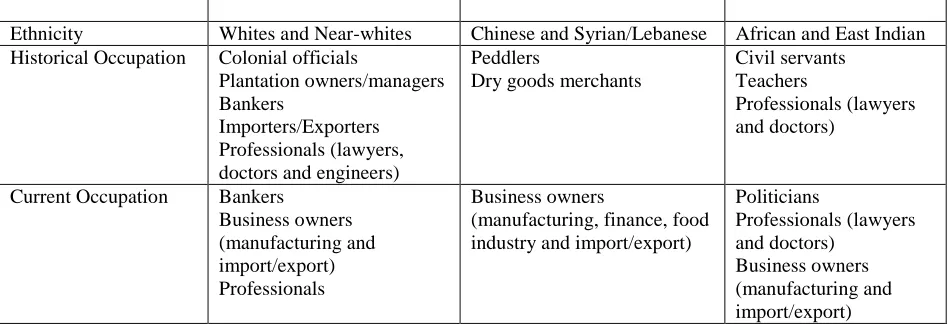
Tobago, I summarize the occupational-ethnic relationship in Table 1.1.
Table 1.1: Occupational-Ethnic Relationships of the Elite
Ethnicity Whites and Near-whites Chinese and Syrian/Lebanese African and East Indian Historical Occupation Colonial officials
Plantation owners/managers Bankers
Importers/Exporters Professionals (lawyers, doctors and engineers)
Peddlers
Dry goods merchants
Civil servants Teachers
Professionals (lawyers and doctors)
Current Occupation Bankers
Business owners (manufacturing and import/export) Professionals
Business owners
(manufacturing, finance, food industry and import/export)
Politicians Professionals (lawyers and doctors) Business owners (manufacturing and import/export)
The study argues that after Trinidad and Tobago achieved independence from
Britain, the pre-independence/colonial elites retained their place in the economic sector
3
local Whites, descendants (legitimate and illegitimate) of planters and European colonial
officials. Ethnic Chinese and Syrian/Lebanese immigrants began arriving on the islands
in the late 1800s and have remained relatively small minorities. The latter group, despite
arriving as impoverished migrants has been able quickly to become business owners and
part of the capitalist class.
The third group of elites is a small group of ethnic African and Indians whose
ancestors came to the islands as slaves and indentured laborers. Pre-independence,
members of these groups achieved success mostly as a result of their access to education.
Some were able to take advantage of opportunities in the civil and teaching services
while a smaller group was able to go to abroad and train to become doctors and lawyers
and an even smaller group became business owners. Post-independence saw the rise of
this group in the political and judicial arenas where they would dominate while
increasing their presence in the capitalist sphere.
The central tenet of this paper is that the Whites and Near-whites2, who were
more directly tied to the colonial authorities, recede into the shadows of power after
independence as the new elites assume the reins of judicial and political leadership. In
the private capital arena the traditional elites – mostly Whites, Near-whites, Chinese,
Syrian/Lebanese – continued to dominate although participation of newer elites –
Africans and East Indians – have also increased in this sphere as a direct result of their
ties to state (government) companies or other civil appointments.
The transformation of the elite in Trinidad and Tobago takes place over a
relatively short time and in response to nationalist sentiment and political expedience.
2
4
Changes were particularly dramatic after the 1970 Black Power rebellion (Ryan, 1972;
Bennett, 1996; and Premdas, 2007). Despite these changes and drawing from the
analysis of Beckford (1970, 1972, 2000a, 2000b, 2000c, 2001) this study explores the
degree to which the super-structure developed by the colonial plantation system is still
evident in current national political and economic institutions. The most important
question is: Are traditional elites able to retain key roles and strongly influence national
life in spite of post-independence political change.
Relying on Beckford’s (1972) model, this paper examines some of the critical
business and political institutions alongside the judiciary in order to reveal the extent to
which it is the members of the new elite group who participate in the government and
judiciary while the traditional group have retained considerable influence in the financial
and economic sectors. This is significant because it considers which groups control the
national economy, legal system and one arm of the national government therefore
possibly influences policy formation.
Trinidad and Tobago’s post-independent political leadership recognizes the role
and importance of the traditional elite, particularly in terms of their economic influence
and financial dominance. One result of this is that governments occasionally reward
members of the traditional elite with appointments to public office; in this study, the
judiciary and national Senate. The new elite play a significant and highly visible role in
politics particularly as elected government officials and growing appointments to the
legal bench. Additionally their presence in the professional and business community has
5
This paper maintains, that in order to sustain a democratic system for fifty years,
national governments, which are comprised mostly of individuals of African and East
Indian heritage, acknowledge the need to appease various sectors of the society, including
the capitalist elites (mostly, Whites, Near-whites, Chinese and Syrian/Lebanese). It
demonstrates that members of the traditional (capitalist) elite are tied to various political
parties as evidenced particularly by Senatorial appointments. These appointments may
be construed as rewards by the political party leadership that is dominated by new elite
members. It is also surmises that through these appointments the traditional elite have
been able to maintain their economic position since independence in 1962. These
political appointments are important because they afford the capitalists elite access to
information while at the same time rewarding them for their support of the political
parties. The support is inferred because many of the capitalist elite families have
6 CHAPTER II
HISTORICAL FRAMEWORK
The success of many former colonies as viable nation-states is mixed (Knight, 1978;
Stone 1986; Clarke 1991 and Payne & Sutton 2001). Many economists, historians, and
political scientists debate the reason for this phenomenon. George Beckford (1972,
2000a, 2000b, 2000c and 2001) suggests that former colonials, particularly those in the
Caribbean, were part of a larger system that was meant to support the colonial
government. This support came even at the expense of many colonies’ wellbeing. In the
English-speaking Caribbean, land was often used to produce sugar, coffee, cocoa and
more recently bananas for export to Europe and America. Beckford argues that the
plantation system created by colonialists initially as part of the larger slave economy left
significant marks on the institutions of the Caribbean long after slavery ended. He
proposes not only that plantation economies created, economic distinctions based
primarily on racial lines and access to the colonial power structure but that the economic
paradigm filtered into social life manifesting in what he described as a plantation society.
According to him this society is characterized by a largely unskilled labor force,
dependent on agriculture, a small ex-patriot supervisory force, cultural pluralism, a caste
system based on occupation and social status, an authoritative managerial style, and
centralized decision making.
This paper argues that since independence in 1962, national politics in Trinidad
7
The network created by this group has meant that the comparatively small Chinese,
White and Syrian/Lebanese ethnic groups and a few Indian and African families have
maintained a strong presence in the political and economic arena. Using Beckford’s
plantation society as a backdrop, this paper explores whether that the planter and colonial
official has been replaced by a few elites who are able to secure their economic, political
and social position by establishing a network of public and private connections. As a
multiethnic country (Table 2.1) Trinidad and Tobago struggles with how its citizens gain
access to the wealth generated from its oil and gas fields. This is especially problematic
because there is no ethnic majority and the two major political parties subscribe to the
British policy of “divide and rule” along ethnic lines. As a result the ethnically African
population is aligned with the PNM and the ethnically East Indian populations with the
UNC.
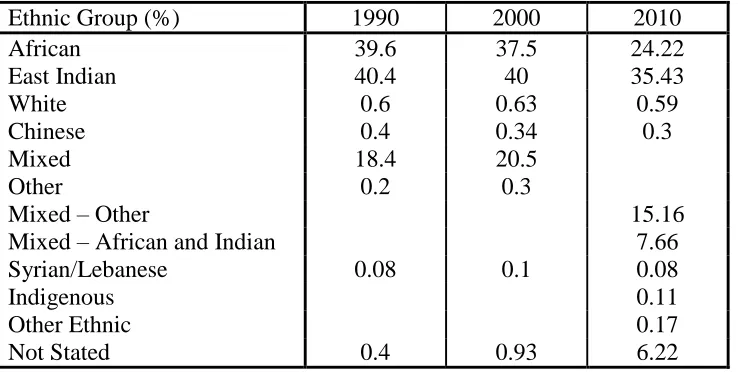
Table 2.13: Population by Ethnic Group
Ethnic Group (%) 1990 2000 2010
African 39.6 37.5 24.22
East Indian 40.4 40 35.43
White 0.6 0.63 0.59
Chinese 0.4 0.34 0.3
Mixed 18.4 20.5
Other 0.2 0.3
Mixed – Other 15.16
Mixed – African and Indian 7.66
Syrian/Lebanese 0.08 0.1 0.08
Indigenous 0.11
Other Ethnic 0.17
Not Stated 0.4 0.93 6.22
8
The White, Chinese and Syrian/Lebanese communities make up about 1% of the
population. In order for these minority groups to gain access to political power and
maintain economic dominance their members tend to align themselves with both major
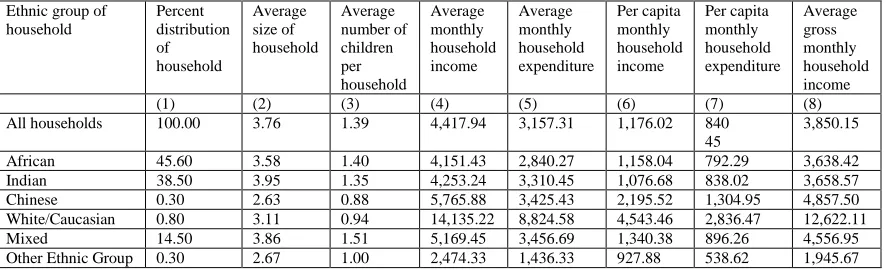
political parties. Table 2.2 describes income distribution, in Trinidad and Tobago dollars,
by ethnicity.
Table 2.24,5: IncomeDistribution by Ethnicity (2000)
Ethnic group of household Percent distribution of household Average size of household Average number of children per household Average monthly household income Average monthly household expenditure Per capita monthly household income Per capita monthly household expenditure Average gross monthly household income
(1) (2) (3) (4) (5) (6) (7) (8)
All households 100.00 3.76 1.39 4,417.94 3,157.31 1,176.02 840
45
3,850.15
African 45.60 3.58 1.40 4,151.43 2,840.27 1,158.04 792.29 3,638.42
Indian 38.50 3.95 1.35 4,253.24 3,310.45 1,076.68 838.02 3,658.57
Chinese 0.30 2.63 0.88 5,765.88 3,425.43 2,195.52 1,304.95 4,857.50
White/Caucasian 0.80 3.11 0.94 14,135.22 8,824.58 4,543.46 2,836.47 12,622.11
Mixed 14.50 3.86 1.51 5,169.45 3,456.69 1,340.38 896.26 4,556.95
Other Ethnic Group 0.30 2.67 1.00 2,474.33 1,436.33 927.88 538.62 1,945.67
Percentage distributed is not representative since Tobago was over sampled
It is clear that the descendents of plantation owners, merchants and colonial
official (mostly Whites or Near-whites) did have an initial advantage in terms of wealth
accumulation. As a result of the colonial system, first under the Spanish and then the
British, Whites and Near-whites were afforded access to land and capital denied to
Africans and East Indians. The Spanish, in an effort to increase the population on
Trinidad and in a futile attempt to help defend the island from other European
4
Source: Central Statistical Office of Trinidad and Tobago.
5Given the demographic makeup of Tobago, the African-origin segment of the
9
powerhouses, especially Britain, encouraged Catholic immigration to Trinidad. A large
number of French along with smaller numbers of Irish and English settlers took
advantage of the “Cedula of Population” moving to Trinidad beginning in 1783.
According to Brereton (1981 and 1998), White migrants were awarded about 30 acres of
land “for each member of his family and half as much for each slave he introduced” (p.
13) while Mulattos and free Blacks received less land. The two other conditions
demanded by the Spanish were that the settlers be Catholic and that they come from a
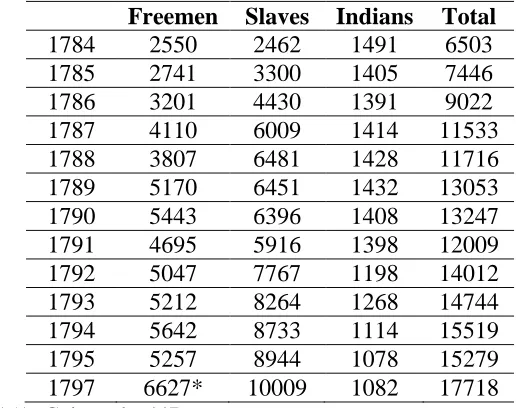
nation friendly to Spain. The Cedula, Brereton maintains, resulted in an increase the
island’s population from 6,503 in 1784 to 17,718 in 1797, Table 2.3, when the British
took over.
Table 2.36: Population Change, 1784 to 1797
Freemen Slaves Indians Total
1784 2550 2462 1491 6503
1785 2741 3300 1405 7446
1786 3201 4430 1391 9022
1787 4110 6009 1414 11533
1788 3807 6481 1428 11716
1789 5170 6451 1432 13053
1790 5443 6396 1408 13247
1791 4695 5916 1398 12009
1792 5047 7767 1198 14012
1793 5212 8264 1268 14744
1794 5642 8733 1114 15519
1795 5257 8944 1078 15279
1797 6627* 10009 1082 17718
*Whites: 2151 Coloureds: 4476
The Cedula helped Whites and Near-whites obtain access to free land. Along
with the slave system of the island it meant that most Non-whites were locked out of the
10
ownership class. Brereton points out however that the White racial group itself was not
homogeneous. She argues that there were multiple divisions within this group (1998).
These included, but were not limited to: place of birth (European mainland vs.
Caribbean); length of residence on the island (old vs. new families/arrivals); language
and ethnicity (Spanish vs. French vs. English); religion (Catholic vs. Protestant – mostly
Anglican); class (elites – plantation and large business owners and high level colonial
officials vs. middle-class – lower level colonial officials, overseers, teachers and other
professionals vs. the lower-class – small village shopkeepers and farmers). Brereton
claims that the small Syrian and Lebanese population that began arriving in 1890 was
subsumed into the White racial category and are often considered as such however it has
maintained itself as a separate own sub-group and has resisted intermarriage with other
groups (both Whites and Non-whites). This group initially worked as peddlers and
small-scale traders, but over time became integral to the commercial infrastructure on the
islands.
The Chinese came to Trinidad in two phases7, a first wave in beginning in 1853
and a second wave in the first part of the 1900s. Originally hired as indentured laborers
many of them quickly abandoned the fields. Instead they became village shopkeepers,
small farmers (mainly cocoa) or merchants involved in the import/export trade. Unlike
East Indian indentured laborers the Chinese were not promised return passage to their
7There has been a more recent wave beginning in the late 1990s but it is yet unclear if
11
homeland. Their numbers remained low however because of high levels of mortality8.
According to Look Lai (1993) the post-indentureship opportunities were very favorable
to the Chinese and many of them were in fact able to buy out their contract before the
five-year period ended. He writes that:
“[B]y the time of the census of 1891, the vast majority of the small Chinese community in Trinidad had gravitated out of its early duality of occupation (part agriculturist, part small trader). Most found themselves in the later occupation, jostling side by side with their Portuguese, Indian, and Black counterparts, but having at least in Trinidad – an image of being the most successful of these groups in this field” (p. 191).
A racialized system of land ownership developed wherein Whites and
Near-whites owned most of the plantations on the islands at the time of emancipation.
According to Williams (1942), “in 1841 the Trinidad planters objected to a proposal from
the Secretary of State that 40 acres should be the smallest area of Crown land granted to
any person” (p. 87). The planters insisted that grants be no smaller than 320 acres and by
opposing this plan they were able to ensure sugar production, the most profitable crop at
that time, would continue to be out of the reach of the newly freed slaves because sugar
needed to be cultivated on large landholdings for maximum efficiency and profitability.
This also effectively meant that the newly freed slaves would be restricted to peasant
agriculture (Mintz 1989). Williams argues that the colonial government actively worked
against the interest of small farmers in favor of large plantation holders, who were often
represented in the Crown Colony system of government. It is the desire to maintain these
large-scale plantations that Williams, Mintz and Beckford claimed inspired and
maintained the hierarchical racialized labor market. Concurring with R.T. Smith,
8
12
Beckford (2000a) argues that plantation “society as a whole was therefore rigidly
stratified by race and colour directly correlated with occupational status on the plantation,
with very limited social mobility” (p. 246)
Access to land ownership was especially essential in the plantation economy.
Large-scale holdings were needed for the production of sugar and later cocoa and coffee.
According to Beckford (2000a), emancipation did little to change the position of Blacks
in the society because the Whites and Near-whites were able “to maintain their
stranglehold over the basic means of production – the land” (p. 247). He claims that even
on an island like Trinidad, with an excess of land (relative to smaller islands) Whites
control over most of the fertile land led to four major consequences. Firstly, social and
economic mobility was very restricted. Secondly, the plantation society developed a
social system “based on caste, race and colour” (p. 247). Thirdly, production and
resources were geared towards fulfilling the needs of the colonial power rather than the
native population. Finally, that labor was organized inefficiently in the plantation
system. Beckford suggests that the plantation system created an unequal society, where
social mobility and wealth was tied to land ownership. Therefore as long as land
ownership was denied to the majority, wealth accumulation would also be elusive. Mintz
(1998) supports this view when he writes that in the competition between the plantation
owner and small-scale (peasant) farmer “for scarce resources – such as agricultural
extension, assistance, government-supported irrigation, and highways. Such struggles are
consistently won by the plantations” (p. 133)
As early as 1857, Williams (1942) states that the profitability of sugar on the
mega-13
plantations on Cuba. Cuban plantations were not only larger, but had better technology,
produced a better product and investors from America had sunk about US$30 million in
the industry by 1896. Alongside Cuban sugar, Trinidad, according to Williams was also
competing with beet sugar from Europe, particularly Germany and by 1902 “king” sugar
was dead.
According to Brereton (1981) cocoa production became a viable alternative to
sugar between 1866 and 1920. Unlike sugar, smaller plots of land could be converted
into cocoa estates and with the loosening of availability of Crown lands by Governor
Gordon9 large numbers of small-scale farmers could become involved in the industry.
Brereton points out that there were two ways smaller farmers would gain access; either as
the owner/cultivator of their land or as a contracted cultivator of someone else’s property.
Usually an investor would purchase large tracts of Crown lands and then turn them over
to the farmer for a five year period and a percentage of the sale of the crop. Despite the
development of these small farms, the White elite were able to ensure their continued
dominance in the economic and political life of the islands. Brereton points out that the
colonial government failed to sustain land reform started by Gordon and continued
preferential access of elites to the capital and the financial market. As the large-scale
model of the plantation began to failed, peasant farmers who were excluded from access
the financial market were unable to form a viable middle-class and would take longer for
this group to emerge.
Even with the failure of large-scale plantation agriculture by 1930, land
ownership remained important to wealth accumulation. Brereton describes how even
14
with the collapse in the prices of sugar and cocoa, the colonial government worked with
large, mostly white plantation owners, to prevent the foreclosure of their properties by the
banks to which they were mortgaged. Laborers on the plantations continued to be
subjected to arduous working conditions. The sugar industry moved towards a system of
cane farmers where smaller farmers would sell their crops to the larger estate, thus
removing the need to pay for labor altogether from the estate’s costs. Brereton also
points out that some of the earliest oil wells were dug, Africans and Indians were
employed to clear the forest, but Whites (British, Americans and local Creoles) and a
Chinese-Trinidadian who were given leases, able to gain access to capital and the
government, and had the technical know-how.
The pattern of social hierarchy established at the inception of European rule
continued as the island moved towards independence in 1962. The planter class (mostly
White), long after the failure of plantation agriculture, continued to receive favorable
treatment from the colonial government and as a result higher had social status. Many of
them were able to use their land to acquire capital (through sale or mortgages) to start
businesses or provide university (usually European but sometimes American) education
for their children especially in medicine and law. This group also controlled the banking
sector, worked for oil companies and owned large merchandizing companies. The
Chinese and Syrian/Lebanese groups, by 1962, had entrenched themselves in the
merchant and trader class, running import/export businesses, working as middle men
between the wholesaler and the rural shopkeeper or acting as the rural shopkeeper. The
Syrian/Lebanese group developed a reputation of being cloth merchants while the
15
mostly employed as laborers, lower level civil servants, store clerks and teachers. Some
did manage to become professionals (lawyers and doctors), clergy and businessmen;
these were more often the exception.
In 1925 the Woods Commission expanded suffrage (Williams, 1942). The
criterion was based on “the domination of property and wealth” (p. 220). Eligibility of
voters and those permitted to serve in the legislative council was tied to proof of income,
residence and education. The trade union movement, which began in the 1920s the trade
union movement, flourished on the islands. Initially it was closely tied to the general
political development of the working-class, which was comprised of mostly ethnically
African and Indian laborers. With leaders like Cipriani, Butler and Rienzi, sugar and oil
workers began to organize themselves. The growing labor movement attempted to
respond to the unfair working conditions that had long received the tacit approval of the
colonial government. Brereton claims that alongside this growing political awareness
was a simultaneous cultural awakening that encouraged people to learn and to appreciate
the various ethnic traditions present on the islands. For the first time, the African and
Indian working class saw leaders who championed their causes. With increased access to
education, many of them were able to achieve middle class status.
Outside of the major urban centers of Port of Spain and San Fernando, however,
the African and Indian remained mostly segregated by geography and employment. This
was not by formal design as in the United States, but rather by coincidence. After slavery
Africans tended moved into urban centers to look for work and remained there. Indians,
having been recruited to replace African labor, were settled, on, or near, the plantations
16
ended many were given plots of land instead of their return passage. Africans received
no such compensation at the end of slavery. Many Indians therefore worked as
agricultural laborers or in the sugar industry. Working class Africans tended to be
employed as laborers in oil, casual day laborers and agriculture. The only real access to
the middle class available to these two groups was education. Primary education was
free by 1851 but the quality was sometimes dubious. A sound primary school education
however could allow a graduate to enter the teaching ranks through a long system of
mentorship and obtain other middle class jobs. Secondary education remained available
mostly to those who could afford to pay for it except when a poor child passed a national
examination that allowed them access. Gaining entry to a secondary school was no
guarantee of attendance or completion since parents, particularly rural ones, would often
be forced into paying for their child’s books and room and board since most of the high
schools were located in urban centers.
The growing African and Indian middle and intellectual class, supported by the
working class pushed for political independence10. Although divided mostly along
ethnicity, two major political parties formed, the PNM lead by Eric Williams with an
overwhelmingly urban, African and Christian membership and the Democratic Labour
Party (DLP) which by default was consisted of mostly Indian, non-Christian and rural
members. This was not the first time race was present in social movements, but
according to Brereton (1981) Williams reacted to the DLP’s 1958 federal election victory
in a speech by accusing them of appealing to race in order to motivate the electorate. She
argues that what Williams in fact was doing is making “an appeal for
10
17
mobilization” (p. 239). Eventually, this pattern of racialized politics, which first surfaced
in the early trade union movement, would become a permanent fixture of the political
scene. The PNM would continue to be perceived as the African party and the DLP along
with all its political descendants, the Indian party.
Political independence however did not lead to radical social change. The PNM
who were able to obtain the political majority in the parliament beginning in 1962 until
1986 were forced to confront the social order in 1970 by the Black Power Movement.
This social rebellion was in response to the rigid cultural divides on the island. Up to this
point in time, Africans and Indians found themselves marginalized socially and excluded
from various fields of employment. Young, mostly middle-class, Afro-Trinidadian
students, organized and led marches in the capital to protest their continued exclusion
from jobs especially those in the private sector like banking. The organizers saw
themselves as champions of all the middle and working classes and not just of
Afro-Trinidadians. Unfortunately for them, many Indo-Trinidadians rejected the idea of Black
Power as a solely African expression. Among some Afro-Trinidadians, including the
ruling class, the movement leaders were seen as rebellious, violent and ungrateful.
Although the movement did achieve some of it goals including the opening up of new
employment opportunities to Africans and Indians, it remains characterized as
Afro-centric in nature.
2.1 HISTORICAL CONTEXT AND THE RISE OF THE POST-INDEPENDENCE ELITE
Using Beckford’s plantation society model, the study examines the political and
18
elites retain the social capital and gain political access through the membership of various
family members in political parties and the financing of political campaigns. These
activities are then rewarded by appointments to a number of state-controlled positions.
Premdas (2007) writes that “[t]he issue of equality and inequality in the context of
inter-ethnic rivalry under the pervasive condition of multi-inter-ethnicity in the contemporary state”
(p.3) accordingly, my study would imply that there might be some covert collusion
between the elite and the political parties who govern the country. The results of which
are reflected in Table 2.2. Citing an article in the Economist Henry (1986) maintains that
within plural societies and from
“the standpoint of Marxian and Dependency perspectives, the new elites that succeeded the former colonial elite have simply adapted to a new role in a continuing relationship between their own peripheral country and the metropolitan center and are the new agents for the maintenance of the old arrangements which are now mediated through transnational corporations and the bureaucratic state” (p. 76).
This suggests the importance of examining the composition of elite in Trinidad and
19 CHAPTER III
LITERATURE REVIEW
3.1 ELITES
Social scientists generally agree that modern societies typically have a hierarchical social
structure, the elite on the top and the working and underclass at the bottom (Mills, 1945
& 1956 and Pareto 2000). The idea of the elite however needs to be examined. The
assumption is often made, not just of their existence but that they are a well-defined
easily identifiable group (Laumann and Pappi 1973 and Zeitlin, Neuman and Ratcliff
1976). Mills’ 1956 classic work, The Power Elite argues that this group is identifiable
and has tremendous power over society. According to Mills, the elite “is composed of
men whose positions enable them to transcend the ordinary environments of ordinary
men and women; they are in positions to make decisions having major consequences” (p.
3). Mills suggests that elites in America are able to influence various parts of the society
including the military, government, business and media. He claims that the emergence of
the elite is shaped by historical events and the nature of modern social institutions which
trends towards centralization of decision making. In an earlier study Mills (1945)
examined seven periods of American history, from 1570 – 1879, and determined that
there are some discernible patterns among the elite with regards to their geographic
20
current study examines the elite of Trinidad and Tobago by looking at senatorial, judicial
and company board of director appointments made from 1962 – 2002 in order to
determine if there are any obvious patterns within this group with regards to ethnicity,
gender, high school affiliations and business connections.
Dahl (1958) and Mintz, Freitag, Hendrick and Schwartz (1976) suggest that some
scholarly work fails to properly define “the elite”. The authors contend that this is a
major deficiency with elite research. Wrong (1968); Bachrach and Baratz (1962); and
Perrucci and Pilisuk (1970) all argue that research on elites does a poor job of defining
precisely who the elite are and what, if any power they actually have. According to these
authors there is a difference between “people who have a reputation for power, which
may or may not be related to actual power” (p. 1041). These authors point out that a
major problem that is evident with much of elite research is the assumption that the
“ruling elite is a well-defined group” (Dahl, 1958). Dahl’s suggestion therefore that the
ruling elite are “a minority of individuals whose preferences regularly prevail in cases of
difference in preference on key political issues” (p. 464) is an excellent working
definition. One of the implications of this study is that these appointees in Trinidad and
Tobago who are the subject of this study, by virtue of their appointments and the nature
of their business interest, have access to information not readily available to others. It is
this access that allows this group and the networks which they are a part of to maintain
21 3.2 SOCIAL NETWORKS
Many researchers use social networks to examine the presence and influence of elites in
the political arena (Moore, 1979; Padgett and Ansell 1993; Alba and Moore 1983;
Kadushin 1995; Heinz, Laumann, Salisbury and Nelson 1990; Higley, Hoffmann-Lange,
Kadushin and Moore 1991; and Ussem 1978). This methodological approach attempts to
uncover the subtle links between individuals and institutions that are not always apparent.
It tries to discover whether the assertion that is often made that political power is
concentrated in the hands of a few (the elite), who use this position to benefit
economically, socially and politically is valid. Often these studies examine the presence
of particular families or ethnic groups in certain industries; as members of executive
boards; political offices or some combination of these. Even though all of these studies
found that there was a core group of elites, the composition and structure of these groups
differed. Some groups are primarily comprised of one ethnicity and others school
friends. Generally however researchers concluded that their membership was primarily
comprised of wealthy individuals but some networks were loosely connected members
revolving around a centralized inner group while other networks were a series of spheres
connected by go-betweens.
Padgett and Ansell (1993) make a strong case for the need to study elite social
networks in order “to penetrate beneath the veneer of formal institutions and apparently
clear goals, down to the relational substratum of people’s actual lives” (p. 1310). Their
work suggests that any investigation of elites must consider public (formal) and private
(informal) links between the group as, “it is clear that marriage [private] and trading
[public] relationships are primary forces behind this blockmodel portrait of the Florentine
22
public that social network methodology can uncover. Aside from family connections,
friendships are also a source of network connections for elites with regard to access to
information, especially in the fields of employment, politics and business (Kadushin,
1995; Krackhardt, 1990; and Gibbons, 2004). This paper contends that the elite network
in Trinidad and Tobago is dominated by members who are connected via family
membership (by blood or marriage); and friendships (formed in secondary school and by
religious affiliation).
The pattern of interlocking directorates between business enterprises and political
appointments or interest groups is another example of elite networks (Dooley, 1969;
Freitag, 1975; and Levine, 1972). The hypothesis that guides this proposal is not just that
this pattern also exist in Trinidad and Tobago, but that in regard to appointments to
non-elected offices including, but not limited to, the boards of public enterprises, judgeships
and as national Senators minority ethnic groups are over-represented when compared to
their composition within the general population. The old elite of Trinidad and Tobago
are primarily comprised of members who are in the ethnic minority. Greeley (1974) in
his own investigation of political participation among ethnic groups found there were
significant differences in the levels of involvement. Alba and Moore (1982) sampled the
ethnicity of the leadership of public and private sector organizations from 1971 – 1972.
According to their findings, certain ethnic minorities, particularly Irish Catholics, are
over represented within the American elite and that White Anglo-Saxon Protestants
(WASPs) elites tend to “have more elite educations, and are older than other groups” (p.
23 3.3 ECONOMIC DEVELOPMENT
Williams (1966) argues in Capitalism and Slavery that the European colonists developed
the Caribbean region to service the needs of its empires with little regard for the region’s
inhabitants. This foundational work examines the connections between economics,
politics and society. Alonso (2002) claims that one result of this colonial arrangement is
dependency on the exportation of one or two (usually agricultural) goods. This means
that the region is often subject to boom and bust cycles as the price of the good rises and
falls on the world market and over which they have little control. Various governments
try to break this pattern through diversification, encouraging foreign investment and
developing the tourism sector but the results are questionable.
Sir W. Arthur Lewis, the St. Lucian-born, Nobel laureate, conceived of his theory
of modernization based on the ideas of classical economists and experiences of Western
industrialized countries (Lesson, 1982 and Rostow, 1990). This two-tiered development
model was proposed to help countries transition from underdeveloped to developed
status. The traditional sector, consisting mainly of subsistence agricultural,
labor-intensive production requires little capital investment is to be a source of food and other
locally-produced goods intended for the national market employing large numbers of
unskilled workers. The modern sector, which is the industrial or manufacturing segment
of the economy employs wage labor, requires capital investment and has as its goal the
generation of profits. This segment of the economic is intended to attract and retain
foreign investment and technology in order to produce goods for an international market.
According to Demas (1980) Lewis’ model “advocates aggressive extra-regional
24
unemployment problem” (p. 82). The two sectors are not to compete with each other, but
rather to support the national economy. The tradition tier employing large number while
supplying food and other goods and the modern tier increasing the foreign currency
reserves, the pool of skilled wage earners and access to technology. St. Cyr (1980)
maintains that Lewis and his disciples “concluded that the islands must industrialise at all
cost” (p. 19) for development to take place.
Cumper (1974) states that a survey of Lewis’ work would demonstrate “that his
main concern has always been with the strategy of development, in relation to which the
policy of developing light manufactures for export was seen by him as a particular tactic
adapted to the needs of the Caribbean” (p. 466). Very few Caribbean nations have had
any success with private foreign investors or marketing their goods on the international
market because of history of mono-crop agricultural production, limited technological
expertise and restricted access to large amounts of capital that is often located in North
American or European metropole. Farrell (1980) suggests that this is a major
shortcoming of Caribbean governments because they do very little to promote the
manufactured exports and “that the Caribbean governments did not follow the Lewis
strategy” (p. 63). Instead the region remains in the same position it has always been,
exporting raw materials (bananas, oil, natural gas, bauxite and asphalt) to the world and
importing finished goods (food, machinery, technology and clothes). Even though many
islands have turned to tourism, the viability of this industry has been tenuous and the
social problems that have resulted are many.
Wallerstien’s world-systems model attempts to understand and account for the
25
that, “despite all the presumed effort (aid, technical assistance, human investment), the
so-called ‘gap’ between the ‘developed’ and the ‘developing’ countries was growing
bigger, not smaller” (p. 344). According to the world-systems model, countries and their
economies are located somewhere within a sphere, either close to the core or towards the
periphery. Hass (2007) contends that this theory “posits real structural forces and
mechanisms that create and reproduce global inequality” (p. 50). Wallerstein’s model
suggests that countries situated within the core, have stronger economies and are more
influential in the world market. These countries are mostly in North America and
Western Europe and have robust manufacturing, technological and financial sectors.
They also usually have stable democratic governments. For countries on the periphery,
much of their economy is based on agriculture and mining. The prices set for these goods
tend to be controlled by forces outside their boundaries in the futures markets in major
metropolitan cities like London, New York and Chicago. Many of the governments in
these countries are unstable and there are often limited democratic institutions.
Dependency theory, which grew out of the world-systems paradigm, examines the
role structural relationships between countries. In this model, distribution of economic
resources among countries is a reflection of the balance of power between them.
According to Leys (1977) this theory, developed by Andre Gunder Frank in the 1970s,
attempts to address the failures of the modernization concept (especially in Latin America
and Africa) and
26
than acting as a solvent of them. Capitalist development … offered nothing to the periphery; and the solution lay in reducing links to the metropoles and bring about ‘autocentric’ national growth” (p. 12).
Proponents of this theory suggest that less developed countries remain underdeveloped
because of the control and influence of more developed countries on major international
institutions like the World Bank and International Monitory Fund (IMF) and other
sources of capital. For these theorists, the role of multinational corporations and business
elite needs to be considered because they argue that these controlling groups have the
power to shape international monitory policy and their monopolization of international
capital have direct consequences on development. According to Gereffi and Fonda
(1992) dependency theory “stresses the fact that structural dependency on foreign capital
and external markets in the more advanced countries of the third world constrains and
distorts, but is not incompatible with, capitalist economic development” (p. 424).
Beckford’s (1972) plantation economy system while not solely a model of
development attempts to explain the underdevelopment of the region. Beckford argues
that economic forces work alongside social ones to inhibit growth. He writes that the
plantation system is “the totality of institutional arrangements surrounding the production
and marketing of the plantation staple” (p. 245). According to this model, an individual’s
caste and color are important factors in the process of social stratification. As a result
Whites and Near-whites are privileged and Non-whites (Blacks and Indians) are
not. Beckford maintains that emancipation did little to end this social order, in fact
because the “plantations managed to maintain their stranglehold over the basic means of
production – the land” (p. 247) the plight of Non-white laborers remains the same. This
27
controlled by a few (the White and Near-white elites) from the colonial era, there is an
abundance of inexpensive and unskilled labor and the peasant farmer is restricted to poor
quality land and receives little institutional support.
Unlike Lewis’ model, the plantation model proposed is by Beckford considers
historical and social factors that shaped the society. Beckford argues that these factors
are important because the privilege afforded to the elites and the access denied the
non-elites have become institutionalized. According to Beckford, Lewis’ model does not
account for these factors and therefore will fail (Demas 1980, Farrell 1980 and St. Cyr
1980). Farrell (1980) writes that the New School of economics (of which Beckford was a
member) “was united in an approach to Caribbean economic analysis which stressed the
colonial origins of the economy and its institutions and focused on the new neo-colonial
order which was being created in the Caribbean area in the post-independence period” (p.
64). Farrell’s analysis the New School indicates that it was fervently opposed to Lewis’
suggestion that the modern sector encourage international companies to invest in the
Caribbean since in their opinion was another form of colonialization. Beckford’s
plantation economy model counters Lewis’ by advocating a more holistic approach not
just to the task of development but also to the possible impediments to any plan.
3.4 TRINIDAD AND TOBAGO
Studies of the business and political elite in the Caribbean and Trinidad and
Tobago are relatively scarce. Generally, research has focused on the problems that face
the political and economic development in the Caribbean as a consequence or in response
28
development of an entrepreneurial class (Ayearst, 1954; Allahar, 2004; Henry, 1989 and
1990; and Adams & Masuoka 1961). This study considers not just the broad subject of
how elites access political and economic power in a post-colonial environment, but
focuses on the ethnic minorities in Trinidad and Tobago and their representation in the
national Senate, judiciary and various company boards. Parris’ (1985) article found that
there was a pattern of interlocking directorships among 28 of the companies traded on the
Trinidad and Tobago Stock Exchange. Most of these board members were from ethnic
minorities and all were educated at two of the most prestigious grammar schools in
Trinidad. While Parris’ paper does not utilize social network theory, it does offer a very
basic analysis of one aspect of the economic elite class that points to board membership
and school alumni.
Premdas’ (2007) work in conjunction with Paris’ suggests that the ethnic
minorities of Trinidad and Tobago enjoy preferential membership within the national
government. Premdas looked mainly at the ethnic tension between African and East
Indians within the public sector in Trinidad and Tobago, stemming from their access to,
and promotion within, the civil service. He includes however some scrutiny of other
ethnic groups within the government. He points out that over the course of 10 elections
between 1961 and 2002, there were 354 Members of Parliament elected and of that
number 20 (5.7%) were white and 7 (2%) were Chinese or part-Chinese. These figures
indicate that the two minority groups are over represented as elected officials in the
national government11. Cabinet ministerial appointments of the 2002 PNM government,
which included national senators (who are appointed and not elected) reflects the fact that
11
29
minorities are a significant segment compared to the population at large. Of the 24
ministers, 3 were white and 1 Chinese. Premdas’ inquiry does indicate that there is a
pattern within the national government that favors ethnic minorities disproportionally
compared to the African and East Indian majority. While neither of these studies utilize
social networking methodologies, they do hint at the possible richness and need for a
30 CHAPTER IV
CONCEPTUAL MODEL
This paper investigates membership within the elite strata of Trinidadian and Tobagoian
society.
1) There are three groups of elites:
a. Local Whites and Near-whites, mainly the of descendents of planters and
European colonial officials;
b. Descendants of ethnic Chinese and Syrian/Lebanese immigrants; and
c. Ethnic Africans and East Indians.
2) These elites have been appointed to various company/agency boards, the judiciary
and the national Senate. The nature of these organizations are:
a. Private companies: wholly owned by private investors (no government
interests)
b. Public enterprises: partly owned by the State, allowing the State the ability
to appoint members to the board of directors
c. National Senate: these are constitutionally required appointments which
are made by the Prime Minster, Leader of the Opposition, President or
some combination of the three.
d. Judiciary: appointments made by the President based on the
31
Elite theorists (Mills, 1945 & 1956; and Pareto 2000) have proposed that one
characteristic particular to modern industrialized society is the development of an elite
stratum. The means by which membership is obtained in this stratum differs from society
to society. Access to this stratum maybe as a result of family ties, profession, economic
wealth, or race. Historically, elite status in Trinidad and Tobago is a consequence of a
combination of factors. One legacy of the plantation system and British Colonial rule is
the formation of a caste system based on race, occupation and wealth. Plantation owners
and colonial officers occupied the top strata while the plantation workers, mostly people
of African and East Indian ethnicity, dominated the lower levels.
Additionally, the islands’ unique cultural composition complicates the social
order. Although the British Colonial system and its officials influenced the legal
structure of the society, a large number of the plantations were owned and run by
Europeans of French and Spanish heritage. The Spanish settlers who were the islands
first Colonial masters had invited French, Irish and other Catholic Europeans to move to
Trinidad in 1783 in a failed attempt to ward off English occupation. The majority of
those who came were French (Whites and free Blacks) with their slaves. Consequently,
Trinidad more so that Tobago was culturally and socially French but legally British. One
direct effect of this was manifested in the way children of White planters and Non-black
mothers were treated. There is evidence that French and Spanish planters, more so than
British planters or colonial officials, tacitly acknowledged their mixed children. This
acknowledgment sometimes took the form of financial support and/or formal education
32
The importance of education cannot be overstated (Williams, 1942 and Brereton,
1981). Access to educational opportunities historically has been limited and the system is
based on the British model that rewards the very smartest and the wealthy.
Pre-emancipation, only free persons (mostly Whites) were entitled to be educated and this
usually meant sending the students to Europe to be formally educated. Once slavery
ended, the government was confronted with a growing population who were mostly
illiterate and unemployed. Both the Colonial government and religions bodies
established a number of primary schools. St. Joseph’s Convent, which would eventually
become a girls’ high school, was founded in 1836 to serve children of the French,
Catholic planter class. Secondary education remained limited until 1859 when the
government opened Queen’s Royal College (QRC) for the education of boys. Catholics
worried about the possible Anglicization of their boys at QRC because even though the
school was officially secular, many of its teachers and administrators were Church of
England officials. The Catholic archbishop requested The Holy Ghost Fathers to start a
school for boys and the College of the Immaculate Conception (CIC) or St. Mary’s
College began in 1863.
These two high schools remained at the forefront of male education well into the
twentieth-century when a number of new schools were opened. Most of these schools
had ties to religious denominations and were similar to the English public or grammar
schools in terms of social prestige and academic achievement of their students although
not all schools are afforded the same level of esteem. Collectively these schools are
referred to as the Prestige or First Choice Schools (see Appendix E) because these are the
33
successful in the national exam administered at the end of primary school. These types of
schools closely resemble the English Public School especially as it relates to social status.
Students usually take the exam between age 10 and 12. Typically they have to score in
the highest percentiles to gain entry into these Prestige Schools and because there is a
shortage of space in this type of secondary school, qualified students are sometimes
denied slots.
In an attempt to create more educational opportunities, the government entered
into an agreement with religious school boards in 1960 known as the Concordat. One
result is that more secondary school seats became available. Schools with religious
affiliations however are guaranteed the ability to select up to 20% of their entrance class.
In theory this quota could only be picked from the high achieving and often children of
who are members of the religious organization, siblings of students already attending,
children of alumni, teachers or administrators benefit from these spots. Competition for
secondary school seats is intensive at the Prestige Schools. Parents invest in private
lessons. Those that could afford it, or have the connections, send their children to private
primary or selected public primary schools which are characterized as feeder institutions
for the Prestige Schools. Early in the history of the nation, education was marked as an
important tool for success.
Society in Trinidad and Tobago at the start of the twentieth-century was highly
complex. Divisions by race and ethnicity were plain. Whites were granted more
deference than Non-whites, but among Whites, there was tension between the British and
non-British. Non-whites were also divided by ethnicity and occupation. Within this
34
jobs and other economic resources that were very limited. Compounding this was the
normative practice of skin color bias. Religious discrimination was also present.
Christians had greater access to official institutions but Catholics claimed to suffer
discrimination when interacting with Colonial offices. Gender inequity was also apparent
both culturally and institutionally as illustrated by the limits in quantity and quality of
girls’ education (especially at the secondary and post-secondary levels) as well as in the
types of occupations or professions available to women. Wealth and occupational
divisions also existed. Plantation owners, high-ranking Colonial officials and
professionals (particularly doctors, lawyers and engineers) were well-placed while
small-scale farmers, itinerant merchants, shop-keepers and low-level Colonial officers like
teachers, postal workers and policemen wheeled less influence while laborers and the
occasional employed had the least influence.
As the country moved towards independence, connections – both formal and
informal, became an important social and political resource in navigating the national
super-structure. Conclusions about an individual’s competence and character were often
inferred based on their public religious affiliation; family name and relations; the high
school (a sometimes primary school) attended; skin color; gender; and profession or
family business. The Black Power Revolt that began in February 1970 openly challenged
this social order. One of the organizers’ complaints was the denial of private sector jobs
particularly in banking and finance to qualified dark-skinned applicants. According to
movement leaders this practice limited occupational and professional access to the
majority ethnic populations (Blacks and East Indians) by a powerful minority (Whites
35
relatively few free secondary school places available. Admittance to, and successful
completion of, high school was necessary for university education. Top performers at the
secondary level could compete for a government sponsored university scholarship that
was necessary if students wanted to peruse law (as a barrister) or medicine but
completing secondary education according to Brereton (1981) “opened up various
possibilities for white-collar jobs: teaching, the civil service, journalism, minor positions
in business, a practice as a solicitor” (p. 126). By 1970, the Non-white middle-class had
grown and literacy rates, especially in urban areas were high but many well-educated
young people felt excluded from joining the private sector because of traditional
recruitment practices.
The government, through the civil and teaching services and the growing number
of state enterprises was able to absorb many of the newly educated, Non-white members
of the middle-class, but entry into the private sector continued to be restricted. While the
Black Power Revolt did succeed in relaxing some of these constraints at the lower and
middle-management levels, admission to upper-management and company directorships
was usually bestowed to family members (in family-owned firms) or expiates or the very
highly qualified and well-connected national in non-family owned businesses. It follows
therefore, that many of board members at privately owned and state companies would be
alumni of the same secondary schools that judges and senators attended since given the
elitist education system only the very brightest and very wealthy attended these schools.
As a consequence of the social history of the country, this paper is interested in
how decisions about appointments to companies, the national Senate and judiciary are
36
maybe a result of high school acquaintances or appear to be a result of specialized
expertise or qualifications. While appointments to judgeships require certain professional
credentials, board membership and the Senate does not. Examining all these
appointments might reveal trends towards the professionalization of boards and the
Senate or using these positions as a political reward (at state enterprises and the
Parliament) or a means of accessing information and networking. Attention is paid to
differences in the ethnic composition of these appointments overtime. It is expected that
post-Black Power, there will be a rise in Non-white appointments because of the revolt;
the ever-increasing number of educated Non-white and the majority Non-whites elected
government. A final question for consideration is the status of women. This paper
investigates trends in the appointment of women either in the private or public sectors.
Beckford’s framework suggests that the plantation society developed into a highly
stratified caste system which, by privileging race, limited access to wealth to the ethnic
majorities (Africans and East Indians). Post-independence Africans and East Indians
have risen to become the political leadership creating a majority political elite while
ownership of private capital has remained in the hands of the Whites, Near-whites,
Chinese and Syrian/Lebanese groups.
4.1 SUMMARY OF CONCEPTUAL MODEL
During the post-independence period, the nation has been undergoing social
transformations that make it increasingly possible for non-whites and women to gain
important roles in the private and public sectors. Similarly, opportunities have also