Natural Language Understanding
using Temporal Action Logic
Martin Magnusson
Department of Computer and Information Science Link¨oping University, SE-581 83 Link¨oping, Sweden
email: [email protected] www.phlai.com/nl1
Abstract
We consider a logicist approach to nat-ural language understanding based on the translation of a quasi-logical form into a temporal logic, explicitly constructed for the representation of action and change, and the subsequent reasoning about this semantic structure in the context of a back-ground knowledge theory using automated theorem proving techniques. The ap-proach is substantiated through a proof-of-concept question answering system imple-mentation that uses a head-driven phrase structure grammar developed in the Lin-guistic Knowledge Builder to construct minimal recursion semantics structures which are translated into a Temporal Ac-tion Logic where both the SNARK au-tomated theorem prover and the Allegro Prolog logic programming environment can be used for reasoning through an in-terchangeable compilation into first-order logic or logic programs respectively.
1 Introduction
A complex and poorly understood area in com-putational linguistics is the integration and use of background knowledge to aid parsing, interpreta-tion and understanding of natural language. There is general agreement that background knowledge is needed, e.g. to select between ambiguous in-terpretations or to provide answers to questions, and that without at least a partial understanding of the world a system can never hope to approach full natural language understanding. As artifi-cial intelligence research moves closer to applica-tions there is an increasing risk that too many nat-ural language projects concentrate on the robust
performance that is required in real-world appli-cations and that they, while realizing that back-ground knowledge is important, tend to make its role peripheral instead of a solid base on which to build upon.
We describe a natural language understanding system based on a logicist knowledge representa-tion foundarepresenta-tion that serves as a research platform for experimentation with the interchange between computational linguistics and knowledge repre-sentation and reasoning. The focus is the rep-resentational and inferential adequacy of the un-derlying techniques, which have been selected for generality and extensibility, rather than on imme-diate applicability or the similarity with human di-alogue characteristics. The techniques are brought together in a simple and clear architecture that holds great potential for development and experi-mentation. A novel integration of natural language technology, knowledge representation technology, and automated reasoning technology in a proof-of-concept question answering system, with the working title NL1, has been implemented and is available as open source1.
2 Temporal Action Logic
The Temporal Action Logic (TAL) is a non-monotonic temporal logic developed specifically for reasoning about actions and dynamical do-mains. The logic has its origin in the Fea-tures and Fluents framework developed by Sande-wall (1994) but was given a new characterization in terms of circumscription by Doherty (1994). Many extensions since have turned TAL into a very expressive language capable of represent-ing, among other things, actions with durations,
per1 ∀t[P er(t, alive)∧P er(t, loaded)]
acs1 [t1, t2]Load R((t1, t2]loaded) acs2 [t1, t2]F ire ([t1]loaded→
R((t1, t2]¬alive∧ ¬loaded))
obs1 [0]¬loaded∧alive
occ1 [1,2]Load occ2 [3,4]F ire
Figure 1: The Yale shooting scenario in TAL.
context-dependent and non-deterministic actions, concurrency, and action side-effects. It also pro-vides solutions to the frame, ramification and qual-ification problems. For a more detailed introduc-tion to TAL the reader is referred to (Doherty et al., 1998).
2.1 TAL Narratives
Domains are described in TAL using fluents that represent properties of the world that change over time. World laws governing the evolution of flu-ents are expressed in narratives, which are high-level descriptions of observations, action schemas, and action occurrences. Narratives receive a se-mantics through a translation to the base language, which is an order-sorted classical first-order logic together with a circumscription policy described below. Figure 1 shows the well-known Yale shoot-ing scenario expressed as a TAL narrative. A per-sistence statement (labelledper1) constrains the fluentsaliveandloaded’s values to persist unless they are affected by some action. Action schemas (acs1 andacs2) use the reassignment operator Rto makeloadedtrue after performing theLoad action and to make bothloadedandalivefalse af-ter performing theF ireaction, but only ifloaded was true when the action was initiated. An ob-servation statement (obs1) initializesloadedand alive to false and true respectively. Finally, the two occurrence statements (occ1andocc2) de-scribe a world history in which theLoadaction is performed between time points 1 and 2, and the F ireaction is performed between 3 and 4.
2.2 Occlusion
The key to the solution of the frame problem in TAL lies in the use of occlusion. When narra-tives are translated into classical logic anOcclude predicate is introduced and constrained to be true at those time points where fluents are forced to change their values due to reassignments. An ad-ditional no-change axiom is added that rules out
Figure 2: An overview of the NL1 architecture.
any fluent changes at any time points when the flu-ent was not occluded. The final step is the min-imization of the Occlude predicate and the ac-tion occurrences, expressing the default assump-tion that no unexpected fluent changes or spuri-ous actions occur unless explicitly specified. The minimization is accomplished through the circum-scription of those parts of the translated theory that contain action schemas and action occurrences re-spectively.
3 System Architecture
NL1 carries on an interactive natural language text dialogue with the user, executing commands and answering queries about a simulated blocksworld. An important emphasis of the system architec-ture, depicted in Figure 2, is the use of declarative knowledge structures in the hope of building a sys-tem that is both convenient to adapt to new usage scenarios and that has a great ultimate potential for extension while at the same time retaining the ba-sic implementation components.
3.1 Natural Language Module
based on the grammar in (Sag et al., 2003), to parse the input text string and build a feature struc-ture representation. The grammar includes seman-tical relations, and the semanseman-tical part of the fea-ture strucfea-ture representation constitutes a Minimal Recursion Semantics (MRS) structure.
One of the benefits of this set-up is that natural language generation can be achieved by running the chart parser “in reverse” using the same gram-mar that was used when parsing. The task of gen-erating a response is then reduced to the task of constructing a suitable MRS structure represent-ing an answer to the user’s request.
The HPSG grammar forms a declarative knowl-edge source that is easily adapted to new vocab-ularies, by changing the lexicon of words and se-mantical relations, and that has a great potential for extension, e.g., moving towards broad cover-age as in the English Resource Grammar project (Copestake and Flickinger, 2000).
3.2 Knowledge Representation Module
The knowledge representation module holds a rep-resentation of both the basic world laws and the particulars of the current scenario, but also a his-tory of the developments of the world during the ongoing dialogue.
The world model, together with action specifi-cations and an initial state is encoded as TAL for-mulas and stored in the blocksworld knowledge base. A continually evolving TAL narrative of ac-tion occurrences represents the world history and is stored in the state knowledge base. Any sen-tence that enters the system reaches the knowl-edge representation module in the form of an MRS structure that needs to be transformed into a full logical form before it is used in reasoning. The MRS structure is passed to the translation compo-nent that implements a partial translation by per-forming a number of transformations, as described in Section 4, that result in a TAL formula. If the natural language module identified the sen-tence as an imperative command, the TAL for-mula is appended to the narrative, but if the sen-tence was identified as a proposition or a question, a reasoning problem is formed by combining the corresponding TAL formula with the background blocksworld theory.
By using TAL as our knowledge representa-tion language we are able to express a wide range of common-sense reasoning scenarios and ensure
that the system is not limited to the relatively sim-ple blocksworld, even though it is used as an illus-trative example.
3.3 Automated Reasoning Module
Performing automated reasoning in the Tempo-ral Action Logic is not trivial since it is a non-monotonic logic with a semantics based on cir-cumscription. When Sandewall developed the basis of the formalism he was concerned more with assessing its correctness rather than per-forming automated reasoning. Later Doherty and Łukaszewicz (1994) showed how the semantics could be expressed using circumscription and, in (Doherty, 1994), that under certain restrictions the circumscription policy could be reduced to predicate completion (defined by Lifschitz (1994)) which is computable and results in an equivalent first-order characterization.
These methods open up the possibility of rea-soning in TAL using a very flexible compilation approach that fits in nicely with the TAL high-level narrative description to base language trans-lation. The idea is to choose an existing domain-independent automated reasoning paradigm and develop a compilation step from the TAL base lan-guage into a lanlan-guage compatible with that para-digm. The most obvious example would be a com-pilation into regular first-order logic and the ap-plication of resolution theorem provers, but other options are certainly possible as will be described below. The flexibility lies in the postponing of the expressibility vs. tractability tradeoff decision to the time at which some specific application do-main is fixed, or even later, to the time at which a specific reasoning problem needs to be addressed. For example, one would like to detect if the the-ory is Horn and then use a logic program compila-tion while still retaining the possibility to automat-ically fall back to first-order or even higher-order logic if necessary. Such a classification of the complexity of the reasoning problem is not pos-sible in general, but even an incomplete version might be tremendously useful in certain domains.
(1) B1 is on the table. Ok.
(2) The table supports B1. Yes.
(3) Does the table support B2? I don’t know.
(4) B2 is on the table and B3 is on B1. Ok.
(5) Does the table support B3? No.
(6) What blocks are clear? B3 is clear and B2 is clear. (7) Pick up B3.
Ok.
(8) Put B3 on the table. Ok.
(9) What blocks are on the table?
B2 is on the table and B1 is on the table and B3 is on the table.
Figure 3: An example dialogue from NL1.
extraction. The other compilation results in a logic program that is further specialized into a program for Allegro Prolog2, a Prolog environment that is fully integrated in the Allegro Common-Lisp de-velopment environment. In both cases, depending on the question type, the result is the deduction of true or false, or the extraction of answer terms from a proof of the query formula. These answer formulas are passed back to the natural language module where they are used in the construction of an answer MRS that generates a natural language response, closing the loop.
3.4 Example Dialogue
The example dialogue in Figure 3 illustrates the working system and consists of numbered interac-tions between an operator and the software. The simplest sentence type is a proposition stating a fact about the world, as in sentence 1. NL1 parses the sentence, translates the result into a TAL for-mula, and adds it to the knowledge base. Since the knowledge is expressed using logic we can define new relations in terms of old relations using ax-ioms, as in the support relation of sentence 2. Be-fore accepting new knowledge NL1 uses its rea-soning capabilities to determine if the new infor-mation contradicts the current knowledge or if it
2http://www.franz.com/support/
documentation/7.0/doc/prolog.html
mrsToTal(MRS)
Rmrs←the list of relations inMRS
for eachr∈Rmrsdo
ifr= the(x) orr= exists(x) then doQ←Q∪ ∃x
else ifr= forall(x) then doQ←Q∪ ∀x
else ifr=rel(ei, x1, . . . , xn)then do Rtal←Rtal∪[now]rel(x1, . . . , xn)
else ifr=rel(x)andrelis a background theory sort addsort(x) =relto the symbol table
else doRtal←Rtal∪r
returnq1. . . qi.[r1∧. . .∧rj]
whereq1, . . . , qi∈Qandr1, . . . , rj∈Rtal
Figure 4: The translation algorithm.
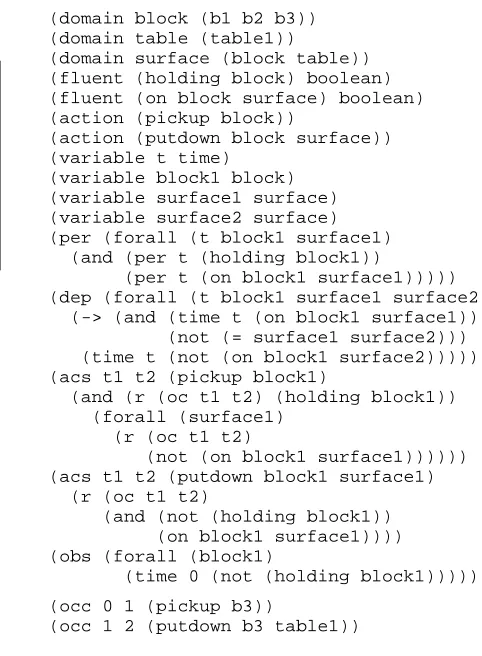
is already entailed and therefore redundant. That the table supports B1 is entailed by the previous fact and the axioms defining support, so the sys-tem simply replies yes. In sentence 3 we demon-strate the evaluation of a simple yes/no-question, although in this case the answer is not known since nothing has been said about block B2 and NL1 makes no closed world assumptions. Sentence 4 adds B2 to the table and B3 on top of B1 so that when the question in sentence 5 is evaluated it fol-lows, from the fact that B3 is on B1 and the fact that a block cannot be in two places at the same time, that the table can not support B3. A much more complex type of questions is what-questions. Sentence 6 poses a what-question about another defined relation, clear. The system processes the question, as described in detail in Section 4, and constructs an answer MRS from which a com-plex natural language reply is generated. The sen-tences in 7 and 8 are recognized as imperative and are parsed into TAL action occurrences that are added to the world history. Finally, the question in sentence 9 demonstrates that the new blocksworld state conforms to the changes specified for the per-formed actions in the background action theory listed in Figure 7.
4 Sentence Processing
con-a. ”What blocks are on the table?” (block x1) (exists x1) (answer x1)
d. (exists (x2 x1)
(and (on e1 x1 x2) (table x2) (block x1) (answer x1)))
e. (exists (x2 x1)
(and (time now (on x1 x2)) (table x2) (block x1) (answer x1)))
f. (exists (x2 x1)
(and (time now (on x1 x2)) (answer x1)))
sort(x1) =block, sort(x2) =table
Figure 5: Input processing for a question.
a. (answer b2) (answer b1)
b. (and
(exists (x2) (time now (on b2 x2))) (exists (x4) (time now (on b1 x4))))
c. (and e1 e2 e3)
Figure 6: Answer processing and generation.
(domain block (b1 b2 b3)) (domain table (table1))
(domain surface (block table)) (fluent (holding block) boolean) (fluent (on block surface) boolean) (action (pickup block))
(action (putdown block surface)) (variable t time)
(variable block1 block) (variable surface1 surface) (variable surface2 surface) (per (forall (t block1 surface1)
(and (per t (holding block1))
(per t (on block1 surface1))))) (dep (forall (t block1 surface1 surface2)
(-> (and (time t (on block1 surface1)) (not (= surface1 surface2))) (time t (not (on block1 surface2)))))) (acs t1 t2 (pickup block1)
(and (r (oc t1 t2) (holding block1)) (forall (surface1)
(r (oc t1 t2)
(not (on block1 surface1)))))) (acs t1 t2 (putdown block1 surface1)
(r (oc t1 t2)
(and (not (holding block1)) (on block1 surface1)))) (obs (forall (block1)
(time 0 (not (holding block1)))))
(occ 0 1 (pickup b3))
(occ 1 2 (putdown b3 table1))
Figure 7: TAL representation of the blocksworld.
verting the MRS structure to a relation list, shown in Figure 5c. Our simple treatment of quantifiers assigns the scope of the entire formula while or-dering each quantifier as they appear in the relation list and treatingtheas an existential quantifier, as in Figure 5d. In Figure 5e, the TAL time operator has been applied to create a temporal formula re-placing the event variablee1with the designated constantnowthat is updated during the dialogue. Finally, to take advantage of the fact that TAL is an order-sorted logic, one-place relations that are identical to sorts defined in the current background theory are compiled into a symbol table and re-moved from the formula in Figure 5f.
blocksworld specification together with the cur-rent world history.
Whatever method chosen, to solve the specific reasoning problem, will produce one or more an-swer formulas as show in Figure 6a. The anan-swers are used to instantiate the question formula from Figure 5f to form the TAL representation in Fig-ure 6b, representing the answers to the question. Again the MRS Trans module applies a number of processing steps, this time to construct an MRS structure representing the answers. First, the TAL time operator is translated into event variables and the quantifiers flattened to relations in Figure 6c. In Figure 6d, the references to the different blocks are made explicit in the relation list and the exis-tential quantifier relations are translated tothe re-lations, assuming the answer recipient knows what instance is meant. Finally, the MRS feature struc-ture in Figure 6e is built and passed to the LKB module which uses the HPSG grammar to gener-ate a natural language sentence corresponding to it. This sentence, displayed in Figure 6f, repre-sents the natural language answer to the natural language question posed in Figure 5a.
5 Discussion
Natural language understanding was among the first research topics of artificial intelligence and has continued to be of great importance. As a con-sequence a large number of natural language un-derstanding and dialogue systems have been built. Even though our system does not contribute any new techniques, it is a novel combination of exist-ing techniques that form an environment in which a variety of linguistic and knowledge representa-tion problems can be attacked.
Both the HPSG grammar and the TAL back-ground knowledge are declarative knowledge sources that can be updated, incrementally and it-eratively extended, or adapted to other use scenar-ios, independent of each other and most of the im-plementation components. They are also very ex-pressive, contributing to the generality of the ap-proach and to the goal of achieving representa-tional adequacy. Equally important to expressive-ness are issues of efficiency. Through a flexible compilation scheme for automated reasoning the tradeoff between expressiveness and efficiency is not set in stone but can be adapted to the task at hand. Different compilation steps can be imple-mented from different subsets of TAL to different
automated reasoners and the choice of which com-pilation step to use is postponed.
While we have defended our design decisions we also acknowledge that they do give rise to some disadvantages. Relying on deep parsing might re-sult in an instance of what is often called the “brit-tleness” problem where sentences slightly outside the competence of the grammar is totally incom-prehensible and any grammatical error has similar results. We agree to some extent with this objec-tion but note that there is interesting work on a Robust Minimal Recursion Semantics (Copestake, 2003) that would help integrate deep and shallow parsing. However, it should be pointed out that certain problems can never be solved using low methods and the mixing of deep and shal-low methods can only obscure their solutions. Al-though generality was listed as an advantage, we also include it as a system drawback and possible point of attack by critics. A more general system will always be worse at any given task than a less general system that is more specialized toward that task. This rule weakens as the complexity of the task grows, but holds for most problems dealt with in current AI research.
5.1 Evaluation
Ultimately deciding on the viability of a frame-work such as NL1 should depend in some way on evaluation, but we have yet to perform any struc-tured evaluation attempts and it is far from obvious how they would be implemented. The emphasis is not on the immediate improvement in the measur-able efficiency of some real-world task like natural language translation, or the maximum coverage of a large number of question answering tasks, but instead on the investigation and exploration of a potentially fruitful marriage between natural lan-guage and knowledge representation technologies. At the same time, it is clear that there are obvious improvements that could be made to the current NL1 system, and that one would like to formulate some measure that made what is intuitively obvi-ous, objectively evident. To this end we propose evaluations through a problem collection.
according to some complexity dimension, which is easier said than done. But even without this classification, one carefully selected sentence, il-lustrative of some complexity of language or rea-soning, can still make or break a system. We propose that one creates and maintains an on-line collection of such examples, similar to the common-sense reasoning problem page (Morgen-stern, 2005), the logically reasoning agents prob-lem page (Thielscher, 2005), or the logic mod-elling workshop (Sandewall, 2005). New exam-ples, illustrating new difficulties, would be sub-mitted by different researchers and added to the problem page (with moderation). Evaluating dif-ferent versions of the same system would then simply be accomplished by noting that the new version solves some additional question (ignoring, among others, issues of efficiency). Comparisons between systems would be entirely possible if one system subsumes the sentences correctly handled by the other system and possible with subjective results if the systems had a partial overlap.
5.2 Limitations and Future Work
We think this project has only scratched the sur-face of what is possible to accomplish using these techniques and that the proposed architecture has great potential. This section will point out the most important current limitations as well as our plans for continued development.
An obvious improvement is an extension of the HPSG grammar coverage to make the dialogue more varied and robust. The grammar does not at present even cover all the language constructs de-scribed in the book that it is based on (Sag et al., 2003) and there are certainly other HPSG gram-mar work that can be adapted to our system to fur-ther complement and extend coverage. An inter-esting experiment would be a coupling to the Eng-lish resource grammar (Copestake and Flickinger, 2000).
Another extension that would put our approach to the test is a method of dealing with different forms of reference. We envision that, in addition to the domain background theory, the knowledge representation module will contain a model of the ongoing dialogue expressed using the same tem-poral action logic. Reference resolution would then be the solution of additional reasoning prob-lems where objects that simultaneously fulfilled declarative constraints from dialogue factors, such
as recency, and background knowledge, would be retrieved.
Time is a central concept in the system, yet at present this is not taken advantage of. Questions are all in present tense, even though everything is set up so as to support one talking to the system about past actions and time.
The current implementation recognizes mands of action and executes them, but such com-mands are restricted to simple atomic operations and the system can not by itself plan a sequence of actions in response to a user request. As part of another project, we are working on extending TAL to incorporate composite actions and action sequences or plans. Such work would fit natu-rally in the framework we have described here and would enable a seamless transition between re-questing simple actions and rere-questing complex actions, possibly requiring the use of deductive planning, without extending the system architec-ture with a special purpose planner.
The compilation approach to automated TAL reasoning is inherently suitable for experimenta-tion. While we have already performed work in this direction, developing several different compi-lations to first-order logic and another to logic pro-grams, we do not expect to run out of ideas in this area. An especially interesting one is the use of deduction system alternatives to resolution, such as natural deduction, that might be more suitable for the kinds of inferences needed in the logicist approach to natural language understanding.
6 Related Work
An early and very impressive demonstration of natural language understanding was the SHRDLU system (Winograd, 1971). NL1 improves upon SHRDLU by using modern HPSG grammars in-stead of CFG grammars and declarative inin-stead of procedural knowledge representation, but still falls short of the complexity of correctly executed dia-logues. Though we are confident that our more general system architecture will catch up in the long run.
the choice of parsing environment and intermedi-ate form, two differences from NL1 are that we explicitly avoid committing to a specific reason-ing paradigm while CLARE is based on the logic programming paradigm, and that the scale of the CLARE project is simply vastly larger than ours.
The idea of using other theorem proving tech-niques than logic programming to aid natural lan-guage understanding has also been explored pre-viously. The work in (Blackburn et al., 1998) uses Dynamic Logic as the semantical representation and a translation to a fragment of first-order logic together with the Bliksem theorem prover as the reasoning mechanism. The feasibility of the set-up is demonstrated by using it to resolve discourse ambiguities. Our approach is similar in the ap-plication of an automated theorem prover after a translation step, but our background knowledge is encoded in Temporal Action Logic, which endows the system with the power to perform actions and reason about their effects.
Other systems, such as the architecture de-scribed in (Allen et al., 2001), deal with dialogues in realistic scenarios where human users want to interact with the system as fluently as possible to accomplish a task. Such efforts strive for
human-like behaviour while we consider the ultimate goal
to be human-level, but possibly very artificial, be-haviour and hypothesize that many issues in hu-man dialogues might well be ignored. Our inter-est lies not in modelling dialogue phenomena, but in using knowledge representation techniques for natural language understanding in a system with a dialogue interface.
Acknowledgements
We would like to thank Lars Ahrenberg for guid-ance and helpful discussions.
References
James Allen, George Ferguson, and Amanda Stent. 2001. An architecture for more realistic conver-sational systems. In Proceedings of the 6th Inter-national Conference on Intelligent User Interfaces IUI’01, pages 1–8. ACM Press.
Hiyan Alshawi, David Carter, Richard Crouch, Steve Pulman, Manny Rayner, and Arnold Smith. 1992. CLARE: A contextual reasoning and cooperative response framework for the core language engine. Technical Report CRC-028, SRI International.
Patrick Blackburn, Johan Bos, Michael Kohlhase, and
Hans de Nivelle. 1998. Automated theorem prov-ing for natural language understandprov-ing. In Problem-solving Methodologies with Automated Deduction (Workshop at CADE-15).
Ann Copestake and Dan Flickinger. 2000. An open-source grammar development environment and broad-coverage english grammar using HPSG. In Proceedings of the Second Conference on Lan-guage Resources and Evaluation LREC-2000.
Ann Copestake. 2003. Report on the design of RMRS. Technical Report D1.1a, University of Cambridge.
Patrick Doherty and Witold Łukaszewicz. 1994. Cir-cumscribing features and fluents. In Proceedings of the 1st International Conference on Temporal Logic ICTL’94, volume 827 of Lecture Notes in AI, pages 82–100. Springer.
Patrick Doherty, Joakim Gustafsson, Lars Karlsson, and Jonas Kvarnstr¨om. 1998. Temporal action logics (TAL): Language specification and tutorial. Link¨oping Electronic Articles in Computer and In-formation Science, 3(15).
Patrick Doherty. 1994. Reasoning about action and change using occlusion. In Proceedings of the Eleventh European Conference on Artificial Intel-ligence ECAI’94, pages 401–405. John Wiley and Sons.
Vladimir Lifschitz, 1994. Circumscription, volume 3 of Handbook of Logic in Artificial Intelligence and Logic Programming, chapter 6, pages 298–352. Ox-ford University Press.
Leora Morgenstern. 2005. The common-sense rea-soning problem page. http://www-formal.
stanford.edu/leora/commonsense/.
Visited February 2006.
Ivan A. Sag, Thomas Wasow, and Emily M. Bender. 2003. Syntactic Theory: A Formal Introduction (Second Edition). CSLI Publications.
Erik Sandewall. 1994. Features and Fluents: The Rep-resentation of Knowledge about Dynamical Systems, volume 1. Oxford University Press.
Erik Sandewall. 2005. Logic modelling workshop. http://www.ida.liu.se/ext/etai/ lmw/. Visited December 2005.
Mark E. Stickel. 2005. SNARK - SRI’s new au-tomated reasoning kit. http://www.ai.sri.
com/˜stickel/snark.html. Visited
Decem-ber 2005.
Michael Thielscher. 2005. Logically reasoning agents problem page. http://www.cl.inf.
tu-dresden.de/˜mit/LRAPP/. Visited
De-cember 2005.