Reranking Translation Hypotheses Using Structural Properties
Saˇsa Hasan, Oliver Bender, Hermann Ney Chair of Computer Science VI
RWTH Aachen University D-52056 Aachen, Germany
{hasan,bender,ney}@cs.rwth-aachen.de
Abstract
We investigate methods that add syntac-tically motivated features to a statistical machine translation system in a reranking framework. The goal is to analyze whether shallow parsing techniques help in iden-tifying ungrammatical hypotheses. We show that improvements are possible by utilizing supertagging, lightweight depen-dency analysis, a link grammar parser and a maximum-entropy based chunk parser. Adding features to n-best lists and dis-criminatively training the system on a de-velopment set increases the BLEU score up to 0.7% on the test set.
1 Introduction
Statistically driven machine translation systems are currently the dominant type of system in the MT community. Though much better than tradi-tional rule-based approaches, these systems still make a lot of errors that seem, at least from a hu-man point of view, illogical.
The main purpose of this paper is to investigate a means of identifying ungrammatical hypotheses from the output of a machine translation system by using grammatical knowledge that expresses syntactic dependencies of words or word groups. We introduce several methods that try to establish this kind of linkage between the words of a hy-pothesis and, thus, determine its well-formedness, or “fluency”. We perform rescoring experiments that rerankn-best lists according to the presented framework.
As methodologies deriving well-formedness of a sentence we use supertagging (Bangalore and Joshi, 1999) with lightweight dependency
anal-ysis (LDA)1 (Bangalore, 2000), link grammars (Sleator and Temperley, 1993) and a maximum-entropy (ME) based chunk parser (Bender et al., 2003). The former two approaches explicitly model the syntactic dependencies between words. Each hypothesis that contains irregularities, such as broken linkages or non-satisfied dependencies, should be penalized or rejected accordingly. For the ME chunker, the idea is to trainn-gram mod-els on the chunk or POS sequences and directly use the log-probability as feature score.
In general, these concepts and the underlying programs should be robust and fast in order to be able to cope with large amounts of data (as it is the case for n-best lists). The experiments presented show a small though consistent improvement in terms of automatic evaluation measures chosen for evaluation. BLEU score improvements, for in-stance, lie in the range from 0.3 to 0.7% on the test set.
In the following, Section 2 gives an overview on related work in this domain. In Section 3 we review our general approach to statistical ma-chine translation (SMT) and introduce the main methodologies used for deriving syntactic depen-dencies on words or word groups, namely su-pertagging/LDA, link grammars and ME chunk-ing. The corpora and the experiments are dis-cussed in Section 4. The paper is concluded in Section 5.
2 Related work
In (Och et al., 2004), the effects of integrating syntactic structure into a state-of-the-art statistical machine translation system are investigated. The approach is similar to the approach presented here:
1In the context of this work, the term LDA is not to be
firstly, a word graph is generated using the base-line SMT system andn-best lists are extracted ac-cordingly, then additional feature functions repre-senting syntactic knowledge are added and the cor-responding scaling factors are trained discrimina-tively on a developmentn-best list.
Och and colleagues investigated a large amount of different feature functions. The field of appli-cation varies from simple syntactic features, such as IBM model 1 score, over shallow parsing tech-niques to more complex methods using grammars and intricate parsing procedures. The results were rather disappointing. Only one of the simplest models, i.e. the implicit syntactic feature derived from IBM model 1 score, yielded consistent and significant improvements. All other methods had only a very small effect on the overall perfor-mance.
3 Framework
In the following sections, the theoretical frame-work of statistical machine translation using a di-rect approach is reviewed. We introduce the su-pertagging and lightweight dependency analysis approach, link grammars and maximum-entropy based chunking technique.
3.1 Direct approach to SMT
In statistical machine translation, the best trans-lationeˆI1ˆ = ˆe1. . .eˆi. . .ˆeIˆof source wordsf1J =
using Bayes decision rule. The first probability on the right-hand side of the equation denotes the translation model whereas the second is the target language model.
An alternative to this classical source-channel approach is the direct modeling of the posterior probabilityP r(eI1|f1J)which is utilized here.
Us-ing a log-linear model (Och and Ney, 2002), we obtain
whereλmare the scaling factors of the models de-noted by feature functionshm(·). The denomina-tor represents a normalization facdenomina-tor that depends only on the source sentencefJ
1. Therefore, we can
omit it during the search process, leading to the following decision rule:
This approach is a generalization of the source-channel approach. It has the advantage that ad-ditional models h(·) can be easily integrated into the overall system. The model scaling factors λM
1 are trained according to the maximum
en-tropy principle, e.g., using the GIS algorithm. Al-ternatively, one can train them with respect to the final translation quality measured by an error criterion (Och, 2003). For the results reported in this paper, we optimized the scaling factors with respect to a linear interpolation of word error rate (WER), position-independent word error rate (PER), BLEU and NIST score using the Downhill Simplex algorithm (Press et al., 2002).
3.2 Supertagging/LDA
Supertagging (Bangalore and Joshi, 1999) uses the Lexicalized Tree Adjoining Grammar formalism (LTAG) (XTAG Research Group, 2001). Tree Ad-joining Grammars incorporate a tree-rewriting for-malism using elementary trees that can be com-bined by two operations, namely substitution and adjunction, to derive more complex tree structures of the sentence considered. Lexicalization allows us to associate each elementary tree with a lexical item called theanchor. In LTAGs, every elemen-tary tree has such a lexical anchor, also called head word. It is possible that there is more than one el-ementary structure associated with a lexical item, as e.g. for the case of verbs with different subcat-egorization frames.
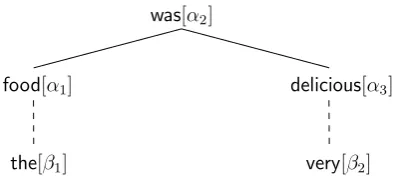
very[β2]
food[α1] delicious[α3]
the[β1]
was[α2]
Figure 1: LDA: example of a derivation tree, β nodes are the result of the adjunction operation on auxiliary trees, α nodes of substitution on initial trees.
coded within the supertags. Usually, a lexical item can have many supertags, depending on the vari-ous contexts it appears in. Therefore, the local am-biguity is larger than for the case of POS tags. An LTAG parser for this scenario can be very slow, i.e. its computational complexity is inO(n6
), because of the large number of supertags, i.e. elementary trees, that have to be examined during a parse. In order to speed up the parsing process, we can ap-plyn-gram models on a supertag basis in order to filter out incompatible descriptions and thus im-prove the performance of the parser. In (Banga-lore and Joshi, 1999), a trigram supertagger with smoothing and back-off is reported that achieves an accuracy of 92.2% when trained on one million running words.
There is another aspect to the dependencies coded in the elementary structures. We can use them to actually derive a shallow parse of the sen-tence in linear time. The procedure is presented in (Bangalore, 2000) and is calledlightweight de-pendency analysis. The concept is comparable to
chunking. The lightweight dependency analyzer (LDA) finds the arguments for the encoded depen-dency requirements. There exist two types ofslots
that can be filled. On the one hand, nodes marked for substitution (inα-trees) have to be filled by the complements of the lexical anchor. On the other hand, the foot nodes (i.e. nodes marked for adjunc-tion inβ-trees) take words that are being modified by the supertag. Figure 1 shows a tree derived by LDA on the sentencethe food was very delicious
from the C-Star’03 corpus (cf. Section 4.1). The supertagging and LDA tools are available from the XTAG research group website.2
As features considered for the reranking exper-iments we choose:
2http://www.cis.upenn.edu/˜xtag/
D D EA EA
P P
S S
the food was very delicious
Figure 2: Link grammar: example of a valid link-age satisfying all constraints.
• Supertagger output: directly use the log-likelihoods as feature score. This did not im-prove performance significantly, so the model was discarded from the final system.
• LDA output:
– dependency coverage: determine the number of covered elements, i.e. where the dependency slots are filled to the left and right
– separate features for the number of mod-ifiers and complements determined by the LDA
3.3 Link grammar
Similar to the ideas presented in the previous sec-tion, link grammars also explicitly code depen-dencies between words (Sleator and Temperley, 1993). These dependencies are calledlinkswhich reflect the local requirements of each word. Sev-eral constraints have to be satisfied within the link grammar formalism to derive correct linkages, i.e. sets of links, of a sequence of words:
1. Planarity: links are not allowed to cross each other
2. Connectivity: links suffice to connect all words of a sentence
3. Satisfaction: linking requirements of each word are satisfied
An example of a valid linkage is shown in Fig-ure 2. The link grammar parser that we use is freely available from the authors’ website.3 Sim-ilar to LTAG, the link grammar formalism is lex-icalized which allows for enhancing the methods with probabilistic n-gram models (as is also the case for supertagging). In (Lafferty et al., 1992), the link grammar is used to derive a new class of
[NPthe food ] [VPwas] [ADJPvery delicious]
the/DTfood/NNwas/VBDvery/RBdelicious/JJ
Figure 3: Chunking and POS tagging: a tag next to the opening bracket denotes the type of chunk, whereas the corresponding POS tag is given after the word.
language models that, in comparison to traditional n-gram LMs, incorporate capabilities for express-ing long-range dependencies between words.
The link grammar dictionary that specifies the words and their corresponding valid links cur-rently holds approximately 60 000 entries and han-dles a wide variety of phenomena in English. It is derived from newspaper texts.
Within our reranking framework, we use link grammar features that express a possible well-formedness of the translation hypothesis. The sim-plest feature is a binary one stating whether the link grammar parser could derive a complete link-age or not, which should be a strong indicator of a syntactically correct sentence. Additionally, we added a normalized cost of the matching process which turned out not to be very helpful for rescor-ing, so it was discarded.
3.4 ME chunking
Like the methods described in the two preced-ing sections, text chunkpreced-ing consists of dividpreced-ing a text into syntactically correlated non-overlapping groups of words. Figure 3 shows again our ex-ample sentence illustrating this task. Chunks are represented as groups of words between square brackets. We employ the 11 chunk types as de-fined for the CoNLL-2000 shared task (Tjong Kim Sang and Buchholz, 2000).
For the experiments, we apply a maximum-entropy based tagger which has been successfully evaluated on natural language understanding and named entity recognition (Bender et al., 2003). Within this tool, we directly factorize the poste-rior probability and determine the corresponding chunk tag for each word of an input sequence. We assume that the decisions depend only on a lim-ited windoweii+2−2 =ei−2...ei+2around the current
word ei and on the two predecessor chunk tags ci−1
i−2. In addition, part-of-speech (POS) tags gI1
are assigned and incorporated into the model (cf. Figure 3). Thus, we obtain the following
second-order model:
P r(cI1|eI1, g1I) =
= I Y
i=1
P r(ci|c1i−1, eI1, g1I) (4)
= I Y
i=1
p(ci|ci−1
i−2, e
i+2
i−2, g
i+2
i−2), (5)
where the step from Eq. 4 to 5 reflects our model assumptions.
Furthermore, we have implemented a set of bi-nary valued feature functions for our system, in-cluding lexical, word and transition features, prior features, and compound features, cf. (Bender et al., 2003). We run simple count-based feature reduction and train the model parameters using the Generalized Iterative Scaling (GIS) algorithm (Darroch and Ratcliff, 1972). In practice, the training procedure tends to result in an overfitted model. To avoid this, a smoothing method is ap-plied where a Gaussian prior on the parameters is assumed (Chen and Rosenfeld, 1999).
Within our reranking framework, we firstly use the ME based tagger to produce the POS and chunk sequences for the different n-best list hy-potheses. Given severaln-gram models trained on the WSJ corpus for both POS and chunk models, we then rescore then-best hypotheses and simply use the log-probabilities as additional features. In order to adapt our system to the characteristics of the data used, we build POS and chunk n-gram models on the training corpus part. These domain-specific models are also added to then-best lists.
The ME chunking approach does not model ex-plicit syntactic linkages of words. Instead, it in-corporates a statistical framework to exploit valid and syntactically coherent groups of words by ad-ditionally looking at the word classes.
4 Experiments
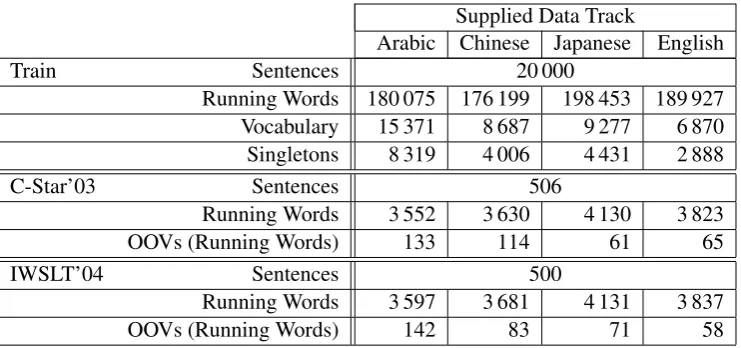
Supplied Data Track
Arabic Chinese Japanese English
Train Sentences 20 000
Running Words 180 075 176 199 198 453 189 927 Vocabulary 15 371 8 687 9 277 6 870 Singletons 8 319 4 006 4 431 2 888
C-Star’03 Sentences 506
Running Words 3 552 3 630 4 130 3 823
OOVs (Running Words) 133 114 61 65
IWSLT’04 Sentences 500
Running Words 3 597 3 681 4 131 3 837
OOVs (Running Words) 142 83 71 58
Table 1: Corpus statistics after preprocessing.
representation, we extractn-best lists as described in (Zens and Ney, 2005). Thesen-best lists serve as a starting point for our experiments. The meth-ods presented in Section 3 produce scores that are used as additional features for then-best lists.
4.1 Corpora
The experiments are carried out on a subset of the Basic Travel Expression Corpus (BTEC) (Takezawa et al., 2002), as it is used for the sup-plied data track condition of the IWSLT evaluation campaign. BTEC is a multilingual speech corpus which contains tourism-related sentences similar to those that are found in phrase books. For the supplied data track, the training corpus contains 20 000 sentences. Two test sets, C-Star’03 and IWSLT’04, are available for the language pairs Arabic-English, Chinese-English and Japanese-English.
The corpus statistics are shown in Table 1. The average source sentence length is between seven and eight words for all languages. So the task is rather limited and very domain-specific. The ad-vantage is that many different reranking experi-ments with varying feature function settings can be carried out easily and quickly in order to ana-lyze the effects of the different models.
In the following, we use the C-Star’03 set for development and tuning of the system’s parame-ters. After that, the IWSLT’04 set is used as a blind test set in order to measure the performance of the models.
4.2 Rescoring experiments
The use ofn-best lists in machine translation has several advantages. It alleviates the effects of the
huge search space which is represented in word graphs by using a compact excerpt of then best hypotheses generated by the system. Especially for limited domain tasks, the size of then-best list can be rather small but still yield good oracle er-ror rates. Empirically,n-best lists should have an appropriate size such that the oracle error rate, i.e. the error rate of the best hypothesis with respect to an error measure (such as WER or PER) is approx-imately half the baseline error rate of the system. N-best lists are suitable for easily applying several rescoring techniques since the hypotheses are al-ready fully generated. In comparison, word graph rescoring techniques need specialized tools which can traverse the graph accordingly. Since a node within a word graph allows for many histories, one can only apply local rescoring techniques, whereas for n-best lists, techniques can be used that con-sider properties of the whole sentence.
For the Chinese-English and Arabic-English task, we set then-best list size ton = 1500. For Japanese-English, n = 1000produces oracle er-ror rates that are deemed to be sufficiently low, namely 17.7% and 14.8% for WER and PER, re-spectively. The single-best output for Japanese-English has a word error rate of 33.3% and position-independent word error rate of 25.9%.
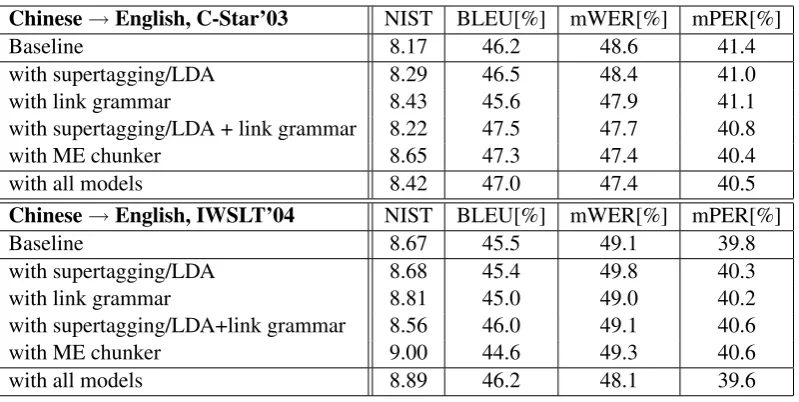
Chinese→English, C-Star’03 NIST BLEU[%] mWER[%] mPER[%]
Baseline 8.17 46.2 48.6 41.4
with supertagging/LDA 8.29 46.5 48.4 41.0
with link grammar 8.43 45.6 47.9 41.1
with supertagging/LDA + link grammar 8.22 47.5 47.7 40.8
with ME chunker 8.65 47.3 47.4 40.4
with all models 8.42 47.0 47.4 40.5
Chinese→English, IWSLT’04 NIST BLEU[%] mWER[%] mPER[%]
Baseline 8.67 45.5 49.1 39.8
with supertagging/LDA 8.68 45.4 49.8 40.3
with link grammar 8.81 45.0 49.0 40.2
with supertagging/LDA+link grammar 8.56 46.0 49.1 40.6
with ME chunker 9.00 44.6 49.3 40.6
with all models 8.89 46.2 48.1 39.6
Table 2: Effect of successively adding syntactic features to the Chinese-Englishn-best list for C-Star’03 (development set) and IWSLT’04 (test set).
BASE Any messages for me?
RESC Do you have any messages for me?
REFE Do you have any messages for me?
BASE She, not yet?
RESC She has not come yet?
REFE Lenny, she has not come in?
BASE How much is it to the?
RESC How much is it to the local call?
REFE How much is it to the city centre?
BASE This blot or.
RESC This is not clean. REFE This still is not clean.
Table 3: Translation examples for the Chinese-English test set (IWSLT’04): baseline system (BASE) vs. rescored hypotheses (RESC) and refer-ence translation (REFE).
already a very strong one. The log-linear inter-polation weightsλmfrom Eq. 3 are directly opti-mized using the Downhill Simplex algorithm on a linear combination of WER (word error rate), PER (position-independent word error rate), NIST and BLEU score.
In Table 2, we show the effect of adding the presented features successively to the baseline. Separate entries for experiments using supertag-ging/LDA and link grammars show that a combi-nation of these syntactic approaches always yields some gain in translation quality (regarding BLEU score). The performance of the maximum-entropy based chunking is comparable. A combination of
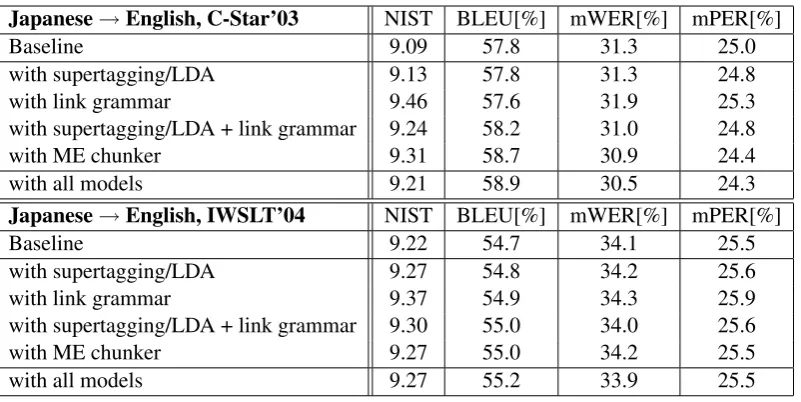
all three models still yields a small improvement. Table 3 shows some examples for the Chinese-English test set. The rescored translations are syn-tactically coherent, though semantical correctness cannot be guaranteed. On the test data, we achieve an overall improvement of 0.7%, 0.5% and 0.3% in BLEU score for Chinese-English, Japanese-English and Arabic-Japanese-English, respectively (cf. Ta-bles 4 and 5).
4.3 Discussion
From the tables, it can be seen that the use of syntactically motivated feature functions within a reranking concept helps to slightly reduce the number of translation errors of the overall trans-lation system. Although the improvement on the IWSLT’04 set is only moderate, the results are nevertheless comparable or better to the ones from (Och et al., 2004), where, starting from IBM model 1 baseline, an additional improvement of only 0.4% BLEU was achieved using more com-plex methods.
For the maximum-entropy based chunking ap-proach, n-grams with n = 4 work best for the chunker that is trained on WSJ data. The domain-specific rescoring model which results from the chunker being trained on the BTEC corpora turns out to prefer higher ordern-grams, withn= 6or more. This might be an indicator of the domain-specific rescoring model successfully capturing more local context.
Japanese→English, C-Star’03 NIST BLEU[%] mWER[%] mPER[%]
Baseline 9.09 57.8 31.3 25.0
with supertagging/LDA 9.13 57.8 31.3 24.8
with link grammar 9.46 57.6 31.9 25.3
with supertagging/LDA + link grammar 9.24 58.2 31.0 24.8
with ME chunker 9.31 58.7 30.9 24.4
with all models 9.21 58.9 30.5 24.3
Japanese→English, IWSLT’04 NIST BLEU[%] mWER[%] mPER[%]
Baseline 9.22 54.7 34.1 25.5
with supertagging/LDA 9.27 54.8 34.2 25.6
with link grammar 9.37 54.9 34.3 25.9
with supertagging/LDA + link grammar 9.30 55.0 34.0 25.6
with ME chunker 9.27 55.0 34.2 25.5
with all models 9.27 55.2 33.9 25.5
Table 4: Effect of successively adding syntactic features to the Japanese-Englishn-best list for C-Star’03 (development set) and IWSLT’04 (test set).
Arabic→English, C-Star’03 NIST BLEU[%] mWER[%] mPER[%]
Baseline 10.18 64.3 23.9 20.6
with supertagging/LDA 10.13 64.6 23.4 20.1
with link grammar 10.06 64.7 23.4 20.3
with supertagging/LDA + link grammar 10.20 65.0 23.2 20.2
with ME chunker 10.11 65.1 23.0 19.9
with all models 10.23 65.2 23.0 19.9
Arabic→English, IWSLT’04 NIST BLEU[%] mWER[%] mPER[%]
Baseline 9.75 59.8 26.1 21.9
with supertagging/LDA 9.77 60.5 25.6 21.5
with link grammar 9.74 60.5 25.9 21.7
with supertagging/LDA + link grammar 9.86 60.8 26.0 21.6
with ME chunker 9.71 59.9 25.9 21.8
with all models 9.84 60.1 26.4 21.9
Table 5: Effect of successively adding syntactic features to the Arabic-Englishn-best list for C-Star’03 (development set) and IWSLT’04 (test set).
out-of-domain data. Thus, further improvements should be possible if the models were adapted to the BTEC domain. This would require the prepa-ration of an annotated corpus for the supertagger and a specialized link grammar, which are both time-consuming tasks.
The syntactically motivated methods (supertag-ging/LDA and link grammars) perform similarly to the maximum-entropy based chunker. It seems that both approaches successfully exploit struc-tural properties of language. However, one outlier is ME chunking on the Chinese-English test data, where we observe a lower BLEU but a larger NIST score. For Arabic-English, the combination of all
methods does not seem to generalize well on the test set. In that case, supertagging/LDA and link grammar outperforms the ME chunker: the over-all improvement is 1% absolute in terms of BLEU score.
5 Conclusion
grammar parser and a maximum-entropy based chunk parser. Adding features ton-best lists and discriminatively training the system on a develop-ment set helped to gain up to 0.7% in BLEU score on the test set.
Future work could include developing an adapted LTAG for the BTEC domain or incor-porating n-gram models into the link grammar concept in order to derive a long-range language model (Lafferty et al., 1992). However, we feel that the current improvements are not significant enough to justify these efforts. Additionally, we will apply these reranking methods to larger cor-pora in order to study the effects on longer sen-tences from more complex domains.
Acknowledgments
This work has been partly funded by the European Union under the integrated project TC-Star (Technology and Corpora for Speech to Speech Translation, IST-2002-FP6-506738, http://www.tc-star.org), and by the R&D project TRAMES managed by Bertin Technologies as prime contractor and operated by the french DGA (D´el´egation G´en´erale pour l’Armement).
References
Srinivas Bangalore and Aravind K. Joshi. 1999.
Su-pertagging: An approach to almost parsing.
Com-putational Linguistics, 25(2):237–265.
Srinivas Bangalore. 2000. A lightweight dependency
analyzer for partial parsing. Computational
Linguis-tics, 6(2):113–138.
Oliver Bender, Klaus Macherey, Franz Josef Och, and
Hermann Ney. 2003. Comparison of alignment
templates and maximum entropy models for natural
language understanding. InEACL03: 10th Conf. of
the Europ. Chapter of the Association for Computa-tional Linguistics, pages 11–18, Budapest, Hungary, April.
Stanley F. Chen and Ronald Rosenfeld. 1999. A gaus-sian prior for smoothing maximum entropy models. Technical Report CMUCS-99-108, Carnegie Mellon University, Pittsburgh, PA.
J. N. Darroch and D. Ratcliff. 1972. Generalized
iter-ative scaling for log-linear models. Annals of
Math-ematical Statistics, 43:1470–1480.
John Lafferty, Daniel Sleator, and Davy Temperley. 1992. Grammatical trigrams: A probabilistic model
of link grammar. InProc. of the AAAI Fall
Sympo-sium on Probabilistic Approaches to Natural Lan-guage, pages 89–97, Cambridge, MA.
Franz Josef Och and Hermann Ney. 2002. Discrimina-tive training and maximum entropy models for
sta-tistical machine translation. InProc. of the 40th
An-nual Meeting of the Association for Computational Linguistics (ACL), pages 295–302, Philadelphia, PA, July.
Franz Josef Och, Daniel Gildea, Sanjeev Khudanpur, Anoop Sarkar, Kenji Yamada, Alex Fraser, Shankar Kumar, Libin Shen, David Smith, Katherine Eng, Viren Jain, Zhen Jin, and Dragomir Radev. 2004. A smorgasbord of features for statistical machine
translation. In Proc. 2004 Meeting of the North
American chapter of the Association for Compu-tational Linguistics (HLT-NAACL), pages 161–168, Boston, MA.
Franz Josef Och. 2003. Minimum error rate training
in statistical machine translation. In Proc. of the
41st Annual Meeting of the Association for Compu-tational Linguistics (ACL), pages 160–167, Sapporo, Japan, July.
William H. Press, Saul A. Teukolsky, William T.
Vet-terling, and Brian P. Flannery. 2002. Numerical
Recipes in C++. Cambridge University Press, Cam-bridge, UK.
Daniel Sleator and Davy Temperley. 1993. Parsing
English with a link grammar. InThird International
Workshop on Parsing Technologies, Tilburg/Durbuy, The Netherlands/Belgium, August.
Toshiyuki Takezawa, Eiichiro Sumita, F. Sugaya, H. Yamamoto, and S. Yamamoto. 2002. Toward a broad-coverage bilingual corpus for speech trans-lation of travel conversations in the real world. In
Proc. of the Third Int. Conf. on Language Resources and Evaluation (LREC), pages 147–152, Las Pal-mas, Spain, May.
Erik F. Tjong Kim Sang and Sabine Buchholz.
2000. Introduction to the CoNLL-2000 shared
task: Chunking. In Proceedings of CoNLL-2000
and LLL-2000, pages 127–132, Lisbon, Portugal, September.
XTAG Research Group. 2001. A Lexicalized Tree
Adjoining Grammar for English. Technical
Re-port IRCS-01-03, IRCS, University of Pennsylvania, Philadelphia, PA, USA.
Richard Zens and Hermann Ney. 2005. Word graphs
for statistical machine translation. In43rd Annual
Meeting of the Assoc. for Computational Linguis-tics: Proc. Workshop on Building and Using Par-allel Texts: Data-Driven Machine Translation and Beyond, pages 191–198, Ann Arbor, MI, June.
Richard Zens, Oliver Bender, Saˇsa Hasan, Shahram Khadivi, Evgeny Matusov, Jia Xu, Yuqi Zhang, and
Hermann Ney. 2005. The RWTH phrase-based
statistical machine translation system. In