Toward hierarchical models for statistical machine translation of
inflected languages
Sonja Nießen and Hermann Ney
Lehrstuhl f¨ur Informatik VI, Computer Science Department RWTH Aachen - University of Technology
D-52056 Aachen, Germany
niessen,ney @informatik.rwth-aachen.de
Abstract
In statistical machine translation, cor-respondences between the words in the source and the target language are learned from bilingual corpora on the basis of so called alignment models. Existing statistical systems for MT of-ten treat different derivatives of the same lemma as if they were indepen-dent of each other. In this paper we argue that a better exploitation of the bilingual training data can be achieved by explicitly taking into account the in-terdependencies of the different deriva-tives. We do this along two direc-tions: Usage of hierarchical lexicon models and the introduction of equiv-alence classes in order to ignore in-formation not relevant for the trans-lation task. The improvement of the translation results is demonstrated on a German-English corpus.
1 Introduction
The statistical approach to machine translation has become widely accepted in the last few years. It has been successfully applied to realistic tasks in various national and international research pro-grams. However in many applications only small amounts of bilingual training data are available for the desired domain and language pair, and it is highly desirable to avoid at least parts of the costly data collection process.
Some recent publications have dealt with the problem of translation with scarce resources. (Brown et al., 1994) describe the use of dictio-naries. (Al-Onaizan et al., 2000) report on an ex-periment of Tetun-to-English translation by dif-ferent groups, including one using statistical ma-chine translation. They assume the absence of linguistic knowledge sources such as morphologi-cal analyzers and dictionaries. Nevertheless, they found that human mind is very well capable of deriving dependencies such as morphology, cog-nates, proper names, spelling variations etc., and that this capability was finally at the basis of the better results produced by humans compared to corpus based machine translation. The additional information results from complex reasoning and it is not directly accessible from the full word form representation of the data.
In this paper, we take a different point of view: Even if full bilingual training data is scarce, monolingual knowledge sources like morpholog-ical analyzers and data for training the target lan-guage model as well as conventional dictionar-ies (one word and its translation per entry) may be available and of substantial usefulness for im-proving the performance of statistical translation systems. This is especially the case for highly in-flected languages like German.
process. We furthermore suggest the use of hi-erarchical lexicon models.
The paper is organized as follows. After re-viewing the statistical approach to machine trans-lation, we first explain our motivation for exam-ining the morphological characteristics of an in-flected language like German. We then describe the chosen output representation after the analysis and present our approach for exploiting the infor-mation from morpho-syntactic analysis. Experi-mental results on the German-English Verbmobil task are reported.
2 Statistical Machine Translation
The goal of the translation process in statisti-cal machine translation can be formulated as fol-lows: A source language string
is to be translated into a target language string
. In the experiments reported in this paper, the source language is German and the tar-get language is English. Every English string is considered as a possible translation for the input. If we assign a probability
cision rule, we have to choose the English string that maximizes the product of the English lan-guage model
and the string translation model
.
Many existing systems for statistical machine translation (Wang and Waibel, 1997; Nießen et al., 1998; Och and Weber, 1998) make use of a special way of structuring the string translation model like proposed by (Brown et al., 1993): The correspondence between the words in the source and the target string is described by alignments which assign one target word position to each source word position. The lexicon probability
of a certain English word
is assumed to depend basically only on the source word aligned to it.
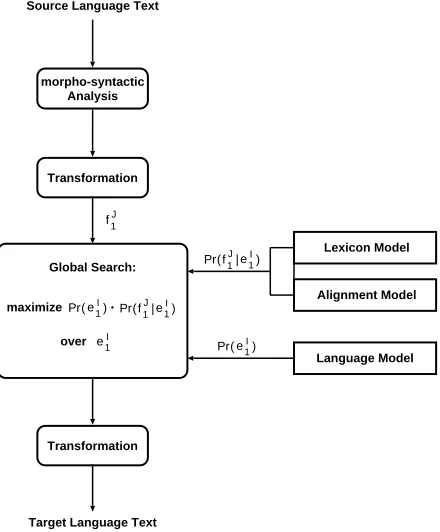
The overall architecture of the statistical trans-lation approach is depicted in Figure 1. In this figure we already anticipate the fact that we can transform the source strings in a certain manner.
3 Basic Considerations
The parameters of the statistical knowledge sources mentioned above are trained on bilingual
Source Language Text
maximize Alignment Model
Transformation Transformation morpho-syntactic
Analysis
Figure 1: Architecture of the translation approach based on Bayes’ decision rule.
corpora. In general, the resulting probabilistic lexica contain all word forms occurring in this training corpora as separate entries, not taking into account whether or not they are derivatives of the same lemma. Bearing in mind that 40% of the word forms have only been seen once in training (see Table 2), it is obvious that learning the cor-rect translations is difficult for many words. Be-sides, new input sentences are expected to con-tain unknown word forms, for which no transla-tion can be retrieved from the lexica. As Table 2 shows, this problem is especially relevant for highly inflected languages like German: Texts in German contain many more different word forms than their English translations. The table also re-veals that these words are often derived from a much smaller set of base forms (“lemmata”), and when we look at the number of different lemmata and the respective number of lemmata, for which there is only one occurrence in the training data, German and English texts are more resembling.
because they are substantially different from full bilingual parallel corpora inasmuch the entries are often pairs of base forms that are translations of each other, whereas the corpora contain full sen-tences with inflected forms. To make the informa-tion taken from external dicinforma-tionaries more useful for the translation of inflected language is an in-teresting objective.
As a consequence of these considerations, we aim at taking into account the interdependencies between the different derivatives of the same base form.
4 Output Representation after Morpho-syntactic Analysis
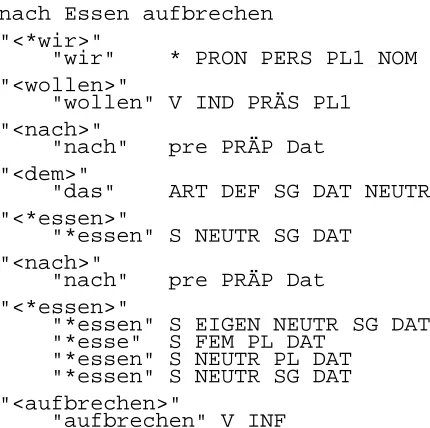
We use GERCG, a constraint grammar parser for German for lexical analysis and morphological and syntactic disambiguation. For a description of the Constraint Grammar approach we refer the reader to (Karlsson, 1990). Figure 2 gives an ex-ample of the information provided by this tool.
Input: Wir wollen nach dem Essen nach Essen aufbrechen
"<*wir>"
"wir" * PRON PERS PL1 NOM "<wollen>"
"wollen" V IND PR¨AS PL1 "<nach>"
"nach" pre PR¨AP Dat "<dem>"
"das" ART DEF SG DAT NEUTR "<*essen>"
"*essen" S NEUTR SG DAT "<nach>"
"nach" pre PR¨AP Dat "<*essen>"
"*essen" S EIGEN NEUTR SG DAT "*esse" S FEM PL DAT
"*essen" S NEUTR PL DAT "*essen" S NEUTR SG DAT "<aufbrechen>"
"aufbrechen" V INF
Figure 2: Sample analysis of a German sentence
A full word form is represented by the infor-mation provided by the morpho-syntactic anal-ysis: From the interpretation “gehen-V-IND-PR¨AS-SG1”, i.e. the lemma plus part of speech plus the other tags the word form “gehe” can be restored. From Figure 2 we see that the tool can quite reliably disambiguate between differ-ent readings: It infers for instance that the word
“wollen” is a verb in the indicative present first person plural form. Without any context taken into account, “wollen” has other readings. It can even be interpreted as derived not from a verb, but from an adjective with the meaning “made of wool”. In this sense, the information inherent to the original word forms is augmented by the dis-ambiguating analyzer. This can be useful for de-riving the correct translation of ambiguous words. In the rare cases where the tools returned more than one reading, it is often possible to apply sim-ple heuristics based on domain specific preference rules or to use a more general, non-ambiguous analysis.
The new representation of the corpus where full word forms are replaced by lemma plus mor-phological and syntactic tags makes it possible to gradually reduce the information: For exam-ple we can consider certain instances of words as equivalent. We have used this fact to better exploit the bilingual training data along two directions: Omitting unimportant information and using hi-erarchical translation models.
5 Equivalence classes of words with similar Translations
Inflected forms of words in the input language contain information that is not relevant for trans-lation. This is especially true for the task of translating from a highly inflected language like German into English for instance: In bilingual German-English corpora, the German part con-tains many more different word forms than the English part (see Table 2). It is useful for the process of statistical machine translation to define equivalence classes of word forms which tend to be translated by the same target language word, because then, the resulting statistical translation lexica become smoother and the coverage is sig-nificantly improved. We construct these equiva-lence classes by omitting those informations from morpho-syntactic analysis, which are not relevant for the translation task.
and the choice of the models.
Linguistic knowledge can provide information about which characteristics of an input sentence are crucial to the translation task and which can be ignored, but it is desirable to find a method for automating this decision process. We found that the impact on the end result due to different choices of features to be ignored was not large enough to serve as reliable criterion. Instead, we could think of defining a likelihood criterion on a held-out corpus for this purpose. Another pos-sibility is to assess the impact on the alignment quality after training, which can be evaluated au-tomatically (Langlais et al., 1998; Och and Ney, 2000), but as we found that the alignment quality on the Verbmobil data is consistently very high, and extremely robust against manipulation of the training data, we abandoned this approach.
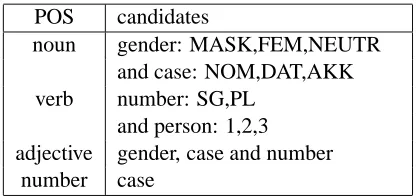
We resorted to detecting candidates from the probabilistic lexica trained for translation from German to English. For this, we focussed on those derivatives of the same base form, which resulted in the same translation. For each set of tags, we counted how often an additional tag could be replaced by a certain other tag without effect on the translation. Table 1 gives some of the most frequently identified candidates to be ig-nored while translating: The gender of nouns is irrelevant for their translation (which is straight-forward, because the gender is unambiguous for a certain noun) and the case, i.e. nominative, dative, accusative. For the genitive forms, the translation in English differs. For verbs we found the candi-dates number and person. That is, the translation of the first person singular form of a verb is of-ten the same as the translation of the third person plural form, for example.
Table 1: Candidates for equivalence classes. POS candidates
noun gender: MASK,FEM,NEUTR and case: NOM,DAT,AKK verb number: SG,PL
and person: 1,2,3 adjective gender, case and number
number case
As a consequence, we dropped those tags,
which were most often identified as irrelevant for translation from German to English.
6 Hierarchical Models
One way of taking into account the interdepen-dencies of different derivatives of the same base form is to introduce equivalence classes at vari-ous levels of abstraction starting with the inflected form and ending with the lemma.
Consider, for example, the German verb form
"ankomme", which is derived from the lemma "ankommen" and which can be translated into English by
"arrive". The hierarchy of equivalence classes is as follows:
!
is the maximal number of morpho-syntactic tags. !#"
contains the forms "ankomme", "ankommst" and "ankommt"; in !("%$ the number (SG or PL) is ignored and so on. The largest equivalence class contains all derivatives of the infinitive"ankommen".
We can now define the lexicon probability of a word to be translated by
with respect to the level):
4 is the representation of a word where the lemma 43& and ) additional tags are taken into account. For the example above,
4*&
is the probability of
for a given4
& . We make the assumption that this probability does not depend on
is always assumed to be 1. In other words, the inflected form can non-ambiguously be derived from the full interpreta-tion.
is the probability of the translation for
to belong to the equivalence class
over 894
&;: amounts to summing up over all possible readings of .
1
We combine the
by means of linear interpo-lation:
Experiments were carried out on Verbmobil data, which consists of spontaneously spoken dialogs in the appointment scheduling domain (Wahlster, 1993). German source sentences are translated into English.
7.1 Treatment of Ambiguity
Common bilingual corpora normally contain full sentences which provide enough context informa-tion for ruling out all but one reading for an in-flected word form. To reduce the remaining un-certainty, we have implemented preference rules. For instance, we assume that the corpus is cor-rectly true-case-converted beforehand and as a consequence, we drop non-noun interpretations of uppercase words. Besides, we prefer indica-tive verb readings instead of subjuncindica-tive or im-perative. For the remaining ambiguities, we resort to the unambiguous parts of the readings, i.e. we drop all tags causing mixed interpretations.
There are some special problems with the anal-ysis of external lexica, which do not provide enough context to enable efficient disambigua-tion. We are currently implementing methods for handling this special situation.
It can be argued that it would be more elegant to leave the decision between different readings, for instance, to the overall decision process in search. We plan this integration for the future.
7.2 Performance Measures
We use the following evaluation criteria (Nießen et al., 2000):
@
SSER (subjective sentence error rate): Each translated sentence is judged by a hu-man examiner according to an error scale from 0.0 (semantically and syntactically cor-rect) to 1.0 (completely wrong).
1
The probability functions are defined to return zero for impossible interpretations ofA .
@
ISER (information item semantic error rate): The test sentences are segmented into infor-mation items; for each of them, the trans-lation candidates are assigned either “ok” or an error class. If the intended informa-tion is conveyed, the error count is not in-creased, even if there are slight syntactical errors, which do not seriously deteriorate the intelligibility.
7.3 Translation Results
The training set consists of 58 322 sentence pairs. Table 2 summarizes the characteristics of the training corpus used for training the parameters of Model 4 proposed in (Brown et al., 1993). Testing
Table 2: Corpus statistics: Verbmobil training. Singletons are types occurring only once in train-ing.
English German no. of running words 550 213 519 790 no. of word forms 4 670 7 940 no. of singletons 1 696 3 452
singletons [%] 36 43
no. of lemmata 3 875 3 476 no. of singletons 1 322 1 457
was carried out on 200 sentences not contained in the training data. For a detailed statistics see Ta-ble 3.
Table 3: Statistics of the Verbmobil test corpus for German-to-English translation. Unknowns are word forms not contained in the training corpus.
no. of sentences 200 no. of running words 2 055 no. of word forms 385 no. of unknown word forms 25
We used a translation system called “single-word based approach” described in (Tillmann and Ney, 2000) and compared to other approaches in (Ney et al., 2000).
7.3.1 Lexicon Combination
i.e. '
is modeled as a uniform distribution over all derivations of the lemma 4*& occurring in the training data plus the base form itself, in case it is not contained. The process of lemmatization is unique in the majority of cases, and as a consequence, the sum in Equation (1) is not needed for a two-level lexicon combination of full word forms and lemmata.
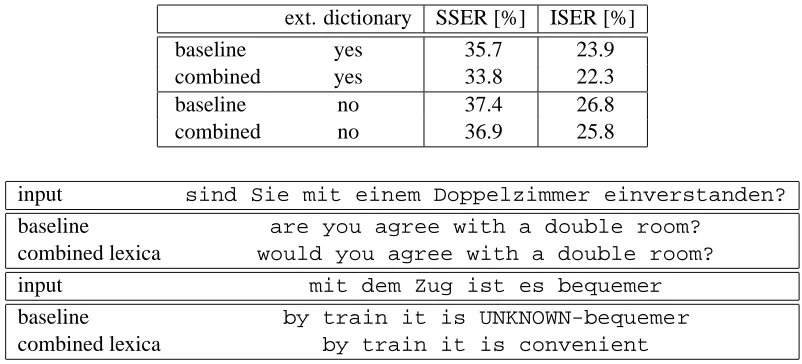
As the results summarized in Table 4 show, the combined lexicon outperforms the conventional one-level lexicon. As expected, the quality gain achieved by smoothing the lexicon is larger if the training procedure can take advantage of an additional conventional dictionary to learn trans-lation pairs, because these dictionaries typically only contain base forms of words, whereas trans-lations of fully inflected forms are needed in the test situation.
Examples taken from the test set are given in Figure 3. Smoothing the lexicon entries over the derivatives of the same lemma enables the trans-lation of “sind” by “would” instead of “are”. The smoothed lexicon contains the translation “conve-nient” for any derivative of “bequem”. The parative “more convenient” would be the com-pletely correct translation.
7.3.2 Equivalence classes
As already mentioned, we resorted to choos-ing one schoos-ingle readchoos-ing for each word by applychoos-ing some heuristics (see Section 7.1). For the nor-mal training corpora, unlike additional external dictionaries, this is not critical because they con-tain predominantly full sentences which provide enough context for an efficient disambiguation. Currently, we are working on the problem of ana-lyzing the entries in conventional dictionaries, but for the time being, experiments for equivalence classes have been carried out using only bilingual corpora for estimating the model parameters.
Table 5 shows the effect of the introduction of equivalence classes. The information from the morpho-syntactic analyzer (stems plus tags like described in Section 4) is reduced by dropping unimportant information like described in Section 5. Both error metrics could be decreased in com-parison to the usage of the original corpus with inflected word forms. A reduction of 3.3% of the
information item semantic error rate shows that more of the intended meaning could be found in the produced translations.
Table 5: Effect of the introduction of equivalence classes. For the baseline we used the original in-flected word forms.
SSER [%] ISER [%] inflected words 37.4 26.8 equivalence classes 35.9 23.5
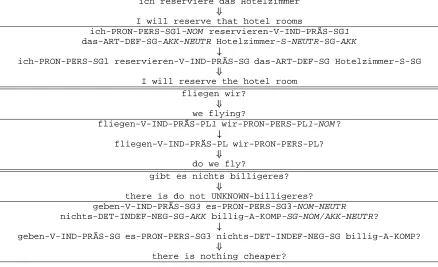
The first two examples in Figure 4 demonstrate the effect of the disambiguating analyzer which identifies “Hotelzimmer” as singular on the ba-sis of the context (the word itself can represent the plural form as well), and “das” as article in contrast to a pronoun. The third example shows the advantage of grouping words in equivalence classes: The training data does not contain the word “billigeres”, but when generalizing over the gender and case information, a correct translation can be produced.
8 Conclusion and Future Work
We have presented methods for a better exploita-tion of the bilingual training data for statisti-cal machine translation by explicitly taking into account the interdependencies of the different derivatives of the same base form. We suggest the usage of hierarchical models as well as an alter-native representation of the data in combination with the identification and omission of informa-tion not relevant for the translainforma-tion task.
First experiments prove their general applica-bility to realistic tasks such as spontaneously spo-ken dialogs. We expect the described methods to yield more improvement of the translation quality for cases where much smaller amounts of training data are available.
Table 4: Effect of two-level lexicon combination. For the baseline we used the conventional one-level full form lexicon.
ext. dictionary SSER [%] ISER [%]
baseline yes 35.7 23.9
combined yes 33.8 22.3
baseline no 37.4 26.8
combined no 36.9 25.8
input sind Sie mit einem Doppelzimmer einverstanden? baseline are you agree with a double room?
combined lexica would you agree with a double room?
input mit dem Zug ist es bequemer
baseline by train it is UNKNOWN-bequemer combined lexica by train it is convenient
Figure 3: Examples for the effect of the combined lexica.
Acknowledgement. This work was partly sup-ported by the German Federal Ministry of Educa-tion, Science, Research and Technology under the Contract Number 01 IV 701 T4 (VERBMOBIL).
References
Yaser Al-Onaizan, Ulrich Germann, Ulf Hermjakob, Kevin Knight, Philipp Koehn, Daniel Marcu, and Kenji Yamada. 2000. Translating with scarce
re-sources. In Proceedings of the Seventeenth
Na-tional Conference on Artificial Intelligence (AAAI), pages 672–678, Austin, Texas, August.
P.F. Brown, S.A. Della Pietra, V.J. Della Pietra, and R.L. Mercer. 1993. Mathematics of statistical ma-chine translation: Parameter estimation. Computa-tional Linguistics, 19(2):263–311.
P. F. Brown, S. A. Della Pietra, and M. J. Della Pietra, V. J. a nd Goldsmith. 1994. But dictionaries are data too. In Proc. ARPA Human Language Tech-nology Workshop ’93, pages 202–205, Princeton, NJ, March. distributed as Human Language Tech-nology by San Mateo, CA: Morgan Kaufmann Pub-lishers.
Fred Karlsson. 1990. Constraint grammar as a frame-work for parsing running text. In Proceedings of the 13th International Conference on Computational Linguistics, volume 3, pages 168–173, Helsinki, Finland.
Philippe Langlais, Michel Simard, and Jean V´eronis.
1998. Methods and practical issues in
evaluat-ing alignment techniques. In Proceedevaluat-ings of 36th
Annual Meeting of the Association for Computa-tional Linguistics and 17th InternaComputa-tional Confer-ence on Computational Linguistic, pages 711–717, Montr´eal, P.Q., Canada, August.
Hermann Ney, Sonja Nießen, Franz Josef Och, Has-san Sawaf, Christoph Tillmann, and Stephan Vogel. 2000. Algorithms for statistical translation of spo-ken language. IEEE Transactions on Speech and Audio Processing, 8(1):24–36, January.
Sonja Nießen, Stephan Vogel, Hermann Ney, and Christoph Tillmann. 1998. A DP based search al-gorithm for statistical machine translation. In Pro-ceedings of the 36th Annual Meeting of the Associa-tion for ComputaAssocia-tional Linguistics and the 17th In-ternational Conference on Computational Linguis-tics, pages 960–967, Montr´eal, P.Q., Canada, Au-gust.
Sonja Nießen, Franz Josef Och, Gregor Leusch, and Hermann Ney. 2000. An evaluation tool for ma-chine translation: Fast evaluation for MT research. In Proceedings of the 2nd International Conference on Language Resources and Evaluation, pages 39– 45, Athens, Greece, May.
Franz Josef Och and Hermann Ney. 2000.
Im-proved statistical alignment models. In Proc. of the 38th Annual Meeting of the Association for Com-putational Linguistics, pages 440–447, Hongkong, China, October.
Franz Josef Och and Hans Weber. 1998. Improv-ing statistical natural language translation with
ich reserviere das Hotelzimmer
E
I will reserve that hotel rooms
ich-PRON-PERS-SG1-NOM reservieren-V-IND-PR¨AS-SG1 das-ART-DEF-SG-AKK-NEUTR Hotelzimmer-S-NEUTR-SG-AKK
F
ich-PRON-PERS-SG1 reservieren-V-IND-PR¨AS-SG das-ART-DEF-SG Hotelzimmer-S-SG
E
I will reserve the hotel room
fliegen wir?
E
we flying?
fliegen-V-IND-PR¨AS-PL1 wir-PRON-PERS-PL1-NOM ?
F
fliegen-V-IND-PR¨AS-PL wir-PRON-PERS-PL?
E
do we fly?
gibt es nichts billigeres?
E
there is do not UNKNOWN-billigeres? geben-V-IND-PR¨AS-SG3 es-PRON-PERS-SG3-NOM-NEUTR nichts-DET-INDEF-NEG-SG-AKK billig-A-KOMP-SG-NOM/AKK-NEUTR?
F
geben-V-IND-PR¨AS-SG es-PRON-PERS-SG3 nichts-DET-INDEF-NEG-SG billig-A-KOMP?
E
there is nothing cheaper?
Figure 4: Examples for the effect of equivalence classes resulting from dropping morpho-syntactic tags not relevant for translation. First the translation using the original representation, then the new representation, its reduced form and the resulting translation.
Annual Meeting of the Association for Computa-tional Linguistics and the 17th InternaComputa-tional Con-ference on Computational Linguistics, pages 985– 989, Montr´eal, P.Q., Canada, August.
Christoph Tillmann and Hermann Ney. 2000. Word re-ordering and DP-based search in statistical
ma-chine translation. In Proc. COLING 2000: The
18th Int. Conf. on Computational Linguistics, pages 850–856, Saarbr ¨ucken, Germany, August.
Wolfgang Wahlster. 1993. Verbmobil: Translation of Face-to-Face Dialogs. In Proceedings of the MT Summit IV, pages 127–135, Kobe, Japan.