A Multilingual Test Collection for the Semantic Search of Entity Categories
Juliano Efson Sales
†, Siamak Barzegar
§,Wellington Franco
‡, Bernhard Bermeitinger
†,
Tiago Cunha
¶, Brian Davis
§∓, Andr´e Freitas
†δand Siegfried Handschuh
††Department of Computer Science and Mathematics - University of Passau, Germany §Insight Centre for Data Analytics - National University of Ireland, Galway
‡Federal University of Cear´a, Campus Crate´us, Brazil
¶University of the International Integration of the Afro-Brazilian Lusophony, Brazil ∓Department of Computer Science - Maynooth University, Ireland
δSchool of Computer Science - The University of Manchester, United Kingdom
{juliano-sales, bernhard.bermeitinger, siegfried.handschuh}@uni-passau.de [email protected], [email protected] [email protected], [email protected], [email protected]
Abstract
Humans naturally organise and classify the world into sets and categories. These categories expressed in natural language are present in all data artefacts from structured to unstructured data and play a fundamental role as tags, dataset predicates or ontology attributes. A better understanding of the category syntactic structure and how to match them semantically is a fundamental problem in the computational linguistics domain. Despite the high popularity ofentity search, entity categories have not been receiving equivalent attention. This paper aims to present the task ofsemantic search of entity categoriesby defining, developing and making publicly available a multilingual test collection comprehending English, Portuguese and German. The test collections were designed to meet the demands of the entity search community in providingmore representativeandsemantically complexquery sets. In addition, we also provide comparative baselines and a brief analysis of the results.
Keywords:semantic search, category search, paraphrasing, entity search, multilingual test collection
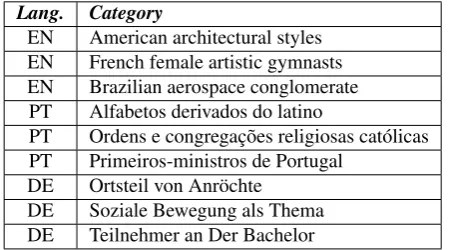
Lang. Category
EN American architectural styles EN French female artistic gymnasts EN Brazilian aerospace conglomerate
PT Alfabetos derivados do latino
PT Ordens e congregac¸˜oes religiosas cat´olicas PT Primeiros-ministros de Portugal
DE Ortsteil von Anr¨ochte DE Soziale Bewegung als Thema DE Teilnehmer an Der Bachelor
Table 1: Examples of categories in English (EN), Por-tuguese (PT) and German (DE).
1.
Introduction
Well-defined tasks and test collections are fundamental re-sources to allow reproducibility and comparability in in-formation retrieval in general, and entity search in particu-lar (Jones, 1981). As entities are the main target of a vast amount of search queries on the Web (Pound et al., 2010), over the years, a mature research community has emerged around theentity searchdomain.
Despite the considerable number of challenges and cam-paigns released in the field (Elbedweihy et al., 2015), in re-cent years, the entity search community has encouraged the development of new tasks. According to Balog and Neu-mayer (2013) three action points were signed as priorities:
1. (i) getting more representative information needs and favouring long queries over short ones;
2. (ii) limiting search to a smaller, fixed set of entity types (as opposed to arbitrary types of entities); and
3. (iii) using test collections that integrate both structured and unstructured information about entities.
In order to suit at least two of these priorities, this paper aims at presenting the task ofsemantic search of entity cat-egoriesby defining, developing and making publicly avail-able test collections, and providing a comparative analysis on the baseline results. In addition to English, the test col-lection comprehends two more languages to contribute to the semantic research community targeting Portuguese and German.
2.
The Semantic Search of Entity Categories
Each type or attribute generally describes a singular charac-teristic of an entity. The nounspresidentandmonument, the adjectiveurbanand named entityUnited Statesare exam-ples of entity types and attributes found in structured data. Users commonly refer to entities by combining a set of these characteristics to create richer descriptive categories, e.g. President of the United StatesandUrban monument. The following text excerpt shows a real example:“Franklin Delano Roosevelt (January 30, 1882 - April 12, 1945), commonly known as FDR, was an American statesman and political leader who served as the 32ndPresident of the United States, from 1933 to 1945.”1
President of the United Statesis anatural language entity categorylabelling the entityFranklin Delano Roosevelt.
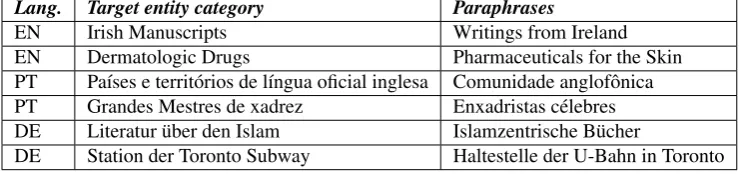
Lang. Target entity category Paraphrases
EN Irish Manuscripts Writings from Ireland EN Dermatologic Drugs Pharmaceuticals for the Skin PT Pa´ıses e territ´orios de l´ıngua oficial inglesa Comunidade anglofˆonica PT Grandes Mestres de xadrez Enxadristas c´elebres DE Literatur ¨uber den Islam Islamzentrische B¨ucher
DE Station der Toronto Subway Haltestelle der U-Bahn in Toronto
Table 2: Examples of paraphrases in English (EN), Portuguese (PT) and German (DE).
We define entity category as a concise and descriptive struc-tured predicate described in natural language that combines one or more types/attributes of an entity.
In addition to their occurrence in unstructured data, entity categories are also available in the form of structured data. DBpedia (Auer et al., 2007) associates descriptive cate-gories to entities representing in the form of Yago prop-erties (Suchanek et al., 2007), which are available in all languages supported by Wikipedia. This information is ex-tracted from the categories present in the Wikipedia articles which are freely described by the Wikipedia community. Table 1 presents a list of entity categories extracted from the Yago/DBpedia dataset.
The use of natural language to create such a category al-lows users to express and potentially search for the same (or close) concept using different words. For example, aBrazilian aerospace conglomerate is also described as
Brazilian Planemaker2 and categorised as Aircraft
man-ufacturers of Brazil3. Having the ability to match para-phrases of complex nominals, allows users to find other relevant categories for different lexical expressions. The current task is designed to evaluate the ability of a system to recogniseparaphrases of entity categorieswritten in En-glish, Portuguese or German.
2.1.
Query Types
According to Pound et al. (2010), in the context ofEntity Search, there are five types of queries summarised as fol-lows:
• Entity query: intending to find a particular entity. Ex-pected results are entities corresponding to some dis-ambiguation of the query entity.
• Type query: intending to find entities of a particu-lar type or class. Expected results are entities that are instances of the specified type, or an identifier of the type itself.
• Attribute query: intending to find values of a partic-ular attribute of an entity or type. Expected results are the values of an attribute specified in the query.
• Relation query: intending to find how two or more entities or types are related. Expected results are the one or more relationships among the query entities or types.
2See the magazine article
Brazilian Planemaker Unveils Its Biggest Military Jet Yetpublished by Business Insider.
3
See the Wikipedia categoryAircraft manufacturers of Brazil.
• Other keyword query: the query intent is described by some keywords that do not fit into any of the above categories. Expected results are resources providing relevant information.
Complex queries combining characteristics oftype queries andattribute queries can benefit from the use of the nat-ural language categories associated with the entities. The categories can provide a shortcut between the natural lan-guage query and the target entities. For example, the INEX-LD Challenge (Wang et al., 2012) defines natural language queries and lists associated entities. For the query “bicycle sport races” several relevant entities hold the Yago cate-goryCycling Competitions. Intuitively we can assume that bicycle sport races and cycling competitions are equiva-lent paraphrases. Creating a mechanism able to pair them makes a shortcut between a natural language expression and a set of entities.
The semantic search of entity categories can be seen as a bridge between unstructured and structured data. In ad-dition, they also suggest which kinds of types/attributes are relevant to create descriptive compositions from the user’s point of view. For example, the combination of
dbo:occupation and dbo:birthPlace generally
createscommonly useddescriptive categories (e.g. French Poets).
3.
Test Collection
The test collections comprehend three knowledge bases of about 345,000 entity categories for English, 105,000 for Portuguese and 235,000 for German, which were created based on the set of DBpedia categories. From these sets, we chose a subset of 110 categories for each language to be part of the query sets. The categories in query sets were chose randomly and filtered later to ensure that they vary in size, number of place/demonym references, number of tem-poral expressions and different noun phrase components, in order to ensure a high semantic variety in the queries. Examples of categories in the English query set are:
• categories having different sizes to represent different degrees of word compositionally. For example, Pre-historic Canines (two terms); Victims of Helicopter Accidents or Incidents in the United States(ten terms).
Language Inter-rater agreement Recall MRR
Top 10 Top 20 Top 10 Top 20
English (EN) 0.9075 0.2806 0.2806 0.3096 0.3143
Portuguese (PT) 0.9489 0.3420 0.3907 0.4641 0.4665
German (DE) 0.9960 0.4487 0.4725 0.6760 0.6768
Table 3: Inter-rater agreement, recall and MRR results considering all relevant categories.
• categories containing different kinds of noun phase components, such as nouns, adjectives, and verbs. For exampleRecurring Events Established in 1875, Mag-azines with Year of Establishment Missing.
We grouped the query sets in blocks of 10 categories and asked volunteers fluent or native in English, Portuguese and German to suggest paraphrases for them. They were instructed to describe the same (or close) meaning using preferably different words and different syntactical struc-tures. After that, we applied a curation process conducted by two researchers to assess the quality of the paraphrases. In the end, we accepted a set of 220 paraphrases for En-glish, 229 for Portuguese and 169 for German, which refer respectively to 98, 96 and 71 categories out of the initial set of 110.
Table 2 shows examples of entity categories and their asso-ciated paraphrases proposed by the volunteers in English, Portuguese and German. The task aims at retrieving the original category when querying using its paraphrase.
3.1.
Evaluation and Relevance Judgements
The task is defined as an information retrieval problem:
• Statement: LetT be a set of entity categories, called target set, and(x, y)a pair of entity categories where
x ∈ T,y /∈ T andy is a paraphrase ofx, meaning that y is a semantic approximation ofx, represented byy≈x.
• Search Procedure: Letf be a semantic search pro-cedure defined by L = f(T, y)whereL = (T,≥), which meansLis an ordered set of entity categories.
• Evaluation Procedure: Letgbe an evaluation proce-dure, defined byr = g(L, x)whereris the ranking position ofxin the listL.
As more than one target category can be relevant to a query, we also designed a second evaluation setting. In this new procedure, for each query, we retrieved the first 50 results using the method presented in Section 4. to be classified as one of the following judgements: not relevant,relevant andhighly relevant, being the last class exclusively used to define the original target category that originated the para-phrase. Each result set was assessed by two fluent or native judges who were instructed to point as relevant those cat-egories that he or she would be interested when searching for the given query. After the judgement process, more than 23,000 categories were analysed. Table 3 shows the inter-rater agreement for each language.
The task allows two evaluation settings. In the first, only the highly relevant category is accepted as a positive re-trieval, assessing a system strictly by guided paraphrasing
Lang. Recall MRR
Top 10 Top 20 Top 10 Top 20
EN 0.2922 0.3287 0.1549 0.1575
PT 0.4736 0.5219 0.3151 0.3183
DE 0.7976 0.8392 0.5960 0.5988
Table 4: Recall and MRR results considering only the highly relevantcategories.
as formalised earlier. In the second, categories classified as relevantare also considered, allowing a broader evaluation.
4.
Baselines and Results
To provide comparative baselines we implemented a method based ondistributional semanticsto cope with the search of entity categories, whose vectors were generated from unstructured text corpora.
Distributional semantics is based on the hypothesis that words co-occurring in similar contexts tend to have simi-lar meaning (Harris, 1954). Distributional semantics pro-vides representations of the meaning of words in a high-dimensional vector space, which is generated by analysing large-scale text corpora (Turney and Pantel, 2010). The simplification of the meaning representation model sup-ports computation of semantic similarity between two terms by calculating the cosine similarity of their vectors. The baselines applied the Skip-gram (Mikolov et al., 2013) vector space model generated from the Wikipedia 2014 cor-pora. We pre-processed the corpora lower-casing and stem-ming each token using the Porter Algorithm (Porter, 1997) and generated the distributional model using the default pa-rameters.
Our baseline is thesum-algebraic-based method, where en-tity categories are compared by an algebraic operation that sums up the vector’s components using the resulting vector to calculate the cosine similarity. We developed the experi-ments with the support of Indra (a distributional semantics tool) (Sales et al., 2018b; Freitas et al., 2016).
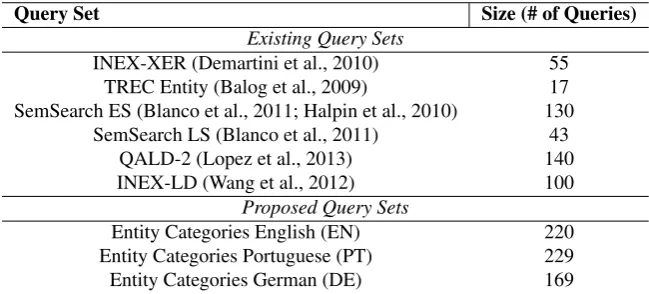
Query Set Size (# of Queries)
Existing Query Sets
INEX-XER (Demartini et al., 2010) 55 TREC Entity (Balog et al., 2009) 17 SemSearch ES (Blanco et al., 2011; Halpin et al., 2010) 130
SemSearch LS (Blanco et al., 2011) 43
QALD-2 (Lopez et al., 2013) 140
INEX-LD (Wang et al., 2012) 100
Proposed Query Sets
Entity Categories English (EN) 220 Entity Categories Portuguese (PT) 229 Entity Categories German (DE) 169
Table 5: Query sets and their sizes in number of queries.
The results show that the proposed baseline performs sig-nificantly different across languages. Considering the Top-20 scenario, while the algorithm retrieves about 32% of the English paraphrases, in the German dataset, this rate jumps to more than 82%. This occurs because many of the Ger-man paraphrases were described using words that share the same linguistic root of the original category. Furthermore, the English target dataset is significantly larger (345,000 against 235,000) which increases the probability of return-ing false-positive categories. For the Portuguese dataset, despite the paraphrases were constructed using a rich vo-cabulary, its target dataset is less than one-third of the En-glish dataset (105,000), which put their results consistently between the other two languages.
Table 3 shows the evaluation considering all relevant cate-gories. In this experiment, in addition to the original target category, we also consider as relevant those categories ap-pointed by both judges simultaneously.
This new scenario of evaluation significantly differs from the previous, specially considering the German language. As we increase the set of relevant categories, the queries do not have the same linguistic roots as before, and so the recall decreases significantly. As both the English and Por-tuguese languages had already rich paraphrases, their recall did not experienced the same gap. The still higher retrieval score of the Portuguese language is again expressed for its smaller target dataset. Both scenarios of evaluation consis-tently points the German, Portuguese and English in better positions as shown by the MRR measure.
The dataset and the source code are respectively avail-able at https://rebrand.ly/cat-paraphases
andhttps://rebrand.ly/cat-source-code.
5.
Related Work
Searching of entity categories was not exploited previously as a formatted task. Currently, the most related task is the entity search, which is commonly evaluated using the five query types generated in the context of challenges and cam-paigns.
Balog and Neumayer (2013) grouped those query sets, nor-malising their results to point to DBpedia instances. The XML Entity ranking track (XER) discusses the stan-dardisation of the evaluation procedures for entity retrieval and provides a large dataset sample in which the Wikipedia
is used as an underlying collection (Demartini et al., 2010). The track explores two main tasks: Entity Ranking (ER) and Entity List Completion (LC), both of them using the Wikipedia 2009 XML data.
Blanco et al. (2011) present the entity search over Linked Data with keyword queries related to entities or their de-scription. In comparison to TREC 2010 and INEX-XER tracks searches over structured data in RDF rather than un-structured data and XML as a data format, Respectively. The goal of INEX-LD (Wang et al., 2012) was to inves-tigate retrieval techniques over a combination of textual (wikipedia) and structured data (RDF). Lopez et al. (2013) aimed to present the faults and failures of question answer-ing systems as interfaces to query linked data sources. The SemSearch ES challenge (Blanco et al., 2011; Halpin et al., 2010) in comparison searches over structured data in RDF rather than unstructured data and XML as the previ-ous tasks.
Although these works deal with the entity searching stud-ies, their focus rely on issues of evaluation and shortcom-ings of different interface to query systems and not aim the study on investigating entity categories. Table 5 shows the size of each query set, along with the size of the query sets proposed in our work.
Sales et al. (2016) proposed a compositional-distributional semantic model to search English entity categories whose syntactic structure plays a fundamental role in composing partial semantic relatedness scores. The method identifies the core concept behind the category and use it to guide the search. Their results, however, cannot be directly com-pared, since Sales et al. (2016) explores a different dataset.
6.
Summary
The analysis of the semantic phenomena associated with interpreting natural language entity category allows a fo-cused understanding of how humans define complex pred-icates and how systems can address complex compositions of predicates. Additionally, the ability to semantically in-terpret categories and to cope with its associated mean-ing variations plays a fundamental role in different seman-tic tasks includingentity search,schema-agnostic queries, question answering systems andtext entailment (Chen et al., 2016; Sales et al., 2016; Freitas, 2015).
However, this task has not been sufficiently individuated, becoming implicit in all of these tasks and not receiving the adequate focus. As a consequence, most discussion on how to cope with semantic variation of categories has been limited in the literature. The semantic search of entity cat-egories can define a new bridge between unstructured and structured data.
7.
Acknowledgment
This publication has emanated from research partially sup-ported by the National Council for Scientific and Techno-logical Development, Brazil (CNPq).
8.
References
Auer, S., Bizer, C., Kobilarov, G., Lehmann, J., Cyganiak, R., and Ives, Z., (2007). DBpedia: A Nucleus for a Web of Open Data, pages 722–735. Springer, Berlin, Heidel-berg.
Balog, K. and Neumayer, R. (2013). A test collection for entity search in DBpedia. In Proceedings of the 36th International ACM SIGIR Conference on Research and Development in Information Retrieval, SIGIR ’13, pages 737–740, New York, USA. ACM.
Balog, K., de Vries, A. P., Serdyukov, P., Thomas, P., and Westerveld, T. (2009). Overview of the TREC 2009 en-tity track. InTREC 2009 Working Notes. NIST, Novem-ber.
Blanco, R., Halpin, H., Herzig, D. M., Mika, P., Pound, J., Thompson, H. S., and Tran, D. T. (2011). En-tity search evaluation over structured web data. In Pro-ceedings of the 1st International Workshop on Entity-Oriented Search, Beijing, China, July.
Chen, J., Xiong, C., and Callan, J. (2016). An empirical study of learning to rank for entity search. In Proceed-ings of the 39th International ACM SIGIR Conference on Research and Development in Information Retrieval, SIGIR ’16, pages 737–740, New York, NY, USA. ACM. Demartini, G., Iofciu, T., and De Vries, A. P. (2010). Overview of the INEX 2009 entity ranking track. In Proceedings of the Focused Retrieval and Evaluation, and 8th International Conference on Initiative for the Evaluation of XML Retrieval, INEX’09, pages 254–264, Berlin, Heidelberg. Springer-Verlag.
Elbedweihy, K. M., Wrigley, S. N., Clough, P., and Ciravegna, F. (2015). An overview of semantic search evaluation initiatives. Web Semantics: Science, Services and Agents on the World Wide Web, 30(0).
Freitas, A., Barzegar, S., Sales, J. E., Handschuh, S., and Davis, B., (2016). Semantic Relatedness for All
(Lan-guages): A Comparative Analysis of Multilingual Se-mantic Relatedness Using Machine Translation, pages 212–222. Springer International Publishing, Cham. Freitas, A. (2015). Schema-agnositc queries over
large-schema databases: a distributional semantics ap-proach. Ph.D. thesis, Digital Enterprise Research Insti-tute (DERI), National University of Ireland, Galway. Halpin, H., Herzig, D. M., Mika, P., Blanco, R., Pound,
J., Thompson, H. S., and Tran, D. T. (2010). Evaluat-ing ad-hoc object retrieval. InProceedings of the Inter-national Workshop on Evaluation of Semantic Technolo-gies, Shanghai, China, November.
Harris, Z. (1954). Distributional structure. Word, 10(23):146–162.
Karen Sp¨arck Jones, editor. (1981). Information Retrieval Experiment. Butterworths.
Lopez, V., Unger, C., Cimiano, P., and Motta, E. (2013). Evaluating question answering over linked data. Web Se-mantics: Science, Services and Agents on the World Wide Web, 21:3 – 13. Special Issue on Evaluation of Semantic Technologies.
Mikolov, T., Chen, K., Corrado, G., and Dean, J. (2013). Efficient estimation of word representations in vector space. InICLR Workshop Papers.
Porter, M. F. (1997). Readings in information retrieval. chapter An Algorithm for Suffix Stripping, pages 313– 316. Morgan Kaufmann Publishers Inc., San Francisco, CA, USA.
Pound, J., Mika, P., and Zaragoza, H. (2010). Ad-hoc object retrieval in the web of data. In Proceedings of the 19th International Conference on World Wide Web, WWW ’10, pages 771–780, New York, NY, USA. ACM. Sales, J. E., Freitas, A., Davis, B., and Handschuh, S. (2016). A compositional-distributional semantic model for searching complex entity categories. InProceedings of the Fifth Joint Conference on Lexical and Computa-tional Semantics, *SEM@ACL 2016, Berlin, Germany, 11-12 August 2016.
Sales, J. E., Freitas, A., and Handschuh, S. (2018a). An open vocabulary semantic parser for end-user program-ming using natural language. In2018 IEEE Twelfth In-ternational Conference on Semantic Computing (ICSC), Jan.
Sales, J. E., Souza, L., Barzegar, S., Davis, B., Freitas, A., and Handschuh, S. (2018b). Indra: A word em-bedding and semantic relatedness server. InProceedings of the Eleventh International Conference on Language Resources and Evaluation (LREC 2018), Miyazaki, Japan, May. European Language Resources Association (ELRA).
Suchanek, F. M., Kasneci, G., and Weikum, G. (2007). Yago: A core of semantic knowledge. In Proceedings of the 16th International Conference on World Wide Web, WWW ’07, pages 697–706, New York, NY, USA. ACM. Turney, P. D. and Pantel, P. (2010). From frequency to meaning: Vector space models of semantics. J. Artif. Int. Res., 37(1):141–188, January.