Generating Stylistically Consistent Dialog Responses
with Transfer Learning
Reina Akama†1, Kazuaki Inada†2, Naoya Inoue†3, Sosuke Kobayashi‡4, Kentaro Inui†⇤5
†Graduate School of Information Sciences, Tohoku University ‡Preferred Networks, Inc.
⇤RIKEN Center for Advanced Intelligence Project
{1reina.a,2kazuaki.inada,3naoya-i,5inui}@ecei.tohoku.ac.jp, 4[email protected]
Abstract
We propose a novel, data-driven, and stylistically consistent dialog response-generation system. To create a user-friendly system, it is crucial to make gen-erated responses not only appropriate but also stylistically consistent. For leaning both the properties effectively, our pro-posed framework has two training stages inspired by transfer learning. First, we train the model to generate appropriate sponses, and then we ensure that the re-sponses have a specific style. Experimen-tal results demonstrate that the proposed method produces stylistically consistent responses while maintaining the appropri-ateness of the responses learned in a gen-eral domain.
1 Introduction
Dialog response-generation (DRG) systems have been studied extensively over the decades. In the recent years, there is a growing interest in a data-driven DRG system leveraging a large amount of conversational texts in social networking services (SNSs) such as Twitter. One successful approach is to train a neural sequence-to-sequence model (seq2seq) (Sutskever et al.,2014) on conversations from SNS, where the seq2seq learns a mapping from a user utterance to the appropriate response with recurrent neural networks (RNNs) (Shang et al.,2015;Li et al.,2016;Serban et al.,2017).
The prior data-driven approach, however, suf-fers a major drawback. Since a wide variety of users, ranging from young to old, and from fe-male to fe-male, participates in an SNS, the learned responses are not guaranteed to be stylistically consistent (e.g. in terms of politeness). For ex-ample, we show actual responses generated by
1a) User: Sìkao(konnichiha . / Hello.)
1b) System: ÂÇC⌫DcqDgDSFj
(kyou mo genki ippai de iko u na . / Yo, man! How ya doing today?) 2a) User: ÂoÍgY
(kyou ha yuki desu . / It is snowing today.) 2b) System: ÍMcfãìgYK
(yuki ga hu tte iru n desu ka . / Is it? ) 3a) User: “DgY( samui desu . / It’s cold.)
3b) System: àWàWKídjDgBR~Yè
(yoshi yoshi , te wo tsunai de age masu wa . / Oh, dear. I’m gonna hold your lovely hands.)
Table 1: Example of stylistically inconsistent re-sponses generated by a vanilla seq2seq trained on our Twitter dialog corpus.
a vanilla seq2seq-based DRG system trained on Twitter conversations in Table 1. The responses have inconsistent style as if the system had multi-ple personalities; the responses are friendly (1b), polite (2b), or feminine (3b). To create a user-friendly DRG system, it is crucial to generate re-sponses that are stylistically consistent.
This paper proposes a novel, data-driven, and stylistically consistent DRG model. A vanilla seq2seq cannot generate stylistically consistent re-sponses without training on a large amount of stylistically consistent dialog responses, which is prohibitively costly. To address this issue, we ap-ply transfer learning, namely transferring knowl-edge about response generation in a general do-main into the task of stylistically consistent re-sponse generation.
In the literature, little attention has been paid to the stylistic consistency of the generated re-sponses. There are some previous attempts on transforming a style of dialog utterances into a specified one (Walker et al.,2012;Miyazaki et al.,
2015). Their approaches assume that original ut-terances are given by a separate independent sys-tem and need some manual annotations. Li et al.
(2016) aim for response generation with a consis-tent “persona” by conditioning a seq2seq on a spe-cific Twitter user ID embedding. However, their work focuses on the consistency in the content of the generated responses and they did not directly evaluate the stylistic consistency of their system.
This is the first study that focuses on building a stylistically consistent end-to-end and data-driven DRG model and empirically evaluates the stylis-tic consistency of generated responses in single-turn dialogs. Our experiments demonstrate that the proposed method produces stylistically consis-tent responses while maintaining the appropriate-ness of responses learned from a general domain.
2 Related Work
The literature includes some prior studies that aim for transforming a style of dialog utterances into a specified one (Walker et al.,2012;Miyazaki et al.,
2015).Walker et al.(2012) extract rules represent-ing characters from their annotated movie subtitle corpora. Miyazaki et al.(2015) propose a method of converting utterances using rewriting rules au-tomatically derived from a Twitter corpus. These approaches have a fundamental problem to need some manual annotations, which is a main issue to be solved in this work. We propose an end-to-end and data-driven framework which addresses both response generation and stylistic transformation.
Transfer learning is a machine learning tech-nique effective for many NLP tasks (Pan and Yang,
2010), which effectively trains a machine learning model by transferring knowledge about a general domain into a target domain. By applying transfer learning to a stylistically consistent DRG system, once we build a DRG system without stylistic con-sistency, it is easy to change its style by adding a small stylistically consistent corpus.
3 Generating Stylistically Consistent Responses with Transfer Learning Given an utterance style, our goal is to create a DRG system that can keep producing utterances with the specified style. Inspired by the success of the data-driven approach, one can prepare a cor-pus of conversations for every possible style and feed it to a seq2seq. However, in order to obtain a stylistically consistent DRG system through a vanilla seq2seq, this method requires millions of training instances for each target style, which is prohibitively expensive.
seq2seq seq2seq
Dialog corpus Style corpus
!" #$∖ #&$ #$
utterance pairs
transfer
vocabulary #$ #&$
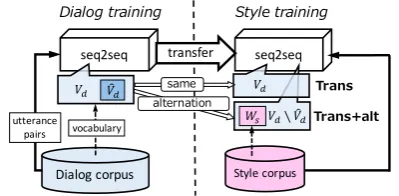
Figure 1: Overview of our framework. Trans
shares the same vocabulary in dialog and style training.Trans+altalters a vocabulary to consider expressions specific in a style corpus.
3.1 General Framework
To address this issue, we propose a novel two-staged training framework for building a stylisti-cally consistent response-generation model, as de-picted in Figure1. The core idea is as follows. A stylistically consistent response generation model has to learn at least three aspects of responses: content, fluency and style. We hypothesize that learning the content and fluency requires a large amount of training instances, whereas learning the style requires far less training instances. Inspired by transfer learning, our training strategy is di-vided into two steps (henceforth, dialog training and style training). We thus assume two types of corpora as training data: (i) dialog corpus, a large conversational corpuswithout stylistic con-sistency, and (ii) style corpus, a small conversa-tional corpuswithstylistic consistency.
In our experiments, we used single-turn dialog (i.e. utterance pairs) as training data. However, the proposed framework is applicable to multi-turn dialog as long as we have a response-generation model.
First, in dialog training, we train a seq2seq re-sponse generation model on a dialog corpus to learn the content and fluency of responses, namely how to generate responses without taking into ac-count stylistic consistency. Seq2seq (Sutskever et al.,2014) is an RNN-based approach effective for response generation (Shang et al.,2015;Li et al.,
2016;Serban et al.,2017). A typical seq2seq has a vocabulary of a limited size (e.g., tens of thou-sands) to speed up the training process, reduce the computational memory usage and prevent overfit-ting. Following a typical practice in seq2seq, we use the top Nd most frequent words in a dialog
corpus as the seq2seq vocabulary (henceforth,Vd)
spe-cial symbol UNK.
Second, in style training, we use a style cor-pus to fine-tune the seq2seq that is already trained with a dialog corpus to ensure that the generated responses are stylistically consistent. The model inherits all the model parameters (i.e. word em-beddings and weight matrices in the RNNs) and the seq2seq vocabulary (henceforth,Vs) from
dia-log training.
Note that obtaining a large-scale dialog corpus is relatively easy. For example, one can simply use the whole Twitter conversations as a dialog corpus. As for a style corpus, one can extract utterances made by a specific character from a movie script as in (Walker et al.,2012). One advantage of our framework is that once a large-scale dialog corpus is obtained and dialog training is done, it is easy to change its style by adding a small style corpus.
3.2 Vocabulary in Transferred Model
When applying transfer learning to a seq2seq, cre-ating a vocabulary for style training is not a trivial job. In our experiments, we explore two strate-gies. In Trans, our first strategy, we simply use the same vocabulary for dialog training and style training (i.e. Vs = Vd). However, this may not
be a good strategy, because the top Nd most
fre-quent words in a dialog corpus do not necessarily include words that are potentially useful for gen-erating stylistically consistent responses.
To remedy this, inTrans+alt, our second strat-egy, we alter the seq2seq vocabulary Vs that
is used for dialog training before style training (henceforth, vocabulary alternation). Let Ws be
a set of the topNsmost frequent words which are
only included in a style corpus, andVˆdbe a set of
the topNsmostinfrequentwords inVd. Instead of
simply settingVs =Vd, we setVs=Vd\Vˆd[Ws
(i.e. the topNd Nsmost frequent words in a
di-alog corpus plus theNsmost frequent words in a
style corpus). Intuitively, we basically employVd
asVs, but replace infrequent words from the dialog
corpus with frequent words in the style corpus. 4 Experiments
4.1 Setups
Datasets A summary of our corpora is shown in Table 2. The dialog corpus contains approxi-mately 3.7 M Japanese utterance pairs extracted from tweet-reply chains on Twitter.1 The style
1Noisy sentences (e.g., URLs) are filtered out.
Utterance pairs Vocabulary Overlap (%)
Dialog corpus 3,688,162 591,880
-Tetsuko corpus 12,564 12,102 7,230 (59.7)
Oja corpus 1,476 2,137 1,532 (71.7)
Table 2: Dialog corpus and style corpora used in our experiments. ‘Overlap’ represents the num-ber of overlap words between a dialog corpus and style corpus.
Model Transferlearning Dialogcorpus corpusStyle Vocabularyalternation Base X
Mix X X X
Trans X X X
Trans+alt X X X X
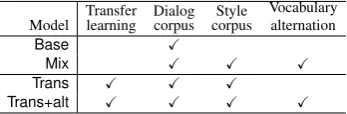
Table 3: Four models for our experiments
corpus contains pairs of utterances extracted from subtitles of a Japanese TV show. We prepare two instances of style corpus: (i) Tetsuko cor-pus, where all the responses are made by Tetusko Kuroyanagi, an elderly, polite, and female TV personality, and (ii) Oja corpus, where all the responses are made by Ojarumaru, a five-year-old kids’ cartoon character who uses classical Japanese expressions (e.g., see Appendix A, Ta-ble5). We use 95 % of the corpora for training and 5 % for validation.
BaselinesWe prepare two baseline models with-out transfer learning: (i)Base, a vanilla seq2seq trained on the dialog corpus only, and (ii)Mix, a vanilla seq2seq trained on the mixture of a dialog corpus and style corpus, where Mix is applied to the vocabulary alternation as well as Trans+alt. We summarize the baseline models and proposed models in Table3.
Settings All the four models use the following settings. The seq2seq encoder and decoder are two-layer LSTMs with 2048 units using 1024-dimensional word embeddings. The vocabulary size (Nd) is 25,000. We train the models
us-ing Adam (Kingma and Ba,2015) with mini-batch size 64 and performed early stopping for perplex-ity using the validation data. For the vocabulary alternation in Mix and Trans+alt, we use Ns =
1,000for Tetsuko corpus and Ns = 500for Oja
corpus.2
4.2 Evaluation Method
Conventionally, DRG systems are evaluated through reference-based evaluation (e.g. BLEU
Style Base Mix Trans Trans+alt
Tetsuko SCAR 19.549.0 22.550.0 53.030.5‡B,†M 60.034.0†‡B,B,†‡MM
Oja SCAR 50.02.5 46.526.5 72.049.0‡B,‡M 82.557.0‡‡B,B,‡‡M,M,††TT
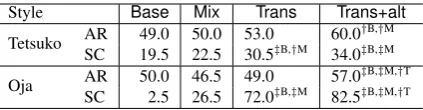
Table 4: Results of human evaluation. AR and SC denotes the appropriateness of response and stylis-tic consistency, respectively. Superscripts†B,†M,†T
(and ‡B,‡M,‡T) indicate the statistical significance
againstBase,MixandTrans(sign test,p <0.05 for†,p <0.01for‡), respectively.
(Papineni et al.,2002;Sordoni et al., 2015;Li et al.,2016)) or subjective human evaluation (Walker et al., 2012; Vinyals and Le, 2015; Shang et al.,
2015). We employ human evaluation, because hu-man evaluation captures more stylistic consistency than reference-based evaluation, and word-overlap similarity metrics such as BLEU correlates weakly with human judgments (Liu et al.,2016).
For query utterances, we randomly extract 50 sentences from Twitter. There is no overlap be-tween these query utterances, and the training and validation data. Each model generates four re-sponses from one query utterance by beam sam-pling (beam width 3) using four different random seeds. Therefore, the total number of responses generated by one model is 200.
We use Yahoo! Crowd Sourcing3 for human
evaluation. Given (i) a query utteranceQ, (ii) the responseRgenerated by a model, and (iii) a style descriptionS that the model are trying to gener-ate with, the workers are independently asked to answer the following two questions:
• Whether R is a grammatically and semanti-cally appropriate response toQ.
• Whether the style ofRmatchesS.
Note that the workers were given only a style de-scription S with several example utterances but not the specific name of individual target character. Each response is judged by five workers, who do not know which model generated each response. The final answer is determined by majority vote.
4.3 Results
Table4shows the percentage of responses judged as ‘appropriate response’ (AR) and ‘stylistically
3https://crowdsourcing.yahoo.co.jp/
consistent’ (SC).4 Base indicates that the dialog
corpus’s style only matches 19.5% in Tetsuko cor-pus and 2.5% in Oja corcor-pus.TransandTrans+alt, the proposed transfer learning frameworks, suc-cessfully generate more stylistically consistent re-sponses while maintaining the appropriateness of generated responses learned from a dialog corpus
(Base v.s. Trans,Trans+alt). In addition,
trans-fer learning is more effective than simply mix-ing a dialog corpus and style corpus (Mix v.s.
Trans+alt). Recall that the difference between
Mix and Trans+alt is whether transfer learning
is applied, namely the two models are trained on the same corpora and seq2seq vocabulary. Fur-thermore, the vocabulary alternation in style train-ing (see Sec.3.2) helps to make the generated re-sponses more stylistically consistent (Trans v.s.
Trans+alt). Overall, the improvement on Oja
cor-pus is more salient than that on Tetsuko corcor-pus. We attribute this to the fact that Tetsuko corpus is closer to the original dialog corpus.
Moreover,Trans+altimproves the appropriate-ness of the responses. On both style corpora,
Trans+altachieves the best result among the four
models. Table 6 in Appendix B and Table 7 in Appendix C show actual responses generated by
Trans+alt. By analyzing the generated responses,
we find that inappropriate responses such as dull responses (e.g., I don’t know) and Internet slangs are relatively fewer, even though we did not make any special treatment. We attribute this to the fact
thatTrans+altis additionally trained on less noisy
real conversations (i.e., TV subtitles) with a bet-ter vocabulary, where new frequent words in a less noisy style corpus are pushed.
The overall results support our assumption that style training requires far less training data than dialog training (see Sec. 3.1). We speculate that styles of utterances are characterized by a smaller variety of lexical choices such as sentence-final auxiliary expressions and personal pronouns. For Japanese, in fact, it is shown that sentence-final auxiliary expressions are an important fac-tor for changing the character of a dialog system (Miyazaki et al.,2015).
5 Conclusion
We have presented a novel end-to-end framework to build a stylistically consistent dialog response-generation system, leveraging transfer learning. We have demonstrated that we are able to pro-duce stylistically consistent responses by transfer learning while maintaining the appropriateness of responses learned from a general domain. The proposed framework allows us to train a response generation model on a large-scale, and easily-obtainable dialog corpus without stylistic consis-tency and then on a small-scale stylistically con-sistent corpus. This is the first work to focus on creating a stylistically consistent end-to-end DRG system and evaluating stylistic consistency in neu-ral dialog response generation studies.
In future work, we plan to improve style train-ing so that it can learn only the style of responses. We will assign a weight indicating the degree of stylistic peculiarity to each word in a style corpus, which controls the aggressiveness of style train-ing. Another future work includes exploring an effective way of creating a style corpus, e.g. auto-matically collecting polite utterances from a large Twitter corpus with a filter, or generating stylisti-cally consistent responses with a smaller or even no specific style corpus.
Acknowledgments
This work was supported by JSPS KAKENHI Grant Number 15H01702.
References
Diederik Kingma and Jimmy Ba. 2015. Adam: A method for stochastic optimization. In The Inter-national Conference on Learning Representations (ICLR).
Jiwei Li, Michel Galley, Chris Brockett, Georgios Sp-ithourakis, Jianfeng Gao, and Bill Dolan. 2016. A persona-based neural conversation model. In Pro-ceedings of the 54th Annual Meeting of the Asso-ciation for Computational Linguistics, pages 994– 1003.
Chia-Wei Liu, Ryan Lowe, Iulian Serban, Mike Nose-worthy, Laurent Charlin, and Joelle Pineau. 2016. How not to evaluate your dialogue system: An em-pirical study of unsupervised evaluation metrics for dialogue response generation. InProceedings of the 2016 Conference on Empirical Methods in Natural Language Processing, pages 2122–2132. Associa-tion for ComputaAssocia-tional Linguistics.
Chiaki Miyazaki, Toru Hirano, Ryuichiro Higashinaka, Toshiro Makino, and Yoshihiro Matsuo. 2015. Au-tomatic conversion of sentence-end expressions for utterance characterization of dialogue systems. In
Proceedings of the 29th Pacific Asia Conference on Language, Information and Computation (PACLIC), pages 307–314.
Sinno Jialin Pan and Qiang Yang. 2010. A survey on transfer learning. IEEE Transactions on knowledge and data engineering, 22(10):1345–1359.
Kishore Papineni, Salim Roukos, Todd Ward, and Wei-Jing Zhu. 2002. Bleu: a method for automatic eval-uation of machine translation. In Proceedings of the 40th annual meeting on association for compu-tational linguistics, pages 311–318. Association for Computational Linguistics.
Iulian Vlad Serban, Alessandro Sordoni, Ryan Lowe, Laurent Charlin, Joelle Pineau, Aaron Courville, and Yoshua Bengio. 2017. A hierarchical latent variable encoder-decoder model for generating dialogues. In
Thirty-First AAAI Conference on Artificial Intelli-gence, pages 3295–3301.
Lifeng Shang, Zhengdong Lu, and Hang Li. 2015. Neural responding machine for short-text conver-sation. In Proceedings of the 53rd Annual Meet-ing of the Association for Computational LMeet-inguis- Linguis-tics and the 7th International Joint Conference on Natural Language Processing (Volume 1: Long Pa-pers), pages 1577–1586. Association for Computa-tional Linguistics.
Alessandro Sordoni, Michel Galley, Michael Auli, Chris Brockett, Yangfeng Ji, Margaret Mitchell, Jian-Yun Nie, Jianfeng Gao, and Bill Dolan. 2015. A neural network approach to context-sensitive gen-eration of conversational responses. In Proceed-ings of the 2015 Conference of the North Ameri-can Chapter of the Association for Computational Linguistics: Human Language Technologies, pages 196–205. Association for Computational Linguis-tics.
Ilya Sutskever, Oriol Vinyals, and Quoc V Le. 2014. Sequence to sequence learning with neural net-works. InAdvances in neural information process-ing systems, pages 3104–3112.
Oriol Vinyals and Quoc Le. 2015. A neural con-versational model. InInternational Conference on Machine Learning(ICML) Deep Learning Workshop 2015.
Marilyn A Walker, Grace I Lin, and Jennifer Sawyer. 2012. An annotated corpus of film dialogue for learning and characterizing character style. In