18th International Conference on Structural Mechanics in Reactor Technology (SMiRT 18) Beijing, China, August 7-12, 2005 SMiRT18-D06-2
PROACTIVE MATERIALS DEGRADATION ASSESSMENT (PMDA)
Joseph Muscara*
US Nuclear Regulatory Commission
Mail Stop: T-10 E10
Washington, DC 20555
Phone: 301-415-5844, Fax: 301-415-5074
E-mail: [email protected]
Nilesh C. Chokshi
US Nuclear Regulatory Commission
Michael A. Switzer
US Nuclear Regulatory Commission
Disclaimer: The opinions expressed in this paper are those of the authors and are not the official position of the US Nuclear Regulatory Commission.
*Corresponding author
ABSTRACT
There is a growing recognition both in industry and at the US Nuclear Regulatory Commission (NRC) that proactive approaches to the management of material degradation are preferred particularly as plants age and continue to operate into their 20-year license renewal period. Therefore, the NRC Office of Nuclear Regulatory Research (RES) has initiated work to develop a foundation for regulatory actions to prevent materials degradation from adversely impacting safety. A two-step approach is being used for this work. The first step is to identify susceptible materials and locations where degradation can reasonably be expected in LWRs in the future. Probabilities of failure and associated uncertainties for important components will also be estimated. The second step is to cooperatively develop and implement an international research program for the components and degradation of interest. This research program will address materials and degradation mechanisms, mitigation, repair and replacement, and nondestructive evaluation. This paper will describe the programs developed to perform the efforts listed above and the potential uses for the results.
Keywords: aging, materials, corrosion, proactive.
1. INTRODUCTION
Materials degradation of components in nuclear power reactors has been experienced since the inception of nuclear power production. Several of these degradation mechanisms have impacted plant operations and required substantial investments in research, mitigation, repair, replacement, and inspection with correspondingly strong regulatory involvement and actions. Some of these degradation problems have included:
• Irradiation embrittlement of reactor pressure vessel steels,
• Stress corrosion cracking and other corrosion problems in steam generator tubes,
• Pipe cracking in BWRs,
• Flow assisted corrosion,
• Irradiation assisted stress corrosion cracking of internal components,
• Boric acid corrosion of low alloy and carbon steels, and
• Fatigue crack growth in reactor pressure vessel steels,
• Thermal embrittlement of cast stainless steels, and
• Environmental degradation of fatigue life in stainless, carbon, and low alloy steels. Although these degradation modes have not resulted in significant operational problems to date, some of them could emerge to become significant as plants age and continue operation into a 20-year license renewal period. Since these degradation phenomena are time-dependent, our expectation is that materials degradation from known and previously experienced mechanisms and from emerging mechanisms affecting different components will continue as plants age. Therefore, management of materials degradation incidents will become more resource-intensive both for the NRC and the industry in future years.
In the past, both the NRC and industry have responded to the occurrence of materials degradation as it occurred. Actions were taken to detect and mitigate the degradation in similar components at the given plant and at other plants after the first incidence of a particular degradation was discovered. For example, the NRC reacted to the discovery of intergranular stress corrosion cracks (IGSCC) in BWR piping in the early 1980s by ordering all BWR plants to shut down, over a relatively short period of time, to conduct in-service inspections. Further, those inspections were required to be conducted by trained personnel using validated techniques. Therefore, the NRC had to develop guidance quickly for the training, validation testing, and passing criteria. Industry had to then quickly develop and implement training and validation testing for hundreds of inspectors for the detection and sizing of IGSCC in BWR piping. The validation samples included cracked pipes that were removed from operating reactors and had to be housed and managed in a radiation controlled space. The NRC also established study groups to evaluate and provide recommendations on a) the BWR pipe cracking phenomena, b) implications with respect to other components and reactor types, c) structural evaluation methods, d) inspection methods, and e) mitigation and repair techniques. The regulatory staff also conducted a concentrated effort to develop regulatory guidance on the inspection, evaluation, mitigation, and repair for IGSCC in BWR piping. The industry conducted extensive research to develop and implement “fixes” to the pipe cracking problem, while NRC conducted research to independently evaluate the effectiveness of proposed “fixes”.
Another example relates to how steam generator tube degradation has been addressed. Various modes of degradation have occurred in steam generator tubes since the early 1970s. Industry has reacted by quickly developing and implementing fixes as each mode of degradation surfaced and by improving inspection techniques for the specific degradation mode. Although the fixes were generally effective in controlling the degradation mode at-hand, often, the fix resulted in generating a new mode(s) of degradation in the steam generator tubes. Steam generator tube degradation has resulted in tube leakage and burst incidents accompanied by many unscheduled outages for inspections and repairs. Extensive degradation in many steam generators has required costly replacement of steam generators and lost revenue. The industry has also spent considerable resources for research and development on degradation modes and fixes, water chemistry control, and inspection technology. NRC has spent extensive effort in research and regulatory activities to provide guidance for maintaining tube integrity and safety.
In recent years, unexpected degradation of materials in components of nuclear power reactors has occurred. This unexpected degradation progressed to the point where the pressure boundary and defense in-depth were compromised and could have adversely impacted plant safety. These occurrences have resulted in high costs to the industry from extended repair and replacement outages and from unplanned extensive inspections at other potentially affected plants. The most recent examples include the hot leg weld cracking at V.C. Summer plant, the reactor vessel head penetration (VHP) circumferential cracking at the Oconee Nuclear Station, and the reactor vessel head degradation at the Davis-Besse Nuclear Power Station. All three of these events involved primary water stress corrosion cracking as either the dominant or initiating form of degradation. In addition to SCC of the VHPs, the event at Davis-Besse involved an unprecedented corrosive attack on the reactor vessel head. In reaction to the Davis-Besse event, the NRC convened a Lessons Learned Task Force (LLTF) to identify technical, regulatory oversight, and regulatory process deficiencies, and to take appropriate corrective actions, as part of a continual learning process. A major feature of action plans that the NRC has undertaken to implement LLTF recommendations, has been a focus on proactive assessment and management of materials degradation.
international research program to incorporate ongoing research and identify new research to develop the technical data needed for effective implementation of proactive materials degradation management programs.
2. IDENTIFICATION OF SUSCEPTIBLE COMPONENTS
Perhaps the most technically challenging step in the overall proactive materials degradation research program is the first step of identifying materials and locations where degradation can reasonably be expected in the future. The NRC is utilizing a two-pronged approach to this first step. The first portion is to identify components that have already experienced, or are likely to experience, degradation using currently available information from the Generic Aging Lessons Learned (GALL) report, Licensee Event Reports (LERs), and a database on plant events, EPIX, maintained by the Institute of Nuclear Power Operations (INPO). A group of experts from the NRC, Pacific Northwest National Laboratory (PNNL), and Argonne National Laboratory (ANL) held a week-long workshop to identify PWR and BWR plant components of interest from these sources and to evaluate the effectiveness of current nondestructive examination and leak monitoring techniques and requirements for these components. A report detailing the results of this evaluation and recommendations for improvements is currently in the draft stages.
The second portion of the identification step involves identifying components that may be susceptible to future degradation using a structured approach that takes into account the specific component material in its operating environment and its associated stressors. For this work, the NRC has assembled a panel of international experts in materials engineering, corrosion science, and reactor systems to systematically develop a list of components susceptible to future degradation. This process is based on the methodology used to develop Phenomena Identification and Ranking Table(s) (PIRT).
2.1 PIRT-Like Process for the Proactive Materials Degradation Assessment (PMDA PIRT)
NRC initially developed and used the PIRT methodology as a tool for identifying and ranking the significance of important phenomena to help prioritize the research needed to improve thermal hydraulic codes. The traditional PIRT process has been oriented toward accident phenomena as opposed to degradation phenomena and has therefore required modification for the task at hand.
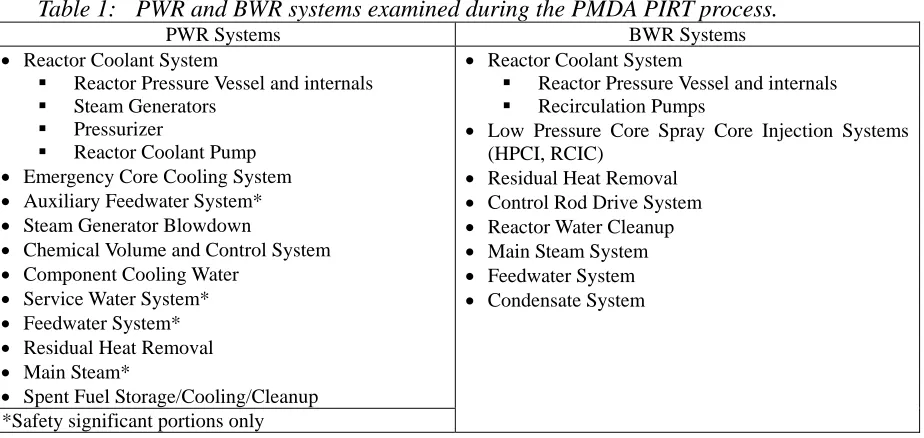
The PMDA PIRT exercise is being facilitated by staff from Brookhaven National Laboratory (BNL). A total of seven expert-panel workshops, each of five days duration, are being held to identify susceptible components and evaluate associated degradation phenomena for both PWR and BWR type reactors. A Westinghouse 4-Loop reactor is being examined as a representative PWR, and a General Electric BWR-5 is being examined as a representative BWR. The plant systems and sub-systems considered are those whose failure would lead to the release of radioactivity or would adversely affect a safety function (see Table 1). Fewer systems are being considered for the BWR examination because the PWR was examined first and certain support systems are similar in the materials of construction and operating environment for both PWR and BWR plant types. Since the materials and environment for these support systems are similar the evaluations of degradation phenomena should be the same for the BWR evaluation as for the PWR. Therefore the PWR evaluations will be used for the BWR plant examination for these similar systems. Differences in components at different PWR and BWR plants are being address by the panel as certain components are considered.
Table 1: PWR and BWR systems examined during the PMDA PIRT process.
PWR Systems BWR Systems• Reactor Coolant System
Reactor Pressure Vessel and internals Steam Generators
Pressurizer
Reactor Coolant Pump
• Emergency Core Cooling System
• Auxiliary Feedwater System*
• Steam Generator Blowdown
• Chemical Volume and Control System
• Component Cooling Water
• Service Water System*
• Feedwater System*
• Residual Heat Removal
• Main Steam*
• Spent Fuel Storage/Cooling/Cleanup *Safety significant portions only
• Reactor Coolant System
Reactor Pressure Vessel and internals Recirculation Pumps
• Low Pressure Core Spray Core Injection Systems (HPCI, RCIC)
• Residual Heat Removal
• Control Rod Drive System
• Reactor Water Cleanup
• Main Steam System
• Feedwater System
• Condensate System
In order to facilitate the process, the expert panel examined the list of components provided by BNL and agglomerated components into sub-groups to reduce the number of assessments to be performed. Components were placed in the same sub-group if they were in the same sub-system, were of the same or similar material type and product form (e.g. cast stainless steel, wrought stainless steel, carbon steel, etc.), and that are exposed to similar operating environments and other stressors, and would therefore be susceptible to the same degradation mechanisms.
Next, the expert panel associated degradation phenomena to each sub-group given the sub-groups’ material type, operating environment, and other stressors. The expert panel also made use of the operating experience provided by BNL as well as individual panel member’s operating knowledge and experience. Though prior operating experience contributed to the identification of degradation phenomena for each of the sub-groups, the panel and this effort are charged with proactively identifying materials and locations where degradation could be reasonably expected in the future. This includes consideration of past experience in addition to degradation that has not yet occurred due to a) long incubation periods, b) new or different degradation mechanisms, c) time dependent phenomena such as concentration of aggressive chemical species, fatigue, and thermal aging, d) plant operating history and more recent changes in operational parameters and environments such as power uprates, temperature, stress, and water chemistry, and e) other considerations.
Once the sub-groups and associated degradation phenomena were identified, the expert panel members individually assigned numerical values to each of three parameters for each degradation phenomenon identified. These three parameters are Susceptibility Factor, Confidence Level, and Knowledge Level and the ratings for these parameters are defined in Table 2. A sub-group’s susceptibility to a particular degradation phenomenon was rated on a 0-3 scale representing the expert’s opinion on the ability for the phenomenon to develop significant material degradation in the sub-group being considered given operating environment and stressor conditions. A rating of “0” indicates the expert did not believe the components in the sub-group are susceptible to the degradation mechanism, whereas a score of “3” indicates a high likelihood of significant degradation based on available supporting information, such as laboratory data, or extensive plant experience. Scores of “1” or “2” were assigned to account for instances between these two extremes. If the expert did not have suitable experience or access to information to support a rating, the phenomenon was not scored (i.e. left blank).
After rating the sub-group’s susceptibility to a degradation mechanism, the expert panel member then provided a confidence level associated with that rating of susceptibility. As the name of the rating suggests, the confidence level is a judgment provided by the expert panel member about his or her rating of susceptibility. Possible values are “1” for low confidence in the susceptibility rating, “2” for medium confidence, and “3” for high confidence.
Table 2: Scoring and associated definitions for parameters rated by individual expert
panel members
Susceptibility Factor – Can significant material degradation develop given plausible conditions?
• Blank = not evaluated by the expert
• 0 = not considered to be susceptible to the particular degradation mechanism by the expert
• 1 = conceptual basis for concern from data, or potential problems under unusual operating conditions, etc.
• 2 = strong basis for concern or known but limited plant problem
• 3 = demonstrated, compelling problem or multiple plant observations Confidence Level – Personal confidence in experts’ judgment of susceptibility
• 1 = low confidence, little known about phenomenon
• 2 = moderate confidence
• 3 = high confidence, compelling evidence, existing problems
Knowledge Level – Extent to which the relevant dependencies have been quantified
• 1 = poor understanding, little and/or low-confidence data
• 2 = some reasonable basis to know dependencies qualitatively or semi-quantitatively from data or extrapolation in similar “systems”
• 3 = extensive, consistent data covering all dependencies relevant to the component, perhaps with models – should provide clear insights into mitigation or management of problem
In addition, the panel members provide two comments to provide insights into their ratings of the three parameters discussed above. The first comment provides a short rationale for scores provided by the expert for the degradation mechanism. The second comment is an identification of the controlling factors associated with the occurrence of this degradation phenomenon in a plant. That is, if an unusual, but plausible, operating condition was required for the sub-group to be susceptible to a particular degradation mechanism that information would be provided here.
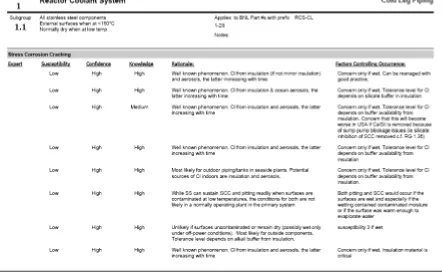
At any point during the scoring the expert panel members may add additional degradation mechanisms to a sub-group as they see fit. Once the individual scores are assigned, BNL collects all scores and comments in an Access database and presents the results in tabular format to the panel for discussion. An example of the scoring results is presented in Figure 1. As is shown in Figure 1, a single page lists the scores and comments for a single degradation mechanism for a sub-group. The purpose of discussing the scores amongst the panel members is for panel members with unique insight into a particular degradation mechanism to share that insight with the rest of the group. Based on this additional information, the other panel members may alter their scores, if desired. However, consensus among the panel members for scores is not the goal of the evaluation process and individual scores are being maintained so that individual expert panel member’s concerns are not overlooked.
Because the results are maintained electronically, the data may be manipulated to identify components that need additional attention based on the expert opinions of the panel members. For example, degradation mechanisms scored high susceptibility, high confidence, and low knowledge level would be of particular interest because the components associated with these mechanisms would be highly susceptible to degradation but there is little knowledge available to manage the degradation. This would in turn indicate the need for research to develop the technical basis and understanding of the degradation mechanisms to implement mitigation strategies to keep the degradation from adversely impacting component integrity and safety.
3. PROJECT STATUS AND FUTURE PLANS
3.1 Identification of Susceptible Components
Figure 1: Example of results from PWR evaluation
Currently, the PMDA PIRT evaluation of the PWR plant type is completed. However, because the report detailing the results and conclusions of this work is still in draft form, detailed results were not presented here. For the PWR evaluation, the expert panel members performed ~1100 assessments on degradation mechanisms for ~370 sub-groups representing ~2200 components. The results of the PWR evaluation will be peer reviewed and a final draft report available by December 2005. The expert panel meetings to evaluate the BWR plant type are expected to be completed in July 2005. The results of the BWR evaluation will be combined with the PWR results, peer reviewed, and a final report containing all results will be published in June 2006.
3.2 Conditional Core Damage Probabilities (CCDPs) and Probabilities of Failure for Identified Components
For components identified by the review of currently available information and the PMDA PIRT activity, conditional core damage probabilities (CCDPs) will be determined as a tool for prioritization of agency resources. Reports listing the components and associated CCDP values will be available in 2005. In addition, probabilities of failure and associated uncertainty estimates for the components will be determined for use in PRAs. This effort will likely begin in 2005 and continue through 2006 with a report detailing the results available in 2007. The results of these calculations will provide the basis for the NRC to implement regulatory actions related to in-service inspection and leak monitoring requirements, if necessary.
3.3 International Cooperative Research Program
The results of the above activities will be an input into development of the international cooperative research program mentioned above to address proactive management of potential materials degradation in operating reactors. This activity, through a cooperative agreement, will sponsor, implement, and share research results that will develop the technical basis for industry and the NRC to proactively implement effective approaches to materials degradation management. The research would involve a number of steps and considerations:
monitoring techniques for the detection, characterization, and evaluation of degradation in the identified materials and components (geometry) of interest.
• Review, evaluate, and develop as necessary techniques that could ameliorate the stressors to mitigate or prevent the expected degradation, and identify where developments are needed. Control of, or changes in water chemistry, temperature, stress state including residual stresses, and surface conditioning or modification would be considered.
• Review and evaluate existing materials and develop new materials as necessary for replacement of components where degradation is expected. The replacement materials must be compatible with the operating environment and resistant to the degradation mode of current concern and other potential degradation modes.
• Review, evaluate, and develop as necessary repair and replacement techniques for the materials and components of interest. These techniques should not render the repaired or replaced component susceptible to any current or other degradation modes. The repair and replacement techniques should minimize development of residual stresses and susceptible microstructures either by optimizing the fabrication parameters and processes or by post-fabrication heat treatment.
• Review, evaluate, develop, and qualify as necessary fabrication inspection techniques for the components and geometries of interest to ensure that repaired or replaced components do not have unacceptable flaws induced by the repair, replacement or heat treatment processes. The first meeting to begin organizing this cooperative program will likely be held in August 2005 in conjunction with the 12th Environmental Degradation of Materials in Nuclear Systems – Water Reactors Conference in Salt Lake City, Utah, USA.
3. SUMMARY
• NRC has initiated programs to proactively address materials degradation to avoid future surprises that could adversely impact plant reliability and safety.
• The NRC is taking a two-step approach to the proactive materials degradation assessment: 1) identify components that can reasonably be expected to degrade in the future, and 2) organize and conduct an international research cooperative program to develop the technical understanding and methods for proactively managing potential material degradation occurrences.
• The NRC is completing a study to identify, from existing information, components that have experienced or are likely to experience degradation, evaluate current nondestructive examination and leak monitoring techniques and requirements for these components, and to identify recommendations for improvements where necessary.
• The NRC is conducting a PMDA PIRT exercise to identify LWR components that may be susceptible to future materials degradation. This exercise utilizes an expert panel that associates degradation mechanisms with components and provides ratings to Susceptibility, Confidence, and Knowledge Level factors for each relevant mechanism and sub-group.
• Conditional core damage probabilities and probabilities of failure are being determined for susceptible components identified through the review of existing information and the PMDA PIRT exercise.