ISSN(Online): 2319-8753 ISSN (Print): 2347-6710
I
nternational
J
ournal of
I
nnovative
R
esearch in
S
cience,
E
ngineering and
T
echnology
(A High Impact Factor, Monthly, Peer Reviewed Journal) Visit: www.ijirset.com
Vol. 6, Issue 12, December 2017
Fuzzy Based Task Scheduling For
Heterogeneous Distributed Computing
Dr. G. Geetharamani1, C. Daniel Sundar Rajan2, J. Arun Pandian3,
Head and Associate Professor, Department of Mathematics, Anna University BIT Campus, Tiruchirappalli, India 1 Associate Professor, Department of Management, Oxford Engineering College, Tiruchirappalli, India 2 Assistant Professor, Department of Computer science and Engineering, M.A.M. College of Engineering and
Technology, Tiruchirappalli, India 3
ABSTRACT: Nowadays, considerable amount of attention has been constant to task scheduling process in
heterogeneous distributed computing system. The task scheduling is a significant problem, where dissimilar tasks are scheduled to target processor in such a way that the overall tasks computation is completed within a shortest achievable time. In this paper, we have presented a Fuzzy based Task Scheduling algorithm (FTSA) to reduce the make-span for parallelizing the subtasks without violating the precedence relationships. Additionally, our major research objective is to develop the advantages of soft computing based task scheduling algorithms in terms of make-span, time complexity, resource utilization, system throughput and dynamic nature. Our research is analyzed and evaluated through experimental outcomes.
KEYWORDS: Heterogeneous Distributed Computing (HDC), Fuzzy Logic and make-span.
I. INTRODUCTION
The distributed system is a group of loosely coupled processor (3- tier) interconnected by a communication network. [1] As per complication of computer system and extensively use of network, there is need of computer system where numerous systems connected together and work to accomplish the goal of the distributed system. A simple instance of a distributed systems are Domain Name System [2], [1] used in network to interpret domain name to IP Address and internet. An internet is also a distributed environment in which they are connected and communicate mutually by the network.
In multiprocessor computing system frequent of tasks are running at the similar time on parallel processors [3]. So, in order to reach high performances in such system, scheduling plays an important position. We can define scheduling as the process of arranging tasks in a particular method, mainly with the orientation of sequence of their arrival or according to their computational time. A good scheduling policy helps in increasing the efficiency of a system and in exploitation of available resources in the best probable way. Scheduling can be generally classified as; static Scheduling and dynamic scheduling[4].
ISSN(Online): 2319-8753 ISSN (Print): 2347-6710
I
nternational
J
ournal of
I
nnovative
R
esearch in
S
cience,
E
ngineering and
T
echnology
(A High Impact Factor, Monthly, Peer Reviewed Journal) Visit: www.ijirset.com
Vol. 6, Issue 12, December 2017
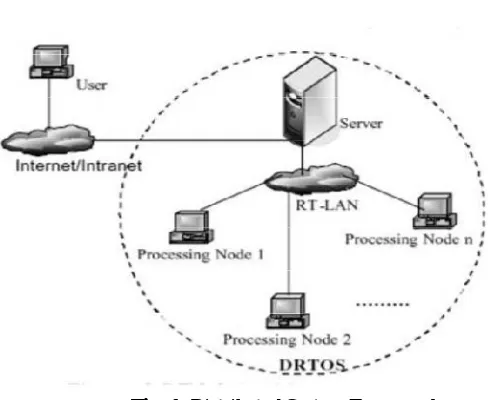
Fig. 1: Distributed System Framework
Further this paper is organized as follows: Section 2 covers the review of work done in the field of task scheduling. Section 3 describes the Proposed task scheduling algorithm. In section 4, result and comparative study of various scheduling algorithms with proposed algorithm is discussed on the basis of various factors in task scheduling algorithms in chart form. Conclusion and future scope is given in section 5.
II. RELATED WORKS
Lie jie, Guo ruifeng and Shao zhixiang [5] have purposed most basic concept of real-time task scheduling and also focuses on hard real time and static scheduling both either uniprocessor and multiprocessor. Scheduling algorithm is an important part of real-time system. They have also investigated task scheduling in real-time systems is a concept by which we can schedule the tasks according to their priorities. They introduced an algorithm for multiprocessor system and distributed real time scheduling algorithm. The purposed algorithm is named as GRMS and DSr [5]. GRMS is used to expand version of RMS. And the DSr is used to execute on the way of distance constraints.
Yaswant singh, myank poplli and shiv Shankar Prasad Shukla [6], 2012 (computer science and information technology) have investigated most important fundamental classification of real-time system, and also effort to deliver a state art for the basic model CDS (Clock driven scheduling), PDS (Priority driven scheduling) and RMA (Rate monotonic algorithms). It likewise presents an algorithm which has been produced by the C programing to distinguish the scheduling and energy utilization of the task. They were additionally displayed IRMA (Inverse rate monotonic algorithms) practically decreases the vitality (energy) by 15 % along with dynamic voltage scaling techniques which offers critically significant energy savings while keep up real-time deadline assurance. furthermore, presented from dynamic and static algorithm to reduce the energy consumption. Different algorithms are used: In static algorithm we have seen RM (Rate monotonic) and DM (deadline monotonic). Where as in dynamic algorithm we introduced Earliest deadline first (EDF) scheduling approach. The feasibility conditions based on which we can drive the performance of mandatory/optional job partitions also seen.
ISSN(Online): 2319-8753 ISSN (Print): 2347-6710
I
nternational
J
ournal of
I
nnovative
R
esearch in
S
cience,
E
ngineering and
T
echnology
(A High Impact Factor, Monthly, Peer Reviewed Journal) Visit: www.ijirset.com
Vol. 6, Issue 12, December 2017
comparison the actual execution of our own calculation along with another dynamic algorithm which grouping focused representation.
Nguyen Duc Thai [8] have introduced algorithm for scheduling a group of tasks in multiprocessor systems. In this calculation H performs best of high and medium degrees of homogeneousness, calculation H's prosperity rate decrease in connection to achievement rate of P EEDF. We consider that when the quantity of processors rises, the achievement rates for all algorithms increments as well. The quantity of processors increments and size of systems gets to be unrivalled so the scheduling of multiple tasks are more hard that we accept. The fundamental issue is that scheduling algorithm for real-time multiprocessor system are significantly more composite than for uniprocessor system. The scheduling algorithm must not only specify the order of the task as well as govern the particular processor to be utilized.
Yu li, student member [9], IEEE and Albert M.K cheng, senior member IEEE have found to enhance general resource utilization by the Hierarchical real-time scheduling (HIRTS) methods in real time embedded system. By utilizing of Hierarchical real-time scheduling (HIRTS) a calculation resource into a gathering of a temporal partition likewise introduced from how with accomplish maximal transparency of task scheduling on regular partitions. They have also audited an alternate ideal procedure, for example comprehensive single resource scheduling technique for applied on different real time task and periodic task, sporadic task, and aperiodic task also represents a transformation method to accomplish transparent task scheduling in a 2- layer HIRTS based on the Regularity based resource partition (RRP) model.
periodic and aperiodic time requirements in DRTS for allocation the task statically and also dynamically with the assistance of an algorithm which have been given by the Hai Jin and Pengliu Tan [10]. But they have not been offered any plan for the dynamically allocatiion of the task and execute the task in DRTS with complex and need related periodic task. They have been additionally presented another allocation algorithm and an alternate scheduling algorithm. The new assignment algorithm is named as Classified processing nodes allocations(CPNA) and First committed first (FCF) algorithm has been given for schedule the task in DRTS.
Georgions L Stavrinides and Helen D. Karatza [11] provides an approaches to execute the job proficiently by using gang scheduling mechanism. They have moreover evaluated the execution of Earliest dead line first and Least laxity first approaches with application composed checkpoint for the gang (group) scheduling of non-pre-emptible, sporadic parallel task in a consistent DRTS. Exactly when any failure happens we expect the perceived immediately and the distributed job is moved back and rescue the execution on its last made checkpoint. at the point where the software frustration happens in the midst of execution of the job then we get an idea by the EDF_IC and LLF_IC for getting the uncertain result.
They have been deals with an algorithm for the imprecise (doubtful) computation as we know that if the jobs have not sufficient time to complete its execution before that deadline, then it is said to be real time job. For this situation the job is supposed to be lost since execution doesn't give back any results to face this troublesome have purposed a framework called imprecise calculation, as imparted by which the execution of a real time job is allowed to return imprecise (uncertain) consequences of poorer but still tolerable (sensible) quality when the deadline of the job can't be meet. They have not considered about the scheduling overheads, nor considered the circumstance where the jobs are pre-emptible.
Tarun Biswas, Pratyay Kuila and Anjan Kumar Ray [12] presented a multi-level queue (MLQ) task scheduling algorithm to minimize the make-span for parallelizing the subtasks without violating the precedence relationships. Here, our main objective is to exploit the advantages of heuristic-based task scheduling algorithms in terms of make-span, time complexity, resource utilization, system throughput and dynamic nature.
ISSN(Online): 2319-8753 ISSN (Print): 2347-6710
I
nternational
J
ournal of
I
nnovative
R
esearch in
S
cience,
E
ngineering and
T
echnology
(A High Impact Factor, Monthly, Peer Reviewed Journal) Visit: www.ijirset.com
Vol. 6, Issue 12, December 2017
proposed that reduces the make-span and maximize the resource utilization using the features of both min-min algorithm and ant colony optimization. It is a two phase algorithm.
III. PROPOSED FTSA ALGORITHM
Our Proposed job scheduling algorithm FTSA, is depends on fuzzy decision making systems. the execution time and priority of task as consider as a fuzzy values, because fuzzy values are used to avoid the redundancy and improve the decision accuracy. based on the related works we consider execution time and priorities are the important parameters to scheduling the tasks in distributed systems.
The decision rank value is calculated using execution time and priority value of individual tasks. the minimum ranked task are allowed to process earlier based on the order all the tasks are processed. the rank value is used to reduce the make-span value of the distributed system, because make-span is the one of the major parameter of distributed system performance. here we gives the detailed algorithm of proposed FTSA algorithm.
Algorithm: Inputs
1. Set of Tasks for process T = {t1, t2,..., tn} from DAGs. Individual tasks are fuzzy value t, t ϵ T set.
2. Set of Heterogeneous of Distributed Processors P = {p1, p2, ..., Pm}. Individual processors are fuzzy value p, p ϵ P set.
Output
1. Scheduled all tasks to all processor in such a way that overall make-span is minimized.
Algorithm
Step 1: Calculate t-level value of ti ε T, ∀i, 1≤i≤n from their respective DAG. let di be the t-level value of ti.
Step 2: For i to n do Place ti in the queue Qi
Calculate rank r value based on priority and execution time of task. EndFor
Step 3: While Q0 ≠ NULL do
Select the task ti having rank using fuzzy classification technique. Assign ti to the processor, where it finishes earliest.
∀k, 1≤k, shift all the tasks ti from Qk to Qk-1 when there is no parent task of tj in Qk
Step 4: Stop
Where, Q is consider as a processor queue based on the rank value only system choose the task to the process queue in proposed algorithm.
IV. IMPLEMENTATION AND EXPERIMENTAL OUTCOME
ISSN(Online): 2319-8753 ISSN (Print): 2347-6710
I
nternational
J
ournal of
I
nnovative
R
esearch in
S
cience,
E
ngineering and
T
echnology
(A High Impact Factor, Monthly, Peer Reviewed Journal) Visit: www.ijirset.com
Vol. 6, Issue 12, December 2017
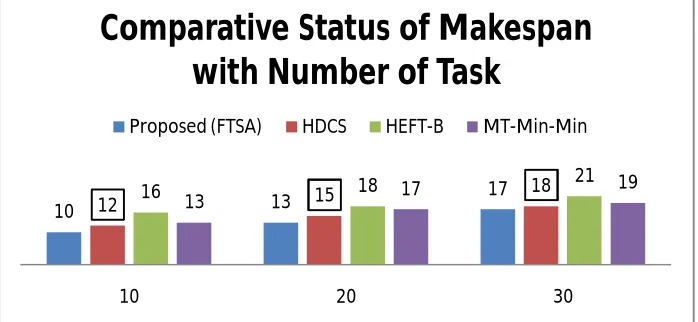
Fig 2. Graphical representation of make-span FTSA, HDCS and MT-Min-Min algorithm
We simulate in three different counts of nodes like ten, twenty and thirty in all above algorithms. the make-spam values of FTSA are always lesser then all other algorithms. based on the experimental outcome we can find FTSA is most efficient then HDCS, HEFT-B and MT-Min-Min algorithms.
V. CONCLUSION
HDCS are applicable in small scale distributed systems. When the number of the small tasks is more than the number of the large tasks in a HDCS, HEFT-B and MT-Min-Min algorithms cannot schedule tasks, appropriately, and the make-span of the system gets relatively large. Furthermore it does not provide a load balanced schedule and in this one resource can execute only one job at a time. To overcome the limitations of these algorithms and to achieve high computing throughput in a distributed environment, a new scheduling algorithm named FTSA, is proposed. The FTSA algorithm working based on fuzzy decision making technique. The experimental results obtained by applying the proposed algorithm for various problems shows that it outperforms the existing scheduling algorithms. This study is only concerned with the number of the resources .number of processes and task execution time. The study can be further extended by considering low and high machine heterogeneity and task heterogeneity.
REFERENCES
[1] Yaswant singh, myank poplli and shiv Shankar Prasad Shukla, “Energy reduction in weakly hard Real-time systems” 2012 computer science
and information technology) (IEEE 2012), PP: 909-915
[2] R. Mall .“Real-time System”: Theory and practice. Pearson Education, 3rd Edition, 2008
[3] Mahfooz A and Ankur K.V “A Comparative Study of Interconnection Network”, International Journal of Computer Applications (0975 – 8887)
Vol. 127, No. 4, pp.37-43, 2015.
[4] Sang C K, Sunggu L and Jaegyoon H, “Push-Pull: Deterministic Search-Based DAG Scheduling for HeterogeneousCluster Systems”, IEEE
Transactions on Parallel and Distributed Systems, Vol. 18, 2007.
[5] Lie jie, Guo ruifeng and Shao zhixiang “The research of scheduling algorithm in Real-time system” 2010 international conference on computer
and communication technologies in agriculture engineering) (IEEE 2010), Volume-1 PP: 333-336
[6] Yaswant singh, myank poplli and shiv Shankar Prasad Shukla, “Energy reduction in weakly hard Real-time systems” 2012 computer science
and information technology) (IEEE 2012), PP: 909-915
[7] Yacin arif and Babak Hamidzadeh, “A Scalable scheduling algorithm for real time distributed system” school of electical and electronic engineering and department of elctrical and computer engineering. (IEEE Confrence 1998) PP: 352-359
[8] Lars cederholm and Niklas Petterson, “Distributed Real Time System Survey” Malardalen university School of innovation Design and
Engineering (IDT workshop 2009)
[9] Yu li, albert M.K cheng student member, “Transparent Real-time scheduling on temporal resource partitions” IEEE and Albert M.K cheng,
senior member IEEE (IEE Transactional 2015) PP: 1-1
10 13
17
12 16 15 18 18
21
13 17 19
10 20 30
Comparative Status of Makespan
with Number of Task
ISSN(Online): 2319-8753 ISSN (Print): 2347-6710
I
nternational
J
ournal of
I
nnovative
R
esearch in
S
cience,
E
ngineering and
T
echnology
(A High Impact Factor, Monthly, Peer Reviewed Journal) Visit: www.ijirset.com
Vol. 6, Issue 12, December 2017
[10] Hai jin and Pengliu Tan, “A Novel dynamic allocation and scheduling scheme with CPNA and FCF algorithms in distributed Real-time
systems” school of computer science and technology, Huazhong University of science and Technology Wuhan, (IEEE Conference 2005) PP: 550-556 Volume:1
[11] Georgios L. Stavrinides and Helen D. Karatza, “Performance Evaluation of gang scheduling in distributed real time systems with possible software faults” Department of Informatics Aristotle University of Thessaloniki 54124 Thessaloniki, Greece (IEEE Conference 2008) PP: 1-7.
[12] Tarun Biswas, Pratyay Kuila and Anjan Kumar Ray, "Multi-level queue for task scheduling in heterogeneous distributed computing system",
Advanced Computing and Communication Systems (ICACCS), 2017 4th International Conference on IEEE, 6-7 Jan. 2017.
[13] Aida A. Nasr, Nirmeen A. El-Bahnasawy and Ayman El-Sayed, "Task Scheduling Algorithm for High Performance Heterogeneous Distributed
Computing Systems", International Journal of Computer Applications (0975 – 8887), Volume 110 – No. 16, January 2015.