C L I N I C A L T R I A L
Prognostic ability of EndoPredict compared to research-based
versions of the PAM50 risk of recurrence (ROR) scores in
node-positive, estrogen receptor-node-positive, and HER2-negative breast
cancer. A GEICAM/9906 sub-study
Miguel Martin
1•Jan C. Brase
2•Amparo Ruiz
6•Aleix Prat
7•Ralf Kronenwett
2•Lourdes Calvo
8•Christoph Petry
2•Philip S. Bernard
9•Manuel Ruiz-Borrego
10 •Karsten E. Weber
2•Ce´sar A. Rodriguez
11•Isabel M. Alvarez
12•Miguel A. Segui
13•Charles M. Perou
3,4,5•Maribel Casas
14 •Eva Carrasco
14•Rosalı´a Caballero
14•Alvaro Rodriguez-Lescure
15Received: 30 December 2015 / Accepted: 16 February 2016 / Published online: 24 February 2016
ÓThe Author(s) 2016. This article is published with open access at Springerlink.com
Abstract
There are several prognostic multigene-based
tests for managing breast cancer (BC), but limited data
comparing them in the same cohort. We compared the
prognostic performance of the EndoPredict (EP) test
(s-tandardized for pathology laboratory) with the
research-based PAM50 non-standardized qRT-PCR assay in
node-positive estrogen receptor-node-positive (ER?) and
HER2-negative
(HER2-)
BC
patients
receiving
adjuvant
chemotherapy followed by endocrine therapy (ET) in the
GEICAM/9906 trial. EP and PAM50 risk of recurrence
(ROR) scores [based on subtype (ROR-S) and on subtype
and proliferation (ROR-P)] were compared in 536 ER?/
HER2-
patients. Scores combined with clinical
informa-tion were evaluated: T (S, tumor size),
ROR-PT (ROR-P, tumor size), and EPclin (EP, tumor size, nodal
status). Patients were assigned to risk-categories according
to prespecified cutoffs. Distant metastasis-free survival
Electronic supplementary material The online version of thisarticle (doi:10.1007/s10549-016-3725-z) contains supplementary material, which is available to authorized users.
& Miguel Martin [email protected]
1 Department of Medical Oncology, Instituto de Investigacio´n
Sanitaria Gregorio Maran˜on, Universidad Complutente de Madrid, Calle Maiquez 7, Madrid, Spain
2 Sividon Diagnostics GmbH, Cologne, Germany 3 Lineberger Comprehensive Cancer Center, University of
North Carolina, Chapel Hill, NC, USA
4 Department of Genetics, University of North Carolina,
Chapel Hill, NC, USA
5 Department of Pathology & Laboratory Medicine, University
of North Carolina, Chapel Hill, NC, USA
6 Department of Medical Oncology, Valencian Institute
of Oncology (IVO), Valencia, Spain
7 Translational Genomics Group, Vall d’Hebron Institute
of Oncology (VHIO), Barcelona, Spain
8 Department of Medical Oncology, A Corun˜a University
Hospital Complex, A Corun˜a, Spain
9 Solid Tumor Molecular Diagnostics Laboratory, ARUP
Laboratories, Utah, USA
10 Department of Medical Oncology, Virgen del Rocio
University Hospital, Seville, Spain
11 Department of Medical Oncology, Salamanca University
Hospital-IBSAL, Salamanca, Spain
12 Department of Medical Oncology, Donostia University
Hospital, Donostia, Spain
13 Department of Medical Oncology, Parc Tauli University
Hospital, Sabadell, Spain
14 Spanish Breast Cancer Research Group (GEICAM), Madrid,
Spain
15 Department of Medical Oncology, Elche University General
(MFS) was analyzed by Kaplan–Meier. ROR-S, ROR-P,
and EP scores identified a low-risk group with a relative
better outcome (10-year MFS: ROR-S 87 %; ROR-P 89 %;
EP 93 %). There was no significant difference between
tests. Predictors including clinical information showed
superior prognostic performance compared to molecular
scores alone (10-year MFS, low-risk group: ROR-T 88 %;
ROR-PT 92 %; EPclin 100 %). The EPclin-based risk
stratification achieved a significantly improved prediction
of MFS compared to ROR-T, but not ROR-PT. All
sig-natures added prognostic information to common clinical
parameters.
EPclin
provided
independent
prognostic
information beyond ROR-T and ROR-PT. ROR and EP
can reliably predict risk of distant metastasis in
node-pos-itive ER?/HER2-
BC patients treated with chemotherapy
and ET. Addition of clinical parameters into risk scores
improves their prognostic ability.
Keywords
Breast cancer
PAM50
EndoPredict
Chemotherapy
Prognosis
Abbreviations
BC
Breast cancer
ET
Endocrine therapy
EP
EndoPredict score
FEC
5-Fluorouracil, epirubicin, and
cyclophosphamide
FEC-P
FEC followed by paclitaxel
FFPE
Formalin-fixed paraffin embedded
MFS
Metastasis-free survival
ROR
Risk of recurrence
ROR-S
ROR score based on subtype information
ROR-P
ROR based on subtype and proliferation
ROR-T
ROR based on subtype and tumor size
ROR-PT
ROR based on subtype, proliferation, and
tumor size
vs
Versus
Background
Gene expression tests are new tools to clinically determine
the risk of relapse in early-stage breast cancer (BC) [
1
,
2
].
The 21-gene recurrence score (Oncotype DX) and
Mam-maprint (NKI-70) [
3
–
10
] have been shown to impact
treatment decisions [
11
–
13
]. Novel prognostic tests, such
as EndoPredict and PAM50, are also able to predict early,
as well as late metastases [
14
,
15
].
EndoPredict is a standardized test for the molecular
pathology laboratory and was the first multigene test used
in a decentralized setting [
16
,
17
]. It was established and
validated in two independent clinical validation studies
(ABCSG6 and ABCSG8) involving patients with ER?/
HER2-
BC treated with adjuvant endocrine therapy (ET)
only [
18
]. EndoPredict provides prognostic information
beyond all common clinicopathological parameters [
18
]
and clinical guidelines [
19
]. The molecular information
(EP score) is further combined with tumor size and nodal
status resulting in the EPclin score.
The PAM50 assay is an optimized gene set used to
identify intrinsic subtypes and predict the Risk Of
Recur-rence (ROR) at 10 years [
20
,
21
]. The ROR score was
developed in a microarray-based cohort of node-negative,
untreated BC patients [
6
,
20
]. Four versions of ROR exist
in the research setting: ROR based on subtype information
(ROR-S), ROR-S with proliferation (ROR-P), ROR-S with
tumor size T), and ROR-P with tumor size
(ROR-PT) [
20
,
21
]. The minimum ROR score of all Luminal B
scores was assigned as the low-risk threshold for each
model and the maximum ROR score of all Luminal A
scores as the high-risk threshold [
21
].
The inclusion of established clinicopathological risk
factors in ROR and EP scores, such as tumor size (ROR-T,
ROR-PT, and EPclin) and nodal status (EPclin), increases
their predictive performance [
18
–
21
]. EndoPredict and
research-based PAM50 were evaluated independently in
the GEICAM/9906 trial [
22
–
25
]. We compared the
prog-nostic performance of the EP test with the research-based,
non-standardized PAM50 assay in node-positive, ER?/
HER2-
BC patients treated with adjuvant chemotherapy
followed by ET.
Patients and methods
Patients and tumor samples
Formalin-fixed paraffin-embedded (FFPE) tumor blocks
used to compare PAM50 and EP scores were collected at
the time of surgery.
EndoPredict gene expression analysis
RNA extraction and gene expression analysis for
identi-fying the ER?/HER2-
subgroup and performing the
EndoPredict have been recently described. Briefly, total
RNA was extracted from one 5-
l
m whole FFPE tissue
section using a silica bead-based, fully automated isolation
method (Tissue Preparation System, VERSANT Tissue
Preparation Reagents, Siemens Healthcare Diagnostics)
[
27
].
To identify patients with ER?/HER2-
tumors, ESR1
and ERBB2 gene expression levels were analyzed and
predefined cut-off levels were applied as recently
descri-bed. The EP score is based on eight cancer-related genes
(BIRC5,
UBE2C,
DHCR7,
RBBP8,
IL6ST,
AZGP1,
MGP,
STC2)
and
three
reference
genes
(CALM2,
OAZ1,
RPL37A), and measured by qRT-PCR [
18
].
PAM50-ROR gene expression analysis
RNA was extracted from two 1-mm FFPE cores as
previ-ously described [
20
]. To determine the research-based
versions of the ROR scores and groups, normalized gene
expression data obtained from the qRT-PCR platform were
gene-median-centered, and the microarray-based PAM50
intrinsic subtype predictor was applied as previously
described [
20
]. Of note, the microarray-based training
dataset, from which survival coefficients were derived, is
based on patients with node-negative disease that did not
receive adjuvant systemic therapy [
6
]. In addition, ROR
thresholds (low and high) consist of subtype distributions
along the ROR scores in the training dataset [
21
].
Statistical analysis
The ROR and EP scores were calculated blinded to clinical
data and sent to the GEICAM study group in Madrid for
independent statistical analysis. Only the GEICAM group
had access to the combined clinical outcome and gene
expression data.
The primary endpoint was distant metastasis-free
sur-vival (MFS) estimated using the Kaplan–Meier method.
Pearson correlations compared gene signatures. Two-sided
log-rank tests were used to compare subgroups.
P
values
\
5 % were considered statistically significant. Each gene
signature was added to a model containing common
clin-ical parameters and one other evaluated signature.
C-indi-ces were then calculated for the clinical variables and
model combinations to estimate the performance of each
variable for predicting distant metastasis. Differences were
evaluated using the log-likelihood ratio statistic test (for
proportional Cox model hazard rates) and the comparison
of c-index with resampling (both one-sided tests).
The PAM50 ROR-S, ROR-P, and ROR-T and ROR-PT
scores classified patients as low-, intermediate-, and
high-risk, using the following pre-defined cut-off values,
respectively: ROR-S (
\
24; 24–53;
[
53), ROR-P (
\
12;
12–53;
[
53), ROR-T (
\
29; 29–65;
[
65), PAM50 ROR-PT
(
\
18; 18–65;
[
65). Both, EP and EPclin categorized
patients into low- (EP score
\
5; EPclin score
\
3.3) and
high-risk groups (EP score
C5; EPclin score
C3.3) [
18
].
The following clinical parameters were used for the
anal-ysis: positive nodal status (1–3; 4–10;
[
10); tumor size [cm
(B1;
[
1–B2;
[
2–B5;
[
5)]; Grade (1; 2; 3); age; and
treatment arm (FEC; FEC-P).
Results
Patient population
A total of 566 (71 %) of 800 available tumor samples were
eligible for evaluation. Tumor samples lacking PAM50 or
EndoPredict data were excluded (5 %). Characteristics of
the patient cohort included in this study are summarized in
Supplementary Table 2S.
Risk categorization
Patients with ER?/HER2-
BC were classified as low-risk
in 32, 20, and 25 % of cases based on the ROR-S, ROR-P,
and EP scores, respectively (Supplementary Table 3S). All
gene signatures identified low-risk groups with a significant
better outcome compared to the other risk groups (Fig.
1
).
The 10-year MFS rates for low-risk groups were 87, 89,
and 93 %, respectively (Fig.
1
). The EPclin low-risk group
was smaller (13 %) compared to T (22 %) and
ROR-PT (19 %) low-risk groups, but had a better, though not
statistically significant, 10-year MFS rate (100 vs. 88 vs.
92 %, Fig.
1
).
Comparing EP versus PAM50 gene signatures
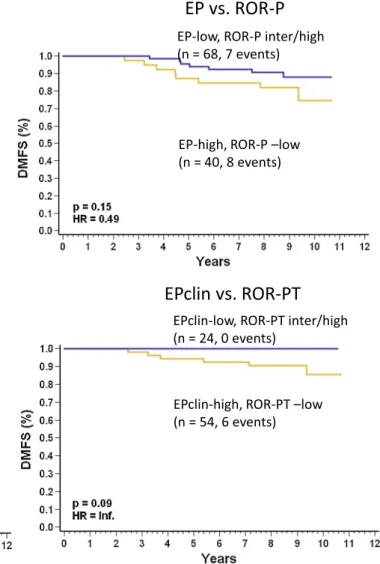
EP-based low-risk patients had a better outcome than
PAM50-based counterparts (Fig.
2
). EPclin-based risk
classification proved a superior predictor of MFS than the
ROR-T score (P
=
0.04), but not in comparison to the
ROR-PT (P
=
0.09) (Fig.
2
).
Prognostic performance of predictors
Compared to clinical parameters, ROR-S, ROR-P, and EP
molecular signatures had substantially higher c-indices
(Fig.
3
) and added significant prognostic information
beyond clinical parameters based on c-index analysis and
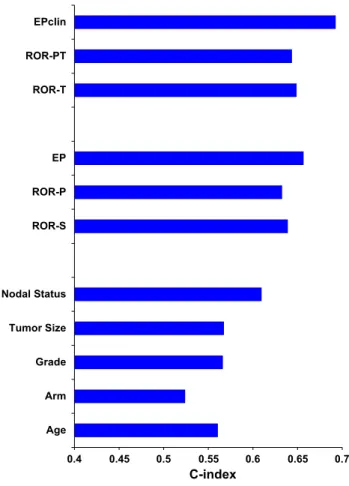
resampling (data not shown). C-indices for EP, ROR-S,
and ROR-P were 0.657, 0.639, and 0.633, respectively.
C-indices for EPclin, ROR-T, and ROR-PT were 0.693,
0.649, and 0.644, respectively (Fig.
3
).
Based on c-indices and resampling, we determined that
EP added prognostic information to ROR-P and clinical
parameters, but not to ROR-S. C-index was significantly
increased by adding EPclin to models containing
clinico-pathological parameters and ROR-T (P
\
0.001), or
ROR-bFig. 1 Kaplan–Meier curve for metastasis-free survival by EP, ROR-S, ROR-P, EPclin, ROR-T, and ROR-PT risk groups. PAM50 ROR-ROR-S, ROR-P, and ROR-T and ROR-PT scores stratify patients (GEICAM/ 9906,N=536) in low-risk, intermediate-risk and high-risk. EP and EPclin stratify patients as low-risk for distant recurrence and high-risk groups.Numbers in parenthesesindicate the 95 % confidence interval of the hazard ratio.EPEndoPredict score,EPclinEP based on tumor size and nodal status,RORrisk of distant recurrence,ROR-S ROR based on subtype,ROR-PROR based on subtype and proliferation,
ROR-TROR based on subtype and tumor size,ROR-PTROR based on subtype, proliferation, and tumor size
EP vs. ROR-S
EP vs. ROR-P
EP-low, ROR-S inter/high
(n = 37, 5 events)
EP-high, ROR-S –low
(n = 76, 16 events)
EP-low, ROR-P inter/high
(n = 68, 7 events)
EP-high, ROR-P –low
(n = 40, 8 events)
EPclin vs. ROR-T
EPclin-low, ROR-T inter/high
(n = 21, 0 events)
EPclin vs. ROR-PT
EPclin-low, ROR-PT inter/high
(n = 24, 0 events)
EPclin-high, ROR-PT –low
(n = 54, 6 events)
EPclin-high, ROR-T –low
(n = 68, 12 events)
Fig. 2 Kaplan–Meier curves for metastasis-free survival by discor-dant samples between EP and ROR scores. Kaplan–Meier curves by EP–ROR-S, EP–ROR-P, EPclin–ROR-T, and EPclin–ROR-PT. Num-bers in parentheses indicate the 95 % confidence interval of the hazard ratio.EPEndoPredict score,EPclinEP based on tumor size
and nodal status,RORrisk of distant recurrence,ROR-SROR based on subtype,ROR-PROR based on subtype and proliferation,ROR-T
PT (P
\
0.001). ROR-T and ROR-PT failed to add
prog-nostic information to EPclin (Table
1
).
Discussion
We compared the prognostic performance of
research-based and non-standardized versions of PAM50-ROR
scores and EndoPredict in ER?/HER2-, node-positive
chemotherapy-treated BC patients from the GEICAM/9906
trial.
ROR-S and ROR-P were significantly correlated with
EP score, and gene signatures showed agreement in risk
classification, indicating that PAM50-ROR and EP scores
identify tumors with similar properties. Despite the
sig-nificant correlation, the discordance rate of 20–21 % can be
explained by the tests’ inherent characteristics. Our c-index
analysis indicated that only EP added significant
informa-tion to ROR-P. None of the other molecular signatures
added information to each other, suggesting that additional
predictors would not improve prognostic performance.
These findings are concordant with our previous combined
analysis of hundreds of signatures and clinical-pathological
data for prognostic prediction in ER-positive breast cancer
where we observed that not much more prognostic power
was obtained by including hundreds of signatures into a
single model beyond the power contained within a
well-developed individual signature when combined with
clin-ical variables [
28
].
The PAM50-based ROR-T and ROR-PT scores include
tumor size, whereas the EPclin score considers nodal status
and tumor size, as part of the risk prediction algorithm.
Similar to the research-based version, a ROR-PT score
weighted for tumor size and proliferation was used to
validate the standardized version of PAM50 assay in the
ATAC and ABCSG8 trials. In our analysis, all hybrid
scores contributed to identifying low-risk groups for distant
metastasis, although number of patients and events differed
across score categories. The EPclin low-risk group was
smaller than the ROR-T and ROR-PT ones and showed no
distant-metastatic events. EPclin had been established in a
node-positive/node-negative cohort and the predefined
cut-off level consequently classified more patients as high-risk
in the node-positive GEICAM/9906 trial. In contrast, the
research-based versions of ROR-T and ROR-PT scores
were derived in a systemically untreated node-negative BC
cohort, and thresholds were based on subtype distribution
and not actual survival outcomes; therefore, the number of
low-risk cases with distant-metastatic events was higher, as
reflected by an MFS of 87–92 % in low-risk groups.
Kaplan–Meier analysis of discordant cases, c-index
analysis, and log-likelihood tests showed that the
EPclin-based risk classification provided independent prognostic
information to the ROR-T and ROR-PT scores. The
improved performance of the EPclin score over pure
molecular scores may be partially explained by the
inclusion of nodal status, one of the strongest single
prognostic factors, in the EPclin score, but which is not
included in any of the other models tested. EndoPredict
validation studies demonstrated that molecular EP score,
tumor size, and nodal status were the only independent
prognostic parameters [
18
]. Hybrid scores’ superior
per-formance compared to their molecular counterparts
sup-ports the recommendation of the Evaluation of Genomic
Application in Practice and Prevention working group to
integrate clinicopathological factors into gene expression
tests [
29
] rather than relying on pure RNA-based
molec-ular scores.
To the best of our knowledge, our study reports the first
direct comparison of EndoPredict and a research-based
version of the PAM50 assay. Earlier comparisons of
multigene signatures suggested similar prognostic
perfor-mances [
30
,
31
]. Recently, the transATAC study, the first
0.4 0.45 0.5 0.55 0.6 0.65 0.7Age Arm Grade Tumor Size Nodal Status ROR-S ROR-P EP ROR-T ROR-PT EPclin
C-index
Fig. 3 Distribution of clinical and molecular parameters c-indices.
EPEndoPredict score, EPclin EP based on tumor size and nodal status,RORrisk of distant recurrence,ROR-SROR based on subtype,
large phase III study comparing different standardized gene
expression-based biomarkers in the same patient cohort
[
32
], compared the standardized and clinically validated
version of PAM50 assay, developed under the nCounter
system (Nanostring Technologies), with the 21-gene
recurrence score. PAM50-ROR provided more prognostic
information than the recurrence score [
32
]. Although our
study did not evaluate the standardized and clinically
val-idated PAM50-ROR score, the GEICAM/9906 trial is an
additional valuable source for biomarker comparisons. In
the context of this trial, we could identify high-risk patients
who need additional treatment to the standard
anthracy-cline-based chemotherapy (±taxane) and could be eligible
for further treatment with novel drugs, such as CDK4/6 or
mTOR inhibitors.
Our results should be interpreted in the context of its
limitations. First, ROR scores were generated using
research-based and non-standardized versions from
qRT-PCR platform. Although research-based PAM50
classifi-cation has been evaluated in several clinical trials using
qRT-PCR [
22
,
33
,
34
], different methods may influence
prognostic ability. Of note, large validation studies (ATAC
and ABCSG8) for the PAM50 assay were performed using
the standardized version with pre-specified cutoffs based
on actual survival outcomes (
\
10, 10–20, and
[
20 % risk
of distant relapse at 10 years) and not subtype distribution
[
32
]. Second, the PAM50 vs. EP comparison was not
conducted according to their intended use. Whereas our
patients were treated with chemotherapy, these predictors
were clinically validated using patients cohorts receiving
endocrine therapy alone. Therefore, next steps should
compare PAM50 and EP in clinical trials with ER?/
HER2-
BC patients treated with ET alone. EndoPredict
and the standardized PAM50 were recently evaluated in the
ABCSG8 trial, which would allow a direct comparison of
both clinical predictors [
35
].
Conclusions
Despite the differences in establishment and the limited
overlap in genes, all molecular predictors evaluated
showed similar prognostic performance. The addition of
clinical parameters, such as tumor size and nodal status,
into risk-score determination improves the prognostic
ability of these assays.
Author contributions MM, CP, PSB, KEW, RK, JCB, CMP, and AP participated in the conception and design of the study. MM, AR, LC, MRB, CAR, IMA, MAS, ARL, PBS, and RC contributed to the collection and assembly of data. MM, JCB, RK, RC, and MC par-ticipated in the analysis of the data. MM, JCB, RK, CP, PSB, KEW, CMP, AP, EC, and RC participated in the interpretation of the data. MM, JCB, CP, RK, CMP, AP, EC, and RC helped in the drafting of the manuscript. All authors contributed to the writing of the manu-script, read, and approved the final manuscript.
Compliance with ethical standards
Conflict of interest CP and RK are employees and shareholders of Sividon Diagnostics GmbH as well as inventors of EndoPredict patent applications. JCB and KEW were employees of Sividon Diagnostics GmbH at the time point of this study and both are inventors on the EndoPredict patent application. KEW is a shareholder of Sividon Diagnostics GmbH. CMP is a stockholder in Bioclassifier LLC, and an inventor on the PAM50 patent application. AP has an uncom-pensated advisory role for Nanostring Technologies. MM, EC, and RC are inventors on the PAM50 patent application. All remaining authors declare that they have no competing interest.
Informed consent All patients provided written informed consent to participate in the GEICAM/9906 trial and to perform molecular analysis on their breast tumors.
Research involving Human Participants All procedures per-formed in studies involving human participants were in accordance with the applicable legislation and the ethical standards of the insti-tutional and/or national research committee and with the 1964
Table 1 Additional prognostic information—GEICAM/9906 ROR-S adds Information to EndoPredict
ROR-P adds information to EndoPredict
EndoPredict adds information to ROR-S
EndoPredict adds information to ROR-P Molecular signature ROR-S—EP ROR-P—EP EP—ROR-S EP—ROR-P
C-index, resampling P=0.1455 P=0.1292 P=0.0557 P=0.0194 Log-likelihood (P=0.08844)a (P=0.09829)a (P=0.05750)a (P=0.03162)a
Hybrid scores ROR-T—EPclin ROR-PT—EPclin EPclin—ROR-T EPclin—ROR-PT C-index, resampling P=0.4786 P=0.5669 P\0.001 P\0.001 Log-likelihood P=0.406 P=0.3181 P\0.001 P\0.001
EPEndoPredict score,EPclinEP based on tumor size and nodal status,RORrisk of distant recurrence,ROR-SROR based on subtype,ROR
-PROR based on subtype and proliferation,ROR-TROR based on subtype and tumor size,ROR-PTROR based on subtype, proliferation, and tumor size
Helsinki declaration and its later amendments or comparable ethical standards.
Open Access This article is distributed under the terms of the Creative Commons Attribution-NonCommercial 4.0 International License (http://creativecommons.org/licenses/by-nc/4.0/), which per-mits any noncommercial use, distribution, and reproduction in any medium, provided you give appropriate credit to the original author(s) and the source, provide a link to the Creative Commons license, and indicate if changes were made.
References
1. Prat A, Ellis MJ, Perou CM (2012) Practical implications of gene-expression-based assays for breast oncologists. Nat Rev Clin Oncol 9(1):48–57. doi:10.1038/nrclinonc.2011.178
2. Weigelt B, Reis-Filho JS, Swanton C (2012) Genomic analyses to select patients for adjuvant chemotherapy: trials and tribulations. Ann Oncol 23(Suppl 10):x211–x218. doi:10.1093/annonc/ mds323
3. Paik S, Tang G, Shak S, Kim C, Baker J, Kim W, Cronin M, Baehner FL, Watson D, Bryant J, Costantino JP, Geyer CE Jr, Wickerham DL, Wolmark N (2006) Gene expression and benefit of chemotherapy in women with node-negative, estrogen recep-tor-positive breast cancer. J Clin Oncol 24(23):3726–3734. doi:10.1200/jco.2005.04.7985
4. Paik S, Shak S, Tang G, Kim C, Baker J, Cronin M, Baehner FL, Walker MG, Watson D, Park T, Hiller W, Fisher ER, Wickerham DL, Bryant J, Wolmark N (2004) A multigene assay to predict recurrence of tamoxifen-treated, node-negative breast cancer. N Engl J Med 351(27):2817–2826. doi:10.1056/NEJMoa041588
5. van’t Veer LJ, Dai H, van de Vijver MJ, He YD, Hart AA, Mao M, Peterse HL, van der Kooy K, Marton MJ, Witteveen AT, Schreiber GJ, Kerkhoven RM, Roberts C, Linsley PS, Bernards R, Friend SH (2002) Gene expression profiling predicts clinical outcome of breast cancer. Nature 415(6871):530–536. doi:10. 1038/415530a
6. van de Vijver MJ, He YD, van’t Veer LJ, Dai H, Hart AA, Voskuil DW, Schreiber GJ, Peterse JL, Roberts C, Marton MJ, Parrish M, Atsma D, Witteveen A, Glas A, Delahaye L, van der Velde T, Bartelink H, Rodenhuis S, Rutgers ET, Friend SH, Bernards R (2002) A gene-expression signature as a predictor of survival in breast cancer. N Engl J Med 347(25):1999–2009. doi:10.1056/NEJMoa021967
7. Buyse M, Loi S, van’t Veer L, Viale G, Delorenzi M, Glas AM, d’Assignies MS, Bergh J, Lidereau R, Ellis P, Harris A, Bogaerts J, Therasse P, Floore A, Amakrane M, Piette F, Rutgers E, Sotiriou C, Cardoso F, Piccart MJ (2006) Validation and clinical utility of a 70-gene prognostic signature for women with node-negative breast cancer. J Natl Cancer Inst 98(17):1183–1192. doi:10.1093/jnci/djj329
8. Albain KS, Barlow WE, Shak S, Hortobagyi GN, Livingston RB, Yeh IT, Ravdin P, Bugarini R, Baehner FL, Davidson NE, Sledge GW, Winer EP, Hudis C, Ingle JN, Perez EA, Pritchard KI, Shepherd L, Gralow JR, Yoshizawa C, Allred DC, Osborne CK, Hayes DF (2010) Prognostic and predictive value of the 21-gene recurrence score assay in postmenopausal women with node-positive, oestrogen-receptor-positive breast cancer on chemotherapy: a retrospective analysis of a randomised trial. Lancet Oncol 11(1):55–65. doi:10.1016/s1470-2045(09)70314-6
9. Cuzick J, Dowsett M, Pineda S, Wale C, Salter J, Quinn E, Zabaglo L, Mallon E, Green AR, Ellis IO, Howell A, Buzdar AU, Forbes JF (2011) Prognostic value of a combined estrogen
receptor, progesterone receptor, Ki-67, and human epidermal growth factor receptor 2 immunohistochemical score and com-parison with the Genomic Health recurrence score in early breast cancer. J Clin Oncol 29(32):4273–4278. doi:10.1200/jco.2010.31. 2835
10. Dowsett M, Cuzick J, Wale C, Forbes J, Mallon EA, Salter J, Quinn E, Dunbier A, Baum M, Buzdar A, Howell A, Bugarini R, Baehner FL, Shak S (2010) Prediction of risk of distant recur-rence using the 21-gene recurrecur-rence score in node-negative and node-positive postmenopausal patients with breast cancer treated with anastrozole or tamoxifen: a TransATAC study. J Clin Oncol 28(11):1829–1834. doi:10.1200/jco.2009.24.4798
11. Albanell J, Gonzalez A, Ruiz-Borrego M, Alba E, Garcia-Saenz JA, Corominas JM, Burgues O, Furio V, Rojo A, Palacios J, Bermejo B, Martinez-Garcia M, Limon ML, Munoz AS, Martin M, Tusquets I, Rojo F, Colomer R, Faull I, Lluch A (2012) Prospective transGEICAM study of the impact of the 21-gene Recurrence Score assay and traditional clinicopathological fac-tors on adjuvant clinical decision making in women with estrogen receptor-positive (ER?) node-negative breast cancer. Ann Oncol 23(3):625–631. doi:10.1093/annonc/mdr278
12. Geffen DB, Abu-Ghanem S, Sion-Vardy N, Braunstein R, Tokar M, Ariad S, Delgado B, Bayme M, Koretz M (2011) The impact of the 21-gene recurrence score assay on decision making about adjuvant chemotherapy in early-stage estrogen-receptor-positive breast cancer in an oncology practice with a unified treatment policy. Ann Oncol 22(11):2381–2386. doi:10.1093/annonc/ mdq769
13. Lo SS, Mumby PB, Norton J, Rychlik K, Smerage J, Kash J, Chew HK, Gaynor ER, Hayes DF, Epstein A, Albain KS (2010) Prospective multicenter study of the impact of the 21-gene recurrence score assay on medical oncologist and patient adju-vant breast cancer treatment selection. J Clin Oncol 28(10):1671–1676. doi:10.1200/jco.2008.20.2119
14. Dubsky P, Brase JC, Jakesz R, Rudas M, Singer CF, Greil R, Dietze O, Luisser I, Klug E, Sedivy R, Bachner M, Mayr D, Schmidt M, Gehrmann MC, Petry C, Weber KE, Fisch K, Kro-nenwett R, Gnant M, Filipits M (2013) The EndoPredict score provides prognostic information on late distant metastases in ER?/HER2- breast cancer patients. Br J Cancer 109(12):2959–2964. doi:10.1038/bjc.2013.671
15. Sestak I, Dowsett M, Zabaglo L, Lopez-Knowles E, Ferree S, Cowens JW, Cuzick J (2013) Factors predicting late recurrence for estrogen receptor-positive breast cancer. J Natl Cancer Inst 105(19):1504–1511. doi:10.1093/jnci/djt244
16. Kronenwett R, Bohmann K, Prinzler J, Sinn BV, Haufe F, Roth C, Averdick M, Ropers T, Windbergs C, Brase JC, Weber KE, Fisch K, Muller BM, Schmidt M, Filipits M, Dubsky P, Petry C, Dietel M, Denkert C (2012) Decentral gene expression analysis: analytical validation of the Endopredict genomic multianalyte breast cancer prognosis test. BMC Cancer 12:456. doi:10.1186/ 1471-2407-12-456
17. Denkert C, Kronenwett R, Schlake W, Bohmann K, Penzel R, Weber KE, Hofler H, Lehmann U, Schirmacher P, Specht K, Rudas M, Kreipe HH, Schraml P, Schlake G, Bago-Horvath Z, Tiecke F, Varga Z, Moch H, Schmidt M, Prinzler J, Kerjaschki D, Sinn BV, Muller BM, Filipits M, Petry C, Dietel M (2012) Decentral gene expression analysis for ER?/HER2- breast cancer: results of a proficiency testing program for the EndoPredict assay. Virchows Archiv 460(3):251–259. doi:10. 1007/s00428-012-1204-4
molecular predictor of distant recurrence in ER-positive, HER2-negative breast cancer adds independent information to conven-tional clinical risk factors. Clin Cancer Res 17(18):6012–6020. doi:10.1158/1078-0432.ccr-11-0926
19. Dubsky P, Filipits M, Jakesz R, Rudas M, Singer CF, Greil R, Dietze O, Luisser I, Klug E, Sedivy R, Bachner M, Mayr D, Schmidt M, Gehrmann MC, Petry C, Weber KE, Kronenwett R, Brase JC, Gnant M (2013) EndoPredict improves the prognostic classification derived from common clinical guidelines in ER-positive, HER2-negative early breast cancer. Ann Oncol 24(3):640–647. doi:10.1093/annonc/mds334
20. Parker JS, Mullins M, Cheang MC, Leung S, Voduc D, Vickery T, Davies S, Fauron C, He X, Hu Z, Quackenbush JF, Stijleman IJ, Palazzo J, Marron JS, Nobel AB, Mardis E, Nielsen TO, Ellis MJ, Perou CM, Bernard PS (2009) Supervised risk predictor of breast cancer based on intrinsic subtypes. J Clin Oncol 27(8):1160–1167. doi:10.1200/jco.2008.18.1370
21. Nielsen TO, Parker JS, Leung S, Voduc D, Ebbert M, Vickery T, Davies SR, Snider J, Stijleman IJ, Reed J, Cheang MC, Mardis ER, Perou CM, Bernard PS, Ellis MJ (2010) A comparison of PAM50 intrinsic subtyping with immunohistochemistry and clinical prognostic factors in tamoxifen-treated estrogen receptor-positive breast cancer. Clin Cancer Res 16(21):5222–5232. doi:10.1158/1078-0432.ccr-10-1282
22. Martin M, Prat A, Rodriguez-Lescure A, Caballero R, Ebbert MT, Munarriz B, Ruiz-Borrego M, Bastien RR, Crespo C, Davis C, Rodriguez CA, Lopez-Vega JM, Furio V, Garcia AM, Casas M, Ellis MJ, Berry DA, Pitcher BN, Harris L, Ruiz A, Winer E, Hudis C, Stijleman IJ, Tuck DP, Carrasco E, Perou CM, Bernard PS (2013) PAM50 proliferation score as a predictor of weekly paclitaxel benefit in breast cancer. Breast Cancer Res Treat 138(2):457–466. doi:10.1007/s10549-013-2416-2
23. Bastien RR, Rodriguez-Lescure A, Ebbert MT, Prat A, Munarriz B, Rowe L, Miller P, Ruiz-Borrego M, Anderson D, Lyons B, Alvarez I, Dowell T, Wall D, Segui MA, Barley L, Boucher KM, Alba E, Pappas L, Davis CA, Aranda I, Fauron C, Stijleman IJ, Palacios J, Anton A, Carrasco E, Caballero R, Ellis MJ, Nielsen TO, Perou CM, Astill M, Bernard PS, Martin M (2012) PAM50 breast cancer subtyping by RT-qPCR and concordance with standard clinical molecular markers. BMC Med Genomics 5:44. doi:10.1186/1755-8794-5-44
24. Prat A, Cheang MC, Martin M, Parker JS, Carrasco E, Caballero R, Tyldesley S, Gelmon K, Bernard PS, Nielsen TO, Perou CM (2013) Prognostic significance of progesterone receptor-positive tumor cells within immunohistochemically defined luminal A breast cancer. J Clin Oncol 31(2):203–209. doi:10.1200/jco.2012. 43.4134
25. Martin M, Brase JC, Calvo L, Krappmann K, Ruiz-Borrego M, Fisch K, Ruiz A, Weber KE, Munarriz B, Petry C, Rodriguez CA, Kronenwett R, Crespo C, Alba E, Carrasco E, Casas M, Caballero R, Rodriguez-Lescure A (2014) Clinical validation of the EndoPredict test in node-positive, chemotherapy-treated ER?/ HER2-breast cancer patients: results from the GEICAM 9906 trial. Breast Cancer Res 16(2):R38. doi:10.1186/bcr3642
26. Martin M, Rodriguez-Lescure A, Ruiz A, Alba E, Calvo L, Ruiz-Borrego M, Munarriz B, Rodriguez CA, Crespo C, de Alava E, Lopez Garcia-Asenjo JA, Guitian MD, Almenar S, Gonzalez-Palacios JF, Vera F, Gonzalez-Palacios J, Ramos M, Gracia Marco JM, Lluch A, Alvarez I, Segui MA, Mayordomo JI, Anton A, Baena JM, Plazaola A, Modolell A, Pelegri A, Mel JR, Aranda E,
Adrover E, Alvarez JV, Garcia Puche JL, Sanchez-Rovira P, Gonzalez S, Lopez-Vega JM, Investigators GS (2008) Random-ized phase 3 trial of fluorouracil, epirubicin, and cyclophos-phamide alone or followed by Paclitaxel for early breast cancer. J Natl Cancer Inst 100(11):805–814. doi:10.1093/jnci/djn151
27. Muller BM, Kronenwett R, Hennig G, Euting H, Weber K, Bohmann K, Weichert W, Altmann G, Roth C, Winzer KJ, Kristiansen G, Petry C, Dietel M, Denkert C (2011) Quantitative determination of estrogen receptor, progesterone receptor, and HER2 mRNA in formalin-fixed paraffin-embedded tissue—a new option for predictive biomarker assessment in breast cancer. Diagn Mol Pathol B 20(1):1–10. doi:10.1097/PDM.0b013e3 181e3630c
28. Fan C, Prat A, Parker JS, Liu Y, Carey LA, Troester MA, Perou CM (2011) Building prognostic models for breast cancer patients using clinical variables and hundreds of gene expression signa-tures. BMC Med Genomics 4:3. doi:10.1186/1755-8794-4-3
29. Evaluation of Genomic Applications in Practice and Prevention (EGAPP) Working Group (2009) Recommendations from the EGAPP Working Group: can tumor gene expression profiling improve outcomes in patients with breast cancer? Genet Med 11(1):66–73. doi:10.1097/GIM.0b013e3181928f56
30. Fan C, Oh DS, Wessels L, Weigelt B, Nuyten DS, Nobel AB, van’t Veer LJ, Perou CM (2006) Concordance among gene-ex-pression-based predictors for breast cancer. N Engl J Med 355(6):560–569. doi:10.1056/NEJMoa052933
31. Haibe-Kains B, Desmedt C, Piette F, Buyse M, Cardoso F, Van’t Veer L, Piccart M, Bontempi G, Sotiriou C (2008) Comparison of prognostic gene expression signatures for breast cancer. BMC Genom 9:394. doi:10.1186/1471-2164-9-394
32. Dowsett M, Sestak I, Lopez-Knowles E, Sidhu K, Dunbier AK, Cowens JW, Ferree S, Storhoff J, Schaper C, Cuzick J (2013) Comparison of PAM50 risk of recurrence score with oncotype DX and IHC4 for predicting risk of distant recurrence after endocrine therapy. J Clin Oncol 31(22):2783–2790. doi:10.1200/ jco.2012.46.1558
33. Cheang MC, Voduc KD, Tu D, Jiang S, Leung S, Chia SK, Shepherd LE, Levine MN, Pritchard KI, Davies S, Stijleman IJ, Davis C, Ebbert MT, Parker JS, Ellis MJ, Bernard PS, Perou CM, Nielsen TO (2012) Responsiveness of intrinsic subtypes to adjuvant anthracycline substitution in the NCIC.CTG MA.5 randomized trial. Clin Cancer Res 18(8):2402–2412. doi:10.1158/ 1078-0432.ccr-11-2956
34. Chia SK, Bramwell VH, Tu D, Shepherd LE, Jiang S, Vickery T, Mardis E, Leung S, Ung K, Pritchard KI, Parker JS, Bernard PS, Perou CM, Ellis MJ, Nielsen TO (2012) A 50-gene intrinsic subtype classifier for prognosis and prediction of benefit from adjuvant tamoxifen. Clin Cancer Res 18(16):4465–4472. doi:10. 1158/1078-0432.ccr-12-0286