ISSN(Online): 2319-8753 ISSN (Print): 2347-6710
I
nternational
J
ournal of
I
nnovative
R
esearch in
S
cience,
E
ngineering and
T
echnology
(An ISO 3297: 2007 Certified Organization)
Website: www.ijirset.com
Vol. 6, Issue 8, August 2017
Experimental Study of Self Compacting
Concrete with Fly Ash, GGBS and Broken
Tiles as Partial Replacement to Cement, Fine
Aggregate and Coarse Aggregate
Balaraju Yugandhar 1, Manthena Sri Lakshmi 2
P.G. Student, Department of Civil Engineering, GITAM University, Visakhapatnam, Andhra Pradesh, India 1
Assistant Professor, Department of Civil Engineering, GITAM University, Visakhapatnam, Andhra Pradesh, India 2
ABSTRACT: Self-compacting concrete has high workability and flowability than normal compacted concrete. With its
segregation resistance and fluidity, it offers a solution to problems in construction field like lack of skilled labour, inadequate compaction, over compaction, segregation etc. In this research mix design of self-compacting concrete (SCC) is standardized using its fresh properties with respect to EFNARC (European federation of national associations representing for concrete) standards. The percentages of partial replacement are 0%, 10%, 20%, 30%, 40% and 50% for each of cement, fine aggregate and coarse aggregate with fly ash, GGBS and broken tiles respectively. A 54 number of specimens of cubes, beams and cylinders each are casted. After casting the specimens are cured for 7days, 28days and 56 days and are tested to know their mechanical properties. Later comparision of compressive strength, flexural strength and split tensile strength for various partial replacements is done with respect to normal SCC. It is found that compressive, tensile and flexural strengths of SCC with partial replacements are higher than the control SCC up to 30% replacement. The optimum percentage replacement is found to be 30%.
KEYWORDS: EFNARC guidelines, Self-Compacting Concrete, Compressive strength, Tensile strength, Flexural
strength.
I. INTRODUCTION
The recent developments in the construction field in India which are caused due to the globalization of technology is related to construction materials. The growth of construction industry is being matched up with an increase in solid waste production. Solid waste amounting to 500-1000 Kg per capita is being created by the construction industry. The solid waste management problem can be solved to some extent by reusing or recycling the waste and this can be achieved through construction industry itself by replacing various construction materials, thereby reducing the serious threat to the environment. By-Products that comes from NTPCs, Steel Industry, and Sugarcane Industry etc., are mainly considered for replacement of construction materials.
Self-compacting concrete (SCC) being different from conventionally compacted concrete has high workability and flow ability to reach every corner of formwork placed. Though SCC was developed in late 1980s world adopted it in rapid phase, which raised the need for more research towards the affordable SCC. In these terms, research has been going on with partial replacement of Portland cement with mineral admixtures like Fly-Ash, GGBS, Silica fume etc. This research has been taken to further step by even replacing Fine aggregate and coarse aggregate with the reasonable materials that can partially replace them.
Fly ash is a by-product of coal based energy production. Out of 176.744MT fly ash generated in India 60.97% (ENVIS Centre on Fly ash) of it is utilized which contains silicon dioxide (SiO2), aluminium oxide (Al2O3) and calcium oxide
ISSN(Online): 2319-8753 ISSN (Print): 2347-6710
I
nternational
J
ournal of
I
nnovative
R
esearch in
S
cience,
E
ngineering and
T
echnology
(An ISO 3297: 2007 Certified Organization)
Website: www.ijirset.com
Vol. 6, Issue 8, August 2017
cement. Even GGBS, a by-product of steel industry contains SiO2 and CaO in large amounts and hence it can be
replaced for both cement and fine aggregate. Out of the tiles produced 15-30% goes to waste during construction as well as in their production. This waste can be managed by using it as a replacement to coarse aggregate in production of concrete.
Nan Sua et al [1] designed a new method for self-compacting concrete (SCC). The designed process includes determining the amount of aggregates and binders and mixing water, as well as type and dosage of superplasticizer (SP). They evolved these method by considering merits and demerits of Okamura’s method (1993).
Later
Sina Dadsetan and Jiping Bai [2] studied the mechanical and microstructural properties of SCC utilizing the supplementary cementitious materials (SCM). The used SCMs are Fly Ash, GGBFS and Metakaolin. They finally concluded with findings of SEM and EDS where C-S-H gel formation is more homogenously formed in Metakaolin (MK) SCC than ground granulated blast furnace slag SCC which led to higher strengths. Fresh and hardened properties are also tested the high strength self-compacting concrete by S.S.vivek and G.Dhinakaran [3]. Later A.pineaud et al [4] studied the mechanical behavior of SCCs at room temperature and high temperatures where free thermal strains are studied as a function of temperature. All the literatures were based on either partial replacement of cement or partial replacement of aggregates. In this research both cement and aggregates were partially replaced simultaneously at the rate of 0%, 10%, 20%, 30%, 40% and 50%.The work done in this research is carried out by conducting fresh concrete tests like V-funnel test, L-box test and slump flow test according to EFNARC guidelines. This tests are conducted for the mix designed according to EFNARC guidelines. After conducting trail tests for the mix design by varying water content, design mix is standardised which obtained test values within range of EFNARC standards. Later the standardised mix is used for casting specimens for various partial replacement percentages.
II. RELATEDWORK
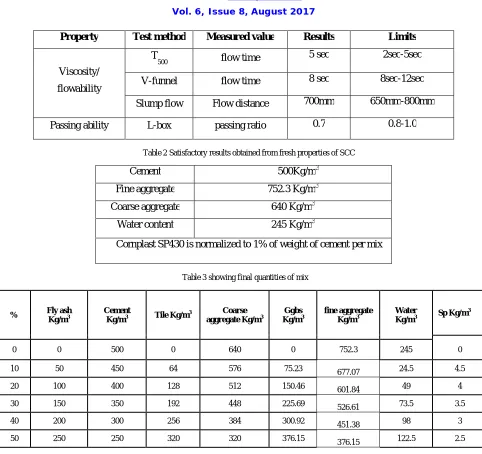
Mix design for self-compacting concrete is calculated as follows, The assumed cement content is 500Kg/m3 andwater to powder ratio assumed as 0.9. 1) Hence, water content is 0.9*500Kg/m3 =450 Kg/m3. As superplasticizer is used 30% of water is reduced. 2) Hence reduced water content = 450-(450∗.3) =315Kg/m3. Coarse aggregate is assumed as 40% of concrete volume. 3) Hence quantity of coarse aggregate (10mm) = (1600*.4) Kg/m3= 640 Kg/m3. Fine aggregate is assumed as 48% of mortar volume and since mortar volume consists of cement, fine aggregate and water therefore volume of cement and water can be taken as 52% of mortar volume. 4) Hence quantity of fine aggregate = 0.48(( )
. )= 752.3 Kg/m
3
. After conducting trail tests the final mix quantities obtained are shown in table 3
Constituent Typical range
Water 150 – 210
Coarse aggregate 750 – 1000
Coarse aggregate <50%
Water powder ratio 0.8 to 1.0
Total powder content 400-600Kg/m3
Sand content >40% of the mortar (volume)
Sand content >50% by weight of total aggregate
ISSN(Online): 2319-8753 ISSN (Print): 2347-6710
I
nternational
J
ournal of
I
nnovative
R
esearch in
S
cience,
E
ngineering and
T
echnology
(An ISO 3297: 2007 Certified Organization)
Website: www.ijirset.com
Vol. 6, Issue 8, August 2017
Property Test method Measured value Results Limits
Viscosity/
flowability
T
500 flow time 5 sec 2sec-5sec
V-funnel flow time 8 sec 8sec-12sec
Slump flow Flow distance 700mm 650mm-800mm
Passing ability L-box passing ratio 0.7 0.8-1.0
Table 2 Satisfactory results obtained from fresh properties of SCC
Cement 500Kg/m3
Fine aggregate 752.3 Kg/m3
Coarse aggregate 640 Kg/m3
Water content 245 Kg/m3
Cornplast SP430 is normalized to 1% of weight of cement per mix
Table 3 showing final quantities of mix
% Fly ash
Kg/m3
Cement
Kg/m3 Tile Kg/m
3 Coarse
aggregate Kg/m3
Ggbs Kg/m3
fine aggregate Kg/m3
Water
Kg/m3 Sp Kg/m
3
0 0 500 0 640 0 752.3 245 0
10 50 450 64 576 75.23 677.07 24.5 4.5
20 100 400 128 512 150.46 601.84 49 4
30 150 350 192 448 225.69 526.61 73.5 3.5
40 200 300 256 384 300.92 451.38 98 3
50 250 250 320 320 376.15 376.15 122.5 2.5
Table 4 showing densities of various percentages materials
The above quantities in table 4 are later calculated for mould volume so that the mix exactly fills the mould without any wastage. Superplasticizer used in this research is at the rate of 1% per Kg of cement (Calculated in weight). Specimens are casted and cured for 7days, 28days and 56days, and are tested respectively.
III. RESULTS
ISSN(Online): 2319-8753 ISSN (Print): 2347-6710
I
nternational
J
ournal of
I
nnovative
R
esearch in
S
cience,
E
ngineering and
T
echnology
(An ISO 3297: 2007 Certified Organization)
Website: www.ijirset.com
Vol. 6, Issue 8, August 2017
% of partial replacement 0% 10% 20% 30% 40% 50%
7-days mean strength (Mpa) 20.66 24.33 26.33 27.33 18.93 13.06
28-days mean strength (Mpa) 31.64 34.89 37.97 39.23 27.58 20.56
56-days mean strength (Mpa) 38.43 40.78 42.07 43.85 40.35 30.01
Table-5 showing compressive strengths at different partial replacements and different ages
Graph-1 showing compressive strengths of SCC at different ages of curing
Graph-1, showed that obtained at 7days strengths, 28-days strengths and 56 days strengths are in similar trend with maximum strength attainment at 30% partial replacement. Also, comparision shows that there is drastic increment in strength between 7-days and 28-days. Which is comparatively less between 28 days and 56 days. All the 28 days strengths showed higher percentage of increase in strength whereas 56 days strength showed lower percentage increase in strength.
% of partial replacement 0% 10% 20% 30% 40% 50%
7-days mean strength (Mpa) 2.2 2.5 2.8 2.9 2.4 1.81
28-days mean strength (Mpa) 2.8 3.01 3.14 3.33 2.91 2.52
56-days mean strength (Mpa) 3.22 3.37 3.54 3.86 3.37 3.02
38.43
40.79 42.07 43.86
37.06
30.23
20.67
24.33 26.33
27.33
18.93
13.07 31.64
34.90
37.97
39.00
27.59
20.56
10.00 12.50 15.00 17.50 20.00 22.50 25.00 27.50 30.00 32.50 35.00 37.50 40.00 42.50 45.00 47.50
0% 10% 20% 30% 40% 50%
C
O
M
P
R
E
SI
V
E
ST
R
E
N
G
TH
,,
M
P
a
PERCENTAGE REPLACEMENTS
Comparision of compresive strengths at ages of 7,28 and 56days
ISSN(Online): 2319-8753 ISSN (Print): 2347-6710
I
nternational
J
ournal of
I
nnovative
R
esearch in
S
cience,
E
ngineering and
T
echnology
(An ISO 3297: 2007 Certified Organization)
Website: www.ijirset.com
Vol. 6, Issue 8, August 2017
The percentage replacements vs compressive strength (Mpa) graph 2 shows the comparision between tensile strengths of 7 days, 28 days and 56 days strengths. These values are in similar trend with peak strength at 30% partial replacement. Also, comparision shows that strength increment is higher between 7 days and 28 days. Which is comparatively less between 28 days and 56 days strengths. But, 20%SCC and 30%SCC have relatively less increment in tensile strength from 7 days to 28 days strengths.
Graph-3 shows that, comparision between flexural strengths shows that 7days- strengths, 28-days strengths and 56 days strengths are in similar trend with peak strength at 30% partial replacement. Also, comparision shows that strength increment is higher between 7-days and 28-days for 20%SCC. This is comparatively less between 28 days and 56 days strengths. But, 20%SCC have relatively higher increment in tensile strength from 7 days to 28 days strengths. This is reverse in the case of 30%SCC. 40%SCC have relatively less increment in flexural strengths for both 7 to 28 days and 28 to 56 days flexural strengths.
Graph-2 showing tensile strengths of SCC at different ages of curing
% of partial replacement 0% 10% 20% 30% 40% 50%
7-days mean strength 5.82 7.37 7.62 7.96 7.453 6.276
28-days mean strength 6.21 7.77 8.25 8.34 7.57 6.41
56-days mean strength 6.60 8.16 8.54 8.93 7.78 6.99
Table-7 showing flexural strengths at different partial replacements and different ages 2.2
2.5
2.8 2.9
2.4
1.81 2.8
3.01 3.14
3.33
2.91
2.52 3.22
3.37
3.54
3.86
3.37
3.02
1.5 1.75 2 2.25 2.5 2.75 3 3.25 3.5 3.75 4
0% 10% 20% 30% 40% 50%
T
E
N
S
IL
E
S
T
R
E
N
G
T
H
,
M
P
a
PERCENTAGE REPLACEMENT
Comparision of tensile strengths at ages of 7,28 and 56days
ISSN(Online): 2319-8753 ISSN (Print): 2347-6710
I
nternational
J
ournal of
I
nnovative
R
esearch in
S
cience,
E
ngineering and
T
echnology
(An ISO 3297: 2007 Certified Organization)
Website: www.ijirset.com
Vol. 6, Issue 8, August 2017
Graph-3 showing flexural strengths of SCC at different ages of curing
IV.CONCLUSION
The present research includes investigation of mechanical properties of self-compacting concrete with fly ash, GGBS and broken tiles as partial replacement for cement, fine aggregate and coarse aggregate respectively. The mechanical properties of self-compacting concrete are evaluated by determining compressive strength, tensile strength and flexural strength for each of the mixes. The results obtained may be used for further development of economic self-compacting concretes by using other secondary cementitious materials. Since the secondary cementitious materials are essentially industrial by-products, it also shows a solution to their disposal. The mix design followed in this research can used to evaluate mix design of self-compacting concrete of any other grade.
The compressive strength of self-compacting concrete increased with increase of percentage of partial replacements (fly ash, GGBS and broken tiles for cement, fine aggregate and coarse aggregate) from 10% to 30%.
But, above 30% partial replacement i.e., 40% and 50% there was decrease in compressive strength.
All the self-compacting concretes with partial replacements showed increase in compressive strength with respect to age.
Though the strengths of 40%SCC and 50%SCC are less at early ages later they have reached the required strength of 30Mpa.
Tile aggregate is more durable in nature. This property of tile aggregate contributed to compressive strengths of 40%SCC and 50%SCC at later ages.
The presence fly ash and GGBS in concrete increases the C-S-H gel formation which contributes to bond development between constituents of concrete and strength in concrete. This can be clearly seen from the results obtained from mechanical properties of SCC.
5.82 7.37 7.62 7.96 7.453 6.276 6.21 7.77 8.25 8.34 7.57 6.41 6.6 8.16 8.54 8.93 7.78 6.99 5 5.25 5.5 5.75 6 6.25 6.5 6.75 7 7.25 7.5 7.75 8 8.25 8.5 8.75 9 9.25
0% 10% 20% 30% 40% 50%
F L E X U R A L S T R E N G T H , M P a PERCENTAGE REPLACEMENT
Comparision of flexural strengths at ages of 7,28 and 56days
ISSN(Online): 2319-8753 ISSN (Print): 2347-6710
I
nternational
J
ournal of
I
nnovative
R
esearch in
S
cience,
E
ngineering and
T
echnology
(An ISO 3297: 2007 Certified Organization)
Website: www.ijirset.com
Vol. 6, Issue 8, August 2017
Tensile strengths and flexural strengths of the self-compacting concrete are within the range of 10% to 15% and 10% to 20% respectively of compressive strength.
In case of tensile strength and flexural strength of self-compacting concretes, 30% SCC achieved higher strength. The 30% partial replacement is the optimum replacement percentage to be replaced in SCC in order to obtain
maximum strength.
The use of secondary materials like fly ash, GGBS and broken tiles which are industrial products reduce the waste disposal crisis and environmental hazards.
The use of fly ash, GGBS and broken tiles is proved economical in this research.
REFERENCES
[1] Nan Sua, Kung-Chung Hsub, His-Wen Chai. A simple mix design method for self-compacting concrete. Cement and Concrete research, vol. 31, pp. 1799- 1807, 2001.
[2] Sina Dadsetan, Jiping Bai. Mechanical and microstructural properties of self-compacting concrete blended with metakaolin, ground granulated blast-furnace slag and fly ash. Construction and building materials, vol. 146, pp. 658-667, 2017.
[3] S.S. Vivek, G. Dhinakaran. Fresh and hardened properties of binary blend high strength self-compacting concrete. Engineering Science and Technology, an international journal, vol. 140, pp. 65-66, 2017.
[4] A. Pineaud , P. Pimienta , S. Remond , H. Carre, Mechanical properties of high performance self-compacting concretes at room and high temperature. Construction and building materials, vol. 112, pp. 747-755, 2016.
[5] “The European guidelines for self-compacting concrete” formed in 2004 by EFNARC, available at www.efnarc.org.
[6] Md Emamul Haque. Indian fly-ash: production and consumption scenario. International Journal of Waste Resources (IJWR), vol. 3(1), pp. 22-25, 2013.