Games. (Under the direction of Dr. James C. Lester.)
Recent years have seen a growing interest in player modeling for open-world digital games. With the objective of creating player-adaptive gameplay, a central problem of player modeling is goal recognition, which aims to recognize players’ intentions from observable gameplay behaviors. Player goal recognition offers the promise of enabling games to dynamically adjust challenge levels, perform procedural content generation, generate interactive narratives, and create believable non-player character interactions. However, player goal recognition in open-world digital games poses significant challenges because of the inherent complexity in players’ gameplay behaviors attributable to a vast number of possible paths to achieve goals. Devising effective goal recognition models that deal with highly noisy action sequences is key to the success of goal recognition in open-world digital games.
and Markov logic networks. The most reliable goal modeling approach is identified through GOALIE’s multidimensional evaluation framework with a specific focus on measuring models’ predictive accuracy and early prediction capacity.
by Wookhee Min
A dissertation submitted to the Graduate Faculty of North Carolina State University
in partial fulfillment of the requirements for the Degree of
Doctor of Philosophy
Computer Science
Raleigh, North Carolina 2016
APPROVED BY:
_______________________________ _______________________________
Dr. James C. Lester Dr. Bradford W. Mott
Committee Chair
_______________________________ _______________________________
DEDICATION
BIOGRAPHY
Wookhee Min was born in Seoul, South Korea. As a K-12 student in the public school system in Gangnam in Seoul, he developed a deep interest in mathematics. With his parents’ support, he was recognized with several awards in mathematics competitions. These achievements paved a way to join the engineering school of Yonsei University in Seoul in 2000.
Wookhee entered the Department of Computer Science at Yonsei University after his first year. Computer science was a perfect fit for his interests, and he became fascinated with challenging problems in algorithms, security, cryptography, and artificial intelligence. During his college years he served in the Republic of Korea Army as a member of Korean augmentation to the United States Army. He worked for Special Operations Theater Support Elements – Korea in Yongsan, South Korea. In 2002 he was honorably discharged as a sergeant and was awarded the Army Commendation Medal.
ACKNOWLEDGMENTS
I would like to sincerely thank my academic advisor, James Lester, for his insightful advice on investigating the areas that have underpinned my dissertation work, including intent recognition, natural language processing, intelligent tutoring systems, and deep learning, among others. His kind and encouraging words have always kept me motivated during my graduate career. I also want to thank Brad Mott. Brad has provided me with careful feedback for an enormously wide range of questions regarding development, research, and even decision-making in my personal life. I am also grateful for Eric Wiebe’s insightful advice, which has substantially broadened my views to learning and educational applications. It has been a great pleasure to work and write research papers together throughout the ENGAGE and AIM projects, which have occupied much of my graduate work. Finally, I am very grateful to have had Min Chi as a member of my dissertation committee. I thank her not only for technical feedback and encouraging comments, but also for her warm regard for my family.
collaboration on the AIM project with Lydia Pezzullo, Jen Tsan, Alex Vail, Chi-Han Wang, and Joseph Wiggins. To my two former colleagues who graduated some time back but who still keep in close touch with me, Eun Young Ha and Seung Lee, I very much appreciate their kindness. I also want to thank three former, more recently graduated colleagues, Alok Baikadi, Joe Grafsgaard and Sam Leeman-Munk. It has been fortunate to get to know them and great pleasure to work with them. I also wish to thank Collin Lynch for his kindness to my family and me. My chats with him have always been uplifting and motivating. Also, I thank my colleagues in the Center for Educational Informatics and friends for their help and support over the course of my graduate career.
TABLE OF CONTENTS
LIST OF TABLES ... viii
LIST OF FIGURES ... ix
CHAPTER 1 INTRODUCTION ... 1
1.1 THESIS STATEMENT AND HYPOTHESES ... 8
1.2 CONTRIBUTIONS ... 13
1.3 ORGANIZATION ... 15
CHAPTER 2 RELATED WORK ... 17
2.1 PLAN,ACTIVITY, AND INTENT RECOGNITION ... 17
2.1.1 PLAN RECOGNITION ... 18
2.1.2 GOAL RECOGNITION ... 27
2.1.3 ACTIVITY RECOGNITION ... 32
2.2 DEEP LEARNING ... 33
2.2.1 OVERVIEW OF DEEP LEARNING ... 33
2.2.2 DEEP FEEDFORWARD NEURAL NETWORKS ... 34
2.2.3 RECURRENT NEURAL NETWORKS ... 38
2.2.4 DEEP LEARNING IN VISION,LANGUAGE AND SPEECH ... 44
2.3 USER MODELING IN INTELLIGENT GAME-BASED LEARNING ENVIRONMENTS ... 46
CHAPTER 3 GOAL RECOGNITION-BASED OPEN-WORLD DIGITAL GAMES ... 51
3.1 AN OVERVIEW OF GOAL RECOGNITION-ENABLED DIGITAL GAMES ... 51
3.2 GENERALIZED OBSERVABLE ACTION LEARNING FOR INTENT EVALUATION (GOALIE) ... 55
3.2.1 GOALIE:GOAL RECOGNITION MODEL TRAINING ... 56
3.2.2 GOALIE:GOAL RECOGNITION MODEL EVALUATION METRICS ... 69
CHAPTER 4 GOAL RECOGNITION DATA CORPORA ... 73
4.1 CRYSTAL ISLAND:OUTBREAK ... 74
4.1.2 STUDY DESCRIPTION ... 76
4.1.3 CORPUS ... 77
4.2 CRYSTAL ISLAND:UNCHARTED DISCOVERY ... 79
4.2.1 BACKSTORY AND GAME PLAY ... 80
4.2.2 STUDY DESCRIPTION ... 82
4.2.3 CORPUS ... 83
CHAPTER 5 SEQUENCE MODEL-BASED GOAL RECOGNITION ... 87
5.1 DATA REPRESENTATION METHODS:ONE-HOT ENCODING AND DISTRIBUTED REPRESENTATIONS ... 88
5.2 LONG SHORT-TERM MEMORY NETWORK-BASED GOAL RECOGNITION ... 91
5.2.1 LSTM-BASED GOAL RECOGNITION MODEL ARCHITECTURE ... 93
5.2.2 LSTM-BASED GOAL RECOGNITION MODEL CONFIGURATIONS ... 97
5.3 LINEAR-CHAIN CONDITIONAL RANDOM FIELD-BASED GOAL RECOGNITION ... 98
CHAPTER 6 EVALUATION ... 102
6.1 RESULTS FOR CRYSTAL ISLAND:OUTBREAK ... 103
6.2 RESULTS FOR CRYSTAL ISLAND:UNCHARTED DISCOVERY ... 110
CHAPTER 7 DISCUSSION ... 117
7.1 DISCUSSION ON EMPIRICAL RESULTS FOR CRYSTAL ISLAND:OUTBREAK ... 117
7.2 DISCUSSION ON EMPIRICAL RESULTS FOR CRYSTAL ISLAND:UNCHARTED DISCOVERY .... 120
7.3 LIMITATIONS ... 123
CHAPTER 8 CONCLUSIONS AND FUTURE WORK ... 129
8.1 HYPOTHESES REVISITED ... 131
8.2 FUTURE WORK ... 134
8.3 CONCLUDING REMARKS ... 139
LIST OF TABLES
Table 4.1: OUTBREAK: Distributions of goals ...79
Table 4.2: UNCHARTED DISCOVERY: Quest descriptions ...83
Table 4.3: UNCHARTED DISCOVERY: Distributions of goals ...86
Table 6.1: Accuracy rates of goal recognition models for the OUTBREAK dataset ...105
Table 6.2: Accuracy rates, convergence points, standardized convergence points, convergence rates, and 1-early convergence rates of the highest performing goal recognition models for the OUTBREAK dataset ...106
Table 6.3: Wilcoxon signed rank statistical test results with respect to the accuracy rate for the OUTBREAK dataset ...107
Table 6.4: Precision, recall, and F1 scores of the distributed LSTMs and CRFs for the OUTBREAK dataset ...109
Table 6.5: Accuracy rates of goal recognition models for the UNCHARTED DISCOVERY dataset ...112
Table 6.6: Accuracy rates, convergence points, standardized convergence points, convergence rates, and 1-early convergence rates of the highest performing goal recognition models for the UNCHARTED DISCOVERY dataset ...113
Table 6.7: Wilcoxon signed rank statistical test results with respect to the accuracy rate for the UNCHARTED DISCOVERY dataset ...114
LIST OF FIGURES
Figure 2.1: A conceptual illustration of layer-wise stacked denoising autoencoders ...37
Figure 2.2: Recurrent neural networks ...38
Figure 2.3: Different classification tasks using recurrent neural networks ...40
Figure 2.4: A conceptual illustration of an LSTM memory block that features three gating units and a memory cell ...42
Figure 2.5: Two examples of LSTM to solve a classification task illustrated in Figure 2.3C ...44
Figure 3.1: Open-world digital games enriched with the goal recognition feature ...52
Figure 3.2: Bayesian network goal recognition model ...60
Figure 3.3: Graphical representation of the Markov logic network ...63
Figure 3.4: N-gram encoded feedforward neural network ...66
Figure 4.1: CRYSTAL ISLAND:OUTBREAK educational game ...75
Figure 4.2: Map of the CRYSTAL ISLAND:OUTBREAK research camp ...76
Figure 4.3: CRYSTAL ISLAND:UNCHARTED DISCOVERY educational game ...80
Figure 4.4: Virtual tablet’s IslandPedia app and problem-solving app ...82
Figure 5.1: (A) An illustration of LSTMs for goal recognition and (B) a distributed action representation generated from a discrete action representation ...94
Figure 5.2: A factor graph representation of linear-chain CRFs ...99
CHAPTER1
INTRODUCTION
Recent years have seen the emergence of digital games that feature open-world environments that offer players significant autonomy over the goals they pursue and the plans they use to achieve their goals (Squire, 2008). In contrast to linear games, which prescribe a particular sequence of gameplay objectives for players to accomplish, the non-linear goals, story plots, and non-deterministic paths to achieve in-game objectives that pervade open-word digital games promote human players’ engagement and support increased replayability. However, open-world digital games pose significant challenges for game designers. Open-world games’ emphasis on player autonomy is at odds with game designers’ focus on crafting coherent storylines and well-paced gameplay; it is difficult for game designers to craft compelling stories if they do not know, in advance, what actions the player is going to take next (Min, Mott, Rowe, Liu, & Lester, 2016; Riedl & Bulitko, 2013).
2009; Gilfeather, 2009; Lopes & Bidarra, 2011), procedural game content generation (Jennings-Teats, Smith, & Wardrip-Fruin, 2010; Shaker, Togelius, & Nelson, 2015), and adaptive pedagogical planning in educational games (Baikadi, Rowe, Mott, & Lester, 2014; Ha, Rowe, Mott, & Lester, 2011; Min et al., 2015; Min, Rowe, Mott, & Lester, 2013; Min, Ha, Rowe, Mott, & Lester, 2014; Min, Mott, et al., 2016; Mott, Lee, & Lester, 2006).
Two high-level approaches to player modeling have been examined: model-based approaches (top-down) and model-free approaches (bottom-up) (Yannakakis et al., 2013). In contrast to model-based approaches that are grounded in an existing theoretical framework (e.g., emotion theories, usability theory, cognitive theory), model-free approaches employ data-driven player modeling, which is often based on supervised machine-learning techniques (Drachen, Canossa, & Yannakakis, 2009; Mott et al., 2006; Thue, Bulitko, Spetch, & Webb, 2010; Weber & Mateas, 2009). Following the model-free player modeling approach, player models have been devised using a broad range of multimodal game interaction data streams (i.e., data-driven approach) from behavioral gameplay data (Min, Ha, et al., 2014), to physiological signals such as skin conductance and blood volume pulse (Martinez, Bengio, & Yannakakis, 2013), to bodily expressions such as body movement and posture (Savva, Scarinzi, & Bianchi-Berthouze, 2012) and facial expressions (Shaker, Asteriadis, Yannakakis, & Karpouzis, 2011).
aim of reducing the cost of content creation and foster player engagement through dynamic content generation (Shaker et al., 2015; Yannakakis et al., 2013), while many games have utilized domain-specific rules (e.g., scripts, finite state machines) rather than devising sophisticated player models (Yannakakis, 2012). Even though these efforts have shed light on practical utilizations of player modeling in targeted domains, scalable solutions applicable to various open-world digital games have not been widely investigated.
As a core player modeling functionality, goal recognition has been the subject of increasing attention (Ha et al., 2011; Kabanza, Filion, Benaskeur, & Irandoust, 2013; Min, Mott, et al., 2016; Mott et al., 2006). Goal recognition, a restricted form of plan recognition that infers an observed agent’s plans or goals (Baker, Saxe, & Tenenbaum, 2009; Carberry, 2001; Geib & Goldman, 2009; Kautz & Allen, 1986), focuses on identifying the agent’s (e.g., human player in digital games) concrete objectives through observed sequences of low-level, primitive actions in virtual game environments.
conducive to learning (Alvarez, Sanchez-Ruiz, Cavazza, Shigematsu, & Prendinger, 2015; Baikadi et al., 2014; Ha et al., 2011; Lee, Liu, & Popović, 2014). In addition to runtime game and curricular adaptations, goal recognition can also facilitate the game design revision process offline, by analyzing players’ inferred goals along with the game and curriculum designers’ intentions in a post-hoc manner (Ha et al., 2011).
This dissertation investigates goal recognition in open-world digital games with fully observable, exploratory player behaviors. Goal recognition in these environments exhibits considerable uncertainty. A sequence of actions is often explainable by multiple goals, while there are a vast number of non-deterministic paths to achieve a goal. Goals are not explicitly presented to the players. In cases where players have little or no prior experience with a game (e.g., educational games administered in classrooms), players are likely to explore the game world (e.g., conversing with non-player characters, triggering game world events) in order to identify goals, rather than perform actions in order to achieve a specific gameplay objective. It is also possible that players unintentionally achieve goals through exploratory actions, abandon goals with little warning, or adopt new goals based upon recent or prior events. Thus, goal recognition in open-world digital games is characterized by considerable uncertainty, and goal recognition models must be able to operate robustly in the face of highly noisy, idiosyncratic sequences of low-level player actions.
current actions may influence their upcoming goals (Ha et al., 2011). Consequently, modeling sequential patterns collectively from a series of player actions and previously achieved goals is crucial for the success of goal recognition (Min, Mott, et al., 2016). As well as player gameplay logs, computational goal modeling can also utilize all available observable features such as events that players have encountered, environments that they observed, multimodal data streams that players have revealed in forms of physiological signals (e.g., electrocardiography, galvanic skin response) and bodily expressions (e.g., gaze, facial expression, posture, gesture), and static player profiles (e.g., personality and gender). Among these features, goal recognition investigated in the dissertation focuses on players’ observed gameplay behaviors, which are sequences of actions and previously achieved goals that are commonly obtainable in various open-world digital games.
Devising reliable computational models is a key affordance of the framework. Without an accurate goal recognition model in place, implementing a player goal-adaptive game is infeasible. This dissertation investigates two deep learning techniques (Bengio, 2009; LeCun, Bengio, & Hinton, 2015; Schmidhuber, 2014) for training computational goal recognition models. Deep learning is a family of machine learning techniques grounded in artificial neural networks, which is capable of extracting hierarchical representations through multi-level abstraction of the training data. Deep learning forms the basis for state-of-the-art techniques for a broad range of classification tasks associated with computer vision, speech recognition, and natural language processing (LeCun et al., 2015), as well as plan and goal recognition (Bisson, Larochelle, & Kabanza, 2015; Min, Mott, et al., 2016).
performance in various sequence labeling tasks, often outperforming standard recurrent neural networks by leveraging a longer-term memory than standard RNNs, preserving short-term lag capabilities, and effectively addressing the vanishing gradient problem (Graves, 2012).
1.1 Thesis Statement and Hypotheses
This dissertation presents GOALIE (Generalized Observable Action Learning for Intent Evaluation), a generalized goal recognition framework featuring valid multidimensional model evaluation, and illustrate applications of GOALIE based on two testbed open-world educational games. GOALIE consists of two key functionalities: (1) offline goal recognition model training and (2) offline multidimensional goal recognition model evaluation. In the following paragraphs, we describe the requirements for GOALIE, with a focus on applications in open-world digital games.
First, GOALIE should provide a scalable solution to devising goal recognition models for a wide range of open-world digital games. GOALIE takes as input only a set of goals and a corpus containing player action sequences performed to achieve the goals, which are generally available in most open-world digital games. An action is composed of a type, a location where the action occurs, narrative states (i.e., players’ narrative progress in the gameplay), and a sequence of previously achieved goals. In this context, the task of goal recognition is to classify player goals (i.e., labels) based on the observed action sequences (i.e., explanatory variables). It should be noted that the set of explanatory variables is not constrained to the observed action sequences, but can be extended according to the characteristics of the game being investigated.
UNCHARTED DISCOVERY (Baikadi et al., 2014; Lester et al., 2014). CRYSTAL ISLAND:
OUTBREAK is a story-centric game-based learning environment for middle grade
microbiology, and CRYSTAL ISLAND: UNCHARTED DISCOVERY is a game-based learning
environment for upper elementary science targeting map, model, and landform education. In both educational games, players are assigned a single high-level objective: solve a science mystery and develop an understanding of landforms and navigation, respectively. Players engage in periods of exploration and deliberate problem solving under an overarching narrative, while players achieve multiple sub-goals following non-deterministic paths in each environment. In these settings, goal recognition is formalized as predicting the next sub-goal that the player will complete as part of achieving the final goal, and so is cast as a multiclass classification problem in which a trained classifier predicts the most likely goal associated with the currently observed action sequence (Min, Mott, et al., 2016). The formulation of goal recognition used in this dissertation assumes that a given sequence of actions maps to a single goal, and no interleaving occurs between actions associated with different goals, since the goal recognition corpus does not lend itself to this type of analysis (Ha et al. 2011). Computational goal recognition models are devised in a machine-learned approach, taking as input action sequences and as output player goals achieved by the action sequences, independently for each of the two open-world educational games.
Reliable goal recognition models should not only correctly predict player goals on overall sequences of actions, but also make early predictions (i.e., making consistently correct predictions as early as possible), since run-time game adaptation is a central objective of goal recognition. To address this demand, GOALIE supports offline multidimensional evaluations of goal recognition models through five metrics including three conventional metrics (accuracy rate, convergence point, and convergence rate) (Blaylock & Allen, 2003) and two novel metrics (standardized convergence point and n-early convergence rate). Among these metrics, convergence point (Blaylock & Allen, 2003) measures how early goal recognition models can consistently make accurate predictions within a converged sequence, which is an action sequence whose last goal prediction is correct. Min and colleagues (Min, Baikadi, et al., 2016; Min, Ha, et al., 2014; Min, Mott, et al., 2016) pointed out potential problems with this classic convergence point metric: it can be misleading with respect to favoring models with lower convergence rates, since the metric ignores non-converged action sequences. GOALIE addresses this problem by introducing two novel metrics and uses the novel metrics over the corresponding conventional metrics to identify reliable goal recognizers for a given open-world digital game.
The other novel metric is n-early convergence rate. The n-early convergence rate extends the convergence rate (Blaylock & Allen, 2003) that measures the percentage of action sequences in which the last goal prediction is correct, by considering the last (n+1) action predictions. In a special case of this metric when n equals 0, the definition of n-early convergence rate is the same as the conventional convergence rate. The dissertation measures models’ early prediction capacity based on these two novel metrics over the two corresponding classic metrics.
Selecting a model with high predictive performance and early prediction capacity is of significant importance, since inaccurate player goal recognitions can subsequently mislead the run-time game adaptation, thereby severely disrupting the player’s game experiences. For example, providing incorrect goal-informed game adaptations for a player who is about to achieve a goal (i.e., poor n-early convergence rate) may result in considerable confusion to the player and disrupt her plan. As another example, a challenge adaptation driven by inaccurate goal recognition might diminish players game experiences, because improper difficulty level in games has been found to cause players to become bored when challenge levels are too low or frustrated when challenge levels are too high (Missura & Gärtner, 2009). Therefore, devising reliable, efficient goal recognition models is a critical next-step in building a robust goal recognition framework.
modeling, sequential patterns characterized in player gameplay behaviors within open-world digital games have inspired us to investigate machine-learning techniques for sequence labeling. In parallel, recent years have witnessed an explosion of interest in deep learning, which has contributed to significant advances in a wide range of pattern recognition research such as computer vision, speech recognition, and natural language processing (LeCun et al., 2015; Schmidhuber, 2014). Additionally, more recently, deep learning has also demonstrated considerable promise as a core computational modeling approach for goal and plan recognition tasks (Bisson et al., 2015; Min, Mott, et al., 2016). Inspired by this work, the dissertation hypothesizes that deep learning approaches targeted to sequence labeling such as long short-term memory networks would provide the best solution for goal modeling in open-world digital games. Along this line, the dissertation investigates five primary hypotheses as follows:
• Hypothesis 1: The pipeline for goal recognition supported by GOALIE, including model
training and model evaluation process, is scalable to multiple open-world digital games such as CRYSTAL ISLAND:OUTBREAK and CRYSTAL ISLAND:UNCHARTED DISCOVERY.
• Hypothesis 2: LSTM-based goal recognition models outperform conditional random
fields, n-gram encoded feedforward neural networks pre-trained with stacked denoising autoencoders, and Markov logic networks with respect to the predictive accuracy across the two open-world educational games, when evaluated using GOALIE.
• Hypothesis 3: LSTM-based goal recognition models outperform conditional random
autoencoders, and Markov logic networks with respect to the convergence rate and convergence point, across the two open-world educational games, when evaluated using GOALIE.
• Hypothesis 4: LSTM-based goal recognition models outperform conditional random
fields, n-gram encoded feedforward neural networks pre-trained with stacked denoising autoencoders, and Markov logic networks with respect to the two novel metrics introduced in GOALIE, standardized convergence point and n-early convergence rate across the two open-world educational games, when evaluated using GOALIE.
• Hypothesis 5: LSTM-based goal recognition models that harness distributed action
representations through a linear projection layer outperform the corresponding LSTM models that utilize the one-hot encoding-based discrete action representation with respect to the accuracy rate, convergence rate, n-early convergence rate, and standardized convergence point across the two open-world educational games, when evaluated using GOALIE.
1.2 Contributions
of the GOALIE framework by reducing the labor-intensive requirement to manually engineer hand-crafted features targeted to each game. This dissertation builds on research that has made contributions to the fields of Goal Recognition, Plan, Activity, and Intent Recognition (PAIR), Player Modeling, and Game AI:
• Goal recognition models devised with n-gram encoded feedforward neural networks pre-trained with stacked denoising autoencoders (FFNNs) significantly outperform Markov logic networks (MLNs)-based goal recognition models with respect to prediction accuracy rates in 10-fold cross validation (Min, Ha, et al., 2014).
• FFNN-based goal recognition models significantly outperform MLN-based goal
recognition models with respect to the convergence rate, a metric that measures the percentage of sequences that are eventually classified to the correct goal, in 10-fold cross validation (Min, Ha, et al., 2014).
• Goal recognition models devised with long short-term memory networks featuring
distributed action representations (LSTMs) significantly outperform both the FFNN and MLN-based goal recognition models with respect to prediction accuracy rates in 10-fold cross validation (Min, Mott, et al., 2016).
• The LSTM-based goal recognition approach significantly outperforms both the FFNN
and MLN-based goal recognition approaches with respect to the convergence rate in 10-fold cross validation (Min, Mott, et al., 2016).
• Previous work has reported that the classic convergence point metric can be misleading
from the inherent tension between convergence rate and convergence point, in which accurate models (i.e., models achieving high accuracy rates and convergence rates) have to consider more noisy action sequences that eventually converged to correct goals but are not trivial to predict when calculating the convergence point, thereby inducing higher (i.e., worse) convergence points (Min, Baikadi, et al., 2016; Min, Ha, et al., 2014; Min, Mott, et al., 2016).
1.3 Organization
The dissertation is organized as follows. Chapter 2 discusses background on plan, activity, and intent recognition (PAIR) and deep learning as well as related work on user modeling in educational games. Chapter 3 presents a high-level illustration of open-world digital games enriched with a goal-directed game adaptation feature with a particular focus on the operational pipeline that includes goal recognition model training, model evaluation, model deployment, online goal recognition, online goal-directed game adaptation, and game revision. Chapter 3 further discusses GOALIE in terms of (1) model training with illustrations using three previous goal-modeling techniques (i.e., Bayesian inference models, Markov logic networks, and feedforward neural networks) and (2) model evaluation using the five metrics described in a preceding paragraph. Chapter 4 describes two goal recognition data corpora that the dissertation examines, along with the two corresponding testbed educational games: CRYSTAL ISLAND: OUTBREAK and CRYSTAL ISLAND: UNCHARTED
DISCOVERY. Chapter 5 describes the two novel goal-modeling approaches in depth: long
CHAPTER 2
RELATEDWORK
The goal recognition framework presented in this dissertation is situated at the intersection of three areas of work: (1) goal recognition, a multi-class classification task for predicting players’ high-level intention based on an observed sequence of low-level game behaviors, (2) deep learning, a family of machine learning techniques that use artificial neural networks, and (3) intelligent game-based learning environments, which serve as the testbeds for the dissertation research. The remainder of this chapter is organized as follows. Section 2.1 describes plan, activity, and intent recognition. In Section 2.2, a brief history, a variety of algorithms, and recent achievements of deep learning are presented. Finally, Section 2.3 introduces user-modeling research centering on modeling users’ knowledge.
2.1 Plan, Activity, and Intent Recognition
In human-human interactions, humans can adeptly infer others’ cognitive and affective states based on observable cues such as bodily expressions and linguistic expressions in addition to contextual information, and this social intelligence plays a pivotal role in interpersonal communication and relationships (Baker et al., 2009; Sukthankar, Geib, Bui, Pynadath, & Goldman, 2014). With the aim to model humans’ cognitive skills and social intelligence from an AI perspective, a broad range of research has been undertaken to investigate plan, activity, and intent recognition (PAIR).
Goldman, 2009; Kautz & Allen, 1986; Sukthankar et al., 2014). Prior work on PAIR has largely focused on observation sequences in which agents’ actions are rationally motivated by well-defined objectives. For instance, smart space activity monitoring (Duong, Phung, Bui, & Venkatesh, 2009), network security (Geib & Goldman, 2009), natural language story understanding (Singla & Mooney, 2011), user interactions (Goodman & Litman, 1992), digital games (Bisson et al., 2015; Fagan & Cunningham, 2003; Gold, 2010; Kabanza et al., 2013; Synnaeve & Bessière, 2011; Weber & Mateas, 2009), and intelligent tutoring systems (Alvarez et al., 2015; Brusilovsky & Millán, 2007; Conati, Gertner, & Vanlehn, 2002; S. J. Lee et al., 2014) have served as testbed applications for plan, activity, and intent recognition, among others (Sukthankar et al., 2014).
It should be noted that “intent recognition” (or “intention recognition”) has been used interchangeably used with both “plan recognition” or “goal recognition.” In some work, “intent recognition” indicates “plan recognition” (Demiris, 2007; Geib & Goldman, 2009; Tomasello, Carpenter, Call, Behne, & Moll, 2005), while “intent recognition” denotes “goal recognition” in other work (Baikadi et al., 2014; Han & Pereira, 2013; Sadri, 2012). This dissertation adopts the latter definition, and interchangeably uses intent recognition and goal recognition. Plan recognition, goal recognition, and activity recognition are presented in the following sections.
2.1.1 Plan Recognition
a sequence of observed behaviors, in which the agent can be either human or machine (Fagan & Cunningham, 2003; Ramirez, Geffner, Ram, & Geffner, 2010; Sukthankar et al., 2014). Compared to planning in which a plan is sought to achieve the given goal, the objective of plan recognition is to infer future plans and goals utilizing already-observed actions, and thus plan recognition can be formulated as inverse planning (Baker et al., 2009; Ramirez et al., 2010; Sadri, 2012).
While classic plan recognition work used rule-based systems that require domain experts to design such rules and so does not offer a scalable solution to various tasks (Sukthankar et al., 2014), much modern work on plan recognition has investigated a plan library-based plan recognition method initially outlined by Kautz and Allen (1986). The plan library approach performs deductive reasoning over a set of first order logic formulae through circumscription. In this approach, a plan library is described in the form of a plan graph that consists of top-level actions as root nodes, in which each top-level action is expanded with unordered sets of child actions, called plan decomposition (Geib & Goldman, 2009). Thus, the task of plan recognition is cast as identifying a set of possible plan hypotheses consistent with a sequence of observed actions, which can be solved as a graph-covering problem on the plan graph. This plan library-based approach has provided a fundamental framework for much of plan recognition work to date (Geib & Goldman, 2009; Sukthankar et al., 2014).
probabilities, where a goal is more likely to be achieved than other goals, even though all of them are explained by the current observation (Geib & Goldman, 2009).
Charniak and Goldman (1993) presented an abduction-based plan recognition approach in the context of the plan library-based approach. Abduction-based reasoning postulates that if a plan is achieved by a sequence of actions and an agent performs the action sequence, the agent is inferred to execute the plan (Charniak & Goldman, 1993; Geib & Goldman, 2009; Sukthankar et al., 2014). To address the problems of prior probabilities of goals in Kautz and Allen (1986), Charniak and Goldman proposed a probabilistic graphical model-based approach utilizing Bayesian networks. They cast the plan recognition as finding plans and goals that have the highest posterior probability in the context of probabilistic abductive reasoning, and empirically evaluated the proposed method on a natural language story understanding task.
In addition to these probabilistic graphical model-based approaches, other plan recognition techniques (sometimes as a hybrid approach with probabilistic models) based on plan library-based methods have been investigated, including parsing and case-based plan recognition. First, parsing is inspired by natural language parsing and understanding because of its similarities to action parsing and plan recognition (Geib & Steedman, 2007; Vilain, 1990). A context-free grammar of plans is generated based on a plan library, and the plan recognition is conducted by parsing observed actions utilizing the induced grammars (Vilain, 1990). In this approach, the runtime complexity is reduced to a polynomial time, which effectively addresses the intractability that underlies in the classic work by Kautz and Allen, but at a cost due to assumptions made in this work (Blaylock, 2005).
Pynadath and Wellman further explored parsing methods. They examined plan libraries in the context of probabilistic context-free grammars (D Pynadath & Wellman, 1996) and probabilistic state-dependent grammars (Pynadath & Wellman, 2000), which subsequently inform Bayesian plan recognition model structures. A statistical parsing approach, which incorporates parsing with probabilistic graphical modeling, has shown promise in addressing challenges stemming from partial observations (David Pynadath & Wellman, 1995) and interleaved and partially-ordered plans (Geib & Goldman, 2009).
process a considerable size of plan library and reason about an agent’s plans. To address authoring issues, case-based plan recognition devises the plan library with machine-learning techniques (Fagan & Cunningham, 2003; Synnaeve & Bessière, 2011; Weber & Mateas, 2009). This approach offers several benefits over the handcrafted plan-library approach: it enables a plan library to be automatically learned in a data-driven approach and the induced plan library can support some sets of idiosyncratic plans and goals that individual agents revealed relative to the manual approach. Some case-based plan recognition systems incrementally learn the plan library that is initialized with generic cases and is tailored as more personal plans are observed (Cheng & Thawonmas, 2004; Fagan & Cunningham, 2003).
In summary, the plan library-based approach requires an plan library and a decision model a priori (Bisson et al., 2015). The plan library specifies the space of plan hypotheses using a hierarchy of goals and actions to achieve the goals, and the decision model describes how the observee makes a decision based on the plan library and finds the most likely plans based on prior observations. Plan libraries are crafted utilizing hierarchical task networks, partially-ordered multiset context-free grammars (Bisson et al., 2015; Geib & Goldman, 2009), or Markov logic formulae (Song et al., 2013), while decision models have been often devised utilizing machine learning techniques. While the plan library based approach has achieved great success in a wide range of plan recognition tasks, designing plan libraries and decision models pose significant challenges; both cases that the plan hypothesis space circumscribed by the plan library does not specify all possible actions and the decision model does not accurately recognize the agent’s plan will together degrade the performance of plan recognition. Thus, both of these should be carefully designed for a successful implementation of plan recognizers.
Markov decision process (MDP) (Baker et al., 2009), and partially observable MDP (Ramírez & Geffner, 2011).
In Ramírez & Geffner’s work (2009), the goal probability is calculated based on the cost difference between two optimal plans to achieve the goal. More specifically, for each goal, (1) an optimal plan is generated achieving the goal being consistent with the observation sequence and (2) another optimal plan is generated achieving the same goal being inconsistent with the observed sequence. The cost difference between the two induced plans informs computation of the likelihood of each goal. While this method eliminates the labor-intensive plan library creation effort, it requires invoking a planning algorithm twice for each goal and for each observation update and thus results in a scalability problem especially in complex domains (Bisson et al., 2015; E-Martín, R-moreno, & Smith, 2015).
parameterized by β (i.e., a noise in agents’ actions), thereby formulating the likelihood function as probabilistic planning that accounts for an approximate principle of rationality.
2.1.2 Goal Recognition
Goal recognition is a cognitive player modeling task that involves automatically inferring agents’ intermediate goals based on observed primitive actions in the environment, agents’ perceptual access to the environment, the past, current context of the environment, and the future context of the environment that will bring about due to the agents’ past and expected behaviors (Baker et al., 2009; Sadri, 2012). Because goal recognition does not attempt to identify agents’ plans including the sequence of their future actions, goal recognition is a sub-task of plan recognition (Blaylock & Allen, 2003; Ha et al., 2011; Mott et al., 2006).
computational approach can achieve 89.6% convergence rate, 58.1% online accuracy rate, and 51.0% convergence point, which outperform hidden Markov models with 5 hidden states, the best competing model.
Goal recognition models have been successfully developed for a wide range of application domains (sometimes in the context of plan recognition), including a home ambient intelligence (Han & Pereira, 2013; Sadri, 2012), cyber security (Geib & Goldman, 2009), terrorism detection (Jarvis, Lunt, & Myers, 2005), digital games (Bisson et al., 2015; Cheng & Thawonmas, 2004; Fagan & Cunningham, 2003; Gold, 2010; Kabanza et al., 2013; Synnaeve & Bessière, 2011; Weber & Mateas, 2009), story understanding (Charniak & Goldman, 1993), interactive storytelling (Karlsson, Ciarlini, Feijó, & Furtado, 2006), human-computer interaction and intelligent interface agents (Armentano & Amandi, 2011; Blaylock & Allen, 2003; Hong, 2001), traffic monitoring (Pynadath & Wellman, 1995), and defense (Mao & Gratch, 2004).
characters (Karpov, Schrum, & Miikkulainen, 2012; Muñoz, Gutierrez, & Sanchis, 2012; Ortega, Shaker, Togelius, & Yannakakis, 2013), level generation (Shaker, Yannakakis, & Togelius, 2010), and adaptive strategy planning (Kabanza et al., 2013; Laviers & Sukthankar, 2014; Weber & Mateas, 2009). Furthermore, educational games enriched with goal recognition can provide personalized curricula and feedback according to students’ goals (Baikadi et al., 2014; Ha et al., 2011; Min et al., 2014; Mott et al., 2006). Goal recognition can be used in conjunction with post-hoc data analyses (e.g., playtesting analysis, telemetry game development) to provide game designers insights to improve game experiences. In this case, player goal recognition can be used to enhance game mechanics and aesthetics for the future game revision (Yannakakis et al., 2013; Zoeller, 2010).
Bellefeuille, Bisson, Benaskeur, & Irandoust, 2010). Their work extended Geib and Goldman’s PHATT algorithm (Geib & Goldman, 2009) to perform intent recognition on opponents’ behaviors. Kabanza et al. (2013) presented a heuristic weighted model counting algorithm that enables recognition of upper and lower bounds of posterior probabilities of goals in real-time strategy games. Synnaeve and Bessière investigated a probabilistic goal recognition approach in RTSs, in which plans and build trees are directly learned from game replays in unsupervised learning, while probabilistic decision models handle partial observations from agents (Synnaeve & Bessière, 2011).
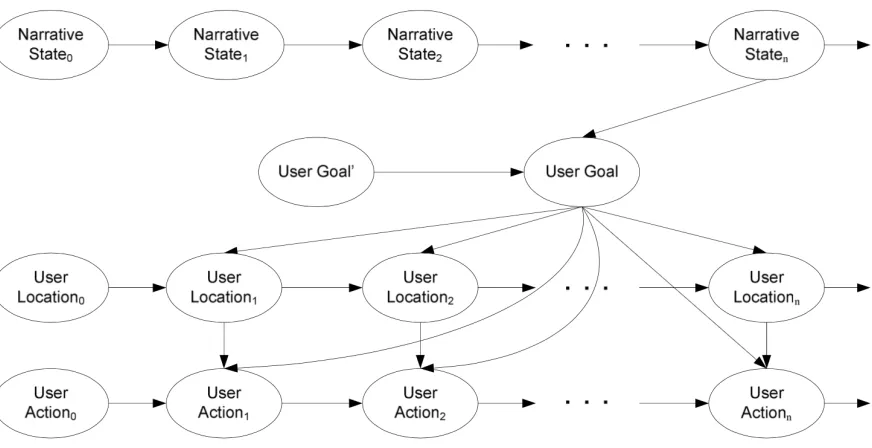
Closely related to the dissertation research, Mott, Lee, and Lester (2006) investigated goal recognition in an open-world educational game with exploratory actions featuring a middle-grade microbiology education. This work presented that successful goal recognition can inform a narrative planner’s delivery of personalized narrative experiences and provide tailored pedagogical support in order to promote players’ engagement and motivation. Mott and colleagues investigated probabilistic graphical goal recognition models, and found that unigram models outperform bigrams and Bayesian networks in an empirical evaluation.
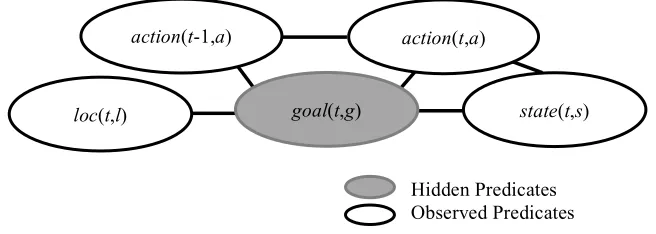
MLN-based approach (2011) investigating discovery events that are domain-specific representations of user progress, and demonstrated that this approach outperforms the previous state-of-the-art work with respect to both the goal recognition accuracy and efficiency. These previous approaches are further described in detail in Sections 3.2.1.1 and 3.2.1.2.
predictive accuracy by effectively modeling temporal information characterized in observation sequences of player behavior in an open-world digital game.
2.1.3 Activity Recognition
While activity recognition and plan recognition share the similar aim of analyzing low-level, goal-driven behaviors to identify users’ high-level objectives, there is a sharp contrast between these two tasks (Geib & Goldman, 2009). Activity recognition centers on recognizing a single, flat activity without predicting agent plans by examining complex, hierarchical structures of activities, which is central in plan recognition. Activity recognition also shares similarities with goal recognition; however, unlike goal recognition, activity recognition focuses on analyzing low-level, spatiotemporal sensor data (e.g., video frame, motion capture data, user interface trace logs), extracting key features from sensor signals that explain users’ activities, and recognizing target activities (e.g., theft detection, health alert for a patient, smart space activity monitoring) harnessing predictive models devised based on extracted features and machine-learning techniques.
techniques have been explored to address the computational challenges posed by activity recognition. Freedman and colleagues (2015) investigated temporal and object relations in addition to the agent’s postural data for unsupervised activity recognition, and Wyatt et al. (2005) presented an unsupervised learning method to automatically produce labeled segmentations of activity data.
2.2 Deep Learning
Deep learning is a family of machine learning techniques grounded in artificial neural networks (Bengio, 2009). Deep learning’s capacity for hierarchical representation learning through multi-level data abstraction has achieved significant advance for various pattern recognition tasks in computer vision, natural language processing, and speech recognition (Schmidhuber, 2014; LeCun, Bengio, & Hinton, 2015). In the following sections, we present an overview of deep learning, introduce two principal deep learning approaches, namely, deep feedforward neural networks and recurrent neural networks, and describe various computational tasks that have been successfully investigated using deep neural networks.
2.2.1 Overview of Deep Learning
discussion regarding the history of artificial neural networks can be found in (Schmidhuber, 2014).
Interest in NNs declined in the late 1980s due to the absence of effective methods for dealing with pathological problems (i.e., vanishing gradients, exploding gradients) that result in model underfitting when training deep NNs. Researchers began making progress on NNs again through multi-dimensional efforts, which collectively have launched a rich line of investigation on deep learning (Schmidhuber, 2014). This achievement has been made by combinations of the following contributions: (1) improvements in hardware (e.g., fast CPUs, GPU acceleration, parallel computing), (2) an increasing amount of data including both labeled and unlabeled data, (3) the advent of effective NN models such as recurrent neural networks (Elman, 1990), long-short term memory models (Hochreiter & Schmidhuber, 1997), and convolutional neural networks (LeCun, Bottou, Bengio, & Haffner, 1998), (4) unsupervised pre-training techniques such as deep belief networks (Hinton, Osindero, & Teh, 2006) and stacked denoising autoencoders (Vincent, Larochelle, Bengio, & Manzagol, 2008), (5) optimization techniques such as 2nd-order Hessian-free optimization (Martens, 2010) and adaptive learning rates (Zeiler, 2012), and (6) effective regularization methods (Srivastava, Hinton, Krizhevsky, Sutskever, & Salakhutdinov, 2014; Vincent et al., 2008).
2.2.2 Deep Feedforward Neural Networks
(n)th layer with (n+1)th layer. Hidden neurons and output neurons often have a non-linear activation function (e.g., sigmoid or hyperbolic tangent for hidden layers, softmax for the output layer), while input neurons are directly encoded based on the training set of interest.
Training deep neural networks is often performed with backpropagation. The training error is propagated from the output layer to the input layer, and all weights in networks are updated using a gradient descent method, in which the gradient is computed by the derivative of the error with respect to weights. Detailed descriptions of NNs can be found in the literature (e.g., Le, 2014; Le, 2015). The back-propagation algorithm using a gradient descent method has been popularly utilized to train NNs since the mid-1980s (Schmidhuber, 2014); however, this algorithm has been shown to not be scalable to deep NNs with multiple layers, not only for its slow learning rate, but also because it often gets trapped in poor local optima (Erhan et al., 2010; Vincent et al., 2010) or due to proliferation of saddle points (Dauphin et al., 2014).
following paragraphs further delineate AE-based pre-training methods, including stacked AEs and stacked denoising AEs.
An AE is interpreted as a nonlinear generalization of principal component analysis, where it encodes high-dimensional input data into a low-dimensional output data by applying a deterministic function (Hinton & Salakhutdinov, 2006). As a variant of AEs, stacked autoencoders (SAEs) perform greedy layer-wise representation learning, sequentially for all layers (Bengio et al., 2007). To pre-train a model, in the first layer, a SAE encodes an example input vector x in the visible layer into h(x) in the hidden layer, using the current weight parameters W1 and an activation function s (e.g., sigmoid) (Equation 2.1). Then, it decodes the encoded input h(x) to z(x) using W2 and s (Equation 2.2), and updates the current weight parameters W1 and W2 so as to minimize the reconstruction error between the original input x and the decoded input z(x), for example using stochastic gradient descent. In the equations, b1 and b2 are biases for W1 and W2, respectively.
Stacked denoising autoencoders (SDAEs) is a variant of SAE (Vincent et al., 2010). SDAEs address a commonly observed challenge posed by SAEs, such that W1 often converges to a trivial solution (i.e., identity function), particularly when the number of variables in the hidden layer is equal to or greater than the number of variables in the visible layer (Vincent et al., 2010). Figure 2.1 shows a conceptual illustration of how the SDAE algorithm learns weights for a visible layer and a hidden layer. A training example x in the visible layer is corrupted (for example, random neurons are set to 0) into a partially destroyed input x’, then x’ is deterministically mapped to h(x’) in the hidden layer using Equation 2.1, and weight parameters (W1 and W2) are updated to minimize the reconstruction error (L) between the uncorrupted input x and the decoded value of the corrupted input z(x’), similar to the manner in which SAEs operate. In summary, SDAEs perform a stochastic mapping of x in the process of the SAEs’ layer-wise pre-training, and this regularization method has been found to help W1 eschew from simply learning the identity function (Vincent et al., 2010).
2.2.3 Recurrent Neural Networks
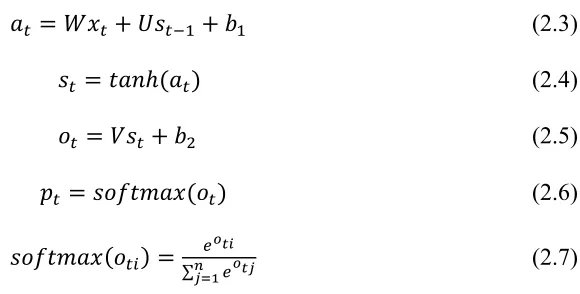
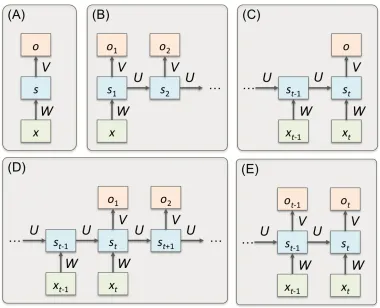
output vector ot at time t (Equation 2.5), and the output vector is referenced to compute pt using another activation function (e.g., softmax) (Equation 2.6 and Equation 2.7). pt is interpreted as a vector that consists posterior probabilities for all available classes, where the unit with the highest value in pt becomes the class label for the input vector, xt. In Equation 2.7, oti denotes the ith component in ot that consists of n components.
𝑎! =𝑊𝑥!+𝑈𝑠!!! +𝑏! (2.3)
𝑠! =𝑡𝑎𝑛ℎ(𝑎!) (2.4)
𝑜! =𝑉𝑠!+𝑏! (2.5)
𝑝! =𝑠𝑜𝑓𝑡𝑚𝑎𝑥(𝑜!) (2.6)
𝑠𝑜𝑓𝑡𝑚𝑎𝑥 𝑜!" = !!!!"!!!"
!!! (2.7)
machine translation system that takes as input an English sentence and translates it to a corresponding Korean sentence). A variant of this model includes Sutskever et al.’s work (Sutskever, Vinyals, & Le, 2014), in which o1 is fed into the model as input at time t+1 to predict o2 (this procedure is repeated until the last o prediction). Finally, Figure 2.3E describes synchronous sequence-to-sequence labeling tasks that produce a synchronized sequence of outputs using a sequence of inputs (e.g. a frame-level video classification that takes as input each frame of the video and predicts if the frame has a human image). Figure 2.2 is in the same context as Figure 2.3E when unfolded.
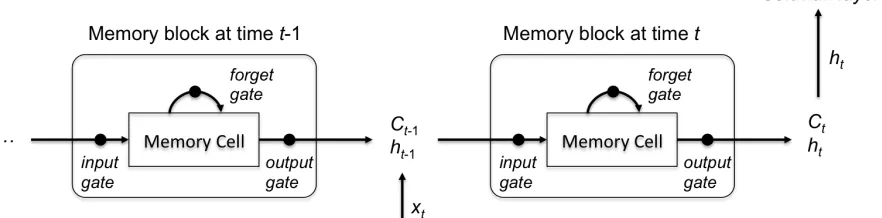
Multiple variations have been derived from the seminal form of RNNs. Recursive neural networks, which relax the from-first-to-last sequential-chain constraint in standard RNNs by generalizing to a tree structure, have been proposed to address challenges in natural language processing work, including sentiment analysis (Socher, Perelygin, & Wu, 2013) and parsing natural scenes and natural languages (Socher & Lin, 2011). Long short-term memory networks (LSTMs) that feature three gating units have been successfully investigated on various sequence labeling challenges (Hochreiter & Schmidhuber, 1997).
In an implementation of LSTMs without peephole connections (Graves, 2012), the input gate (it), forget gate (ft), and candidate value of the memory cell (𝑐!) at time t are computed by Equation (2.8) – (2.10), respectively, in which W and U are weight matrices for transforming the input (xt) at time t and the cell output (ht-1) at time t-1, b is the bias vector of each unit, and σ and tanh are the logistic sigmoid and hyperbolic tangent function, respectively:
𝑖! =𝜎(𝑊!𝑥!+𝑈!ℎ!!!+𝑏!) (2.8)
𝑓! =𝜎(𝑊!𝑥!+𝑈!ℎ!!!+𝑏!) (2.9)
𝑐! =𝑡𝑎𝑛ℎ(𝑊!𝑥!+𝑈!ℎ!!!+𝑏!) (2.10)
candidate of the current memory state via the input gate. This step is described in Equation (2.11):
𝑐! =𝑖!𝑐!+𝑓!𝑐!!! (2.11)
In Equation (2.12), the output gate (ot), similarly calculated as in Equation (2.8) – (2.9), is utilized to compute the cell activation (ht) of the LSTM block, based on the computed memory state (ct) (Equation 2.13):
𝑜! =𝜎(𝑊!𝑥!+𝑈!ℎ!!!+𝑏!) (2.12)
ℎ! = 𝑜! 𝑡𝑎𝑛ℎ(𝑐!) (2.13)
Compared to this variant, another variant of LSTMs has been presented: peephole LSTMs (Graves, 2012). In this architecture, the input and forget gates additionally take as input the previous memory cell’s state, while the output gate utilizes the current memory cell’s state using peephole connections.
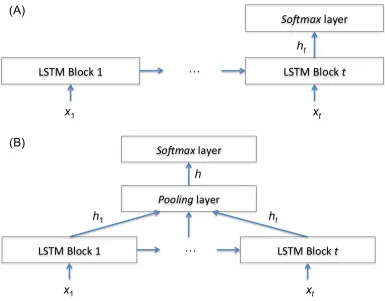
vectors (h1 to ht) (i.e., mean pooling) (Figure 2.5B), among others. Then, the h vector is used to predict the class label of the input sequence x, (x1, …, xt), in an output layer featuring an activation function (e.g., softmax). The unit that is maximally activated (i.e., with the highest posterior probability) in the output layer becomes the most likely class label for x.
2.2.4 Deep Learning in Vision, Language and Speech
been successfully achieved by recurrent neural networks (RNNs), while many computer vision tasks have been most frequently achieved by convolutional neural networks (CNNs) (Schmidhuber, 2014) in the context of deep learning.
RNNs, a variant of RNNs (e.g., gated RNNs, recursive neural networks), or a combination of RNNs with other machine learning techniques (e.g., hidden Markov models) achieved state-of-the-art performance in benchmark tasks including sentiment analysis (Socher et al., 2013), speech recognition (Graves, Mohamed, & Hinton, 2013), optical character recognition (Breuel, Ul-Hasan, Al-Azawi, & Shafait, 2013), language identification (Gonzalez-Dominguez & Lopez-Moreno, 2014), speech recognition (Geiger et al., 2014; Sak, Senior, & Beaufays, 2014), text-to-speech synthesis (Fan, Qian, Xie, & Soong, 2014), and machine translation (Sutskever et al., 2014).
CNNs along with their variants accomplished the-state-of-the-art performance in a Chinese handwriting recognition benchmark (Cireşan & Schmidhuber, 2013), image classification (Szegedy et al., 2015; Md Zeiler & Fergus, 2014), multi-digit number recognition (Goodfellow, Bulatov, Ibarz, Arnoud, & Shet, 2013), scene labeling (Farabet, Couprie, Najman, & LeCun, 2013), object detection (Szegedy, 2013), and video classification (Karpathy et al., 2014). A discussion of the broad range of computational tasks addressed by deep learning can be found in Schmidhuber (2014).
range of natural language processing (NLP) tasks (Mikolov, Chen, Corrado, & Dean, 2013; Mikolov, Sutskever, Chen, Corrado, & Dean, 2013; Mikolov, Yih, & Zweig, 2013) with the aim of representing lexical units’ syntactic and semantic properties on a low-dimensional, continuous vector space, identify inter-relationships across the lexical units (e.g., words, phrases), and improve predictive performance of an NLP task of interest. Initial work on distributed representations was technically grounded in language modeling (Bengio, Ducharme, Vincent, & Janvin, 2003), an unsupervised machine learning task that finds the next word using a sequence of previous words. Words’ distributed representations induced by RNNs are found to effectively capture linguistic regularities between words, such as “queens” – “queen” = “kings” – “king”, which represents syntactic information and “queen” – “woman” = “king” – “man”, which represents semantic information (Mikolov, Yih, et al., 2013).
2.3 User Modeling in Intelligent Game-Based Learning Environments
with the motivating and engaging learning experiences provided by digital games (Jackson & McNamara, 2013; Johnson, 2010; Lester et al., 2013). A key benefit of game-based learning environments is their ability to embed problem-solving challenges within interactive virtual environments, which can enhance students’ motivation (Garris, Ahlers, & Driskell, 2002) and facilitate learning through customized narratives, feedback, and problem-solving support (Rowe et al., 2011; Shute, Ventura, Zapata-rivera, & Bauer, 2009). Moreover, student interaction data from game-based learning activities can be leveraged to evaluate students’ development of competencies and progression towards learning goals (Min et al., 2015; Shute et al., 2009).
Intelligent game-based learning environments support many forms of student modeling to provide user-adaptive game and learning experiences. Student modeling has been mainly conducted in the two principal dimensions: cognitive modeling and affect modeling. Cognitive modeling centers on predicting (1) students’ plans, goals, and behaviors (Baikadi et al., 2014; Conati et al., 2002; Ha et al., 2011; Lee et al., 2014; Min, Ha, et al., 2014; Min, Mott, et al., 2016; Mott et al., 2006) and (2) performance and knowledge (Alvarez et al., 2015; Corbett & Anderson, 1994; Lee & Brunskill, 2012; Min et al., 2015, 2013; Pardos & Heffernan, 2010; Sahebi, Huang, & Brusilovsky, 2014; Shute et al., 2009; Yudelson, Koedinger, & Gordon, 2013), while affect modeling emphasizes on predicting students’ on-going emotional (Calvo & D’Mello, 2010; Picard, 2003) and engagement (Fredricks, Blumenfeld, & Paris, 2004) states during learning processes.
of identifying if the student is actively participating in the learning activities or engaged in the learning objective. Off-task behavior modeling, a cognitive model, enables to identify game behaviors that are not conducive to learning and then eventually support a fine-grained game adaptation synergistically with the student’s knowledge model. Below, we describe two knowledge-modeling approaches that have been investigated to date.
Stealth Assessment. Stealth assessment leverages student interaction data to provide real-time behind-the-scenes measurement of students’ learning processes and outcomes (Shute et al., 2009). Stealth assessments allow educators and researchers to draw inferences about student competencies in an invisible and non-disruptive manner. Specifically, students’ learning is measured by analyzing sequences of observable behavioral cues that revealed from learning activities without posing explicit formative assessments. Recently, Min et al. proposed DeepStealth, a deep-learning-based stealth assessment framework for student knowledge modeling in game-based learning environments (Min et al., 2015).
CHAPTER3
GOALRECOGNITION-BASED OPEN-WORLD DIGITALGAMES
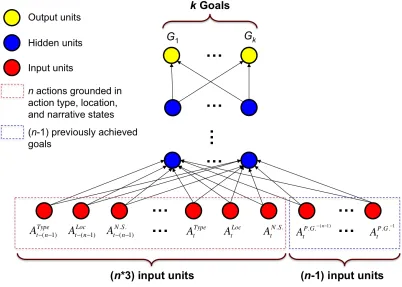
This chapter introduces how open-world digital games can be enriched with player goal recognition. Implementing a goal recognition-based open-world digital game requires goal recognition model training, model evaluation, model deployment, runtime goal recognition, runtime goal-directed game adaptation, and game revision. This dissertation centers on the first two steps, model training and evaluation, as formalized in the Generalized Observable Action Learning for Intent Evaluation (GOALIE) framework. This chapter is organized as follows: we first provide a high-level description of goal recognition-enabled digital games with respect to required components in the pipeline, and then detail the GOALIE framework that accounts for goal recognition model training and evaluation. The goal recognition model training step is described with three previously investigated goal modeling techniques: Bayesian belief networks (Mott et al., 2006), Markov logic networks (Baikadi et al., 2014; Ha et al., 2011), and n-gram encoded feedforward neural networks (Min, Ha, et al., 2014) for a concrete illustration of the process. Finally, the model evaluation step grounded in the five metrics including three conventional and two novel metrics is presented.
3.1 An Overview of Goal Recognition-Enabled Digital Games
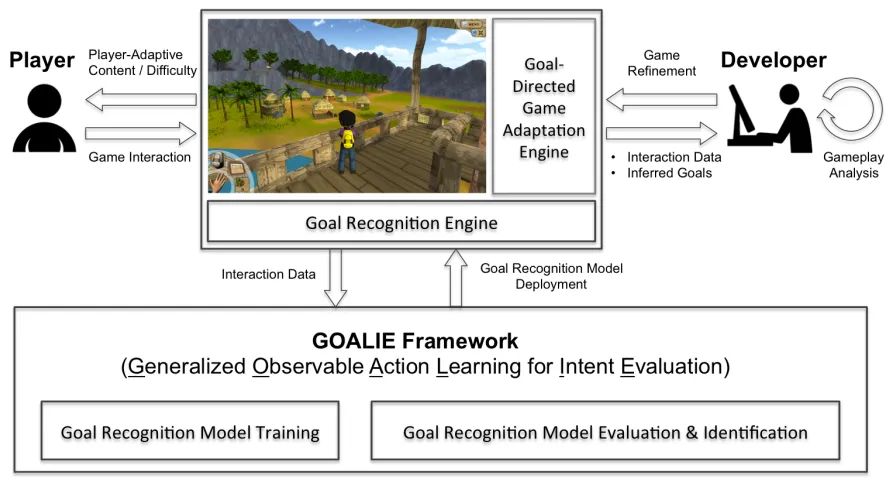
through the Goal-Directed Game Adaptation Engine. The information sent to the Goal Recognition Engine is not bound to game trace logs, but can include any type of interaction data observed through multimodal interfaces such as players’ bodily expressions and physiological signals.
Multimodal data streams have been demonstrated to be tightly linked to affective and cognitive processes (Pantic, Pentland, Nijholt, & Huang, 2007; Yannakakis et al., 2013). Martinez et al. have investigated physiological sensor data to devise players’ affect models utilizing skin conductance and blood volume pulse captured from interactions with digital games (Martinez et al., 2013). Along this line, multimodal physiological signals have been shown to be useful channels for differentiating affective states in learning (Calvo & D’Mello, 2010). On the other hand, physiological sensor data has been investigated for users’ activity
recognition using conditional random fields (Chieu et al., 2006) and fuzzy Bayesian networks (Yang & Cho, 2008).
Moreover, a range of research has demonstrated that bodily expressions (e.g., facial expressions, gestures, postures, eye tracking) offer a rich source of evidence for one’s affect (Ekman & Friesen, 1977; Scherer, Bänziger, & Roesch, 2010) during learning (Grafsgaard, Wiggins, Boyer, Wiebe, & Lester, 2014; Vail, Grafsgaard, Wiggins, Lester, & Boyer, 2014), user attention and interest understanding (Arroyo et al., 2009; Mota & Picard, 2003), and plan and activity recognition in both the unsupervised learning (Freedman et al., 2015) and supervised learning (Gaglio et al., 2015). Eye tracking data streams have been also examined in the context of intelligent user interfaces that support user-adaptive interactions through a user’s high-level mental state understanding (Conati, Merten, Amershi, & Muldner, 2007).
For goal-directed game adaptations, the Goal Recognition Engine preprocesses a multi-stream user interaction data. The low-level interaction logs are encoded into a format that the goal recognition model embedded in Goal Recognition Engine take as input. Then, the Goal Recognition Engine infers a player’s high-level intention based on the goal recognition model that was identified by GOALIE (Section 3.2), and passes a list of goals along with inferred posterior probabilities to Goal-Directed Game Adaptation Engine.
predicted goal and models’ predictive confidence (e.g., the posterior probability of the recognized goal) per player action. The Goal-Directed Game Adaptation Engine can further utilize any observable information such as the game progress (e.g., actions, locations, triggered events, narrative progress, previously achieved goals) and the current environment (e.g., object, non-player character locations) as well as the static player profile.
Then, the Goal-Directed Game Adaptation Engine must determine the type of adaptation (e.g., event generation, content generation) and timing of the adaptation (e.g., if the goal recognition confidence is low, the engine may decide to bypass the current prediction), both of which can be operated by a decision model embedding a set of rules or a machine-learned model. Player goal-driven adaptations can be realized in a variety of forms based on the focus of the game. For example, intelligent game-based learning environments can leverage goal recognition models to predict students’ progress towards learning goals, enabling delivery of tailored hints and feedback to enhance learning. Alternatively, goal recognition models can be utilized to identify user objectives that conflict with a game’s intended narrative (e.g., eliminating an important character), thereby triggering an intervention to re-direct the user’s behavior in the gameworld (Ha, Rowe, Mott, & Lester, 2014).
2011; Yannakakis et al., 2013; Zoeller, 2010). Developers’ telemetry efforts can inform game refinements (e.g., game mechanics, game design changes) and directions of the future game design, to improve playing experiences. By analyzing players’ high-level intentions in conjunction with raw game trace logs, goal recognition can further facilitate the playtesting analysis and game refinement process by game developers. In the following sections, we describe the GOALIE framework that performs offline goal recognition model training and evaluation, which constitutes a pivotal step to enable goal-directed game adaptations and game telemetry-driven game refinement.
3.2 Generalized Observable Action Learning for Intent Evaluation (GOALIE)