ISSN(Online): 2319-8753 ISSN (Print) : 2347-6710
I
nternational
J
ournal of
I
nnovative
R
esearch in
S
cience,
E
ngineering and
T
echnology
(An ISO 3297: 2007 Certified Organization)
Vol. 5, Issue 6, June 2016
A Novel Approach to Scene Text Deblurring
With Accurate Estimation of Kernels
Deepthi C 1, Reeja R Rajan 2 , Prof.Ambikadevi Amma.T 3
P.G. Student, Department of Computer Science and Engineering , JCET,Lakkidi, Kerala ,India1
Assistant Professor, Department of Computer Science and Engineering, JCET, Lakkidi, Kerala, India2
Head of the Department, Department of Computer Science and Engineering, JCET, Lakkidi, Kerala, India3
ABSTRACT: The text resides in the natural scene images play an important role in the environment which can provide the semantic meaning of images in the considerable manner. Recognition and understanding the meaning of the text fields present in the natural scene images would be more complex where the text would not be clear. The content or text in natural scene image gives some clue for many image based applications such as scene understanding, character recognition etc. Text reading in documents is difficult, due to blur, especially image captured by handheld cameras. Deblurring techniques are used to improve the visual quality of images. In this work propose a robust scene text image deblurring method using Text-specific Multi-scale Dictionaries, TMD. The problem of recovering the clear scene text is solved by exploiting the text field characteristics. A series of text-specific multi-scale dictionaries (TMD) and a natural scene dictionary is learned for separately modeling the priors on the text and non-text fields. Text localization method is used to differentiate text fields from non-text ones. The TMD-based text field reconstruction helps to deal with the different scales of strings in a blurry image effectively. The goal is to restore blurry scene text images which contain spatially-varying blur kernels in different text fields. For each text fields perform non-uniform deblurring method because which is more suitable for real situations. A new piece-wise deblurring model is proposed to predict the kernels accurately for the different text fields.
KEYWORDS:Scene text, multi-scale dictionaries, text localization, non-uniform deblurring
I. INTRODUCTION
ISSN(Online): 2319-8753 ISSN (Print) : 2347-6710
I
nternational
J
ournal of
I
nnovative
R
esearch in
S
cience,
E
ngineering and
T
echnology
(An ISO 3297: 2007 Certified Organization)
Vol. 5, Issue 6, June 2016
The natural scene consists of text characters as well as the strings that provide straightforward and unambiguous information on special target and surrounding environment. Text extraction [1][2] from scene images plays an important role in many image and video-based applications, such as context retrieval, assistant navigation, aid reading and scene understanding. In pervasive image acquisition, image blur caused by camera shake frequently happens, which leads to image quality degradation, and thus makes some difficulties in character recognition and image understanding. The scene text deblurring has received ample research interests to improve the visual quality of degraded images. A new robust scene text image deblurring [3] method is introduced using Text-specific Multi-scale Dictionaries, namely TMD.
Text data present in images contain useful information for automatic explanation, indexing, and structuring of images. Extraction of this information involves detection, localization, tracking, extraction, enhancement, and recognition of the text from a given image. However variations of text due to differences in size, style, orientation, and alignment, as well as low image contrast and complex background make the problem of automatic text extraction extremely challenging in the computer vision research area. The proposed methods compare two basic approaches for extracting text region in images: edge-based and connected-component based. The algorithms are implemented and evaluated using a set of images that vary along the dimensions of lighting, scale and orientation. Accuracy, precision and recall rates for each approach are analyzed to determine the success and limitations of each approach.
Detecting text in natural images, as opposed to scans of printed pages, faxes and business cards, is an important step for a number of Computer Vision applications, such as computerized aid for visually impaired, automatic geocoding of businesses, and robotic navigation in urban environments. Retrieving texts in both indoor and outdoor environments provides contextual clues for a wide variety of vision tasks. Moreover, it has been shown that the performance of image retrieval algorithms depends critically on the performance of their text detection modules.
The deblurring problem is heavily ill-posed. Recently the challenge of blind deblurring has attracted much attention, and various image blind deblurring methods have been introduced to conquer the task. These methods can provide promising results for natural landscape images but they are still unsuitable for text images. The main reason is that most of them employ the natural image statistics instead of the characteristics of text fields as the regularizer.
The main contribution towards in this deblurring task is two-fold. The primary contribution is, due to the variety of text sizes in different text fields of an image, for that here introduce a novel TMD based text field reconstruction method to handle different scales of strings in a blurry image effectively. Another contribution is, use a piece-wise scheme as in to estimate the multiple kernels on different text fields selected by a text localization method automatically. The main difference between another method is, that needs to partition whole images into multiple regions, while this method only considers the text fields because here focus on scene text deblurring. In a captured scene text image, multiple text fields are exist with spatially-varying blur kernels. Therefore, it is in general impossible to correctly deblur the whole image if both the camera motion and the scene geometry are neither unknown.
A crucial step in the deblurring process for images is blur kernel estimation. Estimation of the kernel, especially in the presence of noise, is easily turbulent, and the quality of the resulting deblurred images is hence degraded. Since every motion blur in a single exposure image can be represented by two dimensional parametric curves. In which adopt a piecewise-linear model to approximate the curves for the reliable blur kernel estimations. The piece wise linear model is found to be an effective tradeoff between flexibility and robustness as it takes advantage of generic and linear models. The proposed model is not only robust with respect to noise, but also flexible in dealing with various types of blur.
II. RELATEDWORK
The deblurring problem is heavily ill-posed. Recently the challenge of blind deblurring has attracted much attention, and various image blind deblurring methods have been introduced to conquer the task. These methods can provide promising results for natural landscape images but they are still unsuitable for text images. The main reason is that most of them employ the natural image statistics instead of the characteristics of text fields as the regularizer.
ISSN(Online): 2319-8753 ISSN (Print) : 2347-6710
I
nternational
J
ournal of
I
nnovative
R
esearch in
S
cience,
E
ngineering and
T
echnology
(An ISO 3297: 2007 Certified Organization)
Vol. 5, Issue 6, June 2016
camera shake, the user must specify an image region without saturation effects. Camera shake, in which an unsteady camera causes blurry photographs, is a chronic problem for photographers. The explosion of consumer digital photography has made camera shake very prominent, particularly with the popularity of small, high-resolution cameras whose light weight can make them difficult to hold sufficiently steady. Many photographs capture ephemeral moments that cannot be recaptured under controlled conditions or repeated with different camera settings if camera shake occurs in the image for any reason, then that moment is lost. There are two main steps to this approach. First, the blur kernel is estimated from the input image. The estimation process is performed in a coarse-to-fine fashion in order to avoid local minima. Second, using the estimated kernel, there apply a standard deconvolution algorithm to estimate the latent (unblurred) image.
Noisy image pairs[6] are an approach that the image is deblurred with the help of noisy image. In which use two images for motion deblurring, one is noisy and the another is motion blurred. But the issue is thant kind of assumption is not always satisfied.
Camera-based document image deblurring is significant task in digital document processing. Traditional deblurring algorithms [7] have been proposed to work for natural-scene images. However the natural-scene images are not consistent with document images. Using this method distinct characteristic of document images are investigated and propose a content-aware prior for document image deblurring. It is based on document image foreground segmentation. An effective text image deblurring method is introduced based on three text-specific properties. The method relies on the properties [8] of text regions detected by the stroke width transform (SWT) [9].
In most cases the blurred image is deblurred with a single blur kernel. But when an image having motion in different direction is considered then it can cause serious problems. As a result different kernels need to be considered. Removing Blur with Image Statistics [10]is a method in which a single frame is considered for the whole image with the help of segmentation. It can be seen that the statistics of the derivatives are very much changed under different blur kernels. This algorithm searches for mixture model that can best define the distribution observed in the image. It results in two blur kernels and then by taking smooth layers assignment the likelihood is maximized. The output produced is a real world image with rich texture. But it has also got some limitations like the use of box filters [11], unknown direction of the blur, failure to describe the blur size etc.
III.TMDBASEDSCENETEXTDEBLURRING
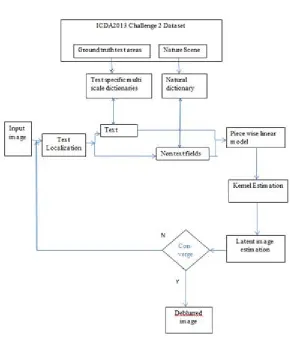
To improve the visual quality of degraded images, deblurring techniques are desired, which also play an important role in character recognition and image understanding. The problem of recovering the clear scene text is handled by exploiting the text field characteristics. Propose a robust scene text image deblurring method using Text-specific Multi-scale Dictionaries, namely TMD. The overview of method is shown in Figure 2.1.
The model represents working of proposed deblurring method, in which the input is a blurry image. The proposed method estimates the latent scene text image iteratively with text specific multi-scale dictionaries and a nature scene dictionary until it converges to a stable solution. The primary step is dictionary learning. Using the text and non-text field characteristics, learn a natural scene dictionary and a series of text-specific multi-scale dictionaries. Then run the structure based partition and grouping method to localize the text fields. By this text localization method differentiate text fields from non-text ones. Next step is, based on TMD and the natural dictionary, construct the dedicated priors for real world text and non-text fields. As a result, optimize the cost function to estimate the blur kernel and the latent image. These procedures will repeat until the blur kernel converges.
ISSN(Online): 2319-8753 ISSN (Print) : 2347-6710
I
nternational
J
ournal of
I
nnovative
R
esearch in
S
cience,
E
ngineering and
T
echnology
(An ISO 3297: 2007 Certified Organization)
Vol. 5, Issue 6, June 2016
Fig .1 overview of TMD based deblurring model
The main disadvantages of existing system is it can’t find the kernel for different text fields in the accurate manner and also degraded system performance in case of more blur noise present in the images. In the proposed system, improved de-blurring concept is introduced which attempts to avid the de-blurring present in the images by introducing the piece-wise de-blurring model which can consider the local evidence and global consistence for robust and accurate estimation of kernels for different text fields.
ISSN(Online): 2319-8753 ISSN (Print) : 2347-6710
I
nternational
J
ournal of
I
nnovative
R
esearch in
S
cience,
E
ngineering and
T
echnology
(An ISO 3297: 2007 Certified Organization)
Vol. 5, Issue 6, June 2016
IV.EXPERIMENTAL RESULTS
Figures shows the results of the TMD based deblurring process. Figure 2 (a) shows the original image (b) shows the selected area for deblurring process. That is, if image is larger then select the particular area for deblurring. (c) is the cropped image.(d) is the intermediate image ,the iterative procedure of proposed method finds out the text fields. At the end of the all iteration the result is clear image that is shown in (e).
(a) (b)
(c) (d)
ISSN(Online): 2319-8753 ISSN (Print) : 2347-6710
I
nternational
J
ournal of
I
nnovative
R
esearch in
S
cience,
E
ngineering and
T
echnology
(An ISO 3297: 2007 Certified Organization)
Vol. 5, Issue 6, June 2016
(e)
Fig.2 TMD based deblurring (a) Original image (b) Area selection (c) Cropped image (d) Intermediate result (e) Final output
V. CONCLUSION
Scene text deblurring using Text specific multiscale dictionaries is a novel method for the task of scene text image deblurring by exploiting the characteristics of the text fields. This deburring method employs the text localization method to locate the text fields, and then take advantages of the TMD and the natural dictionary, trained on the text and non-text patches, to recover the latent image. The text-specific dictionaries are more sparse than the natural dictionary. So scene text can be recovering more clear using text-specific dictionaries than natural dictionary. The dictionary-based method is more general and flexible in modelling the scene text properties than the ad hoc methods in modelling image priors, and is more robust to noises. In addition, because the blur appearing in real world scenarios is hardly a perfect spatial-invariant motion blurring, the non-uniform method on each text field can better recover clear scene texts. The kernels of text fields in non-uniform stage are initialized based on uniform deblurring, which makes the model have modest effect when the kernels in different text fields are significantly varying. Design more elaborated piece-wise deblurring model to take local evidence and global consistence for robust and accurate estimation of kernels for different text fields.
REFERENCES
[1] Jian Zhang, Renhong Cheng, Kai Wang, Hong Zhao, “Research on the text detection and extration from complex images”, Fourth International Conference on Emerging Intelligent Data and Web Technologies, Vol. 10, Page no. 708-713, 2013.
[2] C.P. Sumathi, T. Santhanam, G.Gayathri Devi, “A Survey On Various Approaches Of text Extraction In Images”, International Journal of Computer Science and Engineering Survey (IJCSES),Vol.3, Page no. 27-42, August 2012.
[3] Lukas Neumann, Jirı Matas, “Real-Time Scene Text Localization and Recognition”,IEEE Conference on Computer Vision and Pattern Recognition, pp. 3538–3545, 2012.
[4] Q. Shan, J. Jia, and A. Agarwala, “High-quality motion deblurring from a single image,” ACM Trans. Graph., vol. 27, no. 3, 2008. [5] R. Fergus, B. Singh, A. Hertzmann, S. T. Roweis, and W. T. Freeman,“Removing camera shake from a single photograph,” ACM
Trans.Graph., vol. 25, no. 3, pp. 787–794, 2006.
[6] L. Yuan, J. Sun, L. Quan, and H.-Y. Shum, “Image deblurring with blurred/noisy image pairs,” ACM Trans. Graph., vol. 26, no. 3, 2007
ISSN(Online): 2319-8753 ISSN (Print) : 2347-6710
I
nternational
J
ournal of
I
nnovative
R
esearch in
S
cience,
E
ngineering and
T
echnology
(An ISO 3297: 2007 Certified Organization)
Vol. 5, Issue 6, June 2016
[10] A. Levin, “Blind motion deblurring using image statistics,” in Advances in Neural Information Processing Systems 19. Cambridge, MA, USA MIT Press, pp. 841–848, 2006.
[11] L. Zhong, S. Cho, D. Metaxas, S. Paris, and J. Wang, “Handling noise in single image deblurring using directional filters,” in Proc. IEEE Conf. CVPR, pp. 612–619, Jun. 2013.
[12] Xiaochun Cao, Wenqi Ren, Wangmeng Zuo, Xiaojie Guo, Hassan Foroosh, “Scene Text Deblurring Using Text-Specific Multiscale Dictionaries”, IEEE Transactions On Image Processing, Vol. 24, No. 4, April 2015.
[13] C. Yi and Y. Tian, “Text string detection from natural scenes by structure-based partition and grouping,” IEEE Trans. Image Process.,vol. 20, pp. 2594–2605, Sep.2011.