Video Scene Text Deblurring Using TMD &
ER Text Localization
Puja Appasaheb Chavan1, Prabhudev S2
P.G. Student, Department of Computer Engineering, VACOE, Ahmednagar, Maharashtra, India1
Associate Professor, Department of Computer Engineering, VACOE, Ahmednagar, Maharashtra, India2
ABSTRACT: Numerous advanced video deblurring techniques depends on a robust hypothesis that the caught scenes are static. These techniques are unsuccessful to deblur blurry videos in dynamic scenes. Blurring is unclear parts of an image. To increase the superiority of such images, deblurring methods are required, which plays a significant role in character detection and also image grasping. Utilizing the text field properties improving the blurry scene text exists. The TMD is used for construct the text and natural dictionary is used for non-text field. The implementation can also be completed with the help of modeling character recognition difficulty as a capable consecutive determination from the group of ERs. Enhanced kernel assessment approach is utilized in projected system and analysis is performed on video info. Video frames provide as input and frames are obtained after that. This image is passing to proposed system. Proposed system achieves important enhancements in eliminating blurs and assessing precise optical flows in blurred frames of videos. Experimental outcomes validate the superiority of proposed approach in actual and stimulating videos.
KEYWORDS:Scene Text, Image De-blurring, Multi-Scale Dictionaries, Text Localization.
I. INTRODUCTION
Every Camera recorded image is more or less blurry. We want the documented image to be a correct depiction of the scene that we see. Thus, image deblurring is important in creating images sharp and useful. Text recognition & localization inside regular images helps as a vital element used for subject-based data retrieval, so written data universally offers significant suggestions aimed at recognizing the top ranked explanation of interactive media matter. This issue has enlarged significant concern in equally the scholarly world and business in the latest era. In spite of the great strength given towards resolving the present difficulty, text localization continues to be tough problem. Problems mainly stay with variety of script outlines along with the difficulty of prospects in regular images. For instance, scripts in pictures often change severely in typeface, dimension, and shape, and then are able to changed easily with brightness. Also, text similar environment things, similar blocks, spaces and plants, often lead to various deceptive warnings in text recognition. Motion blur created by means of camera vibration has been any of the major reasons of decreased image superiority in digital imaging, particularly after using telephoto lens or else by means of extended transfer rate. In earlier, various investigators have been functioning on improving clear images after motion-blurred. The motion blur produced by camera vibration typically is displayed using a spatial invariable blurring method. Here we face the difficulty of improving the clear scene text by means of utilizing the text field features. A sequence of TMD as well as a natural scene dictionary is learned for distinctly demonstrating former on the text and non-text fields [1].
II. RELATEDWORK
C. Yi, X. Yang et al. [4] proposed entire performance estimation of image based STC recognition. Produce Global Histogram of Oriented Gradient (GHOG) with the aid of calculating HOG descriptor after global sampling. C. Yi and Y. Tian[5]. suggested text string detection commencing natural scenes via SPG method.
Lukas Neumann et al. [6] presents real-time scene text detection & acknowledgment approach is stated. Realtime operation is done by modeling the character recognition difficulty as an effective consequent choice from the group of Extremal Regions (ERs).
Tae Hyun Kim et al. [8] presented a unique approach that eliminates general blurs in dynamic scenes. They handled general blurs using assessment of a pixel-wise kernel with optical flows. Weiguo Gong et al. [9] proposed video deblurring technique for improving blurry video affected by camera shake. The projected method usages correlation of the present frame & the frames previously present frame, and the frame after the present frame intended for finding a superior deblurred video.
III.SYSTEM ARCHITECTURE
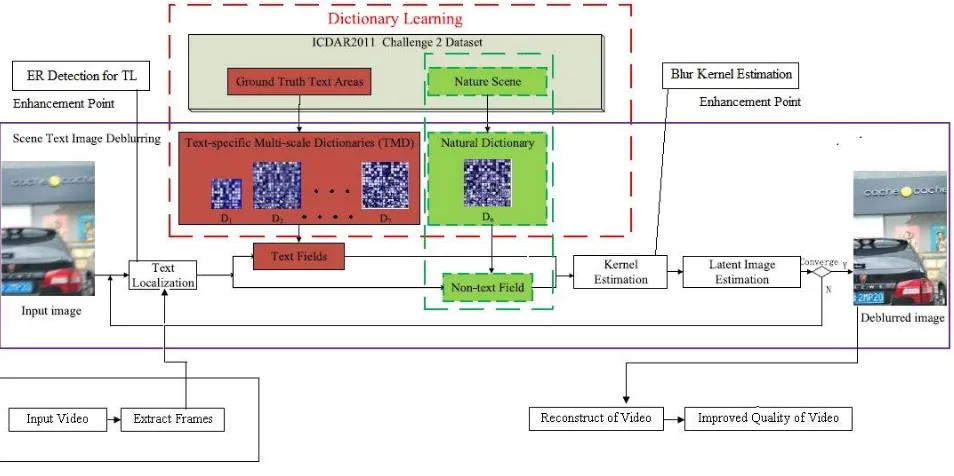
The existing system fails to deblurr blurred videos in dynamic scenes. Motion blurs are the maximum general artifacts in videos noted by means of hand-held cameras. Existing method aimed at text localization doesnt give suitable result (i.e. incomplete text detection or fail to identify the text)[1]. Fig.1. shows proposed system. Video/Image is given as input to proposed system for deblurring. Frames are extracted from video, and then given to text localization. Text localization differentiates the text field from non-text once. Using TMD and natural dictionary construct the text field and non-text field respectively further then evaluation of the kernel and latent image is done. This step is repeat until blur kernel converge. Finally get the deblurr frames from that reconstruct the video. Finally improve the quality of video.
Fig. 1. Proposed System
IV.ERBASE DETECTION ALGORITHM
1. An ER r by threshold Ɵ is designed alike combination of one or more/nothing ERs by threshold Ɵ − 1 and
pixels of value Ɵ. Where Ɵ, 0<= Ɵ <=255.
2. Determining descriptors for pixels introduced at threshold Ɵ and reclaiming the descriptors of regions Ɵ at
threshold Ɵ − 1.
3. Incrementally estimable descriptors are calculated each ER r and then descriptors are utilized as elements for a classifier which evaluates the class-conditional probability p.
4. The value of p (r|character) is followed utilizing inclusion relation of ER through all thresholds i.e. from 0 to 255.
5. Then simply the ERs relate to local max of the probability p (r|character) are chosen.
6. Every pixel is allotted the value of “gradient” estimated by highest intensity modification among the pixel and its neighbors.
7.No of characters are distinguished as ERs in a particular channel and united from all channels. A character is measured as noticed if bordering box of the ER balances at smallest region of the bordering box in the ground reality.
V. BLUR KERNEL ESTIMATION ALGORITHM
Calculate outcomes taking place several kernel standards to acquire efficient latent image. In previous procedure they compute the result on one value of kernel.
VI.EXPERIMENTAL SETUP
The main framework is being assembled utilizing Java Framework (form jdk 1.7) on Windows Platform. The Netbeans (Version 6.9.1) are on the other hand utilized as an advancement tool. JMF(Java Media Framework) API and Xuggler library is utilized for video operation. The framework doesn’t need a specific equipment to run; any standard machine is equipped for running the application.
VII. RESULTS AND DISCUSSION
Fig. 2 shows X-axis: various performance parameters (Precision, Recall & F-measure) and Y-axis: values in (%). Results are taken on three different parameters namely Precision, Recall & F-measure to check performance against blur image.
A performance parameter value for image is given below: Precision: 0.375
Recall: 1
Fig. 2. Performance Graph of Image
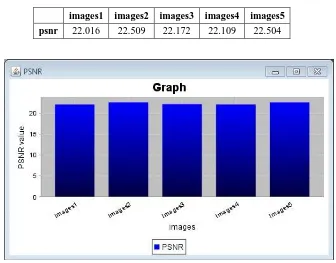
Fig.3 shows X axis: Image dataset and Y axis: PSNR values. Results are taken on PSNR parameter. Graph shows that there are total 5 test images on which PSNR calculated by using gray scale image and deblurr image. Following Table 1 shows the PSNR values for 5 test images.
Table 1: PSNR values for 5 test images
images1 images2 images3 images4 images5 psnr 22.016 22.509 22.172 22.109 22.504
Fig. 4 shows X-axis: various performance parameters (Precision, Recall & F-measure) and Y-axis: values in (%). Results are taken on three different parameters namely Precision, Recall & F-measure to check performance. Graph shows the proposed method achieves highest Precision, Recall and F-measure.
A performance parameter value for image is given below: Precision: 0.4489
Recall: 1
f-measure: 0.6197
Fig. 4. Performance Graph for Video
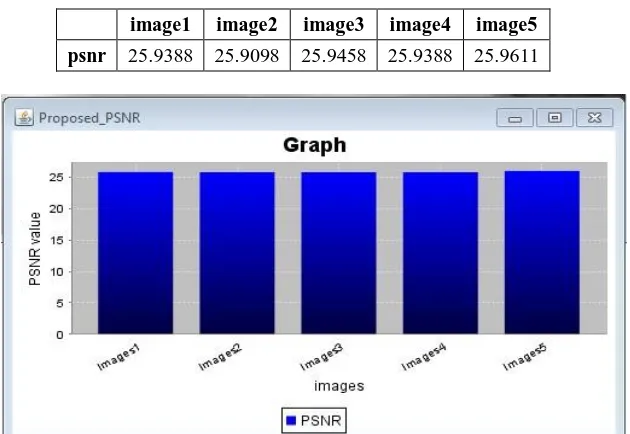
Fig. 5 shows X axis: Image dataset and Y axis: PSNR values. Results are taken on PSNR parameter. Graph shows that there are total 5 test images on which PSNR calculated for image deblurr video images. Following Table 2 shows the PSNR values for 5 test images.
Table 1: PSNR values for 5 test video images
image1 image2 image3 image4 image5 psnr 25.9388 25.9098 25.9458 25.9388 25.9611
VIII.CONCLUSION AND FUTURE SCOPE
In proposed approach an end-to-end real-time video scene text deblurring using TMD & ER base text localization technique is represent. The dictionary-based technique is common and adaptable to signify the video scene text assets than the temporary techniques in constructing video scene text image base, also extra vigorous to noises. Proposed system resolve several drawbacks of existing system. Proposed system allows rapid variations of motions and hence works better than the earlier model. Also presently working on English language only, so TMD is has limitation. In future focus is on TMD so that is will comfortable with other languages too.
REFERENCES
[1] Xiaochun Cao, Wenqi Ren, Wangmeng Zuo, Xiaojie Guo, Hassan Foroosh, “Scene Text Deblurring Using Text-Specific Multiscale Dictionaries”, IEEE Transactions on Image Processing, Vol. 24, No. 4, pp.1302-1314, April 2015.
[2] H. Cho, J. Wang, and S. Lee, “Text image deblurring using text-specific properties”, in Proc. 12th ECCV, pp. 524-537, 2012.
[3] B. Epshtein, E. Ofek, and Y. Wexler, “Detecting text in natural scenes with stroke width transform”, in Proc. IEEE Conf. CVPR, pp. 2963-2970, Jun. 2010.
[4] C. Yi, X. Yang, and Y. Tian, “Feature representations for scene text character recognition: A comparative study”, in Proc. 12th ICDAR, pp. 907-911, Aug. 2013.
[5] C. Yi and Y. Tian, “Text string detection from natural scenes by structure based partition and grouping”, IEEE Trans. Image Process., vol. 20, no. 9, pp. 2594-2605, Sep. 2011.
[6] Lukas Neumann, Jiri Matas, “Real-Time Scene Text Localization and Recognition”, in Proc. IEEE Conf. CVPR 2012, pp.16-21, Jun 2012. [7] Sonia George, Noopa Jagdeesh, “A Survey on Text Detection and Recognition from Blurred Images”, Conference on Innovative Engineering,
Vol. II, Special Issue X, pp. 1180-1184, March 2015.
[8] Tae Hyun, Kim and Kyoung Mu Lee, “Generalized Video Deblurring for Dynamic Scenes”, CVPR 2015.
[9] Weiguo Gong, Wenzhi Wang, Weihong Li, Shu Tang, “Temporal Consistency Based Method for Blind Video Deblurring”, IEEE 22nd International Conference on Pattern Recognition, pp. 861-864, 2014.
[10] Xu Zhou, J. Mateos, F. Zhou, R. Molina, Aggelos K. Katsaggelos Fellow, “Variational Dirichlet Blur Kernel Estimation”, IEEE Trans. Image Process., vol. 11, no. 4, pp. 1057-7149, Dec. 2012.
[11] Lin Zhong, Sunghyun Cho, Dimitris Metaxas, Sylvain Paris, Jue Wang, “Handling Noise in Single Image Deblurring using Directional Filters, IEEE Conference on Computer Vision and Pattern Recognition”, pp. 612-619, 2013.
[12] K. Kim, K. Jung, and J. Kim, “Texture-base approach for text detection in images using support vector machines and continuously adaptive mean shift algorithm”, IEEE Trans. Pattern Anal. Mach. Intell., vol. 25, no. 12, pp. 16311639, Dec. 2003.
[13] Y.F. Pan, X. Hou, and C.L. Liu, “A hybrid approach to detect and localize texts in natural scene images”, IEEE Trans. Image Process., vol. 20, no. 3, pp. 800813, Mar. 2011.
[14] J.-F. Cai, H. Ji, C. Liu, and Z. Shen, “Blind motion deblurring from a single image using sparse approximation”, in Proc. IEEE Conf. CVPR, pp. 104-111, Jun. 2009.
[15] R. Fergus, B. Singh, A. Hertzmann, S. T. Roweis, and W. T. Freeman, “Removing camera shake from a single photograph”, ACM Trans. Graph., vol. 25, no. 3, pp. 787 - 794, 2006.
[16] A. Levin, Y. Weiss, F. Durand, and W. T. Freeman, “Understanding and evaluating blind deconvolution algorithms”, in Proc. IEEE Conf. CVPR, pp. 1964-1971, Jun. 2009.
[17] Q. Shan, J. Jia, and A. Agarwala, “High-quality motion deblurring from a single image”, ACM Trans. Graph., vol. 27, no. 3, 2008, Art. ID 73. [18] B. Epshtein, E. Ofek, and Y.Wexler, “Detecting text in natural scenes with stroke width transform”, in Proc. IEEE Conf. CVPR, San Francisco,
CA, USA, pp. 2963 - 2970, 2010.
[19] J.-F. Cai, H. Ji, C. Liu, and Z. Shen, “Framelet-based blind motion deblurring from a single image”, IEEE Trans. Image Process., vol. 21, no. 2, pp. 562-572, Feb. 2012.
[20] H. Ji and K. Wang, “Two-stage approach to blind spatially varying motion deblurring”, in Proc. IEEE Conf. CVPR, Jun.2012, pp. 7380. [21] L. Zhong, S. Cho, D. Metaxas, S. Paris, and J. Wang, “Handling noise in single image deblurring using directional filters”, in Proc. IEEE Conf.
CVPR, pp. 612-619, Jun. 2013.
[22] M. Elad and M. Aharon, “Image denoising via sparse and redundant representations over learned dictionaries”, IEEE Trans. Image Process., vol. 15, no. 12, pp. 3736-3745, Dec. 2006.
[23] M. Elad, M. A. T. Figueiredo, and Y. Ma, “On the role of sparse and redundant representations in image processing”, Proc. IEEE, vol. 98, no. 6, pp. 972-982, Jun. 2010.