Vol. 6, Issue 2, February 2017
Image Processing and Segmentation of
Human Eye for Prediction of IRIS
Dr.P.Suresh1, N.Subramani2, J.Anish Jafrin Thilak3, S.Sathishkumar4, V.V.Arunsankar 5
Professor, Department of Mechanical Engineering, Karpagam College of Engineering, Coimbatore, India1 Assistant Professor, Department of Mechanical Engineering, Karpagam College of Engineering,
Coimbatore, India2,3,4&5
ABSTRACT: Iris is one the important Biometric Identification technique and also Iris is one of unique identifier of Human then it is stable throughout a life of the person’s. In this work a new method to recognition of the eye have been proposed. Edge detection is one of the important modules of any image processing technique. In this work we have proposed the edge detection technique based on Region of Interest (ROI) and also Edge Length (EL) to recognize the Human eye. The performance of the proposed system has been verified and validated with existing problem. This technique is a novel technique to identify the Iris and also the proposed technique shows significant results and compared with the other conventional technique. Using this technique we can able to predict the Cholesterol inside the eye through image processing.
KEYWORDS: Iris, Edge detection, ROI, Edge Length, Eye image and Cholesterol.
I. INTRODUCTION
Popularity of the iris biometric grew considerably over the past three years. The problems of processing, encoding Iris texture, and designing iris-based recognition systems have attracted the attention of a large number of research teams [1]. On the other side, the iris biometric has been gaining public acceptance. Modern cameras used for iris acquisition are less intrusive compared to earlier iris scanning devices. Iridology is the science of analyzing the delicate structures of the iris of the eye [2,3]. The iris reveals body constitution, inherent weaknesses, and levels of health and transitions that take place in a person's body according to the way one lives [4]. There is an old saying that the eyes are the window of the soul. They can also be a window to one’s health. Like fingerprints or faces, no two irises (the colored part of the eye) are exactly alike [5,6,7]. The iris structure is so unique it is now being used for security identification at ATM machines and airports. And for centuries, it has also been used to analyze people’s health – past, present and future. The study of the iris for medical purposes is called iridology [8]. The iris contains detailed fibers and pigmentation that reflects our physical and psychological makeup. When an organ or body system is in poor health, the nerve running from that body part will start to recede [9]. When it does, it draws with it various degrees of the layers of fibers which make up the color of the iris of the eyes, leaving darkened marks called lesions [10, 11, 12]. Iris is one the important Biometric Identification technique and also Iris is one of unique identifier of Human then it is stable throughout a life of the person’s. In this work a new method to recognition of the eye have been proposed. Edge detection is one of the important modules of any image processing technique. In this work we have proposed the edge detection technique based on Region of Interest (ROI) and also Edge Length (EL) to recognize the Human eye. The performance of the proposed system has been verified and validated with existing problems. This technique is a novel technique to identify the Iris and also the proposed technique shows significant results and compared with the other conventional techniques.
II.PROPOSED WORK SEQUENCE
Vol. 6, Issue 2, February 2017
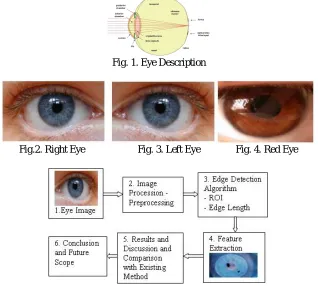
image centre and then it will be incorporated by using edge detection algorithm. Both the results have been compared and analyzed and also proved this technique also helpful for the Iris prediction. Eye description is shown in Figure 1 and then Right eye original image is shown in Figure 2, Left eye original image is shown in Figure 3 and similarly red eye original image is shown in Figure 4. The proposed method flow diagram is shown in Figure 5 in a sequence manner.
Fig. 1. Eye Description
Fig.2. Right Eye Fig. 3. Left Eye Fig. 4. Red Eye
Fig.5. Flow diagram of proposed method
III. EDGE DETECTION ALGORITHM
Segmentation is the process of partitioning a biomedical or digital image into its constituent objects or regions. These types of objects are having some common Characters like colour, density, texture, intensity and size, etc. In the segmentation first step is to predict the edge of the image and parts of the image. Once the edge will be detected from the using edge detection technique then the segmentation will take place. There will be a lot of segmentation techniques will be available. That is Canny edge detection techniques, Genetic Algorithm approach, Random walker method approach, Sobel operator approach, Prewitt operator approach and Roberts operator approach, etc. In this work we have applied only Prewitt operator, Sobel operator and Prewitt operator approach. These techniques will follow the edge based technique.
Vol. 6, Issue 2, February 2017
applied separately to the input image, to produce separate measurements of the gradient component in each orientation that is Gx and Gy. These can be combined together to find the absolute magnitude of the gradient at each point and the orientation of that gradient. The gradient magnitude is given below in Figure 6.
(1)
-1 0 1 1 2 1
-2 0 2 0 0 0
-1 0 1 -1 -2 -1
Gx Gy
Fig.6. Gradient Magnitude Although typically, an approximate magnitude is computed using:
│G│=│Gx│+ │Gy│ (2)
Which is much faster to compute. The angle of orientation of the edge (relative to the pixel grid) giving rise to the spatial gradient is given by:
α = arctan(Gy/Gx) - 3π/4 (3)
In this case, orientation 0 is taken to mean that the direction of maximum contrast from black to white runs from left to right on the image, and other angles are measured anti-clockwise from this. Often, this absolute magnitude is the only output the user sees the two components of the gradient are conveniently computed and added in a single pass over the input image using the pseudo convolution operator shown in Figure 7.
H1 H2 H3
H4 H5 H6
H7 H8 H9
Fig.7. Pseudo convolution Using this mask the approximate magnitude is given by:
│G│=│(H1+2xH2+H3)–(H7+2xH8+H9)│+
│(H3+2x H8+H9)–(H1+2xH4+H7)│ (4)
Vol. 6, Issue 2, February 2017
III. RESULTS AND DISCUSSION
The performance of the three operator’s simulation results shown in below table 1. Table.1. Comparative Results of Edge mapping Technique Original Image Predicted edge image Sobel operator
Prewitt operator
Roberts operator
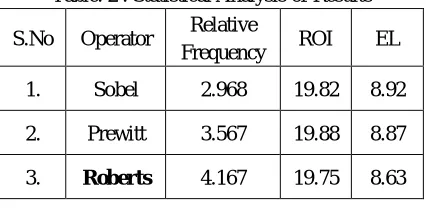
The best and optimum detector type can be evaluated by calculating the edge maps relative to each other through statistical evaluation. Upon this evaluation, an edge detection method can also be emphasised to characterize edges to represent the image for further analysis. The statistical analysis of results is shown in Table. 2 and the valediction of results using existing method is shown in table 3.
Table. 2 . Statistical Analysis of Results S.No Operator Relative
Frequency ROI EL
1. Sobel 2.968 19.82 8.92
2. Prewitt 3.567 19.88 8.87 3. Roberts 4.167 19.75 8.63
Table. 3. Validiction of Results using Existing method S.No Operator Relative
Frequency ROI EL 1. Roberts 4.167 19.75 8.63 2. Canny
Edge 4.178 19.74 8.64
A.FUTURE EXTRACTION -Apart from the regular Edge detection and Region of Interest calculation, Using the same
Vol. 6, Issue 2, February 2017
Fig. 11. Eye Image with cholesterol Fig.12. Prediction of cholesterol inside the eye
IV. CONCLUSION
In this work performance comparison of three techniques have been investigated. Edge detection is one of the important modules of any image processing technique. In this work we have proposed the edge detection technique based on Region of Interest (ROI) and also Edge Length (EL) to recognize the Human eye. The performance of the proposed system has been verified and validated with existing problem. This technique is a novel technique to identify the Iris and also the proposed technique shows significant results and compared with the other conventional techniques and also using this technique we have predicted the cholesterol inside the eye as one of the future extraction.
REFERENCES
[1]. A.K. Jain, A. Ross, and S. Prabhakar, "An introduction to biometric recognition," IEEE Trans. on Circuits and System for Video Technology Special Issue on Image- and Video-based Biometrics, 2004, vol. 14, pp. 4-20.
[2]. Andreas Bulling, Jamie A. Ward, Hans Gellersen and Gerhard Troster, “Eye movement Analysis for Activity Recognition Using Electrooculography”, IEEE Transactions on Pattern Analysis and Machine Intelligence, 2011, Vol. 33 No.4, pp. 741-753.
[3]. Bycoung-su Kim, Hyun Lee and Whoi-Yul Kim, “Rapid Eye Detection Method for Non-Glasses Type 3D Display on Portable Devices”, IEEE Transactions on consumer Electronics, 2010, Vol.56, No.5, pp.2498-2505.
[4]. C.C. Chibelushi, J.S. Mason, and F. Deravi, "Integration of acoustic and visual speech for speaker recognition," EUROSPEECH'93, 1993, pp.345-348.
[5]. Deborah Rankin, Bryan Scotney, Philip Morrow, Rod McDowell and Barbara Pierscionek, “Comparing and Improving Algorithms for Iris Recognition”, 13th International Machine Vision and Image Processing Conference, 2009, pp. 99-104.
[6]. K. Bae, S.-I. Noh, and J. Kim, “Iris feature extraction using independent component analysis,” in Proc. Conf. Audio and Video Based Biometric Person Authentication, Guildford, U.K., Jun. 2003, pp.838–844.
[7]. Natalia A.Schmid, Manasi V,Ketkar, Harshinder Singh and Bojan Cukic, “Performance Analysis of Iris-Based Identification System at the Matching Score Level”, IEEE Transactions on Information Forensics and Security, 2006, Vol.1, No.2, pp. 154-168.
[8]. R. Sanchez-Reillo and C. Sanchez-Avila, "Iris recognition with low template size," Proceedings of the 3rd International Conference on Audio- and Video-Based Biometric Person Authentication, 2001, pp.324-329.
[9]. R.A.Ramlee and S.Ranjit, “Using Iris Recognition Algorithm, Detecting cholesterol Presence”, International Conference on Information Management and Engineering, 2009, pp. 714-717.
[10]. R.M.Farouk, R.Kumar and K.A.Riad, “Iris matching using multi-dimensional artificial neural network”, IET Computer Vision, 2001, Vol.5, Issue 3, pp. 178-184.
[11]. Ross and A.K. Jain, "Multimodal biometrics: an overview" Proceedings of 12th European Signal Processing Conference, 2004, pp.1121-1224.
[12]. Ross, A.K. Jain, and J. Qian, "Information fusion in biometrics" Proceedings of Audio- and Video-based Biometric Person Authentication'01, June, 2001, pp. 354-359.