Need of Eco Friendly Refrigerants to Reduce
Environmental Impacts-A Case Study
Pramod Kinker
Sr. Lecture, Dept. of Mechanical Engg. Government Polytechnic College, Damoh (MP), India
ABSTRACT: The purpose of this study is to identify the various refrigerants on the basis of their environmental impacts. The refrigerant fluids are a key component for air conditioners and refrigerators, both of which are essential for comfortable living. Since the 19th century there have been many refrigerants developed and used but none of them has yet become the standard fluid. The objective of this study is to identify environmental impacts of the most prominent refrigerants as they apply to the refrigeration process. The conventions and the worldwide research on refrigerants suggests the approach of ideal refrigerants which are non hazardous for environment and called as eco friendly refrigerants consequently reduces the environmental impacts.
I. INTRODUCTION
II. IDEAL REFRIGERANTS
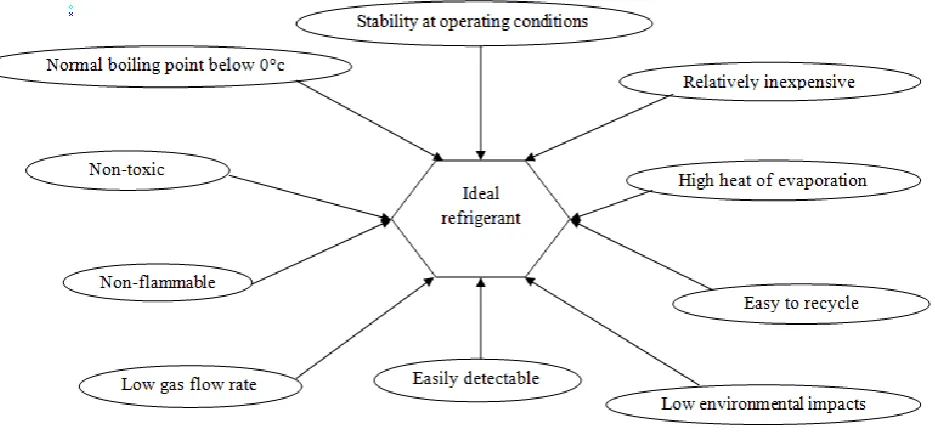
As need arises to save ozone depletion layer and environment it becomes necessary to search the refrigerants having various properties eco friendly in nature and consequently the concept of ideal refrigerant originate. In addition to having the desired physical properties, an ideal refrigerant should be non-toxic, nonflammable, fully stable inside a refrigeration system, environmentally begin even with respect to decomposition products, and easy to manufacture. It also should be self-lubricating (or at least compatible with lubricants), compatible with other materials that are used to fabricate and service refrigeration systems, easy to handle and detect, and low in cost. Furthermore, it should not require operation at extreme pressures. It is a very long list of qualities and none of the current refrigerants can be considered as coming close to the ideal one. When Midgley was asked to develop refrigerants, there were only seven criteria are as shown in fig 2
Fig 2
III. CONTROL OF CFCS AND HCFCS
Table:-1
Sn. Year Scientist/Events Contribution
1 1974 James Lovelock Acknowledged the existence of CFCs in the global atmosphere 2 1974 Rowland and Molina Perception of ozone depletion due to CFC emissions
3 1977 United Nations Environment Program(UNEP)
World plan of action on the ozone layer
4 1987 Vienna Convention Twenty-eight countries agreed for the Protection of the Ozone Layer
5 1989 Montreal Protocol Introduced substances that deplete the ozone layer
6 1990 London Amendment Added methyl chloroform, carbon tetrachloride and an additional range of CFCs to the phase-out schedules and established a mechanism for financial and technical assistance to developing country parties.
7 1992 Copenhagen Amendment Added hydro chlorofluorocarbons (HCFCs), hydrobromofluorocarbons (HBFCs), and methyl bromide to the phase-out schedules and formally created the Multilateral Fund as the route for financial and technology assistance.
8 1997 Montreal Amendment Created a system of licenses for imports and exports of ozone-depleting substances,
9 1999 Beijing Amendment Added bromochloromethane to the phase-out schedules and extended the controls on HCFCs
10 1999 Montreal protocol including the Beijing Amendment
Protection of the ozone layer, many substances are controlled now under the Montreal Protocol on substances that deplete the ozone layer.
IV. LIFE CYCLE ASSESSMENT
There are different methods to measure environmental impacts. (i.e. production, operation, disposal stages). The Eco-indicator 99 has defined the term "environment" as being subject to three types of damage:
a) Human health,
b) Ecosystem quality, and c) Resources.
The higher the Eco-indicator numbers, the more adverse is the environmental impact. The indicators are numbers that express the total environmental load of a product or process and are included in the ISO 14042 standard (International Organization for Standardization).
Some people use the total equivalent warming impacts (TEWI) as defined by the Alternative Fluorocarbons Environmental Acceptability Study and the U.S .Department of Energy (DOE). They represent the sum of the direct contribution of emissions of a product to the atmosphere as greenhouse gases plus the indirect contribution of the carbon dioxide emissions resulting from its operation, including electricity consumption.
V. SUM OF ENVIRONMENTAL IMPACTS
The cumulative Eco-indicator 99 impacts are calculated from the production, operation, and disposal stages considering the required charging quantity. These results can be summarized as follows -
The operation stage is the most important with regard to environmental impacts.
The traditional refrigerant, ammonia, has a low environmental impact.
The Eco-indicator 99 for use of electricity has a large effect on environmental impact.
The destruction stage of HCFCs and HFCs has seven times more impact than the production process. For HC refrigerants, the destruction process is favored due to energy
VI. ECO FRIENDLY REFRIGERANTS
The Montreal protocol phase out the CFC refrigerants like R11 R12 and R500 were the main stay of the refrigeration industry. These refrigerant replaced by HCFC, having small no of chlorine with good physical, thermodynamic and safety properties. Copenhagen revision of the Montreal protocol has depicts restricted HCFC refrigerant due to their considerable ozone depletion and global warming potential. None depleting substances is focused on HFC not contains any chlorine having no ozone depletion effect. HFC 134a in pure and blended mixtures like R404a, R407C and R410A are favorably consider for application in commercial and industrial refrigeration and air conditioning. The use of HFCs and blends is constantly ever-increasing in developed with developing countries. In the Kyoto agreement HFC have been acknowledged as a major green house gases and it may cause of global warming.
As the controlling measures under Kyoto protocol regarding emission of CO2, CH4, and N2O will have a positive effect on ozone depletion. But decision regarding HFC may affect the ability to phase out CFC as per the Montreal protocol. The table 2 shows the comparative environmental properties of CFC with their possible alternative refrigerants.
Table:-2
From the study it has been observed that HFCs have considerable global warming potential, while HFC 152a has a very small GWP and may considered as a medium term substitute with control of flammability. It has been reported that binary and ternary mixtures of R512a with any inflammable refrigerant perform better with increased COP and less power consumption if used in place of R12.The refrigerants NH3, CO2, hydrocarbons and water having no ozone depletion potential and negligible global warming potential can replace CFC. Ammonia is the refrigerant effectively used in vapor compression refrigeration cycle, and can be use for designing and developing new systems to meet the challenges of CFC replacement. The water as refrigerant is used in absorption system with developing technology permits it for use in compression cycles at higher working pressure in the system restricts the use of water as refrigerant. The CO2 as an attractive refrigerant has increased manifolds due to its environmental and economic
Sno. Refrigerants ODP GWP Toxicity Flammability
1 CFC11 1 4500 no no
2 CFC12 1 8500 no no
3 HCFC22 0.055 1700 no no
4 HCFC142b 0.0065 2000 no no
5 HFC32 0 580 no yes
6 HFC125 0 3200 no no
7 HFC134a 0 1300 no no
8 HFC152a 0 140 yes yes
9 ammonia 0 0 no no
10 CO 0 1 no no
11 PROPANE 0 3 no yes
12 butane 0 3 no yes
properties; particularly its use in supercritical series is in active consideration in mobile air conditioners and different applications. The hydrocarbons resembling propane, butane and isobutene are highly flammable but considered the best option as alternatives for replacing HFCs. The hydrocarbon mechanism accompany by suitable safety actions have been adopted by countries in Europe and showing acceptance in developing countries also. The table 3 gives overview of use of alternative eco friendly refrigerant for various applications.
Table:-3
VII. CONCLUSIONS AND RECOMMENDATIONS
The main concentration of this study is to find the need of eco friendly refrigerants to reduce environmental impacts. It is found that the Hydrocarbons are mainly environmental friendly. Therefore the alternate substitute can be used for the domestic and small commercial refrigeration appliances without the hazard of the global environment and lives.
REFERENCES
[1] Johnson 1998, Global warming from HFC, environment impactassessment rev,18, 485 – 492
Wen-tientasi, 2005, An over view of environmental hazards and exposure, and explosive rise of hydroflurocarbon HFCs,chemosphere,61,1539-47 [3] Fatouh M and KafafyM. EI, 2006, Experimental evaluation of a domestic refrigerator working with LPG, applied thermal engineering [4] K.J. Park, T. seo. D.Jungperformance of alternative refrigents for residential air conditing applications, Applied energy 84 (2007) 985-991 [5] K.Mani,V.Selladurai, Experimental analysis of a new refrigerant mixture as drop in replacement for CFC12 and HFC 134a, International journal of thermal sciences 47(2008) 1490-1495
[6] B.O.Boloji, Experimental study of R152a and R32 to replace R134a in a domestic refrigerator,Energy, volume 35 issue 9, sept 2010. 3793-3798 [7] G.D.Mathur, Performance of vapour compression refrigeration system with hydro carbons, proceedings of the 1996 international conference on ozone protection technologies,Washington,DC,USA 1996 pgs 835-844
[8] CYCLE _D vapour compression cycle design.NIST Standard reference data base 49-version 4.0.Gaithersberg,MD:National institute of standards and technology (2004)
[9] Emerson Climate Technologies, “Refrigerant choices for commercial refrigeration”, Emerson Climate Technologies, 2010.
[10] Chao Chieh Yu, Tun-Ping Teng, “Retrofit assessment of refrigerator using hydrocarbon refrigerants”, Applied Thermal Engineering, 66(2014) 507-518
[11] Akio Miyara, “Condensation of hydrocarbons – a review”, International Journal of Refrigeration 31 (2008) 621-632 [12] Eric Granryd, “Hydrocarbons as refrigerants - an overview”, International Journal of Refrigeration 24 (2001) 15-24
[13] Bjorn Palm, “Hydrocarbons as refrigerants in small heat pump and refrigeration systems – a review”, International Journal of Refrigeration 31 (2008) 552-563
[14] A. S. Dalklicet. al. “ A performance comparison of vapour compression refrigeration system using various alternative refrigerants, International communications in Heat and mass transfer 37(2010) 1340-1349
[15] Tun-Ping Tenget. al. “ Retrofit assessment of window air conditioner”, Applied Thermal Engineering 32(2012) 100-107 [16] Lampugnani, G. and Zgliczynski, M., "R290 as a substitute of R502 and R22 in commercial refrigeration and air Conditioning”, International Compressor Engineering Conference. (1996) ( Paper 1087)
[17] Wu, J.H., Yang, L. D., Hou, J., “Experimental performance study of small wall room air conditioner retrofitted with R290 andR1270”, International Journal Refrigeration,35(7) 2012, 1860-1868.
[18] Agrawal 1998 “Alternatives to ozone depleting refrigerants-A discussion of options ”, 19 th IIR conference , Sydney ,Australia,1998.
Application HFCs used Possible eco friendly refrigerant
Domestic refrigeration R134a,R152a HC600a and blends Commercial refrigeration R134a,R404a,R407c HC blends,NH3,CO2 Cold storage, food processing and
industrial refrigeration
R134a R404a R507c NH3,HCs,CO2
Unitary air conditioners R410a,R407c CO2,HCs
Centralized AC (chillers) R134a, R410a,R407c NH3,HCs,CO2,water
Transport refrigeration R134a R404a CO2
Mobile air conditioners R134a CO2,HCs