© 2014, IJCSMC All Rights Reserved 523
Available Online atwww.ijcsmc.com
International Journal of Computer Science and Mobile Computing
A Monthly Journal of Computer Science and Information Technology
ISSN 2320–088X
IJCSMC, Vol. 3, Issue. 11, November 2014, pg.523 – 531
RESEARCH ARTICLE
Different QoS Based Simulation Evaluation
of TORA and GRP Routing Protocol Based
on Frequency Hopping
Jonish
1, Kapil Chawla
2, Kuldeep Vats
3¹M-Tech Department of CSE, SITM, Sonepat, Haryana, India
²Assistant Professor, Department of CSE, SITM, Sonepat, Haryana, India
³Department of CSE, Sonepat, Haryana, India
1 [email protected]; 2 [email protected]; 3 [email protected]
Abstract- Mobile Ad-Hoc network (MANET) is a network of mobile nodes that can communicate with each other without using any centralized control or fixed infrastructure .In this paper analysis of the performance of TORA and GRP routing protocol is done with the use of OPNET simulation tool, we created a 50 mobile nodes networks on data rate 1 and 2 Mbps and transmission power 0.005 watts with buffer size 256000 bits the time of simulation
was 1500 sec. TORA and GRP routing protocols were compared in terms of Download Response Time, Upload
Response Time, Delay, Load and Media Access Delay in scenario for the simulation analysis and performances. The simulation result of the research has practical reference value for further study.
KEYWORDS— TORA, GRP, MANET, QOS, OPNET
I. INTRODUCTION
© 2014, IJCSMC All Rights Reserved 524
and dynamic nature. Routing is a significant issue and challenge in MANET. Many routing protocols have been proposed so far to improve the routing performance and reliability. In this paper evaluation is done on TORA, GRP routing protocol’s performance by using File Transfer Protocol application type of IEEE 802.11 WLAN Standard.
IEEE 802.11 is a WLAN Standard its data rates is up to 2 Mbps which was developed in 1997.After which, various task groups is been developed to extend this standard to 802.11a, 802.11b and 802.11g. The 802.11a task group is created a standard for WLAN operation in the 5 GHz band, with data rates increased up to 54 Mbps. The 802.11b task group is produced a standard for WLAN operations in 2.4 GHz band, with data rates increased up to 11 Mbps with both forward and backward compatibility. It is released in 1999. The 802.11g is developed to have a higher speed extension in the 802.11b. The IEEE 802.11 standard defines two operational modes for WLANs: infrastructure-based and ad hoc. Network interface cards are set to work in either of these modes but not in both modes simultaneously [1]
II. RELATED WORK
Xiaoyan Hong [2] surveys the routing protocols that address scalability. The routing protocols they intend to include in the survey fall into three categories: flat routing protocols, hierarchical routing approaches, and GPS augmented geographical routing schemes. In this paper, descriptions of the protocols have been provided and the differences among them have been discussed, highlighting particular important features impacting scalability. No protocol emerges as the winner for all the scenarios. They concluded that protocols have different, competitive and complementary advantages and are thus appropriate for different applications.
Mostafa Fazeli [3] we study the throughput performance in Mobile Ad Hoc Networks (MANETs) and compares emulated test bed results with simulation results from OPNET (Optimized Network Engineering Tool). The performance of the Mobile Ad Hoc Networks is very sensitive to the number of users and the offered load. When the number of users/offered load is high then the collisions increase resulting in larger wastage of the medium and lowering overall throughput. The aim of this research is to compare the throughput of Mobile Ad Hoc Networks using three different scenarios: 10, 15 and 20 users using simulator OPNET Modeler 14.0.
Ashish Shrestha [4] The performance investigation of reactive and proactive MANET routing protocols, namely AODV, DSR, TORA and OLSR. They have concluded that with regards to overall performance, AODV and OLSR performed pretty well. However, AODV showed better efficiency to deal with high congestion and it scaled better by successfully delivering packets over heavily trafficked network compared to OLSR and TORA.
III. ROUTING PROTOCOLS IN MOBILE AD HOC NETWORK
These are classified into three different categories:
A. Proactive Protocols
© 2014, IJCSMC All Rights Reserved 525
called table-driven methods. Using a proactive protocol, a node is immediately able to send (or drop) a packet. Optimized Link State Routing Protocol (OLSR) is an example of Proactive Protocol.[5][6]
B. Reactive Protocols
Reactive Protocols are bandwidth efficient. Route is found when a path is required by a node to forward packets. Therefore, overhead routing is decreased because of search for the route is not required on which packet is not sent. TORA is an example of Reactive Protocol.
1) Temporally Ordered Routing Algorithm (TORA):
TORA is adaptive and scalable routing algorithm based on the concept of link reversal. It finds multiple routes from source to destination in a highly dynamic mobile networking environment. An important design concept of TORA is that control messages are localized to a small set of nodes nearby a topological change. Nodes maintain routing information about their immediate one-hop neighbors. The protocol has three basic functions: route creation, route maintenance, and route erasure. [7]
C. Hybrid Protocols
It combine characteristics of both pro-active and re-active routing in order to find effective and reliable routes, without large control overhead, by locally using pro-active routing and inter-locally using re-active routing. In this method communication in MANET is possible when nodes are near to each other and the supposition that changes in topology are only important if they happen in the vicinity of a node.
1) Geographic Routing Protocol (GRP):
GRP collects network information at a source node with a small amount of control overheads. According to the information collected, source node can find routes and continuously transmit data even if the current route is disconnected. The result of this approach is achieving fast transfer with less overhead of control massages [8]. This approach is widely known as hybrid routing protocol, because it can simultaneously use the strengths of reactive routing and proactive routing protocols. The source node computes the best route according to collected information and then immediately starts to transmit data packets.
IV. SIMULATION SETUP
© 2014, IJCSMC All Rights Reserved 526
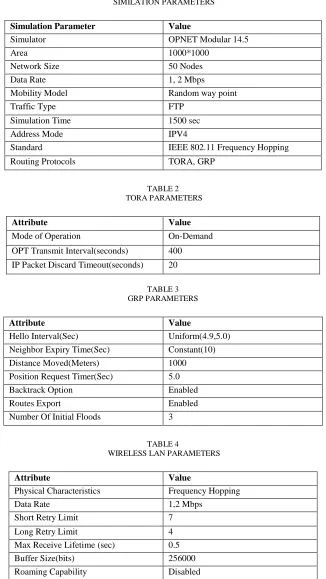
TABLE 1
SIMILATION PARAMETERS
Simulation Parameter Value
Simulator OPNET Modular 14.5
Area 1000*1000
Network Size 50 Nodes
Data Rate 1, 2 Mbps
Mobility Model Random way point
Traffic Type FTP
Simulation Time 1500 sec
Address Mode IPV4
Standard IEEE 802.11 Frequency Hopping
Routing Protocols TORA, GRP
TABLE 2 TORA PARAMETERS
Attribute Value
Mode of Operation On-Demand
OPT Transmit Interval(seconds) 400
IP Packet Discard Timeout(seconds) 20
TABLE 3 GRP PARAMETERS
Attribute Value
Hello Interval(Sec) Uniform(4.9,5.0)
Neighbor Expiry Time(Sec) Constant(10)
Distance Moved(Meters) 1000
Position Request Timer(Sec) 5.0
Backtrack Option Enabled
Routes Export Enabled
Number Of Initial Floods 3
TABLE 4
WIRELESS LAN PARAMETERS
Attribute Value
Physical Characteristics Frequency Hopping
Data Rate 1,2 Mbps
Short Retry Limit 7
Long Retry Limit 4
Max Receive Lifetime (sec) 0.5
Buffer Size(bits) 256000
Roaming Capability Disabled
© 2014, IJCSMC All Rights Reserved 527
Fig. 1 Node Model
V. PERFORMANCE MERICS
A. Download Response Time (sec)
Time elapsed between sending a request and receiving the response packet. Measured from the time a client application sends a request to the server to the time it receives a response packet. Every response packet sent from a server to an FTP application is included in this statistic.
B. Upload Response Time (sec)
Time elapsed between sending a file and receiving the response. The response time for responses sent from any server to an FTP application is included in this statistic.
C. Delay (sec)
It is the time taken by a packet from the movement it is transmitted on the network by source node to reach the destination node.
D. Load (bits/sec)
© 2014, IJCSMC All Rights Reserved 528
E. Media Access Delay (sec)
It represents the global statistic for the total of queuing and contention delays of the data, management, delayed Block-ACK and Block-ACK Request frames transmitted by all WLAN MACs in the network.
VI. SIMULATION RESULTS AND ANALYSIS
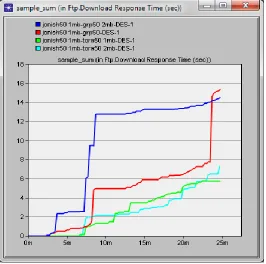
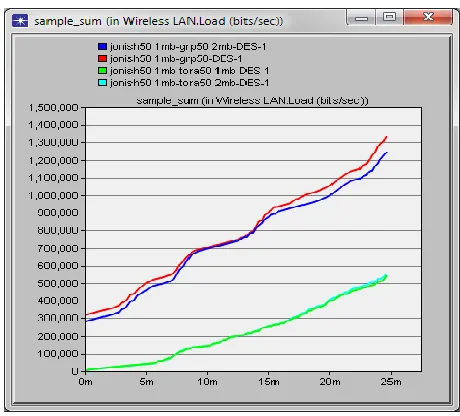
Figure (2 - 6) below show Download Response Time, Upload Response Time, Delay, Load and Media Access Delay in 50 mobile nodes scenario for IEEE 802.11 standard at 1 Mbps and 2 MBPS data rate with GRP and TORA respectively. The color scheme is showing the protocols behavior in different graphs which gives the average values. From these average values we will conclude the behavior of all these routing protocols.
A. Download Response Time (sec)
Fig. 2: FTP Download Response Time in seconds
© 2014, IJCSMC All Rights Reserved 529
B. Upload Response Time (sec)
Fig. 3: FTP Upload Response Time in seconds
According to simulation, as we can see in Fig. 3, FTP Upload Response Time is best in case of best in case of TORA and performance of GRP is showing up down behavior.
C. Delay (sec)
© 2014, IJCSMC All Rights Reserved 530
According to simulation, as we can see in Fig. 4, WLAN Delay is Most in case of TORA 1 Mbps then TORA 2 Mbps after which GRP 1 Mbps and minimum in GRP 2 Mbps. TORA 1 Mbps > TORA 2 Mbps > GRP 1 Mbps > GRP 2 Mbps.
D. Load (bits/sec)
Fig. 5: Wireless LAN Load in bits per second
According to simulation, as we can see in Fig. 5, WLAN Delay is Most in case of GRP 1 Mbps Have attains highest load then GRP 2 Mbps and thereafter GRP 1 and 2 Mbps. Here TORA behaves same both in 1 Mbps and 2 Mbps.
E. Media Access Delay (sec)
© 2014, IJCSMC All Rights Reserved 531
According to simulation, as we can see in Fig. 6, WLAN Media Access Delay is highest in case of TORA 1 Mbps after which here comes TORA 2 Mbps then GRP 1 Mbps and at the last GRP 2 Mbps.
VII. CONCLUSION
In this paper performance of GRP and TORA is evaluated for metrics like Download Response Time, Upload Response Time, Delay, Load and Media Access Delay by using 50 nodes scenario with IEEE 802.11 Frequency Hopping WLAN Standard in 1 Mbps and 2 Mbps. From the above discussion we find out those following results shown in table 5. On the basis of table 5 GRP performed better in terms of delay, MAC delay and TORA Performed better in Download Response Time, Upload Response Time and Load.
TABLE 5
RESULTED PERFORMENCES
S. No. Performance Metrics GRP 1 Mbps GRP 2 Mbps TORA 1 Mbps TORA 2 Mbps
1 Download Response Time Highest High Lowest Low
2 Upload Response Time High Highest Low Lowest
3 Delay Low Lowest Highest High
4 Load Highest High Low Low
5 Media Access Delay Low Lowest Highest High
REFERENCES
[1] Pravin GhoseKar, Girish Katkar and Dr. Pradip Ghorpade, “Mobile Ad Hoc Networking: Imperatives and Challenges”,IJCA, pp. 153-158, 2010.
[2] Xiaoyan Hong, Kaixin Xu and Mario Gerla, “Scalable Routing Protocols for Mobile Ad Hoc Networks”, IEEE Network, vol. 16, issue 4, pp 11-21, Aug.2002.
[3] Mostafa Fazeli, “Assessment Of Throughput Performance Under OPNET Modeler Simulation Tools In Mobile Ad Hoc Networks (MANETs)” 3rd ICCI,CSN , IEEE 2011.
[4] Ashish Shrestha and Firat Tekiner, “On MANET Routing Protocols for Mobility and Scalability.” In International Conference on Parallel and Distributed Computing, Applications and Technologies, p.p. 451-456, November 2009. IEEE Computer Society.
[5] P.Kuppusamy, Dr. K. Thirunavukkarasu and Dr. B .Kalaavathi, "A Study and Comparison of OLSR, AODV and TORA Routing Protocols in Ad Hoc Networks",IEEE 2011.
[6] Aleksandr Huhtonen, "Comparing AODV and OLSR Routing Protocols", Seminar on Internetworking 2004.
[7] Algorithms and Protocols for wireless and mobile Ad Hoc Networks by AZZEDINE BOUKERCHE. [8] Kuldeep Vats , Mandeep Dalal, Deepak Rohila, Vikas Loura, “OPNET Based Simulation and Performance