UNDERCOMPLETE DICTIONARY-BASED FEATURE EXTRACTION FOR RADAR TARGET
IDENTIFICATION
D. W. Wang and X. Y. Ma Wuhan Radar Academy
Wuhan 430019, China
Y. Su
School of Electronic Science and Technology National University of Defense Technology Changsha 410073, China
Abstract—Feature extraction is a challenging problem in radar target identification. In this paper we attempt to exploit the sparse property of the scattering signature with a undercomplete dictionary for target identification, and establish a feature extraction scheme based on the undercomplete dictionary. Furthermore, as an application, we present a feature vector, named as the atom dictionary feature, which is extracted from the scattering signatures over a wide-angle sector. Numerical simulation results show that the proposed atom dictionary feature can improve the performance of radar target identification due to the exploitation of the sparse property of the scattering signature.
1. INTRODUCTION
attractive research area and many efforts have been attempted in the last decade [1, 2]. However, the precise extraction of these CNRFs from scattered data is not usually an easy process, especially in the presence of noise [3, 4]. Therefore, some resonance features which are indirectly related to the pole values of the target are extracted from the natural response components of scattering signals in alternative ways. Recently, Turhan-Sayan [5] attempted to use resonance mechanisms to reduce the aspect angle sensitivity of the extracted feature. It is partly proved that the late-time partitioned energy density vectors constructed by computing the spectral distribution of scattering signature energy of some non-overlapping subsequent time bands can significantly reduce aspect sensitivity. However, although these two features were proven useful under some situations, it is well recognized that the resonance feature-based identification alone will not be sufficient for most targets of interest due to the low resonance energy problem [6].
Different from the resonance features, scattering center feature, contained in the early-time response of target scattering signature, is aspect-dependent and can yield insight into geometrical and physical characters of the target. Extraction method of scattering centers was investigated by several groups, such as Kim et al. [7] and Choi et al. [8]. However, scattering centers are not robust to noise and aspect change, which restricts the scattering center-based target identification performance. For this reason, distinct frequency dependencies of scattering centers were considered [9, 10]. Although the sensitivities to noise and aspect variations can be reduced to some extent by theirs investigations, these approaches suffer from the particular models. Considering the deficiencies, feature extraction without the model restriction has received recently more intensive attention in the radar target identification community [11–18]. The one-dimensional scattering signature [11, 12] and its all kinds of transformations [13– 18] were used to identify target. However, although the particular model restriction is avoided, the extracted feature is still highly aspect-dependent. Thus, for target identification, the scattering signatures of each target at many aspect angles have to be stored, which amounts to a significant storage retrieval problem.
2. CLASSIFICATION WITH UNDERCOMPLETE DICTIONARY
2.1. Definition and Property of Undercomplete Dictionary The signal sparse representation with a complete or overcomplete dictionary has been an active research area for numerous pattern classification problems. However, to the author’s knowledge, very little theoretical work has been put forward on a undercomplete dictionary for the signal representation and classification. In this subsection, we focus our attention on the signal representation and classification with the undercomplete dictionary. In the following, the definition of the signal representation with a undercomplete dictionary is firstly given.
Definition 1: Let RM be a M dimension signal space, we define a undercomplete dictionary Φ as a family including N atoms in
RM(N < M) and a undercomplete dictionary-based representation
of signals∈RM as
s=Φα=
N
i=1
αiϕi (1)
where the coefficient vector α ∈ RN. If α
0 < N where α0 =
Card{j:|αj| = 0} and Card(·) denote the cardinal number of set, we
say the representation is sparse. Furthermore, if ˜α = arg minα0, the expansion supported by the coefficient vector ˜α is the sparsest representation of the signals.
According to the above definition, if letSpanΦbe the closed linear span of atoms inΦ, the spaceSpanΦmust be a subspace of the signal spaceRM, which can be written as
SpanΦ={α1ϕ1+α2ϕ2· · ·+αNϕN|αn∈k,ϕn∈Φ} ⊂RM (2)
wherek denotes complex set.
Obviously, SpanΦ is a complete subspace in signal spaceRM, which means that anys∈SpanΦ⊂RM could be sparsely represented by the dictionary Φ; however, any s ∈ SpanΦ couldn’t be done. Consequently, we can obtain two properties about the undercomplete dictionary.
Property 1: Let Φ = [ϕ1,ϕ2,· · · ,ϕN] ∈ RM×N be a
undercomplete dictionary. If G={ϕγ1,ϕγ2,· · ·ϕγm} is the subspace
composed by any matoms in Φ, then
Property 2: Let Φ = [ϕ1,ϕ2,· · ·,ϕN] ∈ RM×N be a
undercomplete dictionary, for any s ∈ SpanΦ⊂ RM there exists the desired precision εsuch that
e2 < ε, s.t.Φα+e=s (4)
however, ifs∈SpanΦ, Equation (4) can’t be held.
Clearly, Property 1 claims the relationship between subspaces supported by the undercomplete dictionary with different dictionary size. According to the property, it is concluded that with the increasing of the atom number the signal subspace represented sparsely by the undercomplete dictionary will be enlarged. Property 2 shows the classification ability of the undercomplete dictionary to signal space. From the property, we can conclude that the undercomplete dictionary divides the signal space RM into two subspaces, i.e., SpanΦ and SpanΦ. For these two subspaces, different representations, such as sparseness and no sparseness, are presented by the undercomplete dictionary. And furthermore, the difference in the representation can be illuminated by the residue energy e2. Obviously, the signal representation with a complete or overcomplete dictionary discussed by Mallat and Zhang in [21] is a particular case of the representation with a undercomplete dictionary.
2.2. Matching Pursuits with Undercomplete Dictionary The MP algorithm proposed by Mallat and Zhang [21] is a nonlinear iteration procedure for the linear decomposition. In general, an overcomplete dictionary isn’t always necessary to the decomposition procedure. The algorithm is also suitable to the linear representation of signals with a undercomplete dictionary, but with some different properties.
According to the definition in [21], let Φ = (ϕr(t))r∈Γ denote a
dictionary, where rdenotes a generalized index from the set Γ. The inner product between the signals(t) and atomϕr(t) is defined as
s, ϕr=
+∞
−∞ s(t)ϕ
∗
r(t)dt (5)
where superscript ∗ denotes complex conjugate. Assuming the dictionary Φ includes Q atoms and any atom ϕr(t) (i.e., for each r ∈ ΓQ) satisfies ϕr2 = ϕr, ϕr = 1, the MP algorithm involves
For any signal s(t), we project it onto each element ϕr(t) of the
dictionary Φ. ϕr0(t) is selected when
|s, ϕr0| ≥ |s, ϕr|, ∀r ∈ΓQ (6)
and obtain the decomposition
s(t) =s, ϕr0ϕr0+R1s (7)
where R1s denotes the residual after the first decomposition. Then the atom ϕr0(t) is wiped off from the atom dictionary, and R1s
is respectively projected onto the remaining Q−1 elements of the dictionary. Repeating the projection process, after Q iterative, s(t) can be decomposed into
s(t) =
Q−1
n=0
Rns, ϕrnϕrn+RQs (8)
whereR0s=s(t), |Rns, ϕrn| ≥ |Rns, ϕr|,∀r∈ΓQ−n.
Mallat has proven that if Φ is a complete or overcomplete dictionary of the signal space
s(t) = lim
Q→∞ Q−1
n=0
Rns, ϕrnϕrn (9)
If one utilizes a complete or overcomplete dictionary, the MP algorithm can be used to represent any signal in the signal space with any desired precision. Thus, the MP with a complete or overcomplete dictionary provides all signals in signal space with a consistent representation. However, as explained above, for signals in signal space two different representations are presented by a undercomplete dictionary in the space.
We define a undercomplete dictionary Φ = [ϕ1,ϕ2,· · ·,ϕN] ∈ RM×N(N < M), where Γ denotes the index set of atoms in Φ. For
any signals∈Ω⊂RM, two correlation ratios of signal swith respect toΦare defined respectively as
λsupΦ (s) = sup
r∈Γ
|s, ϕr|
s (10)
λinfΦ(s) = inf
r∈Γ
RN−1s, ϕr
and two dictionary distribution ratios are defined respectively as
Binf(Φ) = inf
s=1
λinfΦ(s)
(12)
Bsup(Φ) = sup
s=1
λsupΦ (s) (13)
where Binf(Φ) and Bsup(Φ) represents the lower and upper bound
of the undercomplete dictionary distribution ratio for subspace Ω respectively.
So, for signal s ∈ Ω⊂ RM, the decay of the residual through m
decompositions (m≤N) is satisfied with
s1−Bsup(Φ)2 m/2
≤ Rms ≤ s1−Binf(Φ)2 m/2
(14)
The proof to (14) is given in the following.
Proof: According to the MP procedure, we obtain the mth decomposition which satisfies
Rm−1s,ϕr(m−1)= sup
γ∈Γ
Rm−1s,ϕr=λΦsup(Rm−1s)Rm−1s
(15)
since
Rms2 = Rm−1s2−Rm−1s,ϕr(m−1) 2
= Rm−1s2−[λsupΦ (Rm−1s)]2Rm−1s2
= (1−[λsupΦ (Rm−1s)]2)Rm−1s2 (16) and hence, according to the definition of Bsup(Φ) and Binf(Φ), for
N ≥m >0 we can derive the relationship
[1−Bsup(Φ)2]1/2Rm−1s≤Rms≤[1−Binf(Φ)2]1/2Rm−1s
[1−Bsup(Φ)2]m/2s≤Rms≤[1−Binf(Φ)2]m/2s
(17)
According to previous conclusion in this paper, different representations, such as sparseness and no sparseness, are presented by the undercomplete dictionary Φ to signal spaceRM. Therefore, the norm RNs of signals in SpanΦ is very different from that of
signals inSpanΦ. In general, the former is higher than the latter after
3. SOLUTION OF UNDERCOMPLETE DICTIONARY FOR SIGNAL CLASSIFICATION
As shown above, undercomplete dictionary has an inherent ability to classify signals, and the norm RNs of signals in SpanΦ is usually higher than that of signals inSpanΦafter N decompositions. Therefore, for a practical classification problem, the key issue is that undercomplete dictionaries, as features, are established beforehand to characterize the signals belonging to the different categories. According to the classification procedure mentioned above, the solution of the undercomplete dictionary for signal classification can be generalized as: LetΦ= [ϕ1,ϕ2,· · ·,ϕN]∈RM×N be a undercomplete dictionary,
for a training signal setS= [s1,s2,· · · ,sP]∈RM×P the undercomplete
dictionary can be found by
min
Φ∈RM×NE 2
s.t.ΦA+E=S
(18)
Usually, the optimization in (18) is a NP-hard problem and the global search is very time-consuming. However, it is worth emphasizing that the expansion coefficient matrix A is entirely dependent on the undercomplete dictionary Φ. Once Φ is known, the coefficient matrixA can be found by matching pursuits [21]. Hereby, a two-step algorithm, in a way similar text in [22], is presented for the optimization problem in (18), which is generalized as follows:
1) Φ andS are known. Find a sparse coefficient matrix A; 2)A and S are known. Find the best undercomplete dictionary Φ.
Clearly, the coefficient matrix A isn’t necessarily sparsest in a single iteration and the found undercomplete dictionary Φ isn’t optimal in the global search. Hence, in order to obtain the optimal undercomplete dictionary Φ, the above two-step algorithm must be repeated until a stop-criterion is satisfied. Furthermore, from the above two-step algorithm it is observed that the first part in the algorithm is a simple decomposition process, which can be easily realized by MP algorithm, but the second part is a complicated high-dimension minimum process yet. The key of the solution for the optimization undercomplete dictionary is to solve the minimum problem in the second part.
Assuming that Φ = {ϕ1,ϕ2,· · ·,ϕN} ∈ RM×N represents a
setS, which can be expressed as ˜
S= ΦA∆ (19)
The corresponding residual is given
E=S−S˜ (20)
In order to minimize the residual energy for the given coefficient matrixA, in a way similar to the Method of Optimal Directions in [22], we denote by ∆Φ the adjustment of the undercomplete dictionary Φ:
˜
Φ = Φ + ∆Φ (21)
and the new residual due to the residual E is given ˜
E=E−∆ΦA (22)
So the residual energy after the adjustment is
E˜2 = E−∆ΦA2
= ETE−AT∆ΦTE−ET∆ΦA+AT∆ΦT∆ΦA (23) Obviously, the minimization of the residual energy E˜2 is equivalent to the maximization of the expression
J =AT∆ΦTE+ET∆ΦA−AT∆ΦT∆ΦA (24)
After the differential operation, under the least mean square (LMS) rule we get
∆Φ = (ATA)−1ATE (25) Usually, for a given coefficient matrix A the adjustment ∆Φ of the undercomplete dictionary Φ is only an approximate solution under the LMS rule, and the adjusted undercomplete dictionary ˜Φ is not guaranteed to be optimal for the given signals S. Therefore, the solution procedure must be repeated.
4. FEATURE EXTRACTION BASED ON UNDERCOMPLETE DICTIONARY
4.1. Range Profile Feature and Matching Score Classification Criterion
The 1-D range profile is the scattering distribution of a target along the radial distance and provides information about the position and scattering strength of the target’s scattering centers at that aspect. The range profile as feature vector for radar target identification has been an active research area and many efforts have been attempted in the last decade [11, 12, 15, 16]. The matching score classification criterion (MSCC) [11] is a fundamental criterion for the range profile-based target recognition, with which a class of test data is determined according to the maximum correlation coefficient between the received range profile and all templates. Assuming that the waveformf(x) is a measured range profile of an unknown target, gij(x) is the restored range profile feature template at aspect angle j of ith target, and
x∈[a, b], the matching score can be generalized as
C(f, gij) =
b
af(x)gij∗(x)dx
b
a|f(x)| 2dxb
a |gij(x)|
2dx1/2
(26)
If the range profile f(x) and range profile template gij(x) are normalized to unit energy, a linear relation between the signaturef(x) and templategij(x) is then given by
f(x) =Bijgij(x) +eij (27)
whereeij denotes the decomposition residual,Bij =
b
af(x)gij∗(x)dx= f(x), gij(x) is the projection of f(x) onto gij(x). Obviously, the linear relation in (27) can be thought as a single-stage decomposition expression off(x) on the undercomplete dictionary with the template
gij(x) as atom, which means that MSCC might be thought as an extreme case of the classification procedure of the undercomplete dictionary with multiple atoms.
4.2. Feature Extraction Based on Undercomplete Dictionary with Multiple Atoms
undercomplete dictionary, in this paper the 1-D range profile as an example is used to the feature extraction based on undercomplete dictionary. The extracted feature is named as the atom dictionary feature.
Assuming that matrix Ym = [ymθ1,yθ2m,· · · ,ymθL] is made up of
range profile vectors of themth target from L different aspect sectors, and ymθk = [ymθk(0),yθkm(1),· · · ,ymθk(N −1)]T is the scattered vector at kth aspect angle. Considering that a computationally expensive search of all possible atom vectors must be performed completely for an optimal dictionary selection, in order to simplify the solution procedure the atom dictionary feature Φm of mth target is initialized byQ(less
than L) range profile vectors using an equally spaced selection from Ym, and thenprange profile vectors selected with equal angle interval
from the remaining vectors are used to construct the training data matrixSm. In order to avoid the energy diversity of range profile vector
due to different range and aspect, all training vectors are normalized to unit energy. Then, the atom dictionary feature Φm to characterize
themth target can be easily constructed after several iterations. Furthermore, if the aspect angle sector supported by the atom dictionary feature Φm is equal to [−Θ/2,Θ/2], any normalized range
profileyθ (θ∈[−Θ/2,Θ/2]) can be represented as
yθ =α1θϕ1+· · ·+αqθϕq· · ·+αθQϕQ+eQθ (28)
and
eQθ2 ≤e2max (29)
whereαθqis the projection coefficient of the range profileyθon the atom φq, eQθ is the residual vector after the Q decompositions, e2max is the
residual energy threshold value of all range profiles over [−Θ/2,Θ/2] after the Qdecompositions.
can be supported by the undercomplete dictionary with multiple atoms. Thus, if there exists an atom dictionary feature with multiple atoms which characterizes any range profile on aspect angle sector [−Θ/2,Θ/2], the size of the reference feature database could be reduced to some degree.
5. SIMULATION RESULTS
To demonstrate the effectiveness of the feature extraction scheme based on the undercomplete dictionary, several simulations are conducted using simulated data, calculated scattering signatures of three thin wires through a time-domain electric field integral equation, as well as measured scattering signatures in a time-domain UWB chamber.
5.1. Simulations Using Calculated Scattering Signatures In this experiment, three thin wire targets with different sizes are used. The thin wires have the same length-width-ratio of 1/200 but with different lengths (named as Target 1, 2, and 3 respectively). The far-field scattering signals of three targets at the incident aspect angles
θ = 2.5◦, 5◦, · · ·, 180◦ are calculated using time-domain electric field integral equation with 25 ps sampling interval. The truncated far-field scattering signatures with 128 valid sampling points are obtained in 72 aspect angles to build the raw database.
In order to test the effectiveness of the atom dictionary feature, atom dictionary feature Φ2 of target 2 is initialized by its scattering
signatures at angle index 20, 28 and 36, and scattering signatures at angle index 10 and 50 are used to build the training data matrix S2. Once the initialization is finished, Φ2 is trained with
50 cycles by the corresponding data matrix S2 according to the
algorithm listed in Table 1. Then, all of scattering signatures of three targets are decomposed on the extracted feature Φ2 and the
a very important result that the template storage space for target identification could be reduced significantly by the proposed dictionary feature.
50 100 150 200 0
0.2 0.4 0.6 0.8 1
50 100 150 200 0
0.2 0.4 0.6 0.8 1
50 100 150 200 0
0.2 0.4 0.6 0.8 1
(a) Angle index
Residual energy
Angle index Angle index
(b) (c)
Target 1 Target 2 Target 3 Target 1 Target 2 Target 3 Target 1 Target 2 Target 3
Figure 1. The decomposition residual by atom dictionary feature with the single scattering signature of Target 2 as atom (a) scattering signature at index 20 as atom, (b) scattering signature at index 28 as atom, (c) scattering signature at index 36 as atom.
Furthermore, in order to demonstrate the effectiveness of atom dictionaries to characterize targets further, atom dictionary features of another two targets are extracted according to the previous procedure. Test scattering signature is selected randomly from scattering signatures of Target 2 at 72 different aspects. Then the white Gaussian noise is added to the selected signal to product a noisy signal. The noisy signal is decomposed on the extracted atom dictionary features of three targets with the MP algorithm. The averaged energy of the decomposition residuals of 1000 samples are shown for different SNR in Fig. 3. In this figure, the averaged decomposition residual on the atom dictionary feature of Target 2 is obviously smaller than that corresponding to other two targets even at a very low SNR, such as −10 dB. From simulation results, we can observe that accurate target identification could be carried out using the atom dictionary feature in an almost aspect independent manner without any prior parameterization model hypothesis, and the aspect dependence of template for wide-angle target identification could be reduced effectively by using the atom dictionary feature.
50 100 150 200 0
0.2 0.4 0.6 0.8 1
R
esidual
energy
Angle index
Target 1 Target 2 Target 3
Figure 2. The decomposition residual by extracted atom dic-tionary feature of Target 2 with multiple atoms.
-20 -10 0 10 20
0 0.2 0.4 0.6 0.8 1
Target 1 Target 2 Target 3
SNR
Averaged residual energy
Figure 3. Averaged residual energy of sc(atte)ring signatures from Target 2 on atom dictio-naries corresponding to three tar-gets.
paper is 9.7-m long by 4.6-m wide by 3.3-m high and is lined with 46-cm pyramid absorbers. The generator provides a periodic sequence of ultrashort pulses of negative polarity with amplitude about 25 V and duration about 30 ps (for 0.5 levels) to a UWB coaxial horn antenna of the ridge type. The operating band of the antenna is 1.0∼10.0 GHz at the voltage standing wave ratio < 2.0. The scattering signature of a candidate target is received by an identical horn. A waveform processing oscilloscope with 0 ∼ 50 GHz operating band is used to acquire the received signature.
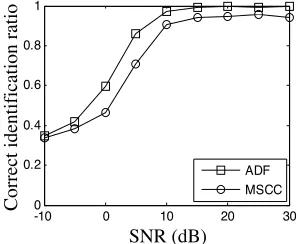
of three targets with two distinctly different representations. After completing the decompositions, residual energy of scattering signatures from the region supported by every of atom dictionary features is distinctly lower than that of scattering signatures away from the supported region. Although for three target models the supported region of the atom dictionary feature cannot be enlarged as same as simulations using calculated scattering signatures due to the aspect-sensitive nature of measured scattering signatures, the discriminable ability to the different targets is enhanced by the fusion procedure of decisions on multiple atoms, which is seen clearly in Fig. 7. Fig. 7 presents the results using the residual energy to identify three targets, where “ADF” denotes the identification results of the extracted atom dictionary feature with multiple atoms, and “MSCC” denotes the results of the single scattering signature as atom with the matching score classification criterion (the scattering signature vectors over the measured angular region of 0◦–180◦ with a 12.4◦ angular increment are used as feature templates). In this experiment, the candidate target is randomly selected from the target library with an equal probability of being present. Once the target has been selected, a test scattering signature is randomly selected from 28 measured signatures of the selected target with an equal probability and contaminated by additive white Gaussian noise with a specified level of signal to noise ratio (SNR). The identification results are conducted by 1000 identification experiments using 1000 independent noisy test sequences. As shown in Fig. 7, the “ADF” identification method outperforms markedly the “MSCC” identification method from−10 dB to 30 dB in our simulations, which demonstrates the effectiveness of the feature extraction scheme based on the undercomplete dictionary further.
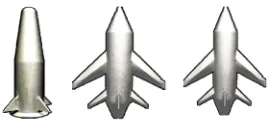
(a) Target 1 (b) Target 2 (c) Target3
Figure 4. Target models used in simulations.
Feature 1
Feature 2
Feature 3
Feature 4 180
134.4 89.6 38.4 0
o
o o o o
Residual ener
gy
20 40 60 80
0 0.2 0.4 0.6 0.8 1
20 40 60 80
0 0.2 0.4 0.6 0.8 1
20 40 60 80
0 0.2 0.4 0.6 0.8 1
20 40 60 80
0 0.2 0.4 0.6 0.8 1
Target 1 Target 2 Target 3 Target 1 Target 2 Target 3 Target 1 Target 2 Target 3 Target 1 Target 2 Target 3
Angle index Angle index
Angle index Angle index
(a) (b)
(d) (c)
Residual energ
y
Residual energy
R
esidual
energ
y
Figure 6. Residual energy after all scattering signatures of three targets are completely decomposed on four atom dictionary features of Target 1 respectively. (a) Feature 1, (b) Feature 2, (c) Feature 3, (d) Feature 4.
Correct identification ratio
SNR (dB)
-10 0 10 20 30
0 0.2 0.4 0.6 0.8 1
ADF MSCC
6. CONCLUSION
In this paper, we carry out an in-depth study on the undercomplete dictionary for signal classification. We explain the classification ability of the undercomplete dictionary and establish a feature extraction scheme based on the undercomplete dictionary. Furthermore, as an application, we present a novel feature named as the atom dictionary feature for radar target identification, which is applied in [23]. Numerical simulation results show that the proposed atom dictionary feature can exploit sparse property in the scattering signature for target identification. Compared with the MSCC, the proposed feature extraction scheme can give a more promising identification due to its inherent decision-fusion procedure. In addition, it is worth paying attention that for some applications the complicated scattering behaveriors of radar target over a wide-angle sector could be represented by the proposed atom dictionary feature and the aspect dependence of the feature could be reduced effectively.
Moreover, it should be noted that the atom dictionary feature is extracted from the whole scattering signature without any prior parameterization model hypothesis. Therefore, as compared with the CNRF and scattering center features, the feature is with less limitation to the target identification applications. In addition, in this paper the time-domain scattering signatures are used to construct the atom dictionary feature. However, the frequency spectrum of the scattering signature can be also used to construct the dictionary, which can avoid the problems in HRRP-based target recognition schemes, such as the significant performance degeneration due to small time shift between the measured and stored HRRP feature templates. Future work needs to emphasize particularly on the problems faced by the atom dictionary feature in practical applications, such as the best size of the atom dictionary feature and design of the identification system.
ACKNOWLEDGMENT
This work was partially supported by the Postdoctoral Science Foundation of China (Grant No. 20070420182).
REFERENCES
2. Lee, J. H. and H. T. Kim, “Radar target discrimination using transient response reconstruction,” Journal of Electromagnetic Waves and Application, Vol. 19, No. 5, 655–669, 2005.
3. Lee, J. H. and H. T. Kim, “Hybrid method for natural frequency extraction: Performance improvement using Newton-Raphson method,” Journal of Electromagnetic Waves and Applications, Vol. 19, No. 8, 1043–1055, 2005.
4. Wang, S., X. Guan, X. Ma, D. Wang, and Y. Su, “Calculating the poles of complex radar targets,” Journal of Electromagnetic Waves and Application, Vol. 20, No. 14, 2065–2076, 2006.
5. Turhan-Sayan, G., “Real time electromagnetic target classification using a novel feature extraction technique with PCA-based fusion,”IEEE Transaction on Antennas and Propagation, Vol. 53, 766–776, Feb. 2005.
6. Dudley, D. G., P. A. Nielsen, and D. F. Marshall, “Ultra-wideband electromagnetic target identification,” Ultra-wideband, Short-pulse Electromagnetics, 457–474, Plenum, New York, 1993. 7. Kim, K.-T., D.-K. Seo, and H.-T. Kim, “Efficient radar target recognition using the MUSIC algorithm and invariant features,” IEEE Trans. Antennas Propag., Vol. 50, No. 3, 325–337, Mar. 2002.
8. Choi, I.-S., D.-K. Seo, J.-K. Bang, H.-T. Kim, and E. J. Rothwell, “Radar target recognition using one-dimensional evolutionary programming-based CLEAN,”Journal of Electromagnetic Waves and Applications, Vol. 17, No. 5, 763–784, 2003.
9. Lee, C. P., D.-M. Chiang, and R. Carriere, “A GTD-based parametric model for radar scattering,” IEEE Transactions on Antennas and Propagation, Vol. 43, No. 10, 1055–1066, October 1995.
10. McClure, M. R. and L. Carin, “Matching pursuits with a wave-based dictionary,” IEEE Trans. on Signal Processing, Vol. 45, 2912–2927, December 1997.
11. Li, H. J. and S. H. Yang, “Using range profiles as feature vectors to identify aerospace targets,”IEEE Trans. on Antennas Propagat., Vol. 41, 261–268, Mar. 1993.
13. Choi, I.-S., J.-H. Lee, and H.-T. Kim, “Efficient reduction of data storage for correlative target recognition using impulse radar,” Journal of Electromagnetic Waves and Applications, Vol. 15, No. 6, 745–753, 2001.
14. Seo, D.-K., K.-T. Kim, I.-S. Choi, and H.-T. Kim, “Wide angle radar target recognition using subclass concept,” Progress In Electromagnetics Research, PIER 44, 231–248, 2004
15. Du, L., H. W. Liu, Z. Bao, and M. D. Xing, “Radar HRRP target recognition based on higher order spectra,” IEEE Trans. Signal Process, Vol. 53, 2359–2368, July 2005.
16. Lee, K. C. and J. S. Ou, “Radar target recognition by using linear discriminant algorithm on angular-diversity RCS,”Journal of Electromagnetic Waves and Applications, Vol. 21, No. 14, 2033– 2048, 2007.
17. Jung, J. H., H. T. Kim, and K. T., Kim, “Comparisons of four feature extraction approaches based on Fisher’s linear discriminant criterion in radar target recognition,” Journal of Electromagnetic Waves and Applications, Vol. 21, No. 2, 251–265, 2007.
18. Lee, K.-C., C.-W. Huang, and M.-C. Fang, “Radar target recognition by projected features of frequency-diversity RCS,” Progress In Electromagnetics Research, PIER 81, 121–133, 2008. 19. Champeney, D. C.,A Handbook of Fourier Theorems, Cambridge
University Press, Cambridge, 1987.
20. Mallat, S., “A theory for multiresolution signal decomposition: The wavelet decomposition,” IEEE Transactions on Pattern Analysis and Machine Intelligence, Vol. 11, 674–693, July 1989. 21. Mallat, S. and Z. Zhang, “Matching pursuits with time-frequency
dictionaries,” IEEE Trans. On Signal Processing, Vol. 41, 3397– 3415, Dec. 1993.
22. Engan, K. S. O. Aase, and J. H. Husoy, “Method of optical directions for frame design,” Proc. ICASSP, 2443–2446, Phoenix, AZ, 1999.