Videographical Analysis of Arm Swing on Spike
Jump Performance of Two Different Functional
Classes’ Volleyball Players
IKRAM HUSSAIN
Department of Physical Education Aligarh Muslim University, Aligarh, Uttar Pradesh India
ARIF MOHAMMAD
Akal College of Physical Education Mastuana Sahib, Sangrur, Punjab India
ASIM KHAN
Shri JJT University, Jhunjhunu, Rajasthan India
Abstract:
digitized with the help of Silicon Coach Pro7 motion analysis software. The kinematic variables for this were taken as the jump height (JH), range of motion (RoM), angular velocity (AV), hyperextension joint angle at shoulder joint (HJASJ) and duration of arm swing (DAS). The one tailed t-test was used for statistical analysis of the data. Results of study indicated that there is a significant difference between intervarsity and intercollegiate level male volleyball players in their volleyball spike jump performance.
Key words: Volleyball, arm swing, spike jump, intervarsity, intercollegiate
Introduction
angular velocity and torque at lower extremity joints, the centre of mass height, and velocity at takeoff for a countermovement jump (Benedicte et al. 2010; Kensaku et al., 1999). Additionally, Hsieh and Heise (2006) found that arm swing was one of the most important factors which contributed to volleyball spike jump height. These studies examined the effect of arm swing on jump height, while few of them have examined the performance of the arm swing in different skill level players (Endo & Masumura 2007; Ridgway & Hamilton 1991; Marquez, Masumura & Ae 2005). Additionally, the volleyball coaching texts adequately explain the importance of arm swing for the volleyball spike jump. The reason for one player’s ability to perform a volleyball spike jump more successfully than another is not generally obvious. The complexity of this skill demands the isolation of component variables which must then be evaluated as to (a) their contribution to the resulting jump and (b) the importance of this contribution.
Thus, this study was designed to examine the arm swing which influences the volleyball spike jump performance, on selected kinematic factors at intervarsity and intercollegiate level male volleyball players.
Methods and materials
Participants
(spikers). They all were healthy and did not have any injury reported within the last year.
Apparatus and Equipment used for the Study
One Canon Legria HF S10 camcorder with tripod, measuring tap, portable weighing machine, Silicon Coach Pro7 motion analysis software, SPSS-16 software and volleyball were used in this investigation.
Procedure of Data Acquisition
To obtain two-dimensional videographical data a high speed Canon Legria HF S10 camcorder operating at shutter speed of 1/2000, with a frame rate of 60 frames per second was used. The camcorder was placed on a tripod at the height of 5 feet on the right angle i.e. perpendicular to the side-line at a distance of 13 meters away from the point of jump (see Figure 1). Prior to acquiring data each subject was asked to warm-up for at least 15 minutes by stretching all major muscle groups for performance and practicing several normal spike jumps. After the warm-up subjects were asked to perform volleyball spike jump. A setter was used to set the ball for spike. Every player spikes at an interval of 2-3 minutes and their performance was recorded. Data were collected from the onset of movement until the peak of the spike jump. Recorded data were downloaded in computer and coordinate data were digitized with the help of Silicon Coach Pro7 motion analysis software. The variables for this study were taken as the jump height (JH), range of motion (RoM), angular velocity (AV), hyperextension joint angle at shoulder joint (HJASJ), and duration of arm swing (DAS).
Figure 1: Experimental setup showing of subject, setter and camcorder position
Statistical Analysis
To infer any endeavour there is a requirement of an appropriate statistical treatment. In this study a t test was used to analyze the data and to infer the difference between intervarsity and intercollegiate male volleyball players.
Results
Results of any practice or exercise are important since a result of any endeavour (scientific investigation) tells us what is the truth or fact regarding any practice or exercise. The results of this investigation are presented in the preceding table.
Table 1: Indicating mean, SD, mean differences (MD) and calculated t of biomechanical variables of arm swing performance between two different functional classes male volleyball players.
Intervarsity Players
Intercollegiate Players
Variables Mean SD Mean SD MD Cal. t
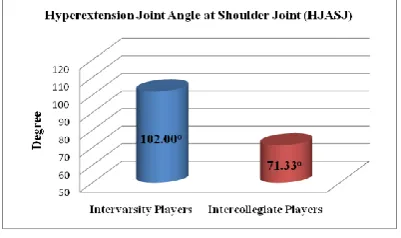
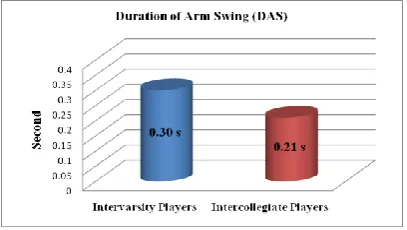
AV 460.00° ± 53.30° 361.83° ± 81.15° 98.17° 5.85* HJASJ 102.00° ± 24.05° 71.33° ± 25.01° 30.67° 4.44* DAS 0.30 sec ± 0.05 sec 0.21 sec ± 0.05 sec 0.09 sec 4.75* *Significant at 0.05 level of significance with 12 df Tab. t = 1.78
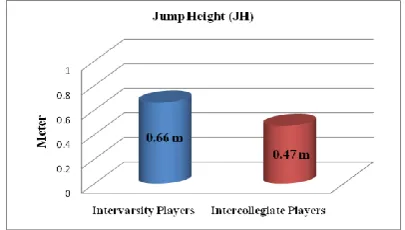
The results of statistical analysis of arm swing variables’ viz. jump height (JH), range of motion (RoM), angular velocity (AV), hyperextension joint angle at shoulder joint (HJASJ) and duration of arm swing (DAS), between intervarsity and intercollegiate level male volleyball players revealed that there is a statistical significance difference between all the variables considered (For JH the cal. t was 2.85, for RoM the cal. t was 3.13, for AV the cal. t was 5.85, for HJASJ the cal. t was 4.44 and for DAS the cal. t was 4.75 reported). All the calculated t concerning selected variable of arm swing was found more than tabulated t (1.78) at 0.05 level of confidence with 12 degree of freedom, which shows significant differences between both experimental groups.
Figure 4: Illustration showing the mean difference of range of motion between intervarsity and intercollegiate male volleyball players
Figure 5: Illustration showing the mean difference of angular velocity between intervarsity and intercollegiate male volleyball players
Figure 7: Illustration showing the mean difference of coordination between intervarsity and intercollegiate male volleyball players
Discussion
A successful volleyball spike jump performance demands different factors concerning spike jump. An appropriate amount of concerning factors or we can say balanced combination of those variables results in optimum performance level. Arm swing of spike jump was taken into account as one of these variables (Romer & Kuhlmann 2008; Hsieh& Heise 2006).
spike motion in comparison with other two skill level groups players. Ridgway and Hamilton (1991) in their study examine the spiking technique of elite and recreational female volleyball players and found that spiking technique of elite volleyball players were far better than intercollegiate volleyball players.
The results of the study further verify that the jump height, which is an influential variable of spike jump performance, was much higher in the intervarsity level volleyball players in comparison with intercollegiate level volleyball players. The reason might be the arm swing which is a requisite to enhance the jump height, this being reported as higher in the intervarsity level volleyball players, which automatically increase the range of motion as well as angular velocity. One of the main reasons for a significant difference between intervarsity and intercollegiate level volleyball players in their arm swing performance is the higher hyperextension of joint angle at shoulder joint which results in the increase of duration of arm swing as when the duration of arm swing increase is provided higher range of motion as well as angular velocity, which increases the spike jump performance.
During the approach phase, intervarsity players brought the arm back farther and earlier prior to the impact of both feet when compared to intercollegiate players. This process assists the arm to store and release the energy from the muscle and tendon at lower extremities, meanwhile helping the trunk to move upward (Hsieh & Heise 2006). That is, the increased range of motion for the arm swing in addition to the earlier time of initiation allowed the arm to generate more energy, which is transferred to various body parts to improve vertical jump performance (Li-Fang & Gin-Chang 2008). The use of arms was found to increase the jump height of the intervarsity level male volleyball players significantly more than that of intercollegiate level players. The differences are swings in
intercollegiate players differently. The greater increase in arm swings in jump height for higher level players could be because of greater upper body strength compared to lower level players (Benedicte et al. 2010; Moore et al. 2007).
Conclusions
On the basis of the results obtained from the present empirical investigation the following conclusions can be drawn: The volleyball player should put more emphasis on the
greater range of arm swing, which increases the jump height for spiking performance.
The player should increase the speed (faster) of the arm swing which would improve their spike performance.
Increase in shoulder hyperextension joint angle at earlier onset of arm swings enhances the duration of arm swing which optimizes the ball velocity.
BIBLIOGRAPHY
Baudin, J. P. 1980. A biomechanical analysis of the volleyball spike jump. Published M. Sc. Degree Thesis, Faculty of Graduate Studies and Research, The University of Alberta.
Benedicte, F., Jean-Louis, C., Guido, C., Jean-Michel, C., and Marc, C. 2010. “Factors correlated with volleyball spike velocity.” The American journal of sports medicine 38(7).
Coleman, S., Benham, A., and Northcott, S. 1993. “A three-dimensional cinematographical analysis of the volleyball spike.” Journal of Sports Sciences 11:259-302.
Endo, T., and Masumura, M. 2007. “Biomechanical analysis of the spike motion for world class male volleyball players.” International Symposium on Biomechanics in Sports. Conference Proceedings Archive, 25.
Enoka, R. M. 1971. “The effect of different lengths of run-up on the height to which a spiker in volleyball can reach.”
New Zealand Journal of Health, Physical Education and Recreation 4(3):5-15.
Feltner, M. E., Fraschetti, D. J., and Crisp, R. J. 1999. “Upper extremity augmentation of lower extremity kinetics during countermovement vertical jumps.” Journal of Sports Sciences 17:449-466.
Harman, E. A., Rosenstein, M. T., Frykman, P. N., and Rosenstein, R. M. 1990. “The effects of arms and countermovement on vertical jumping.” Medicine and Science in Sports and Exercise 22:825-833.
Hsieh, C., and Heise, G. D. 2006. “Important kinematic factors for male volleyball players in the performance of a spike jump.” Proceeding of American Society of Biomechanics, Blackburg, VA.
Hsieh, C., and Heise, G. D. 2008. “Arm swing of volleyball spike jump performance between advanced and recreational female players.” Proceeding of Fourth North American Congress on Biomechanics, Ann-Arbor, MI.
Hussain, I., Khan, A., and Mohammad, A. 2011. “A comparison of selected biomechanical parameters of spike serves between intervarsity and intercollegiate volleyball players.” Journal of Education and Practice 2(2): 18-24.
Kensaku, M., Shintaro, T., Satoshi, M., Satoshi, H., and Satoshi, T. 1999. “Motion analysis in volleyball spike.”
Proceedings of Annual Meeting of Japanese Society for Orthopaedic Biomechanics 20:377-380.
Li-Fang, Liu, and Gin-Chang, Liu. 2008. “The application of range of motion (ROM) and coordination on volleyball spike.” International Symposium on Biomechanics in Sports. Conference Proceedings Archive, 26.
Mark, D. T., Chris, J. H., Denis, B., and Gregg R. B. 2004. “Jumping and landing techniques in elite women’s volleyball.” Journal of Sports Science and Medicine 3:30-36.
Marquez, W. Q., Masumura, M., and Ae, M. 2005. “A Biomechanical analysis of spike motion for different skill levels of male volleyball players.” ISB XXth Congress-ASB 29th Annual Meeting, Cleveland, Ohio.
Mondal, P., and Bhowmick, S. 2013. “A comparison of selected biomechanical parameters of front row spike between short set and high set ball.” International Journal of Physical Education, Fitness and Sports 2 (1): 1-5.
Moore, C. A., Weiss, L. W., Schilling, B., Fry, A. C., and Li, Y. 2007. “Acute effects of augmented eccentric loading on jump squat performance.” Journal of Strength & Conditioning Research 21(2):372-377.
Ridgway, M. E., and Hamilton, N. 1991. “Spiking technique of elite and recreational female volleyball players.” In
Biomechanics in Sports IX, edited by C. L. Tant, P. E. Patterson, & S. L. York, 35-38. Ames, IA: Iowa State University.
Tillman, M. D., Haas, C. J., Brunt, D., and Bennett, G. R. 2004. “Jumping and landing techniques in elite women’s volleyball.” Journal of Sports Science and Medicine 3(1):30-36.
Tilp, M., Wagner, H., and Muller, E. 2008. “Differences in 3D kinematics between volleyball and beach volleyball spike movements.” Sports Biomechanics 7(3):386- 397.
Wagner, H., Tilp. M., Duvillard, S. P., and Mueller, E. 2009. “Kinematic analysis of volleyball spike jump.”