Energy Optimization of Unrolled Block Ciphers
using Combinational Checkpointing
Siva Nishok Dhanuskodi and Daniel Holcomb
[email protected], [email protected]
Department of Electrical and Computer Engineering, University of Massachusetts, Amherst, USA
Abstract. Energy consumption of block ciphers is critical in resource constrained devices. Unrolling has been explored in literature as a tech-nique to increase efficiency by eliminating energy spent in loop control elements such as registers and multiplexers. However these savings are minimal and are offset by the increase in glitching power that comes with unrolling. We propose an efficient latch-based glitch filter for unrolled designs that reduces energy per encryption by an order of magnitude over a straightforward implementation, and by 28-32% over the best existing glitch filtering schemes. We explore the optimal number of glitch filters that should be used in order to minimize total energy, and provide esti-mates of the area cost. Partially unrolled designs also benefit from using our scheme with energies competitive to fully serialized implementations. We demonstrate our approach on the SIMON-128 and AES-256 block ciphers.
1
Introduction
Energy efficiency is one of the main concerns in low-power implementations of block ciphers, regardless of the key strength of the algorithm being implemented. Minimization of energy is important because it allows computation on scavenged energy, long-running devices on small batteries, and so forth. Aside from energy efficiency, area cost and latency are secondary concerns. In the consumer elec-tronics market, a focus on area is justified because area cost translates directly to monetary cost of a chip. Yet, there are many interesting energy-constrained scenarios in defense and healthcare where the monetary cost of silicon area is less critical. In these scenarios, one may wish to trade area against latency by unrolling repetitive cryptographic operations to perform a larger share of the computation in each cycle in order to complete operation sooner. This is especially important for block ciphers such as SIMON that require a large number of rounds. Yet, in order to be suitable for highly-constrained devices, unrolling must be done without significantly compromising the energy efficiency of the computation.
– We present an efficient latch-based glitch filter design that reduces energy of unrolled block ciphers.
– We find the optimal spacing of glitch filters in deeply unrolled block cipher implementations.
– For the first time, we give a technique that allows partially and fully unrolled block ciphers to have an energy efficiency that is competitive with serialized implementations.
2
Background and Related Work
There are a variety of low power design techniques for integrated circuits including near-threshold and subthreshold operation [9] and adiabatic logic styles [2]. However, in this work we focus exclusively on microarchitectural techniques for reducing energy instead of exotic circuits. In the remainder of this section, we review considerations for implementing block ciphers, and existing techniques for mitigating the glitches that dominate their power consumption.
2.1 Implementing Cryptographic Block Ciphers
Block ciphers are cryptographic primitives used to encrypt and decrypt data, typically used as part of a larger encryption mode of operation. Block ciphers are almost always implemented as components of a larger overall system-on-chip design, and this prevents the block cipher from being freely optimized independently of the other SoC components. For example, the block cipher will have to use the same fabrication process and supply voltage as the other components, and typically will share a common clock frequency to avoid clock generation and clock domain crossing. Therefore, any attempt at optimizing block ciphers may be constrained by these chip-scale implementation decisions. The block cipher algorithm iterates over a round function for a specified number of times using different subkeys. The rounds can be implemented through sequential reuse of a single combinational block for each round, or they can be unrolled. If a design is fully serialized (no unrolling), one round function is computed in each clock cycle, and the number of cycles needed to encrypt a block is the same as the number of rounds in the block cipher algorithm. Yet, small low-power SoCs will typically operate at slow clock frequencies, and therefore the clock period may far exceed the critical path delay of a block cipher round. The latency of the block-cipher is then being increased unnecessarily due to the serialization of the round function.
2.2 Glitches and Glitch Filtering
The limiting factor in energy minimization of block ciphers is switching energy. This is especially true in unrolled block ciphers because combinational logic glitches at the input of each round diffuse through the round to cause more glitches at the output of the round. Leakage power is negligible relative to switching power for typical clock periods and technologies used in low power designs [13]. Fundamentally, glitches occur because of mismatched arrival times of gate inputs. This causes the gate output to switch once when the first input arrives, and then switch again when the next input arrives. These two switching events then propagate to many other nodes and cause more switching events in a cascading fashion.
Several techniques to filter glitches have been proposed in literature. Pipelin-ing [8, 19] stops glitches because they cannot propagate through a register, as a register can change its output value only once per clock cycle upon arrival of the clock transition. Gate-freezing [7] stalls the computation in a gate by using an NMOS footer transistor to filter 1-to-0 transitions. The stalled gate is allowed to compute only when its inputs have reached their final state. The scheme has a limitation in that it allows 0-to-1 transitions to pass through a stalled gate. Retiming [15] by moving or adding flip-flops in the datapath to high activity nodes that have a large fanout can reduce glitches and save power. Yet another approach is delay balancing to equalize input arrival times at a gate and reduce the number of output switching events [14, 12, 11].
An AND gate based glitch filtering scheme (Round Gating) was proposed in [4]. The output signals of each round in this scheme are gated by AND gates that wait on an enable signal. The enable signal is derived from a delayed clock such that it goes high to propagate the round outputs through the AND gates only after they have stopped glitching and become stable. A drawback of this scheme is that the enable signals must be reset low between the end of one computation and the start of the next in order to stop propagation of the glitches in the next operation. When the enable signals go low, waves of 0s propagate forward from the glitch filters and propagate through the circuit to charge and discharge the nodes in the round functions similar to a normal computation of the round function. Effectively, resetting the glitch filters is thus causing a second, unnecessary, power-wasting computation to occur. State-retaining barriers [16] provide a mechanism for preventing this power-wasting computation.
3
Methodology
Combinational checkpointing is a microarchitectural technique to increase energy efficiency in a combinational circuit by filtering glitches. In this section, we describe the application of latch-based checkpoints in a block cipher and the methodology used to evaluate the approach.
3.1 Proposed use of Checkpoints for Glitch Filtering
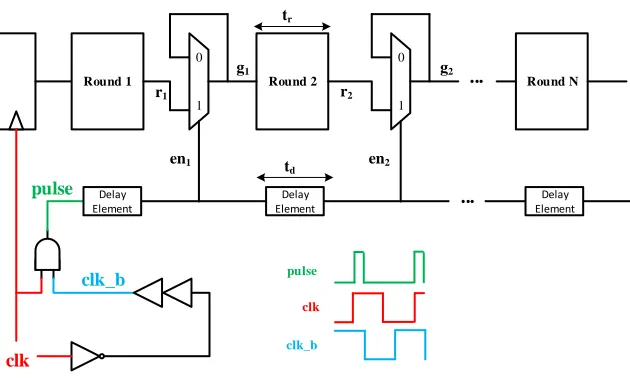
except that the glitch filtering element consists of a positive latch implemented using a multiplexer (MUX) at the output of the round function. The purpose of the filter is to make sure that any glitching activity from its input is not propagated to its output.
The operation of the filter is as follows. The MUX holds on to its previous output value when the enable (select) signal is low, and becomes transparent when enable is high. This causes the latch to be transparent only during the enable pulse. The enable pulse is generated at the rising edge of the clock as the AND of the clock signal and a delayed inverted version of clock. The enable pulse is propagated to the glitch filters combinationally with timing controlled by adding a delay element per round function. If the propagation delay of the delay element (td) is greater than the critical delay of a round function (tr), then
round outputri stabilizes before the rising edge of signaleni, so the latches only
become transparent after the glitching has stopped. Therefore, when this timing condition (td > tr) is satisfied, glitches generated in roundido not propagate
through the glitch filters to roundi+ 1. Because the latch stays open for the duration of the enable pulse, the circuit will function correctly as long as the round outputs stabilize before the falling edge of eni, but the circuit will not
filter any glitches that arrive when the latch is open, and the glitch filter will not have the intended effect.
The timing waveform for a single round is shown in Fig. 2. When the enable signal pulses at the first glitch filter, the stable outputs of round i−1 propagate through roundi and cause a total of 122 transitions on the 128 round output signals. The round outputs wait for the enable signal to arrive at the second glitch filter, and upon its arrival, only 60 transitions occur on the inputs of round
i+ 1; these 60 transitions are single transitions on 60 of the 128 signals, which is close to the expected number of bits that would differ between two uncorrelated 128-bit signals. In this case, the filter has prevented all the spurious glitches from propagating across rounds.
3.2 Evaluation Methodology
Round 2 Round N Round 1
0
1
0
1
clk
...
en1 en2
...
td
r1 r2
clk_b
pulse
clk
clk_b
pulse
g1 g2
Delay Element
Delay Element
Delay Element
tr
Fig. 1: Schematic of latch-based checkpoints for glitch filtering.
Round i
0
1 0
1
gi ri
gi-1
ri-1
ri-1
gi-1
ri
gi eni-1
ri-1
gi-1
eni gi ri
122
trans./enc. 60 trans./enc.
eni-1 eni
tr
td
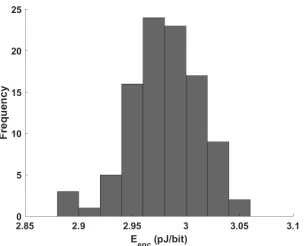
All of the measurements we present in this work are from simulation. Specifi-cally, we simulate designs with 45nm NCSU PDK [1] implemented using CMOS logic style. Synopsys Design Compiler and HSIM are used for synthesis and circuit simulation, respectively. We rely on circuit simulation rather than power simulations using characterized libraries to ensure that we accurately capture glitch propagation effects. Given the time consuming nature of circuit simulation on large designs, which takes several days per encryption for the unrolled AES design, we simulate only two encryptions per design, using inputs that are chosen at random. The first encryption initializes the circuit state, and the second encryption is used for measuring metrics described below. The accuracy of our results should not be compromised by the small number of encryptions simulated because a block cipher’s behavior is fairly independent of the input value used. In support of this claim, the energy consumption of partially unrolled (17 rounds) SIMON for 100 random input vectors is shown in Fig. 3. The variation in energy consumption is small (σ= 0.032pJ/bit) for the chosen input vectors.
Fig. 3: SIMON-128 energy per encryption histogram for 100 random inputs.
Metrics such as toggle rate and energy consumption are measured during the circuit simulation and used to compare our scheme’s performance with others.
Toggle rateis measured as the average number of signal transitions at round outputs per encryption. For example, in SIMON-128 a round output has 128 signals. We compute the total number of signal transitions in all 128 signals that occur during an encryption operation, and divide by bit-width (128) to get the toggle rate. We present energy numbers using a metric of energy-per-encrypted bitdenoted asEenc, which is the total energy consumed to perform
an encryption operation divided by the number of encrypted bits generated during the operation. When considering individual rounds of the block cipher, we use as a metric the contribution of that round to the overallEenc. In our
4
Results
In this section we present results showing energy benefits of using checkpointing. We first demonstrate that glitch filtering using checkpointing leads to a reduction in toggle rate, which translates to energy savings. Further, we vary the number of checkpoints to explore the trade off between checkpointing overhead and glitching energy saved. Finally, we evaluate the effectiveness of checkpointing in partially unrolled designs, and also estimate area penalty incurred by checkpointing.
4.1 Comparison of Average Switching Rates
We first study the effectiveness of the proposed glitch filter by counting switching events on a fully unrolled implementation of SIMON-128. Fig. 4 shows a compar-ison of signal toggle rates (signal transitions/encryption) for the outputs of all the 68 round and key functions. In the ideal case of no glitching activity, at the round outputs, one can expect 0.5 transitions per signal for each encryption, as round outputs are uncorrelated across encryptions.
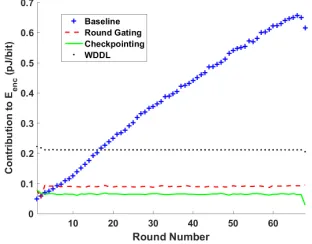
When no glitch filtering is used (baseline design), the switching activity is observed to increase linearly with logic depth (number of rounds). This increase in switching occurs because the logic of the block cipher tends not to mask transitions as they propagate, and because the diffusion property of block ciphers tends to propagate each transition out to many nodes. Our finding of linear increase is consistent with observations made in previous works [3]. For each encryption in the baseline design, the average switching across all rounds is 14.16 transitions per signal, and in the later rounds it is 2x larger than this average.
We analyze the effectiveness of checkpointing and two other techniques that mitigate switching. Compared to baseline, the Round Gating scheme [4] achieves a much lower average switching of 1.79 transitions per signal. Also, the switching activity stays fairly constant across rounds because glitches are never propagated across round boundaries. However as noted in Sec. 2, resetting the AND gates every clock cycle leads to unnecessary switching activity. Our checkpointing scheme has no such resetting and is therefore able to reduce switching to 0.95 transitions per signal, a 47% reduction relative to Round Gating. For comparison purposes, we implement SIMON-128 also using WDDL logic style [18]. WDDL is a dual-rail precharge based logic that is glitch free by design. To mitigate power side channel leakages, every signal pair in WDDL always has exactly 2 transitions per encryption; specifically, among the true and complementary representations of each signal, it is always the case that exactly one representation goes through a 1-0 transition during precharge and a subsequent 0-1 transition during evaluation.
4.2 Energy Savings from Checkpointing in Fully Unrolled Designs
(a) Toggle rate (b) Zoomed in
Fig. 4: Comparison of the average toggle rate of the output signals of each round of SIMON-128 for four different implementation styles.
Fig. 5: Contribution of each round to the overall energy per encrypted bit in four different implementation styles of fully unrolled SIMON-128
SIMON-128 The energy use of each round in the fully unrolled SIMON-128 implementation is plotted in Fig. 5. The energy trends are similar to the toggle rate trends shown in Fig. 4. Tab. 1 lists the breakdown of energy per encryption (Eenc) for baseline (no glitch filter) designs and three glitch filtering schemes. A
fully-unrolled implementation with checkpointing (4.46pJ/bit) performs much better than fully unrolled baseline (25.91pJ/bit) by saving glitching energy. Checkpointing is also competitive in energy with a baseline design that is not unrolled (1-unrolled, 3.78pJ/bit) while offering single cycle latency, compared to 68 cycles in the 1-unrolled baseline. In comparison to Round Gating [4], checkpointing consumes 27.9% lowerEenc. The savings comes from a 47% reduction in toggle
Table 1: Breakdown ofEenc (pJ/bit) in fully unrolled SIMON-128. Glitch filters
are added after every round in Round Gating and our work.
Eenc breakdown
Baseline Glitch filtering scheme (68-unrolled) 1-unrolled 68-unrolled Round Gating Checkpointing WDDL
Data 0.58 16.37 1.90 1.07 6.95
Key 0.40 9.42 1.62 0.88 7.42
Glitch Filter – – 2.36 2.20 –
Delay line – – 0.18 0.19 –
Other 2.80 0.12 0.12 0.12 0.45
Total 3.78 25.91 6.19 4.46 14.82
yet WDDL consumes 2.4x more energy because it uses only positive gates, and therefore requires approximately 3x more gates to implement the same function.
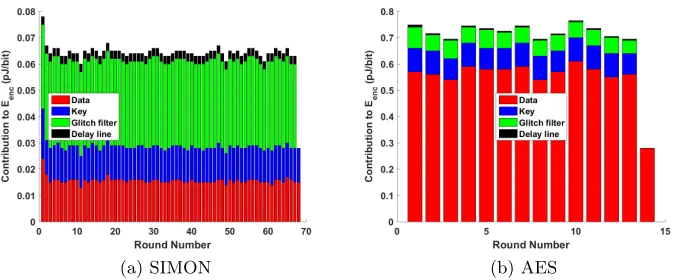
Fig. 6a shows the breakdown of energy consumption per encryption for our scheme. As can be seen in the figure, the switching energy does not increase across rounds, because each round similarly starts its computation from a single switching event. However, the glitch filters themselves consume about 50% of the total energy relative to the extremely simple combinational round function of SIMON. Hence, there is a possibility that using fewer glitch filters might reduce
Eenc further, if the glitches do not increase significantly. We explore this in Sec.
4.3. It can also be noted that the simple delay line that propagates the enable is not costly in energy, as it is a single inverter chain relative to a 128-bit wide computation path. The delay line does not require any tuning if care is taken by adding some margin (buffers) to ensuretd> treven in the presence of process
variation (Fig. 2).
AES-256 We also study the effectiveness of our scheme for the larger design, the fully unrolled implementation of AES-256. The energy breakdown per encryption in Fig. 6b shows that glitches are filtered effectively as there is no significant increase in switching energy with logic depth (round number). The energy cost of glitch filtering is small compared to that of actual computation. Note that the last round in AES is simpler, and therefore consumes less energy. The energy breakdown summary is tabulated in Tab. 2. Our scheme consumes anEenc of
(a) SIMON (b) AES
Fig. 6: Energy/encryption breakdown in fully unrolled implementations using checkpointing after every round.
Table 2: Breakdown ofEenc (pJ/bit) in fully enrolled AES-256. Glitch filters
applied after every round.
No unrolling Baseline Round Gating Checkpointing
Data 5.95 65.07 11.77 7.70
Key 1.55 8.64 1.82 1.13
Glitch Filter – – 0.82 0.82
Delay line – – 0.03 0.07
Other 2.19 – – –
Total 9.69 73.76 14.50 9.77
4.3 Optimal Placement of Checkpoints for Glitch Filtering
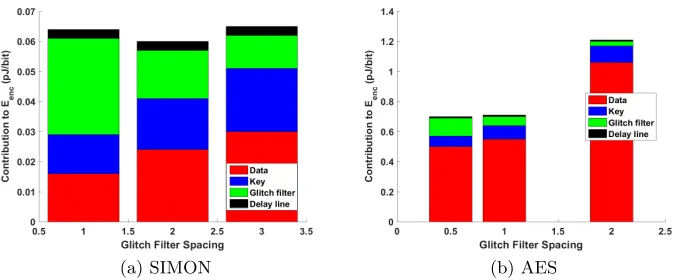
In this section we explore the optimal number of glitch filters to use in our scheme so as to minimize the total energy consumption. Energy optimal glitch filtering requires finding the right trade-off between the cost of glitch filtering and the energy saved by filtering glitches. If too many filters are used, then the cost of the filters themselves will dominate; but if too few filters are used, then the cost of the glitches will dominate. Fig. 7 shows how each round contributes to the energy per encrypted bit when different number of rounds are implemented between the checkpoints. When checkpoints are added after every round (spacing=1) in fully unrolled SIMON-128 (Fig. 7a), more energy is spent in glitch filtering than is spent in actual computation. However, if spacing is increased to 2 where checkpointing is done every other round, the average energy per round is decreased. Increasing the spacing beyond 2 further reduces the cost of glitch filtering but the glitches increase the key and data energy by a larger amount and the total energy increases. Therefore a spacing of 2 rounds between checkpoints is optimal for SIMON-128.
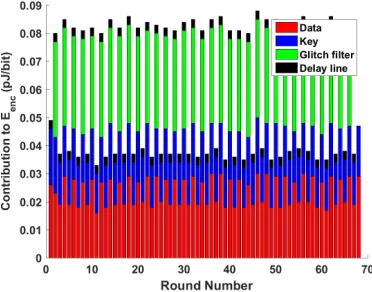
The energy breakdown ofEencfor each round of the fully unrolled SIMON-128
(a) SIMON (b) AES
Fig. 7: Energy efficiency varies with the spacing between checkpoints in fully unrolled designs. Performing more computation between checkpoints reduces checkpointing energy, but allows more data switching to occur
optimal spacing of 2, the design consumes 4.18pJ/bit per encryption which is 6.3% lower than the 4.46pJ/bit when checkpointing is applied after every round (Tab. 1). In addition, the area will be reduced because of the fewer checkpoints. Any block cipher implementation will have some optimal tradeoff of checkpointing energy versus glitching, but the specifics are of course design and technology dependent.
Fig. 7b shows that in AES, the much larger round function justifies adding glitch filtering after every round. Given the small energy cost of the checkpoints relative to round function, one might consider adding glitch filters at half round boundaries. Doing this reduces glitches but increases the cost of glitch filter such that the total energy consumption becomes comparable to glitch filter spacing of 1. Therefore, checkpoint spacing of 1 is optimal in AES-256 as it requires fewer glitch filters for the same energy efficiency as half-round checkpointing.
4.4 Checkpointing in Partially Unrolled Designs
Fig. 8: Energy breakdown ofEenc for each round in fully unrolled SIMON-128 in
the optimal configuration of checkpointing every second round.
2.89pJ/bit), checkpointing enables 34-unrolled design (3.41pJ/bit) to be compet-itive in energy at a much lower latency. Fully unrolling helps save loop control energy but incurs leakage cost, leading to less efficient design (4.18pJ/bit).
Also, 1-unrolled baseline consumes more energy than the 2-unrolled and 4-unrolled baselines because the SIMON key expansion function requires storing
keyi−2 in additional registers to computekeyi if no unrolling were done [6]. The
frequencies in Tab. 3 are chosen conservatively to account for process variations, but the design could be optimized for performance.
Table 3: SIMON-128Eenc (pJ/bit) comparison between optimal checkpointing
and the baseline design for various degrees of unrolling.
Unrollings 1 2 4 17 34 68
Baseline
Eenc(pJ/bit) 3.78 2.95 2.89 6.15 12.43 25.91
Ileak(µA) 132.58 133.51 169.8 417.4 753.3 1419.8 Frequency (MHz) 1667 833 417 98 49 25
Checkpointing
Eenc(pJ/bit) – – 2.92 2.99 3.41 4.18
Ileak(µA) – – 170.4 556.6 1080.2 2016.6
Frequency (MHz) – – 185 73 37 19
Either Latency (cycles) 68 34 17 4 2 1
4.5 Area Cost of Checkpointing
number of rounds, the penalty is more pronounced. For SIMON, we incur a 44% overhead if checkpoints are placed at the energy-optimal spacing of every second round. It is worth noting that using checkpoints after every round in SIMON-128 would incur a much higher 80% area penalty in addition to not being energy optimal.
With regard to timing, we introduce a small timing penalty because of the introduction of the glitch filters in the critical path and some timing margin to make sure the delay element is sufficiently long so that the enable pulse to a glitch filter arrives after the corresponding round output stabilizes. Though we report conservative frequency numbers in Tab. 3 to account for process variations, we do not have any requirements to double the clock period as in other schemes such as WDDL or Round Gating.
Table 4: Area penalty of proposed glitch filtering scheme in units of gate equiv-alents. Even in absolute terms, the area cost of checkpointing is significantly higher in SIMON-128 than in AES-256 because the larger number of rounds requires a larger number of checkpoints, even though the checkpoints are only applied at every second round.
Baseline Checkpointing Area overhead
SIMON-128 56,488 81,321 44.0%
AES-256 342,805 355,630 3.7%
5
Conclusion
In this paper, we have presented an efficient latch-based checkpointing mechanism to reduce the energy per encryption of unrolled block cipher implementations. We demonstrated significant energy savings (28-32%) compared to the best existing scheme for glitch filtering in unrolled block ciphers. Our scheme performs well on block ciphers with simple round functions as in SIMON, and complex round functions as in AES. We also showed that optimal use of glitch filters can lead to further energy savings, resulting in energy consumption that is competitive to a fully serialized implementation while maintaining the latency advantages of an unrolled design. Further, partially unrolled implementations can also greatly benefit from our scheme in scenarios where design constraints limit the degree of unrolling. This technique has applications in improving the efficiency of different unrolled block cipher implementations.
References
1. Ncsu free pdk 45. http://www.eda.ncsu.edu/wiki/FreePDK45:Contents. 2. Athas, W. C., Svensson, L. J., Koller, J. G., Tzartzanis, N., and Chou, E.
3. Banik, S., Bogdanov, A., and Regazzoni, F. Exploring energy efficiency of lightweight block ciphers. In International Conference on Selected Areas in Cryptography(2015), Springer, pp. 178–194.
4. Banik, S., Bogdanov, A., Regazzoni, F., Isobe, T., Hiwatari, H., and Akishita, T.Round gating for low energy block ciphers. In2016 IEEE International
Symposium on Hardware Oriented Security and Trust (HOST)(May 2016), pp. 55–
60.
5. Batina, L., Das, A., Ege, B., Kavun, E. B., Mentens, N., Paar, C., Ver-bauwhede, I., and Yalc¸ın, T. Dietary recommendations for lightweight block ciphers: Power, energy and area analysis of recently developed architectures. In
Radio Frequency Identification. Springer, 2013, pp. 103–112.
6. Beaulieu, R., Shors, D., Smith, J., Treatman-Clark, S., Weeks, B., and Wingers, L.The simon and speck families of lightweight block ciphers. Cryptology ePrint Archive, Report 2013/404, 2013. http://eprint.iacr.org/2013/404. 7. Benini, L., Micheli, G. D., Macii, A., Macii, E., Poncino, M., and Scarsi,
R. Glitch power minimization by selective gate freezing. IEEE Transactions on
Very Large Scale Integration (VLSI) Systems 8, 3 (June 2000), 287–298.
8. Boemo, E., Oliver, J. P., and Caffarena, G. Tracking the pipelining-power rule along the fpga technical literature. In Proceedings of the 10th FPGAworld
Conference(New York, NY, USA, 2013), FPGAworld ’13, ACM, pp. 9:1–9:5.
9. Hanson, S., Zhai, B., Bernstein, K., Blaauw, D., Bryant, A., Chang, L., Das, K. K., Haensch, W., Nowak, E. J., and Sylvester, D. M. Ultralow-voltage, minimum-energy cmos. IBM Journal of Research and Development 50, 4.5 (2006), 469–490.
10. Hsing, H. Tiny aes project. opencores.org/project,tiny_aes.
11. Huda, S., and Anderson, J. Towards pvt-tolerant glitch-free operation in fpgas. In Proceedings of the 2016 ACM/SIGDA International Symposium on
Field-Programmable Gate Arrays(New York, NY, USA, 2016), FPGA ’16, ACM,
pp. 90–99.
12. Karthik, H. S., and Naik, B. M. K. Glitch elimination and optimization of dynamic power dissipation in combinational circuits. InAdvances in Electronics, Computers and Communications (ICAECC), 2014 International Conference on
(Oct 2014), pp. 1–6.
13. Kerckhof, S., Durvaux, F., Hocquet, C., Bol, D., and Standaert, F.-X.
Towards Green Cryptography: A Comparison of Lightweight Ciphers from the Energy Viewpoint. Springer Berlin Heidelberg, Berlin, Heidelberg, 2012, pp. 390–407. 14. Lamoureux, J., Lemieux, G. G. F., and Wilton, S. J. E. Glitchless: Dynamic
power minimization in fpgas through edge alignment and glitch filtering. IEEE
Transactions on Very Large Scale Integration (VLSI) Systems 16, 11 (Nov 2008),
1521–1534.
15. Monteiro, J., Devadas, S., and Ghosh, A. Retiming sequential circuits for low power. InComputer-Aided Design, 1993. ICCAD-93. Digest of Technical Papers.,
1993 IEEE/ACM International Conference on(Nov 1993), pp. 398–402.
16. Musoll, E., and Cortadella, J. Low-power array multipliers with transition-retaining barriers. InPower and Timing Modeling, Optimization and Simulation
(PATMOS)(Oct. 1995), pp. 227–238.
17. Pub, N. F. 197: Advanced encryption standard (aes). Federal Information
Pro-cessing Standards Publication 197 (2001), 441–0311.
18. Tiri, K., and Verbauwhede, I.A digital design flow for secure integrated circuits.
IEEE Transactions on Computer-Aided Design of Integrated Circuits and Systems 25, 7 (July 2006), 1197–1208.
19. Wilton, S. J. E., Ang, S.-S., and Luk, W. The Impact of Pipelining on Energy
per Operation in Field-Programmable Gate Arrays. Springer Berlin Heidelberg,