NEW FACE RECOGNITION DESCRIPTOR BASED ON EDGE INFORMATION FOR SURGICALLY-ALTERED FACES IN UNCONTROLLED ENVIRONMENT
CHOLLETTE CHIAZOR CHUDE-OLISAH
A thesis submitted in fulfilment of the requirements for the award of the degree of
Doctor of Philosophy (Computer Science)
Faculty of Computing Universiti Teknologi Malaysia
To Family
Uche, Synara, and my yet to be born
James P. and Julie J. Olisah
ACKNOWLEDGEMENT
My PhD would not have fully blossomed without the inspiration of the PARACLETE to whom I owe the highest praise. Many thanks to the special ones whose roles in the course of my PhD journey helped me go through this phase in life.
To my supervisor Prof. Dr. Ghazali Bin Sulong, you are truly a SUPER-visor. I am greatly appreciative of you for your support and guidance, most importantly, for providing me the freedom to pursue my ideas and find my own path in research. Also, I have gained a wealth of experience and knowledge working under your supervision, which will always be my delight to share along my life’s journey. I will like to thank Assoc. Prof. Dr. Siti Zaiton M. Hashim for her co-supervision role throughout my PhD program.
To my beloved husband, Dr. Uche Chude Okonkwo, honey thank you for bringing a side of me I never knew I had. I will always cherish your support at all times. To my adorable daughter Synara, you are the epitome of a perfect daughter. You created your own play-world just to afford me the time to bring out the best in me. To my yet to be formed, with love for you, your sister and dad, there is nothing we cannot achieve.
ABSTRACT
ABSTRAK
TABLE OF CONTENTS
CHAPTER TITLE PAGE
DECLARATION ii
DEDICATION iii
ACKNOWLEDGEMENT iv
ABSTRACT v
ABSTRAK vi
TABLE OF CONTENTS vii
LIST OF TABLES xiv
LIST OF FIGURES xv
LIST OF ABBREVIATIONS xxi
LIST OF SYMBOLS xxv
LIST OF APPENDICES xxx
1 INTRODUCTION 1
1.1 Introduction 1
1.2 Problem Background 4
1.3 Problem Statement 10
1.4 Research Goal 12
1.5 Research Objectives 13
1.6 Scope of the Thesis 13
1.7 Significance of the Research 15
1.8 Thesis Structure 17
2 LITERATURE REVIEW 20
2.2 Face Recognition in General 20 2.3 Illumination Compensation Methods 23
2.3.1 Grey-level Based Methods 25
2.3.1.1 Illumination Models 25 2.3.1.2 Illumination Insensitive
Methods 27
2.3.1.3 Illumination
Normalization Methods 28
2.3.2 Colour-based Methods 31
2.3.2.1 Illumination/Reflectance
Separation-based Methods 32 2.3.2.2 Illumination-Invariant
Colour Normalization
Methods 33
2.4 Grey-level Domain Discussions 35
2.4.1 Limitations of Normalization
Techniques 35
2.4.2 Limitations of Model Based Methods 35 2.4.3 Limitations of Illumination-Invariant
Approaches 36
2.5 Colour Domain Discussions 36
2.6 Thesis Direction on Illumination
Compensation 37
2.7 Face Pattern Representation Approaches 37 2.7.1 Gradient Domain Based
Representations 38
2.7.2 Greyscale Domain Based
Representations 39
2.7.2.1 Holistic Based
Representation Methods 40 2.7.2.2 Local Appearance Based
Representation 41
2.9 Plastic Surgery from Medical Standpoint 50 2.9.1 Facial Aesthetic Plastic Surgery 52 2.9.2 Soft Tissue Facial Aesthetic Surgery
Procedures 53
2.9.2.1 Blepharoplasty Procedure 53 2.9.2.2 Skin Resurfacing and
Dermabrasion Procedures 54 2.9.2.3 Liposhaving Procedure 54 2.9.2.4 Brow Lift Procedure 55 2.9.2.5 Lip Augmentation
Procedure 55
2.9.2.6 Rhytidectomy Procedure 56 2.9.2.7 Non-Invasive Aesthetic
Procedures 57
2.9.3 Hard Tissue Facial Aesthetic Surgery
Procedures 58
2.9.3.1 Otoplasty Procedure 58 2.9.3.2 Genioplasty Procedure 59 2.9.3.3 Cheek Implant Procedure 59 2.9.3.4 Rhinoplasty Procedure 60 2.9.4 Facial Aesthetic Surgery Images for
Face Recognition System Design 60
2.10 Classifiers 62
2.10.1 Parametric Classifiers 62
2.10 1.1 Support Vector Machine 62
2.10.1.2 Bayes Classifier 63
2.10.1.3 Linear Regression 63
2.10.2 Parametric Classifiers 64
2.10.2.1 Nearest Neighbour 64
2.10.2.2 k-Nearest Neighbour 64
3 METHODOLOGY 66
3.1 Introduction 66
3.2 An Overview of Face Recognition System 67
3.3 Thesis Assumptions 69
3.3.1 Plastic Surgery Challenges on Face
Recognition 71
3.3.2 Operator-based Analysis of Plastic
Surgery Procedure Effects 74
3.3.3 Quasi-Conformal Property of the
Affine Transformation 78
3.4 Proposed Face Recognition Framework 80 3.5 Experimental Application Scenario 82
3.5.1 Evaluation Metrics 84
3.5.1.1 Identification Task
Evaluation Metric 85
3.5.1.2 Verification Task
Evaluation Metric 86
3.5.2 Data Sets 87
3.5.2.1 Plastic Surgery Data Set 88 3.5.2.2 The Georgia Tech Face
Data Set
89
3.5.2.3 Labelled Faces in the
Wild Data Set 90
3.5.2.4 The Essex Face Data Set 91 3.5.2.5 Heterogeneous Data Set 92 3.6 Database Configuration and Experimental
Setup 93
3.6.1 Database-1: Plastic Surgery 93 3.6.2 Database-2: Multi-variation Factors 95 3.6.3 Database-3: Gross Variation Factors 96
3.6.4 Database-4: Heterogeneous 96
3.7.1 Contemporary Illumination Normalization Algorithms for
Benchmarking 98
3.7.2 Contemporary Face Descriptor
Algorithms for Benchmarking 99
3.7.3 Software Platform 100
3.8 Summary 100
4 PROPOSED ILLUMINATION NORMALIZATION
TECHNIQUE 101
4.1 Introduction 101
4.2 Problem Recall and Definition 101
4.3 Dichromatic Reflection Model 103
4.4 Illumination Invariant Approach 104
4.4.1 Normalized RGB 104
4.4.2 Gamma Correction 105
4.5 Proposed rgbGE illumination normalization
Technique 106
4.6 rgbGE Transformed Image Versus Original
Image 112
4.7 rgbGE Post-Processing and Contemporary
Techniques 115
4.8 Summary 117
5 PROPOSED APPROACH FOR FACE
DESCRIPTOR AND REPRESENTATION 119
5.1 Introduction 119
5.2 Problem Recall and Definition 119
5.3 Designed Facial Descriptor Approach 120 5.3.1 Illumination Normalized Image 122
5.3.2 Edge Gradient Computation 122
5.3.3 Complete Face Structural Pattern
5.3.4 Encoding using Gabor Wavelets 132
5.3.5 LEGGM Down-Sampling 135
5.3.6 LEGGM Normalization 136
5.4 Local Edge Gradient Gabor Magnitude
Pattern 137
5.4.1 Justification 141
5.4.1.1 Plastic Surgery Point of
View 141
5.4.1.2 General Point of View 145
5.4.2 Robustness 146
5.4.3 Complexity 146
5.5 Subspace Learning from LEGGM 147
5.5.1 Subspace Learning at a Glance 150
5.5.2 PCA plus LDA 151
5.5.3 Graph Embedding based sLPP and
LSDA 153
5.6 Statistical Analysis and Discussion 157 5.7 Face Classification using Nearest Neighbour
Classifier 160
5.8 Summary 162
6 EXPERIMENTAL RESULTS AND DISCUSSIONS 163
6.1 Introduction 163
6.2.1 Visual Assessment of various Illumination Normalization
Techniques 164
6.2.2 Validation of the Proposed Illumination Normalization
Technique 166
6.2.3 Evaluation and Comparison of LEGGM with Contemporary Face
6.2.4 Experimental Analysis and Performance Evaluation of LEGGM
with Subspace Learning Models 178 6.2.5 Benchmarking of Designed
Descriptor-based Method with Contemporary Methods in Plastic
Surgery 185
6.3 Performance Evaluation for Other Variation
Factors 187
6.3.1 Experiments on Database-2 and Benchmarking with Contemporary
Methods 188
6.3.2 Experiments on Database-3 and Benchmarking with Contemporary
Methods 190
6.3.3 Experiments on Database-4 193
6.4 Discussions 195
6.5 Summary 198
7 CONCLUSION 199
7.1 Thesis Contributions 202
7.2 Future Works 204
REFERENCES 207
xiv
LIST OF TABLES
TABLE NO. TITLE PAGE
3.1 The determinant of the correlation coefficient of the
A0, A1, A2, B0 and C0 matrices 73 3.2 The constituents of the plastic surgery database 94 3.2 Default parameter settings for some illumination
normalization techniques 98
3.3 Default parameter settings for various descriptors 99 5.1 Conformity to similarity test of some sample
images for different plastic surgery procedures 144 6.1 Recognition performance benchmarking between
different illumination pre-processors 171 6.2 Recognition performances of the LEGGM
descriptor and existing descriptors for different
types of plastic surgery procedures on database-1 177 6.3 Recognition performance of LEGGM with various
subspace learning models 184
6.4 Performance comparisons of the descriptor-based face recognition method with existing methods for
plastic surgery altered faces 186
6.5 Recognition performance of the descriptor-based face recognition method with contemporary
methods for the case of multi-variations 189 6.6 Recognition performance of the descriptor-based
face recognition method with Contemporary
xv 6.7 Performance of the descriptor-based face
xvi
LIST OF FIGURES
FIGURE NO. TITLE PAGE
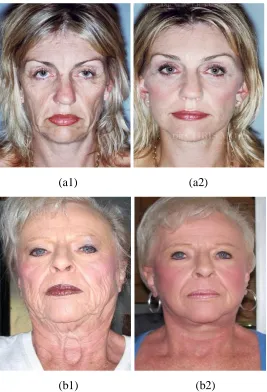
1.1 Pre-surgery (a1-b1) and post-surgery (a2-b2) images of different person faces after the surgery
procedure that changes overall facial appearance 5 1.2 Example of region selection of facial component
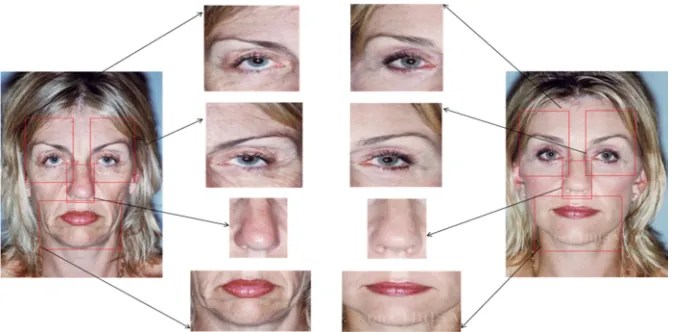
based approach for pre-surgery and post-surgery
face images 6
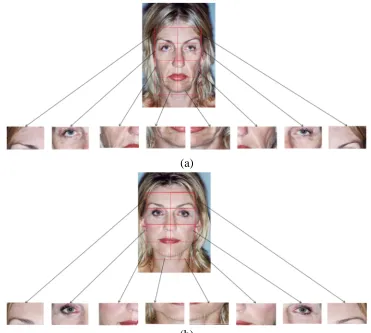
1.3 Example of region selection based on fixed sizes of facial component for pre-surgery and
post-surgery face images 7
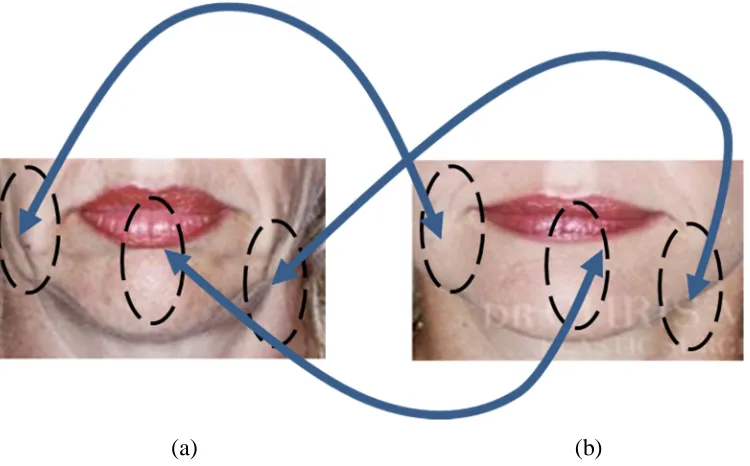
1.4 A close observation of the correspondence between points on a pre-surgery image (a) and
post-surgery image (b) 8
1.5 Example pre-surgery and post-surgery face images divided into granules. The granular images (a1, a2) are horizontal granules, and (b1, b2) vertical
granules 10
2.1 A profile plot of various patterns. (a) Fingerprint pattern, (b) natural image (texture) pattern, and (c)
face pattern 21
2.2 Profile plot of a sample face pattern with varying
degree of illumination 22
2.3 Illustration of face surfaces with various lighting components. (a) diffuse reflection (b) specular
xvii 2.4 Facial tissues that are of significance to plastic
surgery 52
2.5 Facial regions where Blepharoplasty surgery
incisions are made 53
2.6 Demonstrating the act of skin resurfacing and
Dermabrasion 54
2.7 Illustrative example of brow lift procedure 55
2.8 Lip augmentation procedure 56
2.9 Example of face regions where Rhytidectomy
procedure is carried out 57
2.10 Demonstration of Otoplasty surgery procedure. The incisions and sutures are on ear region for
re-positioning and re-modelling 58
2.11 The anatomy of Genioplasty 59
2.12 The anatomy of the nose. The dotted lines are drawn to show regions where modifications are
possible 60
2.13 Aesthetic surgery example images from [6]. (a) Rhytidectomy (face lift), (b) Otoplasty (ear surgery), (c) Rhinoplasty (nose surgery), (d) Chin
Implant, (e) skin resurfacing, and (f) Brow lift 61
3.1 A generalized face recognition system 67
3.2 Schematic illustration of face recognition system; a) contemporary scenario showing illumination problem, b) scenario with challenges of plastic
surgery procedures 70
xviii 3.7 Surgical outcome of using a composition of
geometric transformation on before images (a1, b1). Showing in (a2) is the Rhinoplasty procedure (nose), lip enhancement, and chin implant. In (b2) shows the case of the Rhytidectomy procedure
correcting the skin surfaces 77
3.8 The proposed framework for recognizing
surgically altered images 81
3.9 Face recognition application domains and their
respective task at a glance 83
3.10 Overview of typical airport application of face
recognition 84
3.11 Sample images from the plastic surgery data set 89
3.12 Sample images from the GT data set 90
3.13 Sample faces from the LFW funnelled data set 91
3.14 Sample faces from the Essex data set 92
4.1 The Algorithmic flow for the proposed rgbGE
normalization technique 113
4.2 Normalization using rgbGE on a sample image. (a)-(b) the original images, its colour and greyscale images, (c)-(d) the normalized images,
its colour and greyscale images 114
4.3 Example output of various illumination pre-processors. (a) rgbGE in log domain, (b) rgbGE with visual quality, (c) AS, (d) LOG-DCT, (e)
Homo, (f) LSSF, (g) MAS, (h) SSR, and (i) WN 116
5.1 The descriptor algorithmic process 121
5.2 The first Gaussian smoothing filter. The filter kernel is (a) Gaussian kernel and (b) its picture
form 123
5.3 The second Gaussian smoothing filter. The filter kernel is (a) Gaussian kernel and (b) its picture
xix 5.4 Illustration of convolution process for the
derivative of Gaussian kernel 126
5.5 The derivatives of Gaussian filter with respect to x-axis. The kernels signify (a1, a2) the derivative kernel and its picture form, while (b1, b2) are the derivative of Gaussian kernel and its picture form,
respectively 127
5.6 The derivative of Gaussian filter with respect to y -axis. The kernels signify (a1, a2) are the derivative kernel and its picture form, respectively, while (b1, b2) are the derivative of
Gaussian kernel and its picture form, respectively 128 5.7 Illustration of complete face structural pattern
process. Each matrix is a sub-region (a) the illumination normalized image scaled to and (b)
the computation process. 131
5.8 Gabor wavelets at 5-scales and 8-orientations. (a) The real part of the Gabor wavelet. (b) The
magnitude part of the of the Gabor wavelet 133 5.9 Demonstration of the LEGGM
interpolation-dependent down-sampling process 136
5.10 Fourier spectrum analysis of face signals. up-row the spectrum of the complete face structure image and down-row: the spectrum of the face pattern in its original form, (a1 and b1) The complex FFT of the signal, (a2 and b2) the frequency spectrum of
the FFT 139
5.11 Pictorial overview of the resulting images of the
descriptor main steps 140
5.12 Sample images for conformity to similarity test viewed in colour-map to highlight intensity and edge information. (a) Greyscale and (b) edge with
xx 5.13 Profile plot of various patterns. (a) Face pattern in
its original form, and (b) Complete face structural
pattern 145
5.14 Illustration of subspace learning from LEGGM 149 5.15 Statistical Q-Q plot of the distribution of sample
face data. The high-dimensional data distribution of face sample defined using (a) the direct-mode,
and (b) the LEGGM descriptor. 157
5.16 Statistical Q-Q plot of the distribution of face data defined using subspace learning from LEGGM. (a) LEGGM defined face sample, (b) subspace learning with PCA plus LDA, (c) subspace learning with LSDA, and (d) subspace learning
with sLPP 159
5.17 Pictorial illustration of the order of matching of
sample pairs 161
6.1 Illumination normalization on some example images from the plastic surgery (a), GT (b), LFW
(c), and Essex (d) data sets 165
6.2 Experimental modes for illumination
normalization evaluation 167
6.3 Comparative identification performances of various illumination processors. Some pre-processors performances include the direct-mode
and designed mode 170
6.4 Comparative verification performances of various illumination pre-processors. Some pre-processors performances include the direct-mode and
designed mode 171
6.5 Identification performances of the LEGGM descriptor and existing descriptors without employing subspace learning for different plastic
xxi 6.6 Identification performance of LEGGM with
subspace learning for different plastic surgery
procedures (a-i) 181
6.7 Identification performance of the descriptor-based face recognition method for the case of
multi-variations 188
6.8 Identification performance of the descriptor-based face recognition method for the case of gross
variation 191
6.9 Identification performance of the descriptor-based face recognition method for the heterogeneous
case 194
6.10 Identification rates for rgbGE with visual quality
vs rgbGE without visual quality 197
6.11 Face recognition performances on subset database-1 (plastic surgery) and database-2 (GT) using the Gabor facial descriptor and the LEGGM
facial descriptor 197
7.1 How the generative module fits into face
recognition architecture 204
7.2 Demonstration of the limitations of rgbGE with
xxii
LIST OF ABBREVIATIONS
AHE - Adaptive version of histogram equalization AS - Anisotropic smoothing
BHE - Block based local histogram equalization CAQI - Classified appearance-based quotient image
CIE L*U*V* - Commission international de l’Eclairage L-luminance UV-chrominance
CMC - Cumulative match characteristics curve CLBP - Circular local binary pattern
CLBPHF - Completed local binary pattern histogram features CLBP-M - Completed local binary pattern-magnitude
CLBP-M-S - Completed local binary pattern-magnitude-sign (phase) CLBP-S - Completed local binary pattern-sign (phase)
DCT - Discrete cosine transform DoG - Difference of Gaussians EER - Equal error rate
ER - Error Rate
ES - Evaluation scenario
ES-1 - Evaluation scenario-1 ES-2 - Evaluation scenario-2
FACE - Face analysis for commercial entities FAR - False acceptance rate
FARO - Face recognition against occlusion and expression FFT - Fast Fourier transform
FRR - False rejection rate
FDA - Fisher discriminant analysis
xxiii
GE - Gamma encoding
GFRPS - Geometrical face recognition after plastic surgery GLCM - Grey-level co-occurrence matrix
GPROF - Gabor patch classifiers via rank-order list fusion GRAB - Generalized region assigned binary
GT - Georgia tech face data set HE - Histogram equalization HSI - Hue saturation intensity
HOGOM - Histogram of Gabor ordinal measures Homo - Homomorphic filtering
Homo-1 - Homo in direct-mode Homo-2 - Homo in designed mode HSV - Hue saturation value IGM - Image gradient magnitude IGO - Image gradient orientation ISOMAP - Isometric mapping
IR - Identification rate
PCA - Principal component analysis model
LSDA - Locality sensitive discriminant analysis
sLPP - supervised locality preserving projection k-NN - number of nearest neighbour
LBP - Local binary pattern
LBPHF - Local binary pattern histogram Fourier features LDA - Linear discriminant analysis
LE - Laplacian eigenmaps
LEGGM - Local edge gradient Gabor magnitude (pattern)
LEGGM-PCA plus LDA - LEGGM-PCA plus LDA new feature vector LEGGM-LSDA-LGE - LEGGM-LSDA-linear graph embedding new
feature vector
LEGGM-LSDA-OLGE - LEGGM-LSDA-orthogonal linear graph embedding new feature vector
LEGGM-sLPP-LGE - LEGGM-sLPP-LGE new feature vector LEGGM-sLPP-OLGE- - LEGGM-sLPP-OLGE new feature vector
xxiv LFW - Labelled faces in the wild
LFW158 - Labelled faces in the wild of 158 subjects LFW610 - Labelled faces in the wild of 610 subjects LGBP/
LGBPHS - Local Gabor binary pattern/LGBP histogram sequence LGE - Linear graph embedding
LGXP - Local Gabor XOR pattern LHE - Local histogram equalization LHM - Local histogram matching LN - Local normalization technique LNORM - Local normal distribution
LOG-DCT - Logarithm domain based discrete cosine transform LPP - Locality preserving projection
LSDA - Locality sensitive discriminant analysis LSSF - Large and small scale features
LT - Local transform
MAS - Modified anisotropic smoothing MAS-1 - MAS in direct-mode
MAS-2 - MAS in designed mode MSR - Multi-scale retinex
MVU - Maximum variance unfolding MAS - Modified anisotropic smoothing
NN - Nearest neighbour
OLGE - Orthogonal linear graph embedding PCA - Principal component analysis
PCA plus LDA - Principal component analysis plus linear discriminant analysis PDE - Partial differential equation
PIFS - Partitioned iterated function system Q-Q - Quantile-quantile
rgb/RGB - red, green, and blue (colour channels) rgbGE - rgb gamma encoding
rgbGE-1 - rgbGE without post-processing in direct-mode rgbGE-2 - rgbGE without post-processing in designed-mode
xxv mode
RHS - Right hand side
ROC - Receiver operating characteristics curve SIFT - Scale invariant feature transform
SLBT - Shape local binary feature
sLPP - Supervised locality preserving projection SQI - Self-quotient image
SSIM - Structural similarity image quality map SSR - Single scale retinex
SURF - Speeded-up robust features SVM - Support vector machine
TPLBP - Three-patch local binary pattern
V1-like - Human visual cortex inspired algorithm
VR - Verification rate
WN - Wavelet normalization
xxvi
LIST OF SYMBOLS
A - Sample face image
i
A - ith face image of a subject
j
A - jth neighbourhood face image of the ith face image data point )
(t
A - Sample face image from a training set
i
A~ - ith test image of a subject )
(n K
A - Kth sample image of nth subject ) ( , n q K
A - Kth sample image of nth subject taken under a lighting condition q
- Sample space of images
j i Y
X ,
det(.) - Determinant
j iY
X,
- Metric distance between the two images Xi,andYj, [.]
- Expectation operator
i X
- Mean of Xi
j
Y
- Mean of Yi
i
X
- Standard deviation of Xi
j
Y
- Standard deviation of Yi
s
H - Mathematical operators that represent specific plastic surgery procedure
V - linear map
n
Q - Shape preserving operator n = i, j k
xxvii )
(c
Ik - Intensity colour image at the spatial coordinate c k
S - Specular reflection of an image surface of varying colour responses.
) ( c
S - Spectral reflectance on surface (image) at spatial coordinate c )
(
E - Spectral power distribution of the light incident on an image at the time of capture
) ( k
C - The spectral sensitivity of the image capturing sensor at the wavelength
} , ,
{r g b - Colour channels signifying red, blue and green d
w - Diffuse term of the light incident on an image at the time of capture
s
w - Specular terms of the diffuse term of the light incident on an image at the time of capture.
cDk - Diffuse component of the incoming light at image spatial coordinate c
k
G - Specular component of the incoming light at image spatial coordinate c
) (c
k
- Gamma normalized colour channel image at c )
(c
I - Original image
) (c
I - Image normalized using rgbGE illumination normalization technique
) (c
I - Greyscale version of image normalized by rgbGE in logarithm
domain )
(c
I - rgbGE normalized image with enhanced visual quality
- General representation of all the subspace models )
(c k
- General representation of normalized RGB colour channels at the spatial coordinates c
output
I - Power-law output image
- Exponent of the power function for gamma correction )
(c
xxviii )
(c k
- Defined chromaticity of a surface for rgbGE normalization max
- Desired maximum intensity value for image contrast stretching min
- Desired minimum intensity value for image contrast stretching max
I - Maximum intensity value of rgbGE in logarithm domain normalized image
min
I - Minimum intensity value of rgbGE in logarithm domain normalized image
) (c
f - Gaussian smoothed rgbGE in logarithm domain normalized image
) ; (c
G - Gaussian smoothing filter
- Gradient operator
2
- Laplacian operator
- Edge gradient image
) (c
I - Rescaled to [0, 1] rgbGE logarithm domain normalized image ) ( max c I ) (c
- Face image complete face structural information
,
l - Gabor encoding wave vector at scale µ and orientation v max
l - Maximum Gabor encoding wave vector f
s - Spacing factor between Gabor kernels in the frequency domain
- Maximum frequency of Gabor encoding )
( , c
- Family of Gabor kernels
) ( , c
- Response of spatial-frequency Gabor kernels to the facial structure defined face pattern at pixel point at five scales and eight orientations
) ( , c
LEGGMv - Local edge gradient Gabor magnitude pattern at five scales and eight orientations
) ( ˆ , c GM G
xxix )
( ,v c
- Real part of the Gabor kernels at five scales and eight orientations
) ( ,v c
- Imaginary part of the Gabor kernels at five scales and eight orientations
GM G LEˆ
- Variance of the LEGˆGM,v(c) ) ( ˆ , c M G G LE v u
- Standardized down-sampled LEGˆGM,v(c) feature at five
scales and eight orientations ) ( ˆ , c M G G LE i v u
- All forty ˆ ( )
, c M G G LE v u
features for describing ith sample image of a data set
,
Z - Concatenated ˆ ( )
, c M G G LE v u
feature vector (forty features) for a sample image
- Fast Fourier transform of a signal
- Inverse fast Fourier transform of a signal D
- A high-dimensional (D) coordinates space where several (D) real variables can be treated as a single variable
d
- A low-dimensional (d) coordinates space where several (d) real variables can be treated as a single variable
Δ - Eigenvalue of the scatter matrix W - Eigenvector of the scatter matrix
W - Transpose of the matrix W. (.)
J - Cost-function of the transpose of the matrix for various subspace model
Sω - Within-class scatter matrix for LDA
Sb - Between-class scatter matrix LDA
ij
S - Adjacency matrix that describes the neighbourhood, N of sample points Ai and Aj
p ij
xxx
ij w
S , - Adjacency matrix (cconnectedness) graph for sample points
i
A and Aj of within a class
ij b
S , - Adjacency matrix (cconnectedness) graph for sample points
i
A and Aj of between classes Mi - Mean value of a class
M - Grand mean of the classes of a data set P(Ωi) - Probability of the ith class
xxxi
LIST OF APPENDICES
APPENDIX TITLE PAGE
A The Generation of CMC curve using match scores of rgbGE without visual quality
1
CHAPTER 1
INTRODUCTION
1.1 Introduction
The human mind has an intuitive ability to effortlessly analyse, process and store information about a face for the purposes of identification and authentication. Studies in the fields of cognitive science, psychology and perception, point to the visual cortex as being a major contributor to the recognition ability of the human mind. The visual cortex interprets a face to being composed of series of shapes, which are processed piece-wisely on horizontal level [1]. To recognize an individual, all the parts of the face that are individually processed, are put together to make sense of a person’s identity. Studies [1]-[2] have shown that there is no limit to the visual processing capability of human’s, because even in situations where certain features are not sufficiently available, that is, they might be altered, camouflaged or disguised, a high degree of recognition can still be achieved. Several years of extensive research efforts have been geared towards developing machines with visual processing capabilities that can emulate the recognition capability of the human visual system. However, there is yet to be such very effective biometric system that can be deployed effectively as the human visual system.
2 capability of the machine. Such factors can be regarded as scene-centric conditions and appearance-centric conditions. Examples of the scene-centric conditions are illumination, pose and scale. The appearance-centric conditions include the reversible conditions such as expression, disguise and make-up, and the irreversible conditions such as aging and plastic surgery.
Now let us look at how the above mentioned conditions come to play in the recognition capabilities of machines that are deployed in various application domains. These domains include transaction authorization, social welfare and security.
1. Transaction Authorisation. The unreliability and unpredictability of password protection have in recent time motivated the use of physical access control systems. Most enterprise computers incorporate the face biometric for identity authentication. For the identity of the system user to be determined, there should be existing facial information of the individual in the system. As such, the identity of the user that is carrying out the transaction will be matched to his/her enrolled image in the system in order to ascertain if the person is who he/she claims to be. This is a case of one-to-one verification. There are a number of potential applications in this domain, some of which are automated teller machines in banking, single-sign-on to multiple networked services, access to encrypted documents, issuing of national and international identification passports, voters registration, and so on. In these application scenarios it is possible to control the effect of scene-centric and reversible appearance-scene-centric conditions on the captured image and subsequently the recognition system. However, it is obvious that the irreversible appearance-centric conditions cannot be controlled easily by any common standard.
3 to tag to an image. Other applications are the face identification smart logon feature of most personal devices such as the personal PC/laptop, mobile phones, and modern home authentication devices. Imagine you are requesting to login into your mobile device and you are unable to gain access to your device simply because the environment under which your image is captured is not properly illuminated. Other scene-centric conditions and the appearance-centric conditions can as well affect the recognition capability of the device. This is so since the mobile user may not be able to control the conditions in the various environment within which he finds himself.
3. Security. Under this domain there are several potential applications of face recognition some of which are law enforcement, forensic, surveillance, and border/airport control. The recognition scenario under this domain is the task of identifying a new enrolled face sample that is compared against an entire collection of previously enrolled face images of different persons’. The identification task is a one-to-many phenomenon that can be used to link or ensure that the enrolled sample is not laying claim to more than one identity. The process of registering a user face image in this domain can range from controlled to uncontrolled. This is to say that the formation of the face images of a person can be of different scenes, therefore it can be subject to scene-centric conditions. Also, as the face images of individuals are constantly updated, the appearance-centric conditions can be a factor in the image formation.
Having put forward a clear explanation of the meaning of scene-centric conditions and appearance-centric conditions together with how they can impact on face recognition performance under different application domains, the individual conditions that are categorized as the scene-centric and the appearance-centric conditions will in some places in this thesis where their individual meaning is not significant be collectively referred to as unconstrained conditions.
4 and unconstrained conditions such as pose, scale, expressions, aging, and illumination [3]-[10] are involved in image formation. Likewise, numerous algorithms, techniques and methods have for over the years been developed and implemented in existing face recognition systems in order to be able to address these challenges. However, common to the application domains discussed earlier is the irreversible-appearance changing conditions, which cannot be controlled by adopting any physical measures in face image capture. Therefore, the need for face recognition systems that is robust against the irreversible facial appearance changing condition such as the plastic surgery is crucial for real-world face recognition application domains.
1.2 Problem Background
Facial appearance changes as a result of plastic surgery can manifest itself in the form of textural variations, and geometrical variations in the size and the relative position of the facial features. The challenges plastic surgery poses to face recognition systems can be classified as being twofold, intra-person dissimilarity and inter-person similarity. The facial appearances of an individual can become different after undergoing plastic surgery procedures (intra-person dissimilarity), but can also tend towards the appearance of a different individual (inter-person similarity). Before formulating the problem that this thesis addresses, let us first go through the contributions made so far by previous researchers on the recognition of faces after plastic surgery.
5 considerable improvement in recognition accuracy compared to the accuracies reported in [11] there is still a considerable amount of work to be done to mitigate the influences the irreversible appearance-centric conditions caused by plastic surgery have on face recognition systems. This is for the fact that the approaches presented in the literatures show to indicate a misconception of the effect plastic surgery procedures actually have on facial features. In Figure 1.1 some pre-surgery and post-surgery sample faces are shown, which in the later part of this section will be used to demonstrate how the effects of plastic surgery procedures have been misconstrued in the previous studies.
(a1) (a2)
(b1) (b2)
6 The progress so far in the literatures [12]-[22] is made with the use of intensity based or texture based descriptors such as Gabor and/or local binary pattern (LBP) for the recognition of surgically altered faces. Despite the use of texture/intensity based facial descriptors, the variations in face appearance caused by plastic surgery are addressed in these literatures from a perspective that includes the selection of facial component features that will eventually be described with any of the intensity or texture based facial descriptor algorithms. The feature selection processes are basically adopted differently by various researchers in order to minimize facial variations due to plastic surgery. The approaches adopted can be summarized here as facial region selection approaches [12]-[13], [14], [19], [21], [22], facial region/full face frontal selection approaches [15]-[16], [20] and granular selection approaches [17]-[18].
The region selection, facial region/full face frontal selection and granular-selection approaches are on the concept of locating several local facial parts, which are then described using a facial descriptor. Each processed region contributes to a classifier decision, which is further fused with that of other features for establishing an identity. For the region selection approach, the facial regions located can be adapted to the sizes of the facial regions [12]-[13], [14], [22] or located at fixed intervals across the image [19], [21]. These region selection approaches are demonstrated in Figure 1.2 and Figure 1.3, respectively.
7 Using facial regions that are adapted to the sizes of the facial features such as left-eye, right-eye, nose and mouth, Marsico et al. [12], [13] described each individual region from their intensity level. By employing the partitioned iterated function system (PIFS) each facial part region is processed using their intensity information, which are coded and reconstructed to form feature vectors for recognition. They also showed that other variation factors asides plastic surgery can also be recognition challenges. Aggarwal et al. [14] selected facial regions that include the eyes, nose, eyebrow and mouth, which are cropped and characterized using the principal component analysis (PCA). Feng et al. [22] likewise selected facial regions that are adapted to the sizes of the facial features. Their facial features included eye, nose, lip and skin, where each region containing these features is described using Gabor and grey- level co-occurrence matrix (GLCM). These facial descriptors are likely to enhance on the texture details of the face image.
(a)
(b)
8 On locating at fixed intervals across the image, Liu et al. [19] divided the face into 2-by-8 patches, each containing certain features of interest. These regions (in the form of patches) were then individually described using Gabor. On the other hand, Sun et al [21] divided the face into 8-by-8 patches. Then each patch is independently described using the LBP and Gabor. To demonstrate the consequences of both types of region selection approach in handling facial variations between the face images of an individual, a point-match from a region in the pre-surgery face image is drawn to a corresponding point on the post-pre-surgery image. This is shown in Figure 1.4.
(a) (b)
Figure 1.4 A close observation of the correspondence between points on a pre-surgery image (a) and post-pre-surgery image (b)
9 this example illustration in Figure 1.4 is likewise suffered by approaches that also select facial region/full-frontal features [15]-[16], [20] and granular region selection [17]-[18].
Lakshmiprabha et al. [15] combined the periocular region, which comprises of the left-eye and right-eye, with the full-frontal face. Then, the periocular region and the full frontal face are described using Gabor and LBP. In an extended work [16] they used a shape local binary texture (SLBT) descriptor to independently describe the selected periocular region and the full frontal face image. Jillela et al. [20] likewise selected the full frontal face image and the periocular region. But the periocular region is obtained from the three colour channels of the face image. These regions are described using the scale-invariant feature transform (SIFT) and LBP descriptors.
The granular selection approach utilized by Bhatt et al. [17]-[18] divides the face into non-overlapping parts at different levels of information extraction. An example of the face image divided using a granular-based facial region selection approach is shown in Figure 1.5. Each facial region granularly selected is described independently using the extended uniform circular local binary patterns (EUCLBP) and scale invariant feature transform (SIFT).
10
(a1) (a2)
(b1) (b2)
Figure 1.5 Example pre-surgery and post-surgery face images. The granular images (a1, a2) are horizontal granules, and (b1, b2) vertical granules
1.3 Problem Statement
11 person that have undergone plastic surgery, the intensity/texture-based descriptors fall short since they enhance the texture differences of the face images of an individual who have undergone plastic surgery. Hence, face recognition systems that utilize intensity/texture information might not be hardy against faces altered by plastic surgery procedures.
Comment 1: A plausible solution to the aforementioned problem is to exploit
“the face information that is not likely to be affected by plastic surgery”. This frame of reference serves as a platform for constructing robust and efficient feature
descriptors that are intensity/texture insensitive for the recognition of surgically
altered face images.
This thesis addresses the concern of finding and presenting face information that is insensitive to the effect plastic surgery procedures poses on facial features, and employs such information in designing a new facial descriptor.
Also, since face images are formed by multiple interacting factors related to the conditions within which the images where captured, solving the irreversible appearance-centric problem such as plastic surgery without considering for instance, the illumination problem that constitutes a major challenge to facial descriptors, might hinder effective representation of facial features. Numerous illumination pre-processing techniques have been presented over the years to mitigate the influence of lighting variation in face images. However, a number of the pre-processing techniques diminish the intrinsic shape characteristics in the face image when further processed, while a number of the methods cause the increase in the difference margin in the face images of an individual due to over exaggeration of facial information.
Comment 2: To address this problem the ability to take into cognizance the
resultant output of illumination pre-processing is required in the design of robust
face recognition systems so as not to alter the distinctive and yet discriminative
12 This thesis also addresses the issue of illumination challenge posed to feature extraction process in the recognition system.
In order to proffer solutions to the challenges that this thesis addresses, the following research questions are presented in such a manner that brings to light the objectives of this thesis;
i. What constitutes information minimally influenced by plastic surgery procedures?
ii. How can such facial information be determined and exploited for recognizing surgically altered face images?
iii. What is the technique for addressing non-uniform illumination problem that do not diminish the facial information determined from (ii) and does not introduce separability between face images of a subject?
iv. What is the approach for developing a descriptor that encodes the intensity/texture insensitive facial information without compromising the ability to discriminate between different face classes?
v. Does the transformation of feature vectors, which belong to the class of heavy-tailed distribution, from high-dimensional space to low-dimensional space influence on their discriminative capabilities and how does it vary across different subspace transformation models?
1.4 Research Goal
13
1.5 Research Objectives
i. To define the facial information minimally influenced by plastic surgery procedures, and design a framework that integrates coherently new modules for recognizing plastic surgery altered faces in real-world face recognition system. ii. To develop and propose new illumination normalization technique that
addresses non-uniform illumination problem.
iii. To develop and propose new facial shape and appearance descriptor namely, local edge gradient Gabor magnitude (LEGGM) that is intensity/texture insensitive for intrinsic facial structural pattern characterization. And design a method of subspace learning from LEGGM for face representation.
iv. To investigate and compare the capabilities of various linear subspace methods such as principal component analysis plus linear discriminant analysis (PCA plus LDA), supervised locality preserving projection (sLPP) and locality sensitive discriminant analysis (LSDA) in capturing the discriminative information of the LEGGM pattern in the reduced space.
1.6 Scope of the Thesis
14 The proposed and developed illumination normalization technique in this thesis addresses the influence of uneven illumination and specular highlight due to illumination direction, but no consideration for the ambient component of the light source is made in this thesis.
In order to emphasize on the effectiveness of the proposed face descriptor algorithm to uniquely characterize the intrinsic and yet discriminative features of different person’s face images, the non-parametric nearest neighbour classifier is adopted for classification task. For the most part, it can be argued that the nearest neighbour (NN) is best suited as a baseline algorithm because it does not depend on the information about the data distribution and so its efficiency is solely dependent on how well the face representation step is able to discriminate a person from another [23]. A certain parameter k can as well be specified for the NN, such that comparison can only be within small clusters (k-NN) of sample data. By specifying k, the comparison within small clusters of sample data can improve the decision of the NN classifier. Furthermore, on the usage of parametric classifiers, which uses the underlying distribution of the data, better classifier performance is envisaged. However, classifier performance is not within the scope of this thesis.
15 on face recognition and not on matching persons who have undergone plastic surgery with their pre-surgery images, it is therefore imperative to depict the scenario where all the facial variation factors can individually exists or come into play during the image formation process. The faces into consideration are real faces of persons typified in existing data sets used in the literature. These face images were captured as still images, hence, there is no effect of motion in the images.
1.7 Significance of the Research
In this section, the theoretical as well as the practical significance of this study are discussed.
The previous contributors in this field of study focus mainly on selecting facial component features [12]-[22] as a means of mitigating the effects of plastic surgery. Added to the selection of the facial component features is the use of intensity/texture based descriptors to describe each individual facial component part. These descriptors might be hardy against texture variations in the recognition of faces that have undergone plastic surgery. Therefore, to fill this gap, a theoretical basis from mathematical standpoint that points towards plastic surgery-insensitive features is derived. However, this discovery is medically inspired. The theoretical discovery can bring about a new perspective in the design of algorithms for describing faces altered by surgery. Also, this discovery can benefit a number of research disciplines as discussed as follows:
Image understanding: it can be applied in defining the medical effects of plastic surgery and relate it to picture elements of digital images.
16
Recognition: it can serve as a means of defining insensitive to facial distortion features for other cases of appearance distortions such as aging.
Drawing on the derived theory, this thesis develops a descriptor for characterizing the insensitive to plastic surgery effect features in faces that have been subjected to plastic surgery transformation.
Due to the constantly unfolding global crisis that can threaten the life of large amount of persons at a split of seconds, the security of citizens of every country has never been more heightened. The ability of terrorist to conceal identity using plastic surgery in order to bypass security and cause havoc to life and property cannot be ruled out. Therefore, to be able to explore a more practical scenario, unlike the previous studies where emphasis are only on the recognition of surgery images, this thesis includes other variation factors in order to mimic typical application domains. In this regards, this thesis designs a framework that integrates feature representation and illumination compensation for face recognition. Consequently, an illumination normalization technique that fits to the designed framework that circumvents the influences that poorly illuminated images will have in effectively describing a face image by its intrinsic structural patterns is develop.
17
1.8 Thesis Structure
The organization of this thesis is given in this section. The rest of the chapters in this thesis begin with brief section that highlights the aims of each chapter, and ends with a section that summarizes the ideas presented in the chapters. Each chapter is developed to be self-contained, but there exists cohesion among the chapters in order to ensure the free flow of presentation and understanding of the thesis content. It should also be borne in mind that in the course of this thesis, mathematical notations and definitions are introduced at various points where it is deem such action will give better cohesion and understanding to this work.
In Chapter 2, an in-depth review of literatures that gradually goes from face recognition in general to previous work on face recognition for plastic surgery images is presented. Since face recognition on the topic of plastic surgery is still an emerging research area with very little literatures, the review covers existing illumination compensation methods and face representation methods from the general face recognition point-of-view. Subsequently, a detailed review that brings to light the various approaches that has so far been used in the recognition of surgically altered face images is presented. For each of the review sections, a discussion is presented in such a way that points the reader to the limitations of existing methods and the need for the proposed methods. Furthermore, from a medical stand point, the various plastic surgery procedures and a brief discussions on each of them is presented in such a way that brings to understanding what is modified on account of the surgery procedure
18 analysis forms the motivation and foundation for the development of the new approaches presented in Chapter 4 and 5.
In Chapter 4, the illumination normalization technique which is a new approach for addressing the influence of illumination for effective detection of features is proposed and presented. The problem of uneven illumination and specularities are addressed in this chapter without any estimation of distribution of the illumination on each illuminated object.
In Chapter 5, a new facial shape and appearance descriptor namely, local edge gradient Gabor magnitude (LEGGM) pattern is presented. The proposed descriptor is a variant of Gabor descriptor, but encodes facial shape and appearance. However, unlike the conventional Gabor descriptor, which is limited by its encoding in the grey-level domain, the proposed LEGGM is able to overcome this limitation and provide effective facial pattern characterization. As a variant of Gabor descriptor, the LEGGM exist in high-dimensional space, which effects on classifier performance. To overcome this problem and for increased classifier performance, various linear subspace learning models such as principal component analysis plus linear discriminant analysis (PCA plus LDA), supervised locality preserving projection (sLPP) and locality sensitive discriminant analysis (LSDA) are employed for learning LEGGM data.
207
REFERENCES
1. Dakin, S. C. and Watt, R. J. Biological “Bar Codes” in Human Faces. Journal of Vision, 2009. 9(4): 1–10.
2. Sinha, P., Balas, B., Ostrovsky, Y. and Russell, R. Face Recognition by Humans: Nineteen Results All Computer Vision Researchers Should Know About. Journal of the Proceedings of the IEEE, 2006. 94(11): 1948-1962. 3. Zheng, Z., Yang, F., Tan, W., Jia, J. and Yang, J. Gabor Feature-based Face
Recognition using Supervised Locality Preserving Projection. Journal of Signal Processing, 2007. 87(10): 2473-2483.
4. Olshausen, B. A. and Field, D. J. Emergence of Simple-cell Receptive Field Properties by Learning a Sparse Code for Natural Images. Journal of Nature, 1996. 381(6583): 607-609.
5. Rao, R. P. and Ballard, D. H. An Active Vision Architecture Based on Iconic Representations. Journal of Artificial Intelligence, 1996. 78(1): 461-505. 6. Schiele, B. and Crowley, J. L. Recognition without Correspondence using
Multidimensional Receptive Field Histograms. International Journal of Computer Vision, 2000. 36(1): 31-52.
7. Kepenekci, B., Boray Tek, F. and Akar, G. B. Occluded Face Recognition Based on Gabor Wavelets. Proceedings of the IEEE International Conference on Image Processing. September 22-25, 2002. Rochester, NY: IEEE, 2002. 293-296.
208 IEEE, 2005. 786-791.
9. Ahonen, T., Hadid, A. and Pietikäinen, M. Face Recognition with Local Binary Patterns. Proceedings of the 8th European Conference on Computer Vision. May 11-14, 2004. Prague, Czech Republic: Springer Berlin Heidelberg. 2004. 469-481.
10. Wouter, J. R. and Peter H. N. Robust Face Recognition Algorithm for the Identification of Disaster Victims. Proceedings of the SPIE Image Processing: Algorithms and Systems XI. February 3, 2013. Burlingame, California, USA: SPIE. 2013.865503-865503.
11. Singh, R., Vatsa, M., Bhatt, H., Bharadwaj, S., Noore, A. and Nooreyezdan, S. Plastic Surgery: A New Dimension to Face Recognition. IEEE Transactions on Information Forensics and Security, 2010. 5(3): 441–448. 12. Marsico, M., Nappi, M., Riccio D. and Wechsler, H. Robust Face
Recognition after Plastic Surgery using Local Region Analysis. Proceedings of the 8th International Conference on Image Analysis and Recognition, Part
II. June 22-24, 2011. Burnaby, BC, Canada: Springer Berlin Heidelberg. 2011. 191-200.
13. Marsico, M., Nappi, M., Riccio, D. and Wechsler, H. Robust Face Recognition after Plastic Surgery using Region-Based Approaches. Journal of Pattern Recognition, 2014 [In press].
14. Aggarwal, G., Biswas, S., Flynn, P. J. and Bowyer, K. W. A Sparse Representation Approach to Face Matching Across Plastic Surgery. Proceeding of the IEEE Workshop on Applications of Computer Vision. January 9-11, 2012. Breckenridge, CO: IEEE, 2012. 113-119.
15. Lakshmiprabha, N. S., Bhattacharya J. and Majumder, S. Face Recognition using Multimodal Biometric Features. Proceedings of the IEEE International Conference on Image Information Processing. November 3-5, 2011. Himachal Pradesh: IEEE. 2011. 1-6.
16. Lakshmiprabha, N. S., J. Bhattacharya, and S. Majumder. A Novel Face Recognition Approach using Multimodal Feature Vector. International Journal of Advances in Engineering and Technology, 2012. 3(1): 477-486. 17. Bhatt, H. S., Bharadwaj, S., Singh, R., Vatsa, M. and Noore, A. Evolutionary
209 Gesture Recognition and Workshops. March 21-25, 2011. Santa Barbara, CA: IEEE. 2011. 720-725.
18. Bhatt, H. S., Bharadwaj, S., Singh, R. and Vatsa, M. Recognizing Surgically Altered Face Images using Multiobjective Evolutionary Algorithm. IEEE Transactions on Information Forensics and Security, 2013. 8(1): 89-100. 19. Liu, X., Shan, S. and Chen, X. Face Recognition after Plastic Surgery: A
Comprehensive Study. 11th Asian Conference on Computer Vision, Part II, November 5-9, 2013. Daejeon, Korea: Springer Berlin Heidelberg. 2013. 565-576.
20. Jillela, R. and Ross, A. Mitigating Effects of Plastic Surgery: Fusing Face and Ocular Biometrics. Proceedings of the Fifth IEEE International Conference on Biometrics: Theory, Applications and Systems. September 23-27, 2012. Arlington, VA: IEEE, 2012. 402-411.
21. Sun, Y., Tistarelli, M. and Maltoni, D. Structural Similarity Based Image Quality Map for Face Recognition across Plastic Surgery. Proceedings of the Sixth IEEE Conference on Biometrics: Theory, Applications and Systems, October 29-September 2, 2013, Arlington, VA, USA: IEEE. 2013. 1-8.
22. Feng, R. and Prabhakaran, B. A Novel Method for Post-Surgery Face Recognition using Sum of Facial Parts Recognition. IEEE Conference on Applications of Computer Vision. March 24-26, 2014. Steamboat Springs, CO: IEEE. 2014. 1082-1089.
23. Sarfraz, S. M., Hellwich, O. and Riaz, Z. Feature Extraction and Representation for Face Recognition. In: Intech Open. Face Recognition. I-Tech Education and Publishing. 1-20; 2010.
24. Nefian, A. V. Georgia Tech Face Database.
http://www.anefian.com/research/face_reco.htm. [Accessed: 2 Feb. 2013]. 25. Huang, G. B., Mattar, M., Berg, T. and Learned-Miller, E. Labeled Faces in
the Wild: A Database for Studying Face Recognition in Unconstrained Environments. Proceedings of the Workshop on Faces in 'Real-Life' Images: Detection, Alignment, and Recognition. September 1-16, 2008. Marseille, France: Inria. 2008. 1-14.
26. Kelly M. Visual Identification of People by Computer. Ph.D. Thesis. Stanford University; 1970.
210 Promising Directions, and Open Issues. Journal of Visual Communication and Image Representation, 1999. 10(1): 39-62.
28. Yang, X. and Tian, Y. Texture Representations using Subspace Embeddings. Pattern Recognition Letters, 2013. 34(10): 1130-1137.
29. Phong, B. T. Illumination for Computer Generated Pictures. ACM Journal on Communications, 1975. 18(6): 311-317.
30. Georghiades, A. S., Belhumeur, P. N. and Kriegman, D. From Few to Many: Illumination Cone Models for Face Recognition under Variable Lighting and Pose. IEEE Transactions on Pattern Analysis and Machine Intelligence, 2001. 23(6): 643-660.
31. Basri, R. and Jacobs, D. W. Lambertian Reflectance and Linear Subspaces. IEEE Transactions on Pattern Analysis and Machine Intelligence, 2003. 25(2): 218-233.
32. Shashua, A. and Riklin-Raviv, T. The Quotient Image: Class-Based Re-Rendering and Recognition with Varying Illuminations. IEEE Transactions on Pattern Analysis and Machine Intelligence, 2001. 23(2): 129-139.
33. Wang, H. Li, S. Z. and Wang, Y. Generalized Quotient Image. Proceedings of the IEEE Computer Society Conference on Computer Vision and Pattern
Recognition. June 27-July 2, 2004. Washington, DC, USA: IEEE. 2004. 498-505.
34. Lee, J. Moghaddam, B. Pfister, H. and Machiraju, R. A Bilinear Illumination Model for Robust Face Recognition. Proceedings of the Tenth IEEE International Conference on Computer Vision. October 17-21, 2005. Beijing: IEEE. 2005. 1177-1184.
35. Zhao, J., Su, Y., Wang, D. and Luo, S. Illumination Ratio Image: Synthesizing and Recognition with Varying Illuminations. Pattern Recognition Letters, 2003. 24(15): 2703-2710.
36. Han, H., Shan, S., Qing, L., Chen, X. and Gao, W. Lighting Aware Pre-processing for Face Recognition Across Varying Illumination. Proceedings of the 11th European Conference on Computer Vision Part II. September 5-11, 2010. Heraklion, Crete, Greece: Springer Berlin Heidelberg. 2010. 308-321. 37. Zhang, L. and Samaras, D. Face Recognition from a Single Training Image
211 351-363.
38. Wang, Y., Liu, Z., Hua, G., Wen, Z., Zhang, Z. and Samaras, D. Face Re-Lighting from a Single Image under Harsh Re-Lighting Conditions. Proceedings of the IEEE Conference on Computer Vision and Pattern Recognition, June 17-22, Minneapolis, MN, USA: IEEE. 2007. 1-8.
39. Lowe, D. G. Distinctive Image Features from Scale-Invariant Keypoints. International Journal of Computer Vision, 2004. 60(2): 91-110.
40. Moghaddam, B. and Pentland, A. Probabilistic Visual Learning for Object Detection. Proceedings of the Fifth International Conference on Computer Vision. June 20-23, 1995. Cambridge, MA, USA: IEEE. 1995. 786-793. 41. Kefalea, E. Object Localization and Recognition for a Grasping Robot.
Proceedings of the 24th Annual Conference of the IEEE on Industrial
Electronics Society, August 31-September 4, 1998. Aachen, Germany: IEEE, 1998. 2057-2062.
42. Yuan, H., Ma, H. and Huang, X. Edge-based Synthetic Discriminant Function for Distortion Invariant Object Recognition. Proceedings of the 15th IEEE International Conference on Image Processing. October 12-15, 2008. San Diego, CA, USA: IEEE, 2008. 2352-2355.
43. Chalechale, A., Mertins, A. and Naghdy, G. Edge Image Description using Angular Radial Partitioning. IEE Proceedings on Vision, Image and Signal Processing, 2004. 151(2): 93-101.
44. Gao, Y. and Leung, M. K. Face Recognition Using Line Edge Map. IEEE Transactions on Pattern Analysis and Machine Intelligence, 2002. 24(6): 764-779.
45. Gao, Y. and Qi, Y. Robust Visual Similarity Retrieval in Single Model Face Databases. Journal of Pattern Recognition, 2005. 38(7): 1009-1020.
46. Suzuki, Y. and Shibata, T. An Edge-Based Face Detection Algorithm Robust Against Illumination, Focus, and Scale Variations. Proceedings of the 12th European Signal Processing Conference. September 6-10, 2004. Vienna, Austria: EURASIP, 2004. 2279–2282.
47. Zhao-Yi, P., Yan-Hui, Z. and Yu, Z. Real-Time Facial Expression Recognition Based on Adaptive Canny Operator Edge Detection. Proceedings of the Second International Conference on Multimedia and
212 48. Aràndiga, F., Cohen, A., Donat, R. and Matei, B. Edge Detection Insensitive to Changes of Illumination in the Image. Journal of Image and Vision Computing, 2010. 28(4): 553-562.
49. Suzuki, Y. and Shibata, T. Illumination-invariant Face Identification Using Edge-Based Feature Vectors in Pseudo-2D Hidden Markov models. Proceedings of the 14th European Signal Processing Conference. September 4-8, 2006. Florence, Italy: EURASIP. 2006. 4-8.
50. Samsung, S. Integral Normalized Gradient Image A Novel Illumination Insensitive Representation. Proceedings of the IEEE Computer Society Conference on Computer Vision and Pattern Recognition-Workshops, June 25-25, 2005. San Diego, CA, USA: IEEE. 2005. 166-166.
51. Arandjelovic O. Gradient Edge Map Features for Frontal Face Recognition under Extreme Illumination Changes. Proceedings of the British Machine Vision Conference. September 3-7, 2012. Surrey: BMVA Press. 2012. 1-11. 52. Zhang, T., Tang, Y., Fang, B., Shang, Z. and Liu, X. Face Recognition under
Varying Illumination using Gradient Faces. IEEE Transactions on Image Processing, 2009. 18(11): 2599-2606.
53. Han, H., Shan, S., Chen, X., Lao, S. and Gao, W. Separability Oriented Pre-processing for Illumination-Insensitive Face Recognition. Proceedings of the 12th European Conference on Computer Vision Part VII, October 7-13, 2012. Florence, Italy: Springer Berlin Heidelberg. 2012. 307-320.
54. Chen, W., Er, M. and Wu, S. Illumination Compensation and Normalization for Robust Face Recognition using Discrete Cosine Transform in Logarithm Domain. IEEE Transactions on Systems, Man, and Cybernetics, Part B, 2006. 36(2): 458-466.
55. Jobson, D. J., Rahman, Z. and Woodell, G. A. A Single-Scale Retinex for Bridging the Gap Between Colour Images and the Human Observation of Scenes. IEEE Transactions on Image Processing, 1997. 6(7): 965-976.
56. Wang, H., Li, S. Z., Wang, Y. and Zhang, J. Self Quotient Image for Face Recognition. Proceedings of the International Conference on Image Processing, October 24-27, 2004. Singapore: IEEE. 2004. 1397-1400.