ISSN (Print) : 2320 – 3765 ISSN (Online): 2278 – 8875
I
nternational
J
ournal of
A
dvanced
R
esearch in
E
lectrical,
E
lectronics and
I
nstrumentation
E
ngineering
(An ISO 3297: 2007 Certified Organization)
Vol. 3, Issue 9, September 2014
Comparison of Conventional Controller with
Model Predictive Controller for CSTR Process
S.Allwin1, S.Biksha natesan2, S.Abirami3, H.Kala4, A.Udhaya prakash5
Assistant professor, Department of ICE, Saranathan Engineering College, Trichy, Tamilnadu, India3, 4
UG Student, Department of ICE, Saranathan Engineering College, Trichy, Tamilnadu, India1, 2, 5
ABSTRACT: We designate PID (Proportional Integral Derivative) controller in industries for various process control applications. It provides control action to the discrepant values from the desired values in process output. CSTR (Continuous Stirred Tank Reactor) is the most important process which plays a significant role in process and chemical industries. We have to control various process variables like temperature, concentration, flow, pressure etc. in this process. Hence we need appropriate control action to maintain this process in the desired condition. We use PID controller which yields an overshoot and long settling time, which exacerbate the process. Hence it is not well suited for many complex processes in industries. So we are going for a better type of controller, known as MPC (Model Predictive Control). It is very accurate and reliable in controlling the process variable. MPC has the ability to anticipate the future events and takes action accordingly. In this manuscript comparison of PID controller with MPC is made and we examine the best controller for this CSTR temperature control process.
KEYWORDS: Continuous Stirred Tank Reactor, MPC controller, PID controller, CSTR temperature control process.
I.INTRODUCTION
Normally CSTR process is very complicated in nature and deals with multiple aspects in industries [1]. It consists of more than one process variables and manipulated variables. All the variables in this process are correlated. Any changes in the single variable lead the system to undesirable behaviour [4]. We have to control all the variables based on their relationship between them for controlling the system in a desired value. In industries, they use cascade controller for getting more accurate control action for this process [6]. PID controller plays a crucial role in industries [2]. Due to its demerits we are going for new type of controllers.
Designing a controller to this process is very complicated and big challenge for engineers [10]. Many process and chemical industries uses this CSTR process. There they have to use lots of controller for maintaining the process in desired condition. So we need to use more than one sensor for measuring each parameter from this process. The measured physical variable in this process can be used for designing the controller [8]. In this paper, we are going to find out which controller is going to give an appropriate control action for this CSTR temperature control process. By comparing the controllers one with another, we can finalise the result based on the performance index and time domain specifications [3]. Every controller behaves on its own way in maintaining the process into a desired value.
In the previous paper, they told that we get good performance for the CSTR temperature control process using 2 DOF PID [2]. They are using 2DOF PID controller for this process. It gives satisfactory result to the engineers. In another paper they told that they are getting better solution for the CSTR temperature control process by using polymath programming [3]. They finalised the result using this polymath programming method.
II.CSTR PROCESS
We are going to derive the mathematical model of the CSTR temperature control process. Here the reactor surrounded by a jacket with coolant with lower temperature than reactor, which is used to diminish the temperature of the reactor [1]. The flow of coolant around the jacket determines the process temperature. Here controlled variable is temperature of process and only manipulated variable is flow of coolant in the jacket.
III.PROCESS PARAMETER
All the systems are identified based upon their behaviour of various dynamic inputs applied to it. The dynamic behaviour of the system for various inputs is known as SI (System Identification). From the true behaviour of the system for various inputs, we can derive the mathematical model of the system [7]. For deriving the mathematical model of the system, first we have to choose process variable from the process and then we need to write mass and energy balance equation from the given setup. Mathematical model theoretically represents the behaviour of the system for different inputs. It helps us to steady about the behaviour of the system theoretically before implementing it [9]. Engineers design the controller for the system by using its mathematical modelling. Another way of finding system behaviour is pragmatic designing [7]. We get the behaviour of the system by designing the system pragmatically. As per our anticipation about the process response for various inputs using mathematical modelling, we get the same desired response for implementation of the process pragmatically for the same inputs [8]. This process consists of more than one process variable. So it is a second order system, the basic second order equation is,
Gp = ω
ξω ω
Here,
ξ - Damping ratio
ω -Natural frequency
The mass balance equation of the system is,
Rate of mass flow in – Rate of mass flow out = Rate of change of mass within system
In steady state condition [2], dCA / dt= 0, dT / dt =0, dTj / dt=0[2]
That is,
f1(CA,T,TJ)= =0 = F/V(CAf –CA)– Ko e(-E/RT)CA….(1.1)[2]
ISSN (Print) : 2320 – 3765 ISSN (Online): 2278 – 8875
I
nternational
J
ournal of
A
dvanced
R
esearch in
E
lectrical,
E
lectronics and
I
nstrumentation
E
ngineering
(An ISO 3297: 2007 Certified Organization)
Vol. 3, Issue 9, September 2014
f3 (CA, T, Tj) = =0=Fj / Vj (Tjf-Tj) + UA (T-Tj) / (Vj Pj Cpj)... (1.3)[2]
Reactor parameter’s value:[1]
PHYSICAL PARAMETERS
VALUES UNITS
Ea 32.400 Btu/lbmol
K0 16.96*1012 Hr-1
U 75 Btu/hrft2 oF
PCp 53.25 Btu/ft3 oF
R 1.987 Btu/lbmol oF
F 340 Ft3 /hr
V 85 Ft3
Caf 0.132 Lbmol/ft3
Tf 60 oF
V 8.5 Ft3
VJ/V 0.25 -
PJ Cpj 55.6 Btu/ft30f
These are all the values taken from the model of the CSTR temperature control process. By substituting these values in general equation we get the resultant equation from the above derivation in the form of state model [1],
A= −7.9909 −0.013674
2922.9 4.5564
B= 0
1.4582
C=[0 1]
D= 0
0
By using state space model to transfer function conversion statement in MATLAB, we get the transfer function [t / tf]
of this process [1].
GP = 1.4582S + 11.65
s + 3.434s + 3.557
This is the mathematical model of our CSTR temperature control process, which has been derived from the pragmatic modelled system
.
IV. CONTROLLER DESIGNING A.PID CONTROLLER:
Fig.1 general PID block diagram
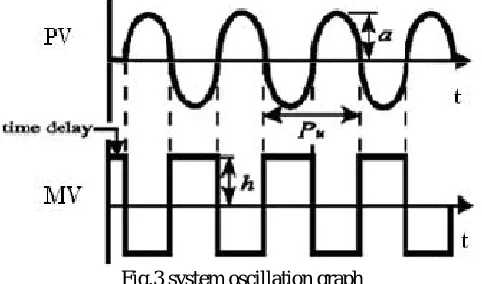
The designing of control parameters for this process is done by various methods. For designing the controller we need to know about the system response. We apply Astrom and Hagglund relay feedback logic to find the system response [1]. We have to replace the PID controller with relay for finding the Kp and Pu.
We find the Kp and Pu values by using this relay feedback logic in MATLAB for tuning the controller.
Fig.2 Astrom and Hagglund relay feedback method
This figure 1.3 represents the model of for Astrom and Hagglund relay feedback logic. Here the relay is used for maintain the process variable in the set point. It will hold until the process variable reaches its set value. After exceeding the desired value it switches the process variable to its negative set value and begins to hold its activity. This process repeats continuously for a long time in the same interval. Whenever there is a small error in the system or the output lags input by π radians, the system will start to oscillate with period of Pu.
Fig.3 system oscillation graph
Figure 1.4 shows that how to get the Kp and Pu values from the response curve. Here ‘a’ is amplitude of process
response curve, Pu is a period of process variable oscillations and h is magnitude of manipulating variable. We take
the Ku and Pu values from the response curve. The period of oscillation is 2 sec and gain is 1.4. By using these values
ISSN (Print) : 2320 – 3765 ISSN (Online): 2278 – 8875
I
nternational
J
ournal of
A
dvanced
R
esearch in
E
lectrical,
E
lectronics and
I
nstrumentation
E
ngineering
(An ISO 3297: 2007 Certified Organization)
Vol. 3, Issue 9, September 2014
Ziegler-Nichols Tuning method:
This method is a trial and error tuning method based on sustained oscillations which was first proposed by Ziegler and Nichols (1942). This is probably the most widely used method for tuning of PID controller and is also known as online or continuous cycling or ultimate gain tuning method. Having the ultimate gain and frequency (Ku and Pu) and using table 1.1, the controller parameters can be obtained.
Kc I D
P control Ku/2 - -
PI control Ku/2.2 Pu/1.2 -
PID control Ku/1.7 Pu/2 Pu/8 Table.1
By using this formula, we can find the control parameter. Put this values in general controller equation. U (t) = ( ) + ∫ ( ) + Td ( )
After substituting these values in equation, we simulate the process in MATLAB. It gives the response to the discrepant values of the given CSTR temperature control process.
Chien-Hrones-Reswick Auto tuning Method:
It is another method of designing a PID controller. It is an efficient method and is used to get the precise control action to error value. It has four types of formula for designing a controller. By knowing the value of dead time and time constant we calculate the controller parameters.
The following tables show the Chien-Hrones-Reswick recommendations for each tuning formula:
Regulator – 0% overshoot
Controller Kc Ti Td
P 0.3TP/ — —
PI 0.6TP/ 4 —
PID 0.95TP/ 2.4 0.42
Table. 2 Where TP is the time constant and is the dead time.
Regulator – 20% overshoot Controller Kc Ti Td
P 0.7TP/ — —
PI 0.7TP/ 2.3 —
PID 1.2TP/ 2 0.42
Table.3 Where TP is the time constant and is the dead time.
Servo – 0% overshoot
Controller Kc Ti Td
P 0.3TP/ — —
PI 0.35TP/ 1.2 —
PID 0.6TP/ 0.5
Where TP is the time constant and is the dead time.
Servo – 20% overshoot
Controller Kc Ti Td
P 0.7TP/ — —
PI 0.6TP/ —
PID 0.95TP/ 1.4 0.47
Table.5 Where TP is the time constant and is the dead time
After substituting the controller parameter values in the general equation, we have simulated the setup.
Tyreus-Luyben Tuning Chart:
The Tyreus-Luyben procedure is quite similar to the Ziegler-Nichols method but the final controller settings are different. Also these methods only propose settings for PI and PID controllers. These settings are based on ultimate gain and period is given in the table 1.6.
Kc I D
PI control Ku/3.2 2.2 Pu
PID control Ku/2.2 2.2 Pu Pu/6.3 Table.6
After finding the controller parameter, we substitute those values into the general equation, then simulate the process in the MATLAB which gives us the response curve.
From the above strategy we finalised the best controller for our process. But we already know that, PID controller has overshoot and long settling time.
Hence now we are going for new type of digitalised controller, known as MPC (Modern Predictive Control).
B. Model Predictive Control:
Modern predictive control is a digital control which is used in chemical and process industries for solving complicated processes since 1980’s. It needs process parameters to control the process in desired value, which has been obtained pragmatically by modelling the process. It keeps future time slots into an account and allows the current time slot to be optimized. MPC can anticipate future events and takes control actions accordingly. But PID controllers and others cannot predict the future events.
Model Predictive Control (MPC) is a multivariable control algorithm that uses:
an internal dynamic model of the process
a history of past control moves and
an optimization cost function J over the receding prediction horizon, The optimization cost function is given by:
= ( − ) + ∆
= i -th controlled variable (e.g. measured temperature) = i -th reference variable (e.g. required temperature)
= i -th manipulated variable (e.g. control valve)
ISSN (Print) : 2320 – 3765 ISSN (Online): 2278 – 8875
I
nternational
J
ournal of
A
dvanced
R
esearch in
E
lectrical,
E
lectronics and
I
nstrumentation
E
ngineering
(An ISO 3297: 2007 Certified Organization)
Vol. 3, Issue 9, September 2014
Fig.4 general MPC block diagram
This is the block diagram of modern predictive controller used in MATLAB for simulating the mathematical model of the process. We configure MPC depends upon the process parameters. It gives as a satisfactory control action to the process compared with conventional controller. MPC has better control ability over the deviation of the process variable
.
V. RESULTS AND DISCUSSIONS
From the above controller designing method, we got various types of response for each controller. These responses provide us a sufficient knowledge about the response of the system for different controller. We tabulated the time domain specifications and performance index values below.
TIME DOMAIN SPECIFICATIONS:
Table.7
Above table1.7 shows the performance of the different controller action upon our CSTR process. Different controller has different settling time and overshoot. From these results we find out which controller will be best for our process. From these values we find that Z-N based PID controller is well suited for our CSTR process among the conventional controller. But we are considering the model predictive controller, it will be the best one for our process. It has short settling time and lower overshoot percentage.
PERFORMANCE INDICES:
Table.8 RISE TIME
(SEC)
SETTLING TIME(SEC)
OVERSHOOT (%)
ZN-PID 0.998 1.98 0
CHR-REG0% 5.3 10.6 0
CHR-SER 0% 2.59 3.94 0.154
T-L 8.7 18.4 0
IAE ISE ITAE MSE
ZN-PID 3.5467 1.7050 1.8022 0.1705
CHR-REG0% 4.5625 2.1551 2.1862 0.2274
CHR-SER 0% 5.2978 2.4237 2.2098 0.4331
In this time domain specification and performance criteria, we select the best controller by considering the minor overshoot and settling time into an account. The comparative analyses of diverse controllers are shown in below figure. This performance index gives as the possibilities of error during the process for different controller. Minimum ISE and ITAE value gives the better controller action for the process.
Fig.5 Amplitude Vs time
Comparison chart has different controller performance and its step response. From this chart we identified that MPC controller has better performance over our process. Compared with other conventional controller, MPC has minimum overshoot and settling time.
VI.CONCLUSION
From the above discussion, we identified the best controller for CSTR temperature control process to be MPC. For controlling temperature in a constant value it is very complicated in industries. MPC controller leverages these difficulties by bringing the process variable to the desired set point as quickly as possible. Even though MPC controller is not suitable for a simple system, it is good for a complicated system like our CSTR temperature control processes. MPC controller has a 0% overshoot and minimum settling time as compared with other conventional controller that we used in this process. So we can consolidate the performance of all of these responses and we finalised the result as MPC is the best controller for our CSTR temperature control process.
REFERENCES
1. Chenimineki kishore, T.Vandhana, Sheereen hussain and S.Srinivasulu raju,”implementation of model predictive control and auto tuning based PID for
effective temperature control in CSTR”,graduate research in engineering and technology,vol.1, no.1, pp.84-89,2012
2. Sandeep Kumar, ”temperature control of CSTR and PID and PID (Two Degree of Freedom) Controller, international journal of advanced research in
computer science and software engineering,vol.2, No.4, pp. 326-329, 2012
3. Kanse nitin.g, dhanke p.b and thombare abhijit ,” modeling and simulation of the CSTR for complex reaction by using polymath”,ResearchJournalof
ChemicalSciences, Vol. 2, No.4 , pp. 79-85, April 2012.
4. Astrom K,J, T. Hagllund; ”PID controllers Theory, Design and Tuning ”,2nd edition, Instrument Society of America, pp.1-12, 1994
5. Mituhiko and hidefumi taguchi, ”two degree of freedom PID controller”, international journal of control, automation and systems, vol.1, No.4, pp.
401-411, Dec 2003
6. Mohd Fua’ad Rahmat,amir mehdi yazdani, mohammad ahmadi movahad and somaiyeh mahmoudzadeh,”temperature control of a continuous stirrer tank
reactor by means of two different intelligent strategies”, international journal on smart sensing and intelligent system,vol.4, No.2, pp. 244-261, June 2011
7. A.D.Shakib joo, ”A Comparison of different control design methods for the linearized CSTR temperature model”, journal of electrical and computer
engineering innovations, vol.1, No.2, pp. 107-114, 2013.
8. Bikash Dey, Lusika Roy,”A comparative study in temperature control of CSTR using PI controller, PID controller and PID controller(Two Degree of
Freedom) controller”, international journal of electronics and computer science engineering, vol. 3, no.1, pp. 62-68, 2012
9. A.Soukkou, A.Khellaf, S.Leulmi and K.Boudeghdegh,” optimal control of a process”, Brazilian journal of chemical engineering, vol.25 No.4, pp. 104-
120, Oct/Dec 2008.
-0.2 0 0.2 0.4 0.6 0.8 1 1.2
0 50 100 150
A M P L I T U D
E TIME