the Genetic Coding System and Unitary Matrices
Sergey V. Petoukhov1
1-Mechanical Engineering Research Institute of Russian Academy of Sciences. Russia, 101990,
Moscow, M. Kharitonievskiy pereulok, 4,
http://eng.imash.ru/, [email protected]
Comment: Some materials of this article were presented by the author in his keynote speech at the
international conference “Artificial Intelligence, Medical Engineering, Education” (Moscow, Russia, 21-23 August 2017, http://www.ruscnconf.org/aimee2017/index.html) and in his lecture at the international workshop of the Competence Center for Algorithmic and Mathematical Methods in Biology, Biotechnology and Medicine (Mannheim, Germany, 27 November 2017,
https://www.cammbio.hs-mannheim.de/kick-off-event.html). They were also presented by the author in his keynote speech at the international Belgrade Bioinformatics Conference 2018 (Belgrade, Serbia, 18-22 June, 2018, http://belbi.bg.ac.rs/).
Abstract. Information molecules of DNA and RNA should obey principles of quantum mechanics where unitary operators in form of unitary matrices have key meanings. Unitary matrices are the basis of calculations in quantum computers. This article presents some author's results, which show that matrix forms of the representation of structured systems of molecular-genetic alphabets can be considered as sets of sparse unitary matrices related with phenomenologic features of the degeneracy of the genetic code. These sparse unitary matrices have orthogonal systems of functions in their rows and columns. A complementarity exists among some unitary genetic matrices in relation each other. Decompositions of numeric genetic matrices into sets of sparse unitary matrices are connected with the logical operation of modulo-2 addition used in quantum computers as well. Tensor (or Kronecker) families of unitary genetic matrices with their fractal-like properties are also considered. Hidden reqularities of frequencies of n-plets of hydrogen bonds are revealed in long DNA sequences and in complete sets of chromosomes of some tested organisms. The mathematical model of these reqularities was proposed on the basis of formalisms of quantum informatics. This model has some analogies with the Hardy-Weinberg law of population genetics. The possible representation of the set of the mentioned frequencies in forms of matrix representations of some 2n-dimensional hypercomplex numbers was also noted.
Keywords: genetic code, alphabet, unitary matrix, dyadic shift, decomposition, spectral presentation, fractal, tensor product, hypercomplex numbers, quantum informatics
1. Introduction.
The information molecules of DNA and RNA of the genetic coding system belong to the world of molecules, in which the principles of quantum mechanics manage. This article presents results of the author's study of abilities of using formalisms of quantum mechanics and quantum informatics to model regular structures of molecular-genetic systems. First of all, we are talking about searching for correspondences between unitary operators and structured alphabets of DNA and RNA in their matrix forms of representation. The article provides additional materials for the development of quantum information modeling of structured molecular-genetic ensembles; elements of the quantum information modeling have been described in the author's work about tetra-group symmetries in long DNA texts [Petoukhov, 2017a].
In line with one of the postulates of quantum mechanics, the evolution of a closed quantum system is described by unitary transformations. Computational processes in quantum computer science are based on unitary operators that serve as quantum gates. “Any unitary matrix specifies a valid
quantum gate” [Nielsen, Chuang, 2010, p. 18]. Any physical impact on a qubit in quantum mechanics is described by a linear unitary operator.
In quantum mechanics and quantum computer science, an important role is played by unitary operators in form of Hadamard matrices with complete orthogonal systems of Walsh functions in them. Hadamard operators are also widely used for spectral representations of signal vectors in the technique of noise-immune communication [Seberry, Wysocki, Wysocki, 2005], the sequency analysis of Harmuth [Harmuth, 1977, 1989], the digital logical holography [Derzhypolskyy, Melenevskyy, Gnatovskyy, 2007; Morita, Sakurai, 1973; Soroko, 1974] and algorithms of quantum informatics [Nielsen, Chuang, 2010]. But the Hadamard matrices with their complete systems of orthogonal functions are not the only unitary matrices with complete systems of orthogonal functions in them.
In this paper, we present other unitary matrices with other complete systems of orthogonal functions that were discovered by the author in the course of the algebraic modeling of molecular alphabets of DNA and RNA. These unitary matrices are sparse ones and they form sets of mutual-complementary matrices (in some algebraic sence). We conditionally call them unitary genetic matrices (or briefly, unitary geno-matrices). This makes us recall the well-known proposition that different natural systems may need - for their spectral analysis - in their own systems of orthogonal functions:
“after Fourier it was found that for some problems, harmonic sinusoids rather than other systems of orthogonal functions, for example, the Legendre polynomials, are better suited. In fact, any particular problem needs its own system of orthogonal functions. This was most clearly manifested in the course of the development of quantum mechanics” [Soroko, 1973]. These unitary sparse geno-matrices contain complete systems of orthogonal functions and have special algebraic properties. They can serve as the basis for a new class of spectral representations of vectors in biology and other fields of science, as well as a new class of bio-mathematical models and algorithms in classical and quantum computer sciences. One should add that quantum-information aspects of life are actively discussed in modern science, for example, in the book [Quantum aspects of life, 2008]; in articles about a biology of quantum information [Matsuno, 1999, 2003, 2015; Matsuno, Paton, 2000]; in articles about a possible meaning of the quantum algorithm of Grower in genetic information [Patel, 2001 a,b,c], etc.
2. Matrix representations of DNA-alphabets and genetic binary oppositions
Science does not know why the basic alphabet of DNA has been created by Nature from just four letters (adenine A, thymine T, cytosine C and guanine G), and why just these very simple molecules were chosen for the DNA-alphabet (out of millions of possible molecules). But science knows [Fimmel, Danielli, Strüngmann, 2013; Petoukhov, 2008; Petoukhov, He, 2009; Stambuk, 1999] that these four molecules are interrelated due to their symmetrical peculiarities into the united molecular ensemble with its three pairs of binary-oppositional traits or indicators (Fig. 1).
№ Binary Symbols C A G T/U
1 01 — pyrimidines 11 — purines
01 11 11 01
2 02 — amino 12 — keto
02 02 12 12
3 03 — three hydrogen bonds; 13 — two hydrogen bonds
03 13 03 13
Fig. 1. Left: the four nitrogenous bases of DNA: adenine A, guanine G, cytosine C, and thymine T. Right: three binary sub-alphabets of the genetic alphabet on the basis of three pairs of binary-oppositional traits or indicators.
These three pairs of binary-oppositional traits or indicators are the following:
traits, any of the DNA-sequences are represented by a corresponding binary sequence. For example, GCATGAAGT is represented by 101011110;
(2) Two letters are amino-molecules (A and C) and the other two are keto-molecules (G and T). From the standpoint of these traits one can designate A = C = 0, G = T = 1. Correspondingly, the same sequence GCATGAAGT is represented by another binary sequence, 100110011;
(3) The pairs of complementary letters, A-T and C-G, are linked by 2 and 3 hydrogen bonds, respectively. From the standpoint of these binary traits, one can designate C = G = 0, A = T = 1. Correspondingly, the same sequence GCATGAAGT is read as 001101101.
Accordingly, each of the DNA-sequences of nucleotides is the carrier of three parallel messages on three different binary languages. At the same time, these three types of binary representations form a common logic set on the basis of the logic operation of modulo-2 addition denoted by the symbol ⊕:
modulo-2 addition of any two such binary representations of the DNA-sequence gives the third binary representation of the same DNA-sequence: for example, 101011110 ⊕ 100110011 = 001101101. One
can remind here the rules of the bitwise modulo-2 addition: 0 ⊕ 0 = 0; 0 ⊕ 1 = 1; 1 ⊕ 0 = 1; 1 ⊕ 1 = 0.
The logic operation of modulo-2 addition is actively used in classical and quantum computers. Below we use the operation of modulo-2 addition for those decompositions of genetic matrices, which lead to interesting sets of inter-complementary unitary matrices of sparse types for special kinds of spectral representations of vectors.
Taking into account the phenomenological fact that each of DNA-letters C, A, T and G is uniquely defined by any two kinds of mentioned binary-oppositional indicators (Fig. 1), these genetic letters can be represented by means of corresponding pairs of binary symbols, for example, from the standpoint of two first binary-oppositional indicators. It is convenient for us - for the further description - use at the first position of each of letters its binary symbol from the second pair of binary-oppositional indicators (the indicator "amino or keto": C=A=0, T=G=1) and at the second positions of each of letters its binary symbol from the first pair of binary-oppositional indicators (the indicator "pyrimidine or purine": C=T=0, A=G=1). In this case the letter C is represented by the binary symbol 0201 (that is as
2-bit binary number), A – by the symbol 0211, T – by the symbol 1201, G – by the symbol 1211. Using these
representations of separate letters, each of 16 doublets is represented as the concatenation of the binary symbols of its letters (that is as 4-bit binary number): for example, the doublet CC is represented as 4-bit binary number 02010201, the doublet CA – as 4-bit binary number 02010211, etc. By analogy, each
of 64 triplets is represented as the concatenation of the binary symbols of its letters (that is as 6-bit binary number): for example, the triplet CCC is represented as 6-bit binary number 020102010201, the
triplet CCA – as 6-bit binary number 020102010211, etc. In general, each of n-plets is represented as the
concatenation of the binary symbols of its letters (below we will not show these indexes 2 and 1 of separate letters in binary representations of n-plets but will remember that each of positions corresponds to its own kind of indicators from the first or from the second set of indicators in Fig. 1).
It is convenient to represent DNA-alphabets of 4 nucleotides, 16 doublets, 64 triplets, … 4n n-plets
in a form of appropriate square tables (Fig. 2), which rows and columns are numerated by binary symbols in line with the following principle. Entries of each column are numerated by binary symbols in line with the first set of binary-oppositional indicators in Fig. 1 (for example, the triplet CAG and all other triplets in the same column are the combination “pyrimidine-purin-purin” and so this column is
correspondingly numerated 011). By contrast, entries of each of rows are numerated by binary numbers in line with the second set of indicators (for example, the same triplet CAG and all other triplets in the same row are the combination “amino-amino-keto” and so this row is correspondingly
000 001 010 011 100 101 110 111 000 CCC CCA CAC CAA ACC ACA AAC AAA 001 CCT CCG CAT CAG ACT ACG AAT AAG 010 CTC CTA CGC CGA ATC ATA AGC AGA 011 CTT CTG CGT CGG ATT ATG AGT AGG 100 TCC TCA TAC TAA GCC GCA GAC GAA 101 TCT TCG TAT TAG GCT GCG GAT GAG 110 TTC TTA TGC TGA GTC GTA GGC GGA 111 TTT TTG TGT TGG GTT GTG GGT GGG
Fig. 2. The square tables of DNA-alphabets of 4 nucleotides, 16 doublets and 64 triplets with a strict arrangement of all components. Each of tables is constructed in line with the principle of binary numeration of its column and rows on the basis of binary-oppositional traits of the nitrogenous bases (see explanations in the text).
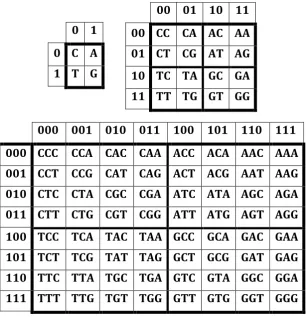
It is essential that these 3 separate genetic tablesform the joint tensor family of matricessince they are interrelated by the known operation of the tensor (or Kronecker) product of matrices (Fig. 3). So they are not simple tables but matrices. By definition, under tensor multiplication of two matrices, each of entries of the first matrix is multiplied with the whole second matrix [Bellman, 1960]. The second tensor power of the (2*2)-matrix [C, A; T, G] of 4 DNA-letters gives automatically the (4*4)-matrix of 16 doublets; the third tensor power of the same (2*2)-(4*4)-matrix of 4 DNA-letters gives the (8*8)-matrix of 64 triplets with the same strict arrangement of entries as in Fig. 2. In this tensor construction of the tensor family of genetic matrices, data about binary-oppositional traits of genetic letters C, A, T and G are not used at all. So, the structural organization of the system of DNA-alphabets is connected with the algebraic operation of the tensor product (Fig. 3). It is important since the operation of the tensor product is well known in mathematics, physics and informatics, where it gives a way of putting vector spaces together to form larger vector spaces. The following quotation speaks about the crucial meaning of the tensor product: «This construction is crucial to understanding the quantum mechanics of multiparticle systems» [Nielsen, Chuang, 2010, p. 71]. For us the most interesting is that the tensor product is one of basic instruments in quantum informatics.
0 1 0 C A 1 T G
Fig. 3. The tensor family of genetic matrices [C, A; T, G](n) (here tensor power n = 1, 2, 3) of
DNA-alphabets of 4 nucleotides, 16 doublets and 64 triplets. The symbol ⨂ means the tensor product.
As is known, the degeneracy of the genetic code has the important specificity: the entire set of 64 triplets is divided by Nature into 2 equal binary-opposition subsets [Rumer, 1968]:
• 32 triplets with “strong roots” (black colors in Fig. 4), i.e., with 8 "strong" doublets AC, CC, CG, CT, GC, GG, GT, TC in their first positions;
• 32 triplets with “weak roots” (white colors in Fig. 4), i.e., with 8" weak" doublets CA, AA, AG, AT, GA, TA, TG, TT in their first positions.
Fig. 4. Black-and-white mosaics represent the distribution of strong and weak doublets in the matrix of 16 doublets (left) and the distribution of triplets with strong and weak roots in the matrix of 64 triplets (on the right). Binary number in brackets in each of matrix cells is a sum of modulo-2 addition of binary numberings of the row and the column of the cell.
Code meanings of triplets with strong roots do not depend on the letters on their third position; code meanings of triplets with weak roots depend on their third letter. What are locations of these
00 01 10 11
00 CC (00) CA (01) AC (10) AA (11)
01 CT (01) CG (00) AT (11) AG (10)
10 TC (10) TA (11) GC (00) GA (01)
11 TT (11) TG (10) GT (01) GG (00)
000 001 010 011 100 101 110 111
000 CCC (000) CCA (001) CAC (010) (011) CAA ACC (100) ACA (101) AAC (110) AAA (111)
001 CCT
(001) CCG (000) CAT (011) CAG (010) ACT (101) ACG (100) AAT (111) AAG (110) 010 CTC
(010) CTA (011) CGC (000) CGA (001) ATC (110) ATA (111) AGC (100) AGA (101) 011 CTT
(011) CTG (010) CGT (001) CGG (000) ATT (111) ATG (110) AGT (101) AGG (100)
100 TCC (100) TCA (101) TAC (110) (111) TAA GCC (000) GCA (001) GAC (010) GAA (011)
101 TCT (101) TCG (100) TAT (111) (110) TAG GCT (001) GCG (000) GAT (011) GAG (010)
110 TTC (110) TTA (111) TGC (100) (101) TGA GTC (010) GTA (011) GGC (000) GGA (001)
strong (black) and weak (white) members of DNA-alphabets in the genetic matrices shown in Figs. 2 and 3?
The unexpected phenomenological fact is a symmetrical location (Fig. 4) of all black and white entries in the genetic matrices of 16 doublets and 64 triplets, which were constructed very formally without any mention about amino acids and the degeneracy of the genetic code.
Symmetrical properties of mosaics in the genetic matrices in Fig. 4 are the following: 1) the left and right halves of the matrix mosaic are mirror-anti-symmetric each to other in its colors: any pair of cells, disposed by mirror-symmetrical manner in the halves, possesses the opposite colors;
2) the block mosaic of the matrix has the cruciform character: both quadrants along each diagonals are identical each other from the standpoint of their mosaic;
3) mosaic of each of rows has the meander character identical to known Rademacher functions rn(t) = sign(sin2nπt), n = 1, 2, 3,…, which are particular cases of Walsh functions and contain only values +1 and -1 (https://www.encyclopediaofmath.org/index.php/Rademacher_system).
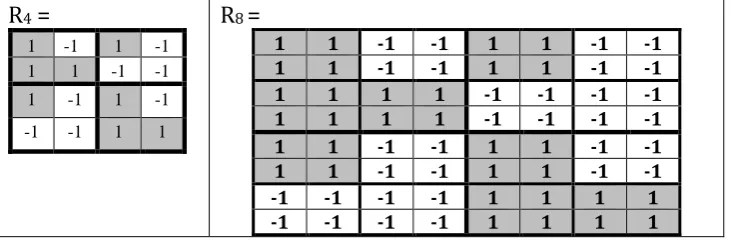
Using this analogy with Rademacher-Walsh functions, one can represent the symbolic genetic matrices in Fig. 4 in forms of numeric matrices R4 and R8 with their entries +1 and -1 in Fig. 5 where
numbers +1 (-1) represent black (white) doublets and triplets correspondingly. Taking into account that meander-like mosaics of rows of matrices R4 and R8 correspond Rademacher functions, we
conditionally called these matrices “Rademacher matrices” in all our publications beginning from our
book [Petoukhov, 2008] (although Hans Rademacher himself never worked with such matrices).
R4 =
1 -1 1 -1 1 1 -1 -1 1 -1 1 -1 -1 -1 1 1
R8 =
1 1 -1 -1 1 1 -1 -1
1 1 -1 -1 1 1 -1 -1
1 1 1 1 -1 -1 -1 -1
1 1 1 1 -1 -1 -1 -1
1 1 -1 -1 1 1 -1 -1
1 1 -1 -1 1 1 -1 -1
-1 -1 -1 -1 1 1 1 1
-1 -1 -1 -1 1 1 1 1
Fig. 5. Numeric representations R4 and R8 of the genetic matrices of 16 doublets and 64 triplets from
Fig. 4. Matrix cells with number +1 (-1) correspond cells with black (white) doublets and triplets in Fig. 4. Each of rows of the numeric matrices represents one of Rademacher-Walsh functions.
It should be noted that a huge quantity 64! ≈ 1089 of variants exists for dispositions of 64 triplets
in a separate (8*8)-matrix. For comparison, the modern physics estimates time of existence of the Universe in 1017 seconds. It is obvious that an accidental disposition of black and white triplets in a
separate (8*8)-matrix will give almost never any symmetry. But in our approach, this matrix of 64 triplets is not a separate matrix, but it is one of members of the family of matrices of genetic alphabets interrelated by means of binary-oppositional traits of nitrogenous bases A, T, C, G (and additionally it is one of members of the tensor family of matrices [C, A; T, G](n) of interrelated alphabets of DNA).
These numeric matrices R4 and R8 with their mosaics (Fig. 5) represent the phenomenological
peculiarities of the degeneracy of the genetic code. The exponentiation of these genetic matrices in the second power leads to their doubling and quadrupling: R42 = 2*R4 and R82 = 4*R8. This resembles the
doubling and quadrupling the genetic material under mitosis and meiosis of biological cells. Let us analyze algebraic properties of these genetic matrices R4 and R8 more deeply.
3. The genetic matrix R4 and sparse unitary matrices
We begin the algebraic analysis of the (4*4)-matrix R4 in Fig. 5. Fig. 6 shows the decomposition
of this matrix into a sum of 4 sparse matrices: R4 = R04 + R14 + R24 + R34 (below we will explain that
1 -1 1 -1
1 1 -1 -1
1 -1 1 -1
-1 -1 1 1
=
1 0 0 0 0 1 0 0 0 0 1 0 0 0 0 1
+ 0 -1 0 0 1 0 0 0 0 0 0 -1 0 0 1 0
+ 0 0 0 -1 0 0 -1 0 0 -1 0 0 -1 0 0 0
+ 0 0 1 0 0 0 0 -1 1 0 0 0 0 -1 0 0
Fig. 6. The dyadic-shift decomposition of the matrix R4 (Fig. 5) into the sum of 4 sparse matrices:
R4 = R04 + R14 + R24 + R34, where R04 is the identity matrix.
By definition, a complex square matrix U is unitary if its conjugate transpose U† is also its inverse:
UU† = I, where I is the identity matrix (the conjugate transpose U† is also its inverse matrix U-1). The
real analogue of a unitary matrix is an orthogonal matrix, for which the conjugate transposition U† is
identical to the ordinary transposition: UUT = I. In this article we consider only the case of real square
matrix. Unitary matrices have significant importance in quantum mechanics because they preserve norms, and thus, probability amplitudes (https://en.wikipedia.org/wiki/Unitary_matrix). The tensor product of two unitary matrices always generates a unitary matrix [Rumer, Fet, 1970, p. 38]. It is interesting that each of sparse matrices R04, R14, R24 and R34 are unitary (or orthogonal
since their entities are real):
R04R04T = I, R14R14T = I, R24R24T = I, R34R34T = I (1)
In molecular-genetic systems, relations of complementarity play the very important role. The book [Chapeville, Haenni, 1974, Chapter 1] notes that the proof of the complementary structure of the bases in DNA has led to the most fundamental discoveries in modern biology: this complementarity provides the most important properties of DNA as a carrier of genetic information, including DNA replication in the course of cell division and also all mechanisms of manifestation of genetic information. But one can note that the set of unitary genetic matrices R04, R14, R24 and R34 (Fig. 6) contains the
following algebraic complementarities in their pairs: unitary matrices R04 and R24 form the first pair of
the algebraic complementarity since they are transformed into each other by the mirror reflection relative to the average vertical line with simultaneous inversion of signs of their non-zero entries (the mirror-anti-symmetry). The same is true for unitary matrices R14 and R34, which form the second pair
with the similar algebraic complementarity of the mirror-anti-symmetric type. The degeneracy of the genetic code is connected with such algebraic complementarities in the set of unitary genetic matrices. Determinants of all the unitary matrices R04, R14, R24 and R34 are equal to 1; by this reason the
matrices R04, R14, R24 and R34 belong to the type of so called special unitary matrices. The special
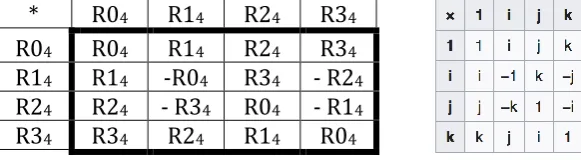
unitary matrices are closed under multiplication and the inverse operation, and therefore form a matrix group called the special unitary group (http://mathworld.wolfram.com/SpecialUnitaryMatrix.html ). The table of multiplication of the closed set of genetic unitary matrices R04, R14, R24 and R34 is
shown in Fig. 7. It coincides with the known multiplication table of the algebra of split-quaternions by J.Cockle, which are used in mathematics and physics [http://en.wikipedia.org/wiki/Split-quaternion ; Frenkel, Libine, 2011].
* R04 R14 R24 R34
R04 R04 R14 R24 R34
R14 R14 -R04 R34 - R24
R24 R24 - R34 R04 - R14
R34 R34 R24 R14 R04
Fig. 7. On left: the multiplication table of the unitary genetic (4*4)-matrices R04, R14, R24 and R34 from
[http://en.wikipedia.org/wiki/Split-quaternion]).
From this fact, one can conclude that the division of the set of 16 doublets in line with the degeneracy of the genetic code is connected with the set of sparse unitary matrices R40, R41, R42 and R43.
The rows of each of the unitary genetic matrices R04, R14, R24 and R34 form a complete orthogonal
system of functions. The action of each of these matrices (except for the identity matrix R04) on an
arbitrary 4-dimensional vector X = [x0, x1, x2, x3] transforms it into a new vector Y, which can be
considered as a spectral representation of the vector X on the basis of the orthogonal system of functions in the rows of the given matrix. The action of the same unitary matrix, taken in its transposed form, on this vector Y restores the original vector X. The exponentiation of each of the matrices R40, R41,
R42 and R43 in a tensor power generates a new unitary matrix with an orthogonal system of functions in
its rows and columns.
One can add that each of (2*2)-matrices in 4 quadrants of the genetic matrix R4 is the sum of 2
unitary matrices. Really, the matrix in two quadrants along the main diagonal [1, -1; 1, 1] is the sum of two unitary matrices [1, 0; 0, 1] and [0, -1; 1, 0]; the matrix in two quadrants along the secondary diagonal is also the sum of two unitary matrices [1, 0; 0, -1] and [0, -1; -1, 0]. One of these unitary matrices is the well-known quantum gate Z=[1, 0; 0, -1].
Unitary matrices are used in quantum informatics as quantum logic elements (quantum gates) for performing quantum computations on their basis. In the case of multi-qubit systems, the operation of the tensor product of matrices is of key importance in connection with the postulate of quantum mechanics: the state space of a composite system is the tensor product of the state spaces of its components. In the light of this, it is especially interesting that the entire genetic (4x4)-matrix R4 (Fig.
5) is constructed as the sum of the tensor products of four unitary (2*2)-matrices, that is, of four quantum gates U0, U1, U2 and U3 (Fig. 8) in line with the following expression (2):
R4 = U0⊗U0 + U0⊗U1 + U3⊗U2 + U3⊗(-U3) (2)
where matrices U0, U1, U2 and U3 are shown in Fig. 8. These matrices are unitary: U0*U0T = I2, U1*U1T
= I2, U2*U2T = I2, U3*U3T = I2, where I2 is the identity matrix.
U0 =
1, 0
0, 1 ; U1 =
0, -1
1, 0 ; U2 =
-1, 0
0, 1 ; U3 =
0, -1 -1, 0
Fig. 8. Unitary (2*2)-matrices U0, U1, U2 and U3.
The set of these 4 matrices is also closed under multiplication. Fig. 9 shows their multiplication table, which coincides with the multiplication table of split-quaternions by J. Cockle by analogy with the case of unitary (4*4)-matrices in Figs. 6 and 7.
* U0 U1 U2 U3
U0 U0 U1 U2 U3
U1 U1 -U0 U3 -U2
U2 U2 -U3 U0 -U1
U3 U3 U2 U1 U0
Fig. 9. The multiplication table of unitary (2*2)- matrices U0, U1, U2 and U3 from Fig. 8. It coincides with
the multiplication table of split-quaternions by J. Cockle reproduced in Fig. 8.
It should be noted that unitary matrices U0, U1, U2 and U3 (Fig. 8) have relations with quantum
Exponentiation of unitary matrices U1, U2 and U3 into ordinary integer powers n = 2, 3, 4,… gives
cyclic groups of matrices with the following periods: U1n = U1n+4, U2n = U2n+2, U3n = U3n+2. In this article
we specially note a connection of cyclic groups with algebraic properties of genetic unitary matrices since such cyclic groups can be useful for modeling many inherited cyclic processes in physiology of organisms.
Exponentiation of each of unitary matrices U0, U1, U2 and U3 into tensor (or Kronecker) powers k = 2, 3, 4, … generates corresponding tensor families of unitary matrices: U0(k), U1(k), U2(k) and U3(k)
where (k) means the tensor power.
4. The complementarity of sparse unitary matrices in genetics and the cruciform principle in inherited sensory informatics
This Section considers the cruciform character of the block black-and-white mosaic of the (4*4)-matrix R4 of 16 doublets, which reflects essential peculiarities of the degeneracy of the genetic code
(Figs. 4 and 5). One can note that genetically inherited constructions of physiological sensory-motor systems demonstrate similar cruciform structures. For example, the connection between the hemispheres of human brain and the halves of a human body possesses the similar cruciform character: the left hemisphere serves the right half of the body and the right hemisphere (Fig. 10) [Annett, 1985, 1992; Gazzaniga, 1995; Hellige, 1993]. The system of optic cranial nerves from two eyes possesses the cruciform structures as well: the optic nerves transfer information about the right half of field of vision into the left hemisphere of brain, and information about the left half of field of vision into the right hemisphere. The same is held true for the hearing system [Penrose, 1989, Chapter 9]. In particular, due to existence of such inter-complementary right and left parts in genetically inherited visual and hearing systems, a person has a stereoscopic perception of his environment. Now we show that a similar cruciform character, which is represented in the mosaic matrix of 16 doublets (Figs. 4, 5, 11), is connected with the following fact: this mosaic matrix is a sum of two sparse unitary matrices that are algebraic complementary to each other (they are mirror-anti-symmetric to each other by analogy with the left and right halves of a human body) and that can be considered as the right and left parts of the cruciform matrix R4.
Fig. 10. The cruciform schemes of some morpho-functional structures of informational systems in human organism. On the left side: the cruciform connections of brain hemispheres with the left and the right halves of a human body. In the right side: the cruciform structure of optic nerves from eyes in brain.
One can suppose that this inherited cruciform character of sensory-motor systems is connected with genetic cruciform structures that include, in particular, the genetic matrices R4 and R8 [Petoukhov,
2008; Petoukhov, He, 2009]. Taking into account the quantum-informational character of molecular-genetic systems and also an important role of unitary matrices in quantum mechanics, it is interesting that – as we have discovered - these genetic matrices R4 and R8 are connected with
inter-complementary sparse unitary matrices described below.
Let us begin with a consideration of the genetic matrix R4 of 16 doublets. We reveal that its
cruciform character is connected with a pair of two sparse unitary matrices, which are mirror-anti-symmetric to each other. Fig. 11 shows that the genetic cruciform matrix R4 is the sum of two sparse
matrices R4R and R4L: R4 = R4R+R4L. These two sparse matrices are inter-complementary in an algebraic
sense since they mirror-anti-symmetric to each other and they jointly form the non-sparse matrix R4.
call the pair of complementary matrices R4R and R4L as the stereoscopic pair (or briefly, the stereo-pair)
where the matrix R4R is called the right stereo-matrix and the matrix R4L is called the left stereo-matrix.
1 -1 1 -1
1 1 -1 -1
1 -1 1 -1
-1 -1 1 1
=
1 -1 0 0
1 1 0 0
0 0 1 -1 0 0 1 1
+ 0 0 0 0 -1 1 -1 -1
1 -1 0 0
-1 -1 0 0
Fig. 11. The cruciform matrix R4 is the sum of two sparse matrices R4R and R4L, non-zero entries of
which coincide with non-zero entries in corresponding quadrants along the main diagonal and the secondary diagonal of the matrix R4.
Taking with the factor 2-0.5, each of these stereo-matrices R4R and R4L is the unitary matrix:
(2-0.5*R4R)*(2-0.5*R4R)T= I; (2-0.5*R4L)*(2-0.5*R4L)T= I. (3)
Under actions of unitary matrices 2-0.5*R4R and 2-0.5*R4L, an arbitrary 4-dimensional vector 𝑋̅
= [x0, x1, x2, x3] is transformed by the following manner:
(2-0.5*R4R)*𝑋̅T = 2-0.5*[x0-x1, x0+x1, x2-x3, x2+x3]T
(2-0.5*R4L)*𝑋̅T = 2-0.5*[x2-x3, -x2-x3, x0-x1, -x0-x1]T (4)
In each of unitary matrices 2-0.5*R4R and 2-0.5*R4L, the set of its rows contains a complete
orthogonal system of functions. The multiplication of each of these sparse unitary matrices with an arbitrary 4-dimensional vector 𝑌̅ leads to a spectral representation 𝑍̅ of the vector 𝑌̅ on the basis of the
complete orthogonal system of functions in rows of the unitary matrix. For example, in the case of the vector 𝑌̅ = [5, -3, 7, 9], its spectral representation 𝑍̅R on the basis of the system of functions in rows of
the unitary matrix 2-0.5*R4R is the following (𝑌̅T means the transposition of the vector 𝑌̅):
𝑍̅R = (2-0.5*R4R)*𝑌̅T = 2-0.5*[8, 2, -2, 16]T (5)
This spectral representation 𝑍̅R means that the vector 𝑌̅ is the sum of the following 4 basic
vectors:
• the vector 2-0.5*[1,-1,0,0] from the first row of the matrix 2-0.5*R4R (Fig. 11) multiplied by the
factor 2-0.5*8;
• the vector 2-0.5*[1,1,0,0] from the second row of 2-0.5*R4R multiplied by the factor 2-0.5*2;
• the vector 2-0.5*[0,0,1,-1] from the third row of 2-0.5*R4R multiplied by the factor -2-0.5*2;
• the vector 2-0.5*[0,0,1,1] from the fourth row of 2-0.5*R4R multiplied by the factor 2-0.5*16.
Really, 2-0.5*8*(2-0.5*[1,-1,0,0]) + 2-0.5*2*(2-0.5*[1,1,0,0]) – 2-0.5*2*(2-0.5*[0,0,1,-1]) + 2 -0.5*16*(2-0.5*[0,0,1,1]) = [5, -3, 7, 9] = 𝑌̅.
The multiplication of the spectral vector 𝑍̅RT with unitary transposed matrix 2-0.5*R4RT restores
automatically the initial vector 𝑌̅: 𝑍̅RT*(2-0.5*R4RT) = [5, -3, 7, 9].
Turning to the left stereo-matrix R4L, one can check that the action of the unitary matrix 2-0.5*R4L
on the same vector 𝑌̅ = [5, -3, 7, 9] leads to the following spectral representation 𝑍̅L of the vector 𝑌̅ on
the basis of orthogonal functions in its rows:
𝑍̅L = (2-0.5*R4R)*𝑌̅T = 2-0.5*[-2, -16, 8, -2]T (6)
The multiplication of the spectral vector 𝑍̅LT with unitary transposed matrix 2-0.5*R4LT restores
vector-signals can be used for noise-immunity coding of information by some analogies with known noise-immunity coding on the basis of Hadamard matrices in digital signal processing.
Exponentiation of the unitary matrix 2-0.5*R4L into integer powers generates a cyclic group with
the period 2: (2-0.5*R4L)n = (2-0.5*R4L)n+2 (the matrix R4L specifies the transformation of reflection in the
informational 4-dimensional space). In contrast, exponentiation of the unitary matrix 2-0.5*R4R in
integer powers generates a cyclic group with the period 8: (2-0.5*R4R)n = (2-0.5*R4R)n+8 (the matrix 2 -0.5*R4R specifies the transformation of turn in the informational 4-dimensional space). Fig. 12 shows
transformations of the vector 𝑋̅ = [x0, x1, x2, x3] under actions of the matrix (2-0.5*R4R)n.
(2-0.5*R4R)*𝑋̅T =
2-0.5*[x0-x1, x0+x1, x2-x3, x2+x3]T
(2-0.5*R4R)5 *𝑋̅T =
2-0.5*[x1-x0, -x0-x1, x3-x2, -x2-x3]T
(2-0.5*R4R)2 *𝑋̅T = [-x1, x0, -x3, x2]T (2-0.5*R4R)6 *𝑋̅T = [x1, -x0, x3, -x2]T
(2-0.5*R4R)3 *𝑋̅T =
2-0.5*[-x0-x1, x0-x1, -x2-x3, x2-x3]T
(2-0.5*R4R)7 *𝑋̅T =
2-0.5*[x0+x1, x1-x0, x2+x3, x3-x2]T
(2-0.5*R4R)4 *𝑋̅T = [-x0, -x1, -x2, -x3]T (2-0.5*R4R)8 *𝑋̅T = [ x0, x1, x2, x3]T
(2-0.5*R4R)9 *𝑋̅T =
2-0.5*[x0-x1, x0+x1, x2-x3, x2+x3]T
Fig. 12. Transformations of the vector 𝑋̅ = [x0, x1, x2, x3] under actions of the matrix (2-0.5*R4R)n.
Another important difference between unitary matrices 2-0.5*R4R and 2-0.5*R4L is the following:
the matrix 2-0.5*R4L is symmetric and correspondingly all its eigenvalues are real. By contrast, the matrix
2-0.5*R4R is asymmetric and has complex eigenvalues.
The multiplication of the stereo-matrices R4R and R4L are non-commutative: R4R*R4L≠ R4L*R4R.
Their commutator R4R*R4L - R4L*R4R taken with the factor 8-0.5 is the unitary matrix: (R4R*R4L
-R4L*R4R)*(R4R*R4L-R4L*R4R)T/8 = I.
In relation to each other, the right and left stereo-matrices R4R and R4L are amicable and disjoint
(these algebraic notions are used in different applications of matrices). In linear algebra, by definition, two square matrices M and N of order n are said to be amicable if MNT = NMT (see, for example, [Seberry,
Wysocki, Wysocki, 2005]). Also by definition, two {0,±1} matrices M and N of the same size are said to be disjoint if for all of their positions the following rule is true: if M has a nonzero entry at the (i, j)-th position then N has zero entry at the same position and vice versa, i.e., M*N=0.
Stereo-matrices R4R and R4L taken in tensor power k = 1, 2, 3,… defines tensor families of matrices
R4R(k) and R4L(k) of order 4k, members of which satisfy the condition (6):
R4R(k)*(R4R(k))T = Is*4k/2 and R4L(k)*(R4L(k))T = Is*4k/2 , (7)
where Is is the identity matrix of order 4k.
The second tensor power of (4*4)-matrices R4R and R4L, that is (16*16)-matrices R4R(2) and R4L(2),
can be written in line with the block algorithms in Fig. 13. (64*64)-matrices R4R(3) and R4L(3) can be
similarly generated from R4R(2) and R4L(2) correspondingly.
R4R(2) =
R4R - R4R 0 0
R4R R4R 0 0
0 0 R4R -R4R
0 0 R4R R4R
; R4L(2) =
0 0 R4R -R4R
0 0 -R4R -R4R
R4R -R4R 0 0
-R4R -R4R 0 0
Fig. 13. The algorithmic construction of the second tensor power of genetic stereo-matrices R4R and
R4L from Fig. 11.
Genetic stereo-matrices R4R(k) and R4L(k) have some analogies with Hadamard matrices. By
definition, Hadamard matrices Hn of order n is a square matrix with entries +1 or -1 that satisfies the
HnHnT = nIn , (8)
where In is the n*n identity matrix. The mentioned analogies allow considering applications of stereo-matrices R4R(k) and R4L(k) in quantum informatics, noise-immune coding and recovering information in
the presence of noise and interferences, and in some other fields in a parallel with traditional using Hadamard matrices there (a web search of bibliography of different applications of Hadamard matrices gives 44 thousands of publications in the period 1978-2005 years [Seberry, Wysocki, Wysocki, 2005]).
As we can judge, stereo-matrices R4R and R4L didn't meet previously in mathematical natural
sciences. They were discovered in the analysis of molecular-genetic structures and they seem to be new interesting mathematical tools for genetic researches, quantum informatics and some other areas. The pair of complementary stereo-matrices R4R and R4L gives new materials to discussions existing from the
ancient time about a role of binary principles "Yin-Yang", "left-right", "male-female", "odd-even" in organization of Nature (see, for example, a collection of facts in the book [Ivanov, 1978]).
Exponentiation of each of genetic unitary (4*4)-matrices 2-0.5*R4R and 2-0.5*R4L in tensor
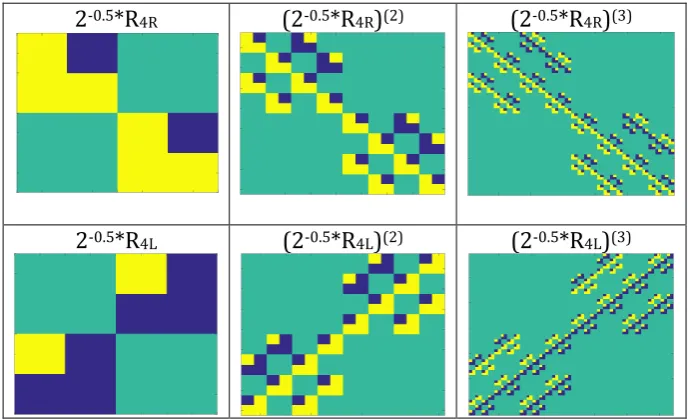
(Kronecker) powers k = 2, 3, 4, … gives new tensor families of unitary matrices (2-0.5*R4R)(k) and (2 -0.5*R4L)(k) of order 4k with complete orthogonal systems of functions in their rows and columns. As
known, exponentiation of matrices in tensor power can generate matrices with fractal structures [Gazale, 1999]. Fig. 14 shows examples of fractal structures inside tensor families of matrices (2 -0.5*R4R)(k) and (2-0.5*R4L)(k).
2-0.5*R4R (2-0.5*R4R)(2) (2-0.5*R4R)(3)
2-0.5*R4L (2-0.5*R4L)(2) (2-0.5*R4L)(3)
Fig. 14. Initial members of tensor families of matrices (2-0.5*R4R)(k) and (2-0.5*R4L)(k) having fractal
structures. Entries +1, -1 and 0 are marked by yellow, blue and green correspondingly.
Let us note additionally that described decompositions of the matrix R4 of 16 doublets (Figs. 4,
6, 11) into sparse unitary matrices were not arbitrary but they were based on objective binary-oppositional indicators of nitrogenous bases C, A, G, A and T/U (Fig. 1) and on the logical operation of modulo-2 addition. One can check that these decompositions were constructed in line with binary numbers in brackets inside matrix cells (Fig. 4). In each cell, such binary number is equal to a sum of binary numberings of the row and the column of the cell on the basis of modulo-2 addition. For example, the cell with the triplet CAG is located in the row 001 and in the column 011. The operation of modulo-2 addition gives their sum: 001⊕011 = 001; this binary number is shown in brackets in the cell with
the triplet CAG. Such type of numeration of cells in matrices, whose rows and columns are numerated by means of dyadic groups of binary numbers, is known in theory of processing digital signals as a "dyadic-shift numeration" [Ahmed, Rao, 1975; Harmuth, 1989; Petoukhov, He, 2009]. Matrices with such numeration of their cells are called dyadic-shift matrices. One can see that such dyadic-shift numeration of cells of the (4*4)-matrix R4 of 16 doublets (Fig. 4, left) divides the set of 16 doublets into
with numberings 10 contains AC, AG, TC and TG; the subset of cells with numberings 11 contains AA, AT, TA and TT. Below we use similar dyadic-shift decompositions for the (8*8)-matrix R8 of 64 triplets
from Fig. 5 with non-trivial results. As known, if any system of elements demonstrates its connection with dyadic shifts, it indicates that the structural organization of its system is related to the logic of modulo-2 addition. Correspondingly the structural organization of the genetic system is related to the logic of modulo-2 addition.
One should note that each of two stereo-matrices R4R and R4L (Fig. 11) is the sum of two unitary
matrices shown in Fig. 15: R4R = K0+K1, R4L = K2+K3. Really, K0*K0T =I4, K1*K1T =I4, K2*K2T =I4 and K3*K3T
=I4, where I4 is the identity matrix of order 4 and the matrix K0 resembles the well-known quantum gate “controlled-NOT”: [1, 0, 0, 0; 0, 1, 0, 0; 0, 0, 0, 1; 0, 0, 1, 0] [Nielsen, Chuang, 2010, p. XXXI].
Rows and columns of sparse matrices K0, K1, K2 and K3 correspond to complete orthogonal
systems of functions. Below we will also meet other examples that genetic unitary matrices with block structures are constructed as sums of more simple unitary matrices.
R4 R =
1 -1 0 0
1 1 0 0
0 0 1 -1 0 0 1 1
=
1 0 0 0 0 1 0 0 0 0 0 -1 0 0 1 0
+
0 -1 0 0
1 0 0 0
0 0 1 0
0 0 0 1
= K
0
+ K
1
R4L
= 0 0 0 0 -1 1 -1 -1
1 -1 0 0
-1 -1 0 0
= 0 0 1 0
0 0 0 -1
0 -1 0 0
-1 0 0 0
+ 0 0 0 -1
0 0 -1 0
1 0 0 0
0 -1 0 0
= K
2
+ K
3
Fig. 15. Each of stereo-matrices R4R and R4L (Fig. 11) is the sum of two unitary matrices: R4R = K0+K1,
R4L = K2+K3, where K0, K1, K2 and K3 are unitary matrices.
Exponentiations of genetic unitary (4*4)-matrices K0, K1, K2 and K3 (Fig. 15) in tensor
(Kronecker) powers n = 2, 3, 4, … give tensor families of unitary matrices K0(n), K1(n), K2(n) and K3(n) of
order 4n with complete orthogonal systems of functions in their rows and columns. Fig. 16 shows initial
members of these tensor families with their fractal structures, which are constituent parts of the fractal structures in Fig. 14.
K0 K0(2) K0(3) K2 K2(2) K2(3)
K1 K1(2) K1(3) K3 K3(2) K3(3)
Fig. 16. Initial members of tensor families of unitary matrices K0(n), K1(n), K2(n) and K3(n) having fractal
5. The 8 sparse unitary matrices in the dyadic-shift decomposition of genetic matrix R8
of 64 triplets
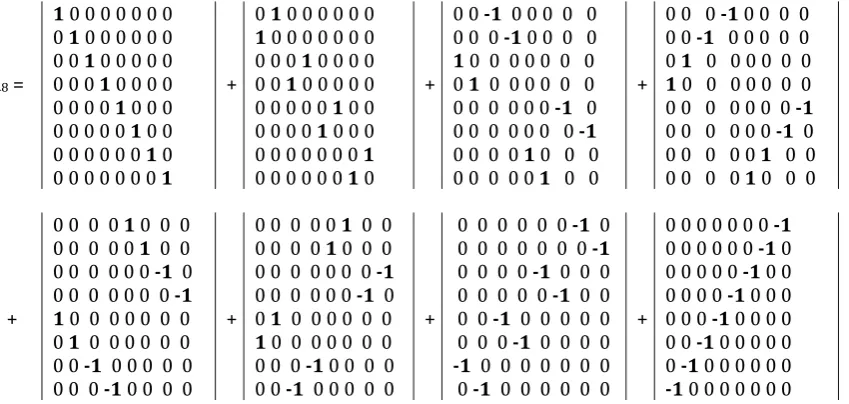
Turn now to the algebraic analysis of the (8*8)-matrix R8 (Fig. 5). Fig. 17 shows the dyadic-shift
decomposition of the matrix R8 into 8 sparse unitary matrices: R8 = R80 + R81 + R82 + R83 + R84 + R85 +
R86 + R87.
One can note that the set of 8 unitary genetic matrices R80, R81, R82, R83, R84, R85, R86, R87 (Fig. 17)
also contains the following algebraic complementarities in corresponding pairs of these matrices: unitary matrices R80 and R87 form the first pair of the algebraic complementarity since they are
transformed into each other by mirror reflection relative to the average vertical line with inversion of signs of their non-zero entries (the mirror-anti-symmetry). The same is true for the pairs of unitary matrices R81 and R86, R82 and R85, R83 and R84, which form the other pairs with their similar algebraic
complementarity of the mirror-anti-symmetric type.
Fig. 17. The dyadic-shift decomposition of the matrix R8 into 8 sparse unitary matrices: R8 = R80 + R81
+ R82 + R83 + R84 + R85 + R86 + R87.
Each of these 8 sparse matrices is unitary: R80*R80T = I, R81*R81T = I, R82*R82T = I, R83*R83T = I,
R84*R84T = I, R85*R85T = I, R86*R86T = I, R87*R87T = I.
Determinants of all these 8 unitary matrices are equal to 1; by this reason they belong to the type of so called special unitary matrices. The special unitary matrices are closed under multiplication and
the inverse operation. They form the special unitary group
(https://en.wikipedia.org/wiki/Special_unitary_group). The multiplication table (Fig. 18) of this closed set of 8 unitary matrices coincides with the multiplication table of the algebra of bi-split-quaternions of Cockle.
The set of these 8 sparse matrices is divided into 2 equal subsets with 4 matrices in each. The first subset contains matrices R80, R81, R82, R83, whose non-zero entries belong only to two quadrants
along the main diagonal of the matrix R8 (in the symbolic matrix of triplets in Fig. 4, all triplets in these
two quadrants begin with letters C or G). In this subset two matrices R80 and R81 are symmetric and two
other matrices R82 and R83 are asymmetric. The second subset contains matrices R84, R85, R86, R87, whose
non-zero entries belong only to two quadrants along the second diagonal of the matrix R8 (in the
symbolic matrix of triplets in Fig. 4, all triplets in these two quadrants begin with letters A or T). All these 4 matrices are symmetric and correspondingly have real eigenvalues.
* R80 R81 R82 R83 R84 R85 R86 R87
R8 =
1 0 0 0 0 0 0 0 0 1 0 0 0 0 0 0 0 0 1 0 0 0 0 0 0 0 0 1 0 0 0 0 0 0 0 0 1 0 0 0 0 0 0 0 0 1 0 0 0 0 0 0 0 0 1 0 0 0 0 0 0 0 0 1
+
0 1 0 0 0 0 0 0
1 0 0 0 0 0 0 0 0 0 0 1 0 0 0 0 0 0 1 0 0 0 0 0 0 0 0 0 0 1 0 0 0 0 0 0 1 0 0 0 0 0 0 0 0 0 0 1
0 0 0 0 0 0 1 0 +
0 0 -1 0 0 0 0 0 0 0 0 -1 0 0 0 0
1 0 0 0 0 0 0 0 0 1 0 0 0 0 0 0 0 0 0 0 0 0 -1 0 0 0 0 0 0 0 0 -1
0 0 0 0 1 0 0 0 0 0 0 0 0 1 0 0
+
0 0 0 -1 0 0 0 0 0 0 -1 0 0 0 0 0 0 1 0 0 0 0 0 0
1 0 0 0 0 0 0 0 0 0 0 0 0 0 0 -1
0 0 0 0 0 0 -1 0 0 0 0 0 0 1 0 0 0 0 0 0 1 0 0 0
+
0 0 0 0 1 0 0 0 0 0 0 0 0 1 0 0 0 0 0 0 0 0 -1 0 0 0 0 0 0 0 0 -1 1 0 0 0 0 0 0 0 0 1 0 0 0 0 0 0 0 0 -1 0 0 0 0 0 0 0 0 -1 0 0 0 0
+
0 0 0 0 0 1 0 0 0 0 0 0 1 0 0 0 0 0 0 0 0 0 0 -1
0 0 0 0 0 0 -1 0 0 1 0 0 0 0 0 0
1 0 0 0 0 0 0 0 0 0 0 -1 0 0 0 0 0 0 -1 0 0 0 0 0
+
0 0 0 0 0 0 -1 0 0 0 0 0 0 0 0 -1
0 0 0 0 -1 0 0 0 0 0 0 0 0 -1 0 0 0 0 -1 0 0 0 0 0 0 0 0 -1 0 0 0 0
-1 0 0 0 0 0 0 0 0 -1 0 0 0 0 0 0
+
0 0 0 0 0 0 0 -1
0 0 0 0 0 0 -1 0 0 0 0 0 0 -1 0 0 0 0 0 0 -1 0 0 0 0 0 0 -1 0 0 0 0 0 0 -1 0 0 0 0 0 0 -1 0 0 0 0 0 0
R80 R80 R81 R82 R83 R84 R85 R86 R87
R81 R81 R80 R83 R82 R85 R84 R87 R86
R82 R82 R83 -R80 -R81 -R86 -R87 R84 R85
R83 R83 R82 -R81 -R80 -R87 -R86 R85 R84
R84 R84 R85 R86 R87 R80 R81 R82 R83
R85 R85 R84 R87 R86 R81 R80 R83 R82
R86 R86 R87 -R84 -R85 -R82 -R83 R80 R81
R87 R87 R86 -R85 -R84 -R83 -R82 R81 R80
Fig. 18. The multiplication table of 8 genetic unitary matrices R80, R81, R82, R83, R84, R85, R86, R87 from
Fig. 17 coincides with the multiplication table of the algebra of bi-split-quaternions of Cockle.
The exponentiation of the sum of matrices R80, R81, R82 and R83 (Fig. 17) taken with the factor 8 -0.5 defines a cyclic group with its period 8: (8-0.5*(R80+R81+R82+R83))n = (8-0.5*(R80+R81+R82+R83))n+8.
The exponentiation of the sum of matrices R84, R85, R86 and R87 (Fig. 17) taken with the factor 8 -0.5 defines a cyclic group with its period 2: (8-0.5*(R84+R85+R86+R87))n = (8-0.5*(R84+R85+ R86+R87))n+8.
Correspondingly this matrix 8-0.5*(R84+R85+R86+R87) defines transformation of reflection in the
8-dimensional informational space.
One should note that these two subsets of 8 unitary genetic matrices have some relations to evolution changes of the genetic code. Modern science knows more than 20 variants (or dialects) of the genetic code represented on website http://www.ncbi.nlm.nih.gov/Taxonomy/Utils/wprintgc.cgi. As this website shows, these dialects differ from the Standard Code only by the code meanings of a small number of triplets. For example, in the Standard Code the triplet TAG encodes the amino acid Leu but in the Chlorophycean Mitochondrial Code it serves as the stop-codon. One can check that in all dialects without exception all stop-codons have their first letter A or T; practically all initiative codons also begin with the letters A or T. Beside this, practically all triplets with changed coding meaning are triplets with the first letters A or T in them; such triplets belong to two quadrants along the second diagonal of the matrix in Fig. 4. All entries of these two quadrants in the corresponding numeric matrix in Fig. 5 belong to the second subset of symmetric unitary matrices R84, R85, R86 and R87 (Fig. 17). A small exception is
the case of two genetic codes of yeast (the Yeast Mitochondrial Code and the Alternative Yeast Nuclear Code), in which the triplets CUU, CUC, CUA and CUG, having the first letter C, change their coding meaning: in the Standard Code, all these 4 triplets encode the amino acid Leu but in the Yeast Mitochondrial Code they encode the amino acid Thr. These 4 triplets having strong roots are located in the upper quadrant of the matrix of triplets in Fig. 4, and their representations by entries +1 in the numeric matrix R8 belong to the unitary matrices R82 and R83 (Fig. 17).
The genetic (8*8)-matrix R8 can be represented via unitary genetic (2*2)-matrices U0, U1, U2 and
U3 from Fig. 8:
R8 = U0⊗U0⊗U0 + U0⊗U0⊗(-U3) + U0⊗U1⊗U0 + U0⊗U1⊗(-U3) +
U3⊗U2⊗U0 + U3⊗U2⊗(-U3) + U3⊗(-U3)⊗U0 + U3⊗(-U3)⊗(-U3) (9)
Each of the 8 summands on the right-hand side of the expression (9) coincides with one of the above unitary matrices R80, R81, R82, R83, R84, R85, R86, R87 (Fig. 17).
Our results about connections of the genetic (8*8)-matrix R8 (Fig. 5) with unitary matrices give
additional approaches to study symmetric relations between the set of 64 triplets and the set of 20 amino acids and stop-codons encoded by triplets. Fig. 19 reproduces the symbolic matrix of 64 triplets from Fig. 4 but with the additional indication of amino acids and stop-codons in the Vertebrate Mitochondrial Code; this dialect is the most symmetrical among all dialects of the genetic code in line with known data of the website http://www.ncbi.nlm.nih.gov/Taxonomy/Utils/wprintgc.cgi. One can see in Figs. 4, 5 and 18 that the genetic symbolic matrix of 64 triplets and its corresponding numeric representation R8 (Fig. 5) have pairs of adjacent rows 0 and 1, 2 and 3, 4 and 5, 6 and 7, whose mosaics
are identical inside each of pairs. Moreover, both rows inside each of these pairs have the identical list of amino acids and stop-codons marked by identical colors (Fig. 19).
000 001 010 011 100 101 110 111
000 CCC Pro CCA Pro CAC His CAA Gln ACC Thr ACA Thr AAC Asn AAA Lys
001 CCT
Pro CCG Pro CAT His CAG Gln ACT Thr ACG Thr AAT Asn AAG Lys 010 CTC
Leu CTA Leu CGC Arg CGA Arg ATC Ile ATA Met AGC Ser Stop AGA 011 CTT
Leu CTG Leu CGT Arg CGG Arg ATT Ile ATG Met AGT Ser Stop AGG
100 TCC Ser TCA Ser TAC Tyr Stop TAA GCC Ala GCA Ala GAC Asp GAA Glu
101 TCT Ser TCG Ser TAT Tyr Stop TAG GCT Ala GCG Ala GAT Asp GAG Glu
110 TTC Phe TTA Leu TGC Cys TGA Trp GTC Val GTA Val GGC Gly GGA Gly
111 TTT Phe TTG Leu TGT Cys TGG Trp GTT Val GTG Val GGT Gly GGG Gly
Fig. 19. The correspondence among 64 triplets and 20 amino acids and stop-codons in the case of the Vertebrate Mitochondrial Code. Both rows inside each of pairs of adjacent rows 0-1, 2-3, 4-5, 6-7 with their even-odd numberings have identical black-and-white mosaics (reproduced in the numeric matrix R8 in Fig. 5) and also identical lists of amino acids and stop-codons
(marked with the same colors).
The described decomposition (Fig. 17) of the numeric matrix R8 of triplets into sums of unitary
matrices is accompanied by a separation of the complete set of 64 triplets into corresponding subsets of triplets. This separation of the set of 64 triplets is accompanied by a relevant separation of the complete set of 20 amino acids and stop–codons into appropriate subsets taking into account the code meaning of each of triplets. For example, the matrix R8 can be represented in the following form using
the decomposition in Fig. 17:
R8 = (R80 + R82) + (R81 + R83) + (R84 + R86) + (R85 + R87) (10)
Here each of 4 expressions in brackets taken with the factor 2-0.5 is a unitary matrix:
0.5*(R80+R82)(R80+R82)T = I8; 0.5*(R81+R83)(R81+R83)T = I8;
0.5*(R84+R86)(R84+R86)T = I8; 0.5*(R85+R87)(R85+R87)T = I8 (11)
where I8 is the identity matrix of order 8.
Fig. 20 shows these 4 inter-complementary matrices (R80+R82), (R81+R83), (R84+R86) and
(R85+R87) whose sum is equal to the matrix R8 from Fig. 5.
1 0 -1 0
R80+R82 =
1 0 1 0
0 1 0 1 0 0 0 0 0 0 0 0 ; R81+R83 =
0 1 0 1
1 0 1 0 0 0 0 0 0 0 0 0 0 0 0 0
0 0 0 0 0 0 0 0 0 0 0 0
1 0 -1 0 0 1 0 -1 1 0 1 0 0 1 0 1
0 0 0 0 0 0 0 0 0 0 0 0 0 0 0 0
0 1 0 -1 1 0 -1 0 0 1 0 1 1 0 1 0
R84+R86 =
0 0 0 0 0 0 0 0 0 0 0 0 0 0 0 0
1 0 -1 0 0 1 0 -1 -1 0 -1 0
0 -1 0 -1 ; R85+R87 =
0 0 0 0 0 0 0 0 0 0 0 0 0 0 0 0
0 1 0 -1 1 0 -1 0 0 -1 0 -1 -1 0 -1 0 1 0 -1 0
0 1 0 -1 -1 0 -1 0 0 -1 0 -1
0 0 0 0 0 0 0 0 0 0 0 0 0 0 0 0
0 1 0 -1 1 0 -1 0 0 -1 0 -1 -1 0 -1 0
0 0 0 0 0 0 0 0 0 0 0 0 0 0 0 0
Fig. 20. The result of the decomposition of the genetic matrix R8 (Fig. 5) into 4 inter-complementary
matrices (R80+R82), (R81+R83), (R84+R86) and (R85+R87), which, taken with the factor 2-0.5, are
unitary matrices with their own complete systems of orthogonal functions. Matrices R80, R81,
R82, R83, R84, R85, R86, R87 are shown in Fig. 17.
Rows and columns of each of the 4 unitary matrices 2-0.5*(R80+R82), 2-0.5*(R81+R83), 2 -0.5*(R84+R86) and 2-0.5*(R85+R87) represent complete systems of orthogonal functions. By this reason,
these 4 matrices can be used for a decomposition of an arbitrary 8-dimensional vector 𝑉̅=[x0, x1, x2, x3,
x4, x5, x6, x7] on the basis of orthogonal functions of each of these orthogonal systems. By this way, an
8-dimensional vector 𝑉̅ receives different spectral representations in a general case. The multiplication
of any of such spectral representations of the vector 𝑉̅ with correspondence transposed unitary matrix
restores the initial vector 𝑉̅. Such spectral representations of vector-signals can be used for
noise-immunity coding of information by some analogies with known noise-noise-immunity coding on the basis of Hadamard matrices in digital signal processing.
Determinants of all the unitary matrices 2-0.5*(R80+R82), 2-0.5*(R81+R83), 2-0.5*(R84+R86) and 2 -0.5*(R85+R87) are equal to 1. Some multiplications of the matrices PR0, PR1, PL0 and PL1 each with other
are commutative and others are non-commutative (12):
(R80+R82)(R81+R83) = (R81+R83)(R80+R82);
(R84+R86)(R85+R87) = (R85+R87)(R84+R86);
(R80+R82)(R84+R86) ≠ (R84+R86)(R80+R82) ;
(R80+R82)(R85+R87) ≠ (R85+R87)(R80+R82);
(R81+R83)(R84+R86) ≠ (R84+R86)(R81+R83);
(R81+R83)(R85+R87) ≠ (R85+R87)(R81+R83) (12)
Exponentiation of unitary matrices 2-0.5*(R80+R82) and 2-0.5*(R81+R83) defines cyclic groups with
their period 8: (2-0.5*(R80+R82))n = (2-0.5*(R80+R82))n+8; (2-0.5*(R81+R83))n = (2-0.5*(R81+R83))n+8.
Exponentiation of unitary matrices 2-0.5*(R84+R86) and 2-0.5*(R85+R87) defines cyclic groups with their
period 2: (2-0.5*(R84+R86))n = (2-0.5*(R84+R86))n+2; (2-0.5*(R85+R87))n = (2-0.5*(R85+R87))n+2.
2-0.5*(R81+R83) (2-0.5*(R81+R83))(2) (2-0.5*(R81+R83))(3)
2-0.5*(R84+R86) (2-0.5*(R84+R86))(2) (2-0.5*(R84+R86))(3)
2-0.5*(R85+R87) (2-0.5*(R85+R87))(2) (2-0.5*(R85+R87))(3)
Fig. 21. Initial members of tensor families of unitary matrices (2-0.5*(R80+R82))(k), (2-0.5*(R81+R83))(k),
(2-0.5*(R84+R86))(k) and (2-0.5*(R85+R87))(k) having fractal structures and complete orthogonal
systems of functions. Entries +2-0.5, -2-0.5 and 0 are marked by yellow, blue and green
correspondingly.
Exponentiation of genetic unitary (8*8)-matrices 2-0.5*(R80+R82), 2-0.5*(R81+R83), 2-0.5*(R84+R86)
and 2-0.5*(R85+R87) in tensor (Kronecker) powers k = 2, 3, 4, … gives tensor families of new unitary
matrices of order 8k with new complete systems of orthogonal functions: (2-0.5*(R80+R82))(k), (2 -0.5*(R81+R83))(k), (2-0.5*(R84+R86))(k) and (2-0.5*(R85+R87))(k) (Fig. 21).
The 4 matrices (R80+R82), (R81+R83), (R84+R86) and (R85+R87) are pairwise amicable:
(R80+R82)(R81+R83)T = (R81+R83)(R80+R82)T; (R80+R82)(R84+R86)T = (R84+R86)(R80+R82)T;
(R80+R82)(R85+R87)T = (R85+R87)(R80+R82)T; (R81+R83)(R84+R86)T = (R84+R86)(R81+R83)T;
(R81+R83)(R85+R87)T = (R85+R87)(R81+R83)T.
Matrices (R80+R82), (R81+R83), (R84+R86) and (R85+R87) taken in tensor powers k = 1, 2, 3,… define
corresponding tensor families whose matrices satisfy the condition (13):
(R80+R82)(k)*((R80+R82)(k))T =Iw*4k/2, (R81+R83)(k)*((R81+R83)(k))T =Iw*4k/2,
(R84+R86)(k)*((R84+R86)(k))T= Iw*4k/2, (R85+R87)(k)*((R85+R87)(k))T =Iw*4k/2 (13)
where Iw is the identity matrix of order 8k.
Now let us comparise the distribution of amino acids and stop-codons in the symbolic matrix in Fig. 19 with the distribution of non-zero entries in numeric matrices R80+R82, R81+R83, R84+R86 and
R85+R87 (Fig. 20). The comparison shows that the phenomenon of pairwise distributions of amino acids
and stop-codons in adjacent rows 0-1, 2-3, 4-5 and 6-7 of the genetic matrix in Fig. 19 is connected with the set of 4 complementary unitary matrices R80+R82, R81+R83, R84+R86 and R85+R87. More precisely,
these 4 matrices define the symmetric separations of the set of 64 triplets and the set of 20 amino acids and stop-codons into the following subsets:
• the set of non-zero entries in the matrix R80+R82 corresponds to the set of 10 amino acids Pro,
His, Gln, Leu, Arg, Ala, Asp, Glu, Val, Gly, which are encoded by the set of 16 triplets - CCC, CAC, CCG, CAG, CTC, CGC, CTG, CGG, GCC, GAC, GCG, GAG, GTC, GGC, GTG and GGG;
• the set of non-zero entries in the matrix R81+R83 corresponds to the same set of 10 amino acids
Pro, His, Gln, Leu, Arg, Ala, Asp, Glu, Val, Gly, which are encoded by another set of 16 triplets - CCA, CAA, CCT, CAT, CTA, CGA, CTT, CGT, GCA, GAA, GCT, GAT, GTA, GGA, GTT, GGT;
• the set of non-zero entries in the matrix R84+R86 corresponds to the following set of amino acids
 (here tensor power n = 1, 2, 3) of DNA-alphabets of 4 nucleotides, 16 doublets and 64 triplets](https://thumb-us.123doks.com/thumbv2/123dok_us/7978958.1323257/5.595.136.462.331.670/tensor-family-genetic-matrices-alphabets-nucleotides-doublets-triplets.webp)