Hallucinating LR Image Based On Similarity
Constraints with Gabor Filter
1
Anjali S Prakash,
2Feba Elza John,
3Anjaly S Pillai &
4Vinu Vijai
1UG Student, Department of ECE, Rajas Engineering College, Vadakkangulam, India,
2UG Student, Department of ECE, Rajas Engineering College, Vadakkangulam, India,
3UG Student, Department of ECE, Rajas Engineering College, Vadakkangulam, India
4UG Student, Department of ECE, Rajas Engineering College, Vadakkangulam, India
ABSTRACT: Hallucination is the process of enhancing a low resolution image. It is generally accepted that most of the face images captured by live cameras are of low resolution. So this paper is used to automatically improve such low resolution (LR) face images to a high resolution (HR) image. It works on patch level by including four constraint functions. After combining the four constraints, hallucinated image is obtained. A database containing some of the low resolution and high resolution images are created. The first two constraints is designed to measure the similarity between an input low resolution image and a trained image. Gabor filter is introduced at the first two similarity constraints. Gabor filter is used for feature extraction. Features like shapes and color of the images are extracted. The third constraint increases the smoothness of the input image and the fourth constraint measures the spatial distance between each patch.
KEYWORDS: Hallucination, Gabor filter, Similarity constraints.
I.INTRODUCTION
Image enhancement plays a vital role in digital image processing. They are meant for improving the quality of an image. Hallucination is the process of enhancing a low resolution image. Face hallucination techniques can be useful in surveillance systems where the resolution of a face image is normally low in video, but the details of facial features which can be found in a high resolution (HR) image may be crucial for identification and further analysis. In applications like face recognition, face detection etc; resolution enhancement techniques are therefore generally essential. Super resolution is the process of determining and adding missing high frequency information in the image to improve the resolution. Face hallucination is a subset of super resolution. This work is intended to enhance the visual quality and resolution of a facial image. Face hallucination which is also referred as face super-resolution (SR) is a technology to estimate a high-resolution (HR) image from low-resolution (LR) image sequences or a single LR one. Super resolution is a term for a set of methods of up scaling video or images. There are two different types of super resolution approaches. In the first type, more than one low resolution images are used to produce a high resolution image. It is generally called multi-frame super resolution. In multi-frame super resolution, HR image is synthesized from input images alone, so these are also called reconstruction based super resolution. Another type of super resolution uses a single low resolution image as the input to produce a high resolution image. This method is called single frame super resolution. Hallucination is nothing but the process of clarifying the details of a low resolution image that is enhancing a low resolution image into a high resolution image.
scene can be used to generate a high resolution image or image sequence. High resolution image offers a high pixel density and thereby more details about the original scene. High resolution is of importance in medical imaging for diagnosis.
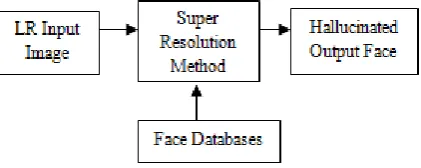
Figure 1: Block schematic of face hallucination system
Face hallucination can be applied in many fields ranging from image compression to face identification. In order to synthesis the high resolution (HR) image from the low-resolution (LR) image, face hallucination techniques are used. Since many detailed facial features are lost in the low-resolution face images, the faces are often indiscernible. For identification, especially by humans, it is useful to render a high-resolution face image from the low-resolution one. This technique is called face hallucination or face super- resolution. Figure 1 shows the basic operation of a face hallucination system. Face hallucination is the super resolution of face images or clarifying the details of a low resolution image.
Many computer vision tasks require inferring a missing high resolution image from the low-resolution input, which was introduced as face hallucination. This technique has many applications in image enhancement, image compression and face recognition. It can be especially useful in a surveillance system where the resolution a of face image is normally low in video, but the details of facial features which can be found in a potential high-resolution image may be crucial for identification and further analysis. However, hallucinating faces is challenging because people are so familiar with the face. A small error might be significant to human perception, whereas for super resolution of generic images the errors in textured regions are often overlooked. This specialized perception of faces requires that a face synthesis system be accurate at representing facial features. We use the high-resolution images from face hallucination to conduct efficient face recognition tasks. Image super-resolution, whose task is to infer a high- resolution (HR) image from one or more low-resolution (LR) input images, is an active technology at present. Especially, the super-resolution for face images, which is also called face hallucination, has important applications such as long- distance video surveillance and video processing. The applications of hallucination are, Medical imaging (i.e. MRI), Satellite imaging, Enlarging consumer photographs, Video surveillance (i.e. Vehicle kidnapping), Converting NTSC video content to high definition television.
The rest of this paper is organized as follows: in Section II literature survey is discussed. In Section III, I present the details of the proposed method which uses Gabor filter for feature extraction. In Sections IV, I carry out the experiments and Section V concludes the paper.
II. LITERATURE SURVEY
A number of hallucination techniques have been proposed in recent years [1-10] that employ a face database to reconstruct a high-resolution (HR) facial image from its low-resolution (LR) counterpart have achieved great success. These are often referred to as “face hallucination” methods because the visually plausible HR facial images are inferred via the use of the prior information contained in a face dataset. Baker et al. [1] were the first to propose a
introduced by the synthesized cartoon with respect to the input face photo. A two step face hallucinating approach [3] integrates both global parametric model and a local nonparametric model. It works on generating a high-resolution face image from an input low-resolution image, with the help of a large collection of other high-resolution face images. By integrating both global and local models, we can generate photorealistic face that is a high resolution image. The sum of the global and local image forms the final result. A robust warping algorithm is used to align the low-resolution face images to obtain hallucination results. But it requires a high computational load and heavy memory load requirement. A learning-based face hallucination framework built in the discrete cosine transform (DCT) domain [4], which can produce a high-resolution face image from a single low-resolution one. However, like other learning-based methods, this algorithm is also limited by the training set and thus the performance depends on how well the low-resolution input matches the training samples and suffers from severe blurring problem. A new face hallucination framework [5] termed from local pixel structure to global image super-resolution (LPS-GIS). Based on the assumption that two similar face images should have similar local pixel structures, the new framework first uses the input low-resolution (LR) face image to search a face database for similar example high-resolution (HR) faces in order to learn the local pixel structures for the target HR face. But the runtime of the algorithm is larger due to warping since it uses optical flow method.
Based on the property of face images, hallucination can be implemented by Eigen transformation [6] by selecting the frequency level in the PCA representation. This method extracts maximum facial information from the low-resolution face images and is robust to noise. The resolution and quality of face images are greatly improved over the low-resolution images.
Existing learning-based face super-resolution (hallucination) techniques generate high resolution images of a single facial modality (i.e., at a fixed expression, pose and illumination) given one or set of low-resolution face images as probe. But in Generalized Face Super-Resolution [7], multiple facial expression hallucination is performed. However, the hallucinated results appear noisy and are relatively poor compared with the results from their simulated experiments. This shows a weakness of learning-based super-resolution techniques which require a certain similarity between training and test images. Most face hallucination methods are usually limited to frontal face with small pose variations. But a simple and efficient multiview face hallucination (MFH) [8], method generates high-resolution (HR) multiview faces from a single given low-resolution (LR) one. The problem is addressed in two steps. A simple face transformation method is proposed by defining a constrained least square problem for LR multiview face transformation and a position-patch based face hallucination method is extended to incorporate HR multiview face details. Compared to the results of previous work, the same view HR faces generated by this method have the nearly same image qualities. Another important issue is that the operation of the method relies on the accuracy of the alignment on LR image input. As part of the experimental evaluation the alignment was performed manually on HR images. However, the alignment on LR images may not be accurate, especially if an automatic method is used.
Next is the Position-based face hallucination method [9], which reconstructs a high-resolution face image from a low resolution observation based on a set of high and low resolution local training image pairs. Instead of basing on probabilistic or manifold learning models, this method synthesizes the high-resolution image patch using the same position image patches of the training image pairs. The final high-resolution facial image is formed by integrating the hallucinated patches. But there is more noise at the local facial features and are blurred.
III. PROPOSED METHOD
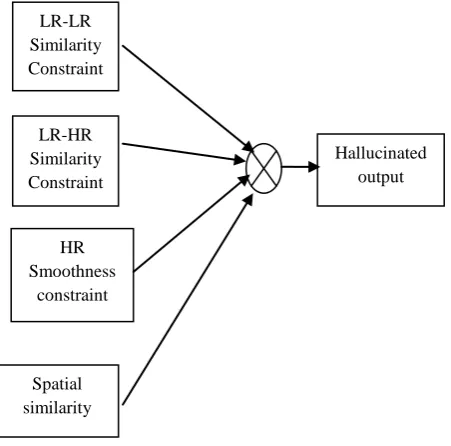
A new face hallucination method is proposed to generate a high resolution (HR) face image from an input low resolution (LR) face image. Inspired by the guided synthesis framework, this method provides an effective way to infer the missing high frequency details within the input LR face image based on the similarity constraints. A database containing low resolution images and high resolution images are created. The first two constraints are designed to compute the similarity between an input LR face image and the training images. Gabor filter is proposed at these two constraint functions for extracting the useful features by eliminating the unwanted or the very low pixel values. Gabor filters provide robustness against varying brightness and contrast of images. The third constraint increases the smoothness of the input image and the fourth constraint measures the spatial distance between each patch. After combining these four constraints, the hallucinated or the high resolution output image will be obtained.
Figure 2: Proposed block diagram
Experimental evaluation demonstrates the good performance of the proposed method on the face hallucination task. The block diagram for proposed method is shown in figure 2. For evaluating the performance of the proposed algorithm, we have also generated the hallucinated image using MATLAB software.
A. Similarity Constraints Computation 1) LR-LR Similarity Constraint
The input image is a low resolution image. The given input image is then compared with the trained low resolution (LR) image. Then for these images, patches are calculated in the search region. Each patch will be a 3×3 matrix.
LR-LR Similarity Constraint
LR-HR Similarity Constraint
HR Smoothness
constraint
Spatial similarity
Input Search Gabor Similarity LAS
LR region filter matrix descriptors
Image LR-LR Similarity
Trained Search Gabor Similarity LAS output LR region filter matrix descriptors Image
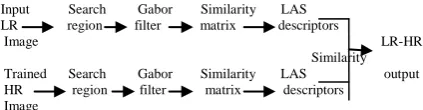
Figure 3: Operation of LR-LR Similarity constraint
Gabor filter is introduced at this section for feature extraction for both the input low resolution image and the trained low resolution image. Features like shapes of the patches and colours of the pixels are extracted and unwanted pixels are eliminated. This is the advantage of proposed method that is the computational complexity is reduced by using the Gabor filter for the early rejection of bad candidates. Bad candidates are nothing but the unwanted pixels. Then similarity matrix calculation is performed for both the images. In similarity matrix the number of pixels having same values is formed into a matrix. It is calculated for both the input and trained low resolution image. A similarity matrix is a matrix of scores that represent the similarity between a number of data points. Each element of the similarity matrix contains a measure of similarity between two of the data points. Similarity matrices are strongly related to their counterparts, distance matrices and substitution matrices. Similarity matrices are used in, finding clusters of data points and Aligning sequences of DNA. In similarity matrix calculation, higher scores are given to more similar characters, and lower or negative sore are given to the dissimilar characters. Next step is the LAS (local appearance similarity) descriptors. In LAS descriptors, the histogram is plotted for both the images. By combining these two histograms, the LR-LR similarity output is obtained.
2) LR-HR Similarity Constraint
The input image is a low resolution image. This input image is then compared with the trained high resolution (HR) image. Then for these images, patches are calculated in the search region. Each patch will be a 3×3 matrix. Gabor filter is introduced at this section for feature extraction for both the input low resolution image and the trained high resolution image. Features like shapes of the patches and colours of the pixels are extracted and unwanted pixels are eliminated. Feature extraction involves simplifying the amount of resources required to describe the large set of data accurately. This is the advantage of proposed method since the computational complexity is reduced by using the early rejection of bad candidates. Bad candidates are nothing but the unwanted pixels. Then similarity matrix calculation is performed for both the images. In similarity matrix the number of pixels having same values is formed into a matrix. It is calculated for both the input low resolution image and the trained high resolution image. In LAS (local appearance similarity) descriptors, the histogram is plotted for both the images.
Input Search Gabor Similarity LAS
LR region filter matrix descriptors Image LR-HR Similarity Trained Search Gabor Similarity LAS output HR region filter matrix descriptors Image
Figure 4: Operation of LR-HR Similarity constraint
The intensity histogram shows how individual brightness levels are occupied in an image; the image contrast is measured by the range of brightness levels. The histogram plots the number of pixels with a particular brightness level against the brightness level. For 8 bit pixels, the brightness ranges from zero (black) to 255 (white). By combining these two histograms, the LR-HR similarity output is obtained. This constraint is similar to the LR-LR similarity constraint but the difference is that the trained high resolution image is used instead of the trained low resolution image.
Feature Extraction
corners/interest points, blobs/region of interest or interest points, ridges, shapes, colors etc. Once feature have been detected, a local image patch around the feature can be extracted. This extraction may involve quite considerable amount of image processing. The result is known as the feature descriptor or the feature vector. When the input data to an algorithm is too large to be processed and it is suspected to be notoriously redundant (e.g., the same measurement in both feet and meters), then the input data will be transformed into a reduced set of features (also named as features vector). Transforming the input data into reduced set of features is called feature extraction. If the feature extracted are carefully chosen it is expected that the feature set will extract the relevant information from the input data in order to perform the desired task using this reduced representation instead of the full size input.
Feature extraction involves simplifying the amount of resources required to describe the large set of data accurately. When performing analysis of large set of data, one of the major problems stems from the number of variables involved. Analysis with a large set of variables generally requires a large amount of energy and computation power or a classification algorithm which over fits the training sample and generalizes poorly to new samples. Feature extraction is the general term for methods of constructing combinations of the variables to get around these problems while still describing the data with sufficient accuracy.
Feature Extraction Techniques
There are two methods to extract the features,
Geometric feature extraction method and non geometric feature extraction method. In geometric method the parts of the image is consider for feature extraction such as eyes, nose and mouth and in the non geometric feature extraction method whole image is consider for feature extraction. We are using non geometric feature extraction method in the proposed work.
Gabor Filter
In image processing, a Gabor filter, named after Dennis Gabor, is a linear filter used for edge detection. A set of Gabor filters with different frequencies and orientations may be helpful for extracting useful features from an image. The advantage of a Gabor filter is concentration on important components of face such as eyes, nose, mouth etc. Gabor features are invariance to illumination, rotation, scale and transform and have optimal localization property in frequency and spatial domain.
Gabor filters can also be applied to get better performances on low quality images. Generally, low quality images are due to the following reasons: The degradations in the capturing process such as low resolutions, motion blurring, inadequate focus or noise produced in the circuits of the devices; the environment influence such as non uniform illumination, shade, or dirt. The core of Gabor filter based feature extraction is the 2D Gabor filter function,
In the spatial domain the Gabor filter is a complex plane wave multiplied by a Gaussian. f is the central frequency of the filter, is the rotation angle, sharpness (bandwidth) along the Gaussian major axis, and is the sharpness along the minor axis (perpendicular to the wave). In addition these filters have been shown to posses optimal localization properties in both spatial and frequency domain and thus are well suited for texture segmentation problems.
thus, the upper layer image analysis and applications can be reliably implemented upon the Gabor features. Gabor filters are used to eliminate the unwanted pixels at the time of the process which makes the computation easier for feature extraction. Gabor filters can also be applied to get better performances on low quality images. Gabor filter based feature extraction is a simple and effective method.
3) HR Smoothness Constraint
In this constraint, the smoothness of the input low resolution image is increased by increasing the high frequency components of the image. Smoothing is an important image processing operation. Smoothing is necessary to reduce noises in order to enhance the overall visual quality of the image. Smoothing filters are very useful in reducing random noise in digital images.
4) Spatial Similarity
Spatial distances between two patches i.e. neighboring patches are calculated. Finally combining all these four constraints, hallucinated or the high resolution is obtained. Thus computational complexity is reduced by reducing the large set of variables which generally requires a large amount of energy and computation power by using Gabor filter.
IV. EXPERIMENTS
A database containing both low resolution images and their corresponding high resolution images are created beforehand. The database images consist of images which are in the format of BMP. The low resolution images are of sizes 50×50and the high resolution images are of size 100×100.
The input image is a low resolution image is read from the database and it is a BMP (Bit Mapped Image) format image. Bit Mapped Image is an image that contains a collection of pixels. The BMP is one of the simplest image formats. It consists of matrix containing number of pixels or dots. Bitmap images (also called raster images): these are pixeled images, i.e. a set of points (pixels) contained in a table, each of these points having one or more values describing its colour. The input image is compared with the trained low resolution image and the trained high resolution image in the two constraints. For both these images, search region is computed and from these search regions, the features are extracted. Features like pixel colors and shapes are extracted. Low valued pixels are eliminated by using Gabor filter, i.e. unwanted pixels are eliminated by using these filters. Thus the unwanted pixels are eliminated earlier which makes the computation easier than the existing methods. Similarity matrix is computed for these extracted pixels. Histograms are plotted and are combined to produce the similarity output. Smoothness is increased at third constraint and spatial distances are calculated to obtain the hallucinated or the high resolution output image.
V. CONCLUSION
In this paper, a low resolution image is converted into a high resolution image and mainly concentrates on feature extraction by using gabor filter. The unwanted pixels are eliminated earlier which makes the computation easier than the existing methods. Since the bad candidates (unwanted pixels) are eliminated, the system becomes simple and effective when compared with the existing methods. By applying Gabor filter, we can eliminate the unwanted pixels that are the pixels with less information about the image. Gabor features are invariance to illumination, rotation, scale and transform and have optimal localization property in frequency and spatial domain. Gabor filter also provide robustness against varying brightness and contrast of images.
REFERENCES
[1] S. Baker and T. Kanade, “Limits on super-resolution and how to break them,” IEEE Trans. Patt. Anal. Mach. Intell., vol. 24, no. 9, pp. 1167– 1183, Sep. 2002.
[2] H. Li, G. Liu, and K. N. Ngan, “Guided face cartoon synthesis,” IEEE Trans. Multimedia, vol. 13, no. 6, 2011.
[3] Ce Liu, Heung-Yeung Shum, William T. Freeman: “Face Hallucination: Theory and Practice”, International Journal of Computer Vision (IJCV), vol. 75, no. 1, pp. 115–134, 2007.
[5] Y. Hu, K.-M. Lam, G. Qiu, and T. Shen, “From local pixel structure to global image super-resolution: A new face hallucination framework,” IEEE Trans. Image Process., vol. 20, no. 2, pp. 433–445, Feb. 2011.
[6] X. Wang and X. Tang, “Hallucinating face by eigentransformation,” IEEE Trans. Syst., Man, Cybern. C, Appl. Rev., vol. 35, no. 3, pp. 425–434, Aug. 2005.
[7] K. Jia and S. Gong, “Generalized face super-resolution,” IEEE Trans. Image Process., vol. 17, no. 6, pp. 873–886, Jun. 2008.
[8]Xiang Ma, Hua Huang, Shaopeng Wang, and Chun Qi: “A Simple Approach to Multiview Face Hallucination”, IEEE signal processing letters, vol. 17, no. 6, June 2010.
[9] Xiang Ma, Junping Zhang and Chun Qi1: “Position-Based Face Hallucination Method”, ICME 2009.