Output Compression, MPC, and iO
for Turing Machines
Saikrishna Badrinarayanan
∗Rex Fernando
†Venkata Koppula
‡Amit Sahai
§Brent Waters
¶Abstract
In this work, we study the fascinating notion of output-compressing randomized encodings for Turing Machines, in ashared randomness model. In this model, the encoder and decoder have access to a shared random string, and the efficiency requirement is, the size of the encoding must be independent of the running time and output length of the Turing Machine on the given input, while the length of the shared random string is allowed to grow with the length of the output. We show how to construct output-compressing randomized encodings for Turing machines in the shared randomness model, assuming iO for circuits and any assumption in the set{LWE, DDH, NthResiduosity}.
We then show interesting implications of the above result to basic feasibility questions in the areas of secure multiparty computation (MPC) and indistinguishability obfuscation (iO):
1. Compact MPC for Turing Machines in the Random Oracle Model. In the context of MPC, we consider the following basic feasibility question: does there exist a malicious-secure MPC protocol for Turing Machines whose communication complexity is independent of the running time and output length of the Turing Machine when executed on the combined inputs of all parties? We call such a protocol as a compact MPC protocol. Hub´acek and Wichs [HW15] showed via an incompressibility argument, that, even for the restricted setting of circuits, it is impossible to construct a malicious secure two party computation protocol in the plain model where the communication complexity is independent of the output length. In this work, we show how to evade this impossibility by compiling any (non-compact) MPC protocol in the plain model to acompact MPC protocol for Turing Machines in the Random Oracle Model, assuming output-compressing randomized encodings in the shared randomness model.
2. Succinct iO for Turing Machines in the Shared Randomness Model. In all existing constructions of iO for Turing Machines, the size of the obfuscated program grows with a bound on the input length. In this work, we show how to construct an iO scheme for Turing Machines in the shared randomness model where the size of the obfuscated program is independent of a bound on the input length, assuming iO for circuits and any assumption in the set {LWE, DDH, Nth Residuosity}.
∗UCLA. Email: [email protected] †UCLA. Email: [email protected]
Contents
1 Introduction 3
1.1 Our Results . . . 5
1.2 Related work . . . 6
2 Technical Overview 7 2.1 Output Compressing Randomized Encodings . . . 7
2.2 Compact MPC for Turing Machines in the Random Oracle Model. . . 8
2.3 Succinct iO for Turing Machines in the Shared Randomness Model . . . 10
3 Preliminaries 11 4 Randomized Encodings: Definitions 11 4.1 Succinct Partial Randomized Encodings . . . 11
4.2 Strong output-compressing Randomized Encodings in the shared randomess model . . . 12
5 Strong Output-compressing Randomized Encodings in the CRS Model 13 5.1 Construction . . . 14
5.2 Proof of Security . . . 15
6 Compact MPC 27 6.1 Construction . . . 28
6.2 Security Proof . . . 30
7 Constructing iO from Output-Compressing Randomized Encodings 33 7.1 Construction . . . 34
7.2 Security . . . 35
7.3 Succinct Partial Randomized Encodings . . . 36
8 Construction of Succinct Partial Randomized Encodings 37 8.1 Correctness and Efficiency . . . 39
8.2 Proof of Security . . . 41
A Secure Multiparty Computation in the Random Oracle Model 46 B Further Preliminaries 48 B.1 Puncturable Pseudorandom Functions . . . 48
B.2 Somewhere Statistically Binding Hash . . . 48
B.3 Indistinguishability Obfuscation for Circuits . . . 49
B.4 Succinct Randomized Encodings . . . 49
C Primitives from [KLW15] 50 C.1 Notations . . . 50
C.2 iO-Compatible Primitives . . . 51
D Proof of Simulation Security for Succinct Partial Randomized Encodings 56 D.1 Proof of Lemma D.1 . . . 60
D.2 Proof of Lemma D.2 . . . 71
D.3 Proof of Lemma D.3 . . . 80
1
Introduction
In this work, we study the fascinating notion of output-compressing randomized encodings for Turing ma-chines. We explore the implication of such encodings to a natural and surprisingly unexplored form of secure multiparty computation for Turing Machines, and also to indistinguishability obfuscation for Turing Machines.
Output-compressing randomized encodings were introduced in the works of Ananth and Jain[AJ15] and Lin, Pass, Seth and Telang [LPST16] as a generalization of randomized encodings [IK00] and succinct randomized encodings [KLW15, BGL+15, CHJV15]. Recall that in an output-compressing randomized
encoding scheme for Turing machines, there exists an encode algorithm that takes as input a Turing machine
M and an input x. It outputs an encoding gMx such that the decode algorithm, given this encoding gMx,
can compute the outputM(x). The efficiency requirement is that for any machineM and inputx, the size of the encoding is poly(|M|,|x|, λ), for some fixed polynomialpoly, whereλ is the security parameter. In particular, the size of the encoding should beindependent of the output length and the running time of the machineM on inputx.1 In those papers, they defined both indistinguishability based and simulation based security notions. In this work, we will focus on the stronger notion of simulation based security which states that an output-compressing randomized encoding scheme is secure if there exists a simulator Sim, that, for any Turing machine M and inputx, given just the output M(x), along with the size of the machine |M|
and the input length|x|, outputs a simulated encoding gMxthat is indistinguishable from a real encoding of
the machineM and inputx.2 As stated here, this goal is impossible due to an “incompressibility” argument
as shown by Lin et al.[LPST16]. Such incompressibility arguments have been a source of impossibility proofs in many areas of cryptography such as functional encryption, garbled circuits and secure multiparty computation [BSW11, AIKW13, CIJ+13, AGVW13, HW15] and this is perhaps the reason why simulation
secure output compressing randomized encodings have not been well studied so far.
Our starting observation is that the above impossibility fails to hold in ashared randomness modelwhere the size of the randomness can grow with the output length. More formally, both the encoder and decoder share a random string (whose size can grow with the output length) and we require two properties: (1) For any machineM and inputx, the size of the encoding ispoly(|M|,|x|, λ), for some fixed polynomialpoly. (2) There exists a simulator Sim, that, for any Turing machine M and input x, given just the output M(x), along with the length of the machine|M| and the input length|x|, outputs a pair of a simulated encoding g
Mx and a shared random string that is indistinguishable from the pair of a real encoding and a uniformly
random string.
In fact, our first main result is that we can indeed construct output-compressing randomized encodings for Turing machines in the shared randomness model based on indistinguishability obfuscation (iO) for circuits and any assumption in{Decisional Diffie Hellman (DDH),Learning With Errors (LWE), NthResiduosity}where the size of the shared randomness equals the output length. Recall that iO is necessary because output-compressing randomized encodings for Turing machines implies iO for circuits as shown by Lin et al.[LPST16] (it is easy to see that this implication to iO remains true even in the shared randomness model). We describe the techniques used in our construction in Section 2.1. We then use this new tool to tackle basic feasibility questions in the context of two fundamental areas in Cryptography: secure multiparty computation (MPC) and indistinguishability obfuscation (iO).
Compact MPC for Turing machines with unbounded output in the Random Oracle model. The first basic feasibility question we address is the following: Consider a set ofnmutually distrusting parties with inputsx1, . . . , xnrespectively that agree on a Turing machineM. Their goal is to securely compute the output M(x1, . . . , xn) without leaking any information about their respective inputs, where we stress that the output
can be of any unbounded polynomial size. Crucially, we require that the communication complexity of the protocol (the sum of the length of the messages exchanged by all the parties) ispoly(|M|,|x1|, . . . ,|xn|, λ) for some fixed polynomialpolywhereλis the security parameter. In particular, the communication complexity
1the size can depend logarithmically on the output length and running time.
2We actually consider a stronger notion where part of the input need not be hidden and we require that the size of the
should be independent of the output length and the running time of the machineM on input (x1, . . . , xn).
We call such an MPC protocol to becompact. Indeed, this communication efficiency requirement is the most natural efficiency requirement in the context of MPC for Turing machines.
Remarkably, this extremely basic question, as stated above, has never been considered before to the best of our knowledge (see related work below for comparison with previous work). At first glance, one may think that Fully Homomorphic Encryption (FHE), one of the most powerful primitives in Cryptography, should help solve this problem. The reason being that, at least in the two party setting, FHE allows one party to encrypt its input and send it to the other party, who can then homomorphically evaluate the function to be computed “under the hood” and compute an encryption of the final output. However, it is not clear how this evaluator would learn the output since he does not have the decryption key. Sending the encryption of the final output to the other party would also blow up the communication complexity. This is related to the question posed by Hub´acek and Wichs [HW15], where they consider a circuit based model, and in fact, our notion generalizes their model. That is, they consider n parties who wish to securely evaluate a circuit on their joint inputs such that the communication complexity of the protocol is independent of the output length of the circuit. In that work, they showed how to achieve semi-honest secure two party computation with this efficiency requirement assuming iO for circuits and somewhere statistically binding (SSB) hash. Further, they showed that in the context of malicious adversaries,3 in the standard model, it is impossible to construct a secure computation protocol with such efficiency requirement even for just two party computation.
However, in this work, we are not willing to give up on achieving malicious secure compact MPC. Instead, we find a way to evade this impossibility result! We do so by considering the well studied programmable random oracle (RO) model [BR93, Nie02, DSW08, Wee09, CJS14, CDG+18]. We stress that typically, people
look to the RO model in the hunt for efficiency improvements but here, we are seeking to establish basic feasibility results using the RO model. Indeed, the RO model has enabled important feasibility results in the past which were impossible in the plain model, for example unconditional non-interactive zero-knowledge arguments for NP with sub-linear communication [IMS12] and Universal Samplers [HJK+16].
More specifically, we show how to construct acompactconstant round MPC protocol for Turing machines in the RO model secure against malicious adversaries assuming iO for circuits and any assumption in{DDH, LWE, NthResiduosity}. Recall that bycompact, we mean that the communication complexity of the protocol is independent of the output length and running time of the Turing machine being evaluated on the joint inputs of the parties. We obtain this result by using output-compressing randomized encodings in the shared randomness model to compile any non-compact malicious secure constant round MPC protocol (even just for circuits) in the plain model into acompactconstant round MPC protocol for Turing machines in the RO model while preserving the round complexity. We again stress that to the best of our knowledge, this is the first MPC protocol for Turing machines where the communication complexity is bounded by a polynomial in the description length of the machine and the input lengths of all the parties. We also observe that as a corollary of our work, we obtain the first malicious secure compact MPC protocol in the circuit based model of Hub´acek and Wichs [HW15], in the RO model. We describe the techniques used in our construction in Section 2.2.
Succinct iO for Turing machines for bounded inputs in the shared randomness model. The problem of bootstrapping from iO for circuits to iO for Turing machines has been the subject of intense study over the last few years. In 2015, in three concurrent works [KLW15, BGL+15, CHJV15]4showed how
to construct iO for Turing machines where the size of the obfuscation grows with a bound on the input length to the Turing machine. In this work, we ask the following question: can we construct iO for Turing machines in the shared randomness model where the obfuscator and evaluator have a shared random string that grows with the input bound but the size of the obfuscation does not?
Lin et al. [LPST16] showed that output-compressing randomized encodings are closely related to iO for Turing machines. That is, they showed that simulation secure output-compressing randomized encodings
3their impossibility in fact even ruled out the simpler setting of honest but deterministic adversaries - such an adversary
behaves honestly in the protocol execution but fixes its random tape to some deterministic value.
4Recently, concurrent to our work, [AL18, AM18, GS18] also showed how to construct iO for Turing machines where, similar
in the plain model implies iO for Turing machines with unbounded inputs.5 In particular, this implies iO for Turing machines with bounded inputs where the size of the obfuscation does not grow with the input bound. As we know, simulation secure output-compressing randomized encodings are impossible in the plain model. However, it turns out that this implication does not carry over in the shared randomness model. That is, if we start with output-compressing randomized encodings in the shared randomness model and apply the transformation in [LPST16], in the resulting iO scheme, the size of the obfuscation does in fact grow with the input bound. The key obstacle is that in the transformation, the obfuscation consists of an output-compressing randomized encoding that is the root of a GGM-like tree ([GGM86]). This encoding, on evaluation, outputs another output-compressing randomized encoding corresponding to its child node and the process is repeated. In order to evaluate the obfuscated program on an input of lengthn, the evaluator has to traverse the obfuscated program up to a depth of lengthn. As a result, the machine being encoded in the root needs the shared randomness for each layer, up to a depth of lengthn. Hence, the size of the machine encoded in the root grows with the input bound and so does the size of the obfuscated program. Note that this approach fails even if the size of the shared randomness for the encoding is just 1 bit (independent of the length of the output).
Nevertheless, we show how to overcome this obstacle by taking a completely different approach. In our solution, the obfuscated program consists of an output-compressing randomized encoding in which, crucially, neither the machine being encoded nor the input to the machine, depends on the input bound of the obfuscation scheme. Hence, the size of the encoding, and therefore, also the size of the obfuscation, does not grow with the input bound. We elaborate more about the techniques used in our construction in Section 2.3. Concretely, we obtain the following result: iO for Turing machines in the shared randomness model assuming iO for circuits and any assumption in{DDH, LWE, NthResiduosity}, where the obfuscator
and evaluator have a shared random string of lengthpoly(n, λ) for some fixed polynomial poly, and the size of the obfuscation is poly1(|M|, λ) for some fixed polynomial poly1. Here, M denotes the Turing machine being obfuscated andndenotes the input bound.
1.1
Our Results
In this paper, we achieve the following results.
1) Output-compressing randomized encodings.
We prove the following theorem:
Theorem 1.1 (Informal). There exists an output-compressing randomized encoding scheme for Turing machines in the shared randomness model assuming the existence of:
• iO for circuits (AND)
• A ∈ {DDH, LWE, NthResiduosity}.
Further, the length of the shared randomness is equal to the output length.
2) Compact MPC for Turing machines with unbounded output in the RO model.
We prove the following theorem:
Theorem 1.2 (Informal). For any n, t >0, there exists a constant round compactMPC protocol amongst
nparties for Turing machines in the Programmable Random Oracle model that is malicious secure against up totcorruptions assuming the existence of:
• Output-compressing randomized encodings in the shared randomness model (AND)
5Lin et al. [LPST16] in fact showed that a weaker notion of distributional indistinguishability based secure output-compressing
• Constant round MPC protocol amongstn parties in the plain model that is malicious secure against up tot corruptions.
Once again, recall that by compact, we mean that the communication complexity of the protocol is independent of the output length and running time of the Turing machine being evaluated on the joint inputs of the parties. Here, we note that the above compiler even works if the underlying MPC protocol is for circuits. That is, we can convert any constant round protocol for circuits into a constant round protocol for Turing machines (with an input bound) by first converting the Turing machine into a (potentially large) circuit.
Also, we can instantiate the underlying MPC protocol in the following manner to get a round optimal compact MPC: append a non-interactive zero knowledge argument based on DLIN in the common random string model [GOS06] to either the two round semi-malicious MPC protocol of [MW16] that is based on LWE in the common random string model or the ones of [GS18, BL18] that are based on DDH/Nth residuosity
in the plain model, to get two round malicious secure MPC protocols in the common random string model. We can then implement the common random string required for the underlying protocol via the RO. We thus achieve the following corollary:
Corollary 1.1. Assuming the existence of:
• iO for circuits (AND)
• DDH, or LWE, or NthResiduosity (AND) • DLIN,
there exists acompact, round optimal(two round) MPC protocolπfor Turing machines in the Programmable Random Oracle model that is malicious secure against a dishonest majority.
Our result also gives a malicious securecompactMPC protocol in the circuit-based setting of [HW15] in the RO model. We also achieve other interesting corollaries by instantiating the underlying MPC protocol in the setting of super-polynomial simulation or in the setting of concurrent executions. We elaborate on both the above points in Section 6.
3) Succinct iO for Turing machines for bounded inputs in the shared randomness model.
We prove the following theorem:
Theorem 1.3(Informal). There exists an iO scheme for Turing machines in the shared randomness model where the size of the obfuscated program is independent of the input bound assuming the existence of:
• iO for circuits,
• DDH, or LWE, or NthResiduosity.
1.2
Related work
A series of works [OS97, GHL+14, GGMP16, Mia16, HY16, LO17] consider MPC for RAM programs.
How-ever, in all of them, the communication complexity of the protocol grows with the running time of the RAM program. As a result, the communication complexity of the protocol in the Turing machine model would also grow with the output length. We stress that in our work, we require that the communication complexity can grow with neither output length nor running time of the Turing machine.
Open Problems. Hub´acek and Wichs [HW15] show that some weak form of obfuscation (that does not seem to imply iO) is necessary to construct compact semi-honest secure MPC protocols in the plain model. One interesting open problem is to study whether, in fact, iO is necessary. Further, another interesting open problem is can we construct compact MPC protocols in the RO model based on weaker assumptions or in fact, obfuscation is necessary? Our construction gives an initial feasibility result for this problem and we believe it would be an interesting research direction to pursue further.
2
Technical Overview
2.1
Output Compressing Randomized Encodings
We will now discuss a high-level overview of our output-compressing randomized encoding (OcRE) scheme in theshared randomness model. LetMbe a family of Turing machines with output size bounded byo-len. An OcREscheme for Min the shared randomness model consists of a setup algorithm, an encoding algorithm and a decoding algorithm. The setup algorithm takes as input security parameterλtogether with a string rndof lengtho-len, and outputs a succinct encoding keyekof sizepoly(λ).6 This encoding key is used by the encoding algorithm, which takes as input a machineM ∈ M, an inputx∈ {0,1}∗, and outputs an encoding g
Mx. Finally, the decoding algorithm can useMgx and rndto recover M(x). For efficiency, we require that
the encoding time depends only on|M|,|x|and security parameterλ. In particular, the size of the encoding should not grow with the output lengtho-lenor the running time ofM onx. 7
The starting point of our construction is the succinct randomized encoding scheme of [KLW15], which is an encoding scheme forboolean Turing machines, and the size of the encoding depends only on|M|,|x|and security parameterλ. We want to use this tool as a building block to build an encoding scheme forgeneral
Turing machines (i.e. with multi-bit output) where the size of the encoding still only depends on |M|,|x|
andλ.As a first step, let us consider the following approach. The encoding algorithm outputs an obfuscated programProg[M, x], which has M and xhardwired, takes input j ∈[o-len], and outputs a KLW encoding ofMj, x (the randomness for computing the encoding is obtained by applying a PRF onj). Here,Mj is a
boolean Turing machine which, on inputx, outputs thejthbit ofM(x). The decoding algorithm runsProg
for each j ∈ [o-len], obtains o-len different encodings, and then decodes each of them to obtain the entire output bit by bit. Clearly, this construction satisfies the efficiency requirement. This is because the size of the programProg depends only on|M|,|x|, and hence the size of the encoding only depends on|M|,|x|, λ. As far as security is concerned, it is easy to show that this scheme satisfies indistinguishability-based security; that is, if (M0, x0) and (M1, x1) are two pairs such thatM0(x0) =M1(x1), |M0|=|M1|, |x0|=|x1|, then
the obfuscation of Prog[M0, x0] is computationally indistinguishable from the obfuscation of Prog[M1, x1].
Unfortunately, recall that our goal is simulation security, and it is not possible to simulate an obfuscation ofProg[M, x], given onlyM(x) as input. In particular, ify =M(x) is a long pseudorandom string (whose length can be much longer than the size of Prog[M,]), then it should be hard to compress y to a short encoding (as shown by Lin et al. [LPST16]).
As noted in the previous section, we will evade the “incompressibility” argument by allowing the shared randomness to have size that grows with the output length. Our goal will be to allow the simulator to embed the output of the machine M in this randomness. Our second attempt is as follows. The setup algorithm computes a short commitment ek to the shared randomness (say with a Merkle tree), and outputs ek as the encoding key. The encoding algorithm computes an obfuscation of Prog[M, x,ek], which has M, x, ek hardwired, takes as input an indexj, a bitb(which is supposed to be thejthbit of the shared randomness),
and an openingπthat the bitb is indeed thejth bit of the shared random string. The program checks the
proofπ, and then computes a KLW encoding of (Mj, x).
While the bit bis essentially ignored in the real-world encoding, it is used by the simulator in the ideal world. In the ideal world, the simulator, on receiving M(x), masks it with a pseudorandomly generated
6We will assumeo-lenis at most 2λ.
one-time pad and outputs the resultant string as the shared randomness, and the short commitment ek is computed as in real world. For the encoding, it outputs an obfuscation of Prog-sim[ek], which takes as input (j, b, π), checks the proof π, unmasks the bitb to obtain M(x)j and simulates the KLW randomized
encoding usingM(x)j. This program has behavior identical toProg[M, x,ek] as long as the adversary only
gives openings to the original bits of the shared randomness.
There is a simple problem with this idea: obfuscation only guarantees indistinguishability of programs that are functionally equivalent, and although the security of a Merkle tree would make it computationally infeasible for an adversary to come up with an opening to a wrong value, these inputs do in fact exist. To fix this problem, we use a special iO-compatible family of hash functions called ‘somewhere-statistically binding (SSB) hash’, introduced by [HW15]. Intuitively, this primitive is similar to a merkle tree except for two additional features. First, it allows a given position to be statistically “bound”, where for that index it is only possible to give an opening for the correct bit. So there are three algorithms, Setup,Open,andVerify, as in the case of a Merkle tree, butSetup additionally takes as input a position to bind. If j is the bound position for H then there is no opening π for a bit b ̸=xj such that Verify(π, b, j, H(x)) accepts. Second,
this bound position is hidden, so we can change it without being detected. Using this new hash allows us to make a series of hybrids where we change the shared randomness one bit at a time without giving up indistinguishability.
2.2
Compact MPC for Turing Machines in the Random Oracle Model.
We now describe the techniques used in our round preserving compiler from any non-compact constant round malicious secure MPC protocol in the plain model to acompactconstant round malicious secure MPC protocol in the RO model, using output-compressing randomized encodings in the shared randomness model.
To begin with, consider any constant round MPC protocol π in the plain model. For simplicity, lets assume that every party broadcasts a message in each round. In order to make it compact, our main idea is a very simple one: use output-compressing randomized encodings to shrink the messages sent by every party in each round so that they are independent of the output length and running time of the machine. That is, instead of sending the actual message of protocol π, each party just sends an output-compressing randomized encoding of a machine and its private input that generates the actual message!
More precisely, consider a party Pwith input xthat intends to send a messagemsg1 in the first round as part of executing protocol π. Let’s denote M to be the Turing machine that all the parties wish to evaluate. Let M1 denote the algorithm used by the first party to generate this messagemsg1 in the first
round. Now, instead of sending msg1, Psends an encoding of machine M1 and input (x, r) wherer is the
randomness used by party P in protocol π. The recipient first decodes this encoding to receive P’s first round message of protocolπ -msg1. Without loss of generality, let’s assume that the length of randomness r is only proportional to the input length (else, internally, M1 can apply a pseudorandom generator). In
terms of efficiency, the description of the machine M1 only depends on M and so it is easy to see that the
size of the encoding does not depend on the non-compact message - msg1. A natural initial observation is that in order to construct a simulator for the protocol, we need to generate simulated encodings. However, as we know that simulation secure output-compressing randomized encodings are impossible, we will resort to using our new encodings constructed in the shared randomness model.
Need for Random Oracle. Does this result in a compact protocol in the common random string (CRS) model, with the CRS being the shared randomness and its size grows with the output length? At this juncture, we first recall that [HW15] showed that malicious secure compact MPC is impossible even in the CRS model where the size of the CRS can grow with the output length.8 As a result, it must be the case that our protocol is not a compact and secure MPC protocol in the CRS model. We first explain why and
8They actually show that it is impossible in an offline/online setting where the initial offline phase takes place independent
this also brings us to the use of the Programmable Random Oracle. To illustrate the issue, let’s continue the protocol execution. Now, after receiving a message in the first round from every other party,Pfirst decodes all these messages to compute a transcripttrans for protocol π. Pthen computes an encoding of machine
M2and input (x, r,trans) whereM2is the machine used to generate the next messagemsg2and sends this
in round 2. Looking ahead to the security proof, the simulator will have to generate a simulated encoding of this message and also simulate the shared randomness. To do that, the simulated shared randomness will have to depend on M2(x, r,trans). Notice that the simulator will have to decide the simulated shared
randomness (aka the CRS) apriori before beginning the protocol execution. However, in the setting of malicious adversaries, this is not possible because the value trans depends on the adversary’s input and randomness, both of which are not even picked before the adversary receives the CRS.
Therefore, we resort to the RO model. Now, in each round, along with its encoding, Palso sends a short index. The recipient first queries the RO on this index to compute the shared randomness that is then used to decode. Looking ahead to the proof, the simulator can pick a random index that the RO has not been queried on so far and “program” the RO’s output to be the simulated shared randomness. This can be executed after receiving the transcript of the previous round and before sending the pair of index and simulated encoding in any round.
Strong Output-compressing Randomized Encodings. Next, it turns out that, in fact, just standard output-compressing randomized encodings do not suffice for the above transformation. To see why, consider any roundj. Lettransdenote the transcript of the underlying protocolπat the end of round (j−1). Now, in roundj, partyPsends an encoding of machineMj and input (x, r,trans), whereMj is the machine used
to generate the jth round message. However, the size of trans could depend on the output length of the
protocol becausetransdenotes the transcript of the underlying non-compact protocolπ. A natural attempt to solve would be to lettrans be the transcript of the new compact protocol up to this point instead of the underlying protocol, and to letMj decode the transcript when forming the next message. This also turns
out to be problematic, though, since we now need a randomized encoding of a machineMj which accesses
the RO. As a result, since the size of the encoding in each round grows with the input to the machine being encoded, the size of the messages in each round also does depend on the output length and so, we are back to square one with a non-compact protocol!
In order to solve this issue, we make the crucial observation that the part of the input to the machine being encoded that actually grows with the output length of the protocol is actually public information. That is, we do not care about any privacy for this part of the input and only require that the size of the encoding does not grow with this public input. Corresponding to this, we define a new stronger version of output-compressing randomized encodings in the shared randomness model, which we callstrong
output-compressing randomized encodings. In more detail, the encoding algorithm takes as input a machine
M, a private inputx1and a public inputx2and outputs an encoding. Informally, the efficiency requirement
is that the size of the encoding ispoly(|M|,|x1|) for a fixed polynomial polyand does not depend onx2, in
addition to being independent of the output length and running time. Further, security requires that, in addition to the output M(x1, x2), the simulator is also given the public input x2 and the tuple of honest
encoding and honest shared randomness should be indistinguishable from the tuple of simulated encoding and simulated shared randomness. Thus, if we use strong output-compressing randomized encodings, we overcome the issue. Our construction of strong output-compressing randomized encodings is very similar to the construction in Section 2.1 except that we replace the succinct randomized encodings with a stronger notion called succinct partial randomized encodings. More details can be found in Section 5.
Another subtle detail is that, while proving security, in the sequence of hybrids, it is essential that we first switch the encodings to be simulated before switching the messages of the protocol π from real to simulated. This is because we can not afford to send honest encodings of simulated messages of protocol
bound. One interesting consequence of the above point is that our transformation is oblivious to whether the underlying simulator rewinds or runs in super-polynomial time. As a result, our construction naturally extends even to the setting of concurrent security if the underlying protocol is concurrently secure.
Notice that our compiler to solve this very basic feasibility question is in fact, remarkably simple, which further highlights the power of simulation secure output-compressing randomized encodings in the shared randomness model. We refer the reader to Section 6 for more details about our compact MPC protocol and proof.
2.2.1 Implication in the circuit model of [HW15]
First, recall that in the setting of Hub´acek and Wichs [HW15], the goal is to construct an MPC protocol for circuits where the communication complexity is independent of the output length of the circuit. At first glance, it might seem that our construction trivially implies a result in the circuit setting as well. However, this is not quite directly true. Observe that in our protocol, the communication complexity grows with the description of the Turing machine and so, when we convert the circuit to the Turing machine model, the communication complexity grows with the size of the circuit. In the case of a circuit, the output length can in fact be proportional to the size of the circuit. To circumvent this, we will consider a Turing machine representation of a Universal circuit, that takes as input a circuitCand an inputxand evaluatesC(x). Now, notice that the size of this universal circuit, and by extension, the size of the Turing machine evaluated, is independent of the circuit being evaluated. Further, we will set the circuit being computed -C, to be part of the “public” input to each strong output-compressing randomized encoding that is computed in each round of the protocol. Since all parties have knowledge ofC, we don’t need to hide this input. As a result, neither the machine being encoded nor the private input depend on the circuit being evaluated and this solves the problem. That is, the communication complexity of the resulting compiled protocol is independent of the output length of the circuit.
2.3
Succinct iO for Turing Machines in the Shared Randomness Model
We now describe the techniques used in our construction of iO for Turing machines in the shared randomness model where the size of the obfuscated program does not grow with a bound on the input length. We will denote such obfuscation schemes as succinct iO schemes in this section. First, we recall from the introduction that the transformation of Lin et al. [LPST16] to go from output-compressing randomized encodings to succinct iO does not work in the shared randomness model. Briefly, the reason was that if we want to support Turing machines with input length n, then there must be n chunks of the shared randomness, and the ‘top-level’ encoding in the LPST scheme must contain a commitment to each of then
chunks, and as a result, the size grows withn.
Therefore, our obfuscation scheme will have a completely different structure. Recall that [KLW15] showed an obfuscation scheme where the size of obfuscation of M with input bound n grows with the security parameter, input bound and machine size (but does not depend on the running time of M on any input). We will use suchweakly-succinct obfuscation scheme to obtain succinctiO.
Consider a programP that takes as input a Turing machineM, input boundn, and outputs a weakly-succinct obfuscation of M with input bound n (the randomness for obfuscation can be generated using a pseudorandom generator). The size of the output grows withn, size of M and security parameter λ. But the important thing to note here is that the size of programP does not grow with input boundn. Therefore, we can use output-compressing randomized encodings to construct succinct iO. The obfuscation algorithm simply outputs an encoding of program P with inputs (M, n). Clearly, the size of this encoding does not grow with n(using the efficiency property of OcRE). The proof of security follows from the security of the obfuscation scheme and the output-compressing randomized encoding scheme.
because their security reduction loses a factor of 2 for each level, and therefore the security parameter must grow at each level. In our case, we have a different proof structure, and the switch from encoding ofP, M0
toP, M1 in the security proof is a single-step jump.
Organization. We first describe some preliminaries in Section 3. In section Section 4, we describe the definition of strong output-compressing randomized encodings for Turing machines in the shared randomness model and this is followed by the construction in Section 5. Then, in Section 6, we construct compact MPC protocols in the random oracle model. Our construction of succinct iO for Turing machines is described in Section 7. Finally, we describe the construction of succinct partial randomized encodings in Section 8 and we defer its proof of security to the supplementary material attached along with the submission.
3
Preliminaries
We will useλto denote the security parameter throughout the rest of the paper. For any stringsof length
n, lets[i] denote theithbit of s. Without loss of generality, we assume all Turing machines are oblivious.
We describe the definition of secure multiparty computation in the random oracle model in Appendix A. Some additional preliminaries can be found in Appendix B.
4
Randomized Encodings: Definitions
4.1
Succinct Partial Randomized Encodings
In this section, we introduce the notion of succinct partial randomized encodings (spRE). This is similar to the notion of succinct randomized encodings (defined in B.4), except that the adversary is allowed to learn part of the input. For efficiency, we require that if the machine has size m, and ℓ bits of input are hidden, then the size of randomized encoding should be polynomial in the security parameter λ, ℓ and m. In particular, the size of the encoding does not depend on the entire input’s length (this is possible only because we want to hideℓ bits of the input; the adversary can learn the remaining bits of the input). This notion is the Turing Machine analogue ofpartial garblingof arithmetic branching programs, studied by Ishai and Wee [IW14].
A succinct partial randomized encoding schemeSPREfor a class of boolean Turing machinesMconsists of a preprocessing algorithmPreprocess, encoding algorithmEncode, and a decoding algorithmDecodewith the following syntax.
Preprocess(1λ, x
2 ∈ {0,1}∗): The preprocessing algorithm takes as input security parameter λ(in unary),
string y∈ {0,1}∗ and outputs a stringhk.
Encode(M ∈ M, T ∈ N, x1 ∈ {0,1}∗,hk ∈ {0,1}p(λ)): The encoding algorithm takes as input a Turing
machineM ∈ M, time boundT ∈N, partial inputx1∈ {0,1}∗, stringhk∈ {0,1}p(λ), and outputs an
encodingMf.
Decode(M , xf 2,hk): The decoding algorithm takes as input an encodingMf, a stringx2∈ {0,1}∗, stringhk
and outputsy∈ {0,1,⊥}.
Definition 4.1. LetMbe a family of Turing machines. A randomized encoding schemeSPRE= (Preprocess,
Encode,Decode) is said to be a succinct partial randomized encoding scheme if it satisfies the following correctness, efficiency and security properties.
• Correctness: For every machineM ∈ M, stringx= (x1, x2)∈ {0,1}∗, security parameterλandT ∈N,
ifhk←Preprocess(1λ, x
• Efficiency: There exist polynomials pprep, penc and pdec such that for every machine M ∈ M, x =
(x1, x2) ∈ {0,1}∗, T ∈ N and λ ∈ N, if hk ← Preprocess(1λ, x2), then |hk| = pprep(λ), the time to
encode Mf←Encode(M, T, x1,hk) is bounded bypenc(|M|,|x1|,logT, λ), and the time to decodeMfis
bounded by min(Time(M, x, T)·pdec(λ,logT).
• Security: For every PPT adversary A = (A1,A2), there exists a PPT simulator S such that for all PPT distinguishers D, there exists a negligible function negl(·) such that for all λ ∈ N, Pr[1 ← D(Expt-SPRE-RealSPRE,A(λ))]−Pr[1 ← D(Expt-SPRE-IdealSRE,A,S(λ))] ≤ negl(λ), where
Expt-SPRE-Real and Expt-SPRE-Ideal are defined in Figure 11. Moreover, the running time of S is bounded by some polynomial pS(|M|,|x1|,logT, λ).
ExperimentsExpt-SPRE-RealSPRE,A(λ) and Expt-SPRE-IdealSPRE,A,S(λ) Expt-SPRE-RealSPRE,A(λ):
- (M, x= (x1, x2), T, σ)← A1(1λ).
- hk←Preprocess(x2,1λ).
- Mf←Encode(M, T, x1,hk).
- Experiment outputsA2(M , σf ).
Expt-SPRE-IdealSPRE,A,S(λ):
- (M, x= (x1, x2), T, σ)← A1(1λ),
t∗= min (T,Time(M, x)), out =TM(M, x, T).
- hk←Preprocess(1λ, x2).
- Mf← S
(
1|M|,1|x1|,hk,1λ,out, t∗
)
.
- Experiment outputsA2(M , σf ).
Figure 1: Simulation Security Experiments for partial randomized encodings
Our construction of succinct partial randomized encodings is closely related to the succinct randomized encodings scheme by [KLW15] and we defer the details to Appendix 8.
4.2
Strong output-compressing Randomized Encodings in the shared
ran-domess model
The notion of succinct randomized encodings (defined in Appendix B) was originally defined for boolean Turing machines. We can also consider randomized encodings for Turing machines with long outputs. Using (standard) succinct randomized encodings, one can construct randomized encodings for Turing machines with multi-bit outputs, where the size of encodings grows linearly with the output size. In a recent work, Lin et al. [LPST16] introduced a stronger notion calledoutput-compressing randomized encodings, where the size of the encoding only depends sublinearly on the output length. Lin et al. also showed that simulation based security notions of output-compressing randomized encodings are impossible to achieve. In this work, we consider a stronger notion of output-compressing randomized encodings in the shared randomness model where the encoder and decoder have access to a shared random string (denoted by crs). Here, the machine also takes another public inputx2 along with a private inputx1 with the requirement that the size of the
encoding should only grow polynomially in the size of the machine and the private inputx1. In particular, it
does not grow withx2or the running time of the machine or its output length. We define it formally below.
A strong output-compressing randomized encoding scheme S.OcRE = (Setup,Encode,Decode) in the shared randomness model consists of three algorithms with the following syntax.
Setup(1λ,1o-len,crs ∈ {0,1}o-len): The setup algorithm takes as input security parameter λ, output-bound o-lenand a shared random stringcrsof lengtho-len. It outputs an encoding keyek.
Encode((M,tmf(·)), x= (x1, x2), T,ek): The encoding algorithm takes as input an oblivious Turing Machine M with tape movement functiontmf(·), input xconsisting of a private part x1 and a public part x2,
time boundT ≤2λ(in binary) and an encoding keyek, and outputs an encodingMg x.
Decode(gMx, x2,crs): The decoding algorithm takes as input an encodinggMx, a public inputx2, the shared
Definition 4.2. A strong output-compressing randomized encoding schemeS.OcRE= (Setup,Encode,Decode) in the shared randomness model is said to be secure if it satisfies the following correctness, efficiency and security requirements.
• Correctness: For all security parameters λ ∈ N, output-length bound o-len ∈ N, crs ∈ {0,1}o-len,
machineM with tape movement functiontmf(·), inputx= (x1, x2), time boundT such that|M(x)| ≤
o-len, if ek ← Setup(1λ,1o-len,crs), gM
x ← Encode((M,tmf(·)), x, Tek), then Decode(Mgx, x2,crs) =
TM(M, x, T).
• Efficiency: There exist polynomials p1, p2, p3 such that for allλ∈N,o-len∈N,crs∈ {0,1}o-len:
1. Ifek←Setup(1λ,1o,crs),|ek| ≤p
1(λ,logo).
2. For every Turing machine M, time bound T, input x = (x1, x2) ∈ {0,1}∗, if
g
Mx←Encode(M, x, T,ek), then|gMx| ≤p2(|M|,|x1|,log|x2|,logT,logo, λ).
3. The running time ofDecode(gMx, x2,crs) is at most min (T,Time(M, x))·p3(λ,logT).
• Security: For every PPT adversary A = (A1,A2), there exists a simulator S such that for all PPT distinguishersD, there exists a negligible function negl(·) such that for allλ∈N,
Pr[1← D(Expt-S.OcRE-RealS.OcRE,A(λ))]
−Pr[1← D(Expt-S.OcRE-IdealS.OcRE,A,S(λ))]≤negl(λ),
whereExpt-S.OcRE-RealandExpt-S.OcRE-Ideal are defined in Figure 2.
ExperimentsExpt-S.OcRE-RealS.OcRE,A(λ) and Expt-S.OcRE-IdealS.OcRE,A,S(λ)
Expt-S.OcRE-RealS.OcRE,A(λ): - (1o-len,(M,tmf(·)), x= (x
1, x2), T , σ)← A1(1λ).
- crs← {0,1}o-len, ek←Setup(1λ,1o-len,crs). - Mf←Encode((M,tmf(·)), x, T ,ek). - Experiment outputsA2(crs,ek,M , σ).f
Expt-S.OcRE-IdealS.OcRE,A(λ): - (1o-len,(M,tmf(·)), x= (x
1, x2), T , σ)← A1(1λ).
- Lett∗= min(T ,Time(M, x)) andb∗=TM(M, x, T). - s← S(1|M|,1|x1|,tmf(·), x
2, t∗, b∗,1λ).
- Lets= (crs,M).f - ek←Setup(1λ,1o-len,crs).
- Experiment outputsA2(crs,ek,M , σ).f
Figure 2: Simulation Security Experiments for strong output-compressing randomized encodings in the shared randomness model
Remark: In particular, note that strong output-compressing randomized encodings (S.OcRE) implies output-compressing randomized encodings (OcRE) by setting the public inputx2to be⊥.
5
Strong Output-compressing Randomized Encodings in the CRS
Model
In this section, we show a construction of strong output-compressing randomized encodings in the common random string (CRS) model. Formally, we show the following theorem:
Theorem 5.1. Assuming the existence of:
• iO for circuits (AND)
• Puncturable PRFs (AND)
• Succinct partial randomized encodings for single-bit output Turing machines,
There exists a strong output-compressing randomized encoding scheme for Turing machines in the shared randomness model.
Instantiating the SSB hash and the succinct partial randomized encodings, we get the following corollary:
Corollary 5.1. Assuming the existence of:
• iO for circuits (AND)
• A ∈ {DDH, LWE, NthResiduosity},
There exists a strong output-compressing randomized encoding scheme for Turing machines in the shared randomness model.
Notation and Primitives used: We will be using the following cryptographic primitives for our con-struction:
• Indistinguishability obfuscation for circuits (Ckt.Obf,Ckt.Eval).
• Succinct partial randomized encodings for single-bit output Turing machines (SPRE.Preprocess,
SPRE.Encode, SPRE.Decode). Without loss of generality, we assume that the algorithmSPRE.Encode uses λbits of randomness - it can internally apply a PRG on this randomness if a larger amount is required.
• Somewhere statistically binding hash(SSB.Gen,SSB.Open,SSB.Verify).
• A Puncturable PRF (F1,PPRF.Puncture1) that takes inputs of sizeλand outputs 1 bit. • A Puncturable PRF (F2,PPRF.Puncture2) that takes inputs of sizeλand outputsλbits.
5.1
Construction
S.OcRE.Setup(1λ,1o,crs∈ {0,1}o): The setup algorithm does the following:
1. Choose hash functionH←SSB.Gen(1λ, o,0).9
2. Computeh=H(crs) and set ek= (h, H).
S.OcRE.Encode(M, x= (x1, x2), T,ek= (h, H)): The encoding algorithm does the following:
1. Computehk=SPRE.Preprocess(1λ, x2).
2. Choose a keyKSPRE for the puncturable PRFF2.
3. LetMi denote the turing machine that, on inputx, runs the machineM on inputxand outputs
theithbit of M(x). Lett denote|SPRE.Encode(M
i, T, x1,hk;r)|using any random stringr.
4. ComputeProgg ←Ckt.Obf(Prog,1λ) where the programProgis defined in Figure 3. Note that the
size of the program Progis padded appropriately so that it is equal to the size of the program Prog-simdefined later in Figure 4.
5. OutputMgx= (Progg, t, H).
9We modify the syntax of the SSB hash system slightly to allow the binding index to range from 0, . . . , oand without loss of
generality, just setSSB.Gen(1λ, o,0) =SSB.Gen(1λ, o,1). That is, when the binding index is set as 0, we actually don’t care at
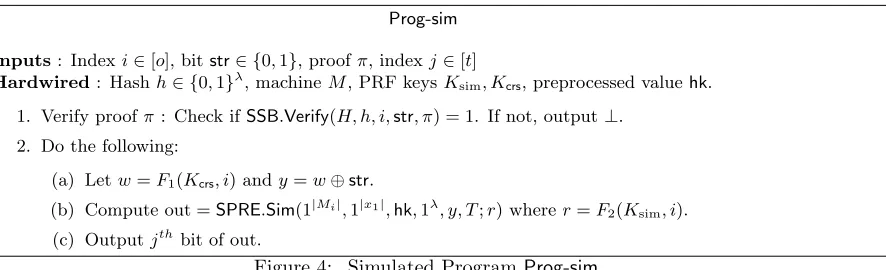
Prog
Inputs: Indexi∈[o], bitstr∈ {0,1}, proofπ, indexj∈[t].
Hardwired: Hash valueh∈ {0,1}λ, machineM, inputx1, PRF keyKSPRE, boundT, preprocessed value
hk.
1. Verify proofπ: Check ifSSB.Verify(H, h, i,str, π) = 1. If not, output⊥.
2. Recall that Mi denotes the turing machine that, on input x, runs the machine M on inputx and outputs theithbit ofM(x). Compute out =SPRE.Encode(Mi, T, x1,hk;F2(KSPRE, i)) and output the
jthbit of out.
Figure 3: CircuitProg
S.OcRE.Decode(Mgx = (Progg, t, H), x2,crs): For each i∈[o], the decoding algorithm computes bit outi as
follows:
1. Parsecrs= (crs[1],crs[2], . . . ,crs[o]), where eachcrs[j] is a bit.
2. Compute SSB proof for eachcrs[j]; that is, compute π[j] =SSB.Open(H,crs, j).
3. Forj= 1 tot, do:
(a) ComputeMfi[j] =Ckt.Eval(Progg,(i,crs[i], π[i], j)).
4. LetMfi= (Mfi[1]Mfi[2] . . . Mfi[t]). Compute outi=SPRE.Decode(Mfi, x2).
Finally, it outputs (out1 out2 . . . outo).
Correctness and Succinctness Correctness follows from the correctness of (SPRE.Encode,SPRE.Decode) and (Ckt.Obf,Ckt.Eval).
Below we show the three efficiency properties required by the definition.
1. Ifek←Setup(1λ,1o,crs),|ek|=ℓhash(λ) +ℓfn(λ), whereℓhash andℓfn are fromSSB.
2. For every Turing machineM, time boundT, inputx= (x1, x2)∈ {0,1}∗, ifgMx←Encode(M, x, T,ek),
then|Mgx|= (|prog|+|t|)≤ |Prog|+poly(λ). Progis padded to be the same length as the programs used in the hybrids andProg-sim, so|Prog|is the maximum of the length of these programs. By inspecting the values hardwired in each of these programs we get|Prog| ≤p(|h|,|M|,|x1|,|hk|, k,logo, t), where
k is the maximum size of the keys of F1 and F2. By the efficiency of SPRE, the definition of SSB
hashes and the definition of puncturable PRFs we get that |Prog| ≤ p2(λ,|M|,|x1|,logo) and thus |gMx| ≤p2(λ,|M|,|x1|,log|x2|,logo) for some fixed polynomial p2.
3. The running time ofDecode(gMx, x2,crs) is at mostO(o×t1+o×t×t2) wheret1is the running time of
SPRE.Decode(Mfi, x2) andt2is the running time ofCkt.Eval(Progg,(i,crs[i], π[i], j)). By the efficiency of
the SPRE scheme and the iO scheme we haveDecode(gMx, x2,crs)≤min (T,Time(M, x))·p3(λ,logT).
5.2
Proof of Security
5.2.1 Description of Simulator
The simulatorS.OcRE.Simgets as input the valueM(x) (which is the output of the machineM on inputx) and the public part of the inputx2, and it must simulate the shared random stringcrsand an encodinggMx
of the machineM andx. We now describe the simulator.
S.OcRE.Sim(1|M|,1|x1|,x
2,1λ,M(x),T):
2. Choose a keyKcrs for the puncturable PRFF1 and a keyKsim for the puncturable PRFF2.
3. Then, for eachi, computecrs[i] =M(x)i⊕wi where wi=F(Kcrs, i) andM(x)i denotes theith bit of M(x). The shared random string is set to be (crs[1]crs[2] . . . crs[o]).
4. Choose a hash functionH ←SSB.Gen(1λ, o,0) and computeh=H(crs).
5. ComputeProg-sim^ ←Ckt.Obf(Prog-sim,1λ), whereProg-simis defined in Figure 4.
6. LetMi denote the turing machine that, on inputx, runs the machine M on inputxand outputs the ithbit ofM(x). Lett denote|SPRE.Encode(M
i, T, z,hk;r)|) using any random stringrand any input z such that|z|=|x1|.
7. SetgMx= (Prog-sim^ , t).
Prog-sim
Inputs: Indexi∈[o], bitstr∈ {0,1}, proofπ, indexj∈[t] Hardwired: Hashh∈ {0,1}λ, machineM, PRF keysK
sim, Kcrs, preprocessed valuehk.
1. Verify proofπ: Check ifSSB.Verify(H, h, i,str, π) = 1. If not, output⊥.
2. Do the following:
(a) Letw=F1(Kcrs, i) andy=w⊕str.
(b) Compute out =SPRE.Sim(1|Mi|,1|x1|,hk,1λ, y, T;r) wherer=F
2(Ksim, i).
(c) Outputjthbit of out.
Figure 4: Simulated ProgramProg-sim
5.2.2 Hybrids
We will show that the real and ideal worlds are indistinguishable via a sequence of (o+ 2) hybrid experiments Hyb0 to Hybo+1 where Hyb0 corresponds to the real world and Hybo+1 corresponds to the ideal world. For eachi∈[o], in hybridHybi∗, the first i∗ bits of the CRS are computed as encryptions of output bits (with thew’s as one time pads). The encoding ofM,xdoes not compute the SRE fori≤i∗. More formally:
Hybrid Hybi∗:
The challenger does the following:
1. Computehk=SPRE.Preprocess(1λ, x 2).
2. Choose a keyKcrs for the puncturable PRFF1and two keysKsim, KSPREfor the puncturable PRFF2.
3. Then, for each i≤i∗, computecrs[i] =M(x)i⊕wi wherewi =F1(Kcrs, i) andM(x)i denotes the ith
bit of M(x).
4. For eachi > i∗, pickcrs[i] uniformly at random.
5. The shared random string is set to be (crs[1]crs[2] . . . crs[o]).
6. Choose a hash functionH ←SSB.Gen(1λ, o, i∗) and computeh=H(crs). Setek=h.
7. ComputeProg-^i∗←Ckt.Obf(Prog-i∗,1λ), where Prog-i∗is defined in Figure 5.
8. LetMi denote the turing machine that, on inputx, runs the machine M on inputxand outputs the ithbit ofM(x). Let tdenote|SPRE.Encode(M
Prog-i∗
Inputs: Indexi∈[o], bitstr∈ {0,1}, proofπ, indexj∈[t] Hardwired : Index i∗, Hash h ∈ {0,1}λ, machine M, input x
1, PRF keysKcrs, Ksim, KSPRE, bound T,
preprocessed valuehk.
1. Verify proofπ: Check ifSSB.Verify(H, h, i,str, π) = 1. If not, output⊥.
2. Ifi≤i∗, do the following:
(a) Letw=F1(Kcrs, i) andy=w⊕str.
(b) Compute out =SPRE.Sim(1|Mi|,1|x1|,hk,1λ, y, T;r) wherer=F
2(Ksim, i).
(c) Outputjthbit of out.
3. Else, if i > i∗: Recall that Mi denotes the turing machine that, on input x, runs the machineM on inputxand outputs theithbit ofM(x). Compute out =SPRE.Encode(Mi, T, x1,hk;F2(KSPRE, i))
and output thejthbit of out.
Figure 5: Hybrid ProgramProg-i∗
9. SetgMx= (Prog-^i∗, t).
Hybrid Hybo+1:
Identical toHybo except that the valuex1is not hardwired intoProg-i∗.
5.2.3 Indistinguishability of Hybrids
We will now show that every pair of consecutive hybrids is computationally indistinguishable and this completes the proof. Formally, we will prove the following theorem. Note thatHybo+1 is indistinguishable
fromHyboby the security of the iO scheme.
Theorem 5.2. For any indexi∗∈[o], the hybridsHybi∗ andHybi∗+1are computationally indistinguishable.
Proof. We will prove this theorem via a sequence of sub-hybridsH0 to H9 where H0 corresponds toHybi∗
andH9 corresponds toHybi∗+1. Note that we will drop the termt from the description of the encoding in
the rest of the proof since it is the same value throughout.
Hybrid H0 This sub-hybrid corresponds toHybi∗, where the adversary receives an obfuscation ofProg-i∗
and a hybrid shared random string. The firsti∗ components ofcrsconsists of encryptions of the firsti∗ bits of M(x)i∗ using the respective w’s as one time pads. The remaining components are chosen uniformly at
random.
1. The adversary sendsM, x= (x1, x2),1o, T to the challenger.
2. The challenger computeshk=SPRE.Preprocess(1λ, x2).
3. Then, the challenger chooses a key Kcrs for the puncturable PRF F1 and keys Ksim, KSPRE for the
puncturable PRFF2.
4. Next, the challenger computes the crs bits usingKcrsfor eachi≤i∗. That is, it setscrs[i] =M(x)i⊕ F1(Kcrs, i) for eachi∈[i∗]. For alli > i∗, the challenger chooses crs[i]← {0,1}.
5. The challenger then chooses hash functionH ←SSB.Gen(1λ, o, i∗). It computesh=H(crs).
6. Finally, the challenger computes an obfuscation of Prog-i∗. It computes gMx ← Ckt.Obf(Prog-i∗,1λ)
HybridH1 In this hybrid, the challenger usesSSB.Gento be binding at positioni∗+ 1 to the bitcrs[i∗+ 1].
1. The adversary sendsM, x= (x1, x2),1o, T to the challenger.
2. Then, the challenger computeshk=SPRE.Preprocess(1λ, x 2).
3. The challenger chooses a keyKcrsfor the puncturable PRFF1and keysKsim, KSPREfor the puncturable
PRFF2.
4. Next, the challenger computes the crs bits usingKcrsfor eachi≤i∗. That is, it setscrs[i] =M(x)i⊕ F1(Kcrs, i) for eachi∈[i∗]. For alli > i∗, the challenger chooses crs[i]← {0,1}.
5. The challenger then chooses hash functionH ←SSB.Gen(1λ, o, i∗+ 1). It computesh=H(crs).
6. Finally, the challenger computes an obfuscation of Prog-i∗. It computes gMx ← Ckt.Obf(Prog-i∗,1λ)
and sends (crs,Mgx) to the adversary.
7. The adversary sends its guessb.
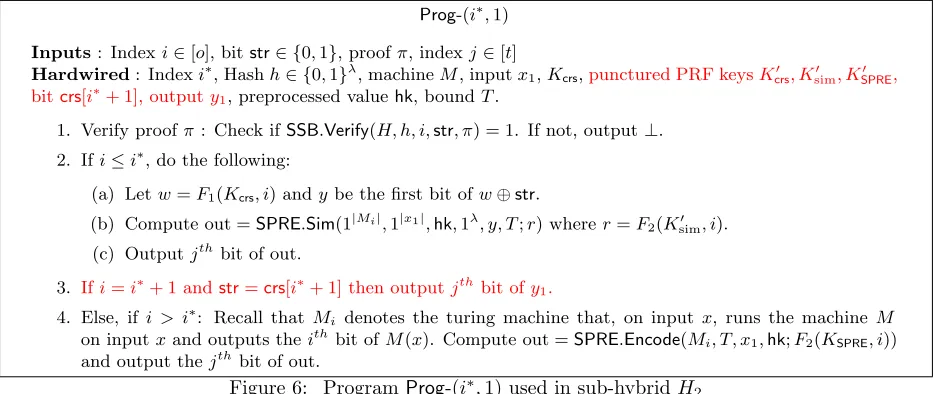
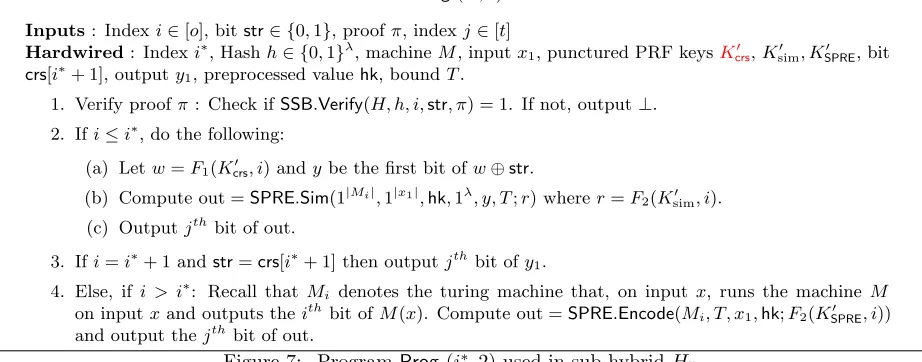
Hybrid H2 In this hybrid, the adversay receives an obfuscation ofProg-(i∗,1) (defined in Figure 6). This
program is similar toProg-i∗, except that the keysKsimandKSPREare punctured at (i∗+ 1). The challenger
hardwires the output for index (i∗+ 1).
1. The adversary sendsM, x= (x1, x2) to the challenger.
2. The challenger computeshk=SPRE.Preprocess(1λ, x2).
3. Then, the challenger chooses a key Kcrs for the puncturable PRF F1 and keys Ksim, KSPRE for the
puncturable PRFF2.
4. Next, the challenger computes the crs blocks usingKcrsfor eachi≤i∗. It setscrs[i] =M(x)i⊕F1(Kcrs, i)
for eachi∈[i∗]. For alli > i∗, the challenger choosescrs[i]← {0,1}.
5. The challenger then chooses hash functionH ←SSB.Gen(1λ, o, i∗+ 1). It computesh=H(crs).
6. Finally, the challenger computes an obfuscation of Prog-(i∗,1) defined in Figure 6. It performs the following steps.
(a) It first computes punctured keys KSPRE′ = KSPRE{i∗ + 1} ← PPRF.Puncture2(KSPRE, i∗ + 1), Ksim′ =Ksim{i∗+ 1} ←PPRF.Puncture2(Ksim, i∗+ 1).
(b) Next, it computes an encoding y1 ofMi∗+1, xwith randomnessF2(KSPRE, i∗+ 1). That is, y1=
SPRE.Encode(Mi∗+1, T, x1,hk;F2(KSPRE, i∗+ 1)).
(c) It computes gMx ← Ckt.Obf(Prog-(i∗,1)[i∗, h, M, x1, Kcrs, Ksim′ , KSPRE′ ,crs[i∗+ 1], y1,hk],1λ) and sends (crs,gMx) to the adversary.