Improved Attacks on Reduced-Round Camellia-128/192/256
Xiaoyang Dong1, Leibo Li1, Keting Jia2, and Xiaoyun Wang1,3?
1
Key Laboratory of Cryptologic Technology and Information Security, Ministry of Education, Shandong University, China
{dongxiaoyang,lileibo}@mail.sdu.edu.cn
2 Department of Computer Science and Technology, Tsinghua University [email protected]
3 Institute for Advanced Study, Tsinghua University [email protected]
Abstract. Camellia is a widely used block cipher, which has been selected as an international
standard by ISO/IEC. In this paper, we consider a new family of differentials of round-reduced Camellia-128 depending on different key subsets. There are totally 224 key subsets corresponding to 224 types of 8-round differentials, which cover a fraction of 1−1/215of the keyspace. And each type of 8-round differential consists of 243 differentials. Combining with the multiple differential attack techniques, we give the key-dependent multiple differential attack on 10-round Camellia-128 with data complexity 291and time complexity 2113. Furthermore, we propose a 7-round property for Camellia-192 and an 8-round property for Camellia-256, and then mount the meet-in-the-middle attacks on 12-round Camellia-192 and 13-round Camellia-256, with complexity of 2180encryptions and 2232.7 encryptions, respectively. All these attacks start from the first round in a single key setting.
Keywords: Camellia, Block Cipher, Key-Dependent Attack, Multiple Differential Attack,
Meet-in-the-Middle Attack.
1
Introduction
The block cipher Camellia with 128-bit block size has variable key lengths of 128, 192, 256, named as Camellia-128, Camellia-192 and Camellia-256, respectively. It was proposed by NTT and Mitsubishi in 2000 [2]. Now Camellia has become a widely used block cipher as an e-government recommended cipher by CRYPTREC [9]. Besides, Camellia was selected as one of NESSIE block cipher portfolio [26] and international standard by ISO/IEC 18033-3 [14]. Therefore, Camellia has received a great deal of attention from cryptanalysts with various attack methods, including higher order differential attack [13], linear and differential attack [26], truncated differential attacks [15,18,27], collision attack [30], square attacks [19,20], impossible differential attacks [22,25,31,23,21], meet-in-the-middle attacks [24,8] and zero correlation cryptanalysis [5] etc.
An important property of Camellia isF L/F L−1layers inserted every 6 rounds. TheF L/F L−1 func-tions are key-dependent funcfunc-tions which provide non-regularity across rounds to resist the differential cryptanalysis. Many previous papers presented attacks on simplified versions of Camellia without the
F L/F L−1 layers and the whitening layers [20,18,22,25,26,30,31]. For the original Camellia, impossible
differential attacks on 10/11/12-round Camellia-128/192/256 were given in [21], and recently improved by Boura et al.in [6]. The Meet-in-the-Middle (MITM) attack on Camellia was firstly proposed by Lu
et al.in [24], which introduced attacks on 10-round Camellia-128, 11-round Camellia-192 and 12-round
Camellia-256 utilizing 5-round and 6-round higher-order MITM properties of Camellia. However this attack does not start from the first round and excludes the whitening layers. Chen et al. [8] attacked 12-round Camellia from the first round by applying the attack model for AES in [10] to construct a 7-round MITM property of Camellia. Besides, zero-correlation cryptanalysis with FFT method(ZC FFT) was applied to 11-round Camellia-128 and 12-round Camellia-192 in [5], which was slightly better than exhaustive search with almost the full codebook.
?
In this paper, we analyzethe original versions of Camellia with F L/F L−1 layers and whitening key
starting from the first round by two methods: key-dependent multiple differential attack and
meet-in-the-middle attack. Multiple differential attack [4,29] uses multiple differentials to accumulate the advantage of many differentials as a distinguisher. The key-dependent differential attack was proposed by Ben-Aroya and Biham [3] to analyze Lucifer, which covered a fraction of 55% of the keyspace. A similar idea was also used by Knudsen and Rijmen to analyze DFC in [16]. Later, Sun and Lai proposed the key-dependent attack to analyze IDEA [28] by distinguishing the non-random distribution of the intermediate values for different key subsets, which composed the full keyspace.
Our Contributions. In this paper, we first consider the key-dependent multiple differential attack (KDMDA) on Camellia-128, by studying the multiple differentials corresponding to different key subsets. There are 224 types of 8-round differentials corresponding to different key subsets for Camellia, and each includes 243 differentials. Each key subset contains a fraction of 1/4 of the keyspace. All the 224 subsets cover a fraction of 1−1/215of the keyspace. Using these differentials, we launch the multiple differential attack on 10-round Camellia-128, which needs 291chosen plaintexts and 2104.5encryptions, and succeeds on a fraction of about 99.99% of the keyspace. It is easy to extend this attack to the full keyspace by exhaustive search on the remaining fraction of 1/215 of the keyspace. This is the first differential attack on Camellia withF L/F L−1 layers.
The key-dependent multiple differential attack is also possible against Camellia-192/256. In order to get better analysis results, we explore the meet-in-the-middle attack on Camellia-192/256. Combined with the differential enumeration technique and multiset proposed by Dunkelman et al.[12], other improved techniques proposed by Derbez et al. [11] and the relations of intermediate variables and subkeys, we propose a new 7-round property for Camellia-192 and an 8-round property of Camellia-256 to reduce the number of elements in a multiset. Based on both properties, we attack the 12-round Camellia-192 and 13-round Camellia-256 which costs 2113 chosen plaintexts, 2180 encryptions and 2154 128-bit memories for Camellia-192, 2113chosen plaintexts, 2232.7encryptions and 2227128-bit memories for Camellia-256, respectively. However, we can not construct a good property for Camellia-128 since the complexity of the precomputation phase are larger than 2128and it should be further explored.
In this paper, we only discuss the attacks onCamellia withF L/F L−1layers and whitening key starting
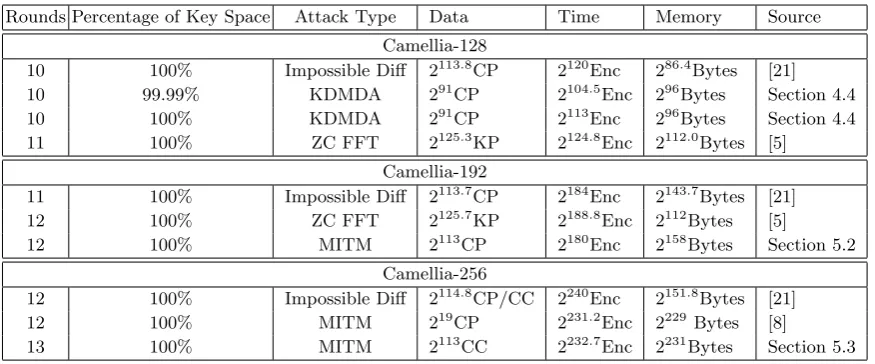
from the first round. Table 1 summarizes our results along with the major previous results, where CP
and CC refer to the number of chosen plaintexts and chosen ciphertexts, respectively.
Table 1.Summary of the Attacks on Reduced-Round Camellia
Rounds Percentage of Key Space Attack Type Data Time Memory Source Camellia-128
10 100% Impossible Diff 2113.8CP 2120Enc 286.4Bytes [21] 10 99.99% KDMDA 291CP 2104.5Enc 296Bytes Section 4.4 10 100% KDMDA 291CP 2113Enc 296Bytes Section 4.4 11 100% ZC FFT 2125.3KP 2124.8Enc 2112.0Bytes [5]
Camellia-192
11 100% Impossible Diff 2113.7CP 2184Enc 2143.7Bytes [21] 12 100% ZC FFT 2125.7KP 2188.8Enc 2112Bytes [5]
12 100% MITM 2113CP 2180Enc 2158Bytes Section 5.2 Camellia-256
12 100% Impossible Diff 2114.8CP/CC 2240Enc 2151.8Bytes [21] 12 100% MITM 219CP 2231.2Enc 2229 Bytes [8]
13 100% MITM 2113CC 2232.7Enc 2231Bytes Section 5.3
multiple differential attack on 10-round Camellia-128. Section 5 illustrates the meet-in-the-middle attacks on 12/13-round Camellia-192/256. Finally, we conclude the paper in Section 6.
2
Preliminaries
In this section we give the notations used throughout this paper, and then briefly describe the block cipher Camellia.
2.1 Notations
The following notations are used in this paper:
Lr−1, L0r−1 the left 64-bit half of the r-th round input
Rr−1, R0r−1 the right 64-bit half of the r-th round input
Xr the state after the key addition layer of the r-th round
Yr the state after the substitution transformation layer of the r-th round
Zr the state after the diffusion layer of ther-th round
kr the subkey used in ther-th round
kwi the whitening key used in the beginning and an the end of Camellia,i= 1,2,3,4
X[i] thei-th byte of a bit string X (1≤i≤8), where the left most byte is the first byte
XL (XR) the left (right) half of a bit string X,
X{i} the i-th most significant bit of a bit string X(1 ≤i≤128), where the left-most bit is the most significant bit
∆X the difference ofX and X0
ham(X) the hamming weight ofX, for example,X = 00100010, ham(X)=2 zero(X) the number ofX’s zero bits, for example,X = 00100010, zero(X)=6
⊕, ∧, ∨ bitwise exclusive OR (XOR), AND, OR
¬x bitwise inversion of bit stringx, e.g.¬0x22 = 0xdd
S the union of sets
|A| the size of the setA
xky bit string concatenation of xandy
≪l bit rotation to the left byl bit
2.2 Brief Description of Camellia
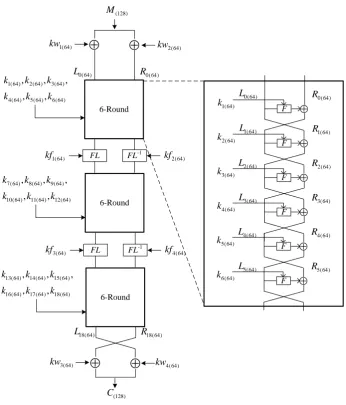
Camellia [2] is a Feistel structure block cipher, and the number of rounds are 18/24/24 for Camellia-128/192/256, respectively. The encryption procedure (depicted in Appendix C) for 128-bit key is as follows.
Firstly, a 128-bit plaintext M is XORed with the whitening key (kw1kkw2) and separated into L0 andR0of equal length. Then, for r= 1 to 18, except forr= 6 and 12, the following is carried out:
Lr = Rr−1⊕F(Lr−1, kr), Rr = Lr−1.
Forr= 6 and 12, do the following:
L∗r=Rr−1⊕F(Lr−1, kr), R∗r=Lr−1,
Lr=F L(L∗r, kfr/3−1), Rr=F L−1(R∗r, kfr/3),
Lastly, the 128-bit ciphertextC is computed as:C= (R18kL18)⊕(kw3kkw4).
For 192- and 256-bit keys, the 128-bit plaintextM is XORed with the whitening key (kw1kkw2) and separated intoL0andR0of equal length. Then, forr= 1 to 24, except forr= 6,12 and 18, the following is carried out:
Forr= 6,12 and 18, do the following:
L∗r=Rr−1⊕F(Lr−1, kr), R∗r=Lr−1,
Lr=F L(L∗r, kfr/3−1), Rr=F L−1(R∗r, kfr/3),
Lastly, the 128-bit ciphertextC is computed as:C= (R24kL24)⊕(kw3kkw4).
The round functionF is composed of a key-addition layer, a substitution transformation layerSand a diffusion layerP. The key-addition layer is an XOR operation of the left half input of the round function and the round key, i.e.Xr=Lr−1⊕krfor ther-th round. There are four types of 8×8S-boxess1, s2, s3 ands4in theStransformation layer. Let the input of the substitution transformationSof ther-th round be Xr= (x1, x2, x3, x4, x5, x6, x7, x8), the outputYr is computed as follows:
Yr=S(Xr) = s1(x1), s2(x2), s3(x3), s4(x4), s2(x5), s3(x6), s4(x7), s1(x8)
.
The linear transformationP is a diffusion operation based on the bytes. Let the input of the transfor-mationP in roundrbeYr= (y1, y2, y3, y4, y5, y6, y7, y8), the output beZr= (z1, z2, z3, z4, z5, z6, z7, z8).
Zr=P(Yr) and its inverseP−1 are defined as follows:
z1=y1⊕y3⊕y4⊕y6⊕y7⊕y8 y1=z2⊕z3⊕z4⊕z6⊕z7⊕z8
z2=y1⊕y2⊕y4⊕y5⊕y7⊕y8 y2=z1⊕z3⊕z4⊕z5⊕z7⊕z8
z3=y1⊕y2⊕y3⊕y5⊕y6⊕y8 y3=z1⊕z2⊕z4⊕z5⊕z6⊕z8
z4=y2⊕y3⊕y4⊕y5⊕y6⊕y7 y4=z1⊕z2⊕z3⊕z5⊕z6⊕z7
z5=y1⊕y2⊕y6⊕y7⊕y8 y5=z1⊕z2⊕z5⊕z7⊕z8
z6=y2⊕y3⊕y5⊕y7⊕y8 y6=z2⊕z3⊕z5⊕z6⊕z8
z7=y3⊕y4⊕y5⊕y6⊕y8 y7=z3⊕z4⊕z5⊕z6⊕z7
z8=y1⊕y4⊕y5⊕y6⊕y7 y8=z1⊕z4⊕z6⊕z7⊕z8
The F L function is used every 6 rounds. F L is defined as (aLkaR, kfLkkfR) 7→ (bLkbR), where
aL, aR, kfL, kfR, bL andbR are 32-bit words.
bR= ((aL∧kfL)≪1)⊕aR, bL= (bR∨kfR)⊕aL.
In accordance with the notations in [1], let the master key of Camellia beK. The subkeys KL, KR
are simply generated from K. For Camellia-128, KL = K, KR = 0. For Camellia-192, KL is the left
128-bit ofK, i.e., KL=K{1−128}, and the concatenation of the right 64-bit ofK and its complement
is used as KR, i.e., KR = K{129−192}k¬K{129−192}. For Camellia-256, KL = K{1−128}, and
KR = K{129−256}. Two 128-bit keys KA and KB are derived from KL and KR by a non-linear
transformation. Then the whitening keys kwi (i = 1, ...,4), round subkeys kr (r = 1, ...,24) and kfj
(j= 1, ...,6) are generated by rotatingKL, KR, KAorKB. For more details of Camellia, we refer to [1].
3
Some Observations of Camellia
This section introduces some observations which help us analyze the reduced-round Camellia.
Observation 1 ([17]) Let X, X0, K bel-bit values, and∆X=X⊕X0, then the differential properties of AND and OR operations are:
(X∧K)⊕(X0∧K) =∆X∧K,
(X∨K)⊕(X0∨K) =∆X⊕(∆X∧K).
Observation 2 Given the input difference of thei-th round∆Li= (α,0,0,0,0,0,0,0),∆Ri= (0,0,0,0,
0,0,0,0), the output difference of (i+ 3)-th round ∆Ri+3 and intermediate difference ∆Yi+2 satisfy the
following equations:
P−1(∆R
i+3)[4] =∆Li[1] =α, P−1(∆Ri+3)[j] = 0, j= 6,7
P−1(∆R
Observation 3 Given the output difference of the(i+2)-th round∆Li+2= (0,0,0,0,0,0,0,0),∆Ri+2= (α,0,0,0,0,0,0,0), the input difference ofi-th round ∆Ri and the intermediate difference∆Yi+1 satisfy
the following equations:
P−1(∆R
i)[4] =∆Ri+2[1] =α, P−1(∆Ri)[j] = 0, j= 6,7
P−1(∆Ri)[1] =∆Yi+1[1], P−1(∆Ri)[j] =∆Yi+1[j]⊕P−1(∆Ri)[4], j= 2,3,5,8.
Observation 4 Let the input difference of F L−1 be(∆a
L,0). Then the output difference ofF L−1 must
be (∆aL,0), when∆aL∧kf2L= 0.
4
Key-Dependent Multiple Differential Attack on Reduced-Round
Camellia-128
In this section, we present truncated differential based on the diffusion layerP for different key subsets. Then, 224 different types of 8-round multiple differentials for different key subsets are constructed. Finally, we launch the key-dependent multiple differential attack on 10-round Camellia-128.
4.1 Some Truncated Differentials
Observation 5 Let the input difference of P be(y1, y2,0,0,0,0,0,0),
– ify16=y2, the output difference of P is(y1, y1⊕y2, y1⊕y2, y2, y1⊕y2, y2,0, y1). – ify1=y2, the output difference of P is(y1,0,0, y2,0, y2,0, y1).
Observation 6 ([27]) If the input difference ofP is(y1, y2, y3, y4, y5, y6,0, y8), then the output difference
ofP is(z1, z2,0,0,0,0,0,0)with probability2−40. And the following equations hold:y1=y6, y2=y8, y3=
y4=y5=y1⊕y2.
Proof. By computing the inversion of P, we get y8 = z1, y6 = z2, y5 = z1⊕z2, y4 = z1 ⊕z2, y3 =
z1⊕z2, y2=z1, y1=z2. Then, y1=y6, y2=y8, y3=y4=y5=y1⊕y2. ut
Using the above observations, we construct the following 4-round truncated differential with proba-bility 2−56,
(00000000,∗ ∗000000) −−−−→Round
P r=1 (∗ ∗000000,00000000)
Round −−−−→
P r=1 (∗ ∗ ∗ ∗ ∗ ∗ ∗0∗,∗ ∗000000)
Round −−−−−−→
P r=2−40 (∗ ∗000000,∗ ∗ ∗ ∗ ∗ ∗0∗) Round −−−−−−→
P r=2−16 (00000000,∗ ∗000000)
Similarly, we get another three 4-round truncated differentials with probability 2−56in the last three columns of Table 2.
Table 2.4-Round Truncated Differentials
Active S-boxes: 0→2→7→2
Case-1 Case-2 Case-3 Case-4
(00000000,∗ ∗000000) (00000000,0∗ ∗00000) (00000000,∗00∗0000) (00000000,00∗ ∗0000) (∗ ∗000000,00000000) (0∗ ∗00000,00000000) (∗00∗0000,00000000) (00∗ ∗0000,00000000) (∗ ∗ ∗ ∗ ∗ ∗ ∗0∗,∗ ∗000000) (∗ ∗ ∗ ∗ ∗ ∗0,0∗ ∗00000) (∗ ∗ ∗ ∗ ∗0∗ ∗,∗00∗0000) (∗ ∗ ∗ ∗0∗ ∗∗,00∗ ∗0000)
4.2 Key Subsets Corresponding to Truncated Differentials
In this section, we extend the 4-round truncated differentials in Table 2 by adding a F L/F L−1 layer at the bottom. As a result, we divide the full keyspace into different subsets corresponding to different differentials.
We denote the two nonzero input byte differences of F L−1 function as c
1, c2. Then we get four types of input differences of the F L−1 function, which are (c1, c2,0,0,0,0,0,0), (0, c1, c2,0,0,0,0,0), (c1,0,0, c2,0,0,0,0), (0,0, c1, c2,0,0,0,0). To reduce the diffusion of the active S-boxes, we make the input and the output differences of theF L−1function equal, which determines a key subset according to Observation 4. Therefore, a value of (c1, c2) corresponds to a key subset. Obviously, the lower the hamming weight of (c1, c2) is, the larger the size of the corresponding key subset will be. In order to reduce the complexity, we choose (c1, c2) to make the size of key subset as large as possible. According to Observation 5, in order to maintain the 4-round truncated differential,c1 should be different fromc2. So we choose 56 values of (c1, c2) where ham(c1) = 1, ham(c2) = 1, andc16=c2, see Table 3. Combining with 4 truncated differentials, we construct 224 key subsets, which are denoted asKDsetji, j = 1,2,3,4and i= 1,2· · ·56.
KDset1i ={K|kf2L= (¬ci1∧ ∗,¬ci2∧ ∗,∗,∗),∗ ∈F28},
KDset2
i ={K|kf2L= (∗,¬ci1∧ ∗,¬ci2∧ ∗,∗),∗ ∈F28},
KDset3
i ={K|kf2L= (¬ci1∧ ∗,∗,∗,¬ci2∧ ∗),∗ ∈F28},
KDset4
i ={K|kf2L= (∗,∗,¬c1i ∧ ∗,¬ci2∧ ∗),∗ ∈F28}.
In each key subset, two bits ofkf2Lare 0, and the other bits traverse all values. The size of a key subset
is 2126for Camellia-128. We denote the union of allKDsetj
i as P KSP ACE.
P KSP ACE=
4 [
j=1 56 [
i=1
KDsetji
Table 3.56 Different Values of (c1, c2) in Hexadecimal
i(ci
1, ci2) i (ci1, ci2) i (ci1, ci2) i (ci1, ci2) i (ci1, ci2) i (ci1, ci2) i (ci1, ci2) i (ci1, ci2) 1 01,02 8 02,01 15 04,01 22 08,01 29 10,01 36 20,01 43 40,01 50 80,01 2 01,04 9 02,04 16 04,02 23 08,02 30 10,02 37 20,02 44 40,02 51 80,02 3 01,08 10 02,08 17 04,08 24 08,04 31 10,04 38 20,04 45 40,04 52 80,04 4 01,10 11 02,10 18 04,10 25 08,10 32 10,08 39 20,08 46 40,08 53 80,08 5 01,20 12 02,20 19 04,20 26 08,20 33 10,20 40 20,10 47 40,10 54 80,10 6 01,40 13 02,40 20 04,40 27 08,40 34 10,40 41 20,40 48 40,20 55 80,20 7 01,80 14 02,80 21 04,80 28 08,80 35 10,80 42 20,80 49 40,80 56 80,40
We collect the keys that do not belong to any one of the KDsetji to form the remaining key set denoted asRKset, which is consisted of two classes:
Class 1 The pattern of kf2L is (∗,¬0,∗,¬0) or (¬0,∗,¬0,∗), where ‘*’ is a random byte. There are
2×(28)2−1 = 217−1 possiblekf2L.
Class 2 The remaining keys are not included in Class 1.
– If zero(kf2L)=2, the number of possible kf2L is 8×4 = 48.
– If zero(kf2L)=3, the number of possible kf2L is 8C43= 32. – If zero(kf2L)=4, the number of possible kf2L is 8C44= 8. Totally, there are 48 + 32 + 8 = 88 possiblekf2L.
So the size of remaining key set is 296×(88 + 217−1)≈2113.
KSP ACE = 4 [ j=1 56 [ i=1
KDsetji
[
RKset.
Let the input difference of F L−1 function be (c
1, c2,0,0), which corresponds a key subset KDset1i.
Therefore, for the key subset KDset1
i, the probability for 4-round truncated differential of the case-1
appending aF L/F L−1 layer with output difference (00000000, c1c2000000) is 2−56×2−16= 2−72.
4.3 Searching 8-Round Multiple Differentials for Every Key Subset
We use 4-round truncated differentials in Table 2 to construct 8-round differentials with F L/F L−1
functions. We extend the 4-round truncated differential by adding two rounds forward and appending a
F L/F L−1layer and two rounds at the bottom to obtain 8-round differentials. We get four types of 8-round
differential patterns, named as type-1/-2/-3/-4 which are constructed by case-1/-2/-3/-4, respectively.
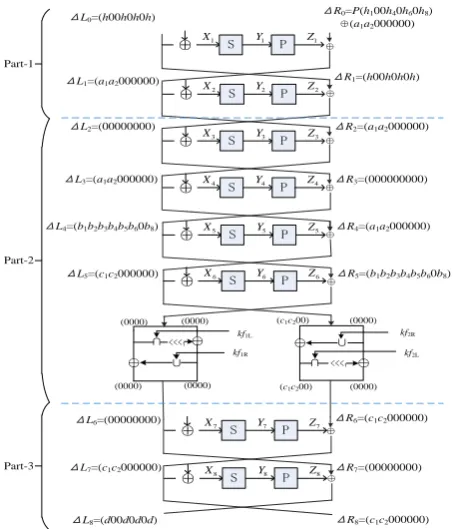
Property 1. For each KDsetji, i = 1,2,· · ·,56, j = 1,2,3,4, we construct a family of 8-round multiple differentials.
1. There are 231 input differences and 26 output differences which produce 231+6= 237 8-round differ-entials with the probability 2−125.
2. 238 input differences and 26 output differences produce 238+6= 244 8-round differentials with proba-bility 2−126.
3. 245 input differences and 26 output differences produce 245+6= 251 8-round differentials with proba-bility 2−127.
⊕ ⊕ ⊕ ⊕ ⊕ ⊕ ∪ ∩
(c1c200) (0000)
kf2R kf2L <<<1 ⊕ ∪ ∩ (0000) (0000) (0000) kf1R kf1L <<<1 (0000) ⊕ ⊕ ⊕ ⊕ ⊕
ΔR0=P(h100h40h60h8)
⊕(a1a2000000)
ΔL0=(h00h0h0h)
ΔR8=(c1c2000000)
ΔL8=(d00d0d0d)
ΔL1=(a1a2000000) ΔR1=(h00h0h0h)
ΔL2=(00000000) ΔR2=(a1a2000000)
ΔL3=(a1a2000000) ΔR3=(000000000)
ΔL4=(b1b2b3b4b5b60b8) ΔR4=(a1a2000000)
ΔL5=(c1c2000000) ΔR5=(b1b2b3b4b5b60b8)
ΔL6=(00000000) ΔR6=(c1c2000000)
ΔL7=(c1c2000000) ΔR7=(00000000)
Part-1
Part-2
Part-3
(c1c200) (0000)
1
X S Y1 P
⊕ Z1
2
X S Y2 P
⊕ Z2
3
X S Y3 P
⊕ Z3
4
X S Y4 P
⊕ Z4
5
X S Y5 P
⊕ Z5
6
X S Y6 P
⊕ Z6
7
X S Y7 P
⊕ Z7
8
X S Y8 P
⊕ Z8
Fig. 1. Type-1: 8-Round Differential Pattern with
F L/F L−1 Layer
8-Round differential
F ⊕
F ⊕
ΔR8 =
(0x08,0x10,0,0,0,0,0,0)
ΔR9 = (*,0,0,*,0,*,0,*)
ΔL9 =
(0x08,0x10,0,0,0,0,0,0)
⊕P(*,0,0,*,0,*,0,*)
ΔL8 = (*,0,0,*,0,*,0,*)
⊕ ⊕
kw3(64) kw4(64)
ΔR10 = (?,?,?,?,?,?,?,?)
ΔL10 =
(0x08,0x10,0,0,0,0,0,0)
⊕P(*,0,0,*,0,*,0,*)
ΔL0 = (h,0,0,h,0,h,0,h)
⊕
kw1(64) ⊕ kw2(64)
ΔR0=P(h1,0,0,h4,0,h6,0,h8)
⊕ (a1,a2,0,0,0,0,0,0)
Fig. 2. Multiple Differential Attack on 10-Round
Proof. We prove the Property 1 by type-1 differential pattern illustrated in Fig. 1. For the top two rounds, we apply the following 2-round differential
(∆L0, ∆R0)
Round −−−−→
P r1
(a1a2000000, h00h0h0h)
Round −−−−−−→
P r=2−14 (00000000, a1a2000000),
where ∆L0= (h,0,0, h,0, h,0, h), ∆R0=P(h1,0,0, h4,0, h6,0, h8)⊕(a1, a2,0,0,0,0,0,0).
By the 2-round differential, we know∆Y1= (h1,0,0, h4,0, h6,0, h8),∆Y2 = (h, h,0,0,0,0,0,0). Ob-viously, there are (28−1) ∆L
0. For each ∆L0, there are 27×27 = 214 possible ∆L1 with probability 2−14 as a result of two activeS-boxes in round 2. Considering the 4 activeS-boxes in the first round to computeP r1 and number of∆Y1 values, there are C43·2
7= 29 possible values of ∆Y
1 with probability 2−6×3 ×2−7 = 2−25, C42·214 = 216 possible values of ∆Y1 with probability 2−6×2×2−7×2 = 2−26,
C1
4 ·221 = 223 possible values of∆Y1 with probability 2−6×2−7×3 = 2−27, and 228 possible values of
∆Y1 with probability 2−28.
So, for the 2-round differential, there are 28×29×214= 231 values of (∆L
0, ∆R0) with probability 2−25×2−14 = 2−39, 28×216×214 = 238 values of (∆L0, ∆R0) with probability 2−26×2−14 = 2−40, 28×223×214= 245values of (∆L
0, ∆R0) with probability 2−27×2−14= 2−41, and 28×228×214= 250 values of (∆L0, ∆R0) with probability 2−28×2−14= 2−42.
The last 2-round differential with the input difference (00000000, c1c2000000) is
(00000000, c1c2000000)
Round −−−−→
P r=1 (c1c2000000, 00000000)
Round −−−−−−→
P r=2−14 (d00d0d0d, c1c2000000).
There are about 26 ∆L
8. The probability of each (∆L7, ∆R7)⇒(∆L8, ∆R8) is 2−13 or 2−14. Totally, there are 231input differences and 26output differences which form 231+6= 2378-round differ-entials, and the probability of each differential is 2−72−39−14= 2−125; there are 238input differences and 26 output differences which form 238+6= 244 8-round differentials with probability 2−72−40−14= 2−126; there are 245 input differences and 26 output differences which form 245+6 = 251 8-round differentials
with probability 2−72−41−14= 2−127. ut
Without loss of generality, we search type-1 differentials as an example to verify the correctness of Property 1 experimentally. The search procedure is as follows.
1. We exhaustively search differentials which match 4-round truncated differential with appending a
F L/F L−1 layer depicted in Part-2 of Fig 1. Let (00000000, a1a2000000) be input difference, and
(00000000, c1c2000000) be the input difference of theF L/F L−1layer, where (c1, c2) is chosen in Ta-ble 3. Store the 4-round differential and its corresponding probability in a 56×216table, where “row” is indexed by (c1, c2), “column” is indexed by (a1, a2), and the elements are the corresponding probabili-tyP rof the differential, which is calculated by the following equations. We denoteY4= (a
0 1a
0
2000000).
P r1=P r((a1a2000000)
S
−→(a01a02000000)), P r2=P r((c1c2000000)
S
−→(a01a02000000)),
P r3=P r(P(a
0 1, a
0
2,0,0,0,0,0,0)
S
−→P−1(a
1⊕c1, a2⊕c2,0,0,0,0,0,0))
P r= P
a01,a02∈F8 2
P r1·P r2·P r3
2. For each row indexed by (c1, c2), calculate the output differences (d100d40d60d8, c1c2000000) of the 8-round differential, whose values form the output differences set, denoted as∆OU T set. And then for each column indexed by (a1, a2), collect the input differences of 8-round differential that could result in (00000000, a1a2000000) differences after two rounds of encryption, to produce the input differences set, denoted as∆IN set.
4.4 Key-Dependent Multiple Differential Attack on 10-Round Camellia-128
For everyKDsetji, i= 1,2· · ·56, j = 1,2,3,4 , we choose 237 input differences from∆IN setwhere the probabilities are all larger than 2−126 and pick all the 26 output differences of ∆OU T set. We launch multiple differential attack using these differentials. We repeat 224 times multiple differential attacks, if one of the attacks succeeds, the right key can be recovered. Otherwise the right key belongs to RKset. The following is one of the 224 attacks.
We choose type-1 differentials andc1= 0x08c2= 0x10 to launch an attack, whose corresponding key subset is KDset132. As the Fig. 2 shows, we add two rounds after the 8-round differentials distinguisher to analyse 10-round Camellia-128.
In [4], there is a strong condition that the set of input differences are “admissible”. However, paper [29] proves the condition is not necessary when applying structure technique. Here, we take advantage of the structure attack model to implement multiple differential attack displayed as follows:
1. Choose 2x structures of plaintexts, and each structure contains 256 plaintexts withL0 = (α1, x1, x2,
α1, x3, α1, x4, α1),R0=P(α2, x5, x6, α3, x7, α4, x8, α5)⊕(α6, α7, x9, x10, x11, x12, x13, x14), where xi
are fixed values andαj take all the possible values in each structure.
2. For each structure, ask for the encryptions of the plaintextsP and store the 256ciphertextsC, indexed byP−1(C
L)[1,4,6,8]. When choosing one ciphertext indexed byP−1(CL)[1,4,6,8] and another
ci-phertext indexed byP−1(C
L)[1,4,6,8]⊕P−1(0x08,0x10,0,0,0,0,0,0,)[1,4,6,8], we get a pair whose
difference matches∆L10. Totally, we get 279+xpairs.
3. For each pair, check whether the input difference is one of the 237 input differences. There are about 279+x×237×2−56= 260+xpairs left.
4. For each pair and each possible∆R9, where |∆R9|=|∆OU T set|= 26, do the following substeps. (a) In the 10th round, we know the input difference and output difference of theF function, so we deduce 64-bit keykw3⊕k10 by the difference distribution table of S-boxes.
(b) We calculate the output value of theF function in 10th round by the values ofkw3⊕k10. In the 9th round, deduce 32-bit key (kw4⊕k9)[1,4,6,8] by the difference distribution table of S-boxes. (c) Increase the corresponding counter of 96-bit subkeykw3⊕k10,(kw4⊕k9)[1,4,6,8], and then we obtain 26subkeys for every pair.
5. Check all counters and generate a listLof thel candidate subkeys whose counters are the highestl
values.
We choose x = 33, then there are 2111+33×237−56 = 2125 pairs, and each matches one of the 237 input differences. The counter expectation for right key is 2125×26×2−126= 25, and the expectation of the counter for wrong key is about 2125×26×2−128 = 23. We use the Blondeau et al.’s method [4] to compute the success rate. We know the number of differentials is |∆|= 237×26 = 243, the sum of the probability of all differentials is P|∆|
i=1P ri = 2−83, the number of pairs isNs = 2125, the bit number of
guessed subkey isnk= 96, andl= 240, then the success probability is:
P s≈1−G∗[G−1(1−
l−1
2nk−2)−1] = 99.9%, where the definitions of functionsG∗() andG−1() refer to Appendix B.
Key-Dependent Multiple Differential Attack on the P KSP ACE. If the key belongs to the
P KSP ACE, obviously this happens with significantly high probability of 1− 1
215 ≈99.99%, then 224
multiple differential attacks can recover the key. For a particular j of KDsetji, i = 1,2,· · ·56, the 56 multiple differential attacks use the differentials which have the common input truncated difference, the structures can be shared in the 56 times multiple differential attacks. So the data complexity of the attack is about 256+33×4 = 291 chosen plaintexts. The time complexity is 293+6× 2
10×224 = 2 104.5 10-round encryptions. The memory complexity is 296 which is used to store the counters for each of the 224 multiple differential attacks.
Key-Dependent Multiple Differential Attack on the FullKSP ACE.For each one ofKDsetji,
Success Rate.If the correct key belongs to the remaining keyspace, then we will definitely recover the key when traversing the remaining keyspace. If the correct key does not belong to the remaining keyspace, then one of the 224 multiple differential attacks recovers the correct key with the probability ofP s. So the success rate of the is the minimum of 224P s, which is about 99.9%.
Complexity Analysis.The data complexity of the attack is about 256+33×4 = 291chosen plaintexts. The whole attack procedure includes 224 multiple differential attacks and traversing the remaining key set. The time complexity is 260+33+6× 2
10 ×224 + 2
113 = 2104.5+ 2113≈2113. The memory complexity is 296which is used to store the counters for each of the 224 multiple differential attacks.
The key-dependent multiple differential attack is also available to 11-round Camellia-192 and 12-round 256. However, we find that it is more efficient for the meet-in-the-middle attack on Camellia-192/256.
5
MITM Attacks on Reduced-Round Camellia-192/256
In this section, we first present a brief description of in-the-middle attack, and then give the meet-in-the-middle attack on reduced-round Camellia combining with multiset, the differential enumeration technique, the relations of intermediate variables and subkeys etc.
5.1 Description of Meet-in-the-Middle Attack
For the meet-in-the-middle attack, the encryption cipher EK is divided into three parts EK = EK22 ◦
Em◦ EK11, and there exists a specific property for the middle part Em, which is used to construct a distinguisher and identify the correct key (K1, K2). The meet-in-the-middle methods we applied are similar to the MITM attaks on AES [12,11]. Therefore we introduce some definitions ofδ−set and multiset.
Definition 1. (δ−set)Theδ−set is a set of 256 intermediate states of Camellia that one byte traverses all values (the active byte) and the other bytes are constants (the inactive bytes).
Definition 2. ( Multiset of bytes [12])A multiset generalizes the set concept by allowing elements to
appear more than once. Here, a multiset of 256 bytes can take as many as (511
255)≈2506.7 different values. We explain the multiset with more details. Let aδ−set (X0,· · ·, X255) be the inputs ofE
m, where
the j-th byte is a variable and the other bytes are kept constant. Let the i-th output byte of Em
be the output of the function. The outputs of function with the δ-set as inputs form a 2048-bit vec-tor EK(X0)[i]k · · · kEK(X255)[i] with ordered arrangement. However, if we don’t consider the
order-ing of the output bytes, the 256-byte value will form a multiset [EK(X0)[i]⊕EK(X0)[i], EK(X0)[i]⊕
EK(X1)[i],· · ·, EK(X0)[i]⊕EK(X255)[i]]. However, given two random functions f, g: F256 → F256, the multisets (f(X0),· · ·, f(X255)) and (g(X0),· · ·, g(X255)) are equal with a probability smaller than 2−467.6(but not 2−506.17). For more details, we refer to [11].
The key part of the meet-in-the-middle attack on AES is to construct a function for the input active byte and one of the output bytes of Em, and reduce the number of the function parameters by specific
truncated differential, which decides the size of the multiset. Based on the subcipherEm, a few rounds
is extended at the top and bottom of Em, i.e. the cipherEK =EK22◦E m◦E1
K1. The attack procedure
is described in Algorithm 1.
It is noticed that the number of values for a good multiset is much less than 2467.6. The precomputation phase is to compute all the values of multiset in a table.
5.2 MITM Attack on 12-Round Camellia-192
Algorithm 1The Main Procedure of Meet-in-the-Middle Attack
Precomputation phase: compute all values of the output sequence of the function constructed on Em, and
store them in a hash table.
Online phase:
1: Encrypt enough chosen plaintexts such that there exists a pair satisfying the specific differential. 2: Guess values of the subkeysK1andK2 to find a pair satisfying the specific truncated differential. 3: Construct aδ-set based on the pair, and partially decrypt to get the corresponding 256 plaintexts.
4: Obtain the corresponding 256 plaintext-ciphertext pairs from the collected data. Then partially decrypt the ciphertexts to get the corresponding 256-byte value of the output sequence ofEm.
5: If a sequence value lies in the precomputation table, the guessedK1 andK2 may be right key. 6: Exhaustively search the remaining subkeys to obtain the right key.
Property 2. Encrypt 28values of theδ−set through 7-round Camellia-192 starting from the third round,
whereR2[1] is the active byte, in the case that a pair of theδ−set conforms to the truncated differential outlined in Fig 3, then the corresponding multiset of bytes (P−1(∆L8))[6] only takes about 2128 instead of 2467.6 values on average.
It is obvious that, the computation of the multiset of bytes (P−1(∆L8))[6] associated with aδ−set is determined by a 36-byte intermediate variable
X4[1]kX5[1,2,3,5,8]kX6kkf1kkf2kX7[2,3,5,7,8]kX8[6].
The main work is to prove that there are only 16 byte variables needed to compute the multiset.
Proof. If a pair of theδ-set conforms the truncated differential as in Fig. 3, the 18-byte variableX4[1]k
X5[1,2,3,5,8]kX6kX7[2,3,5,8] is determined by the 9-byte difference ∆X4[1]k∆Y4[1]k∆Y5[1,2,3,5,8]k
∆X8[1]k∆Y8[1] and 128-bit subkeykf1kkf2. Here, the valueX4[1] is deduced from the differences∆X4[1] and ∆Y4[1]. Similarly, the value X5[1,2,3,5,8] is obtained by the differences ∆Y4[1], ∆Y5[1,2,3,5,8]. In the backward direction, the difference ∆Y6 is computed by ∆Y4[1], ∆Y8[1] and kf1 since ∆L4 =
P(∆Y4) and∆L6 =P(∆Y8) in this case. The difference ∆X6 is computed by∆X4[1], ∆Y5[1,2,3,5,8], which is used to deduce the value X6. Similarly, the difference ∆Y7 is computed by the difference
∆X4[1], ∆Y5[1,2,3,5,8],∆X8[1] andkf2, which helps us deduceX7[2,3,5,8] owing to∆X7=P(∆Y8). Sincekf1kkf2has only 64-bit information by key schedule, the total 36-byte variable is computed by 19-byte variable ∆X4[1]k∆Y4[1]k∆Y5[1,2,3,5,8]k∆X8[1]k∆Y8[1]kX7[7]kX8[6]kkf1 in such case.
However, for every 19-byte variable, we find that the difference∆Y7equals toP−1(F L−1(P(∆Y5)⊕
∆L3))⊕P−1(∆L7), where the probability that∆Y7[4,6,7] equals to 0 is 2−24. So there are only about 2128possible values for 36-byte intermediate variable, actually. ut
Based on the 7-round property, we extend two rounds on the top and three rounds on the bottom to attack the 12-round Camellia-192, see Fig.4. To reduce the computation complexity of the 12-round attack on Camellia-192, we retrieve the equivalent keysk01,k20,k010,k011,k120 , and then deduce the master key. The equivalent keys are defined ask01=k1⊕kw1, k02=k2⊕kw2, k012=k12⊕kw4, k110 =k11⊕kw3, andk010=k10⊕kw4. Note that the master key could be deduced by the equivalent key using the method introduced in [7].
The key recovery is also composed of two phases: precomputation phase and online phase. In the precomputation phase, we get 2128possible values of multiset as described in Property 2, and store them in a hash tableH. The attack procedure of the online phase is similar to Algorithm 1. However we take a balance of the time complexity of Step 2 and Step 3. We guess some related subkeys to find the possible pairs which may satisfy the truncated differential, and then construct theδ−set to get their plaintexts.
The attack procedure of online phase is described as follows.
1. Choose 257structures of plaintexts, and each structure contains 256plaintexts that satisfyL
0= (α, α⊕
⊕ 3
X Y3
3 k
S P
⊕ Z3
⊕ 4
X Y4
4 k
S P
⊕ Z4
⊕ 5
X Y5
5 k
S P
⊕ Z5
⊕ 6
X Y6
6 k
S P
⊕ Z6
⊕ 7
X Y7
7 k
S P
⊕ Z7
⊕ 8
X Y8
8 k
S P
⊕ Z8
⊕ 9
X Y9
9 k
S P
⊕ Z9
⊕ ∪ ∩ <<<1
⊕ 1L kf 1R kf ⊕ ∪ ∩ <<<1
⊕ kf2R
2L
kf 2 (00000000)
L
R2 (*0000000)
3 (*0000000) L 4 (***0*00*) L 5 (????????) L * 6 (????????) L 6 (***0*00*) L 7 (*0000000) L 8 (00000000) L (***0*00*) * 6 (????????) R 8 (*0000000) R (***0*00*)
Fig. 3.The Truncated Differential of 7-round
Camellia-192
⊕
1
X Y1
1 k
S P
⊕ Z1
⊕
2
X Y2
2 k
S P
⊕ Z2
⊕
10
X Y10
10 k
S P
⊕ Z10
⊕
11
X Y11
11 k
S P
⊕ Z11
⊕
12
X Y12
12 k
S P
⊕ Z12
0 1 2 3 4 5
1 2 3 4 5 ( 0 00 )
( 0000000) ( 0 00 )
(0 00 )
R P j j j j j
a
P j j j j j
P aaaa a
0 ( 0 00 )
L jjj j j
1 ( 0000000)
L a
7-round property
9 ( 0000000)
L e
10 ( 0 00 )
L ppp p p
11 (1230 4005) (0 00 )
L P p p p p p
P eeee e
12 (1 2 3 4 5 6 7 8) L r r r r r r r r
12 (12 30 4005)
(0 00 )
R P p p p p p
P eeee e
⊕
⊕ kw2
1 kw
⊕
⊕ kw3
4 kw
Fig. 4. The MITM Attack on 12-round
Camellia-192
y2 are constants, but α, βj (j = 1, ...,6) take all possible values. Ask for corresponding ciphertexts
for each structure, computeP−1(R
12) and store the plaintext-ciphertext pairs L0kR0kL12kR12 in a hash table indexed by 16-bit value (P−1(R
12))[6,7]. Hence, there are 257×2111×2−16= 2152 pairs whose differences satisfyP−1(∆R12)[6,7] = 0 on average.
2. For every pair, do the following substeps to find a pair with corresponding subkeys conforming the truncated differential.
(a) Forl= 2,3,4,5,6,7,8, guess the 8-bit value ofk120 [l] one by one. Partially decrypt the ciphertext
R12[l] and keep only the pairs which satisfy ∆Y12[l] = P−1(∆L12[l]). The expected number of pairs left is about 2152×27×(−8)= 296. After that guessk0
12[1], partially decrypt the remaining pairs to get the valueL10.
(b) Forl= 2,3,5,8, guess the 8-bit value ofk110 [l]. Compute the intermediate valueY11[l] and elimi-nate the pairs whose intermediate values do not satisfy∆Y11[l] =P−1(∆R12)[l]⊕P−1(∆R12)[4](see Observation 2). Then guessk110 [1] and keep the pairs making∆Y11[1] =P−1(∆R12)[1] hold. The expected number of remaining pairs is 296×2−40= 256.
(c) Similarly, forl = 1,2,3,5,8, guess k01[l] and discard the pairs which do not make the equations
∆Y1[1] = P−1(∆R0)[1] and∆Y1[l] = P−1(∆R0)[l]⊕P−1(∆R0)[4](see Observation 3) hold for
l= 2,3,5,8. Then the expected number of remaining pairs is 256×2−40= 216.
3. For the 216 remaining pairs, if we want to find the pair in content with the 7-round truncated differential, we have to guess 64-bit equivalent keyk01[4,6,7]kk02[1]kk011[4,6,7]kk010[1] under each 144-bit subkey guess. Obviously, it is infeasible, since the time complexity is greater than exhaustively searching in such case. However, there are about a pair satisfying the truncated differential, for the probability of the truncated differential occuring is about 2−16for the remaining pairs. Therefore we construct the δ−set for all 216 pairs. If the guessed 144-bit key information is correct, then there should exist a pair to conform the truncated differential, and the corresponding value of the multiset should exist in the tableH. We construct aδ−set for every remaining pair under 144-bit key guesses in the following.
(b) For the pair (L0kR0, L00kR00) corresponding to (X2[1], X20[1]), change the valueX20[1] to a different value X200[1], compute ∆Y20[1] = s1(X200[1])⊕s1(X2[1]), and get the difference ∆L00[1,2,3,5,8]. Then get the left half of the plaintextL000=L0⊕∆L00.
(c) Compute the difference∆Y10[1,2,3,5,8] by the guessed subkey k01[1,2,3,5,8]. Then obtain the difference∆R00 and get the right half partR000 =R0⊕∆R00. Here we get a new plaintext (L000, R000) of theδ−set.
(d) Compute all left 253 values ofX2[1] to obtain all plaintexts of theδ−set, and identify the corre-sponding ciphertexts.
4. For eachδ−set under 144-bit key guesses, compute the intermediate valueY11[2,3,5,8],P−1(L10)[6] for every plaintext-ciphertext pairs by above guessed subkey. Guess 8-bit keyk110 [7] to compute the valueX10[6].
5. Guess 8-bit key k0
10[6] to compute the multiset of byte (P−1(∆L8))[6] = ∆Y10[6]⊕P−1(∆L10)[6]. Detect whether it belongs to H. Here, we need to detect 216 values of multiset for every 160-bit guessed key. Then find the correct subkey if one of 216values belongs toH. Note that the probability that a wrong value of multiset could pass the check is about 2128×2−467.6= 2−339.6.
6. Compute the related part of the master key by the equivalent keysk0
1, k02, k010, k011, k012, and search the unknown part.
Complexity Analysis. The precomputation phase needs about 2128×28 computations and 2130 128-bit memories. Step 1 needs about 2113 encryptions. We also need 2113 128-bit memories to store all plaintext-ciphertext pairs. The complexity of step 2 is dominated by substep 2.(c), which needs about 2168computations. Step 3 needs about 2168simple computations to construct 216δ-for every 144-bit key guess. Step 4 needs about 2160×28×28×2−3= 217312-round encryptions. The time complexity of step 5 is equivalent to 2176×28×2−4= 218012-round encryptions. In total, the time complexity of the attack is about 2180 encryptions, the data complexity is about 2113 chosen plaintexts, the memory complexity is about 2130128-bit.
5.3 The Attack on 13-Round Camellia-256
This section introduces an 8-round property of Camellia-256, which starts from the fifth round and ends at the twelfth round introduced by Property 3. The truncated differential used in this section is outlined in Fig. 5 of Appendix A, the active byte of theδ−set is located atL0
12[5], and the corresponding byte of multiset is defined asP−1(∆L
4)[1].
Property 3. Decrypt 28 values of theδ−set through 8-round Camellia-256 starting from the 12-th round,
where L12[5] is the active byte, in the case that a pair of theδ−set conforms to the 8-round truncated differential outlined in Fig 5 of Appendix A, then the corresponding multiset of bytes (P−1(∆L
4))[1] only takes about 2225instead of 2467.6 values on average.
The sketch of Property 3 is similar to Property 2, we give the proof in Appendix A.
We mount a 13-round attack on Camellia-256 by adding four rounds in the forward and one round in the backward of the 8-round Camellia (see Fig. 6 in Appendix A). We also recover the equivalent keysk01,
k0
2,k03,k40,k130 , and then deduce the master key, where the equivalent keys are defined ask01=k1⊕kw1,
k20 = k2 ⊕kw2, k30 = k3 ⊕kw1, k40 = k4 ⊕kw2, and k013 = k13⊕kw4. The attack is worked in the chosen-ciphertext model. In the precomputation phase, we compute all 2225 possible values of multiset, and store them in a hash table. The attack procedure of the online phase is described as follows.
1. Select 281 structures of ciphertexts, and each structure contains 232 ciphertexts
L13=P(α1, x1, x2, x3, α2, x4, x5, x6), R13= (β1, y1, y2, y3, β2, y4, y5, y6),
wherexiandyi(i= 1, ...,6) are fixed values, andαj, βj(j= 1,2) take all the possible values. Decrypt
2. Compute P−1(∆L
1) for every pair by guessing 64-bit subkey k01, eliminate the pairs which do not satisfyP−1(∆L
1)[6,7] = 0. There are 2144−16= 2128 pairs left on average.
3. Forl = 2,3,4,5,6,7,8, guess the 8-bit value of k02[l] one by one, compute the value Y2[l], and keep the pairs which make∆Y2[l] =P−1(∆L0[l]) hold. Then guess k02[1] to compute L2. The number of pairs kept about 2128−7∗8= 272.
4. For l = 2,3,5,8, guess the 8-bit value of k03[l]. Compute Y3[l] and discard the pairs which do not conform ∆Y3[l] = P−1(∆L1)[l]⊕P−1(∆L1)[4](see Observation 3). Then guess k30[1] and keep the pairs satisfying∆Y3[1] =P−1(∆L1)[1]. There are 232pairs remain for every 168-bit guessed key after this step.
5. Forl= 1,5, guess the 8-bit value ofk013[l], and compute the value∆Y13[l]. Delete the pairs which do not content∆Y13[l] =P−1(∆L13[l]). Then guesskf3R[1], compute∆L∗12[1] by using Observation 1, and delete the pairs when∆L∗12[1]6= 0. Hereafter, the expected number of remaining pairs is about 28.
6. Compute the valueL3by guessing 24-bit subkeyk03[4,6,7], and then deduce the value of subkeyk40[1] for every pair.
7. Construct theδ−set for every pair, and compute corresponding value of multiset. Detect whether it belongs to the precomputed table and find the possible correct key.
8. Compute the related part of the master key by the correct equivalent keysk10, k02, k30, k40, k013, and search the unknown part.
Complexity Analysis. The time complexity of precomputation phase is about 2225×28×2−1= 2232 13-round encryptions. The memory complexity is about 2225×22= 2227 128-bit. The time complexity of online phase is bounded to that of Step 6, which costs 2224×28×2−2= 223013-round encryptions, which also needs 2113chosen ciphertexts to find the correct pairs. In total, the data, time and memory complex-ities of the attack, including the precomputation phase, are 2113 chosen ciphertexts, 2232.3 encryptions and 2227128-bit memories, respectively.
6
Conclusion
In this paper, we give the key-dependent multiple differential attack and meet-in-the-middle attacks on reduced-round Camellia-128/192/256. For key-dependent multiple differential attack, we divide the keyspace into 224+1 subsets to ensure the input and output difference of F L−1 function same, and then produce 224 types of corresponding 8-round differentials, and each type of differentials include 243 differentials. Based on 8-round multiple differentials, we attack 10-round Camellia-128 for every key subsets, which works for about 99.99% of the keys, and exhaustively search for the remaining fraction of 1/215of the keyspace. This attack is more efficient than previous 10-round attack on Camellia-128.
Furthermore, we also discuss the security of reduced-round Camellia-192/256 against the meet-in-the-middle attack. Considering differential enumeration technique, multisets, intermediate variable relations and key relations etc, we mount the attacks on 12-round Camellia-192 and 13-round Camellia-256 with non-marginal complexities.
7
Acknowledgments
We would like to thank anonymous reviewers for their very helpful comments on the paper. This work is supported by the National Natural Science Foundation of China (No. 61133013) and 973 Pro-gram (No.2013CB834205), and the National Natural Science Foundation of China (No. 61402256 and 61272035).
References
2. Aoki, K., Ichikawa, T., Kanda, M., Matsui, M., Moriai, S., Nakajima, J., Tokita, T.: Camellia: A 128-Bit Block Cipher Suitable for Multiple Platforms - Design and Analysis. In: Stinson, D.R., Tavares, S.E. (eds.) SAC 2000. Lecture Notes in Computer Science, vol. 2012, pp. 39–56. Springer (2001)
3. Ben-Aroya, I., Biham, E.: Differential cryptanalysis of lucifer. In: Advances in CryptologyCRYPTO93. pp. 187–199. Springer (1994)
4. Blondeau, C., G´erard, B.: Multiple Differential Cryptanalysis: Theory and Practice. In: Joux, A. (ed.) Fast Software Encryption - FSE 2011. Lecture Notes in Computer Science, vol. 6733, pp. 35–54. Springer (2011) 5. Bogdanov, A., Geng, H., Wang, M., Wen, L., Collard, B.: Zero-Correlation Linear Cryptanalysis with FFT
and Improved Attacks on ISO Standards Camellia and CLEFIA. In: Lange, T., Lauter, K., Lisonek, P. (eds.) SAC 2013 to appear (2013)
6. Boura, C., Naya-Plasencia, M., Suder, V.: Scrutinizing and improving impossible differential attacks: Ap-plications to clefia, camellia, lblock and simon. In: Advances in Cryptology - ASIACRYPT 2014 - 20th International Conference on the Theory and Application of Cryptology and Information Security, Kaoshi-ung, Taiwan, R.O.C., December 7-11, 2014. Proceedings, Part I. pp. 179–199 (2014), http://dx.doi.org/ 10.1007/978-3-662-45611-8_10
7. Chen, J., Jia, K., Yu, H., Wang, X.: New Impossible Differential Attacks of Reduced-Round Camellia-192 and Camellia-256. In: Parampalli, U., Hawkes, P. (eds.) ACISP 2011. Lecture Notes in Computer Science, vol. 6812, pp. 16–33. Springer (2011)
8. Chen, J., Li, L.: Low Data Complexity Attack on Reduced Camellia-256. In: Susilo, W., Mu, Y., Seberry, J. (eds.) ACISP 2012. Lecture Notes in Computer Science, vol. 7372, pp. 101–114. Springer (2012)
9. Cryptography Research and Evaluation Committees: Http://www.cryptrec.go.jp/english/index.html 10. Demirci, H., Sel¸cuk, A.A.: A Meet-in-the-Middle Attack on 8-Round AES. In: Nyberg, K. (ed.) FSE 2008.
Lecture Notes in Computer Science, vol. 5086, pp. 116–126. Springer (2008)
11. Derbez, P., Fouque, P.A., Jean, J.: Improved Key Recovery Attacks on Reduced-Round AES in the Single-Key Setting. In: Johansson, T., Nguyen, P.Q. (eds.) EUROCRYPT. Lecture Notes in Computer Science, vol. 7881, pp. 371–387. Springer (2013)
12. Dunkelman, O., Keller, N., Shamir, A.: Improved Single-Key Attacks on 8-Round AES-192 and AES-256. In: Abe, M. (ed.) Advances in Cryptology - ASIACRYPT 2010. Lecture Notes in Computer Science, vol. 6477, pp. 158–176. Springer (2010)
13. Hatano, Y., Sekine, H., Kaneko, T.: Higher Order Differential Attack of Camellia (II). In: Nyberg, K., Heys, H.M. (eds.) SAC 2002. Lecture Notes in Computer Science, vol. 2595, pp. 129–146. Springer (2003)
14. International Organization for Standardization(ISO): International Standard- ISO/IEC 18033-3, Information technology-Security techniques-Encryption algorithms -Part 3: Block ciphers (2010)
15. Kanda, M., Matsumoto, T.: Security of Camellia against Truncated Differential Cryptanalysis. In: Matsui, M. (ed.) Fast Software Encryption - FSE 2002. Lecture Notes in Computer Science, vol. 2355, pp. 286–299. Springer (2001)
16. Knudsen, L.R., Rijmen, V.: On the decorrelated fast cipher (dfc) and its theory. In: Fast Software Encryption. pp. 81–94. Springer (1999)
17. K¨uhn, U.: Improved Cryptanalysis of MISTY1. In: Daemen, J., Rijmen, V. (eds.) Fast Software Encryption - FSE 2002. Lecture Notes in Computer Science, vol. 2365, pp. 61–75. Springer (2002)
18. Lee, S., Hong, S., Lee, S., Lim, J., Yoon, S.: Truncated Differential Cryptanalysis of Camellia. In: Kim, K. (ed.) ICISC 2001. Lecture Notes in Computer Science, vol. 2288, pp. 32–38. Springer (2002)
19. Lei, D., Li, C., Feng, K.: New Observation on Camellia. In: Preneel, B., Tavares, S.E. (eds.) SAC 2005. Lecture Notes in Computer Science, vol. 3897, pp. 51–64. Springer (2006)
20. Lei, D., Li, C., Feng, K.: Square Like Attack on Camellia. In: Qing, S., Imai, H., Wang, G. (eds.) ICICS 2007. Lecture Notes in Computer Science, vol. 4861, pp. 269–283. Springer (2007)
21. Liu, Y., Li, L., Gu, D., Wang, X., Liu, Z., Chen, J., Li, W.: New Observations on Impossible Differential Cryptanalysis of Reduced-Round Camellia. In: Canteaut, A. (ed.) Fast Software Encryption 2012. Lecture Notes in Computer Science, vol. 7549, pp. 90–109. Springer (2012)
22. Lu, J., Kim, J., Keller, N., Dunkelman, O.: Improving the Efficiency of Impossible Differential Cryptanalysis of Reduced Camellia and MISTY1. In: Malkin, T. (ed.) CT-RSA 2008. Lecture Notes in Computer Science, vol. 4964, pp. 370–386. Springer (2008)
23. Lu, J., Wei, Y., Fouque, P.A., Kim, J.: Cryptanalysis of reduced versions of the Camellia block cipher. IET Information Security 6(3), 228–238 (2012)
25. Mala, H., Shakiba, M., Dakhilalian, M., Bagherikaram, G.: New Results on Impossible Differential Crypt-analysis of Reduced-Round Camellia-128. In: Jacobson, M., Rijmen, V., Safavi-Naini, R. (eds.) SAC 2009. Lecture Notes in Computer Science, vol. 5867, pp. 281–294. Springer (2009)
26. Shirai, T.: Differential, Linear, Boomerang and Rectangle Cryptanalysis of Reduced- Round Camellia. In: the Third NESSIE Workshop (2002)
27. Sugita, M., Kobara, K., Imai, H.: Security of Reduced Version of the Block Cipher Camellia against Truncated and Impossible Differential Cryptanalysis. In: Boyd, C. (ed.) Advances in Cryptology - ASIACRYPT 2001. Lecture Notes in Computer Science, vol. 2248, pp. 193–207. Springer (2001)
28. Sun, X., Lai, X.: The key-dependent attack on block ciphers. In: Advances in Cryptology–ASIACRYPT 2009, pp. 19–36. Springer (2009)
29. Wang, M., Sun, Y., Tischhauser, E., Preneel, B.: A model for structure attacks, with applications to present and serpent. In: Fast Software Encryption. pp. 49–68. Springer (2012)
30. Wu, W., Feng, D., Chen, H.: Collision Attack and Pseudorandomness of Reduced-Round Camellia. In: Hand-schuh, H., Hasan, M.A. (eds.) SAC 2004. Lecture Notes in Computer Science, vol. 3357, pp. 252–266. Springer (2004)
31. Wu, W., Zhang, W., Feng, D.: Impossible Differential Cryptanalysis of Reduced-Round ARIA and Camellia. J. Comput. Sci. Technol. 22(3), 449–456 (2007)
A
The Proof of Property 3
By Property 3, the 8-round property starts from the fifth round and ends at the twelfth round. The active byte ofδ−set is defined at the first bytes of the input of the third roundL12[5], i.e.,L12[5] is the active byte. Considering to decrypt 28 values of the δ−set through 8-round Camellia-256, in the case of that a pair of δ−set conforms to the 8-round truncated differential outlined in Fig. 5, we prove the corresponding multiset of bytesP−1(∆L
4)[1] has 2225values.
Proof. If∆L12[5]6= 0 and there is no difference on the other bytes of the input (L12, R12), (P−1(∆L4))[1] is determined by 321-bit intermediate variable
X11[5]kX10[2,3,4,6,7,8]kX9kX8kX7kkf1{9−33,42−64}kkf2L[1]kkf2R[1]kkf2L{9}kX6[1].
However, if there exists a pair satisfying the truncated differential as described in Fig. 6, the 312-bit intermediate variable
X11[5]kX10[2,3,4,6,7,8]kX9kX8kX7kX6[1]kkf1{9−33,42−64}kkf2L[1]
is determined by 216-bit variable
∆X11[5]k∆Y11[5]k∆Y10[2,3,4,6,7,8]k∆Y9k∆X6[1]k∆Y6[1]kkf1kkf2L[1].
Besides, 9-bit value kf2R[1]kkf2L{9} are also necessary to compute (P−1(∆L4))[1]. Hence the multiset of bytes (P−1(∆L4))[1] could be computed by traversing all the 225-bit intermediate variable
V =∆X11[5]k∆Y11[5]k∆Y10[2,3,4,6,7,8]k∆Y9k∆X6[1]k∆Y6[1]kkf1kkf2L[1]kkf2R[1]kkf2L{9}.
That is to say there are about 2225 possible values of multiset totally. ut
B
Blondeau
et al.’s
Multiple Differential Cryptanalysis
Blondeau et al.’s propose multiple differential cryptanalysis in 2011. A precise analytical model as well as formulas to compute success rate has been given. The success rate of a multiple differential attack can be calculated as follows:
PS ≈1−G∗[G−1(1−
l−1
⊕
5
X Y5
5 k
S P
⊕ Z5
⊕
6
X Y6
6 k
S P
⊕ Z6
⊕
7
X Y7
7 k
S P
⊕ Z7
⊕
8
X Y8
8 k
S P
⊕ Z8
⊕
9
X Y9
9 k
S P
⊕ Z9
⊕
∪ ∩ <<<1 ⊕ 1L kf 1R kf ⊕ ∪ ∩ <<<1
⊕ kf2R
2L
kf 4 (00000000)
L
R4 (*0000000)
5 (*0000000) L * 6 (***0*00*) L 6 (????????) L 7 (????????) L 8 (????????) L * 6 (*0000000) R * 12 (00000000) R ⊕ 10
X Y10
10 k
S P
⊕ Z10
⊕
11
X Y11
11 k
S P
⊕ Z11
⊕
12
X Y12
12 k
S P
⊕ Z12 9 (0***0***) L 10 (0000*000) L 11 (00000000) L * 12 (0000*000) L (0***0***)
Fig. 5.The 8-round Truncated Differential of
Camellia-256
⊕
3 X Y3 3
k
S P
⊕ Z3
⊕
4 X Y4 4
k
S P
⊕ Z4 1 (1 230400 )5
(0 00 )
L P f f f f f P eeee e
2 ( 0 00 )
L fff f f
3 ( 0000000)
L e
⊕
⊕ kw2
1 kw
⊕
1 X Y1 1
k
S P
⊕ Z1
⊕
2 X Y2 2
k
S P
⊕ Z2
0 (1 2 3 4 5 6 7 8) R h h h h h h h h
0 1 2 3 4 5 6 7 8 L i i i i i i i i
8-round property
⊕
13 X Y13 13
k
S P
⊕ Z13
⊕
∪ ∩ <<<1 ⊕ 3L kf 3R kf ⊕ ∪
∩ <<<1
⊕ kf4R
4L
kf
3 kw 4
kw ⊕ ⊕
12 (00000000)
R
12 ( 000 000)1 L a a
13 ( 000 000)1
R a a
13 ( 000 000)1 2 L P r r
Fig. 6. The Meet-in-the-Middle Attack on
13-round Camellia-256
where nk is the number of key candidates,l is the size of list to keep and Nsis the number of samples.
The function GandG∗ are defined as follows:
G∗(τ) def
= G(τ, p∗)
G(τ)def= G(τ, p)
(2)
wherep∗=Σi,jp
(
∗i, j) andp= 2m|∆|∆|0|.Σi,jis the sum of probability of all differential characters andmis
the block size.|∆|denotes the number of input difference values while|∆0|is the number of differentials.
G(−1) is defined byG(−1)(y) = minx|G(x)> y.G(τ, p
∗) andG(τ, p) can be calculated as follows:
G(τ, q) =
G−(τ, q) if τ < q−3
p
q/Ns,
1−G+(τ, q) if τ > q+ 3
p
q/Ns,
Gp(τ, q) otherwise,
(3)
where Gp(τ, q) is the cumulative distribution function of the Poisson distribution with parameter qNs.
G−(τ, q) andG+(τ, q) are defined as follows:
G−(τ, q) =e(−NsD(τk,q))[
q√1−τ
(q−τ)√2πτ Ns
+√ 1
8πτ Ns
] (4)
G+(τ, q) =e(−NsD(τk,q))[
(1−q)√τ
(q−τ)√2πτ Ns
+√ 1
8πτ Ns
] (5)
where D(τkq) is the Kullback-Leibler divergence defined by:
D(τ kq) =τ ln(τ
q) + (1 +τ)ln(
1−τ
1−q) (6)
6-Round
1(64)
kw kw2(64)
(128)
M
1(64) 2(64) 3(64)
4(64) 5(64) 6(64)
, , ,
, ,
k k k
k k k
FL FL-1
6-Round
7(64) 8(64) 9(64)
10(64) 11(64) 12(64)
, , ,
, ,
k k k
k k k
1(64)
kf kf2(64)
FL FL-1
6-Round
13(64) 14(64) 15(64)
16(64) 17(64) 18(64)
, , ,
, ,
k k k
k k k
3(64)
kf kf4(64)
3(64)
kw kw4(64)
0(64)
L R0(64)
18(64)
L R18(64)
(128)
C
0(64)
L
0(64)
R
F
1(64)
k
1(64)
L R1(64)
F
2(64)
k
2(64)
L R2(64)
F
3(64)
k
3(64)
L R3(64)
F
4(64)
k
4(64)
L R4(64)
F
5(64)
k
5(64)
L R5(64)
F
6(64)
k