CHEP 2018: Preface to the Proceedings
Alessandra Forti1, Latchezar Betev2, Maarten Litmaath2, Oxana Smirnova3, Petya Vasileva2, Vassil Vassilev4, and Peter Hristov21University of Manchester, Oxford Rd, Manchester M13 9PL, UK
2CERN, Esplanade des Particules 1, P.O. Box, 1211 Geneva 23, Switzerland 3Lund University, Box 117, 221 00 Lund, Sweden
4Princeton University, Princeton, NJ 08544, USA
Abstract. The 23rd International Conference on Computing in High Energy and Nuclear Physics (CHEP) took place in the National Palace of Culture, Sofia, Bulgaria from 9th to 13th of July 2018. 575 participants joined the plenary and the eight parallel sessions dedicated to: online computing; offline computing; distributed computing; data handling; software development; machine learning and physics analysis; clouds, virtualisation and containers; networks and facilities. The conference hosted 35 plenary presentations, 323 parallel presentations and 188 posters.
1 CHEP conference series
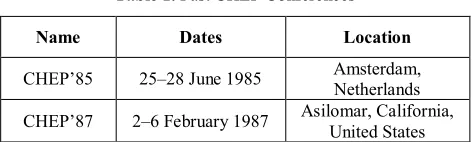
The CHEP conference series was established in 1985 and ever since, CHEP has been one of the most important events in the field of computing in high energy and nuclear physics. The conference covers a broad set of topics such as online, offline and distributed computing; software development, simulation, reconstruction and analysis packages; data handling, data bases and storage solutions; clouds, virtualisation and containers; networking and facilities. It provides a discussion platform between the physicists, computing scientists and IT engineers, as well as between renowned experts and young researchers. The conference is held every 18 months and the host has been selected on “rotational” principle among locations in Europe, the Americas and Asia/Pacific. The conference focuses on the achievements, ongoing activities, plans and trends in the field. The list of past CHEP conferences is shown in Table 1.
Table 1. Past CHEP Conferences
Name Dates Location
CHEP’89 10–14 April 1989 Oxford, England, United Kingdom
CHEP’90 9–13 April 1990 Mexico, United States Santa Fe, New CHEP’91 11–15 March 1991 Tsukuba, Japan CHEP’92 21–25 September 1992 Annecy, France
CHEP’94 21–27 April 1994 California, United San Francisco, States
CHEP’95 18–22 September 1995 Rio de Janeiro, Brazil
CHEP’97 7–11 April 1997 Berlin, Germany
CHEP’98 September 1998 31 August - 4 Chicago, Illinois, United States CHEP’2000 7–11 February 2000 Padova, Italy
CHEP’01 3–7 September 2001 Beijing, China
CHEP’03 24–28 March 2003 San Diego, California, United States
CHEP’04 27 September - 1 October 2004 Switzerland Interlaken,
CHEP’06 13–17 February 2006 Mumbai, India
CHEP’07 2–7 September 2007 Columbia, Canada Victoria, British
CHEP’09 21–27 March 2009 Prague, Czech Republic
CHEP’10 18–22 October 2010 Taipei, Taiwan
CHEP’12 21–25 May 2012 York, United States New York, New
CHEP’13 14-18 October 2013 Amsterdam, Netherlands
CHEP’15 13-17 April 2015 Okinawa, Japan
CHEP’16 10-14 October 2016 California, United San Francisco, States
1.1 CHEP 2018 Conference
CHEP’89 10–14 April 1989 Oxford, England, United Kingdom
CHEP’90 9–13 April 1990 Mexico, United States Santa Fe, New CHEP’91 11–15 March 1991 Tsukuba, Japan CHEP’92 21–25 September 1992 Annecy, France
CHEP’94 21–27 April 1994 California, United San Francisco, States
CHEP’95 18–22 September 1995 Rio de Janeiro, Brazil
CHEP’97 7–11 April 1997 Berlin, Germany
CHEP’98 September 1998 31 August - 4 Chicago, Illinois, United States CHEP’2000 7–11 February 2000 Padova, Italy
CHEP’01 3–7 September 2001 Beijing, China
CHEP’03 24–28 March 2003 San Diego, California, United States
CHEP’04 27 September - 1 October 2004 Switzerland Interlaken,
CHEP’06 13–17 February 2006 Mumbai, India
CHEP’07 2–7 September 2007 Columbia, Canada Victoria, British
CHEP’09 21–27 March 2009 Prague, Czech Republic
CHEP’10 18–22 October 2010 Taipei, Taiwan
CHEP’12 21–25 May 2012 York, United States New York, New
CHEP’13 14-18 October 2013 Amsterdam, Netherlands
CHEP’15 13-17 April 2015 Okinawa, Japan
CHEP’16 10-14 October 2016 California, United San Francisco, States
1.1 CHEP 2018 Conference
The International Conference on Computing in High Energy and Nuclear Physics (CHEP) took place in the National Palace of Culture, Sofia, Bulgaria from 9th to 13th of July 2018 with 575 participants, including 56 students. The conference was organized by the Institute for Advanced Physical Studies, Sofia University, Plovdiv University, New Bulgarian University, Burgas Free University, INRNE-‐‑BAS, IICT-BAS and Sofia Municipality. It was hosted in the National Palace of Culture. The National Palace of Culture (NDK), in the heart of Sofia, is the largest multifunctional conference and exhibition centre in South-Eastern Europe. It was opened in 1981 in celebration of Bulgaria's 1300th anniversary. NDK hosts over 300 events per year with one million guests. It is decorated with 80 monumental works of art entwined into the halls and foyers.
It occupies an area of 123,000 m2 on eight floors and three underground levels. Additional information can be found on the conference Web page chep2018.org.
1.2 CHEP 2018 Program
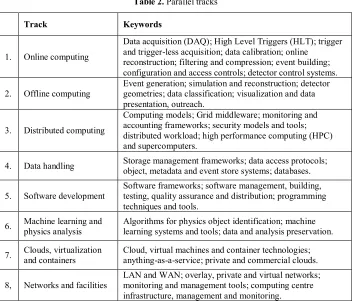
The program of the CHEP 2018 conference accommodated plenary sessions and 8 parallel tracks. 27 plenary talks were either given by invited speakers or selected and promoted from the abstracts in the different tracks. The main topics of the plenary talks concerned HPC and cloud computing, machine learning in High Energy Physics (HEP), overviews of experiment software for data acquisition, high level triggering, reconstruction and analysis, experience from astro-particle and neutrino physics, as well as broader subjects like multithreading and vectorization in HEP, use of blockchains, quantum computing, software citation mechanisms. Several presentations covered common and widely used tools and packages in HEP such as ROOT, EOS and CVMFS. There was a dedicated presentation on the ways to implement a successful diversity program in the field of HEP and nuclear physics computing. 323 parallel presentations and 188 posters were shown during the 49 parallel and 2 poster sessions. The conference concluded with 8 summary talks from each parallel track, and a forward look to the CHEP 2019 conference in Adelaide, Australia. The subjects and the keywords describing the details of each parallel track are summarised in Table 2.
Table 2. Parallel tracks
Track Keywords
1. Online computing
Data acquisition (DAQ); High Level Triggers (HLT); trigger and trigger-less acquisition; data calibration; online
reconstruction; filtering and compression; event building; configuration and access controls; detector control systems. 2. Offline computing Event generation; simulation and reconstruction; detector geometries; data classification; visualization and data
presentation, outreach.
3. Distributed computing
Computing models; Grid middleware; monitoring and accounting frameworks; security models and tools; distributed workload; high performance computing (HPC) and supercomputers.
4. Data handling Storage management frameworks; data access protocols; object, metadata and event store systems; databases.
5. Software development Software frameworks; software management, building, testing, quality assurance and distribution; programming techniques and tools.
6. Machine learning and physics analysis Algorithms for physics object identification; machine learning systems and tools; data and analysis preservation.
7. Clouds, virtualization and containers Cloud, virtual machines and container technologies; anything-as-a-service; private and commercial clouds.
The slides of the presentations and the PDF files of the posters are available from the Indico Web pages at https://indico.cern.ch/event/587955/timetable.
2 International Advisory Committee
The International Advisory Committee (IAC) of the conference was chaired by the three CHEP2018 co-organisers:
Peter Hristov, CERN; Petya Vasileva, CERN; Vassil Vassilev, Princeton.
The chairs of the Program Committee (PC) were elected by the IAC and became ex-officio members of the IAC:
Latchezar Betev, CERN, PC Chair;
Alessandra Forti, University of Manchester, Deputy PC Chair; Maarten Litmaath, CERN, Deputy PC Chair;
Oxana Smirnova, University of Lund, Deputy PC Chair.
The organizers of CHEP2019 became members of the IAC when Adelaide was selected as the next conference lieu:
Paul Jackson, University of Adelaide; Waseem Kamleh, University of Adelaide.
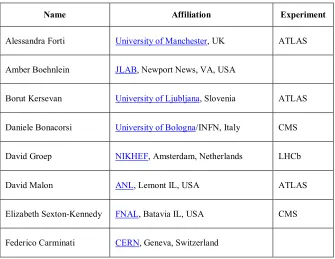
Table 3. Members of the International Advisory Committee
Name Affiliation Experiment
Alessandra Forti University of Manchester, UK ATLAS
Amber Boehnlein JLAB, Newport News, VA, USA
Borut Kersevan University of Ljubljana, Slovenia ATLAS
Daniele Bonacorsi University of Bologna/INFN, Italy CMS
David Groep NIKHEF, Amsterdam, Netherlands LHCb
David Malon ANL, Lemont IL, USA ATLAS
Elizabeth Sexton-Kennedy FNAL, Batavia IL, USA CMS
The slides of the presentations and the PDF files of the posters are available from the Indico Web pages at https://indico.cern.ch/event/587955/timetable.
2 International Advisory Committee
The International Advisory Committee (IAC) of the conference was chaired by the three CHEP2018 co-organisers:
Peter Hristov, CERN; Petya Vasileva, CERN; Vassil Vassilev, Princeton.
The chairs of the Program Committee (PC) were elected by the IAC and became ex-officio members of the IAC:
Latchezar Betev, CERN, PC Chair;
Alessandra Forti, University of Manchester, Deputy PC Chair; Maarten Litmaath, CERN, Deputy PC Chair;
Oxana Smirnova, University of Lund, Deputy PC Chair.
The organizers of CHEP2019 became members of the IAC when Adelaide was selected as the next conference lieu:
Paul Jackson, University of Adelaide; Waseem Kamleh, University of Adelaide.
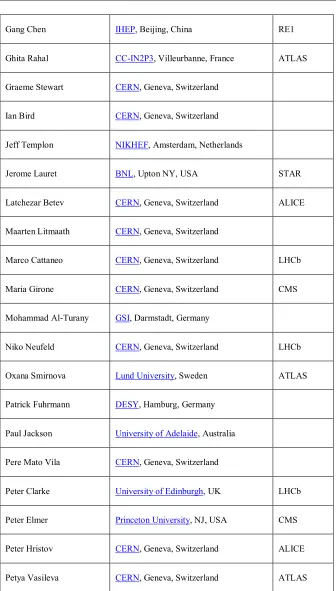
Table 3. Members of the International Advisory Committee
Name Affiliation Experiment
Alessandra Forti University of Manchester, UK ATLAS
Amber Boehnlein JLAB, Newport News, VA, USA
Borut Kersevan University of Ljubljana, Slovenia ATLAS
Daniele Bonacorsi University of Bologna/INFN, Italy CMS
David Groep NIKHEF, Amsterdam, Netherlands LHCb
David Malon ANL, Lemont IL, USA ATLAS
Elizabeth Sexton-Kennedy FNAL, Batavia IL, USA CMS
Federico Carminati CERN, Geneva, Switzerland
Gang Chen IHEP, Beijing, China RE1
Ghita Rahal CC-IN2P3, Villeurbanne, France ATLAS
Graeme Stewart CERN, Geneva, Switzerland
Ian Bird CERN, Geneva, Switzerland
Jeff Templon NIKHEF, Amsterdam, Netherlands
Jerome Lauret BNL, Upton NY, USA STAR
Latchezar Betev CERN, Geneva, Switzerland ALICE
Maarten Litmaath CERN, Geneva, Switzerland
Marco Cattaneo CERN, Geneva, Switzerland LHCb
Maria Girone CERN, Geneva, Switzerland CMS
Mohammad Al-Turany GSI, Darmstadt, Germany
Niko Neufeld CERN, Geneva, Switzerland LHCb
Oxana Smirnova Lund University, Sweden ATLAS
Patrick Fuhrmann DESY, Hamburg, Germany
Paul Jackson University of Adelaide, Australia
Pere Mato Vila CERN, Geneva, Switzerland
Peter Clarke University of Edinburgh, UK LHCb
Peter Elmer Princeton University, NJ, USA CMS
Peter Hristov CERN, Geneva, Switzerland ALICE
Predrag Buncic CERN, Geneva, Switzerland ALICE
Reda Tafirout TRIUMF, Vancouver, BC, Canada ATLAS
Richard Mount SLAC, Menlo Park, CA, USA ATLAS
Simon Lin Academia Sinica, Taipei, Taiwan
Simone Campana CERN, Geneva, Switzerland
Stefan Roiser CERN, Geneva, Switzerland LHCb
Takanori Hara KEK, Tsukuba, Japan BELLE II
Thomas Kuhr LMU, Munich, Germany BELLE II
Thorsten Kollegger GSI, Darmstadt, Germany ALICE
Tobias Stockmanns IKP, Juelich, Germany PANDA
Tommaso Boccali INFN, Pisa, Italy CMS
Tomoaki Nakamura KEK, Tsukuba, Japan
Vassil Vassilev Princeton University, NJ, USA CMS
Vladimir Korenkov JINR, Dubna, Russia
Waseem Kamleh University of Adelaide, Australia
Predrag Buncic CERN, Geneva, Switzerland ALICE
Reda Tafirout TRIUMF, Vancouver, BC, Canada ATLAS
Richard Mount SLAC, Menlo Park, CA, USA ATLAS
Simon Lin Academia Sinica, Taipei, Taiwan
Simone Campana CERN, Geneva, Switzerland
Stefan Roiser CERN, Geneva, Switzerland LHCb
Takanori Hara KEK, Tsukuba, Japan BELLE II
Thomas Kuhr LMU, Munich, Germany BELLE II
Thorsten Kollegger GSI, Darmstadt, Germany ALICE
Tobias Stockmanns IKP, Juelich, Germany PANDA
Tommaso Boccali INFN, Pisa, Italy CMS
Tomoaki Nakamura KEK, Tsukuba, Japan
Vassil Vassilev Princeton University, NJ, USA CMS
Vladimir Korenkov JINR, Dubna, Russia
Waseem Kamleh University of Adelaide, Australia
The IAC had 25 meetings. It elected the chair and deputy chairs of the Program committee, prepared the long list of the track conveners and elected them as members of the Program Committee. Together with the PC, the IAC defined the list of parallel tracks and approved the associated keywords. The details of the program and the distribution of the time slots were prepared by the PC and discussed by the IAC considering the number of submitted abstracts per track. The IAC proposed the invited speakers of CHEP 2018 and selected the list of plenary talks based on the suggested abstracts. The IAC also voted on the proposals for the next CHEP lieu and selected Adelaide, Australia. CHEP 2019 will take place from the 4th to 8th of November 2019. More information can be found on the conference Web site chep2019.org.
3 Program Committee
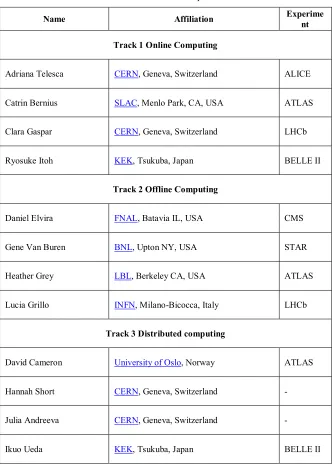
The members of the Program Committee (PC) were nominated by the IAC and the final composition was approved seeking gender, geographical, experiment and institutional balance. The PC members were responsible for the selection of abstracts, allocation of oral and poster slots, and served as track conveners during the conference. In addition, they organised the editorial reviews of the CHEP 2018 proceedings.
Table 4. List of conveners per track.
Name Affiliation Experiment
Track 1 Online Computing
Adriana Telesca CERN, Geneva, Switzerland ALICE
Catrin Bernius SLAC, Menlo Park, CA, USA ATLAS
Clara Gaspar CERN, Geneva, Switzerland LHCb
Ryosuke Itoh KEK, Tsukuba, Japan BELLE II
Track 2 Offline Computing
Daniel Elvira FNAL, Batavia IL, USA CMS
Gene Van Buren BNL, Upton NY, USA STAR
Heather Grey LBL, Berkeley CA, USA ATLAS
Lucia Grillo INFN, Milano-Bicocca, Italy LHCb
Track 3 Distributed computing
David Cameron University of Oslo, Norway ATLAS
Hannah Short CERN, Geneva, Switzerland -
Julia Andreeva CERN, Geneva, Switzerland -
Track 4 Data handling
Costin Grigoras CERN, Geneva, Switzerland ALICE
Elizabeth Gallas University of Oxford, UK ATLAS
Maria Arsuaga Rios CERN, Geneva, Switzerland -
Tigran Mkrtchyan DESY, Hamburg, Germany -
Track 5 Software development
Barthélémy von Haller CERN, Geneva, Switzerland ALICE
Maiken Pedersen University of Oslo, Norway ATLAS
Philippe Canal FNAL, Batavia IL, USA CMS
Patricia Mendez Lorenzo CERN, Geneva, Switzerland -
Track 6 Machine learning and physics analysis
Andrea Rizzi INFN, Pisa, Italy CMS
Michela Paganini Yale University, New Haven, CT, USA ATLAS
Sergei Gleyzer University of Florida, Gainesville, FL, USA CMS
Sofia Vallecorsa CERN, Geneva, Switzerland -
Track 7 Clouds, virtualization and containers
Andrew McNab University of Manchester, UK LHCb
Dave Dykstra FNAL, Batavia IL, USA CMS
Fabio Hernandez CC-IN2P3, Villeurbanne, France -
Track 4 Data handling
Costin Grigoras CERN, Geneva, Switzerland ALICE
Elizabeth Gallas University of Oxford, UK ATLAS
Maria Arsuaga Rios CERN, Geneva, Switzerland -
Tigran Mkrtchyan DESY, Hamburg, Germany -
Track 5 Software development
Barthélémy von Haller CERN, Geneva, Switzerland ALICE
Maiken Pedersen University of Oslo, Norway ATLAS
Philippe Canal FNAL, Batavia IL, USA CMS
Patricia Mendez Lorenzo CERN, Geneva, Switzerland -
Track 6 Machine learning and physics analysis
Andrea Rizzi INFN, Pisa, Italy CMS
Michela Paganini Yale University, New Haven, CT, USA ATLAS
Sergei Gleyzer University of Florida, Gainesville, FL, USA CMS
Sofia Vallecorsa CERN, Geneva, Switzerland -
Track 7 Clouds, virtualization and containers
Andrew McNab University of Manchester, UK LHCb
Dave Dykstra FNAL, Batavia IL, USA CMS
Fabio Hernandez CC-IN2P3, Villeurbanne, France -
Martin Sevior University of Melbourne, Australia BELLE II
Track 8 Networks and facilities
Oksana Shadura University of Nebraska, USA CMS
Pepe Flix PIC, Barcelona, Spain CMS
Sang-Un Ahn KISTI, Daejeon, Korea -
Wei Yang SLAC, Menlo Park, CA, USA ATLAS
4 Local Organizing Committee
The conference chairs are very grateful to the members of the local organising committee, whose precious help made the conference a resounding success: Alexander Penev, PU; Anna Yaneva, SU & CERN; Desislava Nikolova, NDK; Evelina Ananieva, MFA; Elitsa Ivanova; Gancho Dimitrov, CERN; Ivelina Todorova, PU; Martin Vasilev, PU; Milena Veneva, FMI – SU; Stoyan Mishev, IAPS; Todor Ivanov, SU & CERN.
Special thanks to the representatives of the institutions supporting CHEP 2018: Daniela Orozova, BFU; Galya Hristozova, BFU; Georgi Tekev NBU; Leandar Litov, SU; Miroslav Borshosh, NDK; Nevena Ilieva, IICT – BAS; Plamen Iaydjiev, INRNE – BAS, Todor Tchobanov, SM; Tzveta Apostolova, IAPS & BAS; Venelin Kozhuharov, SU.
5 Sponsors
We thank the CHEP 2018 sponsors for crucial contributions to the conference success:
Platinum sponsors
o RHEA Group (www.rheagroup.com)
o T-Systems (www.t-systems.com)
Silver sponsors
o Intel (www.intel.com)
o Chaos Group (www.chaosgroup.com)
o Bulgarian fund for scientific research,
.
6 Acknowledgements
The success of the CHEP 2018 conference would not have been possible without the help and support from the conference secretariat: Anna Yaneva, Elitsa Ivanova, Evelina Ananieva, and Mariana Shopova, to whom we express our gratitude. We are very thankful to Milena Veneva for the organisation of the microphone service, and to the students who volunteered to participate as microphone runners. Our appreciation also goes to Martin Vasilev for the excellent support of the conference Web page (chep2018.org).