ISSN(Online): 2320-9801
ISSN (Print): 2320-9798
I
nternational
J
ournal of
I
nnovative
R
esearch in
C
omputer
and
C
ommunication
E
ngineering
(An ISO 3297: 2007 Certified Organization)
Vol. 3, Issue 5, May 2015
A Review on Clustering Techniques and
Optimization Algorithms for Molecular
Docking and DNA Nanotechnology
E.Kiruba Nesamalar
1, Dr. C.P. Chandran2Ph.D Research Scholar & Assistant Professor, Department of IT, Sri Kaliswari College, Sivakasi, Tamilnadu, India 1 Associate Professor, Department of CSE, Ayya Nadar Janaki Ammal College, Sivakasi, Tamilnadu, India 2
ABSTRACT: In this paper, the literature survey on data mining approaches for the analysis of DNA Nanotechnology using molecular docking is carried out. DNA Nanotechnology is the field in nanotechnology that uses the unique structure of DNA to create different structures. DNA has different characteristics like carrying genetic information, but its structural material is used in DNA Nanotechnology. A major goal of DNA Nanotechnology is to assemble a biochip computer. The molecular docking problem is to find a good position and orientation for docking and a small molecule ligand to a large receptor molecule. It is originated as an optimization problem consists of optimization method and the clustering technique. Optimization problem is the problem of finding the best solution from all feasible solutions. Clustering is a data mining task which groups the data on the basis of similarities among the data. This survey, deals with various approaches and optimization algorithms to Molecular docking using clustering techniques. The performance of various existing clustering algorithms under each of these approaches is also discussed. In this work, existing approaches to molecular docking, various searching methods, different approaches used to evaluate solutions and algorithms used to find the target protein are categorized and analysed.
KEYWORDS: Data Mining, Swarm Intelligence, Protein-Ligand Docking, Molecular Docking, DNA Nanotechnology.
I. INTRODUCTION 1.1 Data Mining
Data Mining refers to the nontrivial extraction of implicit previously unknown and potentially useful information from data in databases. The large collections of data are the potential lodes of valuable information but like in real mining the search and extraction can be a difficult in exhaustive process to find implicit but potentially useful information, Let D ={d1, ..., dn} be the dataset to be analysed. Then, the data mining process is described as the process
of finding a subset D’ of D and hypotheses HU(D’,C) about D’ that a user U considers useful in an application context C. Note that D’ may not only have fewer data elements than D but it may also have a lower dimensionality (m’).
The hypotheses expressing interesting aspects of the data may deal with the whole database or with a single relation (D’ = D or D’ = Ri) they may deal with real subsets of the database (D'Dwith |D'| << |D| and |D'| sufficiently large) or
with single exceptional data items, so-called hot spots ( '
DDwith |D'| =1 or sufficiently small when compared to |D|). Among others, hypotheses properties that hold for all or most ei∈ D', (D'D), classifications of D’ into classes Ci with
different properties Pi [Pi (e1) ≠ Pj(e2) => e1 ∈ Ci ^ e2 Cj ^ i ≠ j ] functional dependencies F or relationships R between two
or more dimensions [d i1= F(di2, .., di1) or R(di1, di1), l ≤ m ].
ISSN(Online): 2320-9801
ISSN (Print): 2320-9798
I
nternational
J
ournal of
I
nnovative
R
esearch in
C
omputer
and
C
ommunication
E
ngineering
(An ISO 3297: 2007 Certified Organization)
Vol. 3, Issue 5, May 2015
a numerical or nominal attribute from the attribute space A. It refers to a procedure that assigns data objects to a set of classes. Unsupervised means clustering does not depend on predefined classes while classifying the data objects.
DNA Nanotechnology
DNA nanotechnology is the design and manufacture of artificial nucleic acid structures for technological uses. In this field, nucleic acids are used as non-biological engineering materials for nanotechnology rather than as the carriers of genetic information in living cells. Researchers in the field have created static structures such as two- and three-dimensional crystal lattices, nanotubes, polyhedra, and arbitrary shapes, as well as functional devices such as molecular machines and DNA computers. The field is beginning to be used as a tool to solve basic science problems in structural biology and biophysics, including applications in crystallography and spectroscopy for protein structure determination. Potential applications in molecular scale electronics and nanomedicine are also being investigated.
Molecular Docking
In the field of molecular modelling, molecular docking is a method which predicts the preferred orientation of one molecule to a second when bound to each other to form a stable complex. Knowledge of the preferred orientation is used to predict the strength of association or binding affinity between two molecules using scoring functions. The associations between biologically relevant molecules such as proteins, nucleic acids, carbohydrates, and lipids play a central role in signal transduction. The relative orientation of the two interacting partners affect the type of signal produced. Docking is frequently used to predict the binding orientation of small molecule drug candidates to their protein targets and predict the affinity and activity of the small molecule. Hence docking plays an important role in the rational design of drugs [1]. The aim of molecular docking is to achieve an optimized conformation for both the protein and ligand and relative orientation between protein and ligand such that the free energy of the overall system is minimized.
Molecular docking is a problem of “lock-and-key”, where one is interested in finding the correct relative orientation of the “key” which will open up the “lock”. The protein can be thought of as the “lock” and the ligand can be thought of as a “key”. Molecular docking is defined as an optimization problem, which would describe the “best-fit” orientation of a ligand that binds to a particular protein of interest. Both the ligand and the protein are flexible, a “hand-in-glove” analogy is more appropriate than “lock-and-key”. The ligand and the protein adjust their conformation to achieve an overall “best-fit” and conformational adjustments resulting in the overall binding is referred to as “induced-fit” [2]. There are two key parts to any docking program, namely a search of the configurational and conformational degrees of freedom and the scoring or evaluation function. The search algorithm must search the potential energy landscape in enough detail to find the global energy minimum. In rigid docking the algorithm explores different positions for the ligand in the receptor active site using the translational and rotational degrees of freedom. Flexible ligand docking adds exploration of torsional degrees of freedom of the ligand to this process.
II. RELATEDWORK
DNA nanotechnology focuses on creating nucleic acid systems with designed dynamic functionalities related to their overall structures, such as computation and mechanical motion. There is some overlap between structural and dynamic DNA nanotechnology, as structures can be formed through annealing and then reconfigured dynamically, or can be made to form dynamically in the first place[3][4].
Structural design
ISSN(Online): 2320-9801
ISSN (Print): 2320-9798
I
nternational
J
ournal of
I
nnovative
R
esearch in
C
omputer
and
C
ommunication
E
ngineering
(An ISO 3297: 2007 Certified Organization)
Vol. 3, Issue 5, May 2015
Tile-based structures.
This approach breaks the target structure into smaller units with strong binding between the strands contained in each unit, and weaker interactions between the units. It is often used to make periodic lattices, but can also be used to implement algorithmic self-assembly, making them a platform for DNA computing. This was the dominant design strategy used from the mid-1990s until the mid-2000s, when the DNA origami methodology was developed [6].
Folding structures.
An alternative to the tile-based approach, folding approaches make the nanostructure from a single long strand. This long strand can either have a designed sequence that folds due to its interactions with itself, or it can be folded into the desired shape by using shorter, "staple" strands. This latter method is called DNA origami, which allows the creation of nanoscale two- and three-dimensional shapes [7].
Dynamic assembly.
This approach directly controls the kinetics of DNA self-assembly, specifying all of the intermediate steps in the reaction mechanism in addition to the final product. This is done using starting materials which adopt a hairpin structure; these then assemble into the final conformation in a cascade reaction, in a specific order. This approach has the advantage of proceeding isothermally, at a constant temperature. This is in contrast to the thermodynamic approaches, which require a thermal annealing step where a temperature change is required to trigger the assembly and favor proper formation of the desired structure [8].
III. MOLECULARDOCKINGAPPROACHES
In Molecular docking three approaches are popular. First approach uses a clustering technique that is applied to reduce the number of potential solutions. Second approach uses a matching technique that describes the protein and the ligand as complementary surfaces. The third approach simulates the actual docking process in which the ligand-protein pair wise interaction energies are calculated.
Clustering techniques for docking
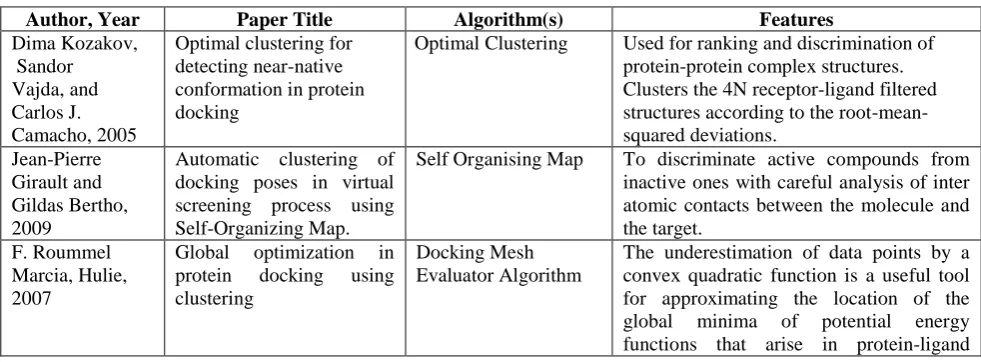
Dima Kozakov, Karl H. Clodfelter, Sandor Vajda, and Carlos J.Camacho have introduced [9] optimal clustering for detecting near-native conformations in protein docking. Two different clustering strategies are developed to predict docked conformations based on the clustering properties of a uniform sampling of low free-energy protein-protein and protein-protein-small molecule complexes. Guillaume Bouvier, Nathalie Evrard-Todeschi, Jean-Pierre Girault and Gildas Bertho have proposed [10] automatic clustering of docking poses in virtual screening process using Self-Organizing Map. A compound clustering is very tedious due to the large number of contacts extracted from the different conformations proposed by docking experiments. F. Roummel Marcia, Hulie have developed [11] global optimization in protein docking using clustering, underestimation and semi definite programming. This worksolves the underestimation problem using SDP and present numerical results for active site prediction in protein docking.
ISSN(Online): 2320-9801
ISSN (Print): 2320-9798
I
nternational
J
ournal of
I
nnovative
R
esearch in
C
omputer
and
C
ommunication
E
ngineering
(An ISO 3297: 2007 Certified Organization)
Vol. 3, Issue 5, May 2015
Shape Complementarity Approach
Several methods are available in the survey to perform Flexible Protein-Ligand Docking to find the ligand binding site. The methods are Geometric matching, shape complementarity, Graph representation, Shape matching, and Fourier shape descriptor. The complementarity between the two surfaces amounts to the shape matching description that may help finding the complementary pose of docking the target and the ligand molecules. Another approach is to describe the hydrophobic features of the protein using turns in the main-chain atoms. One more approach is to use a Fourier shape descriptor technique. Whereas the shape complementarity based approaches are typically fast and robust, they cannot usually model the movements or dynamic changes in the ligand/ protein conformations accurately, although recent developments allow these methods to investigate ligand flexibility. They are also much more amenable to pharmacophore based approaches, since they use geometric descriptions of the ligands to find optimal binding.
S. Bashir and Z. Zsoldos have demonstrated [16] that Geometric methods can be used to solve Protein-Drug Docking problem and analyse the search problem from a computational perspective. RigiDock algorithm, Pose Match algorithm and polynomial time algorithm are used to solve the closed predicted pose to the native structure. A polynomial time algorithm is developed for the matching phase of the docked rigid fragments. Certain scoring function conditions are used to find the optimality of the proposed algorithm. Chandrajit Bajaj, Rezaul Chowdhury and Vinay Siddavanahalli have addressed [17] this problem by adapting Fast Fourier approach. This work is extended from non uniform Fast Fourier Transform-based docking algorithm to include an adaptive search phase. F2 Dock is based on an extensive experimental study on a list of benchmark complexes and solutions based on desolvation energy. Apostolos Axenopoulos, Petros Daras, Georgios Papadopoulos and N. Elias Houstis have presented [18] a shape descriptor for fast complementarity matching in Molecular docking based on Geometric complementarity. A set of local surface patches is generated based on the local surface. The result proves that the shape complementarity method demonstrates superior performance over other well-known geometry based rigid-docking approaches.
Tao Zhang et.al, have applied [19] graph based approach for protein-protein docking. Protein-Protein Docking is the computational approach to predict protein-protein interactions, and the results demonstrate the reliability of this approach. A.Luis Diago and Ernesto Moreno have proposed [20] an evaluation of between molecular surfaces using compactly supported radial basis functions. The scoring of energetic function is the one that must fulfil this function. The compactly supported radial basis function is proposed to create analytical representations of molecular surfaces, which are then included as key components of a new scoring function for molecular docking. Peggy Yao et.al, have developed [21] an efficient algorithms to explore conformation spaces of flexible protein loops. The seed sampling algorithm samples broadly from this space while the deformation sampling algorithm uses seed conformations as starting points to explore the conformation space around them at a finer grain.
Table 1. Clustering techniques for docking
Author, Year Paper Title Algorithm(s) Features
Dima Kozakov, Sandor Vajda, and Carlos J. Camacho, 2005
Optimal clustering for detecting near-native conformation in protein docking
Optimal Clustering Used for ranking and discrimination of protein-protein complex structures. Clusters the 4N receptor-ligand filtered structures according to the root-mean-squared deviations.
Jean-Pierre Girault and Gildas Bertho, 2009
Automatic clustering of docking poses in virtual screening process using Self-Organizing Map.
Self Organising Map To discriminate active compounds from inactive ones with careful analysis of inter atomic contacts between the molecule and the target.
F. Roummel Marcia, Hulie, 2007
Global optimization in protein docking using clustering
Docking Mesh Evaluator Algorithm
ISSN(Online): 2320-9801
ISSN (Print): 2320-9798
I
nternational
J
ournal of
I
nnovative
R
esearch in
C
omputer
and
C
ommunication
E
ngineering
(An ISO 3297: 2007 Certified Organization)
Vol. 3, Issue 5, May 2015
Kahraman, R.J Morris and R.A Laskowski have presented [22] a shape variation in protein binding pockets and their ligands. The normalisation procedure of the standard spherical harmonic coefficients enabled the investigation of the contribution of shape and size to the classification performance. Shape alone outperforms the contribution of size alone in the classification, but size does surprisingly well clefts to clefts and ligands to ligands. T.R Alasdair Laurie and M.Jackson have proposed [23] the method for the prediction of Protein-Ligand Binding sites for structure based drug design and virtual ligand screening. Structure based drug design is a computational approach to lead discovery that uses the three dimensional structure of a protein to fit drug like molecules into a ligand binding site to modulate function. Binding site prediction has been used in several projects and has been incorporated into several docking tools. Geometric shape complementarity methods describe the protein and ligand as a set of features that make them dockable [24]. These features include molecular surface or complementary surface descriptors. The receptor’s molecular surface is described in terms of its solvent accessible surface area and the ligand’s molecular surface is described in terms of its matching surface description.
III.SIMULATION TECHNIQUE
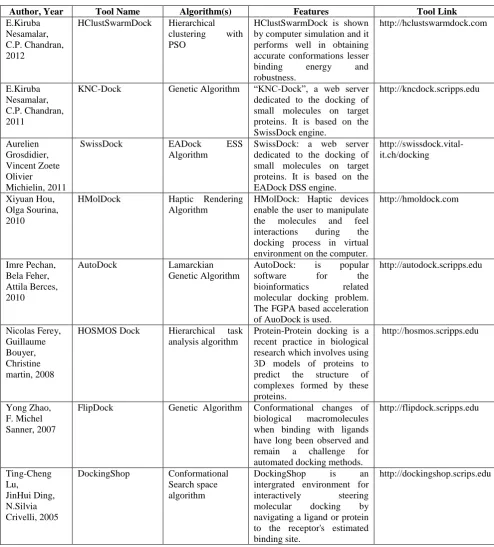
The simulation of the docking process as such is a much more complicated process. In this approach, the protein and the ligand are separated by some physical distance, and the ligand finds its position into the protein’s active site after a certain number of “moves” in its conformational space. The moves incorporate rigid body transformations such as translations and rotations, as well as internal changes to the ligand’s structure including torsion angle rotations. Each of these moves in the conformation space of the ligand induces a total energetic cost of the system, and hence after every move the total energy of the system is calculated. Table 3 shows the simulation techniques used in docking.
E. Kiruba Nesamalar and C.P Chandran have developed [25] HClustSwarmDock: a web server for flexible protein-ligand docking using hierarchical clustering with Swarm Intelligence. A New algorithm HClustSwarmDock is proposed which is based on the PSO combined with Hierarchical Clustering technique. PSO is a computational method that optimizes a problem by iteratively trying to improve a candidate solution with regard to a given measure of quality. The search capacity and the docking accurateness of HClustSwarmDock are evaluated by multiple docking tests.
E.Kiruba Nesamalar and C.P Chandran have proposed [26] a Web-Enabled system design for molecular docking. This work presents “KNC-Dock”, and it is based on the SwissDock engine, combined with setup scripts for curating common problems and for preparing both the target protein and the ligand input files. Monte Carlo algorithms, “Lamarckian” GA, and Granular Computing are implemented in KNC-Dock. An Efficient AJAX/PHP interface was designed and implemented the submit dockings and retrieve the predicted complexes. The web server also provides an access to a database of manually curated complexes [27].
docking.
W Tong, Z Weng, 2004
Clustering protein-protein docking predictions
ZDOCK Clustering Applied to two sets of predictions for 36 test cases, one set generated with a rigid-body docking algorithm ZDOCK.
W. Anisha Goorah, David Ritchee , 2007
Spatial Clustering of protein binding sites for template based protein docking
Spatial Clustering algorithm
ISSN(Online): 2320-9801
ISSN (Print): 2320-9798
I
nternational
J
ournal of
I
nnovative
R
esearch in
C
omputer
and
C
ommunication
E
ngineering
(An ISO 3297: 2007 Certified Organization)
Vol. 3, Issue 5, May 2015
Table 3. Simulation techniques used in docking
Xiyuan Hou, Olga Sourina have proposed [28] a haptic rendering algorithm for biomolecular docking with torque force. Implementation of torque feedback allows the user to have more realistic experience during force
Author, Year Tool Name Algorithm(s) Features Tool Link
E.Kiruba Nesamalar, C.P. Chandran, 2012
HClustSwarmDock Hierarchical clustering with PSO
HClustSwarmDock is shown by computer simulation and it performs well in obtaining accurate conformations lesser binding energy and robustness. http://hclustswarmdock.com E.Kiruba Nesamalar, C.P. Chandran, 2011
KNC-Dock Genetic Algorithm “KNC-Dock”, a web server dedicated to the docking of small molecules on target proteins. It is based on the SwissDock engine. http://kncdock.scripps.edu Aurelien Grosdidier, Vincent Zoete Olivier Michielin, 2011
SwissDock EADock ESS Algorithm
SwissDock: a web server dedicated to the docking of small molecules on target proteins. It is based on the EADock DSS engine.
http://swissdock.vital-it.ch/docking
Xiyuan Hou, Olga Sourina, 2010
HMolDock Haptic Rendering Algorithm
HMolDock: Haptic devices enable the user to manipulate the molecules and feel interactions during the docking process in virtual environment on the computer.
http://hmoldock.com
Imre Pechan, Bela Feher, Attila Berces, 2010
AutoDock Lamarckian Genetic Algorithm
AutoDock: is popular software for the bioinformatics related molecular docking problem. The FGPA based acceleration of AuoDock is used.
http://autodock.scripps.edu Nicolas Ferey, Guillaume Bouyer, Christine martin, 2008
HOSMOS Dock Hierarchical task analysis algorithm
Protein-Protein docking is a recent practice in biological research which involves using 3D models of proteins to predict the structure of complexes formed by these proteins.
http://hosmos.scripps.edu
Yong Zhao, F. Michel Sanner, 2007
FlipDock Genetic Algorithm Conformational changes of biological macromolecules when binding with ligands have long been observed and remain a challenge for automated docking methods.
http://flipdock.scripps.edu Ting-Cheng Lu, JinHui Ding, N.Silvia Crivelli, 2005
DockingShop Conformational Search space algorithm
DockingShop is an intergrated environment for interactively steering molecular docking by navigating a ligand or protein to the receptor's estimated binding site.
ISSN(Online): 2320-9801
ISSN (Print): 2320-9798
I
nternational
J
ournal of
I
nnovative
R
esearch in
C
omputer
and
C
ommunication
E
ngineering
(An ISO 3297: 2007 Certified Organization)
Vol. 3, Issue 5, May 2015
simulation and find the optimum docking positions faster. It enables the user to experience six degree-of-freedom (DOF) haptic manipulation in docking processes. The linear smoothing method was proposed to improve stability of the haptic rendering during molecular docking.
IV. MOLECULARDOCKINGOPTIMIZATIONALGORITHMS
E.Kiruba Nesamalar and C.P Chandran have developed [29] Fuzzy Clustering with ACO for Protein-Ligand Docking. A new algorithm called Fuzzy clustering Ant Colony Optimization is proposed for solving Molecular Docking problems. E. Kiruba Nesamalar and C.P Chandran have presented [30] Genetic clustering with BCO for flexible Protein-Ligand docking. E.Kiruba Nesamalar and C.P Chandran have proposed [31] Integration of Data Mining concepts with Granular Computing for Molecular Docking and mainly applied to structure-based drug design. The molecule docking problem is to predict the three dimensional structure and the affinity of a binding of a target receptor and a ligand. Mohamed Wahib, Asim Munawar, Masaharu Munetomo and Kiyoshi Akama have demonstrated a Bayesian optimization algorithm for de novo ligand design based docking running over (Graphical Processing Unit) GPU. It introduces the use of GPU to overcome the very long time required in evaluating each possible fragment combination.
Yu Liu, Wentao Li, Yongliang Wang, and Mingwei lv have presented based on a variant of PSO named Fully Informed Particle Swarm and the semi empirical free energy force field in AutoDock 4.0, a new approach to flexible docking method called FIPSDock was implemented.
V. CONCLUSION
This survey focused on clustering techniques and optimization algorithms. Three approaches have been discussed in this literature. One approach uses a matching technique that describes the protein and the ligand as complementary surfaces. The second approach simulates the actual docking process in which the ligand-protein pair wise interaction energies are calculated. Three approaches have significant advantages as well as some limitations. The differences in and performance of available docking software are also discussed. ACO, PSO and BCO algorithms are analysed. In this work it is identified that BCO algorithm has the advantages of strong robustness, fast convergence and high flexibility, and fewer control parameters. Finally it is concluded that BCO algorithm is better to find the positions of interacting ligand and a protein with a minimal energy.
REFERENCES
[1] D.B Kitchen and H. Decornez, J.R Furr and Bajorath, “Docking and scoring in virtual screening for drug discovery: methods and applications”, Nature reviews Drug, vol. 3, pp. 935-949, 2004.
[2] B.Q Wei, A.M Ferrari, B.W Mathews and B.K Shoichet, “Testing a flexible-receptor docking algorithm in a model binding site”, Journal of Molecular Biology, vol. 10, pp.1161-1182, 2004.
[3] Pinheiro, A. V.; Han, D.; Shih, W. M.; Yan, H, "Challenges and opportunities for structural DNA nanotechnology". Nature Nanotechnology, Dec12, pp. 763–772.
[4] Bath, Jonathan; Turberfield, Andrew J, “DNA nanomachines". Nature Nanotechnology, May 2007,pp. 275–284.
[5] Chworos, Arkadiusz; Severcan, Isil; Koyfman, Alexey Y.; Weinkam, Patrick; Oroudjev, Emin; Hansma, Helen G.; Jaeger, Luc, "Building Programmable Jigsaw Puzzles with RNA,2004,PP.200-208.
[6] Pelesko, John A, Self-assembly: the science of things that put themselves together pp. 5, 7. ISBN 978-1-58488-687-7. [7] Deng, Z.; Mao, C, "Molecular lithography with DNA nanostructures".Angewandte Chemie International Edition
[8] Rothemund, Paul W. K.; Papadakis, Nick; Winfree, Erik (December 2004)."Algorithmic self-assembly of DNA Sierpinski triangles".PLoS,PP.2048-2053.
[9] Dima kazakov, H. karl, Sandor Vajda and Carlos J. Camacho, “Optimal clustering for detecting near-native conformation in protein docking”, Journal of Biomedical research, vol. 15, pp.551-60, 2004.
[10] Jean-Pierre Girault and Gildas Bertho, “Automatic clustering of docking poses in virtual screening process using self-organizing map”, Journal of Bioinformatics, vol. 26, pp.53-60, 2009.
[11] F. Roummel Marcia, Hulie, “Global optimization in protein docking using clustering, underestimation and semidefinite programming”, Journal of optimization methods and softwares, vol.1, pp.78-83, 2007.
[12] Stephan and yang, “Identification of near-native structures by clustering protein docking conformations” Journal of Biomedical research, vol.1, pp.187-194, 2007.
ISSN(Online): 2320-9801
ISSN (Print): 2320-9798
I
nternational
J
ournal of
I
nnovative
R
esearch in
C
omputer
and
C
ommunication
E
ngineering
(An ISO 3297: 2007 Certified Organization)
Vol. 3, Issue 5, May 2015
[15] W. Anisha Goorah, David Ritchee, “Spatial clustering of protein binding sites for template based protein docking” Journal of Computational Biology, vol. 1, pp. 23-30, 2007.
[16] S.Bashir and Z. Zsoldos, “Toward a robust method for the Protein-Drug Docking problem”, IEEE Transactions on Computational Biology and Bioinformatics, vol. 8, pp.1120-1133, 2011.
[17] Chandrajit Bajaj, rezaul Chowdhury and Vinay Siddavanahalli, “F2 Dock: Fast Fourier Protein-Protein Docking”, IEEE Transactions on
Computational Biology and Bioinformatics, vol.8, pp.45-58, 2011.
[18] Tao Zhang, Qunsheng Peng and Wei Chen, “A graph based approach for Protein-Protein Docking”, IEEE, vol.5, pp.12-20, 2009.
[19] A. Luis Diago and Ernesto Moreno, “Evaluation of Geometric complementarity between molecular surfaces using compactly supported radial basis function”, IEEE Transactions on Computational Biology and Bioinformatics, vol. 6, pp.689-694, 2009.
[20] Peggy Yao, Ankur Dhanik and Nathan Marz, “Efficient Algorithms to explore conformation spaces of flexible protein loops”, IEEE Transactions on Computational Biology and Bioinformatics, vol. 5, pp.534-545, 2008.
[21] A. Kahraman, R.J Morris, R.A Laskowski, “Shape variation in protein binding pockets and their ligands”, Journal of Molecular Biology, vol. 1, pp.283-301, 2007.
[22] T.R Alasdair and M.Richard Jackson, “Methods for the prediction of Protein-Ligand binding sites”, Journal of Current protein and peptide science, vol. 7, pp.395-406, 2006.
[23] B.K Shoichet, Kuntz, "Molecular docking using shape descriptors", Journal of Computational Chemistry, vol. 13, pp.380-397, 2004.
[24] E.Kiruba Nesamalar and C.P Chandran, “HClustSwarmDock: a web server for flexible Protein-Ligand docking using hierarchical clustering with swarm intelligence”, Proceedings of International Conference on Recent Trends in Information Processing and Computing, vol.1, pp.120-126, 2012.
[25] E.Kiruba Nesamalar and C.P Chandran, “Web-Enabled system design for molecular docking”, Proceedings of Seventh All India Conference of KAAS, vol. 3, pp.30-32, 2011.
[26] Aurelien Grosdidier, Vincent Zoete, “SwissDock, a protein small molecule docking web service based on EADock Ess”, Nucleic Acids Research Advance Access published, vol. 10, pp.1-8, 2011.
[27] Xiyuan Hou and Olga Sourina, “Haptic rendering algorithm for biomolecular docking with torque force”, International Conference on cyberworlds IEEE, vol. 10, pp.25-31, 2010.
[28] E.Kiruba Nesamalar and C.P Chandran,” “Fuzzy Clustering with Ant Colony Optimization for Protein-Ligand Docking”, Proceedings of International Conference on Mathematics in Engineering and Business Management, vol. 2, pp.381-386, 2012.
[29] E.Kiruba Nesamalar and C.P Chandran,” Genetic Clustering with Bee Colony Optimization for Flexible Protein-Ligand Docking (GCBCO)”, Proceedings of International Conference on Pattern Recognition, Informatics and Medical Engineering, vol.1, pp.82-87, 2012.
[30] E.Kiruba Nesamalar and C.P Chandran, “Integration of Data Mining concepts with Granular Computing for Molecular Docking”, Proceedings of Emerging Trends, vol.1, pp.22, 2011.
BIOGRPAHY
Dr.C.P.Chandran is an Associate Professor of Computer Science and, Ayya Nadar Janaki Ammal College, Sivakasi, India, (Madurai Kamaraj University). He received his Doctoral degree in Computer Science from Madurai Kamaraj University, India. He has about 16 years of teaching experience in Computer Science. He is an Alumni of Department of Physics, NGM College, Pollachi and Department of Computer Science, Bharathiar University, Coimbatore, India. He is an editor/reviewer of various international journals. His research focuses on data mining in bioinformatics, rough sets, swarm intelligence and granular computing. He has authored 10 international journal papers. He has published 30 research papers in national and international conference proceedings