doi:10.4236/ijcns.2010.32028 Published Online February 2010 (http://www.SciRP.org/journal/ijcns/).
Average Consensus in Networks of Multi-Agent with
Multiple Time-Varying Delays
Tiecheng ZHANG, Hui YU
Institute of Nonlinear and Complex Systems, China Three Gorges University, Yichang, China Email: [email protected], [email protected]
Received November 19, 2009; revised December 15, 2009; accepted January 21, 2010
Abstract
The average consensus in undirected networks of multi-agent with both fixed and switching topology cou-pling multiple time-varying delays is studied. By using orthogonal transformation techniques, the original system can be turned into a reduced dimensional system and then LMI-based method can be applied veniently. Convergence analysis is conducted by constructing Lyapunov-Krasovskii function. Sufficient con-ditions on average consensus problem with multiple time-varying delays in undirected networks are obtained via linear matrix inequality (LMI) techniques. In particular, the maximal admissible upper bound of time-varying delays can be easily obtained by solving several simple and feasible LMIs. Finally, simulation examples are given to demonstrate the effectiveness of the theoretical results.
Keywords: Average Consensus, Multi-Agent System, Multiple Time-Varying Delays, Linear Matrix Inequality
1. Introduction
Recently, more and more researchers have paid a great deal of attention on distributed coordinated control of networks of dynamic agents within the control com-munity. Especially the consensus problem was dis-cussed widely, which can be attributed to the broad applications of multi-agent systems in many areas, including cooperative control of unmanned air vehicles, formation control of multi-robot, flocking, swarming, distribution sensor fusion, attitude alignment and con-gestion control in communication networks, etc. In cooperative control of multi-agent system, a critical issue is to design appropriate protocol and algorithms such that all agents can reach a common consensus value. This problem is called consensus problem.
In the past decades, some theoretical results have been established in [1–11], to name a few. In [1], Vicsek et al. proposed a simple model but interesting discrete-time model of autonomous agents all moving in the plane with the same speed but with different headings. Simulation results provided in [1] show that all agents can eventually move in the same direction without centralized coordination. The first paper pro-viding a theoretical explanation for these observed be-haviors in Vicsek model is [2]. The theoretical results
in [2] are extended to the case of directed graph by Ren et al. [3], in which matrix analysis and algebraic graph theory were used. Moreau [4] used a set-valued Lyapunov approach to study consensus problem with unidirectional time-dependent communication links. Saber et al. [5] discussed average consensus problem. When network communication is affected by time de-lay, the consensus problem is investigated in [5–7]. In [8], Saber provided a theoretical framework for analy-sis of consensus algorithms for multi-agent networked systems with an emphasis on the role of directed in-formation flow, robustness to changes in network to-pology due to link/node failures, time-delays, and per-formance guarantees. Ren et al. provided a tutorial overview of information consensus in multivehicle cooperative control in [9]. Yu et al. [10] proposed weighted average consensus in direction networks and unidirectional networks with time-delay. Multi-vehicle consensus with time-varying reference state was dis-cussed in [11]. Some other issues on consensus prob-lem can be found in [12–16].
Currently, consensus problem for multi-agent net-works with time delay was studied using linear matrix inequality method, for example [17–19] and [20]. In time delay systems of multi-agent, the network topol-ogy of multi-agent is a key factor in the analysis of stability of multi-agent system. Average consensus problem for multi-agent networks with both constant
and time-varying delay has been extensively consid-ered for the cases of multi-agent undirected and/or di-rection networks with fixed and/or switching topology [17,18] and [19]. However, the studies on consensus problem of multi-agent networks with multiple time- varying delays are still sparse. In this case, theoretical analysis is more challenging. In [20], the authors pro-posed a consensus protocol for multi-agent undirected network with multiple time-varying delays based on LMI method.
In this paper, we study the average consensus prob-lem for continuous time undirected networks of multi- agent, coupling multiple time-varying delays. Because the closed-loop system matrix is singular and tradi-tional LMI-based control theory is invalid. Therefore, theoretical analysis for this case is a challenging task. By using orthogonal transformation techniques, suffi-cient conditions based on LMI for multi-agent achiev-ing average consensus is obtained. Compared to [20], a different approach is used in this paper. First of all, the original system is turned into a reduced dimensional system by orthogonal transformation; Secondly, via constructing a different Lyapunov-Krasovskii function, a sufficient condition expressed as LMI is proposed to guarantee all agents reach average consensus in fixed and switching network. Finally, the maximal admissi-ble upper bound of multiple time-varying delays can be easily obtained by solving several simple and feasible LMIs.
This paper is organized as follows. Section 2 is the notation and formally states the problem. Section 3 contains our main results. Simulation results are pre-sented in Section 4. The concluding remarks are made in Section 5.
2. Problem Statement and Preliminaries
In this section, we provide a brief introduction about algebraic graph theory [24] and state the problem.
2.1. Algebraic Graph Theory
Let be a weighted undirected graph of
or-der , where is the set of
nodes, is the set of edges, and
is a weighted adjacency matrix. The node indexes belong to a finite index set
, ,G V E A
2
n n
E V
n n ij A a
1, ,2 3 , nV v v v v
V
1, 2, ,I n . In undirected graph, . if and only if
. Moreover, we assume for all i
ij ji
e e eijE 0 ij 0
ij
a a I. A
undirected graph is always connected. The set of neighbors of nodes vi is denoted by
: ,
i j i j
N v V v v E .
The out-degree of node vi is defined as follows:
1
deg ( )out i n ij
i
v a
. The degree matrix of graph is adiagonal matrix
G
ij
D d , where dij 0 for all i j and dii deg (out vi). The Laplacian matrix associated with the graph is defined as
1,
, ,
, . n
ij j j i ij
ij
a j i
L l D A
a j
i
ar
An important fact of L is that all the row sums of L
e zero and thus 1n
1,1, ,1
Tn is an eigenvector of L associated with the eigenvalue 0.Lemma 1 [5]. If the undirected graph G is con-nected, then its Laplacian matrix L satisfies:
1) L is symmetric and rank ( )L n 1;
2) zero is one eigenvalue of , and and are the corresponding left and right eigenvector respectively, then,
L 1T
n 1n
1T 0
n L and 1L n 0;
3) the rest n1 eigenvalues are all positive and real.
2.2. Consensus Problem on Network
Consider a group of
n
agents with dynamics given by
( )i i
x t u t , i I (1)
where n
i
x is the state of the th agent at time , which might represent physical quantities such as atti-tude, position, temperature, voltage, and so on, and
i
t
( ) i
u t is the control input (or protocol) at time .
t
We say protocol asymptotically solves the con-sensus problem, if and only if the states of agents satisfyi
u
lim x ti( ) x tj( ) 0
t , for all i,j I .Furthermore, if
1
1
lim ( )t i n i 0 ( (0))
i
x t x Ave x n
,We say protocol asymptotically solves the aver-ag
2.3. Control Protocol for Time Delay
Let
i
u
e consensus problem.
ij
notes the time delay for information
communi-s
cated from agentjto agent
i
. Because of time delay, two difficult consensu protocols have been studied. One is[ ( ( )) ( ( ))]
u a x t t x t t
j i
i ij j ij i ij
v
N, i I (2)
t i I . (3)
Literature [5] have taken the protocol in (2) w
[ ( ( )) ( )]
j i
ij j ij i
v N
a x t t x
,
i
u
In the undirected network with switching topology, wead
ithij into account, and obtained that it can as-ymptotically solves the average consensus problem in the fixed and undirected network topology if and only if
max
0, 2 L
. Some conclusions also were
inves-For consensus pr tigated in [16-18].
otocol in (3), communication delay on
er, we are interested in discussing the aver-ly affects the agents who are transmitted. Literature [4] has established the consensus results in the directed and dynamically switching graph. Some results also appeared in [21–23].
In this pap
age consensus problem in network of dynamic agents with fixed and switching topology coupling multiple time-varying delays, where the information passes through different edge with different time-varying delays. To solve such a problem, we assume the time delay sat-isfies ijji in undirected graph, i.e., the delays in transmission from xi to xj and xj to xi coincide. So we use the follow g pro col:
[ ( ( )) (
u
a x t t x tin to
( ))]
j i
i ij j k i k
v N
t
,
i I
(4)With (4), (1) can be written in matrix form:
k
N ))1
( (
i k
k
x t L x t
t , (5)
where ( )
1
, 2 , ,
,
1 2
T n
x t x t x t x t Nn n , is the matrix defined by
t and L
k lkij
1
, ( ) ( ), 0 , ( ) ( ),
.
ij k ij
kij k ij
N
ij j
a i j t t
l i j t
a i j
Because ofAis symmetric and ij ji is a sy
in the undi-re
The tim ing dela
cted network we can obtain Lk mmetric and N
L L
.e-vary ,
1
k k
y ( )k t ,k1, 2, , Nis assumed to satisfy the follow inequations:
0k( )t dk,k( )t hk h 1, k1, 2, , N (6) where
d
k and are constants. andbou
k
h
k
d
d
h
are theupper nd of and
k
h
, nam ly,e d ax
dk ,
max k
h h .
1m k N
1 k N
dress the follow hybrid system:
N ks ( k( ))1
k
x t
L x t t ,
( )
s t I. (7)
where the map ( ) :[0,t ) I
1, 2, , M
is a at determines the network toposwitching signal th logy,
and M denotes the total number of all possible
switc directed graphs.
N Lks L Gs( )s is theLaplacian matrix of the graph
hing un1
k
, ,
s V E As s s that b
G elongs
to a set
G kk: I
, which finite.Lemm mplement [25]). Let S11,
is obviously
a 2 (Schur co S12,
0 22 be given symmetric matrices such that 22 ,
11 12 0
S S
S
then
S
12T 22
S S
S S S 1S T 0
11 12 22 12
Le n
.
n L
s an orth mma 3. For any Laplacian matrix of un-directed connected network, there exist ogonal matrix
W
such that
1 1
1 1 0
0 0
n
n
L
T
W LW
where the last column of matrix W is 1n n ,
(n 1) (n1)
L .
use
Proof: Beca and are the corresponding left
an tor respec
rovide the convergence analysis of
is 1T
n 1n
d right eigenvec tively. The proof of this lemma is straightforward.
3. Main Results
In this section, we p
the average consensus problem in undirected network with fixed and switching topology coupling multiple time-varying delays. Sufficient conditions expressed as LMI are presented for undirected networks of multi- agent with fixed and switching topology, respectively.
3.1. Networks with Fixed Topology
If the fixed communication topology G V E A
, ,
nd 1Lk n 0 kept connected, we have 1T 0n Lk , a , which imply n xi n ui 0
1 1
i i
. Then, Ave( (0))xan invariant we have t sed
equation ( ) 1n ( )
is
quantity. Thus he decompo
x t t , where
1, ,2 3 ,
T n n
, sat
i i t
)
By Lemma 3, we have
))
then
))
Let , wher
t L t) (8)
1 ( ( N k k k t
.
k t WW 1 ( ( N T T k kL WW t t
,
1 ( ( NT T T
k k
k
W t W L WW t t
.
,0 TT T
W t t e
t n1 ng equation:. Then (8) can be transformed into the followi
1
( ( ))
k k
k
t L t t
N (9)whereLksatisfies
1 1
0n
1 1 0 0 k T k n L W L W
.
Lemma 4. If li
tm t 0, then limt
t 0.Proof: From WT
t T
t ,0T
T
. Therefore, when
, we have
t W T
t , 0 li
tm t 0,
we havelim
0. This completes the proof. t tIn the following secti he
conver-dynamical sy .
u e
tim
on, we will discuss t gence of stem (9), that is lim
0t t
Theorem 1. Consider an undirected network of multi-agent with fixed topology coupling m ltipl
e-varying delays satisfies (6). Assume the communi-cation topology G is kept connected. Then, system (5) asymptotically solves the average consensus problem, if there exist positive definite matrices P Q R, k, k
n 1 n 1
, satisfying
1
1 ( 1) ( 1)
( 1) ( 1)
1 1
( 1) ( 1) ( 1) ( 1) 2
0
0 0
0 0
k n n
k
N N
T k
k n n
k k k
n n n n
PL R L P d
(10)where N
1 1 N Tk k k
k
PL L P Q
,
2 [ ( )1 1 1 1 1 1 1, ,
T
diag t L R L h Q
( ) T 1 ].
N t L R LN N N h QN N
Proof: Define a Lyapunov-Krasovskii fun n for
system (9) as follows: ctio
1 2 3
( ) ( ) ( ) ( )
V t V t V t V t ,
1( ) ( ) ( )
T
V t t P t , N
2 ( )
1 ( ) ( ) ( ) k t T k t t k
V t s Q s
ds,0 3 1 ( ) ( ) ( ) k N t T k d t k
V t s R s dsd
where P, Qk and n 1 n1
k
R are positive definite matrix. Along the trajectory of system (9), we have
1
1
) 2 k ( k( ))
k
t t t
,
( N T( )
V
t PL 2 1
( ) N { ( )T ( )
k k
V t t Q t
(1 ( )) T( ( )) ( ( ))}
k t t k t Qk t k t
1 { ( ) ( ) N T k k
t Q t
(1 ) T( ( )) ( ( ))}
k k k k
h t t Q t t
,
3
1
( )
N{
T(
( ))
T(
( ))
k k
k k k k
k
V t
d
t
t L R L
t
t
( ) ( ) } k t T k t s R s ds
.By Newton-Leibniz formula
s an ( ) ( ( )) ( ) ) k t
k t t
t t t s d
(d note that 2x yT x F xT 1 y FyT definite matrix
F
, wehold for any
ap-propriate positive have:
1
( ))
k
t
2 N T( ) (
k k
t PL t
( ) 1
{ 2 ( ) ( ) 2[ ( )] ( ) }
k
N t
T T T
k t t k
k
t PL t L P t s ds
T1 1
{ 2 ( ) ( ) ( ) ( )
N
T T T
k k k k k
k
t PL t d t PL R L P t
T
( ) ( ) ( ) }. t T t ks R s ds
Consequently, 1 1 k( ) N{ 2 T( ) ( ) T( ) T T ( )
k k k k k
V t
t PL t d t PL R L P t( ( )) T ( ( )) T( ) ( )
k k k k k k k
d T t t L R L t t t Q t
(1 ) T( ( )) ( ( ))}
k k k k
h t t Q t t
1
1
{ ( ) ( )
N
T T T
k k k k k k k
k
t PL L P Q d PL R L P t
( ( ))( (1 ) ) ( ( ))}.
T T
k k k k k k k k
t t d L R L h Q t t
1
1
{ ( ) ( 0,
N
T T T
k k k k k k k
k
t PL L P Q d PL R L P t
(11) and )} 1{ ( ( ))( (1 ) ) ( ( ))} 0.
N
T T
k k k k k k k k
t t d L R L h Q t t
(12) As a result, the matrix inequalities (11) hold, if and only if
k
1
1
0
k k k k k k k
k
PL L P Q d PL R L P
Then N
T T
, by Schur complement formula the matrix ine-quality (13) is equivalent to
(13) 1 1 k k N N PL
1 1 0 N T k kk k k
R L P d
(14)where is defined in (10).
Therefore, from Lemma 4, average consensus can be achieved if the matrix inequality (6) holds. This
com-he
witching communication topology following disagreement switching system:
1
pletes t proof.
3.2. Networks with Switching Topology
Considering the s
( )
s
G s I with system (7), we can obtain the
1 ( ( )), ( ) N ks k kL t t s t I
, (15)
where
t
ks
L satisfies
1 1 1 1 0 0 0 ks n T ks n L
W L W
.
Theorem 2. Consider a undirected network of multi-agent with switching topology coupling multiple time-varying delays satisfies (6). Assume the communi-cation topology G s Is( ) is kept connected. Then, system (7) asymptotically solves the average consensus problem, if there exist positive definite matrices
1
, , n
k k
P Q R n1 , satisfying
1 ( 1) ( 1)
1
0
N
ks n n
k PL R
( 1) 1 1( 1) ( 1) ( 1) ( 1) 2
0 0
0 0
N N
T k
ks n n
k k k
n n n n
L P
d
, (16)where 1
1
N
T
ks ks k
k
PL L P Q
,
2 [ ( )1 1 1 1 1 1 1,
T
s s
diag t L R L h Q
,
( ) T 1 ].
N t LNs R LN Ns h QN N
Proof: The proof of theorem 2 is similar to that of theorem 1, so it is omitted here.
ark: When
Rem h1
can obtai 1( )t V3
of the condition (6) is replaced with , we n corresponding results if choosi
1 h
ng ( )V t V ( )t .
4.
n. Con
1 shows four examples of undirected graph, which are all connected, and the corresponding
adja-e limitadja-ed to 0-1 matricadja-es. Ladja-et thadja-e is
Simulation
In this section, simulation examples will be given to validate the theoretical results obtained in the previous sectio sider a group of 10 agents labeled 1 through 10. Figure
cency matrices ar thogonal matrix W
0.0275 0.0303 0.3594 0.1500 0.4082 0.0275 0.0303 0.3594 0.1500 0.4082 0.0275 0.0303 0.3594 0.1500 0.8165 0.0594 0.0294 0.3782 0.1390 0.0000 0.0594 0.0294
0.2404 0.1390 0.0000
0.1323 0.5742 0.2482 0.5742 0.0000
0.4914 0.6506 0.2653 0.2557 0.0000 0.8162 0.3793 0.2234 0.1447 0.0000 0.2559 0.3149 0.4793 0.6714 0.0000 0.0000 0.0000 0.0000 0.1615 0.0000
0.7071 0.0809 0.1749 0.2062 0.3162 0.7071 0.0809 0.1749 0.2062 0.3162 0.0000 0.0809 0.1749 0.2062 0.3162 0.0000 0.1310 0.6023 0.5946 0.3162 0.0000 0.1310 0.6694 0.5946 0.3162 0.0000 0.2061 0.1207 0.3231 0.3162 0.0000 10 10 .
0.1511 0.1290 0.2450 0.3162 0.0000 0.0820 0.1087 0.0230 0.3162 0.0000 0.0090 0.0206 0.0206 0.3162 0.0000 0.9348 0.0000 0.0000 0.3162
where the last column of matrix W is 1n 10. For
4.1. Examples of Networks with Fixed Topology
Consider an undirected network with fixed topology in Figure 1. Employing Theorem 1, we have:
1) for , i.e.,
0 5 10 15 20 25 30
−20 −15 −10 −5 0 5 10 15 20
time(s)
error of system
Time−Delay=0.17 |cos 0.51234t|
1
G
1 0
h 1 d1, . Figure 2
shows the corresponding error system converges zero asymptotically.
2) for Figure 3 shows the
corre-sponding error system converges zero asymptotically. 1 0.25
d
1 0.5
h , d10.17.
G1
2
1 3 4 5
6 7
8 9
10
G2
G3
G4
2
1 3 4 5
6 7
8 9
10
2
1 3 4 5
6 7
8 9
10
2
1 3 4 5
6 7
8 9
[image:6.595.316.527.78.253.2]10
Figure 1. Examples of connected undirected graph.
0 5 10 15 20 25 30
−25 −20 −15 −10 −5 0 5 10
time(s)
error of system
[image:6.595.73.269.199.469.2]Time−Delay=0.25
Figure 2. Error system with fixed topology and cons nta t time-delay d10.25s with h10 converges to zero
as-ymptotically.
Figure 3. E tem wit ed topology and time-
varying delay
rror sys h fix
1( ) 0.17 cos0.51234t t s h1 0.5
with
converges to zero asymptotically.
4.2. Examples of Networks with Switching Topology
A finite automation with set of states
G G G, ,
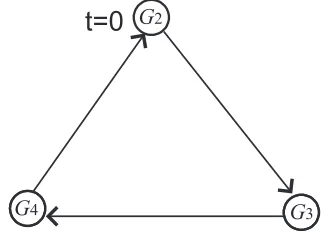
is shown in Figure 4, which represents the of a network with switching topology anhybrid system. It starts at the disc and switches every simulation time step to t
cording to the state machine in Figure
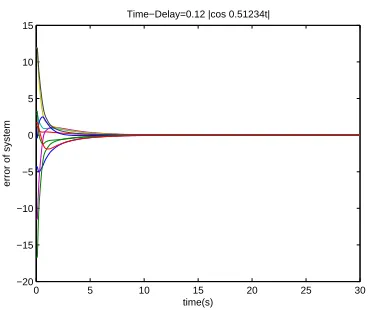
system with time-varying communication ti we take the derivative of delay h10.5. Fr 2,
the feasible maximum is
2 3 4 discrete states d time delay as a rete state G2
he next state ac-4. For multi-agent
me delay, om theorem of the system delay bound
1 0.12
d s. And the corresponding feasible solution P, e obtained by employing
1
QandR1 can b the LM
box in Matlab.
Assume the time-varying dela
I To
e error system ol
is y of th
1( ) 0.12 cos 0.51234t t s
. Figure 5 shows the
corre-sponding error system converges zero asymptotically.
G2
G3
G4
t=0
[image:6.595.66.277.497.677.2] [image:6.595.341.506.578.696.2]0 5 10 15 20 25 30 −20
−15 −10 −5 0 5 10 15
time(s)
error of system
[image:7.595.79.269.76.231.2]Time−Delay=0.12 |cos 0.51234t|
Figure 5. Error system with switching topology and time-varying delay 1( ) 0.12 cos0.51234t ts converges to z asymptotically.
5. Conclusions
This paper addresses an average consensus problem of multiagent systems. Undirected networks with fixed switching network topology coupling multiple tim varying communication delays are considered in this paper. An orthogonal matrix is introduced and the origi-nal system is turned into a reduced dimensioorigi-nal sy At the same time, a Lyapunov-Krasovskii function is constructed in the stable analysis. Sufficient conditions in terms of LMI are given to guarantee the system reach average consensus. Moreover, numerical simulation amples are shown to verify the theoretical analysis.
supported by National Natural Science a under the grant 60604001 and 606-
incial Natural Science Found under the grant 2008CDB316 and 2008CDZ046, and
neighbor rules,” IEEE Transactions on Automatic Control, 001, 2003.
[3] W. Ren, and R. W. Beard, “Consensus seeking in m
“Consensus problems in topology and EEEE Transactions on Automatic Control, pp. 1520–1533, 2004.
eighted average
th a time-varying
93–3398, December 2006.
. 303–313,
ime-delay,”
sus
ero and cooperation in networked multi-agent systems,” in Proceedings of IEEE, Vol. 95, No. 1, pp. 215–233, Janu-ary 2007.
[9] W. Ren, R. W. Beard, and E. M. Atkins, “Information con
and
e- consensus for directed networks of multi-agent,” Micro-computer Information, Vol. 23, No. 7, pp. 239–241, Augest 2007.
[11] W. Ren, “Multi-vehicle consensus wi
stem. reference state,” Systems & Control Letters, Vol. 56, No. 7-8, pp. 474–483, July 2007.
[12] D. P. Spanos, R. O. Saber, and R. M. Murray, “Dynamic
ex-consensus on mobile networks,” In IFAC World Congr., Prague, Czech Republic, 2005.
[13] Y. Hatano and M. Mesbahi, “Agreement over random networks,” IEEE Transactions on Automatic Control, Vol. 50, No. 11, pp. 1867–1872,
6. Acknowledgment
This work was
Nov
Foundation of Chin
74081, Hubei Prov ation [15] A. T. Salehi and A. Jadbabaie, “A necessary and suffi-cient condition for consensus over random networks,” IEEE Transactions on Automatic Control, vol. 53, No. 4, pp. 791–795, April 2008.
Scientific Innovation Team Project of Hubei Provincial College under the grant T200809.
7. References
[1] T. Vicsek, A. Czirok, E. Benjacob, I. Cohen, et al., “Novel type of phasetransition in a system of self-driven particles,” Physical Review Letters, Vol. 75, No. 6, pp. 1226–1229, 1995.
[2] A. Jadbabaie, J. Lin, and A. S. Morse, “Coordination of
groups of mobile autonomous agents using nearest J
Vol. 48, No. 6, pp. 988–1
ulti- Systems & Control Letters, Vol. 57, No. 8, pp. 643–653, Augest 2008.
[20] Y. G. Sun, L. Wang and G. M. Xie, “Average consen agent systems under dynamically changing interaction
topologies,” IEEE Transactions on Automatic Control, Vol. 50, No. 5, pp. 655–661, 2005.
[4] L. Moreau, “Stability of multiagent systems with time- dependent communication links,” IEEE Transactions on Automatic Control, pp. 169–182, 2005.
[5] R. O. Saber, and R. M. Murray, networks of agents with switching time-delays,” I
Vol. 49, No. 9,
[6] R. O. Saber and R. M. Murray, “Consensus protocols for networks of dynamic agents,” in Proceedings of Ameri-can Control Conference, pp. 951–956, June 2003. [7] Y. Tian and C. Liu, “Consensus of multi-agent systems
with diverse input and communication delays,” IEEE Transactions on Automatic Control, Vol. 53, No. 9, pp. 2122–2128, October 2008.
[8] R. O. Saber, J. A. Fax, and R. M. Murray, “Consensus
sensus in multivehicle cooperative control,” IEEE Con-trol Syst. Mag., Vol. 27, No. 2, pp. 71–82, April 2007. [10] H. Yu, J. G. Jian and Y. J. Wang, “W
ember 2005.
[14] R. O. Saber, “Flocking for multi-agent dynamic systems: algorithms and theory,” IEEE Transactions on Automatic Control, Vol. 51, No. 3, pp. 401–420, March 2006.
[16] G. M. Xie and L. Wang, “Consensus control for a class of networks of dynamic agents,” Robust Nonliner Control, Vol. 17, pp. 941–959, 2007.
Y. G. Sun, L. Wa
[17] ng and G. M. Xie, “Average consensus in directed networks of dynamic agents with time-varying delays,” In Proceeding of IEEE Conference Decision & Control, Vol. 57, No. 2, pp. 33
[18] P. Lin and Y. Jia, “Average consensus in networks of multi-agents with both switching topology and coupling time-delay,” Physica A, Vol. 387, No. 1, pp
anuary 2008.
an, “Stability of leaderless di
. Jadbabaie,
“Synchroniza-[23] in networks of dynamic agents with switching topologies and multiple time-varying delays,” Systems & Control Letters, Vol. 57, No. 2, pp. 175–183, February 2008.
[21] D. Angeli and P. A. Blim s-
o-crete-time multiagent systems,” Math. Control Signs Systems, Vol. 18, pp. 293–322, 2006.
[22] A. Papachristodoulou and A
tion in oscillator networks: Switching topologies and non-homogeneous delays,” In Proceedings of the 44th IEEE Conference Decision and Control and the European
Control Conference, pp. 5692–5697, December 2005.
A. Papachristodoulou and A. Jadbabaie, “Synchroniza-tion in oscillator networks with heterogeneous delays, switching topologies and nonlinear dynamics,” In Pr ceedings of the 45th IEEE Conference Decision and Con-trol, pp. 4307–4312, December 2006.
[24] N. Biggs, “Algebraic Graph Theory,” Cambridge Univer-sity Press, Cambridge, U. K., 1974. 6