International Journal of Research (IJR)
e-ISSN: 2348-6848, p- ISSN: 2348-795X Volume 2, Issue 11, November 2015Available at http://internationaljournalofresearch.org
Face Recognition Using Principal Component Analysis
B. Ravi Chandra
M.Tech, Dept of Electronics & Communication Engineering,Dr. K. V. Subba Reddy Institute of
Technology, Kurnool, Andhra Pradesh.
Email: [email protected]
Sri. A. N. Naga Jyothi
Assistant Professor, Dept of Electronics & Communication Engineering, Dr. K. V. Subba Reddy
Institute of Technology, Kurnool, Andhra Pradesh.
Email: [email protected]
Abstract—
An approach to recognize a face using Principal Components Analysis based Genetic Algorithm in the area of computer vision is described in this paper. Face recognition has been one of the interesting and important research fields in the past years. Face recognition is a method by which a face is automatically identified. Facial image analysis plays an important role for human computer interaction but still now automatic face recognition is a big challenge for many applications. PCA is used to extract features from images with covariance analysis method to generate Eigen components of the images and to reduce the dimensionality. Optimization technique which is genetic algorithm gives the optimal solutions from the generated large search space. In this analysis we have used Japanese Female Facial Expression (JAFFE) face database with a result of approximately 96%.
Keywords—Principle Component Analysis; Eigen Components; Genetic Algorithm; Face Recognition; Japanese Female Facial Expression (JAFFE)
I. INTRODUCTION
In the field of computer vision the face recognition has become increasingly relevant in today’s scenario. There are training image with high resolution and if there is any noise then it is filtered and [back groundless] image are taken as a training image and identifies it by a test image [6]. To identify the facial expression still a challenging task now a days. In this paper we discuss face recognition process of human various facial expression using PCA based Genetic Algorithm. To better use the face recognition for the purpose of compression of data is mandatory. Image can be compressed as structural features such as contents
and region [1].The image is reshaped in low dimensional subspace.
This lower dimensional subspace can be represented as a linear combination of eigen faces this
Eigen faces later used in GA. All the face recognition approaches are based on either the overall analysis of the face image that retails to the global information of the face on the location on shape of facial attributes as the eyes, eyebrows, nose, lips etc [Neural+GA] there are various algorithm to implement it such as LDA, PCA, HMM, SVM,ICA.
Genetic Algorithms are a rapidly growing area of artificial intelligence. It was first developed by Jon Holland-university of Michigan based on the Darwin’s theory “survival on the fittest” to provide an efficient techniques for optimization[7].Genetic Algorithms represent an intelligent exploitation of a random search used to solve optimization problems.
Although it randomized, exploit historical information to direct the search into the region of better performance within the search space. Genetic Algorithms are the ways of solving problems by mimicking processes nature uses; i.e. Selection, Mutation, Crossover, and accepting.
In Genetic Algorithm some necessary terms are
Chromosome: A set of genes; a chromosome contains the solution in form of genes.
Gene: A part of chromosome; a gene contains a part of solution.
Population: number of individuals present with same length of chromosome.
Mutation: changing a random gene in an individual.
International Journal of Research (IJR)
e-ISSN: 2348-6848, p- ISSN: 2348-795X Volume 2, Issue 11, November 2015Available at http://internationaljournalofresearch.org
Fitness function: a function that assigns fitness value to the individual. It is problem specific.
Crossover: Crossover is a genetic operator that combines two chromosomes to produce new chromosomes for the offspring.
Fitness: the value assigned to an individual based on how far or close an individual is from the solution; greater the fitness value better the solution it contains.
To solving problems, some solution will be the best among others. The space of all feasible solutions is known as search space. In this process after extracting the features we calculate the weights of all Eigenfaces and these value acts as search space. Each point in the search space represents one possible solution. Then each possible solution can be "marked" by its value or fitness for the problem. The GA looks for the best solution is represented by one point in the search space.
This is motivated by the possibility that the new population will be better than the old one. The Solutions are selected according to their fitness to form new solutions called offspring; more suitable they are more chances they have to reproduce. This is repeated until some condition is satisfied. In this system PCA is used for feature extraction and Genetic Algorithm is used for recognition.
II. RELATED WORK
Many papers published on face recognition for different purpose to overcome different problem. To overcome these problems many researchers have developed many systems like on Principal Component Analysis based and LDA and then on Neural Network used combining Neural Network and Genetic Algorithm and some are on combining Principal Component Analysis and Genetic Algorithm. After that also it is a challenging task to recognize face images from a set of face images. There is no method by which it can be possible to recognize images successfully with the recognition rate 100%. Some researchers have developed a system which gives better recognition rate; some have developed better system which reduces the computational time. Such as using the concept of Genetic algorithm and Step Error Tolerance Back-propagation Neural Network and digital image processing has been published some paper. Static Face Recognition system is developed. In PCA based face recognition the algorithm for real-time Human face tracking is realized. The algorithm takes the advantage not only of geometric relations between a
human face, but also of a good feature extraction. The accuracy of the single-face detection is better than 92% with a simple background and sufficient Light source.
From experiments, the multi-face detection results in slightly
Higher rate of misjudgment. The face detection is accomplished regardless of the viewpointsno matter it is a front view or a side View.
In LDA the ability of discriminant analysis to extract discriminant functions that have capacity of producing accurate classifications is enhanced when the assumptions of normality, linearity, and homogeneity of variance face is represented as a collection of LDP codes for face recognition process. PCA encodes information in an orthogonal linear space, while LDA encodes discriminating information in a linearly separable space and it is not necessarily orthogonal. Algorithms based on LDA are superior to those based on PCA are satisfied.
LDA (Linear Discriminant Analysis) is not an unsupervised learning Algorithm, it is a supervised learning Algorithm. In LDA, the LDP features are obtained by computing the edge response values in all eight directions at each pixel position. It generates a code from the relative strength magnitude. Each Sometimes to recognize image combining two or more systems give better recognition rate. In this paper we have discussed a combining system “PCA based Genetic Algorithm” which gives a good recognition rate and reduces computational times.
III. PRINCIPALCOMPONENT ANALYSIS
In PCA the probe and gallery image must be the same size. The image is treated as the 2-D matrix and as a single vector. The first step is to load the training images. The images must be grayscale image with a consistent resolution. If the image includes background the face recognition approach will not work properly. Each image is converted into column vector by concatenating the row and the images one loaded into a matrix of size M*N, where N is the number of pixel s in each image and M is the number of images .The average image has to calculate and then the deviation is called by subtracting the mean from each original image .Calculate the covariance matrix and then calculate the Eigen vector and the Eigen values of the covariance matrix. These Eigen vectors are called Eigen faces.
International Journal of Research (IJR)
e-ISSN: 2348-6848, p- ISSN: 2348-795X Volume 2, Issue 11, November 2015Available at http://internationaljournalofresearch.org
Fig. 1. Block Diagram of PCA
IV. GENETIC ALGORITHM
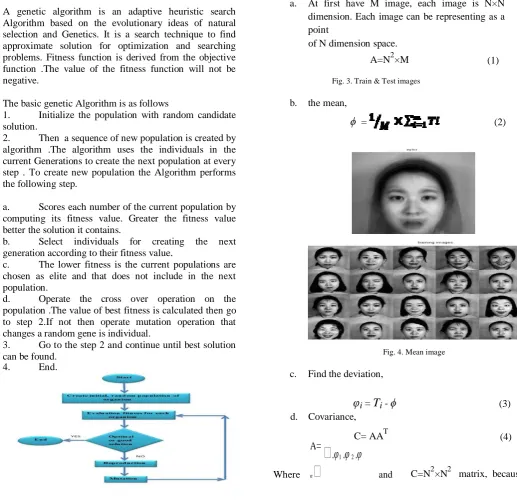
A genetic algorithm is an adaptive heuristic search Algorithm based on the evolutionary ideas of natural selection and Genetics. It is a search technique to find approximate solution for optimization and searching problems. Fitness function is derived from the objective function .The value of the fitness function will not be negative.
The basic genetic Algorithm is as follows
1. Initialize the population with random candidate solution.
2. Then a sequence of new population is created by algorithm .The algorithm uses the individuals in the current Generations to create the next population at every step . To create new population the Algorithm performs the following step.
a. Scores each number of the current population by computing its fitness value. Greater the fitness value better the solution it contains.
b. Select individuals for creating the next generation according to their fitness value.
c. The lower fitness is the current populations are chosen as elite and that does not include in the next population.
d. Operate the cross over operation on the population .The value of best fitness is calculated then go to step 2.If not then operate mutation operation that changes a random gene is individual.
3. Go to the step 2 and continue until best solution can be found.
4. End.
Fig. 2. Flow chart of Genetic Algorithm
V. METHODOLOGY A. Principle Component Analysis (PCA)
In this thesis, Japanese female facial expression standard database has been used. In below it has been used the main approach of PCA where the symbol M represents the number of training image,
ϕ
represents the mean or average image, C represents theCovariance matrix,
φ
represents the deviation.I
i alsorepresents each image as a vector of Ti .
a. At first have M image, each image is N×N dimension. Each image can be representing as a point
of N dimension space.
A=N2×M (1)
Fig. 3. Train & Test images
b. the mean,
ϕ
= (2)Fig. 4. Mean image
c. Find the deviation,
φ
i = Ti -ϕ
(3) d. Covariance,C= AAT (4)
Where
A=
,φ
1 ,φ
2 ,φ
International Journal of Research (IJR)
e-ISSN: 2348-6848, p- ISSN: 2348-795X Volume 2, Issue 11, November 2015Available at http://internationaljournalofresearch.org
A=N2×M matrix, so C is huge. Find out L=ATA that reduces the dimension.
Now calculate the Eigen vector of C using this equation
Ui =AVi (5)
Fig. 5. Eigenfaces
e. Select the best Eigen vector, the selection of the Eigen vectors is done heuristically
B. Genetic Algorithm
1.At first we toke the Eigenfaces that were extracted by principle component analysis shown in figure 6.3.
3.Then calculate the frequency of each gray level. Define a objective function and calculate the fitness value of each Eigenfaces.
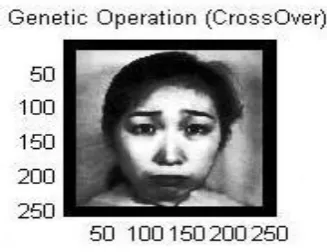
4. Operate the Genetic Algorithm operation on the weights of each Eigenfaces. After operating Crossover we get the Following image.
Fig. 6. Image after applying Crossover
5. If the total Eigenfaces are 20 then we will find the 20 fitness values.
6. Sort the fitness value.
Fig .7. Corresponding image of Fitness value
7.Get a Test image from Test folder. 8.Then go to step 2-4.
9.Subtract the Test image fitness value from the Train images fitness value.
10.Sort the difference values. 11.Minimum value is selected.
And the stop condition of the scheduling function is given above in equation one where bfc is the best fitness value in the current population, bfp is the best fitness value in the past population, is a boundary variation, and ft is the minimum fitness threshold.
|
bfc – bfp| , (ft bfc (6)If, the above stop condition is met, then the GA scheduling function stops and outputs a chromosome with the best fitness value the GAscheduling function continues restarting or reproducing a population.
VI. RESULT AND ANALYSIS
Face recognition system using the concept of principal component analysis and Genetic Algorithm has been discussed. The simulation is done in MATLAB environment. For implementation this work different sample images for Train and Test Database were taken. The MATLAB code was run for a single Test image approximately 20 seconds for 20 Train and Test images and 78 seconds for 100 Train and Test images. The efficiency calculation for our experiment is given in table 1.
Table 1 Efficiency calculation for PCA based GA.
No. of Successfully Unsuccessfully Efficiency Error Face Recognized Recognized (%) (%)
Image Image Image
10 9 1 90% 10%
20 19 1 95% 5%
50 48 2 96% 4%
100 96 4 96% 4%
International Journal of Research (IJR)
e-ISSN: 2348-6848, p- ISSN: 2348-795X Volume 2, Issue 11, November 2015Available at http://internationaljournalofresearch.org
Efficiency Vs Sample Image
98
96
E
ff
ic
ie
n
c
y
94
92
90
G A
88
86
10 20 50 100
No. of Sample Image
Fig.8. Efficiency versus No. of Sample Image.
II. CONCLUSION
Face recognition is highly popular area of research. In this paper, we try to explain basic concepts of face recognition using PCA based Genetic Algorithm. It is an efficient method for recognizing the face in the images.
The PCA based face recognition reduces the computational time and improves the processing speed of face recognition. We used different facial expression of human face images for this experiment. The average Efficiency of this experiment was 94.25% and the average error rate was 5.75%. The experimental result of this paper shows that this method is better robust suitable and high Efficiency than any other before. There are some problems in the time of data processing and extracting feature of face images by which the efficiency is less than 100%.
VIII. REFERENCES
[1] Mahima Agrawal, 2Shubangi.D.Giripunje, 3P.R. Bajaj,”Recognizing Facial Expression using PCA and Genetic Algorithm”, International Journal of Computer & Comunication Technology, April 2011.
[2] Sarawat Anam, Md. Shohidul Islam, M.A. Kashem, M.N. Islam, M.R. Islam, M.S. Islam, “Face Recognition Using Genetic Algorithm and Back Propagation Neural Network”, Proceedings of the International Multi Conference of Engineers and Computer Scientists 2009 Vol I, IMECS 2009, March 18 - 20, 2009, Hong Kong.
[3] Gomathi and K. Baskaran, “improved Face Recognition Method Using Genetic Principal Component Analysis”, Journal of Electronic Science and Technology, Vol. 8, No. 4, December 2010.
[4] Mahendra Pratap Panigrahy, Neeraj Kumar, “Face Recognition Using Genetic Algorithm & Neural Network”, International Journal of Computer Applications (0975 – 8887) Volume 55– No.4, October 2012.
[5] Turk, M. & Pentland, A.P, "Face Recognition Using
EigenFaces",Proceedings of IEEE Conference on Computer Vision and Pattern Recognition, 1991, pp. 586-591.
[6] Venkatesan and Dr.S.Srinivasa Rao Madane, “ Face Recognition System with genetic Algorithm and Anti Colony Optimization”, International Journal of Innovation, Management and Technology, Vol. 1, No. 5, December 2010.
[7] Rafael C. Gonzalez and Richard E Woods,” Digital Image Processing Using MATLAB7”, Person Edu.
[8] D. Goldberg, Genetic Algorithms in Search, Optimization, and Machine Learning, Addison Wesley, 1989.
[9] Yusuf ATILGAN,” FACE RECOGNITION”, MAY, 2009.
[10]Hyvarinen A., Karhunen J., Oja E., Independent Component Analysis, John Wiley, 2001.
[11]A.Golstein, L. Harmon, and A. Lest, “Identi cation of human faces”, Proceedings of the IEEE, 59:748–760, 1971.