Promise Zero Knowledge and its Applications to
Round Optimal MPC
Saikrishna Badrinarayanan UCLA
Vipul Goyal CMU [email protected]
Abhishek Jain JHU
[email protected] Yael Tauman Kalai
Microsoft Research, MIT [email protected]
Dakshita Khurana UCLA
Amit Sahai UCLA [email protected]
Abstract
We devise a newpartitioned simulationtechnique for MPC where the simulator uses different strategies for simulating the view of aborting adversaries and non-aborting adversaries. The protagonist of this technique is a new notion of promise zero knowledge (ZK) where the ZK property only holds against non-aborting verifiers. We show how to realize promise ZK in three rounds in the simultaneous-message model assuming polynomially hard DDH (or QR or Nth-Residuosity).
We demonstrate the following applications of our new technique:
• We construct the first round-optimal (i.e., four round) MPC protocol for general functions based on polynomially hard DDH (or QR or Nth-Residuosity).
• We further show how to overcome the four-round barrier for MPC by constructing a three-round protocol for “list coin-tossing” – a slight relaxation of coin-tossing that suffices for most conceivable applications – based on polynomially hard DDH (or QR or Nth -Residuosity). This result generalizes to randomized input-less functionalities.
Previously, four round MPC protocols required sub-exponential-time hardness assumptions and no multi-party three-round protocols were known for any relaxed security notions with polynomial-time simulation against malicious adversaries.
In order to base security on polynomial-time standard assumptions, we also rely upon a
Contents
1 Introduction 3
1.1 Our Results . . . 5
1.2 Related Work . . . 6
2 Technical Overview 7 2.1 Promise Zero Knowledge . . . 7
2.2 Four Round Secure Multiparty Computation . . . 9
2.3 List Coin-Tossing . . . 12
3 Preliminaries 13 3.1 Secure Multiparty Computation . . . 13
3.2 Delayed-Input Interactive Arguments . . . 14
3.3 Extractable Commitments . . . 14
3.4 Non-Malleable Commitments . . . 15
4 Building Blocks 16 4.1 Trapdoor Generation Protocol . . . 16
4.2 WI with Non-adaptive Bounded Rewinding Security . . . 19
5 Promise Zero Knowledge 19 5.1 Definitions . . . 20
5.2 Constructing Simulation Sound Promise ZK . . . 24
5.3 Security Proof . . . 25
6 Three Round List Coin Tossing 32 6.1 Our List Coin Tossing Protocol . . . 33
6.2 Security Proof . . . 34
7 Four Round Malicious Secure MPC 38 7.1 Building Block: Extractable Commitments with Additional Properties . . . 38
7.2 The MPC Protocol . . . 41
7.3 The Protocol . . . 44
7.4 Security Proof . . . 46
References 67 A WI with Fixed Statement Bounded Rewinding Security 70 B MPC - Proof of Aborting Case 72 C Non-adaptive Bounded Rewinding WI with Reusability Security 77 C.1 Construction . . . 78
1
Introduction
Provably secure protocols lie at the heart of the theory of cryptography. How can we design protocols, not only so that we cannot devise attacks against them, but so that we can prove that no such attacks exist (under well-studied complexity assumptions)? The goal of achieving a proof of security has presented many challenges and apparent trade-offs in secure protocol design. This is especially true with regards to the goal of minimizing rounds of interaction, which has been a long-standing driver of innovation in theoretical cryptography. We begin by focusing on one such challenge and apparent trade-off in the context ofzero-knowledge (ZK) protocols [GMR89], one of the most fascinating and broadly applicable notions in cryptography.
Recall that in a ZK protocol, a prover should convince a verifier that some statement is true, without revealing to the verifier anything beyond the validity of the statement being proven. It is known that achieving zero knowledge with black-box simulation1 is impossible with three or fewer rounds of simultaneous message exchange [GK96, GMPP16]. A curious fact emerges, however, when we take a closer look at the proof of this impossibility result. It turns out that three-round ZK is impossible when considering verifiers that essentially behave completely honestly, but that sometimes probabilistically refuse to finish the protocol. This is bizarre: ZK protocols are supposed to prevent the verifier from learning information from the prover; how can behaving honestly but aborting the protocol early possibly help the verifier learn additional information? Indeed, one might think that we can prove that such behavior cannot possibly help the verifier learn additional information. Counter-intuitively, however, it turns out that such early aborts are critical to the impossibility proofs of [GK96, GMPP16]. This observation is the starting point for our work; now that we have identified a key (but counter-intuitive) reason behind the impossibility results, we want to leverage this understanding to bypass the impossibility result in a new and useful way.
Promise Zero Knowledge. Our main idea is to consider adversarial verifiers that promise not to abort the protocol early with noticeable probability. However, we do not limit ourselves only to adversarial verifiers that behave honestly; we consider adversarial verifiers that may deviate from the prescribed protocol arbitrarily, as long as this deviation does not cause the protocol to abort. A promise zero-knowledge protocol is one that satisfies the correctness and soundness guarantees of ordinary zero-knowledge protocols, but only satisfies the zero knowledge guarantee against ad-versarial verifiers that “promise” not to abort with noticeable probability. The centerpiece of our work is a construction of three-round promise zero-knowledge protocol, in the simultaneous mes-sage model, for proving statements where the statement need not be decided until the last (third) round, but where such statements should come from a distribution such that both a statement and a witness for that statement can be sampled in the last round. We call this primitive adistributional delayed-input promise zero-knowledge argument. Our construction requires only on DDH/QR/Nth -Residuosity assumption. Interestingly, in our construction, we rely upon information learned from the verifier in the third round, to simulate its view in the third round!
Partitioned Simulation, and Applications to MPC. But why should we care about promise ZK? Actual adversaries will not make any promise regarding what specific types of adversarial behavior they will or will not engage in. However, recall our initial insight – early aborting by an adversary should, generally speaking, only hurt the adversary, not help it. We know due to the
1
impossibility results of [GK96, GMPP16], that we cannot leverage this insight to achieve three-round standard ZK (with black-box simulation). Our goal instead, then, is to use our insight to replace ZK with promise ZK for the construction of other secure protocols. Specifically, we consider the most general goal of secure protocol design: secure multi-party computation (MPC), as we discuss further below.
To do so, we devise a novel partitioned simulation strategy for leveraging promise ZK. At a high-level, we split the simulation into two disjoint cases, depending upon whether or not the adversary is an aborting adversary (i.e., one who aborts with high probability). In one case, we will exploit promise ZK. In the other, we exploit the intuition that early aborting should only harm the adversary, to devise alternate simulation strategies that bypass the need for ZK altogether, and instead essentially rely on a weaker notion called strong witness indistinguishability, that was recently constructed in three rounds (in the “delayed-input” setting) in [JKKR17].
Secure Multi-Party Computation. The notion of secure multiparty computation (MPC) [Yao82, GMW87] is a unifying framework for general secure protocols. MPC allows mutually distrusting parties to jointly evaluate any efficiently computable function on their private inputs in such a manner that each party does not learn anything beyond the output of the function.
The round complexity of MPC has been extensively studied over the last three decades in a long sequence of works [GMW87, BMR90, KOS03, KO04, Pas04, PW10, Wee10, Goy11, GMPP16, ACJ17, BHP17, COSV17a, COSV17b]. In this work, we study the problem ofround-optimalMPC against malicious adversaries who may corrupt an arbitrary subset of parties, in the plain model without any trust assumptions. The state-of-the-art results on round-optimal MPC for general functions are due to Ananth et al. [ACJ17] and Brakerski et al. [BHP17], both of which rely on sub-exponential-time hardness assumptions. (See Section 1.2 for a more elaborate discussion on related works.) Our goal, instead is to base security on standard, polynomial-timeassumptions.
We now highlight the main challenge in basing security on polynomial-time assumptions. In the setting of four round protocols in the simultaneous-message model, a rushing adversary may always choose to abort after receiving the honest party messages in the last round. At this point, the adversary has already received enough information to obtain the purported output of the function being computed. This suggests that we must enforce “honest behavior” on the parties within the first three rounds in order to achieve security against malicious adversaries. As discussed above, three-round zero knowledge is impossible, and this is precisely why we look to our new notion of promise ZK and partitioned simulation to resolve this challenge.
However, this challenge is exacerbated in the setting of MPC as we must not only enforce honest behavior but also ensure non-malleabilityacross different cryptographic primitives that are being executed in parallel within the first three rounds. We show how to combine our notions of promise ZK with new simulation ideas to overcome these challenges, relying only on polynomial-time assumptions.
Coin Tossing. Coin-tossing allows two or more participants to agree on an unbiased coin (or a sequence of unbiased coins). Fair multiparty coin-tossing is known to be impossible in the dishonest majority setting [Cle86]. Therefore, while current notions of secure coin-tossing require that the protocol have a (pseudo)-random outcome, the adversary is additionally allowed to abort depending on the outcome of the toss.
Presently, secure multiparty coin-tossing is known to require at least four rounds w.r.t. black-box simulation [GMPP16, KO04]. In this work, we seek to overcome this barrier.
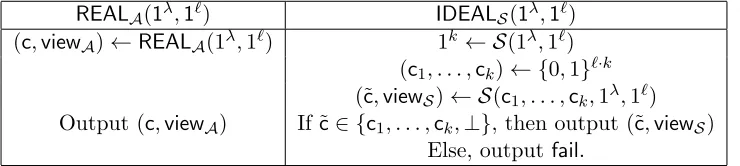
partitioned simulation. The definition of secure coin-tossing roughly requires the existence of a simulator that successfully forces externally sampled random coin, and produces a distribution over adversary’s views that is indistinguishable from a real execution. To account for the adversary aborting or misbehaving based on the outcome, the simulator is allowed to either force an external coin, or force an abort as long as the simulated distribution remains indistinguishable from the real one. Crucially, in the case of an adversary that always aborts before the end of the protocol, the prescribed output of any secure coin-tossing protocol is also abort: therefore, the simulator never needs to forceany external coinagainst such an adversary! Simulating the view of such adversaries that always abort is thus completely trivial. This leaves the case of non-aborting adversaries, which is exactly the setting that promise ZK was designed for.
Using promise ZK, we design a three-round protocol for “list coin-tossing” – a notion that is slightly weaker that regular coin-tossing, but nevertheless, suffices for nearly all important applica-tions of coin-tossing (see below for a discussion). Therefore, promise ZK gives us a way to overcome the four-round barrier for secure coin-tossing [GMPP16, KO04].
1.1 Our Results
We introduce the notion of promise ZK proof systems and devise a new partitioned simulation strategy for round-efficient MPC protocols. Our first result is a three-round distributional delayed-input promise ZK argument system based on DDH/QR/Nth-Residuosity.
Theorem 1 (Informal). Assuming DDH/QR/Nth-Residuosity, there exists a three round
distribu-tional delayed-input promise ZK argument system in the simultaneous-message model.
Round-Optimal MPC. We present two applications of partitioned simulation to round-optimal MPC. We first devise a general compiler that converts any three-round semi-malicious MPC pro-tocol, where the first round is public-coin (i.e., the honest parties simply send random strings in the first round), into a four-round malicious secure MPC protocol. Our compiler can be instanti-ated with standard assumptions such as DDH or Quadratic Residuosity or Nth-Residuosity. The resulting protocol is optimal in the number of rounds w.r.t. black-box simulation [GMPP16]. A three round semi-malicious protocol with the aforementioned property can be obtained based on DDH/QR/Nth Residuosity [GS18, BL18].
Theorem 2 (Informal). Assuming DDH/QR/Nth-Residuosity, there exists a four round MPC protocol for general functions with black-box simulation.
List Coin-Tossing. We also study the feasibility of multiparty coin-tossing in only three rounds. While three round coin-tossing is known to be impossible [GMPP16], somewhat surprisingly, we show that a slightly relaxed variant that we refer to aslist coin-tossing is, in fact, possible in only three rounds.
receives polynomially many random strings from the ideal functionality and “forces” one of them as the CRS. This would still suffice for the NIZK argument system.
We achieve the following result:
Theorem 3(Informal). Assuming DDH/QR/Nth-Residuosity, there exists a three round multiparty list coin-tossing protocol with black-box simulation. This can be generalized to randomized inputless functionalities where security is defined analogously to list coin-tossing.
Finally, we note that by applying the transformation2 of [GMPP16] on the protocol from The-orem 3 for the two-party case, we can obtain a four round two-party list coin-tossing protocol in the unidirectional-message model. This result overcomes the barrier of five rounds for standard two-party coin-tossing established by [KO04].
Corollary 4 (Informal). Assuming DDH/QR/Nth-Residuosity, there exists a four round two-party list coin-tossing protocol in the unidirectional-message model with black-box simulation.
Leveled Rewinding Security. While promise ZK addresses the issue of proving honest behav-ior within three rounds, it does not address non-malleability issues that typically plague security proofs of constant-round protocols in the simultaneous-message model. In particular, when multi-ple primitives are being executed in parallel, we need to ensure that they are non-malleable w.r.t. each other. For example, we may require that a primitive A remains “secure” while the simulator (or a reduction) is (say) trying to extract adversary’s input from primitive B via rewinding.
In the works of [ACJ17, BHP17], such issues are addressed by using complexity leveraging. In particular, they rely upon multiple levels of complexity leveraging to establish non-malleability relationships across primitives, e.g., by setting the security parameters such that primitive X is more secure than primitive Y that is more secure than primitive Z, and so on. Such a use a complexity leveraging is, in fact, quite common in the setting of limited rounds (see, e.g., [COSV16]).
We instead rely upon aleveled rewinding securitytechnique to avoid the use of complexity lever-aging and base security on polynomial-time assumptions. Roughly, in our constructions, primitives have various levels of “bounded rewinding” security that are carefully crafted so that they enable non-malleability relationships across primitives, while still enabling rewinding-based simulation and reductions. E.g., a primitive X may be insecure w.h.p. against 1 rewind, however, another primitive Y may be secure against 1 rewind but insecure against 2 rewinds. Yet another primitive Z may be secure against 2 rewinds but insecure against 3 rewinds, and so on. We remark that leveled rewinding security with a “single level” was previously used in [GRRV14]; here we extend this idea to “multiple levels”.
1.2 Related Work
Concurrent Work. In a concurrent and independent work, Halevi et al. [HHPV17] construct a four round MPC protocol against malicious adversaries in the plain model based on different assumptions than ours. In particular, they rely upon enhanced trapdoor permutations and public-key encryption schemes that admit affine homomorphisms with equivocation (which in turn can be based on LWE/DDH/QR; see [HHPV17]). They do not consider the problems of promise ZK and list coin-tossing.
2The work of Garg et al. [GMPP16] establishes an impossibility result for three round multiparty coin-tossing
Round Complexity of MPC. The study of constant-round protocols for MPC was initiated by Beaver et al. [BMR90]. They constructed constant-round MPC protocols in the presence of honest majority. Subsequently, a long sequence of works constructed constant-round MPC protocols against dishonest majority based on a variety of assumptions and techniques (see, e.g., [KOS03, Pas04, PW10, Wee10, Goy11]).
Garg et al. [GMPP16] initiated the study of the exact round complexity of MPC. They con-structed five (resp., six) round MPC using indistinguishability obfuscation (resp., LWE) and three-round robust non-malleable commitments. Recently, in concurrent works, Ananth et al. [ACJ17] and Brakerski et al. [BHP17] constructed four round MPC protocol based on sub-exponential-time hardness assumptions. While [BHP17] require sub-exponential LWE and adaptive commitments [PPV08], the work of [ACJ17] relied on sub-exponential DDH. Furthermore, [ACJ17] also con-structed a five round MPC protocol based on polynomially hard DDH. Recently, concurrent to our work, Benhamouda and Lin [BL18] constructed five round MPC based on any five round OT.3
Ciampi et al. [COSV17a] constructed four-round multiparty coin-tossing from polynomial-time assumptions. The same authors also construct four-round two-party computation in the simultaneous-message model from polynomial-time assumptions [COSV17b]. However, their results do not extend to general multiparty functionalities, which is the focus of our work.
In the setting of super-polynomial-time simulation, [BGI+17, JKKR17] construct two round two-party computation from sub-exponential DDH. In the multi-party setting, [KS17] construct coin-flipping and [BGJ+17] extend this result to input-less randomized functionalities, again in two rounds with super-polynomial simulation. Garg et al. [GKP17] construct five round concurrent two-party computation from quasi-poly hard assumptions and [BGJ+17] construct three round concurrent MPC from sub-exponential LWE.
All of the above results are in the plain model where no trusted setup assumptions are available. Asharov et. al. [AJL+12] constructed three round semi-malicious MPC protocols in the CRS model. Subsequently, two-round semi-malicious MPC protocols in the CRS model were constructed by Garg et al. [GGHR14] using indistinguishability obfuscation, and by Mukherjee and Wichs [MW16] using LWE assumption. Recently, concurrent to our work, two-round semi-malicious protocols in the plain model were constructed by Garg and Srinivasan [GS17, GS18] and Benhamouda and Lin [BL18] from two-round (semi-malicious) OT. All of these results can be transformed to malicious secure protocols in the CRS model using NIZKs.
2
Technical Overview
In this section, we provide an overview of the main ideas underlying our results.
2.1 Promise Zero Knowledge
Recall that the notion of promise ZK is defined in the simultaneous-message model, where in every round, both the prover and the verifier send a message simultaneously.4 Crucially, the ZK property is only defined w.r.t. a set of admissible verifiers that promise to send a “valid” non-aborting message in the last round with some noticeable probability.
We construct a three round distributional promise ZK protocol with black-box simulation based on DDH/QR/Nth-Residuosity. We work in the delayed-input setting where the statement being
3
Benhamouda and Lin [BL18], in fact, give a more general transformation from anyk-round OT tok-round MPC, fork≥5.
4
proven is revealed to the (adversarial) verifier only in the last round.5 Further, we work in the distributional setting, where statements being proven are sampled from an efficiently sampleable public distribution, i.e., it is possible to efficiently sample a statement together with a witness.
For simplicity of presentation, here we describe our construction using an additional assumption of two-round WI proofs, a.k.a. Zaps [DN00]. In our actual construction of promise ZK, we replace the Zaps with three round delayed-input WI proofs with some additional security guarantees that we construct based on Assuming DDH/QR/Nth-Residuosity.6
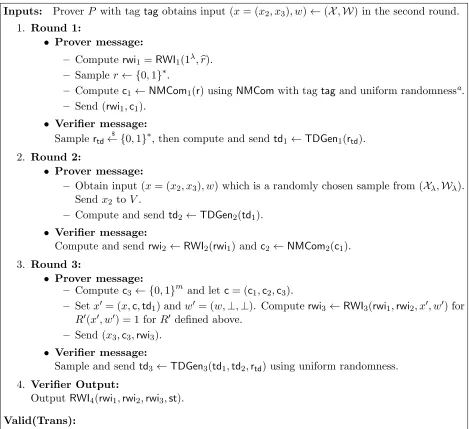
Our construction of promise ZK roughly follows the FLS paradigm [FLS90] for ZK:
• First, the prover and the verifier engage in a three round “trapdoor generation phase” that determines a secret “trapdoor” that is known to the verifier but not the prover.
• Next, in a proof phase, the prover commits to 0 in a (three round) delayed-input extractable commitment and proves via a Zap that either the purported statement is true or that it committed to the trapdoor (instead of 0).
By appropriately parallelizing both of these phases, we obtain a three round protocol in the simultaneous-message model. Below, we discuss the challenges in proving soundness and promise ZK properties.
Proving Soundness. In order to argue soundness, a natural strategy is to rewind the cheating prover in the second and third round to extract the value it has committed in the extractable commitment. If this value is the trapdoor, then we can (hopefully) break the hiding property of the trapdoor generation phase to obtain a contradiction. Unfortunately, this strategy doesn’t work as is since the trapdoor generation phase is parallelized with the extractable commitment. Thus, while extracting from the extractable commitment, we may inadvertently also break the security of the trapdoor generation phase! Indeed, this is the key problem that arises in the construction of non-malleable protocols.
To address this, we observe that in order to prove soundness, it suffices to extract the trapdoor from the cheating prover with some noticeable probability (as opposed to overwhelming probability). Now, suppose that the extractable commitment scheme is such that it is possible to extract the committed value viakrewinds (for some small integerk) if the “main thread” of execution is non-aborting with noticeable probability. Then, we can still argue soundness if the trapdoor generation has a stronger hiding property, namely, security underkrewinds (but is insecure under more thank rewinds to enable simulation; see below). This is an example of leveled rewinding security technique with a single level; later we discuss its application with multiple levels.
We note that standard extractable commitment schemes such as [PRS02, Ros04] (as well as their delayed-input variants) achieve the above extraction property fork= 1. This means that we only require the trapdoor generation phase to maintain hiding property under 1 rewinding. Such a scheme can be easily constructed from one-way functions.
Proving Promise ZK. In order to prove the promise ZK property, we construct a simulator that learns information from the verifier in the third round, in order to simulate its view in the third round! Roughly, our simulator first creates multiple “look-ahead” execution threads7 with
5In our actual construction, we consider a slightly more general setting where a statement x has two parts
(x1, x2): the first partx1 is revealed in the second round while the second part x2 is revealed in the third round.
This generalization is used in our applications of promise ZK, but we ignore it here for simplicity of presentation.
6
In particular, replacing Zaps with delayed-input WI proofs relies on leveled rewinding security technique with multiple levels that we describe in Section 2.2. We do not discuss it here to avoid repetition.
7
the adversarial verifier in order to extract the trapdoor from the trapdoor generation phase. Note that unlike typical ZK protocols where such a look-ahead thread only consists of partial protocol transcript, in our case, each look-ahead thread must contain a full protocol execution since the trapdoor generation phase completes in the third round.
Now, since the adversarial verifier may be rushing, the simulator must first provide its third round message (namely, the second message of Zap) on each look-ahead thread in order to learn the verifier’s third round message. Since the simulator does not have a trapdoor yet, the only possibility for the simulator to prepare a valid third round message is by behaving honestly. However, the simulator does not have a witness for the statement proven by the honest prover. Thus, it may seem that we have run into a circularity.
This is where the distributional aspect of our notion comes to the rescue. Specifically, on the look-ahead execution threads, the simulator simply samples a fresh statement together with a witness from the distribution and proves the validity of the statement like an honest prover. Once it has extracted the trapdoor, it uses its knowledge to cheat (only) on the main thread (but continues to behave honestly on each look-ahead thread).8
2.2 Four Round Secure Multiparty Computation
We now describe the main ideas underlying our compiler from any three round semi-malicious MPC protocol Π (where the first round is public coin) to a four round malicious-secure MPC protocol Σ. For simplicity of presentation, in the discussion below, we ignore the first round of Π, and simply treat it as atwo round protocol.
Starting Ideas. Similar to several previous works, our starting idea is to follow the GMW paradigm [GMW87] for malicious security. This entails two main steps: (1) Enabling extraction of adversary’s inputs, and (2) Forcing honest behavior on the adversary in each round of Π. A natural idea to implement the first step is to require each party to commit to its input and randomness via a three round extractable commitment protocol. To force honest behavior, we require each party to give a delayed-input ZK proof together with every message of Π to establish that it is “consistent” with the input and randomness committed in the extractable commitment.
In order to obtain a four-round protocol Σ, we need to parallelize all of these sub-protocols appropriately. This means that while the proof for the second message of Π can be given via a four round (delayed-input) regular ZK proof, we need a three round proof system to prove the well-formedness of the first message of Π. However, as discussed earlier, three-round ZK proofs are known to be impossible w.r.t. black-box simulation [GK96, GMPP16] and even with non-black box simulation, are not known from standard assumptions.
Promise ZK and Partitioned Simulation. While [ACJ17, BHP17] tackled this issue by using sub-exponential hardness, we address it via partitioned simulation to base security on polynomial-time assumptions. Specifically, we use different mechanisms for proving honest behavior depending upon whether or not the adversary is aborting in the third round. For now, let us focus on the case where the adversary does not abort in the third round of Σ; later we discuss the aborting adversary case.
For the non-aborting case, we rely upon a three-round (delayed-input) distributional promise ZK to prove well-formedness of the first message of Π. As we discuss below, however, integrating
8The idea of using a witness to continue simulation is an old one [BS05]. Most recently, [JKKR17] used this idea
promise ZK in our construction involves overcoming several technical challenges due to specific prop-erties of the promise ZK simulator (in particular, its requirement to behave honestly in look-ahead threads).9 We also remark that in our actual construction, to address non-malleability concerns [DDN91], the promise ZK and the standard ZK protocols that we use are suitably “hardened” using three-round non-malleable commitments [GPR16, Khu17] to achieve simulation soundness[Sah99] in order to ensure that the proofs given by the adversarial parties remain sound even when the proofs given by honest parties are simulated. For simplicity of discussion, however, here we largely ignore this point, and instead focus on the technical ideas that are more unique to our construction. We now proceed to discuss the main technical challenges underlying our construction and its proof of security.
How to do “Non-Malleable” Input Extraction? Let us start with the issue of extraction of adversary’s input and trapdoors (for simulation of ZK proofs). In the aforementioned protocol design, in order to extract adversary’s input and trapdoors, the simulator rewinds the second and third rounds. Note, however, that this process also rewinds the input commitments of the honest parties since they are executed in parallel. This poses the following fundamental challenge: we must somehow maintain privacy of honest party’s inputseven under rewinds, while still extracting the inputs of the adversarial parties.
A plausible strategy to address this issue is to cheat in the rewound executions by sending random third round messages in the input commitment protocol on behalf of each honest party. This effectively nullifies the effect of rewinding on the honest party input commitments. However, in order to implement such a strategy, we need the ability to cheat in the ZK proofs since they are proving “well-formedness” of the input commitments.10
Unfortunately, such a strategy is not viable in our setting. As discussed in the previous subsec-tion, in order to simulate the promise ZK on the main thread, the simulator must behave “honestly” on the rewound execution threads. This suggests that we cannot simply “sidestep” the issue of rewinding and instead must somehow make the honest party input commitments immune to rewind-ing. Yet, we must do this while still keeping the adversary input commitments extractable. Thus, it may seem that we have reached an impasse.
Leveled Rewinding Security to the Rescue. In order to break the symmetry between input commitments of honest and adversarial parties, we use the following sequence of observations:
• The security of the honest party input commitments is only invoked when we switch from a hybrid experiment (say)Hi to another experimentHi+1inside our security proof. In order to
argue indistinguishability of Hi and Hi+1 by contradiction, it suffices to build an adversary
that breaks the security of honest party input commitments with some noticeable probability (as opposed to overwhelming probability).
• This means that the reduction only needs to generate the view of the adversary in hybrids Hi and Hi+1 with some noticeable probability. This, in turn, means that the reduction only
needs to successfully extract the adversary’s inputs and trapdoor (for generating its view) with noticeable probability.
• Now, recall that the trapdoor generation phase used in our promise ZK construction is secure against one rewind. However, if we rewind two times, then we can extract the trapdoor with
9
Our construction of four round MPC, in fact, uses promise ZK in a non-black-box manner for technical reasons. We ignore this point here as it is not important to the discussion.
10
noticeable probability.
• Now, suppose that we can construct an input commitment protocol that maintains hiding property even if it is rewound two times, but guarantees extraction with noticeable probability if it is rewound three times. Given such a commitment scheme, we resolve the above problem as follows: the reduction rewinds the adversary three times, which ensures that with noticeable probability, it can extract both the trapdoor and the inputs from the adversary. In the first two rewound executions, the reduction generates the third round messages of the honest party input commitments honestly. At this point, the reduction already has the trapdoor. Now, in the third rewound execution, it generates random third messages in the honest party input commitments and uses the knowledge of the trapdoor to cheat in the proof.
The above strategy allows us to extract the adversary’s inputs with noticeable probability while still maintaining privacy of honest party inputs. To complete this idea, we construct a new extractable commitment scheme from injective one-way functions that achieves the desired “bounded-rewinding security” property.
Taking a step back, note that in order to implement the above strategy, we created two levels of rewinding security: while the trapdoor generation phase is secure against one rewind (but insecure against two rewinds), the input commitment protocol is secure against two rewinds (but insecure against three rewinds). We refer to this technique asleveled rewinding securitywith multiple levels, and this is precisely what allows us to avoid the use of leveled complexity leveraging.
Using Promise ZK.In the works of [ACJ17, BHP17], the simulator behaves honestly in the first three rounds using random inputs for the honest parties. We depart from this proof strategy, and instead, require our simulator to cheat even in the first three rounds on the main thread.11 Indeed, such a simulation strategy seems necessary for our case since the recent two-round semi-malicious MPC protocols of [GS18, BL18] – which we use to instantiate our compiler – require a cheating simulation strategy even in the first round.
To implement this proof strategy, we turn to promise ZK. However, recall that promise ZK simulator works by behaving honestly in the look-ahead threads. When applied to our MPC construction, this means that we must find a way to behave honestly on the look-ahead threads that are used for extracting inputs and trapdoors from the adversary. However, at first it is not immediately clear how to implement such a strategy. Clearly, our final simulator cannot use honest party inputs on the look-ahead threads to behave honestly.
Instead, our simulator uses random inputs to behave honestly on the look-ahead threads. The main challenge then is to argue that when we switch from using real honest inputs (in an intermedi-ate hybrid) to random inputs on the look-ahead threads, the probability of extraction of adversary’s inputs and trapdoors remains unchanged. Crucially, here, we do not need to consider a joint view across all the look-ahead threads, and instead, it suffices to argue the indistinguishability of adver-sary’s view on each look-ahead thread (when we switch from real input to random input) one at a time. We rely upon techniques from the work of Jain et al. [JKKR17] for this indistinguishability argument. The same proof technique is also used to argue security in the case when the adversary aborts in the third round with overwhelming probability. We discuss this next.
Aborting Adversary Case. In the case where the adversary aborts in the third round with overwhelming probability, we cannot rely upon promise ZK since there is no hope for extraction from such an aborting adversary (which is necessary for simulating promise ZK). Therefore, in
11We emphasize that this strategy is only used in the case where the adversary does not abort in the third round.
this case, the simulator simply behave honestly on the main thread using random inputs (as in [ACJ17, BHP17]). The main challenge then is to switch in an indistinguishable manner from honest behavior in the first three rounds using real inputs to honest behavior using random inputs, while relying only on polynomial-time assumptions.
We address this case by relying upon techniques from [JKKR17]. We remark that we cannot directly use the three-round strong WI argument system of [JKKR17] since it requires the instance being proven to be disclosed to the verifier only in the third round of the protocol. This is not true in our case, since the instance also consists of the transcript of the three-round extractable commitment (and other sub-protocols like the trapdoor generation). Nevertheless, we are able to use ideas from [JKKR17] in a non-black-box manner to enable our security proof; we refer the reader to the technical sections for more details.
Other Issues. We note that since our partitioned simulation technique crucially relies upon identifying whether an adversary is aborting or not, we have to take precaution during simulation to avoid the possibility of the simulator running in exponential time. For this reason, we use ideas first developed in [GK96] and later used in many subsequent works, to ensure that the running time of our simulator is expected polynomial-time.
Finally, we note that the above discussion is oversimplified, and omits several technical points. We refer the reader to the technical sections for full details.
2.3 List Coin-Tossing
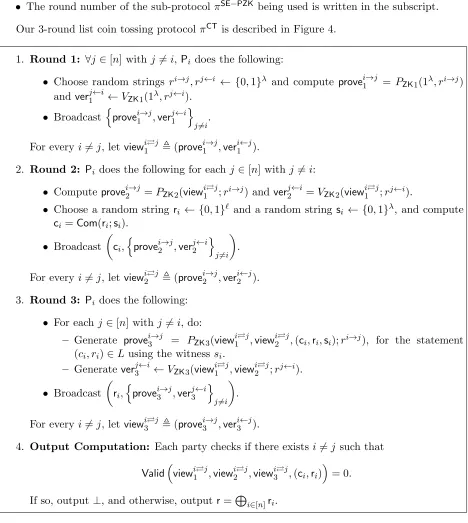
We now describe the main ideas underlying our construction of three round multiparty list coin-tossing. We start by describing the basic structure of our protocol:
• We start with a two-round semi-honest multiparty coin-tossing protocol based on injective one-way functions. Such a protocol can be constructed as follows: In the first round, each party i commits to a string ri chosen uniformly at random, using a non-interactive com-mitment scheme. In the second round, each party reveals ri without the decommitment information. The output is simply the XOR of all the ri values.
• To achieve malicious security, we “compile” the above semi-honest protocol with a (delayed-input) distributional promise ZK protocol. Roughly speaking, in the third round, each party inow proves that the value ri is the one it had committed earlier. By parallelizing the two sub-protocols appropriately, we obtain a three round protocol.
We first note that as in the case of our four round MPC protocol, here also we need to “harden” the promise ZK protocol with non-malleability properties. We do so by constructing a three-round simulation-extractable promise ZK based on DDH/QR/Nth-Residuosity and then using it in the above compiler. Nevertheless, for simplicity of discussion, we do not dwell on this issue here, and refer the reader to the technical sections for further details.
We now describe the main ideas underlying our simulation technique. As in the case of four round MPC, we use partitioned simulation strategy to split the simulation into two cases, depend-ing upon whether the adversary aborts or not in the third round.
out-put” that the simulator needs to enforce on the (aborting) adversary. This is also true for any randomized inputless functionality, and indeed for this reason, our result extends to such function-alities. Note, however, that this is not true for general functionalities where each party has an input.
Non-Aborting Case. We next consider the case where the adversary does not abort in the third round with noticeable probability. Note that in this case, when one execution thread completes, the simulator learns the random stringsrj committed to by the adversarial parties by simply observing the adversary’s message in the third round.
At this point, the simulator queries the ideal functionality to obtain the random output (say) R and then attempts to “force” it on the adversary. This involves simulating the simulation-extractable promise ZK and sending a “programmed” value ri0 on behalf of one of the honest parties so that it leads to the desired output R. Now, since the adversary does not abort in the last round with noticeable probability, it would seem that after a polynomial number of trials, the simulator should succeed in forcing the output. At this point, it may seem that we have successfully constructed a three round multiparty coin-tossing protocol, which would contradict the lower bound of [GMPP16]!
We now explain the flaw in the above argument. As is typical to security with abort, an adversary’s aborting behavior may depend upon the output it receives in the last round. For example, it may always choose to abort if it receives an output that starts with 00. Thus, if the simulator attempts to repeatedly force the same random output on the adversary, it may never succeed.
This is where list coin-tossing comes into the picture. In list coin-tossing, the simulator obtains a polynomial number of random strings from the ideal functionality, as opposed to a single string in regular coin-tossing. Our simulator attempts to force each of (polynomially many) random strings one-by-one on the adversary, in the manner as explained above. Now, each of the trials are inde-pendent, and therefore the simulator is guaranteed to succeed in forcing one of the random strings after a polynomial number of attempts.
Organization. We define some preliminaries in Section 3 and some building blocks for our proto-cols in Section 4. In Section 5, we define and construct Simulation-Extractable Promise ZK. Our three round List Coin Tossing protocol is described in Appendix ??. Finally, the construction of our four round maliciously secure MPC protocol is in Appendix??.
3
Preliminaries
Here, we recall some preliminaries that will be useful in the rest of the paper. Throughout this paper, we will use λ to denote the security parameter, and negl(λ) to denote any function that is asymptotically smaller than poly1(λ) for any polynomial poly(·). We will use PPT to describe a probabilistic polynomial time machine. We will also use the words “rounds” and “messages” interchangeably, whenever clear from context.
3.1 Secure Multiparty Computation
In this work we follow the standard real/ideal world paradigm for defining secure multi-party computation. We refer the reader to [Gol04] for the precise definition.
3.2 Delayed-Input Interactive Arguments
In this section, we describe delayed-input interactive arguments.
Definition 1 (Delayed-Input Interactive Arguments). An n-round delayed-input interactive pro-tocol (P, V) for deciding a language L is an argument system for L that satisfies the following properties:
• Delayed-Input Completeness. For every security parameter λ∈N, and any (x, w)∈RL
such that |x| ≤2λ,
Pr[(P, V)(1λ, x, w) = 1] = 1−negl(λ).
where the probability is over the randomness of P and V. Moreover, the prover’s algorithm initially takes as input only1λ, and the pair (x, w) is given to P only in the beginning of the n’th round.
• Delayed-Input Soundness. For any PPT cheating prover P∗ that choosesx∗ (adaptively) after the first n−1 messages, it holds that if x∗ ∈/L then
Pr[(P∗, V)(1λ, x∗) = 1] =negl(λ).
where the probability is over the random coins of V.
Remark 1. We note that in a delayed-input interactive argument satisfying Definition 1, complete-ness and soundcomplete-ness also hold when (part of ) the instance is available in the first (n−1)rounds.
We will also consider delayed-input interactive arguments in the simultaneous-message setting, that satisfy soundness against rushing adversaries.
3.3 Extractable Commitments
Here onwards until Section 5, we will discuss protocols where only one party sends a message in any round.
Definition 2(Extractable Commitments). Consider any statistically binding, computationally hid-ing commitment scheme hC, Ri. Let TranshC(m, rC), R(rR)i denote a commitment transcript with
committer inputm, committer randomnessrC and receiver randomnessrR, and letDecom(τ, m, rC)
denote the algorithm that on input a commitment transcriptτ, committer messagem and random-ness rC outputs 1 or 0 to denote whether or not the decommitment was accepted (we explicitly
require the decommitment phase to not require receiver randomness rR).
ThenhC, Riis said to be extractable if there exists an expected PPT oracle algorithmE, such that for any PPT cheating committer C∗ the following holds. LetTranshC∗, R(rR)i denote a transcript
of the interaction between C∗ and R. Then EC∗(TranshC∗, R(r
R)i) outputs m, rC such that over
the randomness of E and of sampling TranshC∗, R(rR)i:
Pr[(∃me 6=m,reC) such thatDecom(τ,m,e erC) = 1] =negl(λ)
Remark 2. The notion of extraction described in Definition 2 is often referred to as over-extraction. This is because the extractor E is allowed to output any arbitrary value if TranshC∗, R(rR)i does
not contain a commitment to any valid message. On the other hand, if TranshC∗, R(rR)i is a valid
Definition 3(k-Extractable Commitments). An extractable commitment satisfying Definition 2 is said to bek-extractable if there exists a polynomialp(·)such that the extractorEC∗(TranshC∗, R(r
R)i) with k−1 queries to C∗, outputs m, rC such that over the randomness of E and of sampling
TranshC∗, R(rR)i:
Pr[Decom(τ, m, rC) = 1]≥p(λ)
Delayed-Input Extractable Commitments. We say that an extractable commitment is delayed-inputif the committer uses the input message m only in the last round of the protocol.
Theorem 5. [PRS02, Ros04] For any constant K > 0, assuming injective one-way functions, there exists a three round delayed-input K-extractable commitment scheme satisfying Definition 3.
3.4 Non-Malleable Commitments
We start with the definition of non-malleable commitments by Pass and Rosen [PR05] and further refined by Lin et al [LPV08] and Goyal [Goy11]. (All of these definitions build upon the original definition of Dwork et al. [DDN91]).
In the real experiment, a man-in-the-middle adversary MIM interacts with a committer C in the left session, and with a receiver R in the right session. Without loss of generality, we assume that each session has identities or tags, and require non-malleability only when the tag for the left session is different from the tag for the right session.
At the start of the experiment, the committer C receives an input val and MIM receives an auxiliary input z, which might contain a priori information about val. Let MIMhC,Ri(val, z) be a
random variable that describes the value valf committed byMIM in the right session, jointly with
the view of MIMin the real experiment.
In the ideal experiment, a PPT simulator S directly interacts with MIM. Let SimhC,Ri(1λ, z)
denote the random variable describing the valuevalf committed to by S and the output view ofS.
In either of the two experiments, if the tags in the left and right interaction are equal, then the valuevalf committed in the right interaction, is defined to be ⊥.
We define a strengthened version of non-malleable commitments for use in this paper.
Definition 4 (Special Non-malleable Commitments). A three round commitment scheme hC, Ri
is said to be special non-malleable if:
• For everysynchronizing12 PPTMIM, there exists a PPT simulator S such that the following ensembles are computationally indistinguishable:
{MIMhC,Ri(val, z)}λ∈N,val∈{0,1}λ,z∈{0,1}∗ and{SimhC,Ri(1λ, z)}
λ∈N,val∈{0,1}λ,z∈{0,1}∗
• hC, Ri is delayed-input, that is, correctness holds even when the committer obtains his input only in the last round.
• hC, Ri satisfieslast-message pseudorandomness, that is, for every non-uniform PPT receiver R∗, it holds that {REALR0∗(1λ)}λ and {REALR1∗(1λ)}λ are computationally indistinguishable, where forb∈ {0,1}, the random variableREALRb∗(1λ) is defined via the following experiment.
1. Run C(1λ) and denote its output by (com1, σ), where σ is its secret state, and com1 is
the message to be sent to the receiver.
12A synchronizing adversary is one that sends its message for every round before obtaining the honest party’s
2. Run the receiver R∗(1λ,com1), who outputs a message com2.
3. If b= 0, runC(σ,com2) and send its message com3 toR∗. Otherwise, ifb= 1, compute com3
$
← {0,1}m and send it toR∗. Here m=m(λ) denotes |com3|.
4. The output of the experiment is the output of R∗.
• hC, Ri satisfies 2-extractability according to Definition 3.
Goyal et al. [GPR16] construct three-round special non-malleable commitments satisfying Def-inition 4 based on injective OWFs.
Imported Theorem 1 ([GPR16]). Assuming injective one-way functions, there exists a three round non-malleable commitment satisfying Definition 4.
4
Building Blocks
We now describe some of the building blocks we use in our constructions.
4.1 Trapdoor Generation Protocol
In this section, we define and construct a primitive called Trapdoor Generation Protocol. In such a protocol, a sender S (a.k.a. trapdoor generator) communicates with a receiverR. The protocol satisfies two properties: (i) Sender security, i.e., no cheating PPT receiver can learn a valid trapdoor, and (ii) Extraction, i.e., there exists an expected PPT algorithm (a.k.a. extractor) that can extract a trapdoor from an adversarial sender via rewinding.
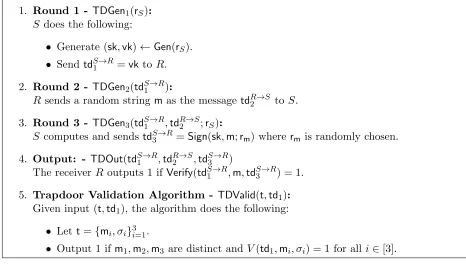
We construct a three-round trapdoor generation protocol where the first message sent by the sender determines the set of valid trapdoors, and in the next two rounds the sender proves that indeed it knows a valid trapdoor. Such schemes are known in the literature based on various assumptions [PRS02, Ros04, COSV17a]. Here, we consider trapdoor generation protocols with a stronger sender security requirement that we refer to as 1-rewinding security. Below, we formally define this notion and then proceed to give a three-round construction based on one-way functions. Our construction is a minor variant of the trapdoor generation protocol from [COSV17a].
Syntax. A trapdoor generation protocol
TDGen= (TDGen1,TDGen2,TDGen3,TDOut,TDValid,TDExt)
is a three round protocol between two parties - a sender (trapdoor generator) S and receiver R that proceeds as below.
1. Round 1 - TDGen1(·):
S computes and sends tdS1→R←TDGen1(rS) using a random string rS.
2. Round 2 - TDGen2(·):
R computes and sendstdR2→S ←TDGen2(tdS1→R;rR) using randomnessrR.
3. Round 3 - TDGen3(·):
S computes and sends tdS3→R←TDGen3(tdR2→S;rS)
4. Output - TDOut(·)
5. Trapdoor Validation Algorithm - TDValid(·):
Given input (t,tdS1→R), output a single bit 0 or 1 that determines whether the value t is a valid trapdoor corresponding to the message td1 sent in the first round of the trapdoor
generation protocol.
In what follows, for brevity, we set td1 to be tdS1→R. Similarly we use td2 and td3 instead
of tdR2→S and tdS3→R, respectively. Note that the algorithm TDValid does not form a part of the interaction between the trapdoor generator and the receiver. It is, in fact, a public algorithm that enables public verification of whether a valuet is a valid trapdoor for a first round messagetd1.
Extraction. There exists a PPT extractor algorithmTDExtthat, given a set of values13(td1,{tdi2,tdi3}3i=1)
such that td12,td22,td32 are distinct and TDOut(td1,tdi2,tdi3) = 1 for alli∈[3], outputs a trapdoor t
such thatTDValid(t,td1) = 1.
1-Rewinding Security. We define the notion of 1-rewinding securityfor a trapdoor generation protocolTDGen. Consider the following experiment between a senderSand any (possibly cheating) receiverR∗.
Experiment E:
• R∗ interacts with S and completes one execution of the protocolTDGen. R∗ receives values (td1,td3) in rounds 1 and 3 respectively.
• Then,R∗ rewindsS to the beginning of round 2.
• R∗ sends S a new second round message td∗2 and receives a message td∗3 in the third round.
• At the end of the experiment,R∗ outputs a valuet∗.
Definition 5 (1-Rewinding Security). A trapdoor generation protocolTDGen= (TDGen1,TDGen2, TDGen3,TDOut,TDValid)achieves 1-rewinding security if, for every non-uniform PPT receiverR∗
in the above experiment E,
Pr
TDValid(t∗,td1) = 1
=negl(λ),
where the probability is over the random coins of S, and where t∗ is the output of R∗ in the experiment E, and td1 is the message from S in round 1.
4.1.1 Construction
We now describe a three round trapdoor generation protocol based on one way functions.
Let S and R denote the sender and the receiver, respectively. Let λ denote the security pa-rameter. Let (Gen,Sign,Verify) be a signature scheme that is existentially unforgeable against chosen-message attacks. Such schemes are known based on one-way functions [GMR88].
Theorem 6. Assuming the existence of one way functions, the protocol ΠTD described in Figure 1 is a 1-rewinding secure trapdoor generation protocol.
13These values can be obtained from the malicious sender via an expected PPT rewinding procedure. The expected
PPT simulator in our applications performs the necessary rewindings and then feeds these values to the extractor
1. Round 1 - TDGen1(rS):
S does the following:
• Generate (sk,vk)←Gen(rS).
• SendtdS1→R=vktoR.
2. Round 2 - TDGen2(tdS1→R):
R sends a random stringmas the message tdR2→S toS.
3. Round 3 - TDGen3(tdS1→R,tdR2→S;rS):
S computes and sends tdS3→R=Sign(sk,m;rm) whererm is randomly chosen.
4. Output: - TDOut(tdS1→R,td2R→S,tdS3→R)
The receiver R outputs 1 ifVerify(td1S→R,m,tdS3→R) = 1.
5. Trapdoor Validation Algorithm - TDValid(t,td1):
Given input (t,td1), the algorithm does the following:
• Lett={mi, σi}3i=1.
• Output 1 if m1,m2,m3 are distinct andV(td1,mi, σi) = 1 for all i∈[3].
Figure 1: Trapdoor Generation Protocol ΠTD.
Proof. Suppose the protocol ΠTD is not 1-rewinding secure. That is, there exists a malicious receiverR∗ that breaks the 1-rewinding security. We will use R∗ to design an adversaryASign that
breaks the unforgeability of the signature scheme. ASign, and upon receiving a verification keyvk, it interacts withCSign and withR∗, as follows: First, it sets td1 =vkand sendstd1 toR∗ in round
1. Upon receiving a query td2 = m from R∗,ASign forwards this to CSign and receives a value σm
from CSign which it sends to R∗ as the messagetd3. Then, upon receiving a query td∗2 =m∗ from
R∗ in the rewound execution,ASign once again does the same. That is,ASign forwards this to CSign
and receives a value σm∗ from CSign which it sends toR∗ as the messagetd∗
3.
Then, since R∗ breaks the 1-rewinding security, it outputs a value t∗ in experiment E such that TDValid(t∗,td1) = 1 with non-negligible probability p. Recall from the definition of the
algorithm TDValid, it must be the case thatt∗={mi, σi}3i=1 such thatm1,m2,m3 are distinct and
V(vk,mi, σi) = 1 for alli. ASign picks the valuemi ∈ {/ m,m∗}and outputs (mi, σi) as a forgery.
Extractor TDExt(·). The extractor works as follows. It receives a verification keyvk=td1, and
a set of values {mi, σi}3i=1 such that mi are all distinct andVerify(vk,mi, σi) = 1 for every i∈[3]. Then, TDExtoutputs t={mi, σi}3i=1 as a valid trapdoor. Correctness of the extraction is easy to
see by inspection.
4.2 WI with Non-adaptive Bounded Rewinding Security
We define the notion of three-round delayed-input witness indistinguishable (WI) argument with “bounded-rewinding security,” and construct such a primitive assuming the existence of polynomi-ally hard DDH (or QR or Nth-Residuosity). In the non-delayed-input setting, such a primitive was implicitly constructed and used previously by Goyal et al. [GRRV14].14
We formally define three-round delayed-input WI withnon-adaptivebounded-rewinding security here. In Appendix C, we describe a construction for the same. For our applications, we instantiate the rewinding parameterB with the value 6.
Definition 6(3-Round Delayed-Input WI with Non-adaptive Bounded Rewinding Security). Fix a positive integerB. A delayed-input 3-round interactive argument (as defined in Definition 1) for an NP language L, with an NP relationRL is said to be WI withNon-adaptiveB-Rewinding Security
if for every non-uniform PPT interactive Turing Machine V∗, it holds that {REALV0∗(1λ)}λ and
{REALV1∗(1λ)}λ are computationally indistinguishable, where for b ∈ {0,1} the random variable REALVb∗(1λ) is defined via the following experiment. In what follows we denote byP1 the prover’s
algorithm in the first round, and similarly we denote by P3 his algorithm in the third round.
Experiment REALVb∗(1λ):
1. Run P1(1λ) and denote its output by (rwi1, σ), where σ is its secret state, and rwi1 is the
message to be sent to the verifier.
2. Run the verifierV∗(1λ,rwi1), who outputs{(xi, wi)}i∈[B−1],xB, wB0, wB1 and a set of messages
{rwii2}i∈[B].
3. For each i∈[B−1], runP3(σ,rwii2, xi, wi), and for i=B, runP3(σ,rwii2, xi, wib) where P3 is
the (honest) prover’s algorithm for generating the third message of the WI protocol, and send its message{rwii3}i∈[B] to V∗.
In Appendix C, we prove the following theorem:
Theorem 7. Assuming DDH/QR/Nth-Residuosity, there exists a three round delayed-input witness-indistinguishable argument system with non-adaptive(B = 6)-rewinding security.
5
Promise Zero Knowledge
In this section, we introduce our new notion of promise zero knowledge interactive arguments. Un-like the standard notion of zero knowledge interactive arguments that is defined in the unidirectional-message model of communication, promise ZK is defined in the simultaneous-unidirectional-message model, where in every round, both the prover and the verifier simultaneously send a message to each other. Cru-cially, in promise ZK, the zero knowledge property is only required to hold against a specific class of “valid” verifiers (that do not send invalid messages).
Validity Check. Before defining promise ZK, we enhance the syntax for simultaneous-message interactive arguments to include an additional algorithm Valid. That is, a simultaneous-message interactive argument is denoted by (P, V,Valid). The notions of completeness and soundness remain intact as before. Looking ahead, the intuition behind introducing the new algorithm is that we want
to capture those verifiers who send a “valid” message in every round (including the last round). We do this by using the Validalgorithm.
This algorithm Valid is protocol specific. For example, if the honest verifier is instructed to prove knowledge of a trapdoor that he generated, and the proof fails, then his messages are not valid. Importantly, even if only the verifier’s last message is invalid, and even though the prover does not need to explicitly respond to this message15 we refer to this transcript as invalid. We denote by Validthe (public verification) algorithm which checks whether the transcript, including the verifier’s last message, is valid or not, that is,
Valid(Trans(P(x, w), V∗)) = 1
if and only if all the messages sent byV∗ appear to be valid, given the transcript. The correctness requirement of this algorithm is that if the verifier’s messages are generated honestly according to the protocol, then
Pr[Valid(Trans(P(x, w), V)) = 1] = 1.
Looking ahead, in our protocols, at the end of each execution of the ZK protocol, the prover will check whether the verifier sent “valid” messages, and if not, the prover will abort.
5.1 Definitions
We now proceed to describe our notion of promise zero knowledge. Roughly speaking, we define promise ZK similarly to standard ZK, with two notable differences: First, promise ZK is defined in the simultaneous-message model. Second, the zero knowledge property is only defined w.r.t. a special class of verifiers who generate a valid transcript, with some noticeable probability. In order to define this notion, we need to have an estimation of the probability that the cheating verifier sends an invalid message throughout the protocol.
Validity Approximation. Consider a delayed-input simultaneous message interactive argument system (P, V,Valid). Consider any verifierV∗, and any efficiently sampleable distributionD={Dλ}, whereDλ samples pairs (x, w) such thatx∈ {0,1}λ and (x, w)∈R
L
In what follows we denote by P = (P1, P2), a prover that is split into two parts. First,
(viewV∗,1,st) ← P1(1λ) is obtained, and then P2(x, w,st) continues the rest of the P algorithm withV∗. This is done primarily because we would like to approximate the the validity probability of V∗ conditioned on viewV∗,1.
LetTrans(P2(x, w,st), V∗) denote the protocol transcript betweenP2andV∗: that is,Trans(P, V∗) =
(viewV∗,1,Trans(P2(x, w,st), V∗)). Let
qviewV∗,1 = Pr[Valid(viewV∗,1,Trans(P2(x, w,st), V
∗)) = 1|(view
V∗,1,st)←P1(1λ)]
where the probability is over the generation of (x, w)← Dλand the coins ofP2. We emphasize that
qviewV∗,1 depends onDand on V
∗, we omit this dependence from the notation to avoid cluttering.
Definition 7. For any constant c∈ N, a PPT oracle algorithmpExtractc is said to be a validity approximation algorithm, if the following holds for all malicious verifiers V∗ and for all efficiently sampleable distributionsD={Dλ}:
15We use this promise ZK protocol as a building block in our MPC protocols, and in these protocols, the party
• If pExtractVc∗,D(viewV∗,1,st) = 0, then qview
V∗,1 <2·λ
−c.
• Otherwise, if pExtractVc∗,D(viewV∗,1,st) =p, then p≥λ−c and p
2 < qviewV∗,1 <2·p.
We now formalize our notion of promise ZK. We note that this only considers the delayed-input distributional setting. For simplicity of exposition, we restrict ourselves to 3-round protocols since this work is only concerned with constructions and applications of 3-round promise zero-knowledge. We note that this definition can be extended naturally to any number of rounds.
Definition 8 (Promise Zero Knowledge). A 3-round distributional delayed-input simultaneous-message interactive argument (P, V,Valid) for a language L is said to be promise zero knowledge against delayed-input verifiersif there exists an oracle machine Sim= (Sim1,Sim2,Sim3) such that
for every constantc∈N, and any validity approximation algorithmpExtractc, for every polynomials
ν =ν(λ)andeν=eν(λ), for every efficiently sampleable distributionD={Dλ}such thatSupp(Dλ) =
{(x, w) :x∈L∩ {0,1}λ, w∈R
L(x) where x= (x2, x3), w= (w2, w3)}, for any delayed-input PPT
verifier V∗ that obtains xi in round iand any z∈ {0,1}poly(λ), conditions 1 and 2 (defined below)
hold for REALV∗ andIDEALV∗ (defined below).
• REALV∗ is computed as follows:
– Sample (viewV∗,1,st)←P1(1λ).
– Sample (x, w)← Dλ where x= (x2, x3).
– Execute the interaction (viewV∗,1,hP2(x, w,st), V∗(viewV∗,1)i), where V∗ obtains xi in round i.
– The output of the experiment is the view ofV∗in the execution(x,hP(x, w), V∗(viewV∗,1)i).
• IDEALV∗ is computed as follows:
– Sample (viewV∗,1,st)←P1(1λ).
– Computep=pExtractVc∗(viewV∗,1,st).
– Sample (x, w)← Dλ where x= (x2, x3). – If p= 0,
∗ Execute the interaction (viewV∗,1,hP2(x, w,st), V∗(viewV∗,1)i), where V∗ obtains xi in roundi.
∗ The output of the experiment is(x,hP(x, w), V∗(viewV∗,1)i).
– Else, execute SimV∗(x,viewV∗,1,st, p)→(viewV∗,2,viewV∗,3), which operates as follows:
∗ ComputeSimV1∗(viewV∗,1,st, p)→st1.
∗ Then compute SimV2∗(x2,viewV∗,1,st1)→(viewV∗,2,st2).
∗ Finally, computeSimV3∗(x3,viewV∗,1,viewV∗,2,st2) to output(viewV∗,3).
Conditions 1 and 2 are defined as follows:
1. No PPT distinguisher can distinguish REALV∗ from IDEALV∗ with advantage greater than λ−c.
2. For any inputx= (x2, x3), the running time ofSimV
∗
1 (viewMIM,1,st, p)is polynomial inλand
linear in 1p, and the running times ofSimV2∗(x2,viewV∗,1,st)andSimV ∗
3 (x3,viewV∗,1,viewV∗,2,st2) are polynomial in λ and independent ofp.
Defining Simulation-Sound Promise ZK in the multi-party setting. We now consider a man-in-the-middle adversary that interacts in promise zero-knowledge protocols as follows: It opens polynomially many sessions where it plays the role of the verifier interacting with an honest prover; these are called “left” sessions, and we denote byν the number of such left sessions. We note that in all left sessions, the honest prover proves the same statement with the same witness. It can simultaneously initiate polynomially many sessions where it plays the role of the prover interacting with an honest verifier: these are called “right” sessions, and we denote by eν the number of such right sessions. We restrict ourselves to synchronous (rushing) adversaries, that for each round j, send all their j’th round messages (in all sessions), before observing any of the honest parties messages for the next round of the protocol.
We formalize the notion of simulation-soundness against a rushing man-in-the-middle adversary below, where we useeato denote any random variableathat corresponds to a right session.
Redefining Validity Approximation. Similarly to before, we need to approximate the prob-ability that the messages sent by a man-in-the-middle adversary in the left execution are valid, conditioned on all messages in the first round of the protocol. We consider ν “left” sessions and
e
ν “right” sessions. Similar to the setting of promise ZK, we denote by P = (P1, P2), an honest
prover for the “left” sessions that is split into two parts, P1 generates the first round message,
and P2 generates the messages of the second and third rounds. Below, we abuse notation and
use P, P1, P2 not only to denote the interaction of the honest prover in a single session, but also
to denote the interaction of the honest prover in all ν left sessions, using independent random-ness for each such execution. LetTransleft(P2(x, w,viewMIM,1,st),MIM) denote all the transcripts in
the “left” sessions between P2(x, w,viewMIM,1,st) and MIM, which can be decomposed as follows: Transleft(P,MIM) = (viewMIM,1,Transleft(P2(x, w,viewMIM,1,st),MIM)). For any viewMIM,1 sampled
according to honest prover and verifier strategy as described above, let
qviewMIM,1 = Pr[Valid(viewMIM,1,Transleft(P2(x, w,viewMIM,1,st),MIM)) = 1|(viewMIM,1,st)←P1(1
λ)]
where Valid above refers to the AND of all the validity tests for each of the ν left sessions, and the probability is over the generation of (x, w)← Dλ and the coins of each of the ν instantiations of P2. We emphasize that qviewMIM,1 depends on D and on MIM, we omit this dependence from
the notation to avoid cluttering. We re-define the algorithmpExtractcfrom Definition 8 to depend additionally on the honest verifier first messages in the right sessions.
Definition 9. For any constant c ∈ N, a PPT oracle algorithm pExtractc is said to be a valid-ity approximation algorithm, if the following holds for all MIM and for all efficiently sampleable distributions D={Dλ}, with probability at least 1−2−λ over the coins of the algorithm, we have
that:
• If pExtractMIMc ,D(viewMIM,1,st) = 0, then qviewMIM,1 <2·λ
−c.
• Else, if pExtractMIMc ,D(viewMIM,1,st) =p, then p≥λ−c and p2 < qviewMIM,1 <2·p.
Remark 3. We briefly describe a canonical polynomial-time validity approximation algorithm for any constant c∈N:
1. pExtractMIMc ,D(viewMIM,1,st) executesλ2·λcindependent executions of all sessions with MIM,
2. Letρ be the number of these executions that resulted in allleft executions begin valid. We call such executions successful trials.
3. If ρ < λ2, output 0.
4. Otherwise, output ρ/(λ2·λc).
We now informally analyze this algorithm:
• Observe that ifpExtractMIMc ,D(viewMIM,1,st)outputs zero, this means that fewer thanλ2 trials
succeeded. On the other hand, if qviewMIM,1 ≥ 2·λ
−c, then the expected number of successful
trials is at least 2λ2. By a Chernoff bound, except with probability at most 2−λ, at least λ2 trials must succeed if qviewMIM,1 ≥2·λ
−c. Thus, the first condition is satisfied.
• Observe that ifpExtractMIMc ,D(viewMIM,1,st)outputs a nonzero value, then this value must be at
least λ−c by construction. And again, the required condition on qviewMIM,1 follows immediately
from a Chernoff bound.
For simplicity, we restrict ourselves to 3 rounds in the definition below. This suffices for our construction and applications.
Definition 10(Simulation-Sound Promise Zero Knowledge). A 3-round publicly-verifiable promise zero-knowledge argument against delayed-input verifiers(P, V,Valid) is said to be simulation-sound if there exists an oracle machine Sim= (Sim1,Sim2,Sim3) such that, for every constantc∈N, and
any validity approximation algorithm pExtractc, for every polynomials ν =ν(λ) and νe=νe(λ), for every efficiently sampleable distribution D={(Xλ,Wλ)} such that Supp((X,W)λ) ={(x, w) : x∈
L∩ {0,1}λ, w ∈ R
L(x) where x = (x2, x3)}, and every distribution Xλ0 such that Xλ and Xλ0 are
computationally indistinguishable, for any PPT synchronous MIM that initiates ν “left” sessions and eν “right” sessions, we require the following to hold. Let
SimMIM(x0,viewMIM,1,st, p)→(viewMIM,2,viewMIM,3,{xei}i∈[eν])
whereviewMIM,1are all the messages sent in the first round (both left and right executions) withMIM,
andstdenotes all the corresponding secret states of the honest parties, andp=pExtractcMIM,D(viewMIM,1,st).
• For any input x0 = (x02, x03), we have thatSimMIM(x0,viewMIM,1,st, p)operates by first
comput-ing
SimMIM1 (viewMIM,1,st, p)→st1
then computing
SimMIM2 (x02,viewMIM,1,st1)→(viewMIM,2,st2)
and then computing
SimMIM3 (x02, x03,viewMIM,1,viewMIM,2,st2) = (viewMIM,3,{xei}i∈[eν]).
Here, viewMIM,2 and viewMIM,3 denotes the set of all messages sent in the second and third
round (respectively) of the multi-party execution with MIM. We require that {xei} (which is
part of the output of SimMIM) is consistent16 with(viewMIM,2,viewMIM,3).
16Note that (view
MIM,2,viewMIM,3) includes the instances {xei}, and we add the instances explicitly to the output