Lattice-Based zk-SNARKs from Square Span Programs
Rosario Gennaro1, Michele Minelli2,3, Anca Nitulescu2,3, and Michele Orr`u2,3 1 City College of New York, USA
2
DIENS, ´Ecole normale sup´erieure, CNRS, PSL University, 75005 Paris, France 3 Inria
{michele.minelli, anca.nitulescu, michele.orru}@ens.fr
Abstract. Zero-knowledge SNARKs (zk-SNARKs) are non-interactive proof systems with short and efficiently verifiable proofs. They elegantly resolve the juxtaposition of individual privacy and public trust, by providing an efficient way of demonstrating knowledge of secret information without actually revealing it. To this day, zk-SNARKs are being used for delegating computation, electronic cryptocurrencies, and anonymous credentials. However, all current SNARKs implementations rely onpre-quantumassumptions and, for this reason, are not expected to withstand cryptanalitic efforts over the next few decades.
In this work, we introduce the first designated-verifier zk-SNARK based on lattice assumptions, which are believed to be post-quantum secure. We provide a generalization in the spirit of Gennaro et al. (Eurocrypt’13) to the SNARK of Danezis et al. (Asiacrypt’14) that is based on Square Span Programs (SSPs) and relies on weaker computational assumptions. We focus on designated-verifier proofs and propose a protocol in which a proof consists of just 5 LWE encodings. We provide a concrete choice of parameters as well as extensive benchmarks on a C implementation, showing that our construction is practically instantiable.
Keywords: post-quantum; SNARK; zero-knowledge.
1
Introduction
Zero-Knowledge Proof Systems. Proof systems [GMR89] are a fundamental tool in theoretical computer science and cryptography. Consider an NP relationRwhich defines the language of all statementsxfor which there exists a witnesswso thatR(x, w) =true.In a zero-knowledge proof forRa prover, knowing a witness, wants to convince a verifier thatxis in the language, without revealing any additional information about the witness.
Since their introduction in [GMR89] zero-knowledge (ZK) proofs have been shown to be a very powerful instrument in the design of secure cryptographic protocols.
For practical applications, researchers immediately recognized two limiting factors in zero-knowledge proofs: the original protocols were interactive and the proof could be as long as (if not longer than) the witness. When considering statistically sound proof systems for NP, unless some complexity-theoretic collapse occurs, the prover Phas to communicate, roughly, as much information as the size of the NP witness. Looking for ways to overcome this bound motivated the study ofcomputationally-soundproof systems, also calledargument systems[BCC88].
Non-interactive zero-knowledge (NIZK) proofs [BFM88] and succinct ZK arguments [Kil92, Mic94] were introduced shortly thereafter. Those results were considered mostly theoretical proofs of concept until more recently, when several theoretical and practical breakthroughs [PHGR13,DFGK14] have shown that such proofs (renamed zk-SNARGs for Succinct Non-interactive ARGuments, or zk-SNARKs if the proofs also guarantee that the prover knows the witnessw) can indeed be used in practical applications.
random oracle model. In the plain model, a non-interactive argument requires the verifierV to generate a common reference stringcrsahead of time and independently of the statement to be proved by the prover P. Such systems are called succinct non-interactive arguments(SNARGs) [GW11]. Several SNARGs constructions have been proposed [Gro10,BCCT12,Lip12,BCC+14, GGPR13, BCI+13,PHGR13,BCG+13, BCTV14], and the area of SNARGs has become popular in the last years with the proposal of constructions which introduced significant improvements in efficiency. An important remark is that all such constructions are based on non-falsifiable assumptions [Nao03], a class of assumptions that is likely to be inherent in proving the security of SNARGs for general NP languages (without random oracles), as shown by Gentry and Wichs [GW11].
Many SNARGs are also arguments of knowledge – so called SNARKs [BCCT12, BCC+14]. Intuitively speaking, the knowledge soundness property of SNARKs says that every prover producing a convincing proof must “know” a witness. Proofs of knowledge are useful in many applications, such as anonymous credentials, computation delegation, confidential transactions, and recursive proof composition [Val08,BCCT13].
Public vs. Designated Verifiability. We distinguish two types of arguments of knowledge:
publicly verifiable ones, where the verification algorithm takes as input only common reference
stringcrs, and designated-verifier ones, where the verifierVtakes as input together with the crs some additional private verification keyvrs. In the first case, proofs are meant to be verified by anyone having access to thecrs. In the case of designated-verifier proofs, the proof can be verified only by the verifierVknowing the secret informationvrs. It is straightforward to note that, with the help of an encryption scheme, any publicly-verifiable proof system can be transformed into an analogous designated-verifier one (by just encrypting the proof under the verifier’s key). It is nonetheless important to note that in the standard model, all NIZK constructions we are aware of somehow imply the existence of an encryption scheme.
Quadratic Span Programs. Gennaro, Gentry, Parno and Raykova [GGPR13] proposed a new, influential characterization of the complexity class NP usingQuadratic Span Programs(QSPs), a natural extension of span programs defined by Karchmer and Wigderson [KW93]. They show there is a very efficient reduction from boolean circuit satisfiability problems to QSPs. Their work has led to fast progress towards practical verifiable computations. For instance, using Quadratic Arithmetic Programs (QAPs), a generalization of QSPs for arithmetic circuits, Pinocchio [PHGR13] provides evidence that verified remote computation can be faster than local computation. At the same time, their construction is zero-knowledge, enabling the server to keep intermediate and additional values used in the computation private. Optimized versions of SNARK protocols based on QSPs approach are used in various practical applications, including cryptocurrencies such as Zcash [BCG+14a], to guarantee anonymity while preventing double-spending.
The QSP approach was generalized in [BCI+13] under the concept of Linear PCP(LPCP), a form of interactive ZK proofs where security holds under the assumption that the prover is restricted to compute only linear combinations of its inputs. These proofs can then be turned into (designated-verifier) SNARKs by using anextractable linear-only encryption scheme, i.e., an encryption scheme where any adversary can output a valid new ciphertext only if this is an affine combination of some previous encryptions that the adversary had as input (intuitively this “limited malleability” of the encryption scheme, will force the prover into the above restriction).
So far all known zk-SNARKs rely on “classical” pre-quantum assumptions4. Yet, there are widely deployed systems relying on zk-SNARKs (for instance, the Zcash cryptocurrency [BCG+14b]) which are expected not to withstand cryptanalitic efforts over the course of the next 10 years
4
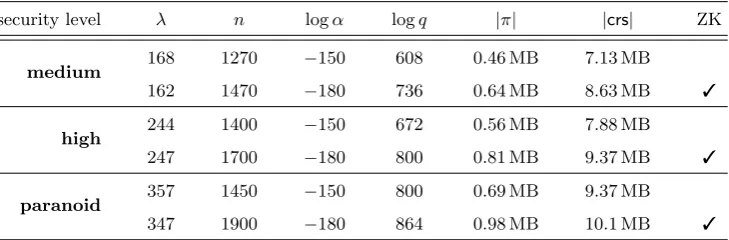
Table 1.Security estimates for different choices of LWE parameters (circuit size fixed tod= 215), together with
the corresponding sizes of the proofπand of the CRS (when using a seeded PRG for its generation).
security level λ n logα logq |π| |crs| ZK
medium 168 1270 −150 608 0.46 MB 7.13 MB
162 1470 −180 736 0.64 MB 8.63 MB 3
high 244 1400 −150 672 0.56 MB 7.88 MB
247 1700 −180 800 0.81 MB 9.37 MB 3
paranoid 357 1450 −150 800 0.69 MB 9.37 MB
347 1900 −180 864 0.98 MB 10.1 MB 3
[ABL+17, Appendix C]. It is an interesting research question, as well our duty as cryptographers, to provide protocols that can guarantee people’s privacy over the next decade. We attempt to make a step forward in this direction by building a designated-verifier zk-SNARK from lattice-based (knowledge) assumptions. Our scheme uses as a main building block encodings that rely on the Learning With Errors (LWE) assumption, initially proposed by Regev in 2005 [Reg05], and right now the most widespread post-quantum cryptosystem supported by a theoretical proof of security.
SNARGs based on lattices. Recently, in two companion papers [BISW17,BISW18], Boneh et al. provided the first designated-verifier SNARGs construction based on lattice assumptions.
The first paper has two main results: an improvement on the LPCP construction in [BCI+13] and a construction of linear-only encryption based on LWE. The second paper presents a different approach where the information-theoretic LPCP is replaced by a LPCP with multiple provers, which is then compiled into a SNARG again via linear-only encryption. The main advantage of this approach is that it reduces the overhead on the prover, achieving what they callquasi-optimality5. The stronger notion of knowledge soundness (which leads to SNARKs) can be achieved by replacing the linear-only property with a stronger (extractable) assumption [BCI+13].
Our contributions. In this paper, we frame the construction of Danezis et al. [DFGK14] for Square Span Programs in the framework of “encodings” introduced by Gennaro et al. [GGPR13]. We slightly modify the definition of encoding to accommodate for the noisy nature of LWE schemes. This allows us to have a more fine-grained control over the error growth, while keeping previous example encodings still valid instantiations. Furthermore, SSPs are similar to but simpler than Quadratic Span Programs (QSPs) since they use a single series of polynomials, rather than 2 or 3. We use SSPs to build simpler and more efficient designated-verifier SNARKs and Non-Interactive Zero-Knowledge arguments (NIZKs) for circuit satisfiability (CIRC-SAT).
We think our work is complementary to [BISW17,BISW18]. However, there are several reasons why we believe that our approach is preferable:
– Zero-Knowledge.The LPCP-based protocols in [BISW17,BISW18] do not investigate the possibility of achieving zero-knowledge. This leaves open the question of whether zk-SNARKs can be effectively instantiated. Considering the LPCP constructed for a QSP satisfiability problem, there is a general transformation to obtain ZK property [BCI+13]. However, in the case of “noisy” encodings, due to possible information leakages in the error term, this transformation cannot be directly applied. Our SNARK construction, being SSP-based, can be made ZK at essentially no cost for either the prover or the verifier. Our transformation is 5
different, exploiting special features of SSPs, and yields a zk-SNARK with almost no overhead. Our construction constitutes the first (designated-verifier) zk-SNARK on lattices.
– Weaker Assumptions.The linear-only property on encodings introduced in [BCI+13] implies all the security assumptions needed by a SSP-suitable encoding, but the reverse is not known to hold. Our proof of security therefore relies on weaker assumptions and, by doing so, “distills” the minimal known assumptions needed to prove security for SSP, and instantiates them with lattices. We study the relations between our knowledge assumption and the (extractable) linear-only assumption inAppendix A.
– Simplicity and Efficiency.While the result in [BISW18] seems asymptotically more efficient than any SSP-based approach, we believe that, for many applications, the simplicity and efficiency of the SSP construction will still provide a concrete advantage in practice. We implemented and tested our scheme: we provide some possible concrete parameters for the instantiation of our zk-SNARKs inTable 1, whereas more details on the implementation, along with benchmark results, are presented inSection 6.
Technical challenges. Although conceptually similar to the original proof of security for QSP-based SNARKs, our construction must incorporate some additional modifications in order to overcome the noise growth of the LWE-based homomorphic operations. These challenges do not arise in the line of work of Boneh et al. [BISW17,BISW18] due to the more general (and stronger) assumption of linear-only encoding (seeAppendix A for details). Additionally, our construction benefits from the optimizations of SSP-based SNARKs [DFGK14].
Instantiating our encoding scheme with a lattice-based scheme like Regev encryption, differs from [GGPR13] and introduces some technicalities, first in the verification step of the protocol, and secondly in the proof of security. Our encoding scheme is additively homomorphic and allows for linear operations; however, correctness of the encoding is guaranteed only for a limited number of homomorphic operations because of the error growth in lattice-based encoding schemes. More specifically, to compute a linear combination ofN encodings, we need to scale some parameters for correctness to hold. Throughout this work we will consider only encodings where a bounded number of homomorphic “linear” operations is allowed, and make sure that this bound is sufficient to perform verification and to guarantee the existence of a security reduction.
2
Prerequisites
2.1 Notation
Letλ∈N be the computational security parameter, andκ∈N the statistical security parameter. We say that a function is negligible inλ, and we denote it by negl(λ), if it is af(λ) = o(λ−c) for any fixed constantc. We also say that a probability isoverwhelming inλif it is 1−negl(λ). We letM.rl(λ) be alength function (i.e., a functionN→N polynomially bounded) inλdefining the length of the randomness for a probabilistic interactive Turing MachineM. When sampling uniformly at random the valueafrom the setS, we employ the notationa←$S. When sampling the value afrom the probabilistic algorithm M, we employ the notation a ←M. We use := to denote assignment. For ann-dimensional column vector~a, we denote itsi-th entry byai. In the same way, given a polynomialf, we denote itsi-th coefficient byfi. Unless otherwise stated, the normk·kconsidered in this work is the`2 norm. We denote by~a·~bthe dot product between vectors
~aand~b. LetRbet a relation between statements denoted byuand witnesses denoted byw.u. Unless otherwise specified, all the algorithms defined throughout this work are assumed to be probabilistic Turing machines that run in timepoly(λ) - i.e.,PPT. An adversary is denoted byA; when it is interacting with an oracleO, we writeAO. For twoPPTmachinesA,B, with the writing
2.2 Square Span Programs
We characterize NP as Square Span Programs (SSPs) over some field Fof order p. SSPs were introduced first by Danezis et al. [DFGK14].
Definition 1 (SSP). A Square Span Program (SSP) over the fieldFis a tuple consisting ofm+ 1 polynomialsv0(x), . . . , vm(x)∈F[x]and a target polynomialt(x)such that deg(vi(x))6deg(t(x)) for alli= 0, . . . , m. We say that the square span programssp has sizemand degree d= deg(t(x)). We say thatssp accepts an inputa1, . . . , a`∈ {0,1}if and only if there exist a`+1, . . . , am∈ {0,1}
satisfying:
t(x)divides v0(x) + m X
i=1
aivi(x) !2
−1.
We say thatsspverifies a boolean circuitC:{0,1}`→ {0,1} if it accepts exactly those inputs (a1, . . . , a`)∈ {0,1}`satisfyingC(a1, . . . , a`) = 1.
Universal circuit. In the definition, we may see C as a logical specification of a satisfiability problem. In our zk-SNARK we will split the`inputs into `u public and`w private inputs to make it compatible with the universal circuitCU : {0,1}`u× {0,1}`w → {0,1}, that take as input an `u-bit description of a freely chosen circuitC and an`w-bit value w, and return 1 if and only if C(w) = 1. Along the lines of [DFGK14], we consider the “public” inputs from the point of view of the prover. For an outsourced computation, they might include both the inputs sent by the clients and the outputs returned by the server performing the computation.
Theorem 2 ([DFGK14, Theorem 2]). For any boolean circuitC:{0,1}`→ {0,1} ofm wires
and n fan-in 2 gates and for any prime p≥ max(d,8), for d =m+n, there exist polynomials
v0(x), . . . , vm(x)∈F[x] and distinct rootsr0, . . . , rd−1∈Fsuch thatC is satisfiable if and only if: d−1
Y
i=0
(x−ri)divides v0(x) + m X
i=1
aivi(x) !2
−1,
wherea1, . . . , am∈ {0,1}correspond to the values on the wires in a satisfying assignment for the circuit.
Definet(x) :=Qdi=0−1(x−ri), then for any circuitC:{0,1}`→ {0,1} of mwires and n gates, there exists a degree d=m+nsquare span program ssp= (v0(x), . . . , vm(x), t(x))over a fieldF, of orderp≥max(d,8)that verifiesC.
SSP generation. We consider the uniform probabilistic algorithmSSPthat, on input a boolean circuit C : {0,1}` → {0,1} of m wires and n gates, chooses a field F, with |F| ≥ max(d,8) for d= m+n, and samples drandom elements r0, . . . , rd ∈ F to define the target polynomial
t(x) =Qdi=0−1(x−ri), together with the set of polynomials{v0(x), . . . , vm(x)} composing the SSP corresponding toC.
(v0(x), . . . , vm(x), t(x))←SSP(C)
2.3 Succinct Non-Interactive Arguments
In this section we provide formal definitions for the notion of succinct non-interactive arguments of knowledge (SNARKs).
Definition 3. A non-interactive (NI) proof system for a relation R is a triple of algorithms Π= (G,P,V)as follows:
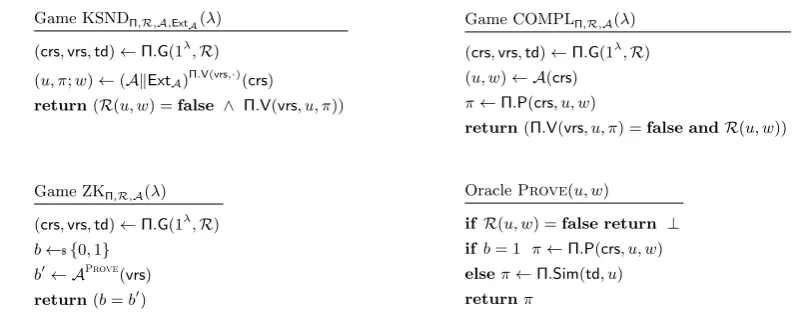
Game KSNDΠ,R,A,ExtA(λ)
(crs,vrs,td)←Π.G(1λ,R)
(u, π;w)←(AkExtA)Π.V(vrs,·)(crs)
return(R(u, w) =false ∧ Π.V(vrs, u, π))
Game COMPLΠ,R,A(λ)
(crs,vrs,td)←Π.G(1λ,R)
(u, w)← A(crs)
π←Π.P(crs, u, w)
return(Π.V(vrs, u, π) =false andR(u, w))
Game ZKΠ,R,A(λ)
(crs,vrs,td)←Π.G(1λ,R)
b←${0,1}
b0← AProve(vrs)
return(b=b0)
OracleProve(u, w)
ifR(u, w) =false return ⊥
ifb= 1 π←Π.P(crs, u, w)
elseπ←Π.Sim(td, u)
returnπ
Fig. 1.Games for completeness (COMPL), knowledge soundness (KSND), and zero-knowledge (ZK).
π←P(crs, u, w) the prover algorithm takes as input the CRS, a statementu, and a witnessw. It outputs some proofπ.
bool←V(vrs, u, π) the verifier algorithm takes as input a statement utogether with a proofπ, and vrs. It outputs true if the proof was accepted,false otherwise.
In the same line of past works [DFGK14,Fuc18], we will assume for simplicity thatcrs can be extracted from the verification keyvrs, and that the unary security parameter 1λ as well as the relationRcan be inferred from thecrs.
Non-interactive proof systems are generally asked to satisfy some security properties that simultaneously protect the prover from the disclosure of the witness, and the verifier from a forged proof. We now examine some of these notions.
A proof is complete if every correctly-generated proof verifies. More formally,
Definition 4 (Completeness).A non-interactive proof systemΠ for the relationRis (computa-tionally) complete if for anyPPTadversaryA:
AdvcomplΠ,R,A(λ) := Pr
COMPLΠ,R,A(λ) =true
=negl(λ), whereCOMPLΠ,R,A(λ) is the game depicted inFig. 1.
The concept that the prover “must know” a witness is expressed by assuming that such knowledge can be efficiently extracted from the prover by means of a so-calledknowledge extractor. For any prover able to produce a valid proof, there exists an efficient algorithm which, when given the same inputs as the prover (and the same random coins), is capable of extracting a witness for the given statement. Formally:
Definition 5 (Knowledge Soundness).A non-interactive proof system Πfor the relation Ris knowledge-soundif for anyPPT adversaryAthere exists an extractor ExtA such that:
AdvksndΠ,R,A,ExtA(λ) := Pr
KSNDΠ,R,A,ExtA(λ) =true
=negl(λ), whereKSNDΠ,R,A,ExtA(λ)is defined in Figure 1.
Anargument of knowledgeis aknowledge-soundproof system. If the adversary is computationally unbounded, we speak ofproofs rather than arguments.
Remark 6. An important consideration that arises when defining knowledge soundness in the
be reusedpoly(λ) times. While this distinction cannot be made in the publicly-verifiable setting, the same is not true for the designated-verifier setting. In the specific case of our construction, we formulate and prove our protocol allowing the adversary access to the verification algorithm (which has been namedstrong soundness in the past [BISW17]), and later discuss which optimizations can take place when using the weaker notion of soundness, where the adversary cannot access the verification oracle.
A proof systemΠforRis zero-knowledge if no information about the witness is leaked by the proof. More precisely,Πspecifies an additional poly(λ) algorithm Π.Simthat takes as input the trapdoor information tdand a statementu, and outputs a valid proofπ indistinguishable from those generated viaΠ.P.
Definition 7 (Zero-Knowledge). A non-interactive proof systemΠis zero-knowledgeif there
for anyPPT adversaryA:
AdvzkΠ,R,A(λ) := Pr
ZKΠ,R,A(λ) =true
=negl(λ), whereZKΠ,R,A(λ)is defined in Figure 1.
Succinctness. Finally, we say that a proof systemΠissuccinct if the proof has size (quasi-)linear in the security parameter, i.e.,|π|= ˜O(λ).
Definition 8 (SNARK).Asuccinct non-interactive argument of knowledge (SNARK) is a non-interactive proof system that is complete, succinct, and knowledge-sound. A zk-SNARK is a SNARK with zero-knowledge.
Publicly verifiable vs. designated verifier. If security (knowledge soundness) holds against adversaries that have also access to the verification statevrs(i.e.,Areceivesvrs) then the SNARK is called publicly verifiable, otherwise it is designated-verifier.
In the remainder of this work all constructions and proofs are given for the designated-verifier setting.
2.4 Encoding Schemes
Encoding schemes for SNARKs were initially introduced in [GGPR13]. Here, we present a variant of this definition that accommodates for encodings with noise.
Definition 9 (Encoding Scheme). An encoding schemeEnc over a fieldFis composed of the following algorithms:
– (pk,sk)←K(1λ), a key generation algorithm that takes as input some security parameter in unary1λ and outputs some secret statesk together with some public informationpk. To ease notation, we are going to assume the message space is always part of the public information and thatpk can be derived fromsk.
– S←E(a), a non-deterministic encoding algorithm mapping a field elementa to some encoding spaceS, such that{{E(a)}:a∈F} partitionsS, where{E(a)}denotes the set of the possible evaluations of the algorithmEon a.
Depending on the encoding algorithm,Ewill require either the public informationpk generated fromK or the secret statesk. For our application, it will be the case ofsk. To ease notation, we will omit this additional argument.
The above algorithms must satisfy the following properties:
Game q-PKEEnc,Z,A,ExtA,z(λ)
(pk,sk)←K(1λ)
α, s←$F∗
σ←(pk,E(1),E(s), . . . ,E(sq),E(α),E(αs), . . . ,E(αsq))
z←Z(pk, σ)
(ct,ctb;a0, . . . , aq)←(AkExtA)(σ, z) return(ctb−αct∈ {E(0)}) ∧ ct6∈
E(Pq iaisi)
Game q-PKEQEnc,A,ExtA(λ)
(pk,sk)←K(1λ)
s←$F
σ←(pk,E(1),E(s), . . . ,E(sq),E(sq+2), . . . ,E(s2q)) (E(c), e;b)←(AkExtA)(σ)
ifb= 0returne∈ {E(c)}
else returne6∈ {E(c)}
Game q-PDHEnc,A(λ)
(pk,sk)←K(1λ)
s←$F
σ←(pk,E(1),E(s), . . . ,E(sq),E(sq+2), . . . ,E(s2q)) y← A(σ)
returny∈
E(sq+1)
Fig. 2. Games forq-PKE, q-PKEQ, q-PDH assumptions.
quadratic root detection: there exists an efficient algorithm that, given some parameterδ(either pkor sk),E(a0), . . . ,E(at), and the quadratic polynomialpp∈F[x0, . . . , xt], can distinguish if pp(a1, . . . , at) = 0. With a slight abuse of notation, we will adopt the writingpp(ct0, . . . ,ctt) = 0 to denote the quadratic root detection algorithm with inputsδ,ct0, . . . ,ctt, andpp.
image verification: there exists an efficiently computable algorithm∈that, given as input some parameterδ(again, either pkorsk), can distinguish if an element c is a correct encoding of a field element.
Our specific instantiation of the encoding scheme presents some slight differences with [GGPR13]. In fact, we can allow only for a limited number of homomorphic operations because of the error growth in lattice-based encoding schemes. We note that this modification does not invalidate previous constructions. Sometimes, in order to ease notation, we will employ the writing ct:= Eval(E(ai)i, ~c) = E(t), actually meaning that ct is a valid encoding of t =
P
aici; that is, ct∈ {E(t)}. It will be clear from the context (and the use of symbol for assignment instead of that for sampling) that the randomized encoding algorithmEis not actually invoked.
Decoding algorithm. When using a homomorphic encryption scheme in order to instantiate an encoding scheme, we simply define thedecoding algorithm Das the decryption procedure of the scheme. More specifically, since we study encoding schemes derived from encryption functions, quadratic root detection and image verification for designated-verifiers are trivially obtained by using the decryption procedureD.
2.5 Assumptions
Throughout this work we rely on a number of computational assumptions. All of them are long-standing assumptions in the frame of dLog-hard groups, and have already been generalized in the scope of “encoding schemes” in [GGPR13]. We recall them here for completeness.
Theq-power knowledge of exponent assumption (q-PKE) is a generalization of the knowledge of exponent assumption (KEA) introduced by Damgard [Dam92]. It says that givenE(s), . . . ,E(sq) andE(αs), . . . ,E(αsq) for some coefficientα, it is difficult to generatect,
b
Assumption 1 (q-PKE). Theq-Power Knowledge of Exponent (q-PKE) assumption holds relative
to an encoding scheme Enc and for the class Z of auxiliary input generators if, for every
non-uniform PPT auxiliary input generatorZ∈ Z and non-uniformPPTadversary A, there exists a
non-uniform extractorExtsuch that:
AdvpkeEnc,Z,A,Ext
A(λ) := Pr
q-PKEEnc,Z,A,ExtA(λ) =true=negl(λ), whereq-PKEEnc,Z,A,ExtA(λ)is the game depicted in Figure 2.
Theq-PDH assumption has been a long-standing, standardq-type assumption [Gro10,BBG05], It basically states that given E(1),E(s), . . . ,E(sq),E sq+2
, . . . ,E s2q
, it is hard to compute an encoding of the missing powerE(sq+1).
Assumption 2 (q-PDH). Theq-Power Diffie-Hellman (q-PDH) assumption holds for encoding Encif for all PPT adversariesAwe have:
AdvqEnc-pdh,A(λ) := Prq-PDHEnc,A(λ) =true=negl(λ), whereq-PDHEnc,A(λ)is defined as inFigure 2.
Optionally, to achieve strong-soundness (seeRemark 6), we need an assumption to be able to “compare” adversarially-generated messages. Theq-PKEQ assumptions states that for any adversary Athat outputs two ciphertexts, there exists an extractorExtA that can tell whether they encode
the same value.
Assumption 3 (q-PKEQ). Theq-Power Knowledge of Equality (q-PKEQ) assumption holds for the encoding schemeEnc if, for everyPPT adversaryA, there exists an extractorExtAsuch that:
AdvqEnc-pkeq,A,ExtA(λ) := Prq-PKEQEnc,A,ExtA(λ) =true
=negl(λ), whereq-PKEQEnc,A,ExtA(λ)is the game depicted in Figure 2.
Teq-PKEQ assumption is needed solely in the case where the attacker has access to a verification oracle. Since the encoding could be non-deterministic, the simulator in the security reduction of Section 5.2 needs to rely on q-PKEQ to simulate the verification oracle. Pragmatically, this assumption allows us to test for equality of two adversarially-produced encodings without having access to the secret key.
Finally, we recall here a well-known assumption for lattices, that we will use to instantiate our quantum-secure encoding scheme.
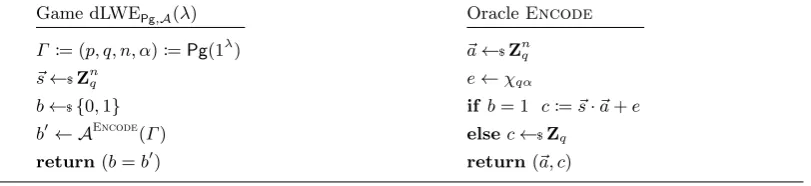
Assumption 4 (dLWE).
The decisional Learning With Errors (dLWE) assumption holds for a parameter generation algorithmPg if for anyPPT adversaryA:
AdvdlwePg,A(λ) := Pr
dLWEPg,A(λ) =true
−1/2 =negl(λ),
wheredLWEPg,A(λ)is defined as inFigure 3.
In [Reg05], Regev showed that solving the decisional LWE problem is as hard as solving some lattice problems in the worst case.
3
An encoding scheme based on Learning With Errors
Game dLWEPg,A(λ)
Γ := (p, q, n, α) :=Pg(1λ) ~
s←$Znq
b←${0,1}
b0← AEncode(Γ)
return(b=b0)
OracleEncode
~a←$Znq
e←χqα
if b= 1 c:=~s·~a+e
elsec←$Zq
return(~a, c)
Fig. 3.The decisional LWE problem for parametersΓ.
Lattices. Am-dimensional latticeΛis a discrete additive subgroup ofRm. For an integerk < m and a rank k matrixB ∈Rm×k, Λ(B) =B~x∈Rm |~x∈Zk is the lattice generated by the columns ofB.
Gaussian distribution. For any σ∈R+, letρ
σ(~x) :=e−πk~xk 2/σ2
be the Gaussian function over
Rn with mean 0 and parameterσ. For any discrete subsetA⊆Rnwe defineρσ(A) :=P~x∈Aρσ(~x), the discrete integral ofρσ overA. We then defineχσ, the discrete Gaussian distribution overA with mean 0 and parameterσas:
χσ:A→R+:~y7→
ρσ(~y)
ρσ(A)
.
We denote byχn
σ the discrete Gaussian distribution over Rn where each entry is independently sampled fromχσ.
3.1 Lattice-based Encoding Scheme
We propose an encoding schemeEncthat consists of three algorithms as depicted inFigure 4. This is a slight variation of the classical LWE cryptosystem initially presented by Regev [Reg05] and later extended in [BV11]. The encoding schemeEnc is described by parametersΓ := (q, n, p, α), withq, n, p∈Nsuch that (p, q) = 1, and 0< α <1. Our construction is an extension of the one presented in [BV11].
We assume the existence of a deterministic algorithm Pg that, given as input the security parameter in unary 1λ, outputs an LWE encoding descriptionΓ. The choice of using adeterministic parameter generationPgwas already argued by Bellare et al. [BFS16]. The main advantage of this choice is that every entity can (re)compute the description for a given security parameter, and that no single party needs to be trusted with generating the encoding parameters. Moreover, it is often the case that real-world encodings have fixed parameters for some well-known values ofλ. For the sake of simplicity, we define our encoding scheme with a LWE encoding descriptionΓ and assume that the security parameterλcan be derived fromΓ.
Roughly speaking, the public information is constituted by the LWE parameters Γ and an encoding ofmis simply an LWE encryption ofm. The LWE secret key constitutes the secret state of the encoding scheme.
3.2 Basic Properties
Correctness.. We say that the encoding scheme is (statistically)correct if all valid encodings are decoded successfully (with overwhelming probability).
K(1λ)
Γ := (p, q, n, α) :=Pg(1λ) ~
s←$Znq
return(Γ, ~s)
E(~s, m)
Γ := (p, q, n, α) :=Pg(1λ) ~a←$Znq
σ:=qα; e←χσ
return(−~a, ~a·~s+pe+m)
D(~s,(~c0, c1))
Γ := (p, q, n, α) :=Pg(1λ)
return(~c0·~s+c1) (modp)
Fig. 4.An encoding scheme based on LWE.
We say that an encodingctof a message munder secret key~sis valid ifD(~s,ct) =m. We say that an encoding is freshif it is generated through theE algorithm. We say that an encoding is staleif it is not fresh.
Lemma 11 (Correctness). Let ct = (−~a, ~a·s~+pe+m) be an encoding. Then ct is a valid encoding of a message m∈Zp if e <2pq .
Image verification.. Using the decryption algorithmD, and provided with the secret key (i.e.,
δ:=sk), we can implement image verification. The algorithm∈for image verification proceeds as follows: decrypts the encoded element and tests for equality between the two messages.
Quadratic root detection.. The algorithm Qfor quadratic root detection is straightforward usingD: decrypt the message and evaluate the polynomial, testing if it is equal to 0.
d-linearly homomorphicity.. Given a vector of d encodings ct~ ∈ Zdq×(n+1) and a vector of coefficients~c∈Zdp, the homomorphic evaluation algorithm is defined as follows:Eval ct~, ~c
:=~c·ct~.
3.3 Technical Challenges
Noise growth.. During the homomorphic evaluation the noise grows as a result of the operations which are performed on the encodings. Consequently, in order to ensure that the output ofEvalis a valid encoding of the expected result, we need to start with a sufficiently small noise in each of the initial encodings.
In order to bound the size of the noise, we first need a basic theorem on the tail bound of discrete Gaussian distributions due to Banaszczyk [Ban95]:
Lemma 12 ([Ban95, Lemma 2.4]). For anyσ, T ∈R+ and~a∈Rn:
Pr[~x←χnσ : |~x·~a| ≥T σk~ak]<2 exp(−πT2). (1) At this point, this corollary follows:
Corollary 13. Let~s←$Znq be a secret key andm~ = (m0, . . . , md−1)∈Zdp be a vector of messages. Letct~ be a vector ofdfresh encodings so that ct~i←E(~s, mi), and~c∈Zdp be a vector of coefficients. If q >2p2σqκd
π, then Eval ~c, ~ct
outputs a valid encoding of m~ ·~c under the secret key ~s with probability overwhelming inκ.
Proof. The fact that the message part is m~ ·~c is trivially true by simple homomorphic linear operations on the encodings. Then the final encoding is valid if the error does not grow too much during these operations. Let~e∈Zd
p be the vector of all the error terms in thedencodings, and let
T =pκ/π. Then byLemma 12 we have:
Pr
~
e←χdσ : |~e·~c| ≥ r
κ πσk~ck
For correctness we need the absolute value of the final noise to be less thanq/2p(cf.Lemma 11). Since it holds that∀~c∈Zd
p,k~ck ≤p √
d, we can state that correctness holds if: r
κ πσp
√
d < q
2p
which givesq >2p2σ r
κd
π. 2
Smudging.. When computing a linear combination of encodings, the distribution of the error term in the final encoding does not result in a correctly distributed fresh encoding. The resulting error distribution depends on the coefficients used for the linear combination, and despite correctness of the decryption still holds, the error could reveal more than just the plaintext. We combine homomorphic evaluation with a technique calledsmudging [AJL+12], which “smudges out” any difference in the distribution that is due to the coefficients of the linear combination, thus hiding any potential information leak. This technique has been also called “noise flooding” in the past [BPR12].
Lemma 14 (Noise Smudging, [Gen09]). LetB1=B1(κ)andB2=B2(κ)be positive integers. Letx∈[−B1, B1]be a fixed integer and y←$[−B2, B2]. Then the distribution ofy is statistically indistinguishable from that ofy+x, as long asB1/B2=negl(κ).
Proof. Let∆ denote the statistical distance between the two distributions. By its definition:
∆= 1 2
B1+B2 X
v=−(B1+B2)
|Pr [y=v]−Pr [y=v−x]|=1 2
−B2 X
v=−(B1+B2) 1
B2 +
B1+B2 X v=B2 1 B2 = B1 B2 .
The result follows immediately. 2
In order to preserve the correctness of the encoding scheme while allowing linear evaluations, we need once againqto be large enough to accommodate for the flooding noise. In particular,qwill have to be at least superpolynomial in the statistical security parameterκ.
Corollary 15. Let ~s∈Zn
q be a secret key and m~ = (m1, . . . , md)∈Zdp be a vector of messages. Letct~ be a vector ofdencodings so that ct~i is a valid encoding of mi, and~c∈Zdp be a vector of coefficients. Let eEval be the noise in the encoding output byEval ct~, ~c
and BEval a bound on its
absolute value. Finally, let Bsm= 2κBEval, and esm←$[−Bsm, Bsm]. Then the statistical distance between the distribution of esm and that of esm+eEval is 2−κ. Moreover, if q >2p BEval(2κ+ 1)
then the result of Eval ct~, ~c+~0, esm
is a valid encoding ofm~ ·~c under the secret key~s.
Proof. The claim on the statistical distance follows immediately from Lemma 14and the fact that the message part ism~ ·~c is true by simple homomorphic linear operations on the encodings. In order to ensure that the final result is a valid encoding, we need to make sure that the error in this output encoding remains smaller thanq/2p. The final error is upper bounded byBEval+Bsm, so we have
BEval+Bsm<
q
2p =⇒ BEval+ 2
κB
Eval< q
2p =⇒ q >2p BEval(2
κ+ 1).
2
Proceduretest-error(~s,(~c0, c1)) Γ := (p, q, n, α) :=Pg(1λ) e0:= (~c0·~s+c1)// p
return(Eq.(3))
Fig. 5.The error testing procedure.
Other requirements for security reduction.. The following lemma will be needed later during the security proof. It essentially defines the conditions under which we can take an encoding, add a smudging term to its noise, sum it with the output of an execution ofEvaland finally multiply the result by an element inZp.
Lemma 16 (For reduction). Let ~s, ~ct, ~c, eEval, BEval be as in Corollary 15, and let ct0 =
(−~a0, ~s·~a0+pe0+m0) be a valid encoding of a messagem0∈Zp with noise e0 bounded by Be. Let
Bsm= 2κBeandesm←$[−Bsm, Bsm]be a “smudging noise”. Then, ifq >2p2((2κ+ 1)Be+BEval),
it is possible to add the smudging termesm to ct0, sum the result with the output ofEval ct~, ~c, multiply the outcome by a coefficient bounded byp, and obtain a valid encoding ofk(m~ ·~c+m0).
Proof. The correctness of the message part comes immediately from performing homomorphic
linear operations on encodings, and the final output is valid if the noise remains below a certain threshold. After adding the smudging term and performing the sum, the noise term is at most
Be+Bsm+BEval= (2κ+ 1)Be+BEval. After the multiplication by a coefficient bounded byp, it
is at mostp((2κ+ 1)B
e+BEval). Thus, the encoding is valid if: p((2κ+ 1)Be+BEval)<
q
2p, (2)
which immediately gives the result. 2
Conditions on the modulus q. Corollaries 13 and15and Lemma 16give the conditions that the modulusq has to respect in order to allow for all the necessary computations. In particular, Corollary 13gives the condition to be able to homomorphically evaluate a linear combination of fresh encodings through the algorithmEval;Corollary 15gives the condition to be able to add a smudging noise to the result of such an evaluation;Lemma 16gives a condition that will have to be satisfied in the security reduction. They are ordered from the least stringent to the most stringent, so the condition that must be satisfied in the end is the one given byLemma 16:
q >2p2((2κ+ 1)Be+BEval) (3)
Leftover hash lemma (LHL). We now recall the definition of min-entropy, and the famous “leftover hash lemma” introduced by Impagliazzo et al. [HILL99].
Definition 17 (Min-entropy).The min-entropy of a random variable X is defined as
H∞(X) =−log
max
x Pr[X =x]
Lemma 18 (Leftover hash lemma). Assume a family of functionsHx:{0,1}n→ {0,1}` x∈X is universal, i.e., ∀a6=b∈ {0,1}n,
Prx∈X[Hx(a) =Hx(b)] = 2−`.
Then, for any random variable Y,
∆((X,HX(Y)),(X, U`))≤ 1 2
p
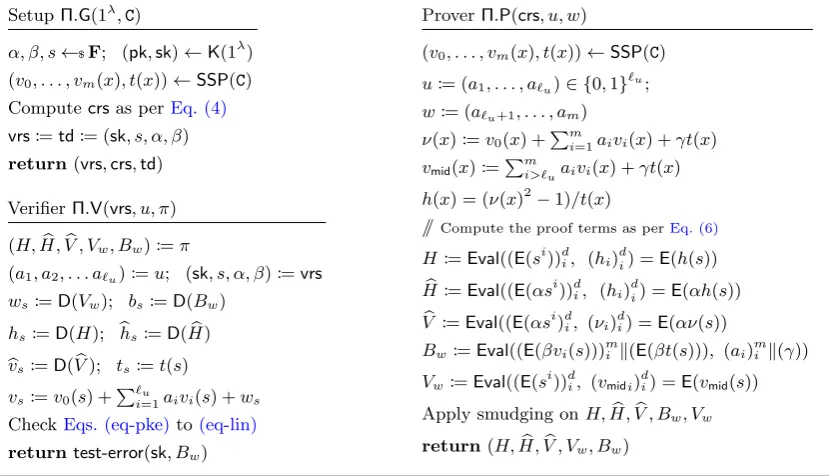
SetupΠ.G(1λ,C)
α, β, s←$F; (pk,sk)←K(1λ) (v0, . . . , vm(x), t(x))←SSP(C)
Computecrsas perEq. (4)
vrs:=td:= (sk, s, α, β)
return(vrs,crs,td)
VerifierΠ.V(vrs, u, π) (H,H,b V , Vb w, Bw) :=π
(a1, a2, . . . a`u) :=u; (sk, s, α, β) :=vrs ws:=D(Vw); bs:=D(Bw)
hs:=D(H); bhs:=D(Hb)
b
vs:=D(Vb); ts:=t(s)
vs:=v0(s) +Pi`u=1aivi(s) +ws
CheckEqs. (eq-pke)to(eq-lin)
returntest-error(sk, Bw)
ProverΠ.P(crs, u, w)
(v0, . . . , vm(x), t(x))←SSP(C)
u:= (a1, . . . , a`u)∈ {0,1}
`u;
w:= (a`u+1, . . . , am)
ν(x) :=v0(x) +Pm
i=1aivi(x) +γt(x)
vmid(x) :=Pm
i>`uaivi(x) +γt(x) h(x) = (ν(x)2−1)/t(x)
//Compute the proof terms as perEq. (6) H:=Eval((E(si))di, (hi)di) =E(h(s))
b
H:=Eval((E(αsi))di, (hi)di) =E(αh(s))
b
V :=Eval((E(αsi)di, (νi)di) =E(αν(s))
Bw:=Eval((E(βvi(s)))mi k(E(βt(s))), (ai)mi k(γ))
Vw:=Eval((E(si))di, (vmidi) d
i) =E(vmid(s))
Apply smudging onH,H,b V , Bb w, Vw
return(H,H,b V , Vb w, Bw)
Fig. 6.Our zk-SNARK protocolΠ.
Zero-Knowledge.. We now present a version of the LHL that will be useful later in this work, when proving the zero-knowledge property of our construction. In a nutshell, it says that a random linear combination of the columns of a matrix is statistically close to a uniformly random vector, for some particular choice of coefficients.
Lemma 19 (“Specialized” leftover hash lemma). Let n, p, q, dbe non-negative integers. Let A←$Znq×d, and~r←$Zdp. Then we have
∆((A,A~r),(A, ~u))≤1 2
p
p−d·qn, whereA~ris computed modulo q, and~u←$Znq.
Proof. For the vector~r, we have thatH∞(~r) =dlogp. Then the proof is immediate fromLemma 18:
∆((A,A~r),(A, ~u))≤1 2
p
2−dlogp·qn= 1 2
p
p−d·qn.
2
4
Our designated-verifier zk-SNARK
LetEncbe an encoding scheme (Definition 9). LetCbe some circuit taking as input an`u-bit string and outputting 0 or 1. Let`:=`u+`w, where`u is the length of the “public” input, and`wthe length of the private input. The value mcorresponds to the number of wires inC andnto the number of fan-in 2 gates. Letd:=m+n. We construct a zk-SNARK scheme for any relationRC on pairs (u, w)∈ {0,1}`u× {0,1}`w that can be computed by a polynomial size circuitCwithm wires andngates. Our protocol is formally depicted inFigure 6.
CRS generation. The setup algorithmGtakes as input some complexity 1λ in unary form and the circuitC:{0,1}`u× {0,1}`w→ {0,1}. It generates a square span program of degreed=m+n over a fieldF, of size |F| ≥dthat verifies Cby running:
Then, it runs (pk,sk)←K(1λ) using the encoding schemeEnc. Finally, it samplesα, β, s←Fsuch thatt(s)6= 0, and returns the CRS:
crs:=ssp, pk, E(1),E(s), . . . ,E(sd), E(α),E(αs), . . . ,E(αsd), E(βt(s)),(E(βvi(s)))
m i=`u+1
(4)
The error for each of these encodings has to be chosen carefully. In a nutshell, we need to intentionally increase the magnitude of the noise in some encodings, in order to mimic its distribution in the simulated CRS provided to the adversary in the security reduction. Failing to do so results in limiting the adversary’s ability to perform homomorphic operations on the CRS and, thus, in a flawed proof. We defer further analysis on this point toSection 6. The verification stringvrs, as well as the trapdoortd, consists of the secret keyskof the encoding scheme, and the secretss, α, β
(we implicitly include thecrsin vrs).
Prover. The prover algorithm, on input some statementu:= (a1, . . . , a`u), computes a witness
w:= (a`u+1, . . . , am) such that (ukw) = (a1, . . . , am) is a satisfying assignment for the circuitC. The (ai)i are such that:
t(x) divides v0(x) + m X
i=1
aivi(x) !2
−1,
as perTheorem 2. Then, it samplesγ←$Fand sets ν(x) :=v0(x) + Pm
i=1aivi(x) +γt(x). Let:
h(x) :=(v0(x) + Pm
i aivi(x) +γt(x))2−1
t(x) =
ν(x)2−1
t(x) , (5)
whose coefficients can be computed from the polynomials provided in the ssp; them by linear evaluation it is possible to obtain:
H:=E(h(s)), Hb :=E(αh(s)), Vb :=E(αν(s)),
Vw:=E m X
i=`u+1
aivi(s) +γt(s) !
,
Bw:=E β m X
i=`u+1
aivi(s) +γt(s) !!
.
(6)
In fact, the encodingH - respectively,Hb - can be computed from the encodings of 1, s, . . . , sd -respectively,α, αs, . . . , αsd - and the coefficients ofEquation (5). The element
b
V can be computed from the encodings of αs, . . . , αsd. Finally, V
w - respectively, Bw - can be computed from the encodings ofs, . . . , sd- respectively,βt(s), βv
`u+1(s), . . . , βvm(s). All these linear evaluations involve at mostd+ 1 terms and the coefficients are bounded byp. Using the above elements, the prover returns a proofπ:= (H,H,b V , Vb w, Bw).
Verifier. Upon receiving a proofπand a statementu= (a1, . . . , a`u), the verifier, in possession of the verification keyvrs(that implicitly contains the crs), proceeds with the following verifications. First, it uses the quadratic root detection algorithm of the encoding schemeEncto verify that the proof satisfies:
b
hs−αhs= 0 and bvs−αvs= 0, (eq-pke) (vs2−1)−hsts= 0, (eq-div)
where (hs,bhs,bvs, ws, bs) are the values encoded in (H,H,b V , Vb w, Bw) :=πandts, vsare computed asts:=t(s) andvs:=v0+P`i=1u aivi(s) +ws.
Then, the verifier checks whether it is still possible to perform some homomorphic operations, using thetest-errorprocedure, implemented inFigure 5for the specific case of lattice encodings. More precisely, the verifier tests whether it is still possible to add another encoding and multiply the result by an element bounded byp, without compromising the correctness of the encoded element. This will guarantee the existence of a reduction in the knowledge soundness proof ofSection 5.2. If all above checks hold, the verifier returnstrue. Otherwise, returnfalse.
Remark 20. Instantiating our encoding scheme on top of a “noisy” encryption scheme like Regev’s introduces multiple technicalities that affect the protocol, the security proof, and the parameters’ choice. For instance, in order to compute a linear combination ofdencodings via Evalwe need to scale down the error parameter and consequently increase the parametersqand nin order to maintain correctness and security. Similarly, the distributions of the error terms and the random vectors are affected by the homomorphic evaluation, and we must guarantee that the resulting terms are still simulatable. All these issues will be formally addressed inSection 5, and then analyzed more pragmatically inSection 6.
5
Proofs of security
In this section, we prove our main theorem:
Theorem 21. If theq-PKE,q-PKEQandq-PDHassumptions hold for the encoding scheme Enc, the protocol ΠonEnc is a zk-SNARK with statistical completeness, statistical zero-knowledge and computational knowledge soundness.
Proof (of statistical completeness).Corollary 13states the conditions onΓ for which the homo-morphically computed encodings are valid with probability at least 1−negl(κ).Lemma 16 affirms that correctly generated proofs satisfyEquation (2)with probability overwhelming inκ. Therefore test-errorreturns true and completeness follows trivially byTheorem 2. 2
5.1 Zero-Knowledge
In order to obtain a zero-knowledge protocol, we perform smudging of the proofs terms, and we randomize the target polynomialt(x). The first step hides the witness, the second makes the distribution of the final noise independent from the coefficientai. The random vectors constituting the first element of the ciphertext are guaranteed to be statistically indistinguishable from uniformly random vectors by leftover hash lemma (cf.Lemma 19).
Proof (of zero-knowledge).The simulator for zero-knowledge is shown inFigure 7. The error are inde-pendently sampled from the same uniform distribution over the (integer) interval [−2κT σBw, 2
κT σ Bw], whereT is a small constant andσBw :=pσ
√
d+ 1pp2+m−`
u. We will call this thesmudging distribution.
SimulatorΠ.Sim(td, u)
(sk, s, α, β) :=td; (a1, . . . , a`u) :=u γw←$F
h:=(v0(s) +P`u
i aivi(s) +γw)
2− 1
/ t(s)
H←E(h); Hb ←E(αh); Vb ←E(αv0(s) +P`iuaiαvi(s) +αγw)
Vw←E(γw); Bw←E(βγw)
Apply smudging onH,H,b V , Bb w, Vw
return(H,H,b V , Vb w, Bw)
Fig. 7.Simulator for Zero-Knowledge.
In both worlds, the proof is a tuple of 5 encodings (H,H,b V , Vb w, Bw). Once thevrsis fixed, each encoding can be written as (−~a, ~a·~s+pe+m), for some~a∈Zn
q and somem∈Zp satisfying the verification equations. Due toLemma 18, the random vectors~aare indistinguishable from uniformly random in both worlds. The error terms are statistically indistinguishable due toLemma 14. (See
Section 6for a detailed explanation of these values.) 2
Zero-knowledge comes at a cost: smudging the error terms requires us to scale the ciphertext modulus byκbits. For those applications where zero-knowledge is not required, we can simplify the protocol by removingγt(x) from the computation ofh(x) and avoiding the smudging procedure on every proof term. In Table 1 we show some choices of parameters, both with and without zero-knowledge.
5.2 Knowledge Soundness
Before diving into the technical details of the proof of soundness, we provide some intuition in an informal sketch of the security reductions: the CRS for the scheme contains encodings ofE(s), . . . , E(sd), as well as encodings of these terms multiplied by some field elementsα, β∈F. The scheme requires the proverPto exhibit encodings computed homomorphically from such CRS.
The reason for requiring the prover to duplicate its effort w.r.t.αis so that the simulator in the security proof can extract representations ofV ,b Hb as degree-dpolynomialsv(x), h(x) such that
v(s) =vs, h(s) =hs, by theq-PKE assumption (forq=d). The assumption also guarantees that this extraction is efficient. This explains the first quadratic root detection checkEquation (eq-pke) in the verification algorithm.
Suppose an adversary manages to forge a SNARK of a false statement and pass the verification test. Then, by soundness of the square span program (Theorem 2), for the extracted polynomials
v(x), h(x) and for the new defined polynomial vmid(x) :=v(x)−v0(x)− P`u
i aivi(x), one of the following must be true:
i. h(x)t(x)6=v2(x)−1, buth(s)t(s) =v2(s)−1, fromEquation (eq-div);
ii. vmid(x)6∈Span(v`u+1, . . . , vm), butBwis a valid encoding ofE(βvmid(s)), fromEquation (eq-lin). If the first case holds, then p(x) := (v2(x)−1)−h(x)t(x) is a nonzero polynomial of degree somek≤2dthat hassas a root, since the verification test implies (v2(s)−1)−h(s)t(s) = 0. The simulator can usep(x) to solveq-PDH forq≥2d−1 using the fact that E sq+1−kp(s)
∈ {E(0)} and subtracting off encodings of lower powers ofsto getE(sq+1).
To handle the second case, i.e., to ensure thatvmid(x) is in the linear span of thevi(x)’s with
`u< i≤mwe use an extra scalarβ, supplement the CRS with the terms{E(βvi(s))}i>`u,E(βt(s)), and require the prover to present (encoded)βvmid(s) in its proof. The adversary againstq-PDH
will choose a polynomialβ(x) convenient to solve the given instance. More specifically, it setsβ(x) with respect to the set of polynomials{vi(x)}i>`u such that the coefficient forx
q+1 in β(x)v
is zero. Then, to generate the values in thecrsit sets β:=β(s) (which can be computed from its input consisting of encodings of powers ofs). Using the above, it runs the SNARK adversary and to obtain from its outputBw an encoding of some polynomial with coefficientsq+1 non-zero and thus solveq-PDH. Also here, the verification algorithm guarantees that even with all the above homomorphic operations, the challenger still decrypts the correct value with 1−negl(κ) probability.
Proof (of computational knowledge soundness). Let AΠ be the PPT adversary in the game for
knowledge soundness (Figure 1) able to produce a proofπfor whichΠ.Vreturnedtrue. We first claim that it is possible to extract the coefficients of the polynomialv(x) corresponding to the values
vsencoded inV. The setup algorithm first generates the parameters (pk,sk) of an encoding scheme Encand picksα, β, s∈F, which are used to computeE(1),E(s), . . . ,E(sd),E(α),E(αs), . . . ,E(αsd). Fix some circuitC, and let sspbe an SSP forC. Let APKE be thed-PKEadversary, that takes as input a set of encodings:
σ:= pk,E(1),E(s), . . . ,E(sd),E(α),E(αs), . . . ,E(αsd)
.
The auxiliary input generator Z is the PPT machine that upon receiving as input σ, samples
β←$Zp, constructs the remaining terms of the CRS (as perEquation (4)), and outputs them inz usingssp. Thus, APKE setscrs:= (sspkσkz) and invokesAΠ(crs). As a result, it obtains a proof π= (H,H,b V , Vb w, Bw). On this proof, it computes:
V :=E v0+ `u X
i=1
aivi(s) +ws !
=Vw+v0+ `u X
i=1
aivi(s). (7)
wherewsis the element encoded inVw. Finally,APKEreturns (V , Vb ). If the adversaryAoutputs a valid proof, then by verification equationEq. (eq-pke)it holds that the two encodings (V,Vb) encode values vs,bvs such that bvs−αvs= 0. Therefore, by q-PKE assumption there exists an extractor ExtPKEthat, using the same input (and random coins) ofAPKE, outputs a vector (c
0, . . . , cd)∈Fd+1 such thatV is an encoding ofPdi=0cisi andVb is an encoding of
Pd
i=0αcisi. In the same way, it is possible to recover the coefficients of the polynomialh(x) used to construct (H,Hb), the first two elements of the proof ofAΠ (again, byEq. (eq-pke)).
Our witness-extractorExtΠ, givencrs, emulates the extractorExtPKE above on the same input
σ, using as auxiliary informationzthe rest of the CRS given as input toExtΠ. By the reasoning discussed above, ExtΠ can recover (c0, . . . , cd) coefficients extracted from the encodings (V,Vb). Consider now the polynomial v(x) := Pdi=0cixi. If it is possible to write the polynomial as
v(x) =v0(x) + Pm
i aivi(x) +δt(x) such that (a1, . . . , am)∈ {0,1}m satisfies the assignment for the circuitCwithu= (a1, . . . , a`u), then the extractor returns the witnessw= (a`u+1, . . . , am).
With overwhelming probability, the extracted polynomialv(x) :=Pdi=0cixi does indeed provide a valid witnessw. Otherwise, there exists a reduction toq-PDH that uses the SNARK adversary AΠ. Define the polynomial
vmid(x) :=v(x)−v0(x)− `u X
i=1
aivi(x).
We know by definition of SSP (Definition 1) and byTheorem 2thatCis satisfiable if and only if
t(x)|v2(x)−1 ∧ vmid(x) =
d X
i
cixi−v0(x)− `u X
i
aivi(x)∈Span(v`u+1, . . . , vm, t)
Therefore, by contradiction, if the adversary AΠ does not know a witness w∈ {0,1}m−`u for u (such that (u, w)∈ RC), but still the two verification checksEq. (eq-div)andEq. (eq-lin)pass, we
ii. vmid(x)6∈Span(v`u+1, . . . , vm, t), butBwis an encoding ofβvmid(s).
LetBPDHbe an adversary against theq-PDH assumption. Given aq-PDH challenge E(1),E(s), . . . ,E(sq),E sq+2, . . . ,E s2q
, forq∈ {2d−1, d}
adversaryBPDHsamples uniformly at randomα←
$F, and defines someβ∈F(that we will formally construct later) and constructs a CRS as perEquation (4). There are some subtleties in howBPDH generates the valueβ. In fact, β can be generated without knowing its value explicitly, but rather knowing its representation over the power basis
si 2q
i=0,i6=q+1 – that is, knowing a polynomialβ(x) and its evaluation ins. Some particular choices ofβ will allow us to provide a solution for aq-PDH challenge.BPDHinvokes the adversaryAΠas well as the extractorExtΠ
on the generated CRS, thus obtaining a proofπand the linear combination used by the prover for the polynomials h(x), v(x) and also extracts a witness for the statement being proved.
For thestrong soundness (see Remark 6), in order to simulate the verification oracle and to answer the verification queries of AΠ, BPDH has to compare its encodings (obtained from the extracted coefficients and its input) withA’s proof terms, accepts if the terms match, and rejects otherwise. Because the encoding scheme is not deterministic, adversaryBPDH invokes the PKEQ extractor and simulates the verification oracle correctly with overwhelming probability.
The reduction in the two mentioned cases works as follows:
i. The extracted polynomialsh(x) andv(x) satisfyt(s)h(s) =v2(s)−1, butt(x)h(x)6=v2(x)−1. By q-PDH assumption this can happen only with negligible probability. We define p(x) =
v2(x)−1−t(x)h(x), that in this case is a non-zero polynomial of degreek ≤ 2dhaving s
as a root. Let pk be the highest nonzero coefficient of p(x). Write ˜p(x) = xk −p−k1·p(x). Since s is a root of xk −p˜(x), it is a root of xq+1−xq+1−kp˜(x). BPDH solves q-PDH by computing E(sq+1) = E(sq+1−kp˜(s)) for q = 2d−1. Since deg(˜p) ≤ k−1, the latter is a known linear combination of encodingsE(1),E(s), . . . ,E(sq) which are available from theq-PDH challenge. More precisely,BPDH will computeEval((E(si+q+1−k))
i,(˜pi)2di −1) onfresh encodings E(1),E(s),E(s2), . . . ,E(sq) solving theq-PDH challenge forq≥2d−1.
ii. In the second case, suppose that the polynomialvmid extracted as previously described cannot
be expressed as a linear combination of{v`u+1, . . . , vm, t}. The proof still passes the verification, so we have a consistent value forBw∈ {E(βvmid(s))}.
BPDH generates a uniformly random polynomiala(x) of degreeq subject to the constraint that all of the polynomialsa(x)t(x) and {a(x)vi(x)}mi=`u+1 have coefficient 0 forx
q+1. We note that forq=d, there areq−(m−`u)>0 degrees of freedom in choosinga(x).
BPDH defines β to be the evaluation of a(x) in s, i.e., β := a(s). Remark that BPDH does not knows explicitly, but having access to the encodings of 2q−1 powers ofs, it is able to generate valid encodings (E(βvi(s)))i andE(βt(s)) using Eval. Note that, by construction of
β, this evaluation is ofd+ 1 elements in Fand that the (q+ 1)-th power ofsis never used. Now, since vmid(x) is not in the proper span, the coefficient of degree q+ 1 of xa(x)vmid(x)
must be nonzero with overwhelming probability 1−1/|F|. The term Bw of the proof must encode a known polynomial ins:P2qi=0bisi :=βvmid(s) =a(s)vmid(s) where the coefficientbq+1 is non-trivial. BPDH can subtract off encodings of multiples of other powers ofs to recover E(sq+1) and breakq-PDH. This requires an evaluation onfresh encodings:
Eval
(E(si))q+di=0 i6=q+1
,(−bi)q+di=0 i6=q+1
. (8)
Adding the above to Bw and multiplying by the inverse of the (q+ 1)-th coefficient (using once againEval) will provide a solution to the q-PDH problem forq=d.
Since the two cases above are not possible byq-PDH assumption,ExtΠ extracts a valid witness if
As previously mentioned inRemark 6, the proof of knowledge soundness allows oracle access to the verification procedure. In the context of a weaker notion of soundness where the adversary does not have access to theΠ.V(vrs,·,·) oracle, the proof is almost identical, except that there is no need for theBPDHadversary to answer queries and to simulate the verification, and therefore no need for theq-PKEQ assumption. This greatly simplifies our construction: the protocol does not need to rely on theq-PKEQ assumption, and the prime modulus can be ofκbits.
6
Efficiency and concrete parameters
The prover’s computations are bounded by the security parameter and the size of the circuit, i.e., P∈Oe(λd). As in [GGPR13,DFGK14], the verifier’s computations depend solely on the security parameter, i.e.,V∈O(λ). The proof consists of a constant number (precisely, 5) of LWE encodings, i.e.,|π|= 5·Oe(λ). Finally, the complexity for the setup procedure is Oe(λd).
Using the propositions fromSection 3and knowing the exact number of homomorphic operations that need to be performed in order to produce a proof, we can now attempt at providing some concrete parameters for our encoding scheme.
We fix the statistical security parameter κ := 32, as already done in past works on fully homomorphic encryption (e.g., [DM15,CGGI16]). We fix the circuit sized:= 215, which is sufficient for some practical applications such as the computation of SHA-256. For some practical examples of circuits, we direct the reader towards [BCG+14a,PHGR13].
For a first attempt at implementing our solution, we assume a weaker notion of soundness, i.e., that in the KSND game the adversary does not have access to a verification oracle (cf.Figure 1). Concretely, this means that the only bound in the size ofpis given by the guessing probability of the witness, and the guessing of a field element. We thus fixpto be a prime6 of 32 bits for the size of the message space.
The CRS is composed of encodings of different nature: some of them are fresh (E(1),E(s), . . . , E(sd)), some happen to be stale in the construction ofAPKEand the construction ofBPDHSection 5.2 (Item i.) (E(αs), . . . ,E(αsd)), and some are stale from the construction ofBPDHSection 5.2(Item ii.) (E(βt(s)),(E(βvi(s)))i). They are displayed inFigure 8. Since, as we have seen,B
PDHmanipulates theq-PDH challenge via homomorphic operations, we must guarantee that the protocol adversary can performat least the same number of homomorphic operations as in the real-world protocol. Therefore, in the real protocol, we must intentionally increase the magnitude of the noise in the CRS: the termsE(αsi) (withi= 0, . . . , d) are generated by multiplying the respectivefresh encodingE(si) by a term bounded byp; the terms E(βt(s)),{E(βv
i(s))}i instead are generated via Evalofd+ 1 elements with coefficients bounded by p. Concretely, when encoding these elements using the encoding scheme ofSection 3, the error forE(αsi) is sampled fromp·χ
σ; the error for E(βt(s)),E(βvi(s))) is sampled from (p
√
d+ 1)·χσ.
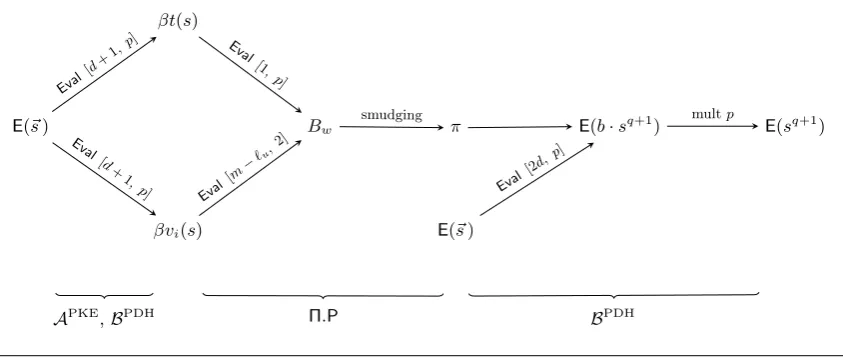
The proofπ consists of five elements (H,H,b V , Vb w, Bw), as per Equation (6).H andVw are computed using an affine function ondencodings with coefficients modulop;H,b Vb are computed using a linear function ond+ 1 encodings with coefficients modulop; finally,Bw is computed using a linear combination ofm−`u encodings with coefficients in{0,1}, except the last one which is modulop. Overall, the term that carries the highest load of homomorphic computations isBw. The generation ofBwis outlined in Figure 8, and to it (as well as to the other proof terms) we add a smudging term for constructing a zero-knowledge proofπ.
In the construction of the adversaryBPDH(Item ii.) we need to perform some further homo-morphic operations on the proof elementBwin order to solve theq-PDH challenge, namely one addition (Equation (8)) and one multiplication by a known scalarbbounded byp. The result of the first operation is denoted byE(b·sq+1) inFigure 8; the final result is the solution to theq-PDH challenge.
6
βt(s)
E(~s) Bw π E(b·sq+1) E(sq+1)
βvi(s) E(~s)
Eval
[d+
1,p
] Eval
[1,
p]
Eval
[m− `u,
2]
Eval
[d+
1,
p]
smudging multp
Eval
[2d,
p]
APKE
,BPDH Π.P BPDH
Fig. 8.Summary of evaluations in the security proof. The leftmost part of the figure refers to the construction of adversaries forq-PKE andq-PDH; the central part refers to the protocol itself (i.e., the construction of the proofπ); the rightmost part refers to the construction of the adversary forq-PDH (Section 5.2
-Item ii.). The syntaxEval[d, p] denotes a homomorphic evaluation ondencodings with coefficients inZp.
E(~s) denotes the PDH challenge.
We now outline the calculations that we use to choose the relevant parameters for our encoding scheme. In particular, we will focus on the termBwsince, as already stated, it is the one that is involved in the largest number of homomorphic operations. The chain of operations that need to be supported is depicted inFigure 8: we now analyze them one by one. The correctness of the other terms follows directly fromCorollary 13.
First of all, the terms (βvi(s))i andβt(s) are produced through the algorithmEvalexecuted on
d+ 1fresh encodings with coefficients modulop. Letσbe the discrete Gaussian parameter of the noise terms in fresh encodings; then, by Pythagorean additivity, the Gaussian parameter of encodings output by this homomorphic evaluation isσEval:=pσ
√
d+ 1. Then the termβt(s) is multiplied by a coefficient inZp, and the result is added to a subset sum of the terms (βvi(s))i, i.e., a weighted sum with coefficients in{0,1}. It is trivial to see that, for the first term, the resulting Gaussian parameter is bounded bypσEval, whereas for the second term it is bounded byσEval
√
m−`u. The parameter of the sum of these two terms is then bounded byσBw :=σEval
p
p2+m−`
u. Let us then consider a constant factorT for “cutting the Gaussian tails”, i.e., such that the probability of sampling from the distribution and obtaining a value with magnitude larger thanT times the standard deviation is as small as desired. We can then write that the absolute value of the error in
Bw is bounded byT σBw. At this point we add asmudging term, which amounts to multiplying the norm of the noise by (2κ+ 1) (cf.Corollary 15). Finally, the so-obtained encoding has to be summed with the output of anEvalinvoked on 2dfresh encodings with coefficients modulo pand multiplied by a constant inZp. The final noise is then bounded by T pσBw(2
κ+ 1) +T pσ
Eval (cf.
Lemma 16). By substituting the values ofσEval,σBw, remembering thatσ:=αq and imposing the condition for having a valid encoding, we obtain
T p2αq√d+ 1pp2+m−`
u(2κ+ 1) + 1
< q
2p.
The above corresponds toEquation (3)with boundsBe:=T σBwandBEval:=T σEval. By simplifying
qand isolatingα, we get:
α < 1
2T p3√d+ 1p
p2+m−`
u(2κ+ 1) + 1 .
Table 2.Comparison with previous works. PQ stands for post-quantum. We note that the construction of [PHGR13] is very different (namely, based on elliptic curves), and comparing security levels is therefore difficult.
PQ λ ZK |π| |crs| d
[PHGR13] 7 256 3 288 B 6.50 MB 23,785 [BISW17] 3 100 7 0.02 MB 1.23 GB 10,000
this work 3 162 3 0.64 MB 8.63 MB 32,767
Onceαandpare chosen, we select the remaining parametersqandnin order to achieve the desired level of security for the LWE encoding scheme. To do so, we take advantage of Albrecht’s estimator7 [APS15] which, as of now, covers the following attacks: meet-in-the-middle exhaustive search, coded-BKW [GJS15], dual-lattice attack and small/sparse secret variant [Alb17], lattice reduction with enumeration [LP11], primal attack via uSVP [AFG14,BG14], Arora-Ge algorithm [AG11] using Gr¨obner bases [ACFP14]. Some possible choices of parameters are reported inTable 1.
Finally, based on these parameters, we can concretely compute the size of the CRS8 and that of the proof π. The CRS is composed ofd+ (d+ 1) + (m+ 1) encodings, corresponding to the encodings of the dpowers of s, the encodings of αmultiplied by the d+ 1 powers of s, the m
encodings of (βvi)i, and the encoding ofβt(s). This amounts to (2d+m+ 2) LWE encodings, each of which has size (n+ 1) logqbits9. For the calculations, we boundmbydand state that the size of the CRS is that of (3d+ 2) LWE encodings. From an implementation point of view, we can consider LWE encodings (~a, b)∈Zn+1
q where the vector~ais the output of a seeded PRG. This has been proven secure in the random oracle model [Gal13]. Therefore, the communication complexity is greatly reduced, as sending an LWE encoding just amounts to sending the seed for the PRG and the valueb∈Zq. For security to hold, we can take the size of the seed to beλbits, thus obtaining the final size of the CRS: (3d+ 2) logq+λ bits. The proofπ is composed of 5 LWE encodings, therefore it has size|π|= 5 (n+ 1) logqbits. Note that in this case we cannot trivially use the same trick with the PRG, since the encodings are produced through homomorphic evaluations.
InTable 2we show a comparison between our implementation, the zk-SNARK of [PHGR13] (informally called “Pinocchio”), and the recent implementation of [BISW17] by Samir Menon,
Brennan Shacklett, and David Wu10. Despite the fact that the construction of Parno et al. [PHGR13] is fundamentally different as it targets encoding over elliptic curves, we believe that they provide a good term of comparison (when used with circuits of the same size) for the loss incurred when using lattice-based encodings instead. Note therefore that the security parameter of [PHGR13] is not comparable with the two other results.