
5PM: Secure Pattern Matching
?Joshua Baron,2 Karim El Defrawy,2 Kirill Minkovich,2 Rafail Ostrovsky,1 and Eric Tressler2
1
Departments of Mathematics and Computer Science, UCLA, Los Angeles, CA, USA 90095
2 Information and System Sciences Laboratory, HRL Laboratories, LLC, Malibu, CA, USA, 90265 {jwbaron,kmeldefrawy,kminkovich,eptressler}@hrl.com,[email protected]
Abstract. In this paper we consider the problem of secure pattern matching that allows single-character wildcards and substring matching in the malicious (stand-alone) setting. Our protocol, called 5PM, is executed between two parties: Server, holding a text of lengthn, and Client, holding a pattern of lengthmto be matched against the text, where our notion of matching is more general and includes non-binary alphabets, non-binary Hamming distance and non-binary substring matching.
5PM is the first secure expressive pattern matching protocol designed to optimize round complexity by carefully specifying the entire protocol round by round. In the malicious model, 5PM requires O((m+n)k2) bandwidth andO(m+n) encryptions, wheremis the pattern length andnis the text length. Further, 5PM can hide pattern size with no asymptotic additional costs in either computation or bandwidth. Finally, 5PM requires only two rounds of communication in the honest-but-curious model and eight rounds in the malicious model. Our techniques reduce pattern matching and generalized Hamming distance problems to a novel linear algebra formulation that allows for generic solutions based on any additively homomorphic encryption. We believe our efficient algebraic techniques are of independent interest.
1 Introduction
Pattern matching is fundamental to computer science. It is used in many areas, including text processing, database search [1], networking and security applications [2] and recently in the context of bioinformatics and DNA analysis [3,4,5]. It is a problem that has been extensively studied, re-sulting in several efficient (although insecure) techniques to solve its many variations, e.g., [6,7,8,9]. The most common interpretation of the pattern matching problem is the following: given a finite alphabet Σ, a text T ∈ Σn and a pattern p ∈ Σm, the exact pattern matching decision problem
requires one to decide whether or not a pattern appears in the text. The exact pattern matching search problem requires finding all indices i of T (if any) where p occurs as a substring starting at position i. If we denote by Ti the ith character of T, the output should be the set of
match-ing positionsM P :={i|p matchesT beginning atTi}. The following generalizations of the exact
matching problem are often encountered, where the output in all cases is the set M P:
– Pattern matching with single-character wildcards1: There is a special character “∗”∈/ Σthat matches any single-character of the alphabet, wherep∈ {Σ∪ {∗}}m andT ∈Σn. Using such
?
This work was done while the first author was at UCLA. The work of the first and fourth author is supported in part by NSF grants CCF-0916574, IIS-1065276, CCF-1016540, CNS-1118126, CNS-1136174, and by US-Israel BSF grant 2008411. It was also supported by the OKAWA Foundation Research Award, IBM Faculty Research Award, Xerox Faculty Research Award, B. John Garrick Foundation Award, Teradata Research Award and Lockheed-Martin Corporation Research Award. The material contained herein is also based upon work supported by the Defense Advanced Research Projects Agency through the U.S. Office of Naval Research under Contract N00014-11-1-0392. The views expressed are those of the author and do not reflect the official policy or position of the Department of Defense or the U.S. Government. The authors would like to thank Jonathan Katz, Sky Faber and Matt Cheung for helpful discussions and comments.
1
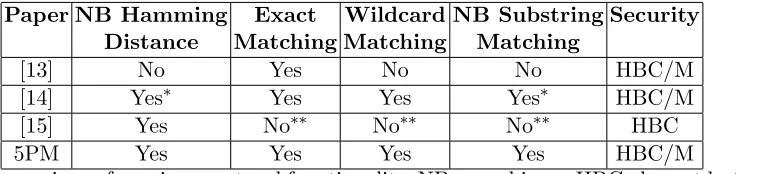
Paper NB Hamming Exact Wildcard NB Substring Security
Distance Matching Matching Matching
[13] No Yes No No HBC/M
[14] Yes∗ Yes Yes Yes∗ HBC/M
[15] Yes No∗∗ No∗∗ No∗∗ HBC
5PM Yes Yes Yes Yes HBC/M
Table 1.Comparison of previous protocol functionality, NB=non-binary HBC=honest but curious,
M=malicious, *=using unary encoding and additional tools, **=can be extended
a “wildcard” character allows one pattern to be specified that could match several sequences of characters. For example the pattern “T A∗” would match any of the following character sequence in a text2:T AA,T AC,T AG, and T AT.
– Substring pattern matching: Fix somel≤m; a match for pis found whenever there exists in
T an m-length string that differs in l characters from p (i.e., has Hamming distancel from
p). For example, the pattern “T AC” hasm= 3. Ifl= 1, then any of the following words will match:∗AC,T ∗C, orT A∗; note that this is an example of non-binary substring matching. A secure version of pattern matching has many applications. For example, secure pattern matching can help secure databases that contain medical information such as DNA records, while still al-lowing one to perform pattern matching operations on such data. The need for privacy-preserving DNA matching has been highlighted in recent papers [10,11,12]. In addition to the case of DNA matching, where substring matching may be particularly useful, Hamming distance-based approx-imate matching has also been demonstrated in the case of secure facial recognition [3]. We note that both of these settings require computation over non-binary alphabets.
1.1 Our Contributions
This paper presents5ecurePatternMatching (or 5PM), a new protocol for arbitrary alphabets that addresses, in addition to exact matching, more expressive search queries including single-character wildcards and substring pattern matching, and also provides the ability to hide pattern length.
5PM has communication complexity sublinear in circuit size (as opposed to general MPC, which has communication complexity linear in circuit size) to securely compute non-binary substring matching in the malicious model. In addition, our extension of Hamming distance computation to substring matching has minimal overhead; our protocol makes a single computation pass per text element, even for multiple Hamming distance values, and therefore is able to securely compute non-binary substring matching efficiently (see Table 1 for a comparison of protocol functionality and Tables 2 and 3 for a comparison of protocol overhead).
5PM performs exact, single-character wildcards, and substring pattern matching in the honest-but-curious and malicious (static corruption) models. Our malicious model protocol requiresO((m+
n)k2) bandwidth complexity. Further, our protocol can be specified to require two (one-way) rounds of communication in the semi-honest model and eight (one-way) rounds of communication in the malicious model.
We construct our protocols by reducing the problems of Hamming distance and pattern match-ing, including single-character wildcards and substring matchmatch-ing, to a sequence of linear operations.
2
Paper Encryptions Exponentiations Multiplications Bandwidth Rds
[16] O(mn) O(mn) O(mn) O(mnk2) O(1) [14] O(n+m) O(nlogm) O(nm) O((n+m)k2)O(1) 5PM O(n+m) O(nm) O(nm) O((n+m)k2) 8
Table 2.Detailed comparison with [14] and [16] for single-character wildcards and substring
match-ing in malicious model with text length=n, pattern length=m, security parameter=k, rounds=Rds.
Paper Encryptions Exponentiations Multiplications Bandwidth Rds
[15] O(n+m) O(nm) O(nm) O((nm)k) O(1) 5PM O(n+m) O(n+m) O(nm) O((n+m)k) 2
Table 3. Detailed comparison with [15] for non-binary substring matching in HBC model with
text length=n, pattern length=m, security parameter=k, rounds=Rds.
We then rely on the observation that these linear operations, such as the inner products and matrix multiplication, can be efficiently computed in the malicious model using additively homomorphic encryption schemes.
The security requirements (informally) dictate that the party holding the text learns nothing except the upper bound on the length of the pattern, while the party holding the pattern only learns either a binary (yes/no) answer for the decision problem or the matching positions (if any), and nothing else.
1.2 Comparison to Previous Work
Exact Matching. In the exact pattern matching setting, the algorithm of Freedman, Ishai,
Pinkas and Reingold [13] achieves polylogarithmic overhead in m and n and polynomial overhead in security parameters in the honest-but-curious setting. Using efficient arguments [17,18] with the modern probabilistically checkable proofs (PCPs) of proximity [19], one can extend (at least asymptotically) their results to the malicious (static corruption) model. However, the protocol in [13] works only for exact matching and does not address more general problems, including single-character wildcards and substring matching, which are the main focus of our work. Other protocols that address secure exact matching (and not wildcard or substring matching) are [12,20,21,22,23,11]; of these, only [22] obtains (full) security in the malicious setting. We note that [23] is more efficient than [13], but only in the random oracle model; here, we are interested in standard security models.
Single-Character Wildcards and Substring Matching. Recently, Vergnaud [14] built on
the work of Hazay and Toft [16] to construct an efficient secure pattern matching scheme for wildcard matching and substring matching (requiring truns over the preliminary matching result to search fortdifferent Hamming distance values, which is also required by 5PM) in the malicious adversary model. More specifically, [14,16] take advantage of the fact that (pi−ti)2 equals 0 if binary values
pi andti are equal and 1 if they are not equal; therefore, binary Hamming distance can essentially
be computed by counting the number of 1s in a particular polynomial-based computation. However, whenpi andti are non-binary, it is unknown how to obtain 0 whenpi andti equal, and 1 (or some
other fixed value) when they are not equal using oblivious polynomial evaluations.
However, non-binary elements can be computed by unary encoding; that is, an element α ∈Σ
α (lexicographically). There are two subtleties of such an approach. The first is that ifα6=β, then
α0 and β0 will have Hamming distance 2 instead of 1; the second is, in the malicious case, zero knowledge proofs are needed to demonstrate thatα0 is well formed.
[14] requires O(m+n) encryptions,O(nlogm) exponentiations,O(nm) multiplications (of en-crypted elements), andO(n+m) bandwidth, all in a constant number of rounds. By contrast, 5PM has the same overhead except for O(nm) exponentiations (see Table 2). However, our work is of interest for several reasons. The first is that we have implemented our protocol and believe it to be more efficient (additional work is needed on this front). The second is that our techniques are of independent interest and may be extended to additional functionalities. Finally, the protocol presented here is fully specified; by contrast, additional work is needed to transform the work of [14] into a protocol that can support non-binary alphabets for substring matching or to calculate Hamming distance in the malicious case.
Non-binary Hamming Distance. Jarrous and Pinkas [15] gave the first construction of a
secure protocol for computing non-binary Hamming distances. In order to count the non-binary mismatches, they leverage 1-out-of-2 oblivious transfers. 5PM can also compute non-binary Ham-ming distance even when the text and pattern have the same length (and where the output is not blinded to only reveal whether or not a pattern match occurred). We note that [15] can be used to implement exact and substring matching with additional tools to blind Hamming distance output (for instance, see [14]). [15], to compare two strings of lengthn, requiresO(n) 1-out-of-2 OTs,O(n) multiplications of encryptions and O(nk) bandwidth, while 5PM requires O(n) exponentiations (which require less computation than OTs),O(n2) multiplications, andO(nk) bandwidth. The ad-vantage of 5PM over [15] is twofold: the first is that 5PM is proven secure in the malicious model while [15] is not; the second is that 5PM, in both the honest-but-curious and malicious models, amortizes well in the substring matching setting, while [15] does not amortize because it cannot reuse OT outputs to compute substring matching (see Table 3).
Other Techniques. In the most general case, secure exact, approximate and single-character
wildcards pattern matching is an instance of general secure two-party computation techniques (for instance, [24,25,26,27]). All of these schemes have bandwidth and computational complexity at best linear in the circuit size. For instance, a naive implementation of Yao [24] requires bandwidth
O(mn) in the security parameter. In contrast, we aim for a protocol where circuit size is O(mn), yet we achieve communication complexity ofO(m+n).
Finally, we observe that with the construction of fully homomorphic encryption (FHE) schemes [28], the following “folklore” construction can be executed for any pattern matching algorithm: Client encrypts its pattern using an FHE scheme and sends it to Server. Server applies the ap-propriate pattern matching circuit to the encrypted pattern (where the circuit output is a yes/no
2 Preliminaries
The rationale behind our secure 5PM protocol is based on a modification of an insecure pattern matching algorithm (IPM) [29] that can perform exact matching, exact matching with single-character wildcards, and substring matching within the same algorithm. In Section 3.1, we show how our modified algorithm can be reduced to basic linear operations whose secure and efficient evaluation allows us to obtain our 5PM protocol.
2.1 Insecure Pattern Matching (IPM) Algorithm
To illustrate how our modified algorithm works, we begin by describing how it performs exact matching; we then show how it handles single-character wildcards and substring matching.
2.1.1 Exact Matching. IPM involves the following steps:
a. Inputs: An alphabetΣ, a text T ∈Σn and a pattern p∈Σm.
b. Initialization: For each character in Σ, the algorithm constructs a vector, here termed a
Character Delay Vector(CDV), of length equal to the pattern length,m. These vectors
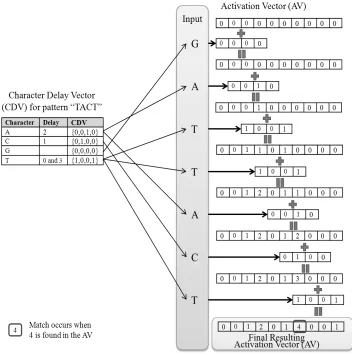
are initialized with zeros. For example, if the pattern is: “T ACT” overΣ={A, C, G, T}, then the CDVs will be initialized to: CDV(A) = [0,0,0,0], CDV(C) = [0,0,0,0], CDV(G) = [0,0,0,0] andCDV(T) = [0,0,0,0].
c. Pattern preprocessing: For each pattern character pi (i ∈ {1, ..., m}), a delay value, drpi, is computed to be the number of characters frompi to the end of the pattern, i.e.,drpi =m−i for therth occurrence ofpi inp. Thedrpith position ofCDV(pi) is set to 1. For example, the
CDVs of “T ACT” would be:
CDV(A) = [0,0,1,0] because d1A= 4−2 = 2
CDV(C) = [0,1,0,0] becaused1
C = 4−3 = 1
CDV(G) = [0,0,0,0] becauseG6∈p
CDV(T) = [1,0,0,1] becaused1T = 4−4 = 0 andd2T = 4−1 = 3
d. Matching pass and comparison with pattern length: A vector of lengthncalled theActivation
Vector (AV) is constructed, and its elements are initialized with zeros. For each input
text character Tj, CDV(Tj) is added element-wise to the AV from position j to position
min(n, j+m−1). To determine if there was a pattern match in the text, after these operations the algorithm checks (when j ≥ m) if AVj = m. If so, then the match started at position
j−m+ 1. The valuej−m+ 1 is added to the set of matching positions (M P). Note that n−AVj is the non-binary Hamming distance of the pattern and the text starting at position
j−m+ 1.
Insecure Pattern Matching (IPM) Example. The pattern to be matched is “TACT” and the text is “GATTACT....” The first step is to construct theCDV using the delays for the characters of the pattern “TACT.” Delays for “T” will be 3 and 0, for “A” they will be 2, and for “C” they will be 1. These delays are then converted to CDVs as shown in Figure 1. The activation vector will be initialized to all zeros. The characters of the text are then considered one at a time. For each input text character (T[j]) at position j in text, the following steps have to be taken: (1) retrieveCDV[T[j]]; (2) add elements of CDV[T[j]] to elements of activation vector from position
j toj+m−1; and (3) check if AV[j] is equal to the pattern length (|T ACT|=m= 4).
Fig. 1. Example of IPM’s operation
2.1.2 Single-Character Wildcards, Pattern Hiding and Substring Matching.
when elements of the AV are searched in the comparison phase, the threshold value being used for comparison will be m−l instead of m, where l is the number of occurrences of “∗” in the pattern. The intuition behind single-character wildcards is that by reducing the threshold for each wildcard, the algorithm implicitly skips matching that position in the text, allowing that position of the pattern to correspond to any character. This operation does not incur any false positives for the same reason that the exact matching IPM algorithm does not: there, for each patternp, there is only one encoding into CDVs and only one sequence of adding CDVs as one moves along the text that could add up to m. The same reasoning holds when “∗” is present in p (except that the sequence adds tom−l).
We note that by using single-character wildcards, one can always hide pattern length by setting
p0 as the concatenation ofpand a string ofn−mwildcards,∗n−m, and usingp0 to execute pattern
matching forp.
Substring matching, or matching text substrings of Hamming distance m−lfrom the pattern, is handled similarly to single-character wildcards; the threshold value being compared against in theAV is decreased tom−l. For further details, we refer the reader to [29].
2.2 Preliminary Cryptographic Tools
This section outlines preliminary cryptographic tools required for our protocols. Forx, y∈Zn q, we
define the inner product ofx and y overZq, denoted hx, yi, asPxiyi mod q.
Additively Homomorphic Encryption: We make use of additively homomorphic semantically secure encryption schemes. For concreteness, in the rest of this paper we concentrate on the additively homomorphic ElGamal encryption scheme whose security depends on the Decisional Diffie-Hellman (DDH) computational hardness assumption. An additively homomorphic ElGamal encryption scheme [30] is instantiated by choosing a group of appropriate prime orderq,Gq, with
generator g, and setting the secret key to be x ∈ Zq and the public key to be (g, h = gx). To
encrypt a messagemone chooses a uniformly random r∈Zq and computes (gr, gmhr). To decrypt
a pair (α, β), one computes logg αβx. It is important to note that for additive ElGamal the decryptor has to both decrypt and also compute a discrete logarithm to discover the message. However, our scheme only requires a determination of whether an encrypted value is of a 0 or not, which can be accomplished without computing logarithms.
Threshold Encryption: The malicious model version of 5PM requires an additively homomor-phic, semantically secure, threshold encryption scheme [31]. While we use threshold ElGamal, in practice, any scheme is acceptable if it satisfies the required properties and supports the needed zero-knowledge arguments. Threshold ElGamal, in the two-party case, can be informally defined as follows [32]: partyP1 has share x1 and partyP2 has share x2. The parties jointly set the secret key to bex=x1+x2 (this can be performed without revealing x1 and x2, see subprotocolπencr in
Section 3.3). Without loss of generality,P1 partially decrypts (α, β) by sending (α,αβx1) toP2, who fully decrypts (α, β) by computing αx1βαx2 =
β
αx1+x2. We denote the partial decryption algorithm
for party Pi asDPi.
Commitment Schemes: For the malicious model protocol, we will make use of perfectly hiding, computationally binding commitment schemes (for further discussion, see [33]). The Pedersen com-mitment scheme [34] is a well-known example of such a comcom-mitment scheme: for a multiplicative group of prime order q, Gq and for fixed generators g, h ∈ Gq, commitment to message s using
Zero-Knowledge Arguments of Knowledge:In order to construct a protocol that guarantees that each party behaves properly even in the malicious setting, we use efficient interactive zero-knowledge arguments of knowledge (ZK-AoKs). For further details, see Section 4.
2.3 Computing Linear Operations Using Additively Homomorphic Encryption
Schemes.
Our secure pattern-matching protocol relies on the following observations about linear operations and additively homomorphic encryption schemes. In what follows, letEbe the encryption algorithm for an additively homomorphic encryption scheme for key pair (pk, sk). Suppose the plaintext group
Gcan be expressed asZn for some n∈N; in particular, Gis a ring. Let Ma,b(G) denote the set of
matrices of sizea×bwith entries in G.
2.3.1 Matrix Multiplication. Consider two matrices, A and B, where A ∈ Mk,l(G) and
B ∈ Ml,m(G). Suppose that P1 possesses pk, Epk(A), the entry-wise encryption of A, and also
the unencrypted matrixB. ThenP1 can computeEpk(A·B), the encryption of the multiplication
of A and B under the same pk. Such an operation is possible because one can obtain an encryp-tion of the inner product over G of an unencrypted vector (x1, ..., xm) with an encrypted vector
(E(y1), ..., E(ym)) by computing ΠE(yi)xi =E(Pxiyi)).
2.3.2 Matrix Operators. Consider a matrixA∈Mk,l(G). One can construct a k×(k+l−1)
matrix A0 by initializing A0 as a matrix with all 0s and then, for each row 1 ≤ i ≤ k, setting (A0(i, i), ..., A0(i, i+l−1)) = (A(i,1), ..., A(i, l)). We denote such a function by A0 ← Stretch(A), and note that since this function is a linear operator, it can be computed using matrix multiplication. We observe that for any encryption schemeE,E(Stretch(A)) =Stretch(E(A)), whenEis applied to each entry in A.
Consider a matrix A ∈Mk,l(G). We denote Cut(A, j) as the matrix A0 ∈Mk,l−2j+2 such that for 1 ≤ a ≤ k, 1 ≤ b ≤ l−2j + 2, A0(a, b) = A(a, b+j −1). In particular, such a function outputs the middle l−2j+ 2 columns of Mk,l. We note that Cut is a simple projection operator
and is also computable by matrix multiplication. We observe that for any encryption scheme E,
E(Cut(A, j)) =Cut(E(A), j)
Finally, consider a matrix A ∈Mk,l(G). We denote by ColSum(A) the function that takes as
inputAand outputs a 1×lvector whoseith entry is the sum of all entries in theicolumn ofA. In particular,ColSum(A) = [1....1]·A. We observe that for any additively homomorphic encryption schemeE,ColSum(E(A)) =E(ColSum(A)).
Since we will be composing these functions, a shorthand for their composition will be convenient. For matricesA∈Mk,l(G) andB ∈Ml,m(G), we denote the composition functionColSum(Cut(Stretch(A·
B), j)) byP M5P M(A, B, j).
2.3.3 Searching an Encrypted Vector, πV F ind. Suppose partyP1 possesses (pk, sk) for an
additively homomorphic encryption algorithm E, and a single value m ∈ G and P2 possesses a vector of l distinct encryptionsEpk(vec), where vec= (x1, . . . , xl)∈Gl. Then P1 can determine if
E(vec) contains an encryption ofm while learning nothing else about vec, while P2 cannot learn
m, through the following protocol πV F ind:
(b) P2 computesE(vec0) by multiplying (via the group operation of the ciphertext space)E(−m) to each encrypted entry in E(vec). Note that an entry in E(vec0) will be an encryption of 0 if and only if one of the encryptions ofE(vec) was an encryption ofm.P2 computesE(vecr) fromE(vec0) by exponentiating each encrypted entry ofE(vec0) by an (independent) random exponent.P2 sends E(vecr) to P1.
(c) P1 decryptsE(vecr) to obtainvecr; if a 0 exists at position i, the ith position of E(vec) is
E(m).
Note that if P2 wishes to hide the position of E(m) from P1, P2 could randomly permute the positions ofE(vecr) and send the permuted vector toP1.
2.3.4 Efficiently Determining Equality of Two Matrices,πV ecEQ. Suppose partiesP1and
P2have agreed upon an additively homomorphic threshold encryption schemeEth. Further, suppose
P1 and P2, possess encrypted matrices Eth(A) ∈ Mk,l(G0) and Eth(B) ∈ Mk,l(G0), respectively,
where the message space G0 is the group Zq, for a prime q. Let DPi denote the partial decryption algorithm of party Pi.P1 and P2 wish to determine if their encrypted matrices are equal without exchanging their decryptions. They can do so by hashing their encrypted matrices to a single group element and exchanging the outcome of the hashes. More specifically, an affine hash functionZklq →
Zq can be specified by lettingP1 and P2 jointly compute a uniformly random pair (a, b)∈Zklq ×Zq
using standard commitment techniques and setting the hash to hf(x) = hx, ai+b, where h·,·i is the inner product over Zq (here, we consider the matrices as kl-length strings). Note that such a
hash function can be computed on encrypted strings because the encryption scheme is additively homomorphic. Denote bycomma (perfectly hiding, computationally binding) commitment scheme; in practice we use Pedersen commitments [34]. We denote the following subprotocol by πV ecEQ:
(a) P1 selects (a1, b1) ∈Zklq ×Zq uniformly at random and computes Eth(b1). P1 computes and sends comm(a1), comm(Eth(b1)), comm(Eth(A)) toP2.
(b) P2selects (a2, b2)∈Zklq ×Zquniformly at random and computesEth(b2).P2sendsa2, Eth(b2), Eth(B)
toP1.
(c) P1 setsa=a1+a2,Eth(b) =Eth(b1+b2) and computesz1=Eth(ha, Ai+b),z2 =Eth(ha, Bi+
b).P1 decommits to a1,Eth(b1) and Eth(A) to P2 and sends DP1(z1), DP1(z2) to P2.
(d) P2 aborts if it does not accept the decommitments, else P2 sets a = a1 +a2, Eth(b) =
Eth(b1 +b2) and computes z1 = Eth(ha, Ai+b), z2 = Eth(ha, Bi+b). P2 sends DP2(z1), DP2(z2), DP2(DP1(z1)), and DP2(DP1(z2)) to P1.
(e) P1aborts ifDP2(DP1(z1))6=DP2(DP1(z2)); otherwiseP1sendsDP1(DP2(z1)) andDP1(DP2(z2))
toP2.
(f) P2 aborts ifDP1(DP2(z1))6=DP1(DP2(z2)).
The bandwidth complexity of πV ecEQ is dominated by the size of Eth(A) (and Eth(B)). Only
with probability 1/q will the decryptions equal each other whenA6=B because the hash function is chosen uniformly at random. In the malicious case, arguments of consistency for correct partial decryptions will also be needed.
3 5PM Protocol
This section uses the above observations and cryptographic tools to construct the secure pattern-matching protocol (5PM). We developπH
5P M for the honest-but-curious adversary model andπM5P M
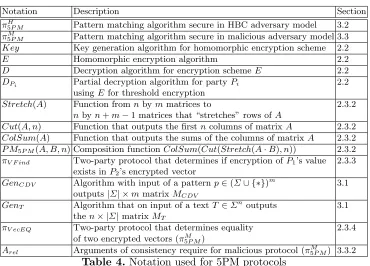
Notation Description Section πH
5P M Pattern matching algorithm secure in HBC adversary model 3.2 πM
5P M Pattern matching algorithm secure in malicious adversary model 3.3 Key Key generation algorithm for homomorphic encryption scheme 2.2
E Homomorphic encryption algorithm 2.2
D Decryption algorithm for encryption schemeE 2.2 DPi Partial decryption algorithm for partyPi 2.2
usingE for threshold encryption
Stretch(A) Function fromnbymmatrices to 2.3.2 nbyn+m−1 matrices that “stretches” rows ofA
Cut(A, n) Function that outputs the firstncolumns of matrixA 2.3.2 ColSum(A) Function that outputs the sums of the columns of matrixA 2.3.2 P M5P M(A, B, n) Composition functionColSum(Cut(Stretch(A·B), n)) 2.3.2 πV F ind Two-party protocol that determines if encryption ofP1’s value 2.3.3
exists inP2’s encrypted vector
GenCDV Algorithm with input of a patternp∈(Σ∪ {∗})m 3.1 outputs|Σ| ×mmatrixMCDV
GenT Algorithm that on input of a textT ∈Σnoutputs 3.1 then× |Σ|matrixMT
πV ecEQ Two-party protocol that determines equality 2.3.4 of two encrypted vectors (π5MP M)
Arel Arguments of consistency require for malicious protocol (πM5P M) 3.3.2
Table 4. Notation used for 5PM protocols
3.1 Converting IPM to Linear Operations.
For a fixed alphabet Σ, a text T ∈ Σn, and pattern p ∈ (Σ∪ {∗})m, IPM can be represented in terms of linear operations described in Section 2.3 as follows:
a. The textT can be transformed into ann× |Σ|matrix,MT. The transformation is performed
by applying a unary encoding of alphabet characters toT, i.e., MT(i, Ti) = 1,∀i∈ {1, ..., n};
all other entries inMT are 0. We denote the algorithm that computes MT from T asMT ←
GenMT(T).
b. TheCDVs of alphabet characters can be grouped into a|Σ| ×mmatrix, MCDV. This step is
equivalent to constructingCDVs for alphabet characters (steps b and c in Section 2.1.1).We denote the algorithm that computeMCDV from pas MCDV ←GenMCDV(p).
c. Multiply MT by MCDV to obtain an n×m matrix MT(CDV) that represents T row-wise in terms of CDVs, where the ith row is CDV(Ti). In reality, since MT and MCDV are 0/1
matrices, multiplication is more computationally expensive than necessary, and vectors can simply be selected (as shown in the IPM description in Section 2.1).
d. Compute MT(CDV) = Stretch(MT(CDV)). This transformation, jointly with the previous step, constructs a matrix ofCDVs where the ith row contains only CDV(Ti), which starts
in theith position in theith row (sets up step d in Section 2.1.1).
e. Compute AV = ColSum(Cut(MT(CDV), m)) to obtain the final activation vector AV of length n−m+ 1. Entries in AV are checked to see if any are equal to the threshold value
m, orm−l for single-character wildcards or substring matching (completes step d in Section 2.1.1).
A key observation is that if only one of MT and MCDV are encrypted, an encrypted activation
3.2 Honest-Cut-Curious (HBC) 5PM Protocol
We begin by describing the intuition behind required modifications to secure IPM in the HBC adversary model. We then describe details of the HBC protocol, π5HP M.
3.2.1 Protocol Intuition. Let E be an additively homomorphic encryption scheme. When
Client sends ServerE(MCDV), by the reasoning of Sections 2.3 and 3.1, Server can computeE(AV),
an encrypted activation vector, using onlyMT andE(MCDV). This is because the pattern matching
operation can be reduced to a sequence of linear operations (namely matrix multiplication and the functions Stretch, Cut, and ColSum). Since Client sends only E(MCDV) and E(m−l), Server
learns nothing about Client’s pattern due to semantic security of the encryption scheme.
Next, Client, for pattern-matching thresholdm(orm−lin the single-character wildcards/substring matching case), executes πV F ind specified in Section 2.3.3, where Client uses E(AV) to discover
whether (and where) a pattern exists. Because of the security of πV F ind, Server does not learn m
and Client learns nothing about E(AV), other than whether or not (and where, if the pattern-matching locations are not hidden by Server) an encryption of m exists in E(AV). In practice, Client sendsE(m) in the same (first) round asE(MCDV), and Server’s response to πV F ind occurs
in the second round, concluding execution of the secure pattern-matching protocol.
Client Server
Input:p∈(Σ∪ {∗})m Input:T ∈Σn
Initialization:
1) (pk, sk)←Key(1k) 2)MCDV ←GenCDV(p) 3)E(MCDV)←MCDV
E(−m+l)← −m+l −−−−−−−−−−−−−−−−−−→4)E(MCDV);E(−m+l);pkC Activation Vector Formation:
5)MT ←GenT(T);
E(AVS)←P M5P M(MT, E(MCDV), m) 6)E(AVr
S)←πV F ind(E(AVS, E(−m+l))) 7) Optional: PermuteE(AVSr)
Decrypting and Determining 6)E(AV
r S)
←−−−−−−−−−−−−−−−−−
Matches:
8)M P={i|D(E(AVSr[i])) = 0}
Output: Output:
M P={j|Tj...Tj+m−1=p} Nothing
Table 5.Overview of 5PM protocol for HBC adversary model,πH5P M. See Table 4 for notation.
3.2.2 πH
5P M Protocol Specification. Recall that over a specified alphabetΣ, Server holds text
T ∈Σnand Client holds a patternp∈(Σ∪ {∗})m. The output of Server is an encrypted activation vectorE(AV) of lengthn. We refer the reader to Sections 3.1 and 2.3.2 for the notation used here. The protocol operation is as follows:
a. Client computes (sk, pk) ← Key(1k) using the key generation algorithm of an additively homomorphic encryption scheme,E.
b. Client computes MCDV ←GenCDV(p). In the case where Client wishes to hide the length of
c. Client encryptsMCDV entry-wise using public key pk to obtain E(MCDV).
d. Client sendsE(MCDV) andpkto Server. In addition, Client sends E(−m) (orE(−m+l) in
the single-character wildcards or substring matching cases). e. Server computes MT ←GenT(T). Server computes E(AV) =
E(P M5P M(MT, MCDV, m)), which is computed as specified in Sections 2.3.1 and 2.3.2.
f. Server executes round 2 ofπV F ind (see Section 2.3.3) usingE(−m) andE(AV). Server sends
output of the subprotocol, denotedE(AVSr), to Client.
g. Optional: Per πV F ind, Server randomly permutes E(AVSr) to hide possible pattern match
locations.
h. Client executes round 3 ofπV F indusingE(AVSr) to determine results of the pattern matching.
We note that πH5P M can perform substring matching for multiple substring lengths (such as a Hamming distance bound) simultaneously by sending multiple E(m−l) values at step 6 in the specification shown in Table 5. Then, for each value of l, Server constructs a distinct E(AV) and sends Client a distinct corresponding E(AVSr) indicating matching locations for that l value. In particular,πH5P M does not require multiple independent protocol executions to compute substring matching for a range of substring length values. In addition,πH
5P M can simply compute the Hamming
distance of the pattern with each consecutive m positions of the text by simply not executing
πV F ind and sending the output of the protocol at step 5, and Client can decrypt to obtain all of
the Hamming distance values between the pattern and the text.
Theorem 1. Given an additively homomorphic semantically secure encryption scheme over a
prime-order cyclic group (Key, E, D), π5HP M is secure in the HBC model.
See Section 7 for a detailed security proof.
3.3 Malicious Model 5PM Protocol
In this section we explain how to modify πH5P M to obtain a protocol, π5MP M, which is secure in the malicious (static corruption) model. We describe an instantiation ofπM5P M based on additively homomorphic threshold ElGamal encryption (see Section 2.2) for concreteness; generalization to other encryption schemes follows provided they have efficient Σ protocols for the statements re-quired here. First, we explain the intuition behindπM5P M. Second, we give interactive zero-knowledge consistency arguments that will be required. Finally, we divideπM5P M into six subprotocols and de-scribe their construction and how they are combined into the final protocol πM5P M. In the interest of clarity and space, we leave the exact protocol specification and security proof to Sections 6 and 7, respectively. Note that this protocol, as shown in Section 2.1.2, can be modified to both hide pattern length (by using, for patternp, the patternp0 equal to top concatenated with∗n−m)
and also to match against multiple substring values without multiple executions of the entire proto-col (i.e., by sending multipleE(m−l) values and computing a new activation vector for each value).
3.3.1 Protocol Intuition. The eight round protocol for the malicious model,π5MP M, consists of
the following six subprotocols:
(a) πencr: initializes an additively homomorphic threshold encryption scheme.
(b) πS,AV: allows Server to construct an encrypted activation vector for Client’s encrypted pattern
and Server’s text.
(c) πC,AV: allows Client to construct an encrypted activation vector for Client’s pattern and
(d) πvec: allows Client and Server to verify that their activation vectors are equal without revealing
them.
(e) πrand: allows Server to send an encryption of its randomized activation vector to Client.
(f) πans: shows to Client where the pattern matches the text (if at all).
The intuition behind constructing π5MP M is as follows: In π5HP M, only Server performs the com-putation to obtain the activation vector, AV. In the malicious setting, Client has to verify that Server correctly computedAV. Since Server performsO(nm) multiplications when computing AV
inπ5HP M, requiring a zero-knowledge argument for each multiplication therefore would require band-width of at leastO(nm). Such overhead is unacceptable if bandwidthO(n+m) is desired.
We utilize a more bandwidth-efficient approach to ensure that a malicious Server has computed the correct AV: in π5MP M, both Client and Server perform secure pattern matching independently using the function P M5P M where one of MCDV and MT are encrypted, and then compare their
results. Each party computes an AV in parallel (see subprotocols πC,AV and πS,AV, respectively,
in Section 3.3.3) using an additively homomorphic threshold encryption scheme (instantiated using subprotocolπencrin Section 3.3.3). To ensure that no cheating has occurred, Client and Server then
check that each other’s AV was computed correctly. Therefore, proving that Server has behaved honestly is reduced to proving that Client and Server have obtained the same result from matching
p against T. To efficiently perform a comparison of encrypted AVs, Client and Server check that their encrypted AVs are equal using subprotocol πV ecEQdescribed in Section 2.3.4 (in addition to
some zero-knowledge arguments to demonstrate well-formedness). Only if hashedAV values match will Server provide Client with its decrypted (and blinded)AV (using the subprotocolsπrand and
πans in Section 3.3.3). The comparison subprotocol is denoted byπvec in Section 3.3.3.
Throughout, both Client and Server will have to use various arguments of consistency outlined in Section 3.3.2 to prove that they have not deviated from the protocol.
There is one additional technical difficulty that we have to overcome: In order to prove security we must provide simulators that simulate transcripts when interacting with adversarial parties (see Section 7 for security definitions and simulator constructions). When constructing the simulator for Client’s view, the simulator receives the actual answer that it must provide to Client from the ideal functionality only at the last moment (if Client does not abort). Thus, the simulator must provide a final answer which is not consistent with the previous interactions, while the real Server must be unable to do so. To achieve this, we demonstrate that the simulator can extract the knowledge of the exponent of someh∗ specified by Client during the first subprotocol (πencr); then, the final
subprotocol (πans) uses a zero-knowledge argument of knowledge that demonstrates that either
the final randomized AV is corrector that Server knows the discrete logarithm of h∗. Since a real Server cannot extract the discrete logarithm of h∗, but the simulator can by construction, this allows the simulator to reveal the correct randomized AV even when it is inconsistent with the previous outputs of the conversation. We stress that we do not use NP-reductions but rather build highly efficient protocols to fit our needs.
3.3.2 Zero-Knowledge Arguments of Knowledge (ZK-AoKs) of Consistency. We first
describe five required interactive arguments which we rely on to prove statements required for the
π5MP M protocol. They are designed for use with the specified threshold ElGamal encryption scheme (Section 2.2). We apply a standard construction outlined in Section 4 of this paper to transform three-move arguments of knowledge and construct five-move ZK arguments of knowledge πDL,
in five moves; we note that either Client or Server may execute the arguments of consistency asP
while the other party will then execute asV.πDL is the only ZK-AoK used on its own in π5MP M; it
proves knowledge of a discrete logarithm of a public h=gx.πisBIT is a ZK-AoK that proves that
an encryption is either of 0 or of 1; πeqDL is a ZK-AoK that proves that two discrete logarithms
are equal; and πf in is a ZK-AoK that proves thateither two discrete logarithms are equal or that
P knows the discrete logarithm of a public h=gx. The five required interactive arguments are:
(a) AM01, an AoK of Consistency for Matrix Formation 0/1:P, for anl×umatrix of encryptions,
E(M), proves to V that each column ofE(M) contains encryptions of 0 and at most one 1. (b) AM1, an AoK of Consistency for Matrix Formation0/1-1: P, for anl×umatrix of encryptions,
E(M), proves to V that each row ofE(M) contains encryptions of 0 andexactly one 1. (c) APD, an AoK of Consistency for Partial Decryption: P, for a vector of l encryptions, (xi, yi)
and a vector of their lpartial decryptions (x0i, yi0), proves to V that the partial decryptions are correctly constructed.
(d) ARand, an AoK of Consistency for Randomization: P, for a vector oflencryptions (xi, yi) and
a vector of their exponentiations, (xri
i , y ri
i ), proves to V thatP knowsri for each i.
(e) AFD, an AoK of Consistency for Final Decryption: P, for a vector of l encryptions (xi, yi),
their partial decryptions (x0i, yi0), and somegw, proves toV that either P has computed all the partial decryptions correctly or that it possesses the discrete logarithm wof gw.
3.3.3 πM5P M Protocol Outline. We provide the details of π5MP M by describing individual
sub-protocols that constitute it,πencr,πS,AV,πC,AV,πvec,πrand and πans. These subprotocols use the
interactive arguments described in Section 3.3.2 to prove various statements of consistency. We denote comm(s) as the (perfectly hiding, computationally binding) commitment of s, which, us-ing Pedersen commitments [34], is gshr =comm(g, h, r, s). For the exact protocol specification of
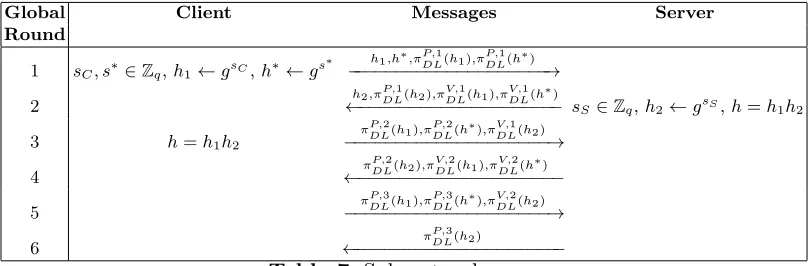
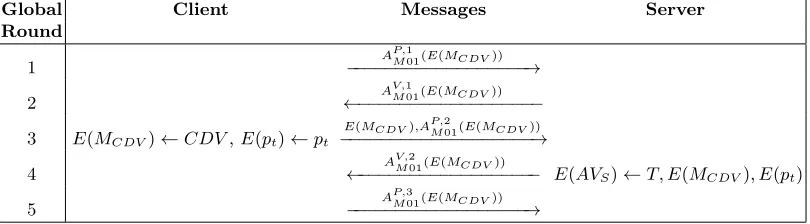
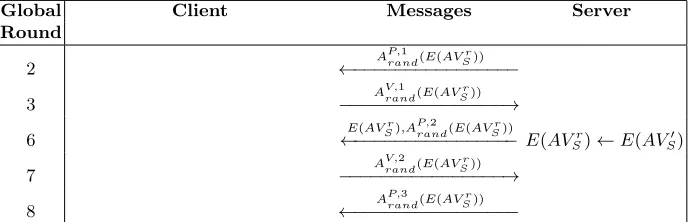
π5MP M, including precisely how the subprotocols are interleaved so that πM5P M requires only eight rounds, see the Section 6.2; we will, however, mention here during which global rounds (1 through 8) in which these subprotocols occur.
We remark that in our construction of ZK arguments of knowledge from Σprotocols, whenever a ZK subprotocol is required, the first two rounds of the five-round protocol can be completed in parallel at the very beginning of the overall protocol π5MP M. Such “preprocessing” does not affect security. Further, knowledge extraction used in the security proofs is not affected by this prepro-cessing.
π
encr is a two =party protocol executed between Client and Server that initializes anaddi-tively homomorphic threshold encryption scheme (e.g., ElGamal) and also sets up an independent “trapdoor”s∗ alluded to in Section 3.3.1 and required for the simulator in the security proof. In the ElGamal case, for simplicity, we assume that Client and Server have already agreed on appropriate prime q such that logq =O(k), Gq and g ∈Gq. This subprotocol begins at the first global round
and ends at global round 6. Client chooses its secret key sC and trapdoor s∗, and sets h1 ← gsC,
h∗ ← gs∗. Client sends h1, h∗ to Server. Client executes two parallel instantiations of πDL proving
knowledge of the discrete logs of h1 and h∗ (i.e., sC and s∗). Then, Server chooses its secret key
sS, sets h2 ← gsS, and sends h2 to Client and executes πDL proving knowledge of the discrete
logarithm ofh2 (i.e.,sS). Both parties set the public key to be h=h1h2 =gsC+sS.
π
C,AV is a two-party protocol executed between Client and Server which outputs to ClientThis subprotocol starts at global round 2 and ends at global round 6. First, Server constructs
MT ← GenMT(T) as specified in Section 3.1. Then, Server encrypts MT and sends E(MT) to Client. Server also executes, forE(MT),AM1 to prove that E(MT) is formatted correctly (namely,
that each row of E(MT) has one encryption of a 1 per row and encryptions of 0 everywhere else.
Therefore, each row ofE(MT) corresponds to the encoding of exactly one element of the alphabet
Σ). Client then obtainsE(AVC) by computingE(P M5P M(MT, MCDV, m)) (see Section 2.3.2) and
then multiplying each encryption by E(−pt) (whereptis the pattern-matching threshold),
observ-ing that the functionP M5P M can be computed using encrypted E(MT).
π
S,AV is a two-party protocol executed between Client and Server which outputs to Server anencrypted activation vector corresponding to matching Client’s pagainst Server’s T. This subpro-tocol starts at global round 3 and ends at global round 5, with ZK preprocessing occurring during global rounds 1 and 2. Client encrypts MCDV and pt, and sends E(MCDV) and E(pt) to Server.
Client also executesAM01to prove thatE(MCDV) is formatted correctly (namely,E(MCDV)
con-sists of at most one encryption of 1 per column and concon-sists of encryptions of 0 everywhere else. This therefore ensures that there is at most one character delay value per distance). Server com-putesE(AVS) by computingE(P M5P M(MT, MCDV, m)) and then multiplying each encryption by
E(−pt) (this slightly differs from Server’s actions duringπH5P M since the consistency proof of πvec
must also include subtraction of the pattern-matching threshold pt).
π
vec is a two-party protocol executed between Client and Server that outputs to each partywhether their respective encrypted activation vectors are equal (without revealing their values). This subprotocol begins at global round 3 and ends at global round 8, with ZK preprocessing oc-curring during global rounds 1, 2 and 3. Client computesE(AVC0) by multiplying each element of
AVC with an encryption of 0; Server computes E(AVS0) from E(AVS) similarly. Client and Server
execute πV ecEQ (see Section 2.3.4) where Client has input E(AVC0) and Server has input E(AVS0).
In addition, whenever a party sends the other a partial decryption, they executeAP D to prove that
the execution is well formed. Note that the probability that πV ecEQ will complete without abort
for unequal vectorsAVS and AVC is negligible (1q).
π
rand is a two-party protocol executed between Client and Server that outputs to Client anencrypted vector E(AVSr) that contains randomizations of the values in non-matching (non-zero) positions in E(AVS0). This subprotocol starts at global round 6 and ends at global round 8, with ZK preprocessing occurring during global rounds 2 and 3. Server computesE(AVSr) fromE(AVS0) by exponentiating each encryption in E(AVS0) by a random value. Server sends E(AVSr) to Client and executes Arand to prove that E(AVSr) was obtained correctly fromE(AV
0
S).
π
ans is a two-party protocol executed between Client and Server that outputs to Client therandomization,AVr
S, of Server’s activation vectorAVS. Note thatAVSr will have a 0 wherever there
is a match; every non-matching entry will contain a random element. Client is assumed to already know E(AVSr). This subprotocol starts at global round 6 and ends at global round 8, with ZK preprocessing occurring during global rounds 2 and 3. We present a slightly modified version of the actual subprotocol used because in practice this protocol must be rearranged slightly to keepπM5P M
at 8 rounds (see Section 6.2 for details). Server sends DS(E(AVSr)) to Client and executes AF D
to prove that either DS(E(AVSr)) was obtained correctly or that Server knows s∗ (for h∗ sent by
Client in the first round of πencr). Client aborts if it does not accept AF D and otherwise obtains
3.3.4 Protocol Efficiency and Security. Overall the bandwidth ofπM5P M is dominated by the
O(m|Σ|) encrypted values that Client sends to Server in πS,AV and O(n|Σ|) encrypted values that
Server sends to Client inπC,AV andπans. Since alphabet size,|Σ|, is constant, we obtain the desired
bandwidth, including the ZK protocols, ofO((m+n)k2) for security parameterkand total number of encryptions ofO(m+n). In particular, when Client hides pattern size, the corresponding pattern will have length n, and therefore the bandwidth complexity is O(nk2). Computational complexity for Client is dominated by the subprotocolπC,AV, where Client performsO(mn) exponentiations of
encrypted elements, and computational complexity for Server is dominated by subprotocolsπS,AV,
where Server performs O(mn) multiplications of encrypted elements, and πvec and πans, where
O(nk) exponentiations are needed for the ZK protocols.
Theorem 2. Assuming that the Decisional Diffie-Hellman (DDH) problem is hard,πM5P M is secure
in the malicious (static corruption) model.
See Section 7 for a detailed security proof.
4 Converting Σ protocols to Zero-Knowledge Arguments of Knowledge
(ZK-AoKs)
Here, we describe the construction used to convert a Σ protocol into an efficient zero-knowledge argument of knowledge. We first provide the necessary definitions. We then give a construction of an efficient extractable equivocable commitment scheme. We finally use this scheme to construct a zero-knowledge argument of knowledge from a Σ protocol for the same relation. We note that an algorithm is expected PPT if it is a probabilistic algorithm that runs in expected polynomial time.
4.1 Definitions
Let R be a binary relation where for all (x, w) ∈ R, |w| ∈ poly(|x|). w is called the witness for
x. Consider an interactive argument consisting of a pair of PPT algorithms (P, V) (thought of as probabilistic next-message functions). x is known to both P and V, while w is only known to P. Informally,P proves toV that there is awsuch that (x, w)∈R. We consider interactive protocols that have the following specification:
a. P sends messagea,|a| ∈poly(|x|).
b. V selects messagee∈ {0,1}poly(|x|) uniformly at random and sendsetoP. We denote eas the
challenge.
c. P sends a reply z∈ {0,1}poly(|x|).
Note that this interaction is public coin for V. Based on the tuple (also called a conversation) (a, e, z), V either accepts or rejects. For any x, we call a conversation (a, e, z) that V accepts an
accepting conversation.
Definition 1. A 3-move interactive protocol Π = (P, V) of the above specification is said to be a
Σ protocol for a relation R if it satisfies the following properties:
a. Completeness: On common input x, if the honest prover P has as private input w such that
b. Special Soundness: For any common input x and any pair of accepting conversations (a, e, z)
and (a, e0, z0) forx where e6=e0, there exists aw that can be computed in polynomial time such that (x, w)∈R.
c. Special Honest-Verifier Zero-Knowledge (SHVZK): There exists a PPTM that on input x and a properly formatted e outputs an accepting conversation of the form (a, e, z) with the same probability distribution (over e) as conversations between honest P and honest V.
Definition 2. An interactive protocol for a relation R consisting of a pair of PPT algorithms
(P, V)is an argument of knowledgewith knowledge error κ if the following properties are satisfied: a. Completeness: On common input x, if the honest prover P has as private input w such that
(x, w)∈R, then honest V always accepts.
b. Knowledge Soundness: There exists a (expected) PPT E called the knowledge extractor which, given input x and oracle (black-box) access to P, attempts to compute w such that (x, w) ∈R. For any prover P∗, let (x) be the probability that V accepts on input x. Then there exists a constant c such that whenever (x)> κ(x), E will output a correct w in expected time at most
|x|c
(x)−κ(x) where an individual oracle call to P
∗ is considered as one step.
κ can be thought of as the probability that V can be convinced that there exists awsuch that (x, w)∈R even if such a pair does not exist.
Lemma 3 ([35]) Let Π be a Σ protocol for relation R where the challenge e is drawn uniformly
at random from {0,1}t. Then Π is a proof of knowledge with knowledge error 2−t.
Remark 1. Lemma 3 holds because Definition 4.1 includes the special soundness property.Σ pro-tocols that only have standard soundness will not always satisfy the lemma.
Definition 3. For any binary relationR, an interactive protocol consisting of a pair of PPT
algo-rithms (P, V) is a zero-knowledge argument if it satisfies the following properties:
a. Completeness: On common input x, if the honest prover P has as private input w satisfying
(x, w)∈R, then honest V always accepts.
b. Soundness: For allx such that there does not exist aw with(x, w)∈R, V will only accept with negligible probability.
c. Zero-Knowledge: For all PPT V∗, there is a PPT simulator M with oracle access to V∗ such that, given input x and V∗’s auxiliary input, V∗’s view of its interaction with real P is compu-tationally indistinguishable from V∗’s view of its interaction with M.
We demonstrate that anyΣprotocol for a binary relation Rcan be converted into a ZK argument of knowledge forR. We first construct an extractable equivocable commitment scheme and use this scheme together with theΣ protocol specification for the ZK-AoK construction.
4.2 Extractable Equivocable Commitment Schemes
To construct a ZK-AoK from aΣ protocol, an efficientextractable equivocable commitment scheme
will be required. Such a scheme is an interactive protocol between a PPT committer C and a PPT receiverRconsisting of three functions:EComSetinstantiates the commitment scheme,com
computes the commitment, andEComV er verifies that decommitment is valid. More specifically,
c ← com(s, r, pk) for messages and randomness r and sendsc toR as its commitment to m. To decommit,C sends (r, m) to R.R computes {0,1} ←EComV er(m, r, c, pk),accepts if 1 is output and rejects otherwise.
Definition 4. Acomputationally binding equivocable commitment scheme is a pair of PPT
algo-rithms (R, C) that interact as above and satisfy the following properties.
a. Statistically Hiding: For pk correctly constructed and any messages s and s0, the distributions of com(s, r, pk) andcom(s0, r0, pk) are statistically indistinguishable over the choice of random input (e.g., r and r0).
b. Computationally Binding: For any PPT algorithm C running in expected time polynomial in k, the probability that C on input pk can compute a tuple (s, r, s0, r0) such that com(s, r, pk) =
commit(s0, r0, pk) with s6=s0 is negligible in k.
c. Equivocable: There is a PPT algorithmS that, on inputs t,pk, any commitment cand any ac-cepting decommitment(s, r)toc, can construct for any valids0 anr0 such thatc=com(s0, r0, pk). An equivocable commitment scheme is extractableif there is a PPT algorithm E that, upon oracle access to R, is able to obtain a trapdoor tin expected polynomial time.
We now give a construction of an equivocable commitment scheme, EP, based on Pedersen commitments [34]. We assume that the receiver R and committer C have already agreed on a prime order groupGq and generator g∈Gq. The committer C has a messages. Forb∈ {0,1}, we
denote ¯b= 1−b.
EP - Commitment:
EP-1: R chooses for 1 ≤ i ≤ k and 0 ≤ j ≤ 1, x1,0, x1,1, ... , xk,0, xk,1 ∈ Zq uniformly and
independently at random and sets hi,j ←gxi,j.R sends (h1,0, h1,1, ..., hk,0, hk,1) to C.
EP-2: Cchoosese∈ {0,1}k.C choosesr
1, ...rk∈Zq uniformly and independently at random.
C setsc=hr1
1,e1 ·...·h
rk
k,ek·g
s←com
Gq,g,h1,e1,..,hk,ek(s, r1, ..rk).C sends eand c toR.
EP-3: R sends (x1,e¯1, ..., xk,¯ek) to C.
C checks that for 1≤i≤k,hi,¯ei =g
xi,ei¯ . If not,C aborts.
EP - Decommitment
EP-4: C sends s, r1, ..., rk.
EP-5: R verifies thatc=hr1
1,e1 ·...·h
rk
k,ek·g
s and aborts if equality does not hold.
The aboveEPprotocol has bandwidth complexityO(k2) and computational complexityO(k2log2k). Just like Pedersen commitments, this commitment scheme is statistically hiding and computa-tionally binding.
We show that knowledge of any discrete logarithm xi,j from the public key together with a
valid decommitment would allow S to open commitments to any value. Indeed, let the public key be (h1,e1, ..., hk,ek), where hi,ei = g
xi. Without loss of generality, suppose S obtained x
1 and also obtainedc, s, r1, ..., rk such that c=com(s, r1, ..., rk, pk). Let s0 be any message.S setsr0i =ri for
2≤i≤k and sets r10 = s+x1r1−s0
x1 mod q. Then com(s 0, r0
1, r2, ..., rk) =c=com(s, r1, ..., rk).
To demonstrate that this scheme is extractable, for any R we construct a simulator MR. MR
runs EP honestly with Rthrough EP-3, then rewinds toEP-2and sends a newe0 ∈ {0,1}k toR.
discrete logarithm of any of the hi,js is roughly the same probability that MR will fail to extract
a trapdoor since knowledge of the discrete logarithms occurs at EP-3; therefore, we require many trapdoors to ensure that the probability that R sends an invalid response at EP-3is negligible in the security parameter.
4.3 Construction of a ZK-AoK from Σ Protocols
We give a construction for how to transform a three-move Σ argument of knowledge Σrel for a
binary relationRrel into a five-move ZK argument of knowledge πrel forRrel using the extractable
equivocable commitment scheme EP described in Section 4.2. Recall from Section 4.1 that we denote the transcript for a Σ protocol as (a, e, z), where e is chosen uniformly at random by V. We assume that V and P have already agreed on a multiplicative group Gq with prime order q
and generator g ∈ Gq. P (x, w) ∈ Rrel; V possesses x. We denote the following construction by
Σ-ZK-AoK, which consists of the following steps:
rel-1: P executesEP-1acting as receiver.
rel-2: V selects eaccording to the second message of Σrel. V executes EP-2using e as the value
being committed.
rel-3: P computesaaccording to the first message specification ofΣrel.P executesEP-3and also
sends atoV.
rel-4: V executesEP-4, opening e.
rel-5: P executes EP-5 and aborts if P does not accept. P computes z according to the third
message specification of Σrel in response to a,eand x.P sends ztoV.
rel-6: V verifies (a, e, z) according toΣrel.
πrelhas bandwidth complexityO(k2) and computational complexityO(k2log2k) in addition to
that ofΣrel.
Lemma 1. If Σrel is a Σ-protocol, then πrel is a ZK argument of knowledge.
Proof: Completeness. Completeness follows from the completeness ofΣrel.
Soundness. To demonstrate soundness, assume that there exists an x such that there is no
w with (x, w) ∈ Rrel and yet V accepts πrel with non-negligible probability. Let (a, e, z) be the
transcript forΣrel contained within πrel. Then it follows that Σrel has a verifierV that accepts a
transcript with non-negligible probability for the same x. This implies that there are at least two distinct challenges e and e0 such that P can produce accepting transcripts (a, e, z) and (a, e0, z0) forΣrel within πrel (in fact, there must be a non-negligible number of such challenges). However,
by special soundness of Σrel, aw can be computed in polynomial time from these transcripts such
that (x, w)∈Rrel. But such aw does not exist, which leads to a contradiction.
To demonstrate that πrel is zero-knowledge, for any verifier V∗, we describe the simulator
MV.MV acts as an honest prover for steps rel-1 through rel-4. At step rel-4, MV receives V∗’s
challenge e. MV then, by the SHVZK property of Σrel, computes (a, z) such that (a, e, z) is an
accepting transcript for x. Note that in particular, the fact that Σ protocols are special honest verifier zero knowledge is important, as it implies the ability to construct correct transcripts for arbitrary (pre-selected) distributions of verifier messages.MV rewinds to steprel-3 where it sends
a (as well as executes EP-3) and executes the rest ofπrel honestly. In particular, MV sends z at
step rel-5. V∗’s view of its interaction with P is indistinguishable from its view of its interaction
commits to its challenge (in a perfectly binding fashion) before it receives the first message ofΣrel.
Since the distribution of e is not affected by initial messages, MV’s transcript of Σrel within πrel
is computationally indistinguishable from P’s output for Σrel by the special honest-verifier
zero-knowledge (SHVZK) property of Σrel. Computational indistinguishability of the whole transcript
follows.
To show the existence of a knowledge extractor, EP, for each P, let Erel,P be the knowledge
extractor for Σrel and let SP be the trapdoor extractor for the commitment scheme EP. EP
then runs ZK-AoK using S as a subprotocol to extract the trapdoor for EP. EP then rewinds
to rel-4, after P has already instantiated the commitment scheme and sent its initial message a
for Σrel, and changes its challenge for Σrel according to the specification of Erel,P. Note thatEP
will have to decommit to multiple challenges for Σrel at step rel-4 in order to execute Erel,P as
a subprotocol. However, since EP possesses the trapdoor forEP and EP is equivocable, EP can
decommit (e.g., construct messages for EP-4) to whatever challenge Erel,P specifies. SinceS can
extract the trapdoor in polynomial time, and ErelP can extract the witness forΣrel in (expected) polynomial time,EP can extract the witness for πrel in (expected) polynomial time.
Remark 2. We note that above, the zero-knowledge simulator MV was able to interact with V
without actually knowing the witnessw forx. This is because of the simulation soundness ofΣrel;
namely, since a simulator can produce accepting transcripts only by seeing the Verifier’s challenge there (and without seeingw),MV can produce proper transcripts forπrel without ever knowingw.
Such a property is called simulation soundness and will be useful for a security reduction needed forπM
5P M (see Section 7.3.3).
5 Required Σ Protocols
In this section we outline specific Σ protocols needed for the malicious model version of 5P M,
π5MP M. These three-move protocols are executed between a PPT prover (P) and a PPT verifier (V) and are used to construct zero-knowledge arguments of knowledge using the transformation in Section 4.3. For each Σ protocol, we first describe the relation demonstrated by P, and then we describe the three protocol messages exchanged betweenP andV. We note that with the exception of Σf in, the security of each of the followingΣ protocols is proven in the places in which they are
cited; the security of Σf in follows since it is a standard example of an OR Σ protocol of two Σ
protocols already shown here (for more, see [35]).
1. ΣDL, Proving Knowledge of Discrete Logs [36]: For g and h = gx, P demonstrates
knowledge of witnessx. The relationRDL is ((Gq, q, g, h), x)∈RDL ifh=gx. TheΣprotocol steps
are:
- ΣDL−1:P chooses r∈Zq and setsa←gr.P sends atoV. - ΣDL−2:V chooses a challengec∈Zq and sends c toP. - ΣDL−3:P setsz←r+cx and sendsz toV.
- ΣDL−4:V checks thatgz =ahc and aborts if not.
2. ΣeqDL, Proving Equality of Discrete Logs [30]: For g, h, x, y ∈ Gq, P demonstrates
knowledge of a witnesswsuch thatx=gwandy =hw. The relationReqDLis ((Gq, q, g1, g2, h1, h2), w)∈
ReqDL ifh1 =g1w and h2 =g2w. TheΣ protocol steps are:
- ΣeqDL−2:V choosesc∈Zq and sends c toP. - ΣeqDL−3:P setsz←r+wc and sendsz toV.
- ΣeqDL−4:V checks thatgz =axc and thathz=byc and aborts if not.
3. ΣisBit, Proving Encryption of 0or 1 [37]: P demonstrates that it possesses an ElGamal
encryption of m∈ {0,1}with generators g, public keyh and randomnessr (recall that encryption of m is of the form (gr, gmhr) = (x, y)). P proves that either log
gx = loghy or loggx= loghy/g.
The relation RisBit is ((Gq, q, g, h, α, β),(b, r))∈RisBit if (α, β) = (gr, gbhr) and b∈ {0,1}. TheΣ
protocol steps are:
- ΣisBit−1:
– If m= 1: P chooses r1, d1, w2 ∈Zq and sets a1←hr1(ghr)−d1,a2←hw2. – If m= 0: P choosesw1, r2, d2 ∈Zq and setsa1 ←hw1,a2←hr2(hrg−1)−d2.
P sends (a1, a2) to V.
- ΣisBit−2:V chooses c∈Zq and sends ctoP. - ΣisBit−3:
– If m= 1: P setsd2←c−d1,r2 ←w2+rd2. – If m= 0: P setsd1←c−d2,r1 ←w1+rd1.
P sends (d1, d2, r1, r2) to V.
- ΣisBit−4:V verifies that c=d1+d2,hr1 =a1(gmhr)d1 and hr2 =a2(gm−1hr)d2 and aborts if not.
4. Σf in, Proving Equality of Discrete Logarithmss Or Knowledge of Discrete
Loga-rithm:P demonstrates forg, h, g1, h1, g2, h2 ∈Gq thateitherit knows the value logg1h1= logg2h2
or he knows x such that h =gx given g. The relation Rf in is ((Gq, q, g1, g2, h1, h2, g, h),(α, x))∈
Rf in if either (DLE):h1=g1α and h2 =g2α or (DL:)h=gx. TheΣ protocol steps are:
- Σfin−1:
– If DLE:P choosesr1, d1, w2 ∈Zq and setsa1 ←gr1h−d1,a2 ←g1w2 and a3 ←gw22. – If DL:P chooses w1, r2, d2 ∈Zq and setsa1 ←gw1,a2←g1r2h
−d2
1 anda3 ←g2r2h
−d2
2 .
P sends (g1, h1, g2, h2, g, h, a1, a2, a3) to V.
- Σfin−2:V choses c∈Zq and sends ctoP.
- Σfin−3:
– If DLE:P setsd2 ←c−d1,r2←w2+αd2. – If DL:P setsd1 ←c−d2,r1←w1+xd1.
P sends (d1, d2, r1, r2) to V.
- Σfin−4:V verifies thatd1+d2 =c,gr1 =a1hd1, g1r2 =a2hd12, andg
r2
2 =a3hd22 and aborts if not.
6 Detailed π5MP M Specification
We provide here the detailed protocol specification of the malicious model version of 5P M,π5MP M. First, we must specify the various zero-knowledge arguments of consistency that are required.
6.1 Arguments of Knowledge of Consistency
scheme (Section 2.2). We apply theΣ-ZK-AoK construction outlined in Section 4 to transform the three-move arguments of knowledge outlined in Section 5 to construct the five-move ZK arguments of knowledge πDL, πisBit, πeqDL and πf in. All arguments are executed between a prover P and a
verifier V. πDL is the only ZK-AoK used on its own in π5MP M; it proves knowledge of a discrete
logarithm of a public h=gx.πisBIT is a ZK-AoK that proves that an encryption is either of 0 or
of 1;πeqDL is a ZK-AoK that proves that two discrete logarithms are equal; andπf in is a ZK-AoK
that proves that either two discrete logarithms are equal or that P knows the discrete logarithm of a publich=gx. The five required interactive arguments are:
AM01, an AoK of Consistency for Matrix Formation 0/1:In this interactive argument,P sends
an l×u matrix of encryptions, E(M). P demonstrates to V that each column in E(M) contains at most one encryption of 1, and the rest of the encryptions are of 0. We assume that P has sent
E(M) to V. We denote by AM01 the five-move interactive argument where P proves to V using (l+ 1)u parallel instantiations of πisBit that each entry of E(M) is an encryption of either 0 or
1 and that each column-wise product of E(M) is an encryption of either 0 or 1. If V accepts the argumentAM01, then it accepts that each column is made up of entries that are either 0 or 1 and sum up to 0 or 1; therefore, each column contains encryptions of 0 and at most one 1.
AM1, an AoK of Consistency for Matrix Formation 0/1-1: Similar to the above interactive
argument, P sends an l×u matrix of encryptions, E(M). P demonstrates toV that (unlike the above argument) each row in E(M) contains exactlyone encryption of 1 and the rest are encryp-tions of 0. To prove that an encryption (x, y) is of 1, P sends y0 = y/g and uses πDL to prove
that loggx= loghy0. V then can see that (x, y) is an encryption of 1 only if y/y0 =g. We assume thatP has sentE(M) toV. We denote byAM1 the five-move interactive argument where P sends (xi, yi0) for each of the row-wise products, (xi, yi), of E(M) and then P proves to V using l·u
instantiations ofπisBitthat each entry ofE(M) is an encryption of a 0 or a 1 and proves toV using
u instantiations of πDL that each row-wise product of E(M) is an encryption of a 1. IfV accepts
the argument AM1, then it accepts that each row is made up of entries that are either 0 or 1 and
sum to 1; therefore, each row contains encryptions of 0 and exactly one 1.
APD, an AoK of Consistency for Partial Decryption:In this interactive argument,P possesses
and sends a vector ofl encryptions (xi, yi) and a vector of theirl partial decryptions (xi, yi/xsiP),
wheresP isP’s private key.P demonstrates toV that he has computed the partial decryptions
cor-rectly. We assume thatP has already sent the vector oflencryptions andlpartial decryptions and that V already knowsgsP. We denote by A
P D the five-move interactive argument where P sends,
for each i,xsP
i , and proves toV using lparallel instantiations of πeqDL, that logggsP = logxix
sP
i .
ARand, an AoK of Consistency for Randomization: In this interactive argument, P possesses
and sends a vector of l encryptions (xi, yi) and a vector of their randomizations, (xrii, y ri
i ), to V
and demonstrates knowledge of ri for each i. P proves, using πeqDL, that logxix
ri
i = logyiy
rI
i for
each i. We assume that P has already sent the l encryptions and l randomizations. We denote by
ARand the five-move interactive argument where P proves to V, using l parallel instantiations of
![Table 13. Performance results for 1024 and 2048 bit key length in seconds for different settings ofthe alphabet Σ, the pattern p and the text T using fast-decryption Paillier [40].](https://thumb-us.123doks.com/thumbv2/123dok_us/1881525.1245204/49.612.71.559.228.518/performance-results-dierent-settings-alphabet-pattern-decryption-paillier.webp)
