Available Online atwww.ijcsmc.com
International Journal of Computer Science and Mobile Computing
A Monthly Journal of Computer Science and Information Technology
ISSN 2320–088X
IMPACT FACTOR: 5.258
IJCSMC, Vol. 5, Issue. 5, May 2016, pg.147 – 154
Required Image Retrieval by Capturing User
Intention Using Image Pool Clustering
Mr. Naresh M.Bhagat
1, Dr. M.A.Pund
21
ME (CSE), Second Year, Department of CSE, Prof. Ram Meghe Institute of Technology and Research, Badnera, Amravati
Department of CSE, Prof. Ram Meghe Institute of Technology and Research, Badnera, Amravati
ABSTRACT— Image search is a particular data search used to determine images. For searching images, a user may give
query terms such as keyword, image file, or click on few image, and the system will determine images "similar" to the query.
The resemblance used for search criteria could be Meta tags, colour distribution in images, region/shape attributes, etc.
Many Commercial Internet scale image search engines use only keywords as queries. The search engines (e.g. Google
Image Search, Bing Image Search) mostly depend on surrounding text features. It is not easy for them to understand user’s
search intention only by query keywords and this leads to uncertain and noisy search results. It is important to use visual
Information in order to solve the ambiguity in text-based image retrieval. In this paper, we propose a novel Internet image
search approach. The user needs to click on one query image with the minimum attempt and images from a pool retrieved by
text-based search are re-ranked based on both visual and textual content. To capture the users’ search intention from this
one-click query image in four steps has been presented in this paper.
Keywords— Image search, Intention, Visual, Clustering, Re-ranking.
I. INTRODUCTION
Today‟s commercial Internet scale image search engines use only text information. Users type keywords in the hope of finding
a certain type of images. The search engine returns thousands of images ranked by the text keywords extracted from the
surrounding text. However, many of returned images are noisy, disorganized, or irrelevant .Even the state-of-the-art, such as
Google Image Search[1] and Microsoft Live Image Search [2], use no visual information. Using visual information to re-rank
and improve text based image search results is a natural idea. Most of the existing works assume that there is one dominant cluster of images inside each image set returned by a keyword query, and treat images inside this cluster as “good” ones.
online image search. In addition, these approaches cannot handle ambiguity inside a keyword query, since the assumption that
images returned by querying one keyword are all from one class does not hold, and the structure of the returned image set is
much more complicated .For example, the query for “apple” can return images from 3 main classes (images that are
semantically similar), such as Fruit apple,apple pie, and Apple digital products. Within each main class, therecan be several
distinct sub classes (images that are visually similar). Also, there are images that can be labelled as noise (irrelevant images) or
neglect (hard to judge relevancy) in which a picture indexing and abstraction approach for pictorial database retrieval is used
[1]. In this paper, we propose a framework and make a system to re-rank text based image search results in an interactive way.
After query by keyword, user can click on one image, indicating this is the query image. We then re-rank all the returned images
according to their similarities with the query. The most challenging problem in this framework is how to define similarity. There
are many features in vision and CBIR community, either low level ones such as color, texture, and shape, or higher level ones
such as face. Using different features will produce different results, and there is no single feature that can work well for all
images. How to integrate various visual features to make a decision about similarity between the query image and other images
becomes the essential problem, especially for the diverse and open data set on the Internet. In CBIR community, the relevance
feedback approaches [18] focus on how to find a better combination weight of features based on multiple labelled images
provided during multiple user feedback sessions. The performance has been limited. In addition, most approaches require online
training based on the feedback samples, thus are difficult to be used for real time online applications.
II. LITERATURE SURVEY
The search ranked by the text keywords extracted from the surrounding text. However many of returned images are noisy,
disorganized, or irrelevant. Even the state-of-the art, such as Google Images Search and Microsoft Live Image Search, use no
visual information. Using visual information to re-rank and improve text based image search results is a natural idea. Surfing
images on the web are text-based and are limited by the fact that query keywords cannot describe image content accurately.
Content-based image retrieval uses visual features to evaluate image similarity. Content-based image retrieval, a technique
which uses visual contents to search images from large scale image databases.
Zhang et al. proposed geometry preserving visual phases which captured the local and long range spatial layouts of visual
words. One of the major challenges of content-based image retrieval is to learn the visual similarities which reflect the semantic
relevance of images well. Image similarities can be learned from a large training set where the relevance of pairs of images is
known.
Deng et al. learned visual similarities from a hierarchical structure defined on semantic attributes of training images. Since web
images are highly diversified, defining a set of attributes with hierarchical relationships for them is challenging.
Huang et al. proposed probabilistic hyper graph ranking under the semi-supervised learning framework. It utilized both labelled
and unlabeled images in the learning procedure.
Xiao Tang et al. proposed a novel Internet image search approach. It requires the user to give only one click on a query image
and images from a pool retrieved by text based search are re-ranked based on their visual and textual similarities to the query
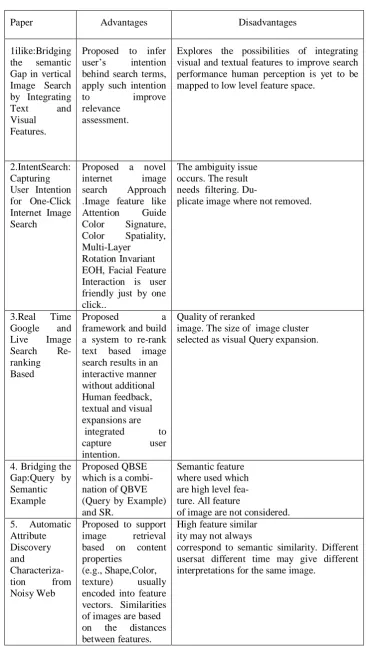
TABLE I. LITERATURE SURVEY
Paper Advantages Disadvantages
1ilike:Bridging the semantic Gap in vertical Image Search by Integrating Text and Visual
Features.
Proposed to infer user‟s intention behind search terms, apply such intention
to improve
relevance assessment.
Explores the possibilities of integrating visual and textual features to improve search performance human perception is yet to be mapped to low level feature space.
2.IntentSearch: Capturing User Intention for One-Click Internet Image Search
Proposed a novel internet image search Approach .Image feature like Attention Guide Color Signature, Color Spatiality, Multi-Layer
RotationInvariant EOH, Facial Feature Interaction is user friendly just by one click..
The ambiguity issue occurs. The result needs filtering. Du-
plicate image where not removed.
3.Real Time Google and Live Image Search Re-ranking Based
Proposed a
framework and build a system to re-rank text based image search results in an interactive manner without additional Human feedback, textual and visual expansions are integrated to capture user intention.
Quality of reranked
image. The size of image cluster selected as visual Query expansion.
4. Bridging the Gap:Query by Semantic Example
Proposed QBSE which is a combi- nation of QBVE (Query by Example) and SR.
Semantic feature where used which are high level fea- ture. All feature
of image are not considered. 5. Automatic
Attribute Discovery and
Characteriza- tion from Noisy Web
Proposed to support image retrieval based on content properties
(e.g., Shape,Color, texture) usually encoded into feature vectors. Similarities of images are based on the distances between features.
High feature similar ity may not always
III.EXISTING SYSTEM
In Existing system, one way is text-based keyword expansion, making the textual description of the query more detailed.
Existing linguistically-related methods find either synonyms or other linguistic-related words from thesaurus, or find words
frequently co-occurring with the querykeywords .For example, Google image search provides the “Related Searches” feature to
suggest likely keyword expansions. However, even with the same query keywords, the intention of users can be highly diverse
and cannot be accurately captured by these expansions. Search by Image is optimized to work well for content that is reasonably well described on the web. For this reason, you‟ll likely get more relevant results for famous landmarks or paintings than you
will for more personal images like your toddler‟s latest finger painting.
IV.PROPOSEDSYSTEM
We do consider that adding visual information to image search is significant. On the other hand, the interaction has to be as
simple as possible. The absolute minimum is One- Click. In this paper, we plan a novel Internet image search approach. It wants
the user to provide only one click on a query image and images from a pool retrieved by text-based search are re-ranked based
on their visual and textual similarities to the query image. We consider that users will believe one-click interaction which has
been used by several popular text-based search engines. For instance, Google needs a user to choose a recommended textual
query expansion by one-click to obtain extra outcome. In this paper, the main problem to be solved is how to capture user
intention from this one click query image.
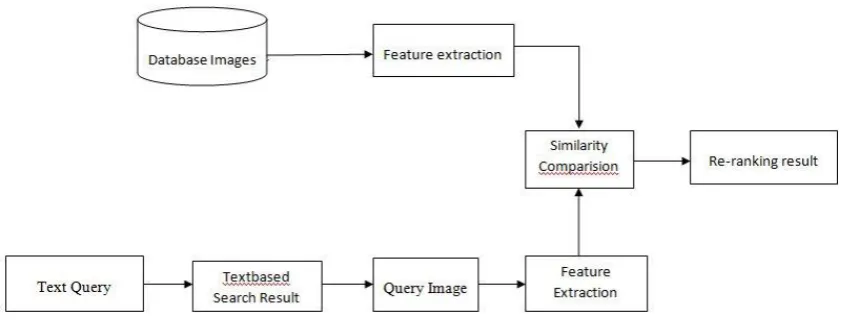
Figure 1. proposed system
V. SYSTEMARCHITECTURE
First User enters a keyword on the search engine, which retrieves the thousands of images, from which user clicks on one quer y
image. The query image is first categorized into adaptive weight categories. Under every category, a specific pre-trained weight
schema is used to combine visual features adapting to this kind of images to improved re-rank the text-based search result.
Perform clustering of images based on the visual and textual similarity, a cluster of images visually similar to query image are
found, which are used as multiple positive image examples from which textual and visual similarity metrics is obtained. These
metrics used for image re-ranking, because they are more specific and robust to the query image. Efficient re-ranking of images
is done using visual and textual similarity.
The block diagram as shown in Figure identifies the CBIR use cases:
Primarily query keywords or text keywords are given as input to text search box.
Query by Image: The query image is selected from text based search result.
Database Images: It contains a large list of images with which the query image is compared to extract related images.
Feature Extraction of query image: The features of the query image are extracted and stored in the temporal storage.
Similarity Measurements: The task of comparing the query image features with the database images individually and the matched result is obtained.
Retrieve Images: The images related to query image in serial form
Figure 2. system architecture
VI.EXPERIMENTAL EVALUATION
A database consists of different types of images has implemented in the system. The relevant images are retrieved in the screen
using different features of the color images. The detailed explanation is given below.
A. Image Retrieval Using Color Histogram
Histogram represents the distribution of intensity of the color in the image. The image retrieval consists of the following stages.
1) Query image is given from the user.
2) Histogram of the Color image is calculated.
3) Color Histogram of the database images are calculated.
4) Euclidean Distance is calculated.
5) Sorted the distance in ascending order and Top K images are displayed on the screen.
B: Image Retrieval Using Color & Texture
For retrieving the images color, edge & texture features are considered. The detailed steps are given below.
1) Query is given from the user.
2) Color & texture features are extracted calculated and these are stored in a matrix. This is called as Feature Vector.
3) Feature vector is also formed for the images present in the database.
4) Euclidean Distance is calculated between the feature vector of query image and database images.
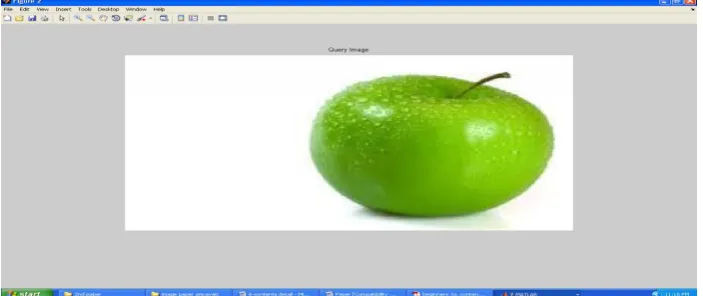
Figure 3. Query keyword input.
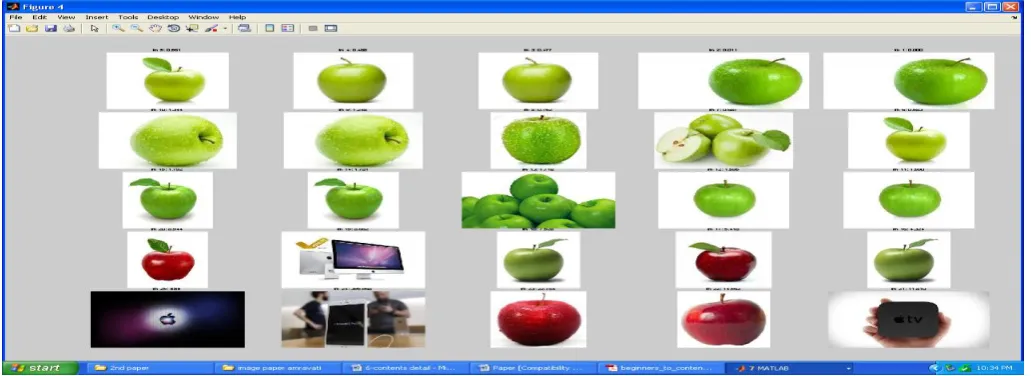
As shown in figure 2 user has to type query keyword to get the result. For example if user type query keyword „apple‟ it retrieve
the relevant images from image database. It shows all images which are tagged as a apple. The figure 3 shows all images
retrieve from image database contain ambiguous or noisy result. As shown in figure 3 the result for query keyword „apple‟
shows green apple images, red apple images and apple accessories which is ambiguous or noisy result.
Figure 4. Query keyword output.
After selecting green apple image as query image the images from a pool retrieved by text-based search are re-rankedbased on
both color and textual content. When the user give the query image the color and the texture feature is extracted and compared
with the feature of the images in the database. The color feature is compared with the color feature. The texture feature is
compared with the texture feature. Both color and texture feature are compared with the color and texture feature in the
database
.
Figure 6. Re-ranking result
We re-rank the top N retrieved images by the original keyword query based on their visual similarities to the query image.
VII. CONCLUSION
Image search is a particular data search used to find images. To search for images, a user may give query terms such as
keyword, image file/link, or click on some image, and the system will return images "similar" to the query. In this, a novel
Internet image search approach which only needs one-click user response. Intention specific weight schema is proposed to
combine visual features and to compute visual similarity adaptive to query images. Without additional human feedback, textual
and visual expansions are integrated to capture user intention. Expanded keywords are used to extend positive example images
and also enlarge the image pool to include more relevant images. This framework makes it possible for industrial scale image
search by both text and visual content. The proposed new image re ranking framework consists of multiple steps, which can be
improved separately or replaced by other techniques equivalently effective.
REFERENCES
[1] Xiaoou Tang; Ke Liu; Jingyu Cui;Fang Wen;and Xiaogang Wang; IntentSearch:Capturing User Intention for One-Click Internet Image Search, 2012.
[2] J. Deng; A.C. Berg; and L. Fei-Fei; Hierarchical Semantic Indexing for Large Scale Image Retrieval, in Proceedings of l International Conference Computer Vision and Pattern Recognition, 2011.
[3] J. Krapac; M. Allan; J. Verbeek; and F. Jurie; Improving web image search results using query- relative classifiers, in Proceedings of IEEE International Conference on Computer Vision and Pattern Recognition,2010 .
[5] Z. Zha; L. Yang; T. Mei; M. Wang; and Z. Wang; Visual Query Expansion, in Proceedings of IEEE 17th ACM International Conference on Multimedia, 2009
[6] J. Cui, F. Wen; and X. Tang; Real Time Google and Live Image Search Re-Ranking,in Proceedings of IEEE- 16th AMC International Conference on Multimedia,2008
[7] Jingyu Cui; Fang Wen; Xiaoou Tang; IntentSearch: Interactive On-line Image Search Re-ranking,2008
[8] F. Jing; C. Wang; Y. Yao; K. Deng; L. Zhang; and W. Ma; Igroup: Web Image Search Results Clustering, in Proceedings of IEEE- 14th Ann. ACM International Conference on Multimedia,2006
[9] N. Ben-Haim; B. Babenko; and S. Belongie; Improving Web- Based Image Search via Content Based Clustering, in Proceedings of International Workshop Semantic Learning Applications in Multimedia,2006