The proceedings version of this paper appears at CCS ’18. This is the full version.
Partially Specified Channels:
The TLS 1.3 Record Layer without Elision
Christopher Patton and Thomas Shrimpton
Florida Institute for Cybersecurity Research Computer and Information Science and Engineering
University of Florida {cjpatton,teshrim}@ufl.edu
Abstract
We advance the study of securestream-based channels (Fischlin et al., CRYPTO ’15) by considering the multiplexing of many data streams over a single channel, an essential feature of real world protocols such as TLS. Our treatment adopts the definitional perspective of Rogaway and Stegers (CSF ’09), which offers an elegant way to reason about what standardizing documents actually provide: a partial specification of a protocol that admits a collection of compliant, fully realized implementations. We formalizepartially specified channels as the component algorithms of two parties communicating over a channel. Each algorithm has an oracle that provides specification details; the algorithms abstract the things that must be explicitly specified, while the oracle abstracts the things that need not be. Our security notions, which capture a variety of privacy and integrity goals, allow theadversary to respond to these oracle queries; security relative to these notions implies that the channel withstands attacks in the presence of worst-case (i.e., adversarial) realizations of the specification details. We apply this framework to a formal treatment of the TLS 1.3 record and, in doing so, show that its security hinges crucially upon details left unspecified by the standard.
1
Introduction
As protocols such as TLS [32], SSH [37], IPSec [23], and QUIC [21] have evolved, so have the formal tools used to analyze them. Often it is the protocol standards themselves, rather than fully realized implementations, that inspire and guide mathematical abstractions of these protocols, but their complexity makes the task of developing these abstractions quite challenging and prone to missing subtle attacks. Much of this complexity stems from the fact that protocols are only partially specified. The TLS 1.3 standard [30], whose record layer mechanism is the subject of this paper, contains numerous “SHOULDs”, “SHOULD NOTs” and “MAYs.” Each of these provides a guideline, but not a rule (those are “MUSTs” and “MUST NOTs”), for compliant realizations of the standard. In addition, and like other protocol standards, TLS 1.3 leaves many implementation details unspecified. Thus, the standard actually describes a collection of implementations that share a core set of behaviors.
Standards are not more explicit and prescriptive for good reason. To be broadly adopted, they need to be flexible in the face of a variety of deployment concerns, such as backwards compatibility, interoperability with other protocols, and limitations of existing infrastructure. They also need to balance performance with security and account for competing (and often conflicting) interests of stakeholders. But this need for flexibility presents an important challenge to provable security: namely, deciding which of the standard’s guidelines and unspecified implementation details are relevant to security, and so should be captured in the model.
of decryption failures (in particular, whether the encoding was invalid or the MAC was incorrect), leading to plaintext-recovery attacks [36, 17, 27]. The research community reacted by incorporating distinguishable errors into updated models [14, 19], but left more subtle attack vectors unaddressed [3], leading in turn to more sophisticated models [22, 6]. This reactive evolution of the adversarial model is to be expected. But since standards only partially specify the protocol, it is hard to anticipate where vulnerabilities might arise in implementations.
This work explores a definitional viewpoint that may help us to be more proactive, by making explicit in the security model which parts of the protocol are fully specified, and which are not. Concretely, our goal is to establish the security of the TLS 1.3 record layer [32], which (partially) specifies how plaintext and ciphertext data are formatted, encrypted, and transmitted from sender to receiver. To this end, we formalize a new primitive that we call apartially specified channel.
Modeling the TLS 1.3 record layer. The starting point of our model is the stream-based channel abstraction, introduced by Fischlin et al. [19] (hereafter FGMP). The FGMP syntax for stream-based chan-nels accurately captures the interfaces exposed by real secure-channel implementations in that it treats the sender- and receiver-side inputs and outputs as streams of fragments, as opposed to atomic messages. (It also admits distinguishable error messages.) We augment their syntax in order to account formultiplexing of many data streams over the same channel, as this is an essential feature of many secure channel protocols, including TLS 1.3. And although this protocol is our focus, we expect our syntax should be applicable to the authenticated encryption mechanism in other protocols, such as SSH, IPSec, QUIC, and DTLS [31].
We extend the FGMP notions of privacy and integrity to this setting. There are two main flavors of privacy: the first, PRIV-S, is analogous to indistinguishibility under chosen-plaintext attack, since the ad-versary only controls the sender’s inputs; in the second, PRIV-SR, we also allow the adad-versary to mount chosen-ciphertext fragment attacks. With each of these, we consider different “degrees” of privacy corre-sponding to various security goals considered in prior works [28, 19, 18]. For integrity, we formalize two notions: integrity of ciphertext streams (INT-CS) and plaintext streams (INT-PS). Following FGMP, we show how to achieve PRIV-SR security from a scheme that is both PRIV-S and INT-CS secure; just as with FGMP, we will need an additional property called status simulatability (SIM-STAT). Our notions are applicable to settings in which reliable transport (e.g., via TCP) is expected, and failure of the underlying transport mechanism to deliver stream fragments in order is deemed an attack (as in TLS and SSH).
A number of implementation details that are not specified by TLS 1.3 are relevant in the adversarial model of FGMP. For example, there are explicit rules that govern the manner in which plaintext fragments are buffered and coalesced into atomic plaintext records, but the specification leaves many design choices up to the implementation. In order to establish the security of the record layer in this setting, we first need to determine how to reason about these missing pieces. To do so, we apply thepartially specified protocol approach of Rogaway and Stegers [33] (RS) to the study of secure channels. Loosely speaking, a partially specified channel (PSC) consists of named algorithms for the sender and receiver operations that each take a specification details (SD) oracle. The algorithms form the cryptographic core of the secure channel, and hence the part that must be realized precisely; everything that is not explicitly part of the cryptographic core is handled by the oracle. Crucially, in our security notions, it is the adversary itself who will service calls to the SD-oracle. Thus, a proof of security for a particular PSC implies that all details swept into the SD-oracle are irrelevant with respect to these definitions; they can be implemented to behave in an adversarial manner, without concern.
Second, following FGMP, our notion of ciphertext-stream integrity implies that the receiver only consumes the stream produced by the sender. Records written to the channel are delimited by strings calledrecord headers, whose values are specified by the standard. These bits are not authenticated, and the standard does not require the receiver to check that their values are correct; thus, the record layer cannot achieve our strong notion of ciphertext-stream integrity. But intuitively, the value of these bits should not impact security. Our framework provides a clean way to reconcile this intuition with our model: we show that the value of these bits are indeed irrelevantif and only if they are authenticated (Theorem 3).
Our analysis applies to draft 23 [32], which was current at the time of writing. We shared our findings with the IETF working group responsible for standardizing TLS 1.3 and the specification was updated so that the record header is authenticated. This change appears in the final version of the standard [30].
Roadmap of the paper. The next section motivates our analytical framework, putting it in context with
prior work on secure channels and partially specified protocols. Section 3 outlines additional related work on TLS. In Section 4 we formulate our syntax and adversarial model, and define our notions of privacy (Section 4.2) and integrity (Section 4.3). Section 5 presents our formal treatment of the record layer and discusses some limitations of our model with respect to TLS. We conclude in Section 6 with directions for future work.
1.1
Revision history
Note the following changes from the proceedings version of this paper [29].
1. 2020/04/03. Revise the record layer specification (Figure 7; cf. [29, Figure 4]) and the statement of Theorem 4. The original proof of Theorem 4 contained an error in the transition from game 3 to game 4. To patch it, minor changes to the specification are needed to ensure the receiver can correctly compute the record boundaries whenever the channel is in-sync. It is also necessary to restrict the adversary so that he receiver computes these deterministically and independently of the adversary’s state.1 This amount to assuming that the record boundaries can be computed from the sequence of
records written to the channel. This is true of the record layer, of course, so these changes do not change our claims for the TLS 1.3 standard as it is.
2. 2020/04/03. Weaken INT security (Figure 6; cf. [29, Figure 4]) by requiring Enc-queries to have distinct nonces and update Theorem 3 (cf. [29, Theorom 5.2]) and Theorem 4 (cf. [29, Theorom 5.3]) accordingly. The previous notion is stronger than usual (cf. nAE [26]) and therefore excludes common instantiations of the AEAD scheme. For example, AES-GCM is known to be vulnerable to ciphertext integrity attacks when nonces are allowed to repeat [15]. Fortunately, it is straight-forward to patch the proofs to account for the weaker assumption.
2
PSCs in relation to prior work
Our framework weds two existing approaches to analyzing real-world cryptography. First, we extend secure stream-based channels to consider multiplexing of plaintext streams over the same channel. This addresses a problem left open by FGMP [20] and permits, for the first time, the analysis of TLS in this setting. The second approach is the partially specified protocol framework of RS, which we use to reason about the standard itself.
SSH. Their model regards ciphertexts as atomic, but ciphertexts written to the channel may be (and rou-tinely are)fragmented as they traverse the network, which leaves these protocols susceptible to attacks [2]. Likewise, the APIs for real secure channels regard the input plaintext as a stream, meaning that a single logical plaintext may be presented as a sequence of fragments, too. It took another ten years for the model to be significantly extended, by Boldyreva et al. [13], to address ciphertext fragmentation and attacks that exploit it. Finally, in 2015 by FGMP formalized stream-based secure channels that address plaintext frag-mentation, with updates provided in 2016 by Albrecht et al. [1]. As FGMP point out [20], these works help shed formal light on truncation [35] and cookie-cutter [12] attacks. (However, as we discuss in Section 5.3, their work is somewhat limited with regard to these.)
Although theory has advanced significantly, it still falls short of capturing an important feature that real protocols provide: a means of multiplexing a number of data streams over the same channel. The TLS 1.3 record layer, for example, handles streams for three distinct sub-protocols: handshake,alert, and application-data. Explicitly modeling the multiplexing of these streams is necessary for a rigorous analysis of TLS, since each of these sub-protocols has side-effects on the sender and receiver state and, hence, implications for the security provided by the channel.
Whereas FGMP regard the plaintext stream as a sequence of message fragments M1, M2, . . . , we will consider streams of the form (M1,sc1),(M2,sc2), . . . wheresci denotes the stream context of its associated
message fragment. The stream context is metadata that allows for differentiation of fragments into logical streams, each associated to a higher-level application, protocol, etc. Following prior work, our syntax models a unidirectional channel between a sender and receiver. We decompose the sender into two randomized, stateful algorithms: the stream multiplexer (Mux), and the channel writer (Write). Correspondingly, we decompose the receiver into the channel reader (Read), and the stream demultiplexer (Demux). One might think it cleaner to regard the sender and receiver as atomic processes, as the aforementioned works do. We break with this syntax in order to precisely capture multiplexing of streams, and to separate this functionality from the cryptographic operations that turn plaintext strings into ciphertexts. (More on this in Section 4.2.)
Partially specified protocols. In their treatment of the SSH protocol, BKN introduce a paradigm they call Encode-then-Encrypt-and-MAC, which cleanly abstracts many of the details of the SSH specification. In particular, they treat the details of encoding as a generic transform and give a sufficient condition on this transform for the security of the overall protocol. Of course, this idea—and more generally, the Encode-then-Encipher paradigm [9]—is applicable to the problem of analyzing TLS 1.3. But our consideration of stream-based channels makes our adversary considerably stronger than that considered by BKN. It stands to reason, then, that there are details of the protocol and implementation that are relevant to the stronger model, but not the weaker one. (In particular, we must at least account for processing of plaintext- and ciphertext-stream fragments.) How shall we go about uncovering what these security-critical matters are?
There are many ways to appraoch this problem. The approach of RS, which we adopt here, is simply to formalize what a standardis: a partial specification (the things that are mandated and explicitly described) plus additional specification details (everything else). RS apply this approach to authentication protocols, in particular the Needham-Schroeder-Lowe protocol. We apply it to secure channels. The component algorithms of a PSC,Mux, Write, Read, and Demux, formalize the core functionalities of the sender and receiver thatmust be fully specified; the rest of the specification details (SD) are formalized via an oracle given to each of the algorithms. The functionality of this SD oracle is left unspecified, and in our security games,queries made to the oracle are serviced by the adversary. This is clearly a very strong attack model: in addition to influencing the behavior of the algorithms via their inputs, the adversary is allowed to participate in portions of their computation. The actual strength of the model depends on what quantities are exposed to the SD, and how the SD return values are used within the algorithms. At one extreme, an empty (or otherwise trivial) SD yields a traditional kind of attack model; at the other, if secret state (e.g., the key) is passed to the SD, then no security is possible. In this way, our model can provide principled guidance to the standard-writing process by surfacing choices that are relevant to security.
(a la [18]), and which things do not need such hard guarantees.
3
Related work
We have already mentioned the line of papers that our work extends [8, 7, 14, 19, 1]; this section points out important related efforts.
The miTLS project. From the standpoint of scope, the work most closely related to ours is the recent paper by Delignat-Lavaud et al. [18] (DLFK+). It provides a formal analysis of the TLS 1.3 record layer (draft 18) “as is”, but their approach is fundamentally different from our own. The paper is the latest from miTLS (mitls.org), a project whose goal is to formally verify the security of TLSas is, without omitting any details. The strategy is to implement the record layer in a programming language that is amenable to formal analysis (F∗), express their security goals as games in the same language, and find a formal proof that the scheme’s security (in a sense they define) reduces to standard computational assumptions (also expressed in F∗). This methodology amounts to a formalization of code-based game-playing techniques now common in cryptography [10]. Our work is technically different from theirs on a couple fronts. First, our analysis applies to a set of compliant implementations (corresponding to different realizations of the specification details), whereas their work applies only to their implementation. Our notions are also more flexible: we capture the goal of hiding the message length as one of many possible privacy goals, whereas this property is mandatory in their security notion. Second, our adversarial model is stronger in that it permits fragmentation of the plaintext and ciphertext streams; neither capability is considered by DLFK+. We elaborate on this and other points about their setting in Appendix B.
We do not mean to diminish the work of DLFK+ in pointing out these short comings. On the contrary, the value of their contribution (and of the miTLS project overall) is hard to overstate. They provide a reference implementation of the record layer in which we have a high degree of confidence, both in terms of security and, crucially, correctness. Practitioners are paying attention [32, Section 12.2], and using this reference will ultimately facilitate the development of secure production code. As such, we view our work as complimentary to DLFK+.
Other analyses of the record layer. In an analysis of TLS 1.2, a paper by Paterson, Ristenpart,
and Shrimpton [28] put forward a notion of stateful,length-hiding AE that admits schemes with associated padding (to hide the plaintext length) and variable-length MACs, both features of TLS 1.2. Their formalism necessarily elides a number of details of the protocol. Badertscher et al. [5] characterized the TLS 1.3 record layer (draft 08) as anaugmented secure channel (ASC), which allows for sending a message with two parts: the first being private, and both parts being authenticated. Bellare and Tackmann analyze the multi-user security of the TLS 1.3 record layer [11]. They shed light on the following problem: if the same message is encrypted in a number of sessions, then what information does this leak about the sessions? A popular TLS endpoint might serve billions of client a day. Many of these flows are identical (such as the initial GET); thus, an adversary who observes these identical flows can try to guess the key used for one of the clients. Its odds are improved by the sheer number of clients encrypting an identical message. This attack vector lead the designers of TLS 1.3 to “randomize” the IV used for generating the nonce; Bellare and Tackmann analyze the exact security of this approach in the multi-user setting.
4
Partially specified channels
In this section we formalize PSCs and their attendant security notions. We begin with some notation and conventions.
Notation. Let |X| denote the length of a stringX ∈ {0,1}∗ and let |X| denote the length of vector X.
We denote the i-th bit of string X by Xi or X[i], and the i-th element of vector X by Xi or X[i]. Let
{0,1}∗∗= ({0,1}∗)∗. We defineXkY to be the concatenation of stringsXandY; letcat:{0,1}∗∗ → {0,1}∗
denote the mapX7→X1k · · · kXm, where|X|=m. LetX[i:j] denote the substringXik · · · kXj ofX. If i6∈[1..j] orj6∈[i..|X|], then defineX[i:j] =ε. LetX[i:] =X[i:|X|] andX[:j] =X[1:j]. We writeX Y if
prefixY, e.g., 1011 % 10 = 11. (If Y 6X, then defineX%Y =ε.) Let hiin denote an invertible encoding
of integer 0≤i≤2n−1 as ann-bit string.
Algorithms may have access to one or more oracles, written as superscripts (e.g.,AO). The runtime of an
algorithm includes the time required to evaluate its oracle queries. If an algorithmAis deterministic, then we writey ← A(x) to denote executing Aon input ofxand assigning its output to y; ifA is randomized or stateful, then we writey ←← A(x). If X is a set, then we write x←← X to denote samplingxrandomly from X according to some distribution; ifX is finite and the distribution is unspecified, then it is uniform. Ifn∈N\ {0}, then let [n] ={x∈N: 1≤x≤n}.
Pseudocode. Our pseudocode follows the conventions of RS with a few minor differences. (Refer to [33,
Sec-tion 2].) our pseudocode is statically typed. Available types arebool(calledboolean in RS, an element of {0,1}),int(integerin RS, an element ofZ),str(stringin RS, an element of{0,1}∗), andstruct(recordin
RS). New types may be defined recursively from these: for example,type struct{strname,intage}person
declares a data structure with two fields, the first astr and the second anint. Variables may be declared with the word declare, e.g. declare personAlice. Variables need not be explicitly declared, in which case their type must be inferable from their initialization (i.e., the first use of the variable in an assignment statement). There are also associative arrays that map arbitrary quantities to values of a specific type. For example,declare strX[ ] declares an associative arrayX. We let X[k] andXk denote the value inX
associated withk. We will find it useful to explicitly define the “type” of a procedure (i.e., algorithm) by its interface. For instance, the type A(strX,strY)7→(inti,intj) indicates that Atakes as input a pair of strings and outputs a pair of integers. Multiple variables of the same type may be compactly declared, e.g., as declare strX, Y,intz rather thandeclare strX,strY, intz. We also use this convention when defining procedure interfaces, e.g.,A(strX, Y)7→(inti, j).
If a variable of one type is set to a value of another type, then the variable takes the value , read “undefined”. Uninitialized variables implicitly have the value. The symbolis interpreted as 0 (i.e., false) in a boolean expression, as 0 in an expression involving integers, and asεin an expression involving strings. We introduce the distinguished symbol⊥, read “invalid”, which can be assigned to any variable regardless of type. Unlike, its interpretation in an expression is undefined, except that (X =⊥) should evaluate to true just in case variableX was previously set to⊥. We remark that⊥has the usual semantics in cryptographic pseudocode; the symbolis useful for specifying protocols compactly.
A value of any type may be assigned to an anonymous variable ∗, e.g., ∗←x, but the value of ∗ is undefined in an expression. We lethx1, . . . , xmidenote an invertible encoding of arbitrary valuesx1, . . . , xm
as a string. Decoding is written ashx1, . . . , xmi ←X and works like this (slightly deviating from [33, Section
2]): if there exist x01, . . . x0m0 such that X =hx01, . . . , x0m0i, m0 =m, and each x0i has the same type as xi,
then setxi←x0i for eachi∈[m]. Otherwise, setxi ← for eachi∈[m].
Finally, it is customary in cryptographic pseudocode to pass all variables byvalue; for technical reasons, which will become apparent later on, we also permit variables to be passed byreference. Specifically, variables passed to procedures may be embellished with the keyword var. If the variable appears on the left hand side of an assignment statement, then this immediately changes the value of the variable; when used in an expression, the variable is treated as its value. A procedure’s interface makes explicit which inputs must be passed by reference. For example, in a procedureA(intx,var inty)7→intz, variablexis passed by value, whiley is passed by reference.2
4.1
Syntax
Formally, a PSC is a 5-tuple of randomized algorithmsCH= (Init,Mux,Write,Read,Demux). All but the first expect access to an oracle, which we generically write asO in the following definitions:
• Init( )7→(strMu,Wr,Re,De). The initialization algorithmmodels key agreement and initialization of the sender state (Mu,Wr) and receiver state (Re,De).
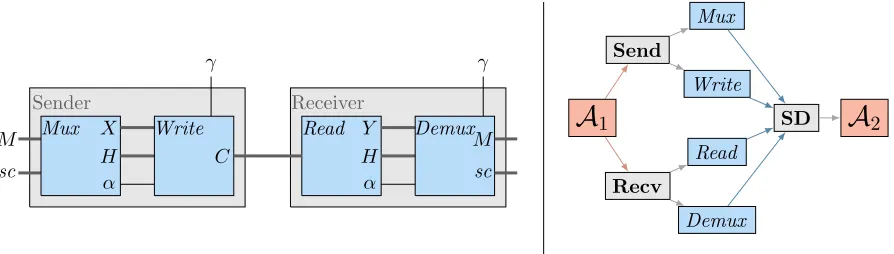
• MuxO(strM,sc,var strMu) 7→ (strX, H, α). The multiplexing algorithm takes as input a plaintext fragmentM, stream contextsc, stateMu, and returns a channel fragmentX, its contextH, and some auxiliary outputα.
Sender
M
sc
Mux X H α
Write
Receiver
Read Y H
α
Demux
C γ
M
sc
γ
A
1A
2Send
Recv
Mux
Write
Read
Demux
SD
Figure 1: left: illustration of our syntax. Right: illustration of the execution model (who may call whom).
• WriteO(strX, H, α,var strWr) 7→ (strC, γ). On input of a channel fragment X, context H, and auxiliary informationα, and stateWr, thechannel writing algorithm produces a ciphertext fragmentC
and status informationγ.
• ReadO(strC,var strRe) 7→ (strY, H, α). On input of a ciphertext fragment C and state Re, the channel reading algorithm returns a ciphertext fragmentY, its contextH, and auxiliary outputα. • DemuxO(strY, H, α,var strDe) 7→ (strM,sc, γ). The demultiplexing algorithm takes a ciphertext
fragment Y with channel context H, auxiliary information α, and state De, and returns a plaintext fragmentM with stream contextsc, along with status informationγ.
The oracleOprovides the specification details and may be invoked any number of times by the caller during its execution. The SD-oracle may have its own state and coins; to be clear, the oracle and its caller do not have joint state, and their coins are independent. We require that each of these procedures halts, regardless of coin tosses or SD-oracle responses, in a bounded number of steps that depends only on the length of its inputs.
Our convention will be that SD-oracle queries are of the formhcaller,instruction, x1, . . . , xmi, wherecaller
and instruction may be thought of as strings. When it is necessary to specify an SD-oracle query, we will endeavor to make them suggestive of the intended semantics under correct operation. (See Figure 7 for examples.) SD-oracle responses are also always strings, but we do not define conventions for them.
Status messages and auxiliary outputs.All algorithms may produce someauxiliary informationalong
with its outputs. This allowsMux andRead to convey state (denotedα) toWrite andDemux (resp.), and allowsWrite and Demux to surface status information (denoted γ) to applications. (See Figure 1 for an illustration.) Among other things, this models distinguishable decryption errors [14], an attack vector that has heavily influenced the development of secure channels [36, 17, 27, 3]. (FGMP model distinguishable errors, too.) Our consideration of information leakage via auxiliary output is inspired by a paper by Barwell, Page, and Stam [6]. Their subtle AE setting models decryption leakage in a manner general enough to capture error indistinguishibility [14, 19], as well as other settings for authenticated encryption [4, 22].
Correctness.Conventionally, one would define a correctness condition as part of the syntax for this new
primitive. Following RS, however, we will not explicitly define correctness of PSCs, as our aim will be to achieve securityeven for channels that are not correct: in particular, when the SD is realized by an adversary. We elaborate on the consequences of this choice in Appendix A, but note that this means we will not be able to assume correctness in our security proofs.
4.2
Privacy
Exppriv-srCH,`,b(A)
1 declare strS,Env,boolsync
2 (Mu,Wr,Re,De)←←Init( )
3 sync←1
4 b0←← A1Send,Recv
(varEnv)
5 return b0
Send(M0,sc0, M1,sc1)
6 L0 ←leak(`, M0,sc0)
7 L1 ←leak(`, M1,sc1)
8 if L06=L1then return (⊥,⊥)
9 (X, H, α)←←MuxSD(Mb,scb,varMu)
10 (C, γ)←←WriteSD(X, H, α,varWr)
11 S←SkC
12 return (C, γ)
Recv(C)
13 (Y, H, α)←←ReadSD(C,varRe)
14 (M,sc, γ)←←DemuxSD(Y, H, α,varDe)
15 if sync and Y S then
16 S←S%Y;M,sc← ⊥
17 else sync←0
18 return (M,sc, γ)
SD(I)
19 O←← A2(I,varEnv);return O
leak(`, M,sc)
20 switch(`)
21 case lensc: returnh|M|,sci
22 case len: return h|M|,|sc|i
23 case none: return ε
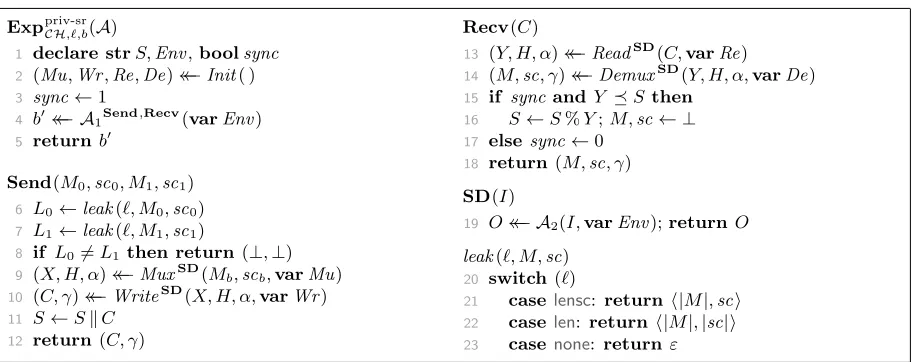
Figure 2: The PRIV-SR notion of security for a partially-specified channelCH. The PRIV-SR notion is parameterized by the permitted leakage`∈ {lensc,len,none}.
Recv oracle. In both notions, whenever a query toSend or Recv induces an SD-oracle call, that call is serviced by the adversary.
Following prior work [7, 13, 19] we keep track of whether the channel isin-syncat any given moment dur-ing the adversary’s attack. Loosely, the channel is said to be in-sync if the stream of ciphertext “consumed” by the receiver, so far, is a prefix of the stream of ciphertext output by the sender. In order to avoid trivial distinguishing attacks in the PRIV-SR game, it is necessary to suppress the message fragments output by the receiver while the channel is in-sync.
Channel synchronization. We say the channel is in-sync as long as the ciphertext fragments Y output
by Read—which models receiver-side buffering and defragmentation—remains a prefix of the ciphertext stream transmitted by the sender. In this way, the sequence of Y’s output by the reader constitute the ciphertext stream “consumed” by the receiver (i.e., by Demux) so far. This restricts the behavior of the sender-side code in a way not seen in FGMP, but the restriction appears to be minor; a natural division of labor is to have Read buffer the ciphertext stream and output ciphertexts that are ready to decrypt; the job of Demux, then, is to decrypt and process the message stream. This cleanly separates the tasks of “buffering” and “consuming” the ciphertext. The alternative would be to leave the receiver operations atomic, as FGMP have done; but this choice leads to complex security notions, as it requires handling synchronicity for a number of different cases (e.g., [20, Definition 4.1]).
The adversary.Our execution model for security games is adopted from the RS framework, but we will be
a bit more precise in our formulation. The adversary queries oracles provided by the security experiment, which in turn may invoke the adversary for fulfilling SD queries. To ensure that each oracle query completes before the next query is issued, the adversary may not issue a query while another query is pending. In effect, the adversary may not use its oracles for computing its responses to SD queries.
We formalize this idea as follows. An adversary is a pair of stateful, randomized algorithms with interfaces A1(var strEnv)7→bool andA2(strI,var strEnv)7→strO. Most games in this paper begin by declaring
a variable Env of type str, which is used to share state between A1 and A2. These games also define an
oracle SD that, on input of a string I, executesO ←← A2(I,varEnv) and returns O. When A1 makes a
query to Send orRecv and a PSC algorithm is invoked, the PSC algorithm is given oracle access to SD
for making SD queries. AlgorithmA2 may change the value ofEnv as a side effect, allowing it to convey
information toA1; algorithmA1 may also convey information toA2 by modifying the value ofEnv.
In the remainder, we will often denote the pair (A1,A2) byA for convenience. We require that each
silently extend this execution model and these conventions to all subsequent security experiments in this paper.
The PRIV-SR and PRIV-S notions.Refer to the PRIV-SR experiment defined in Figure 2. For a given PSCCHand challenge bitb, the experiment compactly encapsulates three different notions of privacy, each associated to a permitted leakage parameter ` ∈ {lensc,len,none}. When ` = lensc, only message-stream privacy is captured; when`=lenthe notion captures privacy of both the message streams and their context; finally,`=noneadds length-hiding to the list.3
Let A = (A1,A2). The game begins by initializing the adversary state Env, sender state (Mu,Wr),
and receiver state (Re,De). AlgorithmA1 is then executed with access to two oracles. The first, Send,
takes as input a 4-tuple of strings (M0,sc0, M1,sc1). It first checks that the values of leak(`, M0,sc0) and
leak(`, M1,sc1) are equal; if not, it returns an indication of invalidity of the query. It then executesMux and
Write, withSDas the SD oracle, and returns the output (C, γ) toA1. (Recall thatA2may updateEnv as
a side effect of theSD queries made byMux andWrite.) StringC is appended toS, which keeps track of the sender ciphertext stream. The second oracle,Recv, takes as input a ciphertext fragmentCand invokes (Y, H, α) ←← ReadSD(C,varRe), then (M,sc, γ) ←← DemuxSD(Y, H, α,varDe). If the channel is in-sync and Y is a prefix of the sender stream S, then the oracle “consumes” Y from the stream and suppresses the output ofM andsc by settingM,sc ← ⊥. (This is necessary because (M,sc) corresponds to an input to Sendand might trivially leak b, depending on the permitted leakage `.) Otherwise, the oracle declares the channel to be out-of-sync and outputs (M,sc, γ) without suppressing M and sc. After the adversary interacts with its oracles, it outputs a bit b0, the outcome of the game. We define the advantage A in attackingCHin the PRIV-SR (`) sense as
Advpriv-srCH,` (A) = 2 Pr
b
Exppriv-srCH,`,b(A) =b −1,
where the probability is over the coins of the game, A1, A2, and the choice of b (implicitly sampled as b←← {0,1}). In this experiment, we track the following adversarial resources: the time-complexityt of the adversary (that is, the maximum runtime of eitherA1orA2), the number ofSendqueries q1 and the total
length in bits of the inputs of each queryµ1, and the number ofRecvqueriesq2and their total bitlengthµ2. We define the maximum advantage of any adversary with these resources asAdvpriv-srCH,` (t, q1, q2, µ1, µ2).
A chosen-plaintext (fragment) attack version of PRIV-SR is obtained simply by removing theRecv from the experiment; we refer to this game as PRIV-S and define the PRIV-S advantage ofA in the same way; as there is noRecv oracle, we dropq2, µ2 from the adversarial resources.
4.3
Integrity
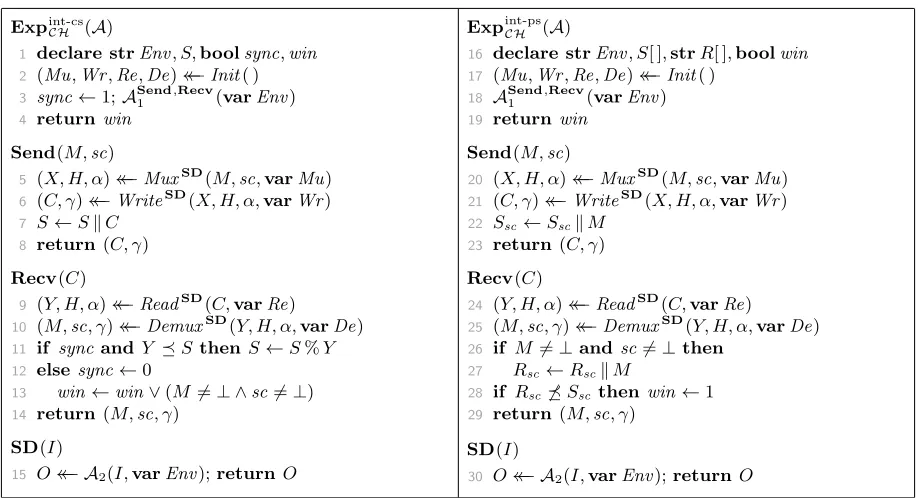
Following FGMP, we consider integrity of both the ciphertext stream (INT-CS) and the plaintext streams (INT-PS). The first formalizes the conservative goal that the channel (i.e., the ciphertext stream) should remain in-sync, just as discussed in Section 4.2. The second formalizes a weaker property, namely that the plaintext streams carried by the channel should remain in-sync.
The INT-CS notion.Refer to the INT-CS experiment defined in Figure 3. It begins just as in the PRIV-SR game. The Send oracle is similar to the PRIV-SR game, except A1’s queries consist of pairs (M,sc)
instead of a 4-tuple. We keep track of whether the channel is in-sync in the exact same manner. If ever the out-of-syncRecv oracle outputs a valid message fragment and context, then the game sets a flagwin←1; the outcome of the game is the value of win after A1 halts. Define the advantage of A in attacking CH
in the INT-CS sense asAdvint-cs
CH (A) = Pr
Expint-cs
CH (A) = 1
, where the probability is over the coins of the experiment and of the adversary. We define the function Advint-cs
CH (t, q1, q2, µ1, µ2) as the maximum
advantage of any adversary running in timet, making at mostq1 queries toSendandq2 queries toRecv, and the total bit-length of its queries toSend(resp. Recv) does not exceedµ1(resp. µ2) bits.
The INT-PS notion.Integrity of the plaintext streams is defined via the INT-PS game in Figure 3. This
game is a bit different than the others in that we do not keep track of whether the ciphertext stream is in-sync; rather, we are concerned with the input and output plaintext streams. For each stream contextsc∈ {0,1}∗
Expint-cs CH (A)
1 declare strEnv, S,boolsync,win
2 (Mu,Wr,Re,De)←←Init( )
3 sync←1;ASend1 ,Recv(varEnv)
4 return win
Send(M,sc)
5 (X, H, α)←←MuxSD(M,sc,varMu)
6 (C, γ)←←WriteSD(X, H, α,varWr)
7 S←SkC
8 return (C, γ)
Recv(C)
9 (Y, H, α)←←ReadSD(C,varRe)
10 (M,sc, γ)←←DemuxSD(Y, H, α,varDe)
11 if sync and Y S then S←S%Y
12 else sync←0
13 win←win∨(M6=⊥ ∧sc6=⊥)
14 return (M,sc, γ)
SD(I)
15 O←← A2(I,varEnv);return O
Expint-psCH (A)
16 declare strEnv, S[ ],strR[ ],boolwin
17 (Mu,Wr,Re,De)←←Init( )
18 ASend1 ,Recv(varEnv)
19 return win
Send(M,sc)
20 (X, H, α)←←MuxSD(M,sc,varMu)
21 (C, γ)←←WriteSD(X, H, α,varWr)
22 Ssc←SsckM
23 return (C, γ)
Recv(C)
24 (Y, H, α)←←ReadSD(C,varRe)
25 (M,sc, γ)←←DemuxSD(Y, H, α,varDe)
26 if M 6=⊥and sc6=⊥then
27 Rsc ←RsckM
28 if Rsc6Ssc then win←1
29 return (M,sc, γ)
SD(I)
30 O←← A2(I,varEnv);return O
Figure 3: left: game for defining ciphertext-stream integrity (INT-CS) for partially specified channel CH. Right: game for defining plaintext-stream integrity (INT-PS) ofCH. LetA= (A1,A2).
queried by the adversary, we keep track of the corresponding input stream Ssc. (That is, Ssc =cat(M), where M is the sequence of message fragments pertaining tosc asked of Send.) For each sc 6=⊥output byRecv, we keep track of the corresponding output stream Rsc. (That is,Rsc=cat(M), whereM is the sequence of valid message fragments pertaining toscoutput byRecv.) The adversary wins if at any point in the game, it holds thatRsc 6Ssc for somesc ∈ {0,1}∗. Define the advantage ofAin attacking CH in the INT-PS sense asAdvint-psCH (A) = Pr
Expint-psCH (A) = 1
,where the probability is over the coins of the experiment and of the adversary.
INT-CS 6⇒ INT-PS for PSCs. Traditional results for AE schemes establish an intuitive relationship
between integrity of ciphertexts and plaintexts: that the former is strictly stronger than the latter. See Bellare and Namprempre [8, Theorem 3.1] in the case of stateless and randomized AE, and FGMP [20, Appendix C] for stream-based channels. It is perhaps counter-intuitive, then, that INT-CS does not imply INT-PS in our setting. The reason for this is that we do not require that PSCs be operationally correct in the security games; indeed, the correctness of the scheme is used in a crucial way in those proofs. We cannot formalize correctness for PSCs without restricting the SD-oracle in some way, and doing so would reduce the generality of our results. Nevertheless, in Appendix A, we give a natural definition of correctness for fully specified channels—like PSCs, but with a fully realized SD-oracle—that extends FGMP’s correctness condition to the multiplexed setting. With this definition we show something a bit stronger than usual: that INT-CS implies INT-PS if and only if the SD-oracle is realized correctly.
4.4
Receiver-status simulatability and a generic composition
Expsim-stat CH,S,b(A)
1 declare strEnv, S
2 (Mu,Wr,Re,De)←←Init( )
3 b0←← ASend1 ,Recv(varEnv)
4 return b0
Send(M,sc)
5 (X, H, α)←←MuxSD(M,sc,varMu)
6 (C, γ)←←WriteSD(X, H, α,varWr)
7 S←SkC
8 return (C, γ)
Recv(C)
9 if b= 1then
10 (Y, H, α)←←ReadSD(C,varRe)
11 (∗,∗, γ)←←DemuxSD(Y, H, α,varDe)
12 else γ←← SSD (C, S)
13 return γ
SD(I)
14 O←← A2(I,varEnv);return O
Figure 4: the SIM-STAT game for partially specified channelCH.
controlled SD. In this section, we give a notion of security we callreceiver-status simulatablity (SIM-STAT) and show that it, PRIV-S, and INT-CS imply PRIV-SR.
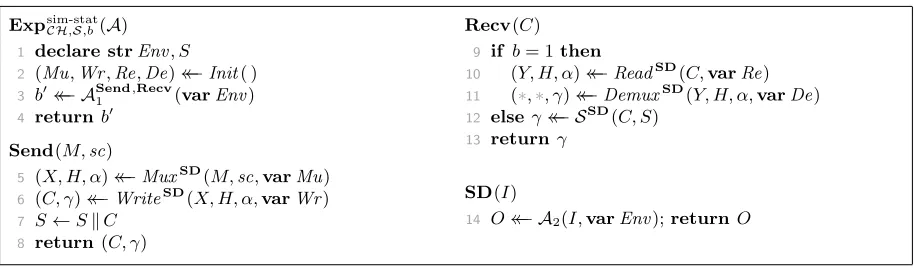
The SIM-STAT notion.The notion naturally captures what the adversary learns from the receiver’s state by observing the status messages it outputs. It is inspired by the ideas put forward in the subtle AE setting [6] and naturally generalizes a notion of FGMP. The SIM-STAT game (defined in Figure 4) is a simulation-based game in which the adversary is asked to distinguish the status information output by the real receiver from those output by a simulatorS. The simulator is given the ciphertext stream S produced by the sender, as well as the input fragmentC, and so it can tell if the channel is in-sync, but it is not given the receiver state. Informally, security demands that for every efficient adversary, there is an efficient simulator such that the adversary cannot distinguish real status messages from fake ones with non-negligible probability.
The game is associated to adversary A= (A1,A2), a challenge bitb, and a receiver-status simulator S.
On input of C, ifb = 1, then oracle Recv executes the usual receiver code and outputsγ; otherwise, the oracle executes S on input of (C, S), where S is the sender stream (recorded by Send), and with oracle access to SD for servicing SD requests. WhenS halts and outputs a string γ, the oracle outputs γ. We define the advantage ofAin attackingCH with simulatorS in the SIM-STAT sense as
Advsim-statCH,S (A) = 2 Prb
Expsim-statCH,S,b(A) = 1
−1.
Define the maximum advantage of anyt-time adversary with resources (q1, q2, µ1, µ2) in winning the game
instantiated with simulatorSasAdvsim-stat
CH,S (t, q1, q2, µ1, µ2).We require thatShalts, regardless of its current
state, internal coin tosses, and the result of its SD requests, in a bounded number of time steps. Its runtime also accounts for the time needed to evaluate its oracle queries; thus, its runtime depends on the time A takes to compute its SD responses.
PRIV-S∧INT-CS∧SIM-STAT⇒PRIV-SR.We prove that for any`, security in the sense of PRIV-S (`),
INT-CS, and SIM-STAT suffice for PRIV-SR (`).
Theorem 1. Let ` ∈ {lensc,len,none} and let CH be a PSC. For every t, s, q1, q2, µ1, µ2 ∈ N and s-time
simulator S it holds that
Advpriv-srCH,` (t,r)≤Advpriv-sCH,`(t+O(q1+sq2), q1, µ1) 2Advint-csCH (˜t,r) + 2Advsim-statCH,S (˜t,r),
where˜t=t+O(q1+q2)andr= (q1, q2, µ2, µ2).
G1(A) G2(A)
1 declare strEnv, S,boolsync,win,b
2 (Mu,Wr,Re,De)←←Init( )
3 b←← {0,1};sync←1
4 b0←← ASend1 ,Recv(varEnv) 5 return (b=b0)
Send(M0,sc0, M1,sc1)
6 L0←leak(`, M0,sc0)
7 L1←leak(`, M1,sc1)
8 if L0 6=L1then return (⊥,⊥)
9 (X, H, α)←←MuxSD(Mb,scb,varMu)
10 (C, γ)←←WriteSD(X, H, α,varWr)
11 S←SkC;return (C, γ)
Recv(C)
12 (Y, H, α)←←ReadSD(C,varRe)
13 (M,sc, γ)←←DemuxSD(Y, H, α,varDe)
14 if sync and Y S then
15 S←S%Y;M,sc← ⊥
16 else sync←0
17 win←win∨(M6=⊥ ∧sc6=⊥)
18 if win thenM,sc← ⊥
19 return (M,sc, γ)
G3(A)
20 declare strS,boolb
21 (Mu,Wr,Re,De)←←Init( )
22 b←← {0,1}
23 b0←← ASend1 ,Recv(varEnv)
24 return (b=b0)
Send(M0,sc0, M1,sc1)
25 L0 ←leak(`, M0,sc0)
26 L1 ←leak(`, M1,sc1)
27 if L06=L1 then return(⊥,⊥)
28 (X, H, α)←←MuxSD(M
b,scb,varMu)
29 (C, γ)←←WriteSD(X, H, α,varWr)
30 S←SkC;return (C, γ)
Recv(C)
31 M,sc← ⊥;γ←← SSD (S, C)
32 return (M,sc, γ)
Figure 5: games G1,G2, andG3for proof of Theorem 1.
Proof of Theorem 1. Fix t, s, q1, q2, µ1, µ2 ∈ N and let r = (q1, q2, µ1, µ2). Let A = (A1,A2) be a t-time
PRIV-SR adversary with resourcesrand letSbe ans-time simulator. We exhibit an INT-CS adversaryB= (B1,B2), a SIM-STAT adversary C= (C1,C2), and a PRIV-S adversaryD= (D1,D2) such that
Advpriv-srCH,` (A)≤2Advint-csCH (B) + 2Advsim-statCH,S (C) +Advpriv-sCH,`(D),
whereBandCrun in timet+O(q1+q2) and each uses query resourcesr, andDruns in timet+O(q1+sq2) and uses resources (q1, µ1).
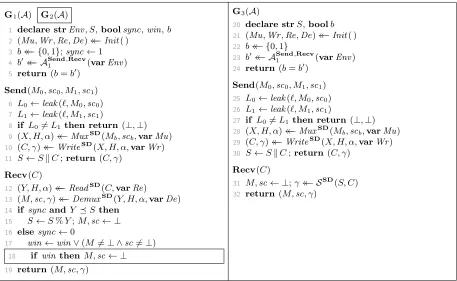
The proof is by a game-playing argument; refer to games G1,G2, and G3 defined in Figure 5. (Note
that the SD oracle is not explicitly defined in these games; it has the same definition as in the PRIV-SR game.) GameG1 is the PRIV-SR notion embellished with a book-keeping flag win, whose value is set on
line 5:17. However, the value ofwin does not affect the distribution of oracle outputs (or the game) in any way. So for anyAand a uniform randomb∈ {0,1}, the random variablesG1(A) = 1 andExppriv-srCH,`,b(A) =b
are identically and independently distributed.
Game G2, which includes the boxed instruction at line 5:18, is identical to gameG1 until the flagwin
gets set. By the Fundamental Lemma of Game Playing [10], we have Pr
b
Exppriv-srCH,`,b(A) =b ≤Pr
G2(A) = 1
+ Pr
G2(A)setswin.
(1)
Next, defineB1Send,Recv(varEnv) as follows. It samples a bitb, then executesb0 ←← A1Send0,Recv0(varEnv). On input of (M0,sc0, M1,sc1), oracle Send0 checks that leak(`, M0,sc0) equals leak(`, M1,sc1). If not, it
outputs (⊥,⊥); otherwise, it asks (C, γ)←←Send(Mb,scb) and outputs (C, γ). On input ofC, oracleRecv0
asks (M,sc, γ)←←Recv(C) and outputs (M,sc, γ). Finally, whenA1halts, algorithmB1halts. Next, define
algorithm B2(I,varEnv) by executingO ←← A2(I,varEnv) and returning O. It is clear by the definition
of the INT-CS game that ifAsetswin in its game, thenBalso setswin in its game. Hence, for anyA, PrG2(A)setswin
≤PrExpint-csCH (B)setswin
Observe that in game G2 the Recv oracle always returns (⊥,⊥, γ), i.e., M and sc are always set to
⊥. Thus, if the status messageγ were predictable without knowing the reader or demultiplexer states (Re andDe resp.), then gameG2could be simulated by a PRIV-CPA adversary, because theRecv oracle inG2
would be simulatable.
With this observation, we create gameG3fromG2by replacing the entireRecv code with the statement
“M,sc ← ⊥;γ ←← SSD(S, C)”, whereS is the given simulator for the SIM-STAT security experiment. We also remove the win and sync flags, as they are no longer relevant. The definition of game G3 leads
us to define algorithm C1Send,Recv(varEnv) as follows. It samples a bit b ←← {0,1} and executes b0 ←← ASend1 0,Recv0(varEnv). Queries toSend0 are answered just as they were in the definition ofB
1 above. On
input ofC, oracleRecv0 asksγ←←Recv(C) and outputs (⊥,⊥, γ). Finally, whenA1halts and outputsb0,
algorithm C1 halts and outputs (b = b0). Define C2 just as we defined B1 above. Then for any A, S,
andd∈ {0,1},
Pr
G3−d(A) = 1= PrExpsim-statCH,S,d(C) = 1
(3) and so
Pr
G2(A) = 1
= Pr
G2(A) = 1
−Pr
G3(A) = 1
+ Pr
G3(A) = 1
=Advsim-statCH,S (C) + Pr
G3(A) = 1
.
(4)
Lastly, we define DSend
1 (varEnv) as follows. InitializestrS and executeb0←← A
Send0,Recv0
1 (varEnv).
On input of (M0,sc0, M1,sc1), Send0 asks (C, γ) ←← Send(M0,sc0, M1,sc1), computes S ← SkC, and
outputs (C, γ). On input of C, oracle Recv0 executes γ ←← SSD(C, S) and outputs (⊥,⊥, γ). Finally, when A1 outputs b0, halt and outputb0. Next, define D2 just as we defined C2 and B2 above. From the
definition ofG3, it is clear that for any A,
Pr
G3(A) = 1
= Pr
b
Exppriv-sCH,`,b(D) =b
. (5)
Summarizing, we have that for every adversaryAand simulatorS, there exist adversariesB,C, andDsuch that
Advpriv-srCH,` (A) = 2Pr
b
Exppriv-srCH,`,b(A) =b −1 ≤2Pr
G2(A) = 1
+Advint-csCH (B)−1 ≤2Advsim-statCH,S (C) + Pr
G3(A) = 1
+Advint-csCH (B)−1 = 2Advsim-statCH,S (C) +Advpriv-sCH,`(D) + 2Advint-csCH (B).
(6)
The claimed bound follows. To complete the proof, we note that B and C use query resources r and D uses query resource (q1, µ1). Since simulating each query requires O(1) time, adversaries B and C run in timet+O(q1+q2), andDruns in timet+O(q1+sq2).
Remark. We emphasize that, although we have used SIM-STAT to prove a generic composition result, the
notion is not merely a technical one. The intuition it captures is important: distinguishable error messages have been exploited repeatedly [36, 17, 27, 3] to attack AE-powered secure-channel protocols. As a result, there has been a considerable push in the cryptographic community to make addressing this subtlety a first class consideration [14, 22, 6].
5
The TLS 1.3 record layer
when the record layer is viewed through the lens of our security notions. This is followed (in Section 5.2) by a decomposition of the record layer into its component building blocks. Then we show how to securely compose these into a PSC thatnearlyformalizes the specification; we propose a small change to the standard that significantly improves flexibility of the scheme.
Note about the draft. This analysis pertains to draft 23 [32], current at the time of writing. Note that
the change to the record layer we suggest here will be adopted in the final version of the protocol [30].
5.1
Overview
TLS can be viewed as three client-server protocols executing concurrently: thehandshake protocol handles (re-)initialization of the channel; the record protocol is used to exchange application data between the client and the server; and the alert protocol is used to close the channel. The record layer refers to the mechanism used to protect flows between client and server in each sub-protocol. Each of these flows is authenticated and encrypted as soon as the client and server have exchanged key material. (Usually the only unprotected messages are the initialclient helloand part of theserver hello.) Intuitively, each of these flows constitutes a logical data stream, and the record layer is a means of multiplexing these streams over a single communications channel (e.g., a TCP connection). Among the record layer’s many design criteria is the need to maximize flexibility for implementations. This means, somewhat paradoxically, that the specification does not fully specify every aspect of the construction. Rather, the record-layer specification [32, Section 5] defines some core functionalities that must be implemented and provides a set of parameters for compliant, fully realized schemes.
Content types. Each stream has an associatedcontent type. Available types are handshake, application data, alert, and change ciphersuite spec (CCS); additional content types may be added subject to certain guidelines [32, Section 11]. If the client or server receives a message of unknown content type, it must send anunexpected message alert to its peer and terminate the connection. The CCS type is only available for compatibility with systems accustomed to processing records for TLS 1.2 and earlier. Usually a CCS message must be treated as an unexpected message, but under specific conditions, it must simply be dropped.
Records. Plaintext records encode the content type, the stream fragment, the length of the fragment
(which may not exceed 214 bytes), and an additional field calledlegacy record version, whose value is fixed
by the specification. (It is only present for backwards compatibility.) All flows, including unprotected ones (the initial handshake message and CCS messages) are formatted in this manner. The streams of data are transformed into a sequence of records; stream fragments of the same content type may be coalesced into a single record, but therecord boundaries are subject to the following rules [32, Section 5.1]:
• Handshake, no interleaving: if two records correspond to a single handshake message, then they must be adjacent in the sequence of records.
• Handshake, no spanning a key change: if two records correspond to a single handshake message, then they both must precede the next key change (defined in Section 5.1). If this condition is violated, then the second record must be treated as an unexpected message.
• Handshake and alert, no zero-length messages: only application data records may have zero length. • One alert per record: alert messages must not be fragmented across records, and a record containing an
alert message must contain only that message.
Additional content types must stipulate appropriate rules for record boundaries.
Records are optionally padded and then protected using an AEAD scheme [32, Sections 5.2–5.4]. First, the record R is encoded as a string X = R.fragmentk hR.typei8k (h0i8)p for some p ∈ N such that the
length of the ciphertext is less than 214+ 256 bytes. The padded record X is encrypted with associated
data ε (the empty string) and with a nonce N that we will define in a moment. The protected record is defined as
whereopaque typehas a fixed value (23),legacy record versionhas a fixed value (771, or 0x0303 in hexadec-imal), and length is the length ofencrypted record in bytes. The nonce N is computed from a sequence number seqn and an initialization vector IV [32, Section 5.3]; both the key K andIV are derived from a shared secret [32, Sections 7.1–7.2] using an extract-and-expand key-derivation scheme [24]. The length of theIV is determined from the permitted nonce lengths of the AEAD scheme.4 The nonceN is computed
asIV ⊕ hseqni|IV|, where 0≤seqn≤264−1. Note that the client and server each uses a different key and
IV for sending messages to the other; thus, each constitutes a unidirectional channel.
Usage limits, key changes, and protocol-level side-effects. The spec mandates that the key be changed prior to the sequence number reaching its limit of 264−1 in order to prevent nonce reuse. It also recommends that implementations keep track of how many bytes of plaintext have been encrypted and decrypted with a single key and to change the key before the “safety limit” of the underlying AEAD scheme has been reached.
As mentioned above, upon receipt of a message of unknown type, the receiver should send its peer an unexpected messagealert message. The alert stream is generally used to notify the recipient that the peer is tearing down its connection and will no longer write to the channel. There areclosure alerts anderror alerts [32, Section 6]. Both signal the tear down of the writer state, but they provide different feedback. Theunexpected messagealert is an example of the latter. Error alerts are also used to indicate things like the ciphertext is inauthentic, or the record is malformed. An example of the former is close notify, which indicates that the receiver should not expect any more data from the peer, but that no error occurred.
The key and IV change during the normal course of the protocol. An update is always a side effect of the handshake protocol. During transmission of application data, an update is signaled by a particular handshake message described in [32, Section 4.6.3], which informs the receiver that the sender has reinitialized its state and so must do so as well. The key change re-initializes the state of the sender and receiver with a fresh key and IV (derived from the shared secret), and the sequence number is set to 0 [32, Section 5.3]. Therefore, no sender or receiver state (that is, no state that pertains to the record layer) is held over after re-initialization of the channel.
Observations about the standard. The standard defines some core functionalities, but leaves many design choices up to the implementer; our analysis aims to establish what security the record layer provides given this level of flexibility. Our approach is shaped by two questions. First, which fully specified components can be altered without impacting security? Second, which unspecified or partially specified components are security critical? We begin with a couple of observations.
Record boundaries may leak the content type. The content type of each record is encrypted along
with the fragment. The intent, presumably, is to hide both the contentandits type, but the record boundary rules stipulated by the standard make hiding the type unachievable in general. Consider the one alert per recordrule, for example. The implementation is allowed to coalesce fragments of the same type, but a record containing an alert must contain only that alert. Thus, thelengthof each record output by the sender may (depending on the implementation) leak whether the record pertains to an alert or to application data. Of course, the standard doespermitimplementations that hide the content type of each record, but this is quite different frommandating this property. The take away is thatencrypting the content type does not imply its indistinguishibility, since the record boundaries depend on it.
Associated data is unauthenticated. One aspect of the scheme that is precisely defined is the
for-mat of the ciphertext transmitted on the wire. Each begins with a header composed of opaque type, legacy record version, and length. The values of the first two fields are fixed by the spec, and the last field is crucial for correct operation, since it informs the receiver of how many bytes to read next. What should the receiver do if the header is different than specified? Changing thelength field bits should result in the next ciphertext either being too short or too long, and so would be deemed inauthentic with over-whelming probability. Ifopaque type orlegacy record version is mangled, then it should be safe to proceed since this does not affect the inputs to decryption. However, doing so would be deemed an attack in our ciphertext-integrity setting; changing these bits means the stream is out-of-sync, but since they are not au-thenticated (encryption usesεfor associated data), the receiver would successfully decrypt. In fact, checking theopaque type and legacy record version fields is left optional by the spec: implementations MAY check
ExpprivAE,b(A) Exp
int AE(A)
1 X,Q ← ∅;K←← K
2 res←← AEnc res←0;AEnc,Dec
3 return res
Enc(N, A, M)
4 if N∈ X return ⊥
5 C←EncN,AK (M)
6 if b= 0then C←← {0,1}λ(|M|)
7 Q ← Q ∪ {(N, A, C)};X ← X ∪ {N} 8 return C
Dec(N, A, C)
9 M ←DecN,AK (C)
10 if M 6=⊥and(N, A, C)6∈ Qthen res←1
11 return M
Expmpriv-sM,`,b (A) Exp
sim-mstat M,S,b (A)
12 Env ←ε; (mx,dx)←←Init( )
13 b0←← AMux
1 (varEnv)
14 b0←← ADemux
1 (varEnv)
15 return b0
Mux(M0,sc0, M1,sc1)
16 L0 ←leak(`, M0,sc0)
17 L1 ←leak(`, M1,sc1)
18 if L06=L1 then return(⊥,⊥)
19 (X, γ)←←MuxSD(Mb,scb,varmx)
20 return (|X|, γ)
Demux(X)
21 if b= 1then (∗,∗, γ)←←DemuxSD(X,vardx)
22 else γ←← SA(|X|)
23 return γ
SD(I)
24 O←← A2(I,varEnv);return O
Figure 6: left: security games PRIV and INT for AEAD scheme AE = (Enc,Dec, λ) with key space K. Right: security games mPRIV-S and SIM-mSTAT for partially specified stream multiplexerM= (Init,Mux,Demux). The former has an associated permitted leakage parameter`∈ {lensc,len,none}; procedureleak is as defined in Figure 2.
these fields are correct and abort the connection if not [32, Section 5.2]. This presents us with a dilemma: if we leave this choice up to the specification details, then there is a trivial INT-CS attack, and so in order to salvage security, we need to lift this “MAY” to a “MUST”.
This dilemma points to something rather strange about the record layer’s design: something that ought not be security critical—in particular, the value of the delimiter bits—is security critical. Indeed, this observation motivates our partially specified viewpoint. To formalize the idea that the value of the delimeter bits should not impact security, we simply let the specification details choose these bits itself. This is safe as long as the bits are authenticated and do not depend on sensitive values. We will formalize this idea in our PSC in Section 5.3.
Remark. An alternative conclusion is that this vulnerability is only an artifact of our strong adversarial model; mangling the delimiter bits should not affect the inputs to decryption, and so does not constitute a “real attack” on privacy or integrity in an intuitive sense. To this point we offer a warning: this intuition is correct only if down-stream handling of the plaintext is independent of the contents of these fields. Since such behavior is beyond the scope of the TLS standard (and even our security model), these legacy fields constitute an attack surface for implementations. The risk is not inconsiderable, as it is difficult to predict how systems will evolve to make use of TLS, and of these bits in particular. Indeed, they owe their very existence to the need to maintain compatibility with older systems.
5.2
The building blocks
for authenticated encryption with associated data and a method of generating nonces. These are the core cryptographic functionalities and must be implemented correctly; as such, we will require these to be fully specified.
Stream multiplexers. First, a partially specifiedstream-multiplexer is a tripleM= (Init,Mux,Demux) defined as follows.
• Init( )7→(strmx,dx). Generates the initial state of the stream multiplexer (used by the sender) and demultiplexer (used by the receiver).
• MuxO(strM,sc,var strmx) 7→ (strX, γ). Takes as input a plaintext fragment M, its stream con-textsc, and the current statemx, and returns a channel fragmentX and a status message γ.
• DemuxO(strX,var strdx)7→(strM,sc, γ). Takes a channel fragmentX and the current statedx and returns a plaintext fragmentM, its stream contextsc, and the statusγ.
The specification details are provided by the oracleO. Our intention is to capture only non-cryptographic functionalities with stream multiplexers. (Of course,M may, in principal, use some sort of cryptographic primitive, or even output encrypted records.) In order to facilitate a rigorous analysis of how design choices here impact security of the channel overall, we formulate two security properties for partially specified multiplexers. Both are defined in Figure 6.
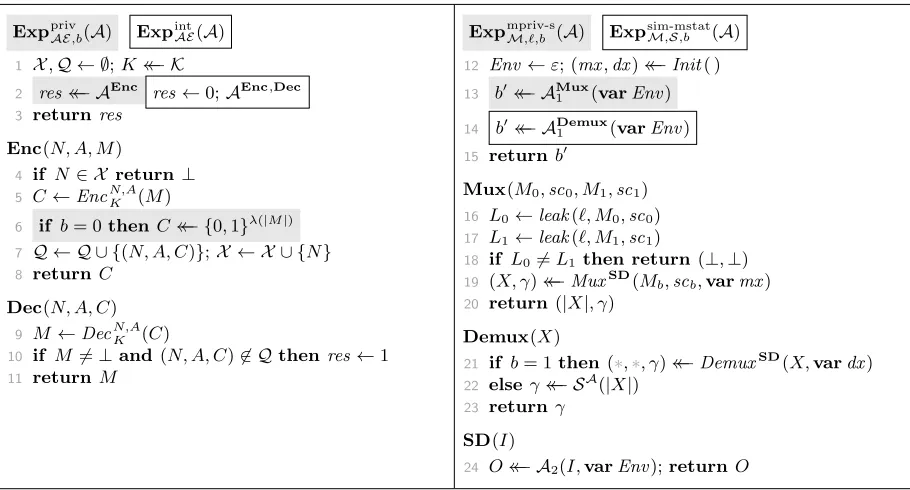
The mPRIV-S notion. The first captures an adversary’s ability to discern information about the inputs
toMux given (information about) its outputs. Like the PRIV-S game (Section 4.2), the mPRIV-S game is parameterized by the permitted leakage`, one oflensc,len, ornone(see Figure 2), and a challenge bitb. We again formalize the adversary as a pair of algorithms (A1,A2). The first,A1, is given an oracleMux with
the same interface as Send in the PRIV-S game. The oracle invokes procedure Mux on inputs (Mb,scb)
(and with oracle access to SD for handling SD requests, which in turn invokes A2), and the adversary is
asked to guessbbased on the outcome of its queries. Where the games differ, however, is in the information available to the adversary. Rather than return (X, γ) directly, the oracle returnsγand only thelength of X. This captures a much weaker property than usual indistinguishibility: rather than insisting (X, γ) not leak anything beyond L =leak(`, M,sc), we insist only that (|X|, γ) not leak anything beyond L. Define the advantage ofA= (A1,A2) in attackingMin the mPRIV-S (`) sense as
Advmpriv-sM,` (A) = 2 Pr
b
Expmpriv-sM,`,b (A) =b −1.
Let Advmpriv-sM,` (t, q, µ) denote the maximum advantage of any t-time adversary making at most q queries toMux with total bit-length at mostµ.
The SIM-mSTAT notion. The second notion captures simulatability of the status message output
by Demux. It is associated with a simulator S and a bit b. After initialization, the adversary is given access to an oracleDemux. On input ofX, ifb= 1, then the oracle executes procedureDemux on inputX
and returns the status message; otherwise it executes the simulatorSon input|X|and with access toSDfor servicing SD requests. Define the advantage ofAin attackingMin the SIM-mSTAT sense with simulatorS as
Advsim-mstatM,S (A) = 2 Pr
b
Expsim-mstatM,S,b (A) =b −1.
LetAdvsim-mstat
M,S (t, q, µ) denote the maximum advantage of anyt-time adversary makingqqueries toDemux
with total bit-length at mostµ.
AEAD schemes. We describe the syntax for authenticated encryption with associated data as prescribed by the spec [25]. An AEAD scheme is a tripleAE= (Enc,Dec, λ). The last element is a functionλ:Z→Z
which describes the ciphertext length as a function of the plaintext length; we insist thatλ is a bijection. AlgorithmsEnc andDec are both deterministic and have the following interfaces:
• Enc(strK, N, A, M) 7→ strC. Maps a key K, nonce N, associated data A, and plaintext M to a ciphertextCsuch that ifC6=⊥, then|C|=λ(|M|)≥ |M|.
We may denote the execution of Enc on (K, N, A, M) by EncN,AK (M). (Similarly for Dec.) We respec-tively define the key, nonce, associated-data, and message space as the sets K,N,A,M ⊆ {0,1}∗ for
which Enc(K, N, A, M) 6= ⊥ if and only if (K, N, A, M) ∈ K × N × A × M; correctness requires that Dec(K, K, N, A,Enc(K, N, A, M)) = M for every such (K, N, A, M). (This condition implies that AE is bothcorrect andtidy in the sense of Namprempre, Rogaway, and Shrimpton [26].)
We will use standard notions of indistinguishibility under chosen-plaintext attack (PRIV) and integrity of ciphertexts (INT) as defined in Figure 6. As usual, the indistinguishibility game requires that the adversary not repeat a nonce. The adversary for the PRIV and INT games is simply a randomized algorithm A( )7→
bool. that expects access to one or more oracles. To distinguish it from other adversaries in this paper, we will refer to it as an AEAD adversary. Define the PRIV advantage of adversaryAin attackingAE as
AdvprivAE (A) = 2 Pr
b
ExpprivAE,b(A) =b −1
and let AdvprivAE (t, q, µ) denote the maximum advantage of anyt-time adversary making at most q queries with total bit-lengthµ. Define the INT advantage of adversaryAin attackingAE as
AdvintAE(A) = Pr
ExpintAE(A) = 1 and let Advint
AE(t, q1, q2, µ1, µ2) be the maximum advantage of any t-time adversary making at most q1
(resp.q2) queries toEnc (resp. Dec) with total bit-length at most µ1(resp.µ2).
Nonce generators. Finally, anonce generatoris a pair of algorithmsN = (Init,Next), the first randomized and the second deterministic.
• Init( )7→strng. Initializes the state of the generator.
• Next(var strng) 7→ strN. Computes the next nonce N given the current state ng and updates the state.
We associate toN and an integert∈Na procedureColl, which first executesng←←Init( ), then computes Ni ← Next(varng) for each i ∈ [t]. Finally, if for every 1 ≤i < j ≤ t it holds that Ni 6=Nj, then the
procedure outputs 0; otherwise it outputs 1. DefinecollN(t) = PrCollN(t) = 1.
5.3
The partially specified record layer
We are now ready to formalize the record layer specification. Refer to the PSC TLS[M,AE,N] defined in Figure 7. It differs from the standard (draft 23) in one small, but security-critical way: the standard mandates that the AEAD scheme be invoked withε as the AD, whereas in our scheme, the stringA—the record header—is used as AD. To fully comply with the spec, one would replace A with ε on lines 7:21 and 7:39. However, this leads to a trivial ciphertext stream integrity attack: suppose the sender outputs
Y =AkY0. Then the adversary can deliverA∗kY0 to the receiver for someA∗6=Awhere |A∗|=|A|. IfY
is consumed by the receiver, then the channel will be deemed out of sync, but the output of the receiver will be unaffected. We note that this attack is not an artificat of our security model. The strength of our model—and hence the possibility of this attack—is inherited from the stream-based channel setting; if one were to directly extend FGMP’s syntax and security notions so that they encompass multiplexing, then the record layer woul have the same problem.
The procedure Mux invokes M (7:14) in order to compute the next channel fragment (i.e. record). It is designed to never operate on 0-length records (7:15); if the first input X to Write is undefined (i.e.,
X =ε), then it outputs a 0-length ciphertext fragment (7:20). The data on the wire is AkY0, whereY0 is the ciphertext andAis a string chosen by the SD (7:19).
// The sender state.
1 type struct{strng,mx }Muxer
2 type struct{strK}Writer // The receiver state.
3 type struct{strng,buf }Reader
4 type struct{
5 strK,dx,boolsync 6 }Demuxer
Init( )
7 declare MuxerMu,WriterWr
8 declare ReaderRe,DemuxerDe
9 (Mu.mx,De.dx)←← M.Init( )
10 Mu.ng←← N.Init( );Re.ng←Mu.ng
11 Wr.K←← K;De.K←Wr.K
12 De.sync←1
13 return Mu,Wr,Re,De
MuxO(M,sc,var MuxerMu)
14 (X, α)←← M.MuxO(M,sc,varMu.mx)
15 if X =then return(,, α) 16 N← N.Next(varMu.ng)
17 return (X, N, α)
WriteO(X, N, α,var WriterWr)
18 declare strA, γ
19 hA, γi ←← O(hwrite,ready,|X|, αi) 20 if X=then return (, γ)
21 Y0← AE.Enc(Wr.K, N, A, X)
22 if Y0=⊥orO(hparse, AkY0i)6=h|A|+|Y|,|A|ithen
23 γ←← O(hwrite,invalid ptxti)
24 return(, γ)
25 return (AkY0, γ)
ReadO(C,var ReaderRe)
26 declare strα,intc,booldrop
27 Re.buf ←Re.bufkC;hc, i ← O(hparse,Re.bufi)
28 hdrop, αi ←← O(hread,drop,Re.bufi)
29 Y ←Re.buf[:c];Re.buf ←Re.buf%Y
30 if Y =ordrop then return(,, α)
31 N← N.Next(varRe.ng)
32 return (Y, N, α)
DemuxO(Y, N, α,var DemuxerDe)
33 declare strX, γ,inta
34 γ←← O(hdemux,ready,|Y|, αi)
35 if (Y =andγ6=)or¬De.sync
36 then return(⊥,⊥, γ)
37 else if Y 6=then
38 h , ai ← O(hparse, Yi);A←Y[:a];Y0←Y%A
39 X← AE.Dec(De.K, N, A, Y0)
40 if X=⊥then
41 De.sync←0
42 γ←← O(hdemux,invalid ctxti)
43 return(⊥,⊥, γ)
44 (M,sc, γ)←← M.DemuxO(X,varDe.dx)
45 return (M,sc, γ)
Figure 7: partially specified channelTLS[M,AE,N] = (Init,Mux,Write,Read,Demux) composed of a partially specified stream multiplexerM, an AEAD schemeAE with key spaceK, and a nonce generatorN.
Presumably, Y is equal to AkY0, where Y0 is a ciphertext and A is a string chosen by the SD. On input ofY, the SD is invoked to determine the length ofA(7:34). IfY 6=, then stringY0 is decrypted (using A
as associated data) and the resulting channel fragmentX (i.e. record) is input to the stream demultiplexer. If Demux ever encounters an invalid ciphertext, then thereafter it never outputs a valid fragment (7:34 and 7:40–42). It uses a flagsync to track this. If the receiver is in-sync andY is 0-length, thenDemux may poll the stream demultiplexer to see if a message fragment is available for outputting. (That is, line 7:43 may be invoked onX =ε.) Usage limits are enforced by the SD (7:19 and 7:34).
Our construction captures all protocol-level side effects in the record layer specification [32] with the exception of any sender or receiver state carried over after re-initialization of the channel. Indeed, our security model does not encompass re-initialization, since the game is defined for an already initialized channel. We made this choice because the record layer was designed so that no state is carried across key changes. (See the discussion Section 5.1.)
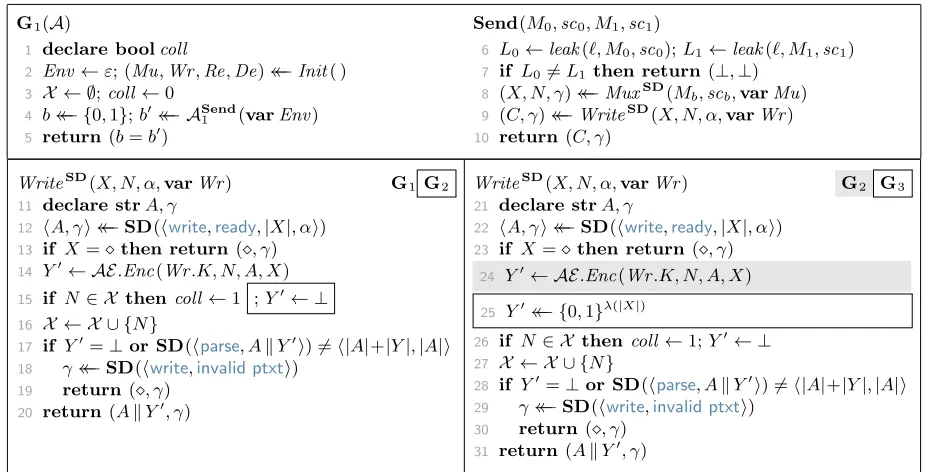
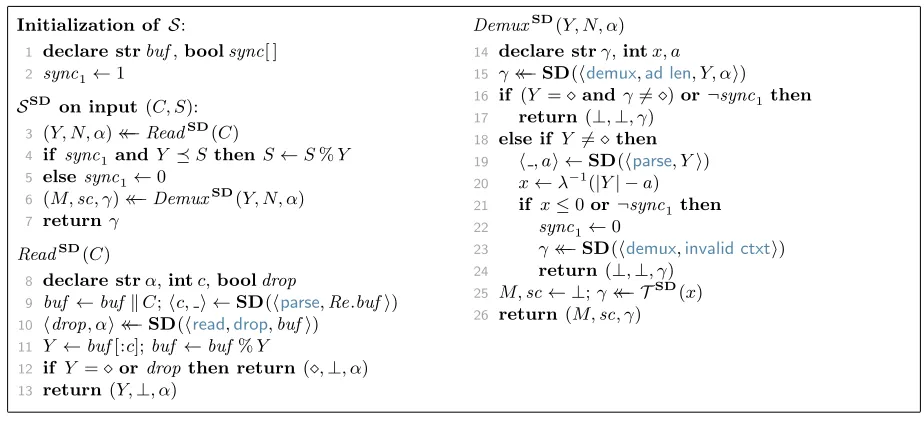
Security. LetCH=TLS[M,AE,N] be as defined in Figure 7. Our first step is to show that PRIV of AE and mPRIV-S ofMimply PRIV-S forCH:
![Figure 7: partially specified channel TLS[M, AE, N] = (Init, Mux , Write, Read , Demux ) composed of a partiallyspecified stream multiplexer M, an AEAD scheme AE with key space K, and a nonce generator N.](https://thumb-us.123doks.com/thumbv2/123dok_us/7978847.1323235/19.612.77.536.64.453/figure-partially-specied-channel-composed-partiallyspecied-multiplexer-generator.webp)