The Pythia PRF Service
Adam Everspaugh
?, Rahul Chatterjee
?, Samuel Scott
??, Ari Juels
†, and Thomas Ristenpart
‡?
University of Wisconsin–Madison,
{
ace,rchat
}
@cs.wisc.edu
??
Royal Holloway, University of London,
[email protected]
†Jacobs Institute, Cornell Tech,
[email protected]
‡
Cornell Tech,
[email protected]
Abstract
Conventional cryptographic services such as hardware-security modules and software-based key-management systems offer the ability to apply a pseudorandom function (PRF) such as HMAC to inputs of a client’s choosing. These services are used, for example, to harden stored password hashes against offline brute-force attacks.
We propose a modern PRF service called PYTHIA de-signed to offer a level of flexibility, security, and ease-of-deployability lacking in prior approaches. The key-stone of PYTHIAis a new cryptographic primitive called averifiable partially-oblivious PRF that reveals a por-tion of an input message to the service but hides the rest. We give a construction that additionally supports efficient bulk rotation of previously obtained PRF val-ues to new keys. Performance measurements show that our construction, which relies on bilinear pairings and zero-knowledge proofs, is highly practical. We also give accompanying formal definitions and proofs of security. We implement PYTHIA as a multi-tenant, scalable PRF service that can scale up to hundreds of millions of distinct client applications on commodity systems. In our prototype implementation, query latencies are 15 ms in local-area settings and throughput is within a factor of two of a standard HTTPS server. We further report on implementations of two applications using PYTHIA, showing how to bring its security benefits to a new en-terprise password storage system and a new brainwallet system for Bitcoin.
1
Introduction
Security improves in a number of settings when appli-cations can make use of a cryptographic key stored on a remote system. As an important example, consider the compromise of enterprise password databases. Best practice dictates that passwords be hashed and salted
be-fore storage, but attackers can still mount highly effective brute-force cracking attacks against stolen databases.
Well-resourced enterprises such as Facebook [41] have therefore incorporated remote cryptographic oper-ations to harden password databases. Before a password is stored or verified, it is sent to aPRF serviceexternal to the database. The PRF service applies a cryptographic function such as HMAC to client-selected inputs under a service-held secret key. Barring compromise of the PRF service, its use ensures that stolen password hashes (due to web server compromise) cannot be cracked using an offline brute-force attack: an attacker must query the PRF service from a compromised server for each pass-word guess. Such online cracking attempts can be mon-itored for anomalous volumes or patterns of access and throttled as needed.
While PRF services offer compelling security im-provements, they are not without problems. Even large organizations can implement them incorrectly. For ex-ample, Adobe hardened passwords using 3DES but in ECB mode instead of CBC-MAC (or another secure PRF construction) [26], a poor choice that resulted in disclo-sure of many of its customers’ passwords after a breach. Perhaps more fundamental is that existing PRF services do not offer graceful remediation if a compromise is de-tected by a client. Ideally it should be possible to cryp-tographically erase (i.e., render useless via key deletion) any PRF values previously used by the client, without requiring action by end users and without affecting other clients. In general, PRF services are so inaccessible and cumbersome today that their use is unfortunately rare.
flexibil-ity required to simultaneously support a variety of clients and applications. As we now explain, achieving these features necessitated innovations in both cryptographic primitive design and system architecture.
Key features and challenges. We refer to an entity us-ing PYTHIAas aclient. For example, a client might be a web server that performs password-based authentica-tion for all of its end users. Intuitively, PYTHIAallows such a client to query the service and obtain the PRF out-putY =Fk(t, m)for a messagemand a tweaktof the
client’s choosing under a client-specific secret keykheld by the service. Here, the tweak tis typically a unique identifier for an end user (e.g., a random salt). In our running password storage example, the web server stores
Y in a database to authenticate subsequent logins.
PYTHIA offers security features that at, first glance, sound mutually exclusive. First, PYTHIAachieves mes-sage privacy formwhile requiring clients to revealtto the server. Message privacy ensures that the PRF ser-vice obtains no information about the messagem; in our password-storage example,mis a user’s password. At the same time, though, by revealingt to the PRF ser-vice, the service can perform fine-grained monitoring of related requests: a high volume or otherwise anomalous pattern of queries on the sametwould in our running ex-ample be indicative of an ongoing brute-force attack and might trigger throttling by the PRF service.
By using a unique secret keykfor each client, PYTHIA supports individual key rotation should the valueY be stolen (or feared to be stolen). With traditional PRF services and password storage, such key rotation is a headache, and in many settings impractical, because it requires transitioning stored valuesY1, . . . , Yn (one for
each user account) to a new PRF key. The only way to do so previously was to have allnusers re-enter or reset their passwords. In contrast, the new primitive employed forFk in PYTHIAsupports fast key rotation: the server
can erase k, replace it with a new key k0, and issue a compact (constant-sized) token with which the client can quickly update all of its PRF outputs. This feature also enables forward-security in the sense that the client can proactively rotatekwithout disrupting its operation.
PYTHIAprovides other features as well, but we defer their discussion to Section 2. Already, those listed above surface some of the challenging cryptographic tensions that PYTHIA resolves. For example, the most obvious primitive on which to base PYTHIAis an oblivious PRF (OPRF) [29], which provides message privacy. But for rate-limiting, PYTHIArequires clients to revealt, and ex-isting OPRFs cannot hide only a portion of a PRF input. Additionally, the most efficient OPRFs (c.f., [31]) are not amenable to key rotation. We discuss at length other
re-lated concepts (of which there are many) in Section 7.
Partially-oblivious PRFs. We introduce partially oblivious PRFs (PO-PRFs) to rectify the above ten-sion between fine-grained key management and bulk key management and achieve a primitive that supports batch key rotation. We give a PO-PRF protocol in the random oracle model (ROM) similar to the core of the identity-based non-interactive key exchange protocol of Sakai, Ohgishi, and Kasahara [47]. This same construction was also considered as a left-or-right constrained PRF by Boneh and Waters [14]. That said, the functional-ity achieved by our PO-PRF is distinct from these prior works and new security analyses are required. Despite relying on pairings, we show that the full primitive is fast even in our prototype implementation.
In addition to a lack of well-matched cryptographic primitives, we find no supporting formal definitions that can be adapted for verifiable PO-PRFs. (Briefly, previous definitions and proofs for fast OPRFs rely on hashing in the ROM before outputting a value [19, 31]; in our set-ting, hashing breaks key rotation.) We propose a new as-sumption (a one-more bilinear decisional Diffie-Hellman assumption), give suitable security definitions, and prove the security of the core primitive in PYTHIAunder these definitions (in the appendix). Our new definitions and technical approaches may be of independent interest.
Using PYTHIA in applications. We implement PYTHIA and show that it offers highly practical per-formance on Amazon EC2 instances. Our experiments demonstrate that PYTHIAis practical to deploy using off-the-shelf components, with combined computation cost of client and server under 12 milliseconds. A single 8-core virtualized server can comfortably support over 1,000 requests per second, which is already within a fac-tor of two of a standard HTTPS server in the same con-figuration. (Our PYTHIA implementation performs all communication over TLS.) We discuss scaling to han-dle more traffic volume in the body; it is straightforward given current techniques.
We demonstrate the benefits and practicality of PYTHIAfor use in a diverse set of applications. First is our running example above: we build a new password-database system using a password “onion” that com-bines parallelized calls to PYTHIA and a conventional key hashing mechanism. Our onion supports PYTHIA key rotation, hides back-end latency to PYTHIA during logins (which is particularly important when accessing PYTHIA as a remote third-party service), and achieves high security in a number of compromise scenarios.
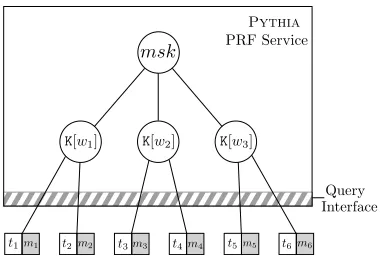
Figure 1: Diagram of PRF derivations enabled by PYTHIA. Everything inside the large box is operated by the server, which only learns tweaks and not the shaded messages.
“brainwallet” [15]; use of PYTHIAhere prevents offline brute-force attacks of the type that have been common in Bitcoin.
Our prototype implementation of PYTHIAis built with open-source components and itself is open-source. We have also released Amazon EC2 images to allow com-panies, individuals, and researchers to spin-up PYTHIA instances for experimentation.
2
Overview and Challenges
We now give a high-level overview of PYTHIA, the moti-vations for its features, what prior approaches we inves-tigated, and the threat models we assume. First we fix some terminology and a high-level conceptual view of what a PRF service would ideally provide. The service is provisioned with a master secret keymsk. This will be used to build a tree that represents derived sub-keys and, finally, output values. See Figure 1, which depicts an example derivation tree associated with PYTHIA as well as which portions of the tree are held by the server (within the large box) and which are held by the client (the leaves). Keys of various kinds are denoted by cir-cles and inputs by squares.
From themskwe derive a number ofensemble keys. Each ensemble key is used by a client for a set of re-lated PRF invocations — the ensemble keys give rise to isolated PRF instances. We label each ensemble key in the diagram by K[w]. Here w indicates a client-chosenensemble selector. Anensemble pre-keyK[w]is a large random value chosen and held by the server. To-gether,mskandK[w]are used to derive the ensemble key
kw =HMAC(msk,K[w]). A table is necessary to
sup-port cryptographic erasure of (or updates to) individual ensemble keys, which amounts to deleting (or updating) a table entry.
Each ensemble key can be used to obtain PRF outputs
of the formFkw(t, m)whereF is a (to-be-defined) PRF
keyed bykw, and the input is split into two parts. We
calltatweakfollowing [33] andmthe message. Look-ing aheadtwill be made public to PYTHIAwhilemwill be private. This is indicated by the shading of the PRF output boxes in the figure.
Deployment scenarios. To motivate our design choices and security goals, we relay several envisioned deploy-ment scenarios for PYTHIA.
Enterprise deployment: A single enterprise can deploy PYTHIAinternally, giving query access only to other sys-tems they control. A typical setup is that PYTHIAfields queries from web servers and other public-facing sys-tems that are, unfortunately, at high risk of compromise. PRF queries to PYTHIA harden values stored on these vulnerable servers. This is particularly suited to storing check-values for passwords or other low-entropy authen-tication tokens, where one can store Fkw(t, m)wheret
is a randomly chosen, per-user identifier (a salt) andmis the low-entropy password or authentication token. Here
wcan be distinct for each server using PYTHIA. Public cloud service: A public cloud such as Ama-zon EC2, Google Compute Engine, or Microsoft Azure can deploy PYTHIA as an internal, multi-tenant service for their customers. Multi-tenant here means that differ-ent customers query the same PYTHIA service, and the cloud provider manages the service, ensemble pre-key table, etc. This enables smaller organizations to obtain the benefits of using PYTHIAfor other cloud properties (e.g., web servers running on virtual machine instances) while leaving management of PYTHIAitself to experts.
Public Internet service: One can take the public cloud service deployment to the extreme and run PYTHIA in-stances that can be used from anywhere on the Internet. This raises additional performance concerns, as one can-not rely on fast intra-datacenter network latencies (sub-millisecond) but rather on wide-area latencies (tens of milliseconds). The benefit is that PYTHIAcould then be used by arbitrary web clients, for example we will ex-plore this scenario in the context of hardening brainwal-lets via PYTHIA.
One could tailor a PRF service to each of these set-tings, however it is better to design a single, application-agnostic service that supports all of these settings si-multaneously. A single design permits reuse of open-source implementations; standardized, secure-by-default configurations; and simplifies the landscape of PRF ser-vices.
as simple web interfaces); scales to hundreds of millions of ensembles; and produces outputs indistinguishable from random values even when adversaries can query the service. To this list of basic requirements we add:
• Message privacy: The PRF service must learn noth-ing aboutm. Message privacy supports clients that require sensitive values such as passwords to remain private even if the service is compromised, or to promote psychological acceptability in the case that a separate organization (e.g., a cloud provider) man-ages the service.
• Tweak visibility: The server must learn tweakt to permit fine-grained rate-limiting of requests.1 In the password storage example, a distinct tweak is as-signed to each user account, allowing the service to detect and limit guessing attempts against individ-ual user accounts.
• Verifiability: A client must be able to verify that a PRF service has correctly computed Fkw for a
ensemble selectorwand tweak/message pairt, m. This ensures, after first use of an ensemble by a client, that a subsequently compromised server can-not surreptitiously reply to PRF queries with incor-rect values.2
• Client-requested ensemble key rotations: A client must be permitted to request a rotation of its en-semble pre-keyK[w]to a new oneK[dw]. The server
must be able to provide an update token∆wto roll
forward PRF outputs under K[w] to become PRF
outputs underK[dw], meaning that the PRF is
key-updatablewith respect to ensemble keys. Addition-ally,∆wmust becompact, i.e., constant in the
num-ber of PRF invocations already performed underw. Clients can mandate that rotation requests be au-thenticated (to prevent malicious key deletion). A client must additionally be able totransfer an en-semble from one selectorwto another selectorw0.
• Master secret rotations:The server must be able to rotate the master secret keymskwith minimal im-pact on clients. Specifically, the PRF must be key-updatable with respect to the master secret keymsk
so that PRF outputs undermsk can be rolled for-ward to a new master secret mskd. When such a
rotation occurs, the server must provide a compact update tokenδwfor each ensemblew.
• Forward security: Rotation of an ensemble key or
1In principle, the server need only be able to link requests
involv-ing the samet, not learnt. Explicit presentation oftis the simplest mechanism that satisfies this requirement.
2This matters, for example, if an attacker compromises the
commu-nication channel but not the server’s secrets (mskandK[w]). Such an attacker must not be able to convince the client that arbitrary or incor-rect values are corincor-rect.
master secret key results in complete erasure of the old key and the update token.
Two sets of challenges arise in designing PYTHIA. The first is cryptographic. It turns out that the combi-nation of requirements above are not satisfied by any ex-isting protocols we could find. Ultimately we realized a new type of cryptographic primitive was needed that proves to be a slight variant of oblivious PRFs and blind signatures. We discuss the new primitive, and our effi-cient protocol realizing it, in the next section. The second set of challenges surrounds building a full-featured ser-vice that provides the core cryptographic protocol, which we treat in Section 4.
3
Partially-oblivious PRFs
We introduce the notion of a (verifiable) partially-oblivious PRF. This is a two-party protocol that allows the secure computation ofFkw(t, m), whereF is a PRF
with server-held key kw andt, m are the input values.
The client can verify the correctness of Fkw(t, m)
rel-ative to a public key associated to kw. Following our
terminology, tis a tweak andmis a message. We say the PRF is partially oblivious becausetis revealed to the server, butmis hidden from the server.
Partially oblivious PRFs are closely related to, but dis-tinct from, a number of existing primitives. A standard oblivious PRF [29], or its verifiable version [31], would hide both tandm, but masking both prevents granular rate limiting by the server. Partially blind signatures [1] allow a client to obtain a signature on a similarly par-tially blinded input, but these signatures are randomized and the analysis is only for unforgeability which is insuf-ficient for security in all of our applications.
We provide more comparisons with related work in Section 7 and a formal definition of the new primitive in Appendix B. Here we will present the protocol that suf-fices for PYTHIA. It uses an admissible bilinear pairing
e : G1×G2 → GT over groupsG1,G2,GT of prime
orderq, and a pair of hash functionsH1:{0,1}∗→G1 and H2 : {0,1}∗ → G2 (that we will model as ran-dom oracles). More details on pairings are provided in Appendix B. A secret keykwis an element ofZp. The
PRFFthat the protocol computes is:
Fkw(t, m) =e H1(t), H2(m)
kw
.
This construction coincides with the Sakai, Ohgishi, and Kasahara [47] construction for non-interactive identity-based key exchange, wheretandmwould be different identities andkwa secret held by a trusted key authority.
PRF-Cl (w, t, m)
PRF-Srv (msk)
r←$Zq
x←H2(m)r
w, t, x
-˜
x←e(H1(t), x)
kw←HMAC(msk,K[w]) pw←gkw
y←x˜kw
pw, y, π
π←$ZKP(DLg(pw) =DLx˜(y))
Ifpwmatches &
πverifies then Rety1/r Else Ret⊥
Figure 2: The partially-oblivious PRF protocol used in PYTHIA. The value π is a non-interactive zero-knowledge proof that the indicated discrete logs match. The client also checks thatpwmatches ones seen
previ-ously when using selectorw.
PRF-Cl (w, t, m)
PRF-Srv (msk)
w, t, m
-˜
x←H3(tkm)
kw←HMAC(msk,K[w])
pw←gkw
y←x˜kw
pw, y, π
π←$ZKP(DLg(pw) =DLx˜(y))
Ifpwmatches &
πverifies then Rety Else Ret⊥
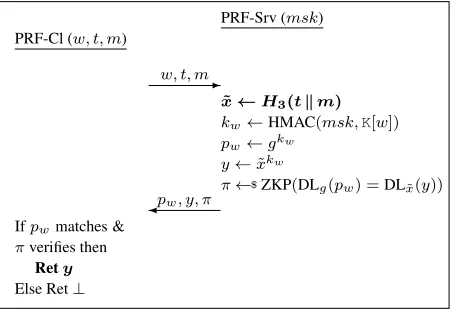
Figure 3: The unblinded PRF protocol supported by PYTHIA. Differences from the partially-oblivious pro-tocol in Figure 2 are shown inbold.
our analyses will necessarily be different, but we note that all three settings similarly exploit the algebraic struc-ture of the bilinear pairing. See Section 7 for further dis-cussion of related work.
The client-server protocol that computesFkw(t, m)in
a partially-oblivious manner is given in Figure 2. There we letgbe a generator ofG1. We now explain how the protocol achieves our requirements described in the last section.
Blinding the message: In our protocol, the client blinds the messagem, hiding it from the server, by rais-ing it to a randomly selected exponent r←$Zq. As
e H1(t), H2(m)r
=e H1(t), H2(m)
r
, the client can unblind the outputyof PRF-Srv by raising it to1/r. This
protocol hidesm unconditionally, asH2(m)r is a uni-formly random element ofG2.
Verifiability: The protocol enables a client to verify that the output of PRF-Srv is correct, assuming the client has previously storedpw. The server accompanies the output yof the PRF with a zero-knowledge proofπof correct-ness.
Specifically, for a public key pw = gkw, where g
is a generator of G1, the server proves DLg(pw) =
DLx˜(y). Standard techniques (see, e.g., Camenisch and Stadler [20]) permit efficient ZK proofs of this kind in the random oracle model.3The notable computational costs
for the server are one pairing and one exponentiation in GT; for the client, one pairing and two exponentiations
inGT.4
Efficient key updates: The server can quickly and easily update the key kw for a given ensemble
selec-tor w by replacing the table entry s = K[w] with a new, randomly selected values0, thereby changingkw=
HMAC(msk, s)tokw0 =HMAC(msk, s0). It can then
transmit to the client an update token of the form∆w= kw0 /kw∈Zq.
The client can update any stored PRF value
Fkw(t, m) = e H1(t), H2(m)
kw
by raising it to∆w;
it is easy to see thatFkw(t, m)
∆w=F
k0
w(t, m).
The server can use the same mechanism to update
msk, which requires generating a new update token for eachwand pushing these tokens to clients as needed.
Unblinded variants. For deployments where oblivious-ness of messages is unnecessary, we can use a faster, un-blinded variant of the PYTHIA protocol that dispenses with pairings shown in Figure 3. The only changes are that the client sendsmto the server, there is no unblind-ing of the server’s response, and, instead of computunblind-ing
˜
x←e(H1(t), x)
the server computes
˜
x←H3(tkm).
All group operations in this unblinded variant are over a standard elliptic curve groupG=hgiof orderqand we use a hash functionH3: {0,1}∗→G.
An alternative unblinded construction would be to have the server apply the Boneh-Lynn-Shacham short signatures [13] to the client-submittedtkm; verification of correctness can be done using the signature verifica-tion routine, and we can thereby avoid ZKPs. This BLS
3Some details: The prover picksv←$Z
qand then computest1=
gvandt2= ˜xvandc←H3(g, pw,˜x, y, t1, t2). Letu=v−c·k.
The proof isπ = (c, u). The verifier computest01 =gu·pc wand
t02= ˜xuyc. It outputs true ifc=H
3(g, pw,x, y, t˜ 01, t02).
4The client’s pairing can be pre-computed while waiting for the
Command Description
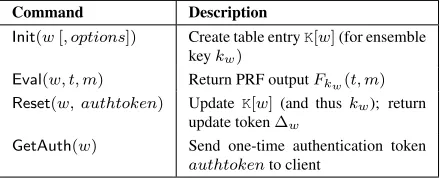
Init(w[, options]) Create table entryK[w](for ensemble keykw)
Eval(w, t, m) Return PRF outputFkw(t, m)
Reset(w, authtoken) UpdateK[w](and thuskw); return update token∆w
GetAuth(w) Send one-time authentication token authtokento client
Figure 4: The basic PYTHIAAPI.
variant may save a small amount of bandwidth.
These unblinded variants provide the same services (verifiability and efficient key updates) and security with the obvious exception of the secrecy of the messagem. In some deployment contexts an unblinded protocol may be sufficient, for example when the client can maintain state and submit a salted hashminstead ofmdirectly. In this context, the salt should be held as a secret on the client and never sent to the server.
4
The P
YTHIAService Design
Figure 4 gives the high-level API exposed by PYTHIA to a client. We now describe its functions in terms of the lifecycle of an ensemble key. We assume a security parameternspecifying symmetric key lengths; a typical choice would ben= 128.
We defer to later sections the underlying client-server protocols and to Appendix A details on key lifecycle management options, additional API calls for token man-agement and ensemble transfer, and a discussion of mas-ter secret key rotation.
Ensemble initialization. To begin using the PYTHIA service, a client creates an ensemble key for selectorw
by invoking Init(w [, options]). PYTHIA generates a fresh, random table entry K[w]. Recall that ensemble key kw = HMAC(msk,K[w]). So Initcreates kw as
a byproduct.
Ideally,wshould be an unguessable byte string. (An easily guessed one may allow attackers to squat on a key selector, thereby mounting a denial-of-service (DoS) at-tack.) For some applications, as we explain below, this isn’t always possible. If an ensemble key forwalready exists, then the PYTHIA service returns an error to the client. Otherwise, the client receives a message signify-ing that initialization is successful.
Init includes a number of options we detail in Ap-pendix A.
PRF evaluation. To obtain a PRF value, a client can perform an evaluation query Eval(w, t, m), which re-turns Fkw(t, m). Here t is a tweak and m is a
mes-sage. To compute the PRF output, the client and server
perform a one-round cryptographic protocol (meaning a single message from client to server, and one message back). We present details in Section 3, but remind the reader thattis visible to the server in the client-server protocol invoked byEval, whilemis blinded.
The server rate-limits requests based on the tweak t, and can also raise an alert if the rate limit is exceeded. We give example rate limiting policies in Section 5.
Ensemble-key reset. A client can request that an en-semble keykwbe reset by invokingReset(w). This reset
is accomplished by overwritingK[w]with a fresh, ran-dom value. The name service returns a compact (e.g., 256-bit) update token∆wthat the client may use to
up-date all PRF outputs for the ensemble. It stores this to-ken locally, encrypted under a public key specified by the client, as explained below.
Note that resetresults in erasure of the old value ofkw.
Thus a client that wishes to delete an ensemble keykw
permanently at the end of its lifecycle can do so with a Resetcall.
Reset is an authenticated call, and thus requires the following capability.
Authentication. To authenticate itself for API calls, the client must first invokeGetAuth, which has the server transmit an (encrypted) authentication tokenauthtoken
to the client out-of-band. The token expires after a pe-riod of time determined by a configuration parameter in PYTHIA. Our current implementation uses e-mail for this, see Appendix A for more details. Of course, in some deployments one may want authentication to be performed in other ways, such as tokens dispensed by administrators (for enterprise settings) or simply given out on a first-come-first-serve basis for each ensemble identifier (for public Internet services).
4.1
Implementation
We implemented a prototype PYTHIA PRF service as a web application accessed over HTTPS. All requests are first handled by an nginx web server with uWsgi as the application server gateway that relays requests to a Django back-end. The PRF-Srv functionality is imple-mented as a Django module written in Python. Storage for the server’s key table and rate-limiting information is done in MongoDB.
We use the Relic cryptographic library [2] (written in C) with our own Python wrapper. We use Barreto-Naehrig 254-bit prime order curves (BN-254) [4]. These curves provide approximately 128-bits of security.
con-figuration files.
For the purpose of comparison, we implemented three variants of the PYTHIAservice. The first two are the un-blinded protocols described in Section 3. In these two schemes, the client sendsmin the clear (possibly hashed with a secret salt value first) and the server replies with
y = H1(tkm)k. In the first scheme, denoted UNB, the server providesp=gk
1 and a zero-knowledge proof whereg1is a generator ofG1. The second scheme, de-notedBLS, uses a BLS signature for verification. The server providesp=gk
2 whereg2is a generator ofG2and the client verifies the response by computing and com-paring the values:e(y, g2) =e(H1(tkm), p).
Our partially-oblivious scheme is denotedPO.
For the evaluation below we use a Python client im-plementing PRF-Cl for all three schemes using the same libraries indicated above for the server and httplib2 to perform HTTPS requests.
4.2
Performance
For performance and scalability evaluation we hosted our PYTHIAserver implementation on Amazon’s Elastic Compute Cloud (EC2) using a c4.xlarge instance which provides 8 virtual CPUs (Intel Xeon third generation, 2.9GHz), 15 GB of main memory, and solid state storage. The web server, nginx, was configured with basic set-tings recommended for production deployment including one worker process per CPU.
Latency. We measured client query latency for each protocol using two clients: one within the same Amazon Web Service (AWS) availability zone (also c4.xlarge) and one hosted at the University of Wisconsin–Madison with an Intel Core i7 CPU (3.4 GHz). We refer to the first as the LAN (local-area network) setting and the second as the WAN (wide-area network) setting. In the LAN set-tings we used the AWS internal IP address. All queries were made over TLS and measurements include the time required for clients to blind messages and unblind results (PO), as well as verify proofs provided by the server (un-less indicated otherwise). All machines used for evalua-tion were running Ubuntu 14.04.
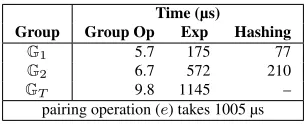
Microbenchmarks for group operations appear in Figure 5 and Figure 6 shows the timing of individual op-erations that comprise a single PRF evaluation. All re-sults are mean values computed over 10,000 operations. These values were captured on an EC2 c4.xlarge instance using the Python profiling library line profiler. The most expensive operations, by a large margin, are exponentia-tion inGtand the pairing operation. By extension,PO
sign, prove, and verify operations become expensive. We measured latencies averaged over 1,000 PRF re-quests (with 100 warmup rere-quests) for each scheme and
Time (µs)
Group Group Op Exp Hashing G1 5.7 175 77
G2 6.7 572 210
GT 9.8 1145 – pairing operation (e) takes 1005 µs
Figure 5: Time taken by each operation in BN-254 groups. Hashing times are for 64-byte inputs.
Server Op Time (ms)
Table 1.2
Rate-limit 0.9
UNB BLS PO
Sign 0.3 0.3 1.5
Prove 0.5 0.3 2.5
Client Op UNB BLS PO
Blind - - 0.3
Unblind - - 1.2
Verify 0.9 2.0 4.0
Figure 6: Computation time for major operations to perform a PRF evaluation. Table retrievesK[w] from database; Rate-limit updates rate-limiting record in database; andSigngenerates the PRF output;
the results appear in Figure 7. Computation time domi-nates in the LAN setting due to the almost negligible net-work latency. The WAN case with cold connections (no HTTP KeepAlive) pays a performance penalty due to the four round-trips required to set up a new TCP and TLS connection. While even 400 ms latencies are not pro-hibitive in our applications, straightforward engineering improvements would vastly improve WAN timing: us-ing TLS session resumption, usus-ing lower-latency secure protocol like QUIC [46], or even switching to a custom UDP protocol (for an example one for oblivious PRFs, see [5]).
Throughput. We used the distributed load testing tool autobench to measure maximum throughput for each scheme. We compare to a static page containing a typi-cal PRF response served over HTTPS as a baseline. We used two clients in the same AWS region as the server. All connections were cold: no TLS session resumption or HTTP KeepAlive. Results appear in Figure 8. The maximum throughput for a static page is 2,200 connec-tions per second (cps);UNBandBLS1,400 cps; andPO
1,350 cps. Thus our PYTHIAimplementation can handle a large number of clients on a single EC2 instance. If needed, the implementation can be scaled with standard techniques (e.g., a larger number of web servers and ap-plication servers on the front-end with a distributed key-value store on the back-end).
Latency (ms)
LAN WAN
Scheme Cold Hot Noπ Cold Hot Noπ
UNB 7.0 3.8 2.4 389 82 80
BLS 7.9 4.9 2.4 392 85 80
PO 14.9 11.8 5.2 403 96 84
RTT ping 0.1 82
Figure 7: Average latency to complete a PRF-Cl with client-server communication over HTTPS. LAN: client and server in the same EC2 availability zone. WAN: server in EC2 US-West (California) and client in Madi-son, WI. Hot connections made with HTTP KeepAlive enabled; cold connections with KeepAlive disabled. No
π: KeepAlive enabled; prove and verify computations are skipped.
1,200 1,300 1,400 1,500 1,600 1,300
1,400 1,500 1,600
Established (conns/sec)
Of
fered
(conns/sec)
Static UNB BLS PO
Figure 8: Throughput of PRF-Srv requests and a static page request over HTTPS measured using two clients and a server hosted in the same EC2 availability zone.
MongoDB. A table entry is two 32 byte values: a SHA-256 hash of the ensemble selectorwand its associated valueK[w]. In MongoDB the average storage size is 195 bytes per entry (measured as the average of 100K en-tries), including database overheads and indexes. This implementation scales easily to 100 M clients with under 20 GB of storage.
To rate-limit queries, our implementation stores tweak values along with a counter and a timestamp (to ex-pire old entries) in MongoDB. Tweak values are also hashed using SHA-256 which ensures entries are of con-stant length. In our implementation each distinct tweak requires an average of 144 bytes per entry (including overheads and indexes). Note however that rate limit-ing entries are purged periodically as counts are only required for one rate-limiting period. Our implementa-tion imposes rate-limits at hour granularity. Assuming a maximum throughput of 2,000 requests per second, rate-limiting storage never exceeds 1 GB.
All told, with only 20 GB stored data, PYTHIA can serve over 100 M clients and perform rate-limiting at
PW-Onion(pw) h1←MD5(pw)
sa←${0,1}160
h2←HMAC[SHA-1](h1, sa)
h3←PRF-Cl(h2) =HMAC[SHA-256](h2, msk)
h4←scrypt(h3, sa)
h5←HMAC[SHA-256](h4)
Ret(sa, h5)
Figure 9: The Facebook password onion. PRF-Cl(h2) invokes the Facebook PRF service HMAC[SHA-256](h2, Ks)with PRF-service secret keyKs.
hour granularity. Thus fielding a database for PYTHIA can be accomplished on commodity hardware.
5
Password Onions
Web servers and other systems frequently store pass-words in hashed form. Apassword onionis the result of additionally invoking a PRF service to harden the hash. In currently suggested onions, one sequentially combines local hashing and application of the PRF service.
We now present a service that we have implemented on top of PYTHIAfor managing password onions. First, we describe the limitations of contemporary systems as exemplified by a recently disclosed architecture em-ployed by Facebook [42]. Then we show how our password-onion system, which was easily engineered on top of PYTHIA, can address these limitations.
In what follows, we use the term “client” or “web server” to denote the server performing authentication and storing derived values from passwords and “PRF server” to denote the PYTHIAservice.
5.1
Facebook password onion
An example of a contemporary system, used by Face-book, is given in Figure 9.5 Their PRF service applies HMAC using a service-held secret and returns the result. In this architecture, an adversary that compromises the web server and the password hashes it stores must still mount an online attack against the PRF service to com-promise accounts. This is a big advance on the hashing-only practices that are commhashing-only used.
The Facebook architecture nevertheless has some shortcomings. It is easy to see from Figure 9 that Face-book’s system, like most contemporary PRF services, lacks several important features present in PYTHIA. One
5This figure is of “archaeological” interest. It appears that
is message privacy: the Facebook PRF service applies HMAC toh2. This is the salted hash of the password, and so learning the salt as well as compromising the PRF service suffices to re-enable offline brute-force attacks. This threat is avoided by PYTHIAdue to blinding.
Another feature is batch key updates. In fact, the Face-book PRF service doesn’t permit autonomous key up-dates at all, in the sense of an update tomskthat can be propagated into PRF output updates. Should the client (password database) be compromised, the only way to reconstitute a hash in an existing password onion is to wait until a user logs in and furnishes pw. It is not clear whether the Facebook PRF service performs granu-lar rate-limiting, although no such capability is indicated in [41]. PYTHIA, as we shall see, addresses all of these issues by design in our password onion system.
The Facebook onion also presents a subtle perfor-mance issue. By applying cryptographic primitives se-rially, the time to hash a password equals the time for local computations, call it tlocal, plusthe time for the
round-trip PRF service call, call ittprf. An attacker that
compromises the web service and PRF service incurs no network latency, and thus may gain a considerable ad-vantage in guessing time over an honest web server. In our PYTHIA-based password onion service, we address this issue by observing that it is possible to avoid seri-alization of key derivation functions on the web server and the PRF service call. That is, we introduce in our PYTHIA-based service the idea of parallelizable pass-word onions.
5.2
P
YTHIApassword onion
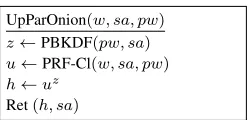
The onion algorithm we construct for PYTHIAis shown in Figure 10. For PYTHIA, the output of PRF-Cl is an element of a group GT. To use this service, a
web server stores (h, sa) upon password registration; it verifies a proffered password pw0 by checking that UpParOnion(w, sa, pw0) =h. Written out we have that:
h=uz=e(H1(sa), H2(pw))kwz.
This design ensures that the key update functions in the PYTHIAAPI may be used to update onions as well. For example, to update an ensemble keykwtok0w, the service
computes and furnishes to the web server an update token ∆w = kw0 /kw. The web server may computeh∆w for
each stored valueh.
Parallelization. Password verification here is paral-lelizablein the sense thatzandumay be computed in-dependently and then combined. Such parallel imple-mentation of the onion achieves a password verification latency of max{tlocal, tprf} (plus a single
exponentia-tion), as opposed totlocal+tprf in a serialized
imple-mentation.
UpParOnion(w, sa, pw) z←PBKDF(pw, sa) u←PRF-Cl(w, sa, pw) h←uz
Ret(h, sa)
Figure 10: An updatable, parallelizable password onion. PRF-Cl returns elements of a groupG. The valuewis a unique PRF-service identifier for the web server (e.g., a random 256-bit string) andsais a random per-user salt value.
A web server generally aims to achieve a verification latency equal to some latency targetTthat is high enough to slow offline brute-force attacks, but low enough not to burden users. For a parallelized onion a web server can meet its latency target by settingtlocal, tprf ≈T. At the
same time an offline attacker that has compromised the web server and PYTHIAmust perform abouttlocal+tF > T work to check a single password guess, wheretF is
the computation time of Fkw (i.e., tprf minus network
latency). An attacker can parallelize, but her total work still goes up relative to the serial onion approach for the same latency targetT.
We estimate the security improvement of parallel onions over serial onions using our benchmarks from Section 4.2. We fix a login latency budget of T = 300ms.6 The latency costs for a PYTHIA query with
hot connections are 12 ms (LAN) and 96 ms (WAN). If one performs computations serially with a fixed T then PBKDF computations need to be reduced by 4% (LAN) and 32% (WAN) compared to the parallel approach. In the event that the PYTHIAserver and password database are compromised, the serial onion enables speedup of of-fline dictionary attacks by the same percentages.
Rate limiting and logging. The transparency of tweaks enables the PYTHIAPRF service in this setting to execute any of a wide range of rate-limiting policies with per-account visibility (in contrast to what may be in Face-book an account-blind PRF service). As an example demonstrating the flexibility of our architecture, in our implementation PYTHIAperforms a tiered rate-limiting: for a given account (t), it limits queries to at most 10 per hour per account, and at most 300 per month. (In ex-pectation, guessing a random 4-digit PIN would require 1.4 years under this policy.) It logs violations of these thresholds. In a production environment, it could also send alerts to security administrators.
We emphasize that a wide range of other rate-limiting policies is possible. We also point out that PYTHIA’s rate
6This is the default setting for Python’s bcrypt and scrypt modules,
limiting supplements that normally implemented at the web server for remote login requests. PYTHIAperforms rate limiting and may issue alerts even if the web server is compromised.
Key update. The key update calls in the PYTHIAAPI, and the ability to rotate either kw or msk efficiently,
propagates up to the password onion service. Key up-dates instantly invalidate the web server’s existing pass-word database—a useful capability in case of compro-mise. A compromised database becomes useless to an attacker attempting to recover passwords, even with the ability to query PYTHIA. Using a key update token, the web server can then recover from compromise by re-freshing its database.
We created a client simulator with MongoDB and the mongoengine Python module. With this we bench-marked key updates with 100,000 database entries. The client requested a key update from PYTHIA, received the update token∆w, and updated each database entry. The
complete update required less than 1 ms per entry, and terminated in less than 97 seconds for all 100,000 en-tries. For a larger database we assume updates scale lin-early, and so an update for 1 million users completes in under 17 minutes.
The web server need not need lock the database to per-form updates; it can execute them in parallel with normal login operations. Doing so does require additional ver-sioning information for each entry to indicate the version ofkw(in the simplest form, whether or not it has received
the latest update).
Database replication. Password databases can be repli-cated with a key transfer using the API callTransfer(see Appendix A). In this replication each new copy uses a unique ensemble key selector and thus a cryptograph-ically independent PRF service key. Given a database
w,{(sa1, h1), . . . ,(sad, hd)}withdusers, the
adminis-trator invokesTransfer(w, w0)to obtain a token∆w→w0.
The client computesh0i = h∆w→w0
i for i ∈ [1..d] and
sends the new database(w0,{(sa1, h10), . . . ,(sad, h0d)})
to the new server. The client does not modify salt values, which allows PYTHIAto link online guessing attacks car-ried out from multiple compromised web servers. Repli-cation in this way costs database copy time plus 1 ms per entry to apply the update token, thus making it on the order of minutes for hundreds of thousands of users.
6
Hardened Brainwallets
Brainwallets are a common but dangerous way to se-cure accounts in the popular cryptocurrency Bitcoin, as well as in less popular cryptocurrencies such as Litecoin. Here we describe how the PYTHIA service can be used
directly as a means to harden brainwallets. This appli-cation showcases the ease with which a wide variety of applications can be engineered around PYTHIA.
How brainwallets work. Every Bitcoin account has an associated private / public key pair(sk, pk). The private keysk is used to produce digital (ECDSA) signatures that authorize payments from the account. The public keypk permits verification of these signatures. It also acts as an account identifier; a Bitcoin address is derived by hashingpk(under SHA-256 and RIPEMD-160) and encoding it (in base 58, with a check value).
Knowledge of the private keyskequates with control of the account. If a user loses a private key, she therefore loses control over her account. For example, if a high en-tropy keyskis stored exclusively on a device such as a mobile phone or laptop, and the device is seized or physi-cally destroyed, the account assets become irrecoverable. Brainwallets offer an attractive remedy for such phys-ical risks of key loss. A brainwallet is simply a password or passphrasePmemorized by a Bitcoin account holder. The private keyskis generated directly fromP. Thus the user’s memory serves as the only instrument needed to authorize access to the account.
In more detail, the passphrase is typically hashed using SHA-256 to obtain a 256-bit stringsk =SHA-256(P). Bitcoin employs ECDSA signatures on thesecp256k1 elliptic curve; with high probability (≈ 1−2−126),sk is less than the group order, and a valid ECDSA pri-vate key. (Some websites employ stronger key derivation functions. For example, WrapWallet by keybase.io [32] derivesskfrom an XOR of each of PBKDF2 and scrypt applied toPand permits use of a user-supplied salt.)
Since a brainwallet employs only P as a secret, and does not necessarily use any additional security mea-sures, an attacker that guessesP can seize control of a user’s account. As account addresses are posted publicly in the Bitcoin system (in the “blockchain”), an attacker can easily confirm a correct guess. Brainwallets are thus vulnerable to brute-force, offline guessing attacks. Nu-merous incidents have come to light showing that brain-wallet cracking is pandemic [15].7
6.1
A P
YTHIA-hardened brainwallet
PYTHIA offers a simple, powerful means of protecting brainwallets against offline attack. HardeningP in the same manner as an ordinary password yields a strong key
˜
Pthat can serve in lieu ofP to derivesk.
To use PYTHIA, a user chooses a unique identifierid, e.g., her e-mail address, an account identifieracct, and a
7At one point, rumor had it that cracking brainwallets was more
passphraseP. The identifieracctmight be used to distin-guish among Bitcoin accounts for users who wish to use the same password for multiple wallets. The client then sends(w = id, t = idkacct, m = P)to the PYTHIA service to obtain the hardened value Fkw(t, m) = ˜P.
Here,idis used both as an account identifier and as part of the salt. Message privacy in PYTHIAensures that the service learns nothing aboutP. ThenP˜ is hashed with SHA-256 to yield sk. The corresponding public key
pk and address are generated in the standard way from
sk[8].
PYTHIA forces a would-be brainwallet attacker to mount an online attack to compromise an account. Not only is an online attack much slower, but it may be rate-limited by PYTHIA and detected and flagged. As the PYTHIA service derives P˜ using a user-specific key, it additionally prevents an attacker from mounting a dictio-nary attack against multiple accounts. While in the con-ventional brainwallet setting, two users who make use of the same secretP will end up controlling the same account, PYTHIAensures that the same passwordP pro-duces distinct per-user key pairs.
Should an attacker compromise the PYTHIA service and stealmskandK, the attacker must still perform an offline brute-force attack against the user’s brainwallet. So in the worst case, a user obtains security with PYTHIA at least as good as without it.
Additional security issues. A few subtle security issues deserve brief discussion:
• Stronger KDFs: To protect against brute-force attack in the event of PYTHIA compromise, a resource-intensive key-derivation function may be desirable, as is normally used in password databases. This can be achieved by replacing the SHA-256 hash ofP˜above with an appropriate KDF computation, or alternatively using an onion ap-proach described in Section 5.
• Denial-of-service: By performing rate-limiting, PYTHIA creates the risk of targeted denial-of-service attacks against Bitcoin users. As Bitcoin is pseudonymous, use of an e-mail address as a PYTHIA key-selector suffices to prevent such at-tacks against users based on their Bitcoin addresses alone. Users also have the option, of course, of us-ing a semi-secretid. A general DoS attack against the PYTHIAservice is also possible, but of similar concern for Bitcoin itself [9].
• Key rotation: Rotation of an ensemble keykw (or
the master keymsk) induces a new value ofP˜and thus a new(sk, pk)pair and account. A client can handle such rotations in the na¨ıve way: transfer funds from the old address to the new one.
• Catastrophic failure of PYTHIA: If a PYTHIA ser-vice fails catastrophically, e.g., msk or K is lost, then in a typical setting, it is possible simply to reset users’ passwords. In the brainwallet case, the result would be loss of virtual-currency assets protected by the server—a familiar event for Bit-coin users [38]. This problem can be avoided, for instance, using a threshold implementation of PYTHIA, as mentioned in Section 6.2 or storingsk
in a secure, offline manner like a safe-deposit box for disaster recovery.
6.2
Threshold Security
In order to gain both redundancy and security, we give a threshold scheme that can be used with a number of Pythia servers to protect a secret under a single pass-word. This scheme uses Shamir’s secret sharing thresh-old scheme [48] and gives(k, n)threshold security. That is, initially,nPythia servers are contacted and used to protect a secrets, and then anykservers can be used to recoversand any adversary that has compromised fewer thankPythia servers learns no information abouts.
Preparation. The client chooses an ensemble key se-lectorw, tweak t, password P, and contactsn Pythia servers to computeqi = PRF-Cli(w, t, P) mod pfor
0 < i ≤ n. The client selects a random polynomial of degreek−1 with coefficients from Z∗p where pis
a suitably large prime: f(x) = Pkj=0−1xja
j. Let the
secret s = a0. Next the client computes the vector
Φ = (φ1, ..., φn) where φi = f(i)−qi. The client
durably stores the valueΦ, but does not need to protect it (it’s not secret). The client also stores public keyspi
from each Pythia server to validate proofs when issuing future queries.
Recovery. The client can reconstructsif she hasΦby querying anykPythia servers givingkvaluesqi. These qi values can be applied to the correspondingΦvalues
to retrieve k distinct points that lie on the curve f(x). With k points on a degreek−1 curve, the client can use interpolation to recover the unique polynomialf(x), which includes the curve’s intercepta0=s.
Security. If an adversary is given Φ, w, t, the public keys pi, a ciphertext based ons, and the secrets from m < kPythia servers, the adversary has no information that will permit her to verify password guesses offline. Compared to [48], this scheme reduces the problem of storingnsecrets to having access tonsecure OPRFs and durable (but non-secret) storage of the valuesΦand pub-lic keyspi.
dishonest (or goes out of service), it can be easily re-placed by the client without changing the secrets. To re-place a Pythia server that is suspected to be compromised or detected as dishonest, the client reconstructs the secret
susing anykservers, executesResetoperations on all remaining servers: this effects a cryptographic erasure on the valuesΦandf(x). The client then selects a new, random polynomial, keepinga0fixed, and generates and stores an updatedΦ0that maps to the new polynomial.
7
Related Work
We investigated a number of designs based on exist-ing cryptographic primitives in the course of our work, though as mentioned none satisfied all of our design goals. Conventional PRFs built from block ciphers or hash functions fail to offer message privacy or key rota-tion. Consider instead the constructionH(tkm)kw for
H: {0,1}∗ →
Ga cryptographic hash function map-ping onto a groupG. This was shown secure as a con-ventional PRF by Naor, Pinkas, and Reingold assum-ing decisional Diffie-Hellman (DDH) is hard in Gand when modelingH as a random oracle [43]. It supports key rotations (in fact it is key-homomorphic [12]) and verifiability can be handled using non-interactive zero-knowledge proofs (ZKP) as in PYTHIA. But this ap-proach fails to provide message privacy if we submit both
tandmto the server and have it compute the full hash. One can achieve message-hiding by using blinding: have the client submit X = H(tkm)r for random r∈Z|G|and the server reply withX
kwas well as a ZKP
proving this was done correctly. The resulting scheme is originally due to Chaum and Pedersen [22], and sug-gested for use by Ford and Kaliski [28] in the context of threshold password-authenticated secret sharing (see also [3, 18, 23, 37]). There an end user interacts with one or more blind signature servers to derive a secret au-thentication token. If Gcomes equipped with a bilin-ear pairing, one can dispense with ZKPs. The resulting scheme is Boldyreva’s blinded version [11] of BLS sig-natures [13]. However, neither approach provides gran-ular rate limiting when blinding is used: the tweakt is hidden from the server. Even if the client sendstas well, the server cannot verify that it matches the one used to computeXand attackers can thereby bypass rate limits. To fix this, one might use Ford-Kaliski with a sep-arate secret key for each tweak. This would result in having a different key for each unique w, tpair. Mes-sage privacy is maintained by the blinding, and querying
w, t, H(t0km)rfort 6=t0does not help an attacker cir-cumvent per-tweak rate limiting. But now the server-side storage grows in the number of uniquew, tpairs, a client using a single ensemblewmust now trackNpublic keys when they use the service for N different tweaks, and
key rotation requiresNinteractions with the PRF server to getN separate update tokens (one per unique tweak for which a PRF output is stored). WhenN is large and the number of ensembleswis small as in our password storage application, these inefficiencies add significant overheads.
Another issue with the above suggestions is that their security was only previously analyzed in the context of one-more unforgeability [45] as targeted by blind signa-tures [21] and partially blind signasigna-tures [1]. (Some were analyzed as conventional PRFs, but that is in a model where adversaries do not get access to a blinded server oracle.) The password onion application requires more than unforgeability because message privacy is needed. (A signature could be unforgeable but include the en-tire message in its signature, and this would obviate the benefits of a PRF service for most applications.) These schemes, however, can be proven to be one-more PRFs, the notion we introduce, under suitable one-more DDH style assumptions using the same proof techniques found in Appendix B.
Fully oblivious PRFs [29] and their verifiable ver-sions [31] also do not allow granular rate limiting. We note that the Jarecki, Kiayias, and Krawczyk construc-tions of verifiable OPRFs [31] in the RO model are essentially the Ford-Kaliski protocol above, but with an extra hash computation, making the PRF output
H0(tkmkH(tkm)kw). Our notion of one-more
un-predictability in the appendix captures the necessary re-quirements on the inner cryptographic component, and might modularize and simplify their proofs. Their trans-form is similar to the unique blind signature to OPRF transformation of Camenisch, Neven, and shelat [19]. None of these efficient oblivious PRF protocols support key rotations (with compact tokens or otherwise) as the final hashing step destroys updatability.
The setting of capture-resilient devices shares with ours the use of an off-system key-holding server and the desire to perform cryptographic erasure [35, 36]. They only perform protocols for encryption and signing func-tionalities, however, and not (more broadly useful) PRFs. They also do not support granular rate limiting and mas-ter secret key rotation.
Our main construction coincides with prior ones for other contexts. The Sakai, Ohgishi, and Kasa-hara [47] identity-based non-interactive key exchange protocol computes a symmetric encryption key as
one might hope that returning the constrained PRF key
H1(t)kw to the client suffices for our applications, but in fact this totally breaks rate-limiting. Security analysis of our protocol requires new techniques, and in particu-lar security must be shown to hold when the adversary has access to a half-blinded oracle — this rules out the techniques used in [14, 44].
Key-updatable encryption [12] and proxy re-encryption [10] both support key rotation, and could be used to encrypt password hashes in a way support-ing compact update tokens and that prevents offline brute-force attacks. But this would require encryption and decryption to be handled by the hardening service, preventing message privacy.
Verifiable PRFs as defined by [24,25,34,39] allow one to verify that a known PRF output is correct relative to a public key. Previous verifiable PRF constructions are not oblivious, let alone partially oblivious.
Threshold and distributed PRFs [24, 40, 43] as well as distributed key distribution centers [43] enable a suffi-ciently large subset of servers to compute a PRF output, but previous constructions do not provide the granular rate limiting and key rotation we desire. However, it is clear that there are situations where applications would benefit from a threshold implementation of PYTHIA, for both redundancy and distribution of trust, as discussed in Section 6.2 for the case of brainwallets.
8
Conclusion
We presented the design and implementation of PYTHIA, a modern PRF service. Prior works have explored the use of remote cryptographic services to harden keys derived from passwords or otherwise improve resilience to com-promise. PYTHIA, however, transcends existing designs to simultaneously support granular rate limiting, efficient key rotation, and cryptographic erasure. This set of fea-tures, which stems from practical requirements in appli-cations such as enterprise password storage, proves to require a new cryptographic primitive that we refer to as a partially oblivious PRF.
Unlike a (fully) oblivious PRF, a partially oblivious PRF causes one portion of an input to be revealed to the server to enable rate limiting and detection of on-line brute-force attacks. We provided a bion-linear-pairing based construction for partially oblivious PRFs that is highly efficient and simple to implement (given a pair-ings library), and also supports efficient key rotations. A formal proof of security is unobtainable using existing techniques (such as those developed for fully oblivious PRFs). We thus gave new definitions and proof tech-niques that may be of independent interest.
We implemented PYTHIA and show how it may be easily integrated it into a range of applications. We
de-signed a new enterprise “password onion” system that improves upon the one recently reported in use at Face-book. Our system permits fast key rotations, enabling practical reactive and proactive key management, and uses a parallelizable onion design which, for a given au-thentication latency, imposes more computational effort on attackers after a compromise. We also explored the use of PYTHIAto harden brainwallets for cryptocurren-cies.
Acknowledgements
The authors thank Kenny Paterson for feedback on an early draft of this paper. This work was supported in part by NSF grants 1330308, 1065134, and CNS-1330599, as well as a gift from Microsoft.
References
[1] Masayuki Abe and Tatsuaki Okamoto. Provably secure partially blind signatures. InAdvances in Cryptology–CRYPTO. Springer, 2000.
[2] D. F. Aranha and C. P. L. Gouvˆea. RELIC is an Efficient LIbrary for Cryptography. https: //github.com/relic-toolkit/relic.
[3] Ali Bagherzandi, Stanislaw Jarecki, Nitesh Saxena, and Yanbin Lu. Password-protected secret sharing. InComputer and Communications Security. ACM, 2011.
[4] Paulo SLM Barreto and Michael Naehrig. Pairing-friendly elliptic curves of prime order. InSelected Areas in Cryptography. Springer, 2006.
[5] Mihir Bellare, Sriram Keelveedhi, and Thomas Ris-tenpart. Dupless: server-aided encryption for dedu-plicated storage. In USENIX Security. USENIX, 2013.
[6] Mihir Bellare, Chanathip Namprempre, David Pointcheval, Michael Semanko, and Matthew Franklin. The one-more-RSA-inversion prob-lems and the security of Chaum’s blind signature scheme.Journal of Cryptology, 16(3), 2003.
[7] Mihir Bellare, Thomas Ristenpart, and Stefano Tes-saro. Multi-instance security and its application to password-based cryptography. InAdvances in Cryptology–CRYPTO. Springer, 2012.
[8] Technical background of version 1 Bitcoin
ad-dresses. https://en.bitcoin.it/wiki/
[9] Bitcoin wiki, “weaknesses”. https://en. bitcoin.it/wiki/Weaknesses.
[10] Matt Blaze, Gerrit Bleumer, and Martin Strauss. Divertible protocols and atomic proxy cryptogra-phy. In Advances in Cryptology–EUROCRYPT. Springer, 1998.
[11] Alexandra Boldyreva. Threshold signatures, mul-tisignatures and blind signatures based on the gap-Diffie-Hellman-group signature scheme. InPublic Key Cryptography. Springer, 2002.
[12] Dan Boneh, Kevin Lewi, Hart Montgomery, and Ananth Raghunathan. Key homomorphic PRFs and their applications. InAdvances in Cryptology– CRYPTO. Springer, 2013.
[13] Dan Boneh, Ben Lynn, and Hovav Shacham. Short signatures from the Weil pairing. InAdvances in Cryptology–ASIACRYPT. Springer Berlin Heidel-berg, 2001.
[14] Dan Boneh and Brent Waters. Constrained pseu-dorandom functions and their applications. In Ad-vances in Cryptology-ASIACRYPT. Springer, 2013.
[15] Brainwallet. https://en.bitcoin.it/
wiki/Brainwallet.
[16] Emmanuel Bresson, Jean Monnerat, and Damien Vergnaud. Separation results on the “one-more computational” problems. InTopics in Cryptology– CT-RSA. Springer, 2008.
[17] Daniel R. L. Brown. Irreducibility to the one-more evaluation problems: More may be less. Cryptol-ogy ePrint Archive, Report 2007/435.
[18] Jan Camenisch, Anna Lysyanskaya, and Gregory Neven. Practical yet universally composable two-server password-authenticated secret sharing. In Computer and Communications Security. ACM, 2012.
[19] Jan Camenisch, Gregory Neven, and abhi she-lat. Simulatable adaptive oblivious transfer. In Advances in Cryptology–EUROCRYPT. Springer Berlin Heidelberg, 2007.
[20] Jan Camenisch and Markus Stadler. Proof systems for general statements about discrete logarithms. Technical Report No. 260, Dept. of Computer Sci-ence, ETH Zurich, 1997.
[21] David Chaum. Blind signatures for untraceable payments. In Advances in Cryptology. Springer, 1983.
[22] David Chaum and Torben Pryds Pedersen. Wal-let databases with observers. In Advances in Cryptology–CRYPTO. Springer, 1993.
[23] Mario Di Raimondo and Rosario Gennaro. Prov-ably secure threshold password-authenticated key exchange. In Advances in Cryptology– EUROCRYPT. Springer, 2003.
[24] Yevgeniy Dodis. Efficient construction of (dis-tributed) verifiable random functions. InPublic Key Cryptography. Springer, 2002.
[25] Yevgeniy Dodis and Aleksandr Yampolskiy. A ver-ifiable random function with short proofs and keys. InPublic Key Cryptography. Springer, 2005.
[26] Paul Ducklin. Anatomy of a password disaster – Adobe’s giant-sized cryptographic
blun-der, 2013. https://nakedsecurity.
sophos.com/2013/11/04/anatomy-of- a-password-disaster-adobes-giant-sized-cryptographic-blunder/.
[27] Taher ElGamal. A public key cryptosystem and a signature scheme based on discrete logarithms. In Advances in Cryptology–CRYPTO. Springer, 1985.
[28] Warwick Ford and Burton S. Kaliski, Jr. Server-assisted generation of a strong secret from a pass-word. In International Workshops on Enabling Technologies: Infrastructure for Collaborative En-terprises. IEEE, 2000.
[29] Michael J Freedman, Yuval Ishai, Benny Pinkas, and Omer Reingold. Keyword search and oblivious pseudorandom functions. InTheory of Cryptogra-phy. Springer, 2005.
[30] Oded Goldreich, Shafi Goldwasser, and Silvio Mi-cali. How to construct random functions. Journal of the ACM, 33(4), 1986.
[31] Stanislaw Jarecki, Aggelos Kiayias, and Hugo Krawczyk. Round-optimal password-protected se-cret sharing and t-PAKE in the password-only model. InAdvances in Cryptology–ASIACRYPT. Springer, 2014.
[32] Max Krohn and Chris Coyne. Wrap Wallet. https://keybase.io/warp.
[33] Moses Liskov, Ronald L Rivest, and David Wag-ner. Tweakable block ciphers. In Advances in Cryptology–CRYPTO. Springer, 2002.
[35] Philip MacKenzie and Michael K Reiter. Delega-tion of cryptographic servers for capture-resilient devices. Distributed Computing, 16(4), 2003.
[36] Philip MacKenzie and Michael K Reiter. Net-worked cryptographic devices resilient to capture. International Journal of Information Security, 2(1), 2003.
[37] Philip MacKenzie, Thomas Shrimpton, and Markus Jakobsson. Threshold password-authenticated key exchange. In Advances in Cryptology–CRYPTO. Springer, 2002.
[38] R. McMillan. The inside story of Mt. Gox, bitcoin’s $460 million disaster. Wired, 2014.
[39] Silvio Micali, Michael Rabin, and Salil Vadhan. Verifiable random functions. In Foundations of Computer Science. IEEE, 1999.
[40] Silvio Micali and Ray Sidney. A simple method for generating and sharing pseudo-random func-tions, with applications to clipper-like key escrow systems. In Advances in Cryptology–CRYPTO. Springer, 1995.
[41] Alec Muffet. Facebook: Password hashing & au-thentication. Presentation at Real World Crypto, 2015.
[42] Allec Muffet. Facebook: Password hashing and
authentication. https://video.adm.ntnu.
no/pres/54b660049af94.
[43] Moni Naor, Benny Pinkas, and Omer Rein-gold. Distributed pseudo-random functions and KDCs. InAdvances in Cryptology–EUROCRYPT. Springer, 1999.
[44] Kenneth G Paterson and Sriramkrishnan Srini-vasan. On the relations between non-interactive key distribution, identity-based encryption and trapdoor discrete log groups. Designs, Codes and Cryptog-raphy, 52(2), 2009.
[45] David Pointcheval and Jacques Stern. Provably secure blind signature schemes. In Advances in Cryptology–ASIACRYPT. Springer, 1996.
[46] Jim Roskind. QUIC: Multiplexed stream transport over UDP.Google working design document, 2013.
[47] R. Sakai, K. Ohgishi, and M. Kasahara. Cryptosys-tems based on pairing. InCryptography and Infor-mation Security, 2000.
[48] Adi Shamir. How to share a secret. Communica-tions of the ACM, 22(11):612–613, 1979.
Selector option Description
Email Contact email for selector
Resettable Whether client-requested rotations allowed Limit Establish rate-limit pert
Time-out Date/time to deletekw
Public-key Key under which to encrypt and store up-date and authentication tokens
Alerts Whether to email contact upon rate limit vi-olation
Figure 11: Optional settings for establishing key selec-tors in PYTHIA.
A
Additional P
YTHIAAPI details
Many PYTHIA-dependent services can benefit from ad-ditional API features and calls beyond the primary ones discussed in the body of the paper. (For example, the PYTHIA password onion system in Section 5 uses the TransferAPI call.) We detail these other API features in this appendix.
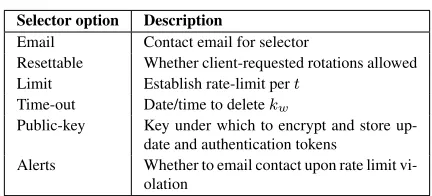
Key-management options. The client can specify a number of options in the callInitregarding management of the ensemble keykw. The client can provide a contact
email address to which alerts and authentication tokens may be sent. (If no e-mail is given, no API calls requiring authentication are permitted at present and no alerts are provided. Later versions of PYTHIAwill support other authentication and alerting methods.)
The client can specify whetherkwshould be resettable
(default is “yes”). The client can specify a limit on the total number ofFkw queries that should be allowed
be-fore resettingK[w] (default is unlimited) and/or an ab-solute expiration date and time in UTC at which point K[w]is deleted (default is no time-out). Either of these options overrides the resettable flag. The client can spec-ify a public keypkclfor a public-key encryption scheme
under which to encrypt authentication tokens and update tokens (forReset,Transfer, as described below, and for master secret key rotations). Finally, the client can re-quest that alerts be sent to the contact email address in the case of rate limit violations. This option is ignored if no contact email is provided. The options are summa-rized in Figure 11.
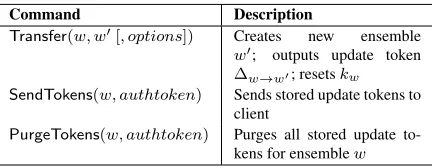
PYTHIAalso offers some additional API calls, given in Figure 12, which we now describe.
Ensemble transfer. A client can create a new ensemble
w0(with the same options as inInit) while receiving an update token that allows PRF outputs under ensemblew
to be rolled forward tow0. This is useful for importing a password database to a new server. The PYTHIA ser-vice returns an update token∆w→w0for this purpose and
stores it encrypted underpkcl. For the casew0 =w, this
![Figure 9: The Facebook password onion. PRF-Cl(invokes256]h2)theFacebookPRFserviceHMAC[SHA-(h2, Ks) with PRF-service secret key Ks.](https://thumb-us.123doks.com/thumbv2/123dok_us/7930779.1316869/8.612.103.267.261.403/figure-facebook-password-onion-invokes-thefacebookprfservicehmac-service-secret.webp)