Article
Communities of Practice as Systems: The Case of
TEALEAF
Thomas McCloughlin
Dublin City University, Dublin, Ireland; [email protected]; Tel.: +353-86-399-7054
Abstract:
This work provides an update to the Erasmus Plus TEALEAF project The outcomes of a week-long EU-funded / Irish Government-recognized teacher course in July 2016 is described within the context of a qualitative small scale study investigating teachers' progress in the course. The explicit aim of the teacher course was to equip a diverse group of teachers with the initial tools to work to produce simple digital apps for learning about biodiversity in their respective domains. A community of practice seeks to establish a new concept of the pre-existing generalised collective conscience through triangulated conversation between the generalised and particularised collective and individual consciences. In particular to revise the generalised collective conscience that teachers can program apps for learning about biodiversity. A number of features of teaching and learning were selected in general and their relationship to constructivism delineated. The teachers were prompted for their responses to each day of the course through a self evaluation tool and the responses were ranked according the the rubric. The data was analyzed using multidimensional scaling - ASCAL procedure - in SPSS 23TM and within the repertory grid domain according to the RepSocio tool in Rep 5TM. The plots show a gradual development throughout the week in terms of specific features becoming 'stronger' or exerting more influence towards the middle of the course and fragmenting after that. Analyses were able to show which participants correlated most closely with the hypothetical IDEAL within the community of practice. Concerning this community of practice, the interrelationships within the community are determined using a social mapping exercise moving from the individual consciences to a particularised collective conscience.
Keywords: communities of learning; systems; apps; teacher education; TEALEAF
1. Introduction
This work provides an update to the Erasmus Plus TEALEAF project which in turn is a continuation of that part of the SOPHIA project which specifically addressed serious games in learning about ecology [1-3]. The outcomes of a
week-long EU-funded / Irish Government-recognized teacher course in July 2016 is described within the context of a qualitative small scale study investigating teachers' progress in the course. The teacher course cemented the careful development of a community of practice [4] among sub-groups of teachers from five countries from different domains of education. The explicit aim of the teacher course was to equip a diverse group of teachers with the initial tools to work to produce simple digital apps for learning about biodiversity in their respective domains. The picture was complicated further by the fact that almost all of the participants were not 'digital natives'[5], and some were self-confessed 'digital avoiders'. The everyday perception is that teachers might facilitate coding or app development in a passive supervisory role, but that they would be ill-equipped to produce an app themselves, this is substantiated by the preliminary background research which suggested at least a deficit in confidence to do so [6]. Thus this project is couched within the wider question of the role of the teacher within a constructivist model of learning with technology [7]. The term ‘constructivist’ is value-laden; and as one of the cornerstones of radical constructivism is skepticism of the match between knowledge and an external objective reality, it becomes difficult therefore to think coherently of a single type or definition of constructivist learning environment [8]. The starting point of the SOPHIA project was the notion that a constructivist teacher is one who wishes to constantly improve their practice and who seeks to involve the students in the construction of knowledge aided inter
alia by meaningful dialogue. In the TEALEAF project, an apparent
'squaring-the-circle' was advanced, whereby the project was tasked with the mission of teaching and evaluating something that they had little confidence in and rather than 'do a course' to remediate any perceived deficit, teachers were encouraged to 'grow together' into a shared space with national sub-spaces. Such spaces are akin to 'communities of learning' which follows the principles of knowledge management within the community of practice which in paraphrased form are:
• an evolving design whereby the participants could provide input that would be incorporated;
• open dialogue between participants and organizers;
• different levels of participation respecting real world commitments; • community spaces at the local - home - and wider levels - international; • a focus on values which goes beyond procedural knowledge;
• combining familiarity and new experiences so as not to fatigue nor overwhelm participants;
Module 1. Directly teaching teachers the fundamentals of biodiversity.
Module 2. Evaluating existing computer apps for learning about biodiversity: trialling in the classroom.
Module 3. Review of biodiversity content, direct instruction in ScratchTM and StencylTM, game design.
Module 4. Evaluating new designed computer apps for learning about biodiversity: trialling in the classroom.
The TEALEAF project sought to determine whether teachers thought to improve their practice through taking on a new way of teaching and learning. In our previous work, we found that for some, a more traditional-type lesson could stimulate a constructivist approach in some, whereas a novel, ICT-based lesson might stimulate the opposite response in others. The ability to reflect critically was very variable and the idea that the teacher could be constructivist as opposed to a technician delivering a constructivist lesson was not clear cut. Constructivism is thought by many teachers to be a methodology only, and equated with ‘active learning’ or a ‘hands-on approach’.
Shulman's classic work [9] on pedagogical content knowledge, PCK, has been adapted by [10] and [11], the former who describes technological PCK - TPCK; and the latter who specifically address information and communications technology, ICT-based PCK, i.e., ICT-TPCK.
point about biodiversity to children and develop an app in order to do so, and to some the task ahead seemed insurmountable. Thus, we see that there were pedagogical content knowledge limitations comprising content knowledge deficits; pedagogical practice lacunae, and how to employ technology in order to address the same lack in children's constructed experience.
The research question for the project overall is to determine whether a community of practice can be established to produce apps to further understanding of biodiversity. The baseline research demonstrated that the two attributes of 'biodiversity' and 'app development' appeared to be mutually exclusive domains. Thus the project needed to forge ahead with a way to disrupt this systemic barrier.
The research question for this part of the project was whether in establishing a community of practice brought about an opportunity to stabilise the system in flux as a result of the
perturbation visited upon the community by the difficult task given to it.
2. Method
Teachers of five different nationalities1 from different domains of education hold particularised collective consciences in conversation with the individual conscience of each participant in the project. A community of practice seeks to establish a new concept of the pre-existing generalised collective conscience through triangulated conversation between the generalised and particularised collective and individual consciences. In particular to revise the generalised collective conscience that teachers can program apps for learning about biodiversity. How this was achieved was by the making explicit of the conversations between consciences using a reflective evaluation instrument which recorded daily reflections of the participants in terms of the systematic development as participants in the community of learning. The responses to the reflective evaluation instrument were codified by applying integers to answers which signified a psychological strength within a conceptual space. The integers were then arranged in a matrix which was then subjected to principal components analysis producing components which are plotted in Cartesian planes.
The self-evaluation questions which were presented to each participant on each of the five days of the course were as follows.
1. What new knowledge did I encounter today? 2. What new skills were encouraged today?
3. What did I find difficult today, and how would I address that?
4. How will I change my practice based on what I learned today?
5. How does what I learned today change my understanding or attitude towards teaching biodiversity?
A rubric needed to be developed in order to rank responses. In previous work [12], the responses were mapped against three main criteria based on the quality of the reflection carried out by the teacher based on the theory that a constructivist teacher would be someone who is constantly checking the new experience against their constructed value system.
1. ‘reflection for action’; i.e., the participant reflects on what has taken place, and some action is considered for the future, even if it is to return to the status quo - rank of 3.
2. ‘reflection-on-action’; i.e., the participant reflects on what is taking place and some change is considered - rank of 2.
3. ‘reflection-in-action’; i.e., the participant reflects on what is taking place and expresses some view that they adapted to the teaching experience as it unfolded - rank of 1.
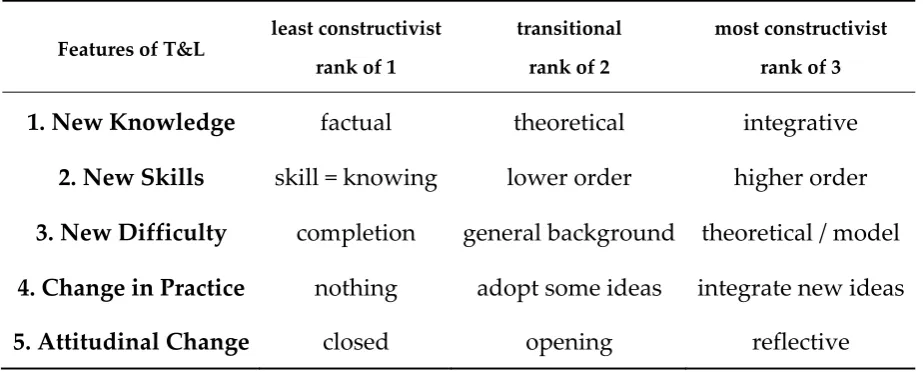
In this work, a slightly different approach is taken, whereby rather than focussing on a single attribute of the constructivist paradigm, a number of features of teaching and learning were selected in general and their relationship to constructivism delineated, and this is represented in Table 1.
Table 1. Generalised rubric summarizing the detailed version in the Appendix
Features of T&L least constructivist rank of 1
transitional
rank of 2
most constructivist
rank of 3
1. New Knowledge factual theoretical integrative
2. New Skills skill = knowing lower order higher order
3. New Difficulty completion general background theoretical / model
4. Change in Practice nothing adopt some ideas integrate new ideas
5. Attitudinal Change closed opening reflective
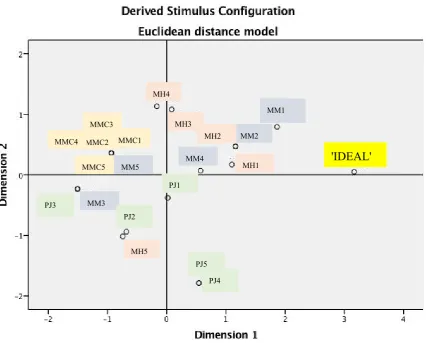
The teachers were prompted for their responses to each day of the course through a self evaluation tool and the responses were ranked according the rubric in Table 1. The data was analyzed using multidimensional scaling - ASCAL procedure - in SPSS 23TM and within the repertory grid domain according to the RepSocio tool in Rep 5TM [13]. Also included was the hypothetical 'IDEAL' based on previous work in using such a construct [14] which in this case was constructed by assuming low ranks for day 1 and building up to 3 on day 3. Following this, a problem arises; should one naturally expect a teacher on a course to remain at this level of rank since all novelty is encountered by the middle of the course and thereafter, consolidation is paramount, thus the ranks drop again?
5. Results and Discussion
Figure 1. Derived stimulus configuration employing an Euclidean distance model calculating two dimensions. Stress = 0.1099; RSQ = 0.95326 . The letters codify the participants: MM, MMC, MH, PJ. The numbers 1 - 5 denote the day of the course.
However, concerning a community of practice, one might seek to determine the interrelationships within the community, so some type of social mapping exercise would be necessary, thus we move from the individual consciences to a particularised collective conscience. The tool chosen for this was the RepSocio protocol within the Rep 5 program, Figure 2. According to Figure 2, the strongest link or connection between persons within the community of practice is taken to be denoted by the score on the line between persons, and once again the IDEAL construct plays a role. The strongest links are between PJ and MMC, and between MM and MH, next PJ and MM , and then MMC and MM, followed by PJ and MH. To some degree, the IDEAL is an outlier drawing links from only two people, and then only at the 75% level, thus there is a nested structure to this 'system'.
'IDEAL'
MM1
MM2
MM3
MM4 MM5
MMC5
MMC1 MMC2
MMC3
MMC4
PJ5 MH2 MH3
PJ4 PJ2
PJ3
MH4
MH5 PJ1
Figure 2. Socionet drawn by Rep 5 'RepSocio' tool. It is drawn at the 75% overall similarity, and linkages at or higher than 75% are drawn.
5. Conclusions
It has to be recognised that conceiving of an IDEAL construct raises almost as many problems as it tries to alleviate. When the methods outlined in this work are extrapolated to the wider cohort of participants a better picture will emerge as to where the scores should be following the middle of the course. MDS is an important method since all the data points are included in the calculation so that the IDEAL is not merely a point dropped into the plot, and therefore the dimensions calculated actually do reflect a total interactivity within the community of learning. What is required now is to continue this work to investigate how the whole cohort operated to calibrate the IDEAL. The work presented here does provide a snapshot of the complexity of the sub-system whereas the Repertory Grid method provides a snapshot of the complexity - described as 'orderliness' - of the individual's thinking which when entered into the Socionet protocol, such as in Figure 2, a picture of the complexity of the sub-system is also presented, such as the relationships between individuals, who stands out as the common link, or partial outlier.
Whereas groups of teachers may appear to move, adapt or develop within a given system, and fluctuations in complexity occur, the net level of complexity appears to remain constant. Adaptation within the overall system is non-linear and based on the 'procession' of the Irish teachers to the IDEAL. The teachers appear to approach the IDEAL in the first days of the course but then move away because the criteria assume a linearity, however the analyses can detect fluctuations within the system which point to adaptation, and typically, they are not predictable. The instrument needs to be adapted to allow for dampening effects resulting from perceptions of difficulty peaking and diminishing, and the task requiring less novel information to proceed.
Acknowledgments: Erasmus Plus European Union Grant TEALEAF 2014-FR01-KA201-008559
Conflicts of Interest: The funding sponsors had no role in the design of the study; in the collection, analyses, or interpretation of data; in the writing of the manuscript, and in the decision to publish the results.
References
1. McCloughlin, T., H. Gash, and S. O’Reilly. Teaching ecology using simple variable-based Flash games. in Science Live for Teachers (SL4T). 2009. Dublin: Dublin City University / Royal Dublin
Society.
2. McCloughlin, T., S. O’Reilly, and H. Gash, Constructing science through dialogue and
computer-aided learning, in SOPHIA: Teacher professional development, N. Valanides, Editor. 2009, University of Cyprus: Nicosia. p. 80-123.
3. McCloughlin, T., H. Gash, and S. O’Reilly. Creating a whole-class digital learning environment using a simple variable-based flash game. in 6th PanHellenic Conference with International Participation: Information and Communication Technologies in Education. 2008. Limassol:
University of Cyprus.
4. Wenger, E.C., R. McDermott, and W.C. Snyder, Cultivating communities of practice: a guide to
managing knowledge. 2002, Cambridge, MASS: Harvard Business School Press. 5. Prensky, M., Digital game-based learning. 2007, Minnesota: Paragon House.
6. Gash, H., et al., Biodiversity and computer applications: a qualitative case study, in INTED 2016. 2016, IATED: Barcelona, Spain.
7. Mitra, S., et al., Acquisition of Computer Literacy on Shared Public Computers: Children and the 'Hole in the wall'. Australasian Journal of Educational Technology, 2005. 21(3): p. 407-426. 8. Matthews, M.R., Constructivism in Science and Mathematics Education, in National Society for the
Study of Education, 99th Yearbook, D.C. Phillips, Editor. 2000, University of Chicago Press: Chicago. p. 161-192.
10. Mishra, P. and M.J. Koehler, Technological pedagogical content knowledge: a framework for teacher knowledge. Teachers College Record, 2006. 108(6): p. 1017-1054.
11. Angeli, C. and N. Valanides, Epistemological and methodological issues for the conceptualization,
development, and assessment of ICT–TPCK: Advances in technological pedagogical content knowledge (TPCK). Computers and Education, 2009. 52: p. 154-168.
12. Gash, H., T.J.J. McCloughlin, and S. O'Reilly. A meta-evaluation of constructivist science lessons. in 3rd Biennial conference: Sciences serving science, cross-disciplinary issues in mathematics and
science education. SMEC '08. 2008. Dublin City University.
13. Gaines, B.R. and M.L.G. Shaw. Rep 5 Conceptual Representation Software: Introductory manual
for version 1.0. 2009.
14. McCloughlin, T.J.J., Closeness of fit to the ideal: classification and similarity of teachers' reflections using multidimensional scaling. Problems of Education in the 21st Century, 2015. 67(67): p.