BRAND COMMITMENT
IN A CONSUMER BANK
SERVICES CONTEXT – AN
EXPLORATORY STUDY
Addendum
F.H. DEBLING
PhD
BRAND COMMITMENT
IN A CONSUMER BANK
SERVICES CONTEXT - AN
EXPLORATORY STUDY
Addendum
FIONA HELEN DEBLING
This Addendum is submitted in partial fulfilment of
the requirements of the University of the West of
England, Bristol
for the Doctor of Philosophy
Bristol Business School, University of the West of
England
Declaration
I declare that this Addendum is my own work. It is submitted in partial fulfilment of the requirements for the degree of Doctor of Philosophy at the University of the West of England, Bristol.
Acknowledgements
With grateful thanks to Director of Studies, Dr Alan Tapp for his ongoing feedback, suggestions, and encouragement.
Copyright © 2005
This thesis is supplied on the understanding that it is copyright material and that no part of it may be reproduced without full acknowledgement.
Word Count
TABLE OF CONTENTS - ADDENDUM
HOW VALIDITY AND RELIABILITY HAVE BEEN TREATED IN THIS PHD 1
1.1 CREDIBILITY...2
1.2 TRANSFERABILITY...9
1.3 DEPENDABILITY...9
1.4 CONFIRMABILITY...10
1.5 CONCLUDING REMARKS...12
THE ORIGINAL CONTRIBUTION OF THIS PHD...13
2.1 A BONDING AND BINDING ATTACHMENTS FRAMEWORK...15
2.2 MODELLING CONSUMER BANKING SERVICES COMMITMENT...20
2.3 SELF-BRAND IDENTIFICATION WITH CORPORATE BRAND VALUES. 22
2.4 GENDER DIFFERENCES IN CONSUMER BANKING...24
2.5 SENSE OF FREEDOM TO MOVE BANK...24
2.6 COMMITIMENT TYPOLOGY...24
CONTRIBUTION OF THE PROPOSED CONSUMER BANKING SERVICES
PROVIDER BRAND COMMITMENT SCALE...28
REFERENCES...30
APPENDIX A: INTERVIEW EXTRACTS...38
APPENDIX B: CONSUMER BANKING SERVICES PROVIDER BRAND
COMMITMENT SCALE...40
LIST OF TABLES AND FIGURES - ADDENDUM
Figure 1: Preliminary Conceptual Framework (after Practitioner Interviews, Phase 1). 16
Figure 2: Extended Framework (after synthesis with Bank Customer Interviews, Phase 2)
...17
Figure 3: Consumer Banking Services Commitment Model with mediating variables..21
Figure 4: Commitment Typology in Consumer Services Banking...26
Table 1: Techniques suggested to improve results in interpretivist research...3
Table 2: Documentation...11
Table 3: Attachments Framework for Commitment in Consumer Banking Services...18
Table 4: Two States of Commitment...27
Table 5: Three Spuriously Brand Loyal or ‘Calculative’ Commitment States...27
Table 6: Extracts from Unconditional Commitment and Conditional Commitment Data38
Table 7: Extracts from ‘Inertia of Loyalty’ Data...38
GLOSSARY
Commitment is ascertained in the study, by its effect, as: ‘a resistance to switching for positive reasons’. A formal definition is:
The pledging or binding of a customer, through emotional and/or psychological (evaluative) attachments to one banking services provider, out of a set of banks, producing a resistance to the notion of switching business to another bank, which resistance is neither primarily the outcome of: (i) perceived permanent or temporary economic/contractual ties; nor is it mainly a result of: (ii)
inertia.
Inertia: is repeat patronage based on indifferent or negative regard towards the banking service provider, or towards its attributes, and is founded on the customer perceptions that it would take too much time and trouble to switch business to another provider because of the perceived lack of a much better alternative.
Three Components of commitment:
Affective Commitment is to maintain a relationship because you want to (Allen and Meyer, 1990). It isbased on the strength of an individual’s positive preference toward a particular organisation, their liking, identification and involvement with the goals and values of an organisation for its own sake, apart from its purely instrumental worth (Buchanan, 1974, p.533; Mowday Steers and Porter, 1979, Herscovitch and Meyer, 2002).
Calculative Commitment is to maintain a relationship because you need to,(Allen and Meyer, 1990),as long as the benefits attached to this brand exceed the costs of switching to another brand. Maintaining this consistent patronage is based mainly upon a cognitive/psychological evaluation of the brand, which implies that the consumer appears as seemingly loyal for opportunistic reasons (Amine, 1998). This has also been termed Continuance Commitment (Allen and Meyer, 1990, Bansal, Irving and Taylor, 2004), Structural, or Cost Commitment (Kiesler, 1971).
Normative or Moral Commitment is to stay with an organisation because of a feeling that you ought to (Allen and Meyer, 1990) out of a sense of duty or obligation, which is based on moral
SECTION ONE
HOW VALIDITY AND RELIABILITY HAVE BEEN TREATED IN THIS PhD
In this work an interpretive approach explored in depth forty marketing practitioners’ and consumers’ views of customer brand commitment to consumer banking services providers. Validity in qualitative research can be viewed as: “The extent to which an account accurately represents the social phenomenon to which it refers” (Hammersley, 1990, p.57).
Several authors (amongst them: Deshpande, 1983; Deutscher, 1970; and Merton, 1957) have noted that qualitative research methods emphasise validity, while playing down the importance of reliability, whereas quantitative research methods in the positivistic paradigm emphasise reliability with ‘hard’ and ‘replicable data’ (Deshpande, 1983). For Deshpande (1983), under the qualitative paradigm, “Validity is critical; ‘real’, ‘rich’, and ‘deep’ data” are stressed.
The interpretive approach in this study therefore aims to capture the essence of a phenomenon and to highlight rich and illuminating data. Validity is high under such a paradigm, as the researcher aims to gain access to the knowledge and meaning of those involved (in this case, those involved are marketing practitioners and consumers of banking services). But some measures that are needed to encourage reliability are in conflict with the goal of establishing validity within the qualitative paradigm. Morgan (1983, p.14-15) contends:
“Different research perspectives make different kinds of knowledge claims, and the criteria as to what counts as significant knowledge vary from one to another.”
Over time alternative dimensions proposed in a framework for qualitative work by Lincoln and Guba, (1985) have subsequently been presented as accepted trustworthiness criteria for
These dimensions have been grouped under trustworthiness, the umbrella criterion for evaluating qualitative enquiry, by numerous authors including: Lincoln and Guba (1985, chapter eleven); Guba and Lincoln (1989); Erlandson, Harris, Skipper and Allen, (1993); Kvale, (1996) and Denzin and Lincoln, (2000, p.22).
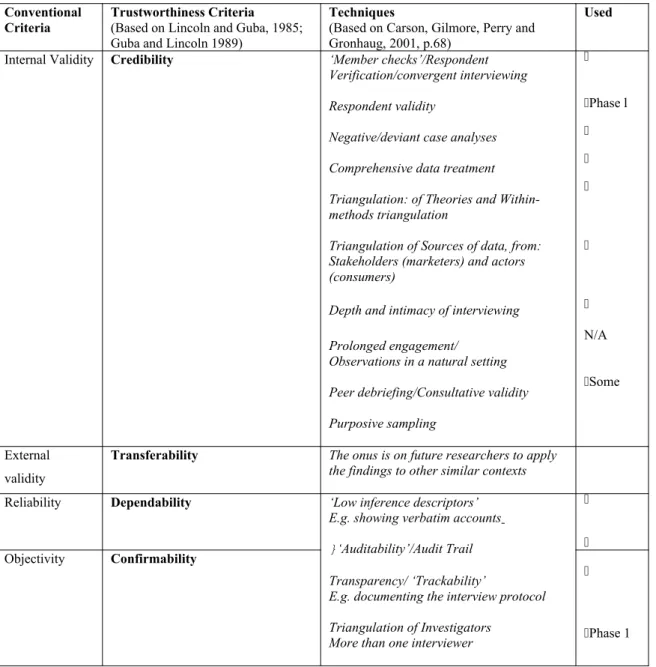
In this work Table 1 firstly lists techniques considered by several authors to support such a
trustworthiness criterion in qualitative research. Moreover, Table 1 indicates that most of the techniques have been employed at least partially in the present study.
An assessment and discussion of this work’s validity, reliability and generalisability is structured around the four Guba and Lincoln (1989) dimensions, beginning with credibility, the most important dimension for qualitative work, as established earlier (Deshpande, 1983; Deutscher, 1970; and Merton, 1957), because it relates to validity.
1.1 CREDIBILITY
In the interpretive paradigm, where there is a belief that no single objective reality exists, internal validity is problematic since there are multiple perspectives. In the interpretive paradigm,
according to Burrell and Morgan (1979), “Social reality, insofar as it is recognised to have any existence outside the consciousness of any single individual, is regarded as being little more than a network of assumptions and intersubjectively shared meanings”(p.30-31).
A credibility criterion therefore replaces the idea of internal validity from positivist paradigms, and is concerned with matching findings to reality with “the isomorphism between constructed realities of respondents and the reconstructions attributed to them”(Guba and Lincoln 1989, p.237). Unlike its conventional internal validity ‘equivalent’, then, achieving credibility lies in matching
respondents’ perspectives with the views interpreted by the author.
Table 1: Techniques suggested to improve results in interpretivist research Conventional
Criteria
Trustworthiness Criteria
(Based on Lincoln and Guba, 1985; Guba and Lincoln 1989)
Techniques
(Based on Carson, Gilmore, Perry and Gronhaug, 2001, p.68)
Used
Internal Validity Credibility ‘Member checks’/Respondent Verification/convergent interviewing Respondent validity
Negative/deviant case analyses Comprehensive data treatment Triangulation: of Theories and Within-methods triangulation
Triangulation of Sources of data, from: Stakeholders (marketers) and actors (consumers)
Depth and intimacy of interviewing Prolonged engagement/
Observations in a natural setting Peer debriefing/Consultative validity Purposive sampling
Phase l N/A Some External validity
Transferability The onus is on future researchers to apply the findings to other similar contexts
Reliability Dependability ‘Low inference descriptors’
E.g. showing verbatim accounts
}‘Auditability’/Audit Trail Transparency/ ‘Trackability’
E.g. documenting the interview protocol Triangulation of Investigators
More than one interviewer
Objectivity Confirmability
Phase 1
Heavily Adapted from Carson, D., Gilmore, A. Perry, C. and Gronhaug, K. (2001, p.68) Qualitative Marketing Research Sage publications, London and indebted to Halldorsson and Aastrup (2003), Lincoln and Guba (1985), and Silverman (2001).
‘Member checks’ or Respondent verification
Respondent verification was continuous during the data collection and analysis stage; informal and formal ‘member checks’ are considered “the single most crucial technique for establishing
credibility” to verify that the constructions collected are those that havebeen offered by respondents (Guba and Lincoln, 1989, p.239). This was undertaken in this work through
summarising what an interviewee has just said about an individual item in order to give the respondent a chance to correct errors of fact or of interpretation and to add additional information.
A second, informal element of ‘member checking’ included convergent interviewing (Dick, 1990, p.3), or what Blyth and Robson, (1981) describe as a ‘rolling’ approach (including in later
topics to emerge spontaneously, thereby avoiding being ‘confined by predetermined agendas’
(Holstein and Gubrium, 1995, p.17). Practitioner interviewees were then prompted for their reactions on issues identified from earlier interviews as playing a role in customer-brand commitment, such as ‘emotion’.
A more formal member check, called ‘respondent validation’ (Bryman, 1989 p. 164) included
“asking respondents to comment on drafts about facts and their interpretations of those facts”
(Carson et al.2001, original emphasis). It offered a chance to put “the respondent on record as having said certain things and as having agreed that the interviewer ‘got it right’ ” (Carson et al. 2001). Although Bryman (1989p.164) sees it as helpful to bring researcher’s and subject’s perspectives into closer alignment, that author maintains, with others, that there are limits to interpretation: “To argue that we have become part of the worlds we studied, or that we understand them in precisely the same way as those who live within them do, would be a grave error” (Van Maanen and Kolb, 1985, p.27).
Formal respondent validation of transcripts would have been asking too much of consumer participants, whose goodwill had been tapped through long interviews. Senior industry practitioners interviewed in phase 1 seemed to have little time or interest (a practical problem highlighted by Bloor, 1978, p.550) to comment on a report on practitioner findings and interpretations sent to them. One DM practitioner offered to answer supplementary questions, instead of commenting on the findings report sent to him. A solution that could have been adopted has been offered by Yin (1994) who advises that if, you have not heard from the respondents by a certain date, then the facts and interpretations of them in the draft can be deemed credible.
Given practical and philosophical drawbacks in respondent validation, Silverman (2001p. 236) alternatively recommends the methods of ‘deviant-case analysis’ and ‘comprehensive data treatment’, to overcome the anecdotal quality of qualitative data and to claim validity. These two methods were adopted and are discussed next.
Negative case analysis
Negative case analysis is “asking questions designed to find exceptions to a rule in theory that therefore invalidate the ‘rule’ ” (Carson et al., 2001) in order to “disprove your emerging explanations of the data" (Dick 1990, p.11), which can also be demonstrated through attempting alternative interpretations of exceptions.
Data with alternative interpretations were given in the Thesis Appendices. Some apparently committed cases contrasted with the stronger, positive expressions of resistance to changing bank discussed on pp. 208-212 of the thesis. Analysis identified that some of these ‘negative cases’ were expressed in language that clearly included instrumental contingencies absent from less ‘conditionally’ committed examples:
“As long as they are efficient”, (Male interviewee Pi, gardener, emphasis added).
Deviant case analysis
An example of ‘deviant-case analysis’ in the thesis was finding some customers making
recommendations in cases that lacked expressions of a high resistance to switching (thesis pp: 309-310). These cases led to refinements in a proposed commitment scale since it was more usual that higher numbers of recommendations per customer were evident only when commitment was stronger. Thus the methodology used was based on a hermeneutic process involving
“reconsideration of previous positions” (Guba and Lincoln, 1989).
Comprehensive data treatment
Coding of themes (e.g. all the recognised instances of ‘inertia’) and NUD.IST software’s fast retrieval process helped the author to re-examine the data. This gives greater confidence that the patterns reported actually existed throughout the data, rather than only in favourable examples (Glassner and Loughlin, 1987). Examplesbased on memory can risk highlighting only extreme examples. An example of comprehensive examination of the data was the revelation that some customers ‘calculatively’ plan to remain with the main bank, contingent only on certain conditions. Thishelped to identify varied‘commitment states’, such as conditionally committed and two ‘no commitment’ states of temporary hostage and prisoner. Excerpts from data supporting varied ‘commitment states’ can be seen in the Addendum Appendix (Tables 6, 7 and 8).
As mentioned earlier, credibility is also enhanced by triangulation techniques. The application of these is discussed next.
Triangulation
Lincoln and Guba (1985) cite triangulation as a way of making it more likely that “credible findings and interpretations will be produced”. Given developed literature on commitment, the author of this work took a mixed inductive-deductive approach to validity and reliability issues. Four modes of triangulation, which are considered by Denzin (1978) to establish research validity and reliability, have underpinned this research: triangulation of theories; within-method
The fourth mode, Triangulation of Investigators, (supporting reliability) will be discussed later, under confirmability.
Triangulation of theories
Triangulation of theoriesasks the question put by Stake, (1995, p. 185):
“Does the meaning of the observation remain the same when studied against different theoretical perspectives…?”
In this work the author examined whether, for example, a customer who appears to be highly committed to her main bank shows evidence of key components found in employee-organisational commitment or the drivers of a higher degree of commitment present in that literature, or in the behavioural approach of social psychology. “As meanings increasingly remain the same, the confidence grows that a good interpretation is being made” (ibid).
The research secondly builds on other theory linked with commitment, such as product loyalty and relationship marketing literature. It additionally compares and synthesises data with attachment models, such as a conceptual framework of service bonds by Liljander and Strandvik (1995).
Within-methods triangulation
This type of triangulation method is: “using different kinds of measurements which provide repeated verification” (Miles and Huberman, 1984, p.234). In this research, Within-Methods Triangulation is demonstrated when the author (in Phase 2) added a different data collection mode - a short, commitment Likert-scale administered at the end of each open-ended, semi-structured consumer interview, (as shown in Appendix B-5, thesis p.437). This extra measurement technique thus contributes to internal validity through credibility.
The author also included a range of question styles in both phases of the research “to validate a conclusion” (Holliday, 2002). In the consumer interviews in particular the range included: open-ended questions, probes and projective techniques. These last included asking consumer
participants for a ‘third person’ description (Sirgy, Grewal, Mangleburg, Park, Chon, Claiborne, Johar, and Berkman, 1997) of the car their bank’s typical customers might drive. Indirectly the method uncovers the image interviewees have of their bank’s users and of their bank’s brand values. It was considered a less subjective elicitation technique for brand image, since classic brand attributes that consumers associate with certain cars had already been researched and published (Hussey and Dunscombe, 1999).
kinds of techniques would uncover any self-brand identification with the bank or with the bank’s corporate values or any subconscious motives for choosing to remain with a bank.
Triangulation of Sources
Diesing (1972, pp: 147-148) explains the link between validity and triangulation ofsources.
“… The validity of a piece of evidence can be assessed by comparing it with other kinds of evidence on the same point. Each has its own characteristic ambiguities and shortcomings which are unlikely to coincide with those of another kind…”
Within this work there were three different key types of sources of data (three types of
interviewees). Sources of data were split across two phases of research. In Phase 1, twenty-two
stakeholdersources for the interviews included seven key banking informants and fifteen brand building expert dm /practitioners experienced in financial services marketing including banking. In Phase 2, eighteen consumer bank services customers were interviewed so that their actor views could be compared and contrasted with the earlier practitioner perspectives, thus reducing possible sources of bias or idiosyncratic views.
That completes the discussion of Triangulation techniques. We finish with credibility by discussing the final few methods: Depth and intimacy of interviewing; Peer debriefing and
Purposive sampling.
Depth and intimacy of interviewing versus
Prolonged engagement and observations in a natural setting
The requirement for observation in a natural setting in qualitative work “to obtain depth of understanding” (Lincoln and Guba, 1985) is not appropriate here, where these methods might seem intrusive. Depth interviews of at least one hour in duration were undertaken instead, to ensure intimacy on the sensitive topic of personal banking. In Phase 1 successive interviews with
practitioners contained successively more in-depth questions. Prompts and, in Phase 2 consumer interviews, the use of (published) projective elicitation techniques (as discussed earlier) increased the depth of interviewing.
Peer Debriefing
The purpose of debriefing by peers is to clarify, to help to guard against bias and to produce new insights (Carson et al., 2001). Use of debriefing with informed colleagues is recommended as
consultative validity (Robson, 1989) forming ‘external checks’ on the enquiry process (Lincoln and Guba 1985, p.301). Debriefing was carried out in various ways.
suggestions resulting in changes to overall design and item wording. Papers were presented internally at Bristol Business School and at the Manchester Metropolitan University Doctoral Colloquium, 1997 and ongoing feedback received from academics and blind reviewers on related conceptual and empirical papers published. Early practitioner findings were also presented to DM financial services practitioners. Ongoing feedback was additionally received from PhD supervisors knowledgeable about: consumer behaviour, market research, branding, financial services and direct marketing.
Purposive sampling
Denzin and Lincoln (1994, p.202) recommend qualitative researchers “seek out groups and settings and individuals where…the processes being studied are most likely to occur”. And Guba and Lincoln (1989 p.178) recommend a serial approach to purposive sampling, meaning “elements are chosen in ways that best serve the particular needs of the enquiry at that moment”.
In this work flexibility in the purposive nature of the sampling could have been greater, given greater resources, adding a further phase of interviewing to explore how commitment might vary between genders. The research was limited to two criterion-based, serial phases: first marketing practitioners with some financial services direct marketing and/or brand building experience; and then customers holding a current account at a variety of newer and traditional banking providers, in the second phase. Efforts were made during Phase 2 to ensure a broad selection of consumer participants to assist in fulfilling one of the six different types of purposive sampling described by Patton (1980), ‘maximum variation sampling’. Guba and Lincoln (1989) call this sampling method the constructivist’s sampling mode of choice as it provides the “broadest base of local
understanding”.
In qualitative approaches to research authors point out that respondents must be selected for their relevance rather than on randomness or how representative they are (Guba and Lincoln, 1989; Carson et al, 2001).Whilst recruitment to consumer interview included fulfilling a quota of a variety of demographic backgrounds, the author was conscious of needing to include consumer interviewees who ascribed their varying levels of attachment to a main bank to a range of different influences and was able to check whether this was happening as interviewing progressed. It is demonstrated in the findings that the consumer sample for consumer Phase 2 contains cases of various degrees of commitment (from low, through inertia, to high commitment) and contains different components of commitment found in organisational commitment literature. Given greater resources it would have been good purposively to seek out further cases of high customer
commitment to compare with those already interviewed and analysed.
This concludes the section on credibility. Techniques supporting the other three dimensions of
1.2 TRANSFERABILITY
Transferability “may be thought of as parallel to external validity or generalisability”(Guba and Lincoln, 1989, p.241) but constructivists do not attempt to transfer their findings with confidence to other sectors. The author readily acknowledges that to be the case here: the findings have relatively low transferability. Marketers had already recognised that a customer’s brand loyalty for
goods was not a personal disposition across sectors but specific to certain product categories (Guest, 1955; Cunningham, 1956). Indeed, reviewers of an early paper related to this study commented on the need to narrow down the context of this work from looking at commitment within a spectrum of consumer financial services to concentrate on a particular financial service, such as consumer banking services, since financial services differ markedly in terms of frequency of contact, customer involvement and so on.
Lincoln and Guba (1985, p.297) argue that the burden of proof of transferability should fall less with the original investigator as with future researchers applying that knowledge in another context and is dependent on the similarity of the contexts. In this case, other ‘continuous consumer
services’ that have both retail and virtual distribution and relatively frequent transactions might be considered similar contexts.
1.3 DEPENDABILITY
Dependability is whether the results of a study are consistent with the data collected (Lincoln and Guba, 1985, p.288). Whereas alterations in methodology or constructs are threats to reliability, they are expected products in a naturalistic enquiry (Guba and Lincoln, 1989), which rests on emergent rather than ‘a priori’ research design and changes can be seen as ‘the hallmarks of a maturing and successful enquiry’ (Erlandson et al., 1993). Dependability is established through an enquiry audit trail (Guba and Lincoln, 1989). This work included documentation under a number of the six Halpern, (1983) audit trail categories, including recording the intentions (in the research proposal and aims) and the logic and analysis process (e.g. in the working hypotheses), so that these could be inspected (Guba and Lincoln, 1989).
in thesis Appendix A-4 ‘Phase Two Consumers’ Interview Schedule’ (pp. 430-432). It also allowed for systematic analysis to compare and contrast themes, to check for patterns and consistency in responses to a consistent set of open-ended questions. De Ruyter and Scholl (1998) argue that “by operating in a systematic way in the interview or focus groups, the reliability of qualitative
research can be warranted” and McCracken, (1998) supports systematic processes, as long as “the use of a questionnaire does not pre-empt the open ended nature of the qualitative interview”.
Low inference descriptors
High dependability, or reliability, in qualitative research is also associated with “low inference descriptors” (Seale, 1999, p. 148). This term’s meaning includes allowing access to the original, verbatim utterances within their context so that readers can interpret them for themselves as well as receiving the author’s reconstructions of the findings presented or summarised in tabular form. Under the Halpern (1983) ‘raw data’ category, printouts of word-processed transcripts and use of NUD.IST for Phase 2 enabled the preservation, for inspection, of both raw transcripts and of transcripts marked with coded data. The present study allows readers access to the original data, but at the expense of brevity.
1.4 CONFIRMABILITY
Confirmability relates, loosely, to establishing what positivists might view as ‘objectivity’ and also evaluates how easily others could track the process of this research study through all its
documentation and through its very transparency (including the steps taken for data collection through analysis to interpretation).
Bringing discussion of each of four main evaluation criteria for the qualitative research enquiry in this study to a close, then, are a few remaining techniques. Triangulation of investigators supports the first dimension of confirmability, as it has been briefly explained, above.
Triangulation of Investigators
Two investigators (interviewers) were used in the first, practitioner phase of the work in this research since research ‘objectivity’ can be threatened ‘by relying exclusively on the data provided by a single observer’ (Lincoln and Guba, 1985, p.292).
An audit trail/transparency
Ruyter and Scholl, 1998). These include research questions, exhibits shown to participants, the consumer semi-structured interview protocol and commitment scale in the thesis appendices to aid transparency. Prompts containing lists of values shown to consumer participants were originally derived theoretically and revised to incorporate participants’ own values (see thesis Appendix pp. 433-434).
Interview transcripts and notes aid reliability and contribute to an audit trail (Halpern, 1983; Lincoln and Guba 1985), which could be inspected for confirmability, since: “The most significant factor of qualitative research is to demonstrate transparency of findings so that they can be trusted’ (Carson et al., 2001, p.197). Other records, such as supervisory contact reports about the process of the research, help to document research decisions.
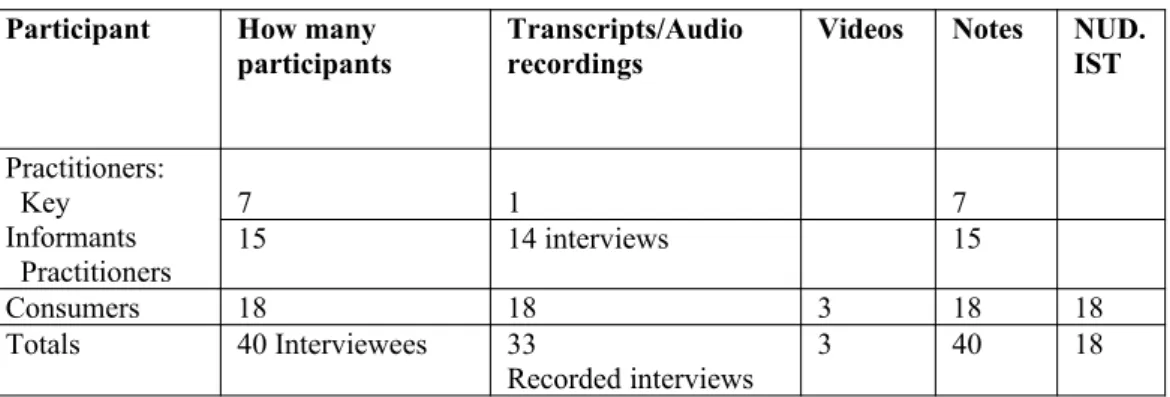
Table 2: Documentation
Participant How many
participants
Transcripts/Audio recordings
Videos Notes NUD.
IST
Practitioners: Key Informants Practitioners
7 1 7
15 14 interviews 15
Consumers 18 18 3 18 18
Totals 40 Interviewees 33
Recorded interviews 3 40 18
Table 2 demonstrates that this research satisfies Kirk and Miller’s (1986) demand for
documentation of procedures. Where there was no transcription, written questions and answers were exchanged by e-mail and post. Maynard and Clayman, (1991) recommend audiotapes and videos as being more reliable than field notes. Word-processed interview transcripts were checked against the thirty-three audio tape recordings, against notes taken during all interviews and
additionally, in some consumer cases against video-tapes (where permitted), thus not only improving the accuracy of transcribed texts but also allowing immersion in the full data while coding and interpreting. The records can demonstrate support in the data for the findings.
1.5 CONCLUDING REMARKS
The strongest techniques allowing this research’s claim to trustworthiness are its use of all modes of triangulation: of theories, within-methods, sources and investigators. In this research, internal validity is also strongly supported by triangulation of theory.
hermeneutic tradition of a continuous cycle of “iteration, analysis, critique, reanalysis and so on”
(Guba and Lincoln, 1989), did include examining exceptions to brand commitment expectations (such as advocacy and its links with higher commitment) and the consideration of examples of ‘spurious brand loyalty’ or repeat patronage without commitment, such as inertia cases (in the Appendices). This form of negative case analysis, or ‘analytic induction’ and “seeing or hearing multiple instances of it from different sources and by squaring the finding with others it needs to be squared with” (Miles and Huberman, 1984, p.234) helped this author to move outside the existing theory and led to refinements of previous assumptions, theory or Phase 1 practitioner findings. This process largely offsets any epistemological reservations about the dangers of researchers following theory too closely that have been expressed by Lincoln and Guba (1985) and by Silverman (2001).
All research enquiries have their limitations and arguably this study’s credibility could have been strengthened through greater use of respondent validation, such as showing more of the
interviewees their transcripts for approval. That said, constructivists criticise this technique on the basis of ‘who is to referee on whose interpretation is the sounder if the respondent and
interviewer’s interpretations differ?’ (Silverman, 2001).
Validity and depth of insights from data are often considered key strengths of qualitative research. Analysis of Phase 2 consumer interviews employed NUD.IST software, which both facilitated the preservation of raw data and eased rapid searching for similar, or negativeor deviant cases
comprehensively throughout the data, especially from consumers in Phase 2. This led to strong internal validity and refutation of the potential accusation that is often levied at qualitative
research, even by its proponents, that it might constitute merely a collection of anecdotes (Mehan, 1979 and Bryman 1988, p. 77).
SECTION TWO - ADDENDUM
THE ORIGINAL CONTRIBUTION OF THIS PhD
Abstract
This PhD contributes to knowledge about brand commitment in a consumer banking services context. The thesis examines qualitative data, from practitioners as well as consumers, in the light of the organisational commitment and socio-psychological foundations of commitment theory. It thereby provides deeper insight, than research to date, on sources of organisational attachment and other variables that can be associated with varied degrees of customer-bank commitment.
This Addendum highlights five main areas where the study extends knowledge and where it adds to the few models and scales of consumer banking services commitment that have been developed so far.
Firstly this exploratory study produces a Bonding and Binding Attachments Framework. This framework identifies seven key factors relating to customer commitment to banks. The attachments are: ‘Technical’, ‘Economic Value’, ‘Social’, ‘Experiential’, Self-Brand identification with
corporate brand values;‘ ‘Hostage ties’ and ‘Behaviour’.
The dimensions of this qualitatively researched framework are specific to banking and complement or extend attachment and bonding frameworks previously conceptually proposed in the services literature. The dimensions also extend a prior banking attachments inventory, which focused solely on ‘positive’ forms of attachment.
An examination of attachments highlighted the importance of other interacting variables, apart from the attachment factors themselves, thus offering a Commitment model for consumer banking services.
A secondarea of contribution is that this is one of the first studies in a consumer, banking context to connect customer identification with a bank’s corporate brand values, and their higher degree of commitment to the bank. This, small-scale, empirical study thereby links and extends knowledge from goods branding theory and from organisational commitment theory to a services context.
Fourthly, and building on the concept of free choice (volition) associated with higher commitment in psychological commitment literature, the study finds it is a customer’s perceived sense of freedom from constraints to switch that helps to distinguish different degrees of commitment. Why and how this is so will be explained later. This Addendum thereby offers a Commitment Typology. This adds to theory by dividing ‘true brand loyalty’ (containing commitment) into two positive states: ‘Conditionally Committed’ and ‘Unconditionally Committed’; and by dividing ‘spurious brand loyalty’ (repeat patronage lacking commitment) into three states: ‘Inertia’, ‘Temporary Hostage’ and ‘Prisoner’.
Finally, a proposed Commitment Scale (in the Appendix) helps to discern between these five commitment/no commitment states. This scale, designed in a UK consumer banking services provider context, refines and extends some items examined qualitatively in the present study. Additionally it contributes to knowledge by adding refinements to the few existing empirically tested (Dutch) service provider commitment or (Spanish) bank commitment scales.
Introduction
The following sections of the Addendum will be organised around five areas of this PhD study’s contribution to knowledge and which were highlighted in the Abstract above. To summarise, these include:
(1) A Bonding and Binding Attachments framework for customer commitment in consumer banking services and findings that stem from it regarding relationships customers expect to have with their banks, customer social intimacy/distance preferences, and the association of: (2) Self-identification
and (3) Gender with higher degrees of commitment. The Addendum will include the study’s finding that it is the perceived sense of freedom from constraint, (rather than presence of financial switching costs themselves) which partly determines commitment states, leading to (4) a
Commitment Typology. The Addendum offers future researchers in this specific field (5) a proposed Customer-Bank Commitment Scale (see Appendix) specifically designed for UK
consumer banking services providers, extending and complementing existing service/bank provider commitment scales originally produced in Dutch or Spanish and suggesting associated, extra items that fall out of the present study’s qualitative findings.
acknowledges empirical research (Sanchez and Iniesta, 2004) covering some similar ground in Spanish retail banking. This qualitative, UK study adds to their work by presenting a context-specific and detailed Bonding and Binding Attachments framework and a Commitment Typology, leading to proposed commitment scale refinements.
A literature search shows that two basic approaches to commitment theory are evident: behavioural and attitudinal. Behavioural theory focuses on the binding effect of actions (Becker, 1960;Kiesler, 1971,1977; Salancik, 1977), extended through exchange theory (Weiss and Andersen, 1992) and ‘investment models’ (Rusbult, 1980; Farrell and Rusbult, 1981 and Rusbult and Farrell, 1983) to involve the weighing up of the benefits of staying, against switching costs and the alternatives. By contrast, attitudinal approaches to commitment generally take the organisation (or, here, a
customer’s main bank) to be the object of commitment. They tend to measure affective
commitment: identification, involvement characterised by a belief in the goals and values of an organisation, willingness to exert effort on its behalf, and a strong desire to remain with it (Porter and Smith, 1970).
In the present study and in the proposed commitment scale the attitudinal approach has been adopted. This focuses on attachment to an organisation and is divided into affective versus
calculative commitment components, (see Glossary). Kumar Hibbard and Stern (1994) have used this approach already for channel intermediary commitment and Bansal et al. (2004) for consumer auto repair services.
Other prior and behavioural theory is far from being ignored. A re-examination with practitioners and synthesis with consumer interviewees has been made of factors said to increase commitment in behavioural and psychological commitment theory (for factors derived from Kiesler 1971,1977, see Debling, 1999). Especially useful for developing the commitment typology and scale herein was an association with higher commitment of the concept of ‘freedom of choice’ or ‘volition’ (Kiesler, 1971,1977; Salancik, 1977; Barnes, 1997; Pritchard, Havitz and Howard, 1999; Butcher Sparks and O’ Callaghan, 2001).
2.1 A BONDING AND BINDING ATTACHMENTS FRAMEWORK
Reichers (1985, 1986) suggested that instead of synthesising the two separate attitudinal and behavioural approaches to commitment, one way forward would be to identify a more specific set of commitment foci. Samuelsen and Sandvik (1997) also claim that:
The present research therefore examines and adds to our understanding of the underlying factors, motives or objects of commitment, within the specific context of consumer banking services. These factors have variously been called the ‘foci’ of commitment (Jackson, 1985; Samuelsen and Sandvik, 1997); or relationship ‘bonds’ (Berry and Parasuraman, 1991; Strandvik and Liljander, 1994 and Holmlund and Kock, 1996 in retail banking; and Liljander and Strandvik, 1995 in services). They are termed customer-organisational attachment bonds by Aldlaigan and Buttle (1998; 2005); seen as ten consumer attachments (Gabbott, 1998); ‘relationship benefits’, (Gwinner et al, 1998); or ‘moorings’ (Bansal and Taylor, 2005, where relationship value was considered from customers’ perspectives). Prior conceptual and empirical attachment models for services and other businesses therefore existed but they were not all integrated with commitment theory and specific to consumer banking before the present study.
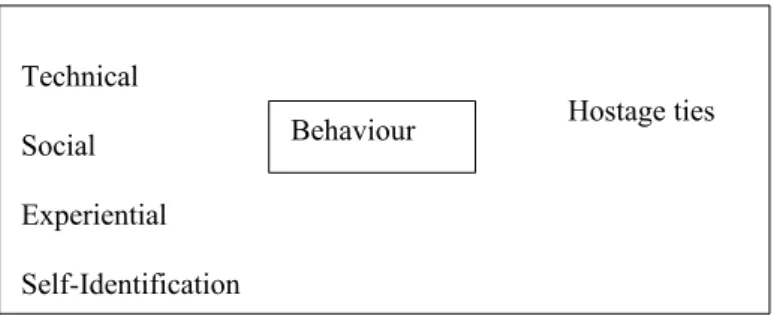
After initial interviews with bankers and financial services direct marketers/branding experts, a preliminary conceptual framework was drawn up. This posited key drivers of customers’ perceptions of quality, satisfaction, of trust and their degree of customer commitment. Initially these key factors included: Technical quality, Social bonding, Experiential (quality of the service experience plus communications); andcustomer Self-identification with corporate brand
values/image. Two other key factors were also identified at this stage. Firstly, there was Behaviour; actions linking a customer to the provider, such as repeat patronage, recommending or cross-buying of more products from the same institution. And secondly there were Hostage ties, such as loans, direct debits or long-term investments that might tie a customer in but not necessarily make them positively disposed to the bank. The last were supported conceptually, as ‘legal bonds’ in Liljander and Strandvik (1995) and in Holmlund and Kock (1996), who proposed that economic and legal bonds, like loan contracts, could “function as high [relationship] exit barriers” (ibid). The preliminary framework is shown in Figure 1.
Figure 1: Preliminary Conceptual Framework (after Practitioner Interviews, Phase 1)
Adding to Bonding Theory
A further phase of research asked consumer bank customers why they stay with their main bank and explored the factors that these customers mentioned as potentially influencing their loyalty
Technical
Hostage ties Social
Experiential
Self-Identification
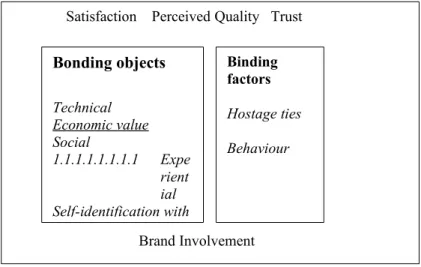
behaviour or commitment. Figure 2 shows how an attachments framework had developed after synthesis with the second phase of interviews and literature.
Figure 2: Extended Framework (after synthesis with Bank Customer Interviews, Phase 2)
This second, consumer interviewee phase yielded an Economicvalue factor separate from the original Technical factor.
Figure 2 also distinguishes bonding, attitude objects of commitment from binding factors. Objects on the left of Figure 2 might bond us to our main bank cognitively (through evaluation) and/or
affectively (through how the consumer feels about the attitude object). Binding factors are customer actions that support maintenance of a ‘relationship’. The two binding factors, (customer Behaviour
and Hostageties) on the right of Figure 2 involve some customer action or intention and therefore can be viewed as part of the third, or conative, ‘behaviour-tendency’ component of attitude
(Williams, 1981, p. 99) in an attitudinal approach to commitment. The way Figure 2 groups various binding factors together oversimplifies, however. That customers sign up for longer-term facilities such as loans (Hostage ties), like customers’ repeat patronage (Behaviour), need not indicate a higher degree of positive commitment. Contrastingly, customer actions, like recommendations or concentration of patronage at the main bank, could be viewed as manifestations of positive
commitment or discretionary behaviour (Bansal et al., 2004; Meyer and Herscovitch, 2001, p. 312) beneficial to the service provider.
The framework adds knowledge to the only other empirically researched attachment framework in UK consumer banking known to the author (Aldlaigan and Buttle, 2005) by adding the ‘binding factors’ mentioned above. It thus extends their three-part bank attachment inventory of: (i) organisational credibility, (ii) customer-bank shared values and (iii) interpersonal values, which model focused only on customers’ positive attachments. A qualitative phase of the Aldlaigan and Buttle (2005) enquiry nonetheless supports the present study’s Hostage ties, with some customers feeling ‘powerless’ with ‘no control, especially when committed to a long-term loan or mortgage’
Satisfaction Perceived Quality Trust
Brand Involvement
Binding factors
Hostage ties
Behaviour
Bonding objects
Technical Economic value Social
1.1.1.1.1.1.1.1 Expe
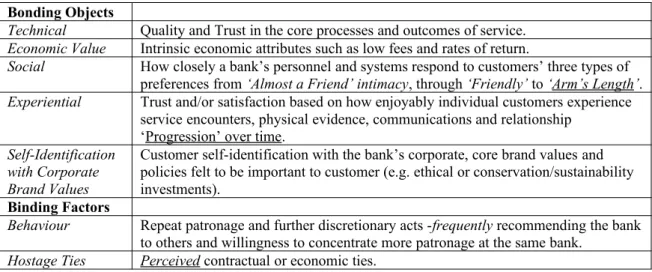
(ibid). But these findings were not integrated into their final model. Table 3 briefly summarises each bonding and binding factor.
Table 3: Attachments Framework for Commitment in Consumer Banking Services Bonding Objects
Technical Quality and Trust in the core processes and outcomes of service.
Economic Value Intrinsic economic attributes such as low fees and rates of return.
Social How closely a bank’s personnel and systems respond to customers’ three types of
preferences from ‘Almost a Friend’ intimacy, through ‘Friendly’ to ‘Arm’s Length’.
Experiential Trust and/or satisfaction based on how enjoyably individual customers experience
service encounters, physical evidence, communications and relationship ‘Progression’ over time.
Self-Identification with Corporate Brand Values
Customer self-identification with the bank’s corporate, core brand valuesand policiesfelt to be important to customer (e.g. ethical or conservation/sustainability investments).
Binding Factors
Behaviour Repeat patronage and further discretionary acts -frequently recommending the bank
to others and willingness to concentrate more patronage at the same bank.
Hostage Ties Perceived contractual or economic ties.
Some attachment models in the past have proposed that customers should be most attached when larger numbers of bonds are accumulated (e.g. Berry and Parasuraman, 1991; Aldlaigan and Buttle, 1998). Contrastingly, there is evidence in the present study that intensity of overall positive regard toward the bank can be based on a small number of sources of attachment which may sometimes be associated with a high degree of commitment, (expressed as resistance to the notion of changing bank). This study thus throws some doubt on the ‘cumulative’ nature of some prior attachment models with implications for the construction of measurement scales.
Describing the dimensions of Customer-Bank Attachments
Dimensions of each bonding and binding factor are now described more fully, emphasising aspects adding to previous knowledge. The present study extends the Aldlaigan and Buttle (2005) positive bank attachment inventory not only by adding two binding factors but also by separating Technical
from Economicvalue and by distinguishing the Experiential (temporal or ‘relational’ and tangible dimensions) from the Social (interpersonal)dimensions.
Technical – This covers range and flexibility of policies, services and processes available. Trust or confidence can be gained through security, privacy, reliability, accuracy, size, credibility, heritage and judged expertise. The utility of information received and how it is presented are other technical dimensions found. Access, hours and location, are important. The present study identified that some customers for whom self-sufficiency is a key factor are primarily concerned with their bank’s efficiency and professionalism in ‘getting the details right’. They may value speedy systems or availability of the latest technological systems, neatness, efficiency of the process and the
Economic Value – This includes whether the offering, (e.g. flexible mortgage repayment facilities, or ‘free services’, or structural rewards, such as Air Miles or student incentive), is perceived as ‘a good deal’, ‘good value’ or ‘honest advice’. Borrowers consider how enabling their bank is,if seeking credit, overdraft or loan facilities, resulting in some customers having a strong, positive regard for their bank when they feel policies, terms and conditions have been clearly, honestly and mutually agreed.
Social – Before this study, a ‘social bond’ had been treated as a strong attachment to bank branch, personnel or advisers (Liljander and Strandvik, 1995; Aldlaigan and Buttle, 1998 and 2005). The present study identifies that some customers’ prefer to remain at ‘Arm’s length’, without name recognition (because of unease about privacy or security and a mistrust of a selling motive from ‘overly friendly’ staff). This study thus adds ‘Arm’s Length’ to the ‘Fraternisation’ and
‘Friendship’ dimensions identified by Gwinner et al. (1998). Other customers prefer a dependent
relationship with their bank; engage little with personal finance information, rely on their bank to keep their money safe and are happy to receive advice and guidance. They may want a more personalised, accountable service compared to those wanting self-sufficiency or interdependence. Multi-dimensional customer-bank ‘relationship’ preferences may influence customer satisfaction and hence customers’ levels of affective commitment indirectly. These contributions build on previous research (Barnes, 1997), contending that the social ‘bond’, rather than being simply about getting closer to customers, concerns how well banks meet customers’ varied social closeness or
distance preferences.
Experiential – This factor includes customer perceptions of: staff appearance or professionalism; tangibles, such as communications, information layout in Internet banking and of ‘Physical evidence’ such as branch layout and décor. Practitioner and customer data in this study highlight that relationally oriented customers want their bank to acknowledge a ‘Progression’ in the relationship, through ‘continuity’ of account history knowledge, through flexibility; staff willingness; or through making the customer feel special or ‘privileged’. Acknowledgement includes: being differentiated from ‘cold prospects’ in DM, or when requesting extended facilities, or if upgrading an account. For ‘continuous’ services like banking, therefore, a further services ‘P’, for ‘Progression’ over time, could be added to the three existing services marketing P’s (Booms and Bitner, 1981): ‘Process’, ‘People’ and tangible, ‘Physical evidence’.
Self – Practitioners, theory and some evidence from customers support at least three different ways in which customers could identify with bank image or policies but suggest that only
Behaviour – Customer actions include consistent repeat patronage, which may not be based on commitment. Here behaviour linked with higher degrees of commitment is found to be on a
discretionary basis, (rather than being the automatic outcome of high satisfaction/commitment, inferred from Dick and Basu, 1994) and includes: recommending the bank to at least three others and concentrating more banking services patronage at the same provider (cross purchasing).
Hostage ties - These include: multiple direct debits and standing orders; credit card(s); loans, mortgages; financial penalties on longer-term savings policies, investment funds, pension and economic ties at other institutions that would constrain transfer to another bank for a certain period. This study discovers that how ‘locked in’ the customer feels , can depend on a sense of being accepted by another bank based on past personal financial history (e.g. credit score or debt repayment record).
The next section outlines commitment influences outside these binding and bonding factors.
2.2 MODELLING CONSUMER BANKING SERVICES COMMITMENT
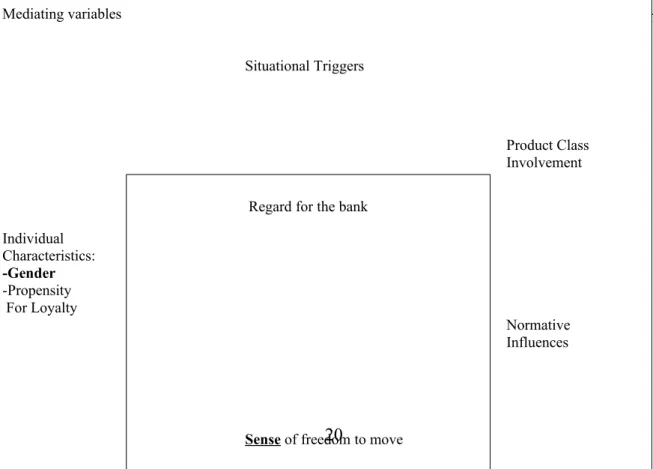
Figure 3 summarises a commitment model for consumer banking services resulting from the qualitative study undertaken, synthesising the attachments framework and some of the other influences on commitment to a bank. Figure 3 highlights in bold where the commitment model adds to prior knowledge.
Overall regard for the bank is customers’ brand trust, perceived quality, satisfaction and brand involvement. This overall disposition towards the bank can be positive, indifferent or negative. But, as pointed out in Strandvik and Liljander (1994), a customer may stay with a bank, despite an overall negative attitude toward the bank, because of bonds and exit barriers between the customer and the provider.
There follows a brief description of mediating variables summarised in Figure 3. Scale items for most of these, except for Situational triggers, are suggested in the Appendix.
Figure 3: Consumer Banking Services Commitment Model with mediating variables
Mediating variables
Situational Triggers
Product Class Involvement
Individual
Characteristics:
-Gender
-Propensity
For Loyalty
Normative Influences
Intentions towards Alternatives Regard for the bank
Situational triggers – these prompt customer consideration of moving business to another bank and include: changing job, partner or mortgage, moving house, approaching a change in life stage; offers/incentives from competing banks (termed Influential triggers in Roos, Edvardsson and Gustafsson, 2004); and perceived poor treatment, deteriorating performance (errors) or being turned down for a loan (termed Reactional triggers in Roos et al., 2004).
Normative influences - are pressures from family, partner, other adviser, or place of work. They can be positive or negative towards or against: (a) switching bank; (b) a specific banking services provider; or (c) type of provider.
Product class involvement - includes risk perceptions; reading regularly about banking, linked to knowledge/experience of personal finance and to a customer’s self-judged confidence in taking banking decisions.
Propensity for loyalty – in banking services is a reliance on few providers, contrasted with: wishing to spread risk; shopping around for deals; or a preference for using specialists for each service.
Intentions toward alternatives - whether an alternative banking services provider is a future consideration for any given customer.
The next sections will be organised around the three, key remaining contributions:
Self-Identification and higher commitment; Gender differences in banking; and how a customer’s Sense of freedomto move bank helps to distinguish various commitment states, leading to a new
typology.
2.3 SELF-BRAND IDENTIFICATION WITH CORPORATE BRAND VALUES
Binding factors:
Hostage ties
Behaviour 1.1.1.1.3.1.1.1 Bond
ing obje cts:
1.1.1.1.3.1.1.2
Corporate brand values, or clusters of values in consumers’ minds, are found in the present study to be relevant to customer commitment in consumer banking, where corporate branding is a strategy frequently followed by banking services providers, even though: ‘You are in a low interest…not tangible’ sector (Creative, major dm agency, G10).
This PhD builds on prior work connecting various dimensions of company brand image, including bank position and values-congruence, with customer loyalty or attachment (Liljander and Strandvik 1995; Bloemer, de Ruyter and Peeters, 1998; and Aldlaigan and Buttle, 2005). Since Kelman (1958) and O’Reilly and Chatman, (1986) attachment to the organisation, its image or values has been included as one of three components frequently cited in relationship, customer satisfaction or attachment models (Lehtinen, 1985; Crosby and Stephens, 1987; Jackson’s, 1985 commitment ‘foci’ for industrial relationships). The concept of shared values was a component in the Morgan and Hunt (1994) relationship trust and commitment model. The present study, though, represents one of the first empirical studies to find a connection between a higher level of customer
commitment and customer identification with company brand values in consumer banking services.
This finding has theoretical support from the leisure industry where Buchanan (1985) modelled identification as the highest of three levels of commitment: Control (identification), Cohesion
(social affiliation) and Continuance (weighing benefits versus costs). Attachment to the goals and values of a firm was also central to definitions of affective commitment (see Glossary) from Buchanan (1974) in employee-organisational commitment literature. Mowday, Steers and Porter, (1979, p.226) saw employee-organisational commitment as the ‘strength of an individual’s
identification and involvement in a particular organisation’. And channel research from Mohr and Nevin, (1990); Anderson and Weitz (1992); and Kumar et al. (1994) consistently reports a view of affective commitment thatpeople stay basically because they like and identify with the values of a firm.
Although it could not be assumed that dimensions of commitment found in
employee-organisational relationships can be transferable to commitment between customers and their banks, the Buchanan (1974) definition lends theoretical support to practitioner interviewee definitions of brand commitment: “Simplistically… it’s where you have emotional commitment which is outside the function and practicalities of the product or service.” (DM Brand-building judge, I.1)
Aside from identification with bank values and policies, for some customers, an attachment to their bank was partly based on nostalgic association(s) with particular past life stages or vivid periods of time, such as: childhood, growing up, student years or having young children. The study also systematically explored customer identification with another image dimension of bank branding,
their bank’s typical customers. However, links with higher degrees of commitment were not
established for either bank ‘user-image’ congruence, or customer-bank nostalgic associations.
Thus this study distinguishes between three types of customer-bank ‘identification’ based on bank
values and policies, user-image and nostalgia. It also extends previous knowledge in that higher degrees of commitment, (as expressed in customer resistance to the notion of switching), were only found where there was a customer-perceived connection between a bank’s values and policies and the ‘central’, personal values cherished by an individual. This finding, consistent with voter commitment in Crosby and Taylor (1983), thus adapts and extends a goods-related, instrumental values perspective on post-purchase behaviour from Munson and McQuarrie, (1988), to a banking
services setting:
- The likelihood of [committed] repeat patronage is felt to increase when the values associated with the [banking service provider] brand match those values that are central to the consumer.
Related scale items are included under ‘Self-identification’ on the proposed commitment scale so that the proposition can be retested quantitatively.
For increased commitment banks should develop differentiated, evocative corporate brand values, rather than a ‘user image’ to which customers might only relate psycho-demographically and which may reinforce satisfaction but not necessarily customer trust and commitment. But consumer emotions about banking may not be aroused when practitioners claim, ‘all of the gobbledegook is focused on the rational, why you should invest in that’ or ‘…the man on the street doesn’t
understand it’ (Integrated marketing group Creative, F9).
2.4 GENDER DIFFERENCES IN CONSUMER BANKING
Females in the present study more frequently judged themselves to be lacking in both knowledge and confidence when selecting financial services, than did the males interviewed. Females also expressed higher degrees of resistance to the notion of switching, a central effect of commitment (Kiesler, 1971; Pritchard et al. 1999) than males interviewed.
regularly than males (at thirty-two per cent). Mintel (2003) repeat patronage figures, (which need not reflect committed ‘loyalty’), identify that sixty-seven per cent of women had never changed current account provider, compared with fifty-eight per cent of male respondents. It can be inferred from Stafford (1996) that females are slightly more interested than males in long-term ‘relational’ attributes, such as whether the bank supplies economic value and a full range of services.
By ‘relational’, neither emotion nor interpersonal preference (though associated with female customers in Shemwell et al, 1994) can especially be inferred from the data in the present study as underpinning any suggested gender differences. Caution is recommended in interpreting the gender findings from this study’s small, South West regional sample. Levels of reported confidence may not reflect experience; women reportedly take increased responsibility (Mintel, 2003) for at least their short-term personal finances.
2.5 SENSE OF FREEDOM TO MOVE BANK
A sense of freedom to move one’s bank is found to be vital to commitment. This psychological perspective differs from some research’s concentration on the mere presence of switching costs, (such as loans), as potential economic or contractual exit barriers (Liljander and Strandvik, 1995; Holmlund and Kock, 1996). It leads to a commitment typology outlined next.
2.6 COMMITIMENT TYPOLOGY
Prior theory distinguished ‘true brand loyalty’ (consistent purchasing based on commitment), from ‘spurious brand loyalty’ based on inertia (Day, 1969, p.30; Engel et al. 1982, Assael, 1987; Rossiter and Percy, 1987; Bloemer and Kasper, 1993). The importance of this is that Day (1969) posits that the ‘spurious loyal’ buyer of goods lacks any attachment to brand attributes and can thus be attracted away by better deals or marketing incentives. Previous theory subsequently identified three states: inertia, (Bloemer and Kasper, 1993 in audio cassettes), habit and variety seeking (Knox and Walker, 2001 in groceries) as key sources of ‘spurious brand loyalty’ for goods.
Bloemer and Kasper (1993) had suggested ‘indifference with the choice’ amongst reasons for spurious loyalty. Inertia had been characterised in Bloemer and Kasper (1993) as a low
involvement type of satisfaction called ‘latent satisfaction’ or ‘mere acceptance’, and been classed in services by Liljander and Strandvik (1995) as indifferent commitment or lack of commitment.
Before the present study three categories of ‘relationship commitment’ in Finnish consumer banking services had additionally been identified qualitatively as: positive, indifferent or negative
indifferent toward their bank. They are quite dissatisfied with their bank though resigned to tolerate its shortcomings ‘I’ve got used to the way it is’ because they perceive it is too much trouble to move (unless refused a facility, or seriously let down). But, additionally, they hold a negative product class belief that there is no better alternative.
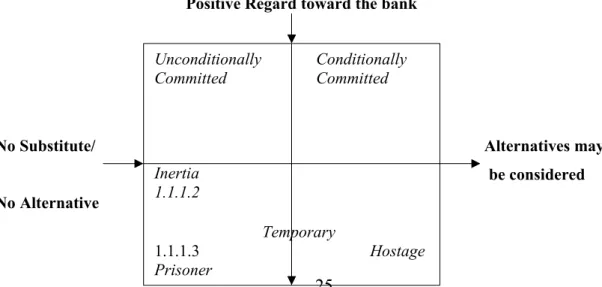
Secondly, ‘Expressed relationship loyalty’ (Strandvik and Liljander, 1994) had been categorised as whether customers ‘had ever considered’ changing bank (in the past). But commitment, unlike loyalty, is a future-oriented construct, measured in terms of intentions (Dwyer, Schurr and Oh, 1987; Anderson and Weitz, 1989; Scheer and Stern, 1992; Kumar, et al., 1994). The present study found that a customer’s ability to consider moving bank is thus bound up with both a sense of freedom from perceived Hostageties and is also closely linked with customer resistance to persuasive communications (an effect of commitment in Kiesler, 1971) and therefore with their future intentions towards alternatives. At the outset, ‘attitudes to alternatives’ had only been considered in terms of degree of ‘search for’ or ‘awareness of’ alternative providers. This study shows that in order to identify between different strengths and states of commitment it is important to discern whether an alternative is a future consideration for any given customer.
Hence a more telling distinction between banking services customers’ different states of ‘commitment’ found in this study can be ascertained when:
- A customer’s overall disposition towards the banking services provider is compared with: - The customer’s perceived sense of freedom from cost constraints to move business to another
bank; and
- Whether the customer believes there to be a suitable substitute, or significantly better alternative available and could intend to use an alternative in the future .
This is shown on a matrix (Figure 4).
Figure 4: Commitment Typology in Consumer Services Banking
Positive Regard toward the bank
No Substitute/ Alternatives may
be considered No Alternative
Unconditionally Conditionally
Committed Committed
Inertia 1.1.1.2
Temporary
Negative regard toward the bank
Definitions based on loyalty to goods miss some of the reasons for ‘spurious brand loyalty’ that were found in the continuous services context of this present study. The typology resulting from the present study (Figure 4) contributes to theory by dividing ‘true brand loyalty’ (containing commitment) into two positive states: conditionally committed and unconditionally committed; and by dividing ‘spurious brand loyalty’ (repeat patronage lacking commitment) into three states for consumer banking services: inertia, temporary hostage and prisoner.
This typology offers a clear-cut way to sort bank customers into groups relevant to their commitment or ‘spurious brand loyalty’ status so that management can follow up on how to improve retention amongst the conditionally committed group, or reinforce unconditionally committed customers and can adapt their marketing and service quality strategies accordingly. It leads to the commitment scale proposed in the Appendix. The scale should also help to identify what proportion of bank customers feel trapped, or are spuriously loyal because of temporary financial ties, or inertia. Descriptions of the five statesfollow in Tables 4 and 5; these are grounded in both customer and practitioner data, extracts from which are given in Tables 6, 7 and 8 in the Appendix of this Addendum.
Table 4: Two States of Commitment
Unconditionall y
Committed
Unconditionally committed customers have a strong commitment to the service
provider brand, expressed in high resistance to the notion of changing banks. This resistance is not rooted mainly in temporary or permanent financial obligations to stay, nor is it based primarily on inertia. It is based on a strong positive regard for the bank, its attributes, or its personnel - including trust, satisfaction, involvement and identification with values the bank stands for; a desire to stay based on a belief that there is simply no substitute for this company brand. These customers are likely to recommend their bank frequently to others and may choose to concentrate their personal finance purchases with the same bank.
Conditionally Committed
Conditional commitment is based on positive regard and a moderate degree of
commitment to the bank expressed in some reluctance to change banks but a perception that a change of provider might be a possibility in the future if performance of the current provider should deteriorate, or should a better offer or better incentives become available. The main bank may be part of a customer portfolio of banks used.
Inertia Customers in inertia are dissatisfied with their bank but believe there would be too much trouble, time taken, or informational overload in seeking to switch banks. Even if they have a sense of relative freedom from any perceived economic or contractual switching costs they do not move because they believe ‘all banks are
similar’ on the things that matter to them. This negative product class belief is
added to the proposed commitment scale in order to strengthen inertia measurement. Otherwise temporary hostages may agree, with those in inertia, that they would move ‘if it were easy to do so’ or that it is too much trouble to move banks (Bloemer and de Ruyter 1999 items).
Temporary Hostage
Temporary Hostages feel that they are not free to move for a certain length of time
because of economic ties such as loans and mortgages, or switching costs of an economic or contractual nature such as financial penalty clauses for the early redemption of policies, (including policies held elsewhere that might trigger the timing of a future switch of account). They have an overall indifferent or negative disposition toward their bank, based on distrust and/or dissatisfaction with some key attributes, might want to move bank in the future; and may be aware of alternatives.
SECTION THREE
CONTRIBUTION OF THE PROPOSED CONSUMER BANKING SERVICES
PROVIDER BRAND COMMITMENT SCALE
The proposed scale in the Appendix complements and extends the few commitment scales that have been applied in marketing to consumer services providers or to consumer banking services providers. In particular it contributes items distinguishing a sense of freedom from constraints of a contractual or financial nature and includes a section on self-identification within affective
commitment(see Glossary).
The scale aims to position bank customers into appropriate cells of a commitment matrix (see Figure 4 and Tables 4 and 5). In comparison, Spanish consumer banking loyalty scale (Beerli, Martin and Quintana, 2004) and consumer banking commitment scale (Sanchez and Iniesta, 2004), fall short of distinguishing whether customers feel temporarily or irrevocably trapped in their bank, which theoretically constitutes either ‘spurious brand loyalty’, or calculative commitment.
Marketers would find such distinctions useful if adapting the proposed scale