R E S E A R C H
Open Access
An advanced Bayesian model for the visual
tracking of multiple interacting objects
Carlos R del Blanco
*, Fernando Jaureguizar and Narciso García
Abstract
Visual tracking of multiple objects is a key component of many visual-based systems. While there are reliable algorithms for tracking a single object in constrained scenarios, the object tracking is still a challenge in
uncontrolled situations involving multiple interacting objects that have a complex dynamics. In this article, a novel Bayesian model for tracking multiple interacting objects in unrestricted situations is proposed. This is accomplished by means of an advanced object dynamic model that predicts possible interactive behaviors, which in turn depend on the inference of potential events of object occlusion. The proposed tracking model can also handle false and missing detections that are typical from visual object detectors operating in uncontrolled scenarios. On the other hand, a Rao-Blackwellization technique has been used to improve the accuracy of the estimated object trajectories, which is a fundamental aspect in the tracking of multiple objects due to its high dimensionality. Excellent results have been obtained using a publicly available database, proving the efficiency of the proposed approach.
Keywords:visual tracking, multiple objects, interacting model, particle filter, Rao-Blackwellization, data association
1 Introduction
Visual object tracking is a fundamental part in many video-based systems such as vehicle navigation, traffic monitoring, human-computer interaction, motion-based recognition, security and surveillance, etc. While there exist reliable algorithms for the tracking of a single object in constrained scenarios, the object tracking is still a challenge in uncontrolled situations involving multiple objects with complex dynamics. The main pro-blem is that object detectors produce a set of unlabeled and unordered detections, whose correspondence with the tracked objects is unknown. The estimation of this correspondence, called the data association problem, is of paramount importance for the proper estimation of the object trajectories. In addition, visual object detec-tors can produce false and missing detections as conse-quence of object appearance changes, illumination variations, occlusions, and scene structures similar to the objects of interest (also called clutter). This fact makes more complex the estimation of the true corre-spondence between detections and objects. Another important issue related to the data association is the
computational cost, since it grows exponentially with the number of objects.
To alleviate the data association problem, the tracking also relies on the prior knowledge about the object dynamics, which constrains the feasible associations between detections and objects. Nonetheless, the model-ing of the object dynamics can be a very difficult task, especially in situations in which the objects undergo complex interactions.
Besides, the estimation of the object trajectories can be quite inaccurate in situations involving many objects due to the high dimensionality of the resulting tracking problem, which is called the curse of dimensionality [1].
In this article, an efficient Bayesian tracking frame-work for multiple interacting objects in complex situa-tions is proposed. Complex object interacsitua-tions are simulated by means of a novel dynamic model that uses potential events of object occlusions to predict different object behaviors. This interacting dynamic model allows to appropriately estimate a set of data association hypotheses that are used for the estimation of the object trajectories. On the other hand, a Rao-Blackwellization strategy [2] has been used to derive an approximation of the posterior distribution over the object trajectories,
* Correspondence: [email protected]
Escuela Técnica Superior de Ingenieros de Telecomunicación, Universidad Politécnica de Madrid, Madrid, 28040, Spain
which allows to achieve accurate estimates in spite of the high dimensionality.
The organization of the article is as follows. The state of the art is presented in Section 2. The description of the tracking model for interacting objects is described in Section 3. The inference method used to estimate the object trajectories from the given tracking model is pre-sented in Sections 4, 5, and 6. Results are shown in Sec-tion 7, and lastly, conclusions are drawn in SecSec-tion 8.
2 State of the art
Many strategies have been proposed in the scientific lit-erature to solve the data association problem. The sim-plest one is the global nearest neighbor algorithm [3], also known as the 2D assignment algorithm, which computes a single association between detections and objects. However, this approach discards many feasible associations. On the other hand, the multiple hypotheses tracker (MHT) [4,5] attempts to compute all the possi-ble associations along the time. However, the number of associations grows exponentially over time, and conse-quently the computational cost becomes prohibitive. Therefore, a trade-off between computational efficiency and handling of multiple association hypotheses is needed. In this respect, one of the most popular meth-ods is the joint probabilistic data association filter (JPDAF) [6,7], which performs a soft association between detections and objects. This consists in com-bining all the detections with all the objects, which prunes away many unfeasible hypotheses, but also restricts the data association distribution to be Gaussian. Subsequent works [8,9] have tried to overcome this lim-itation using a mixture of Gaussians to model the data association distribution. However, heuristic techniques are necessary to prune the number of components and make the algorithm computationally manageable. The probabilistic multiple hypotheses tracker (PMHT) [10,11] assumes that the data association is an indepen-dent process to overcome the problems with the prun-ing. Nevertheless, the performance is similar to that of the JPDAF, although the computational cost is higher.
The data association problem has been also addressed with particle filtering techniques. These allow to deal with arbitrary data association distributions in a natural way, establishing a compromise between the computa-tional cost and the accuracy in the estimation. In prac-tice, the performance of the particle filtering techniques depends on the ability to correctly sample association hypotheses from a proposal distribution. In [12], a Gibbs sampler is used to sample the data association hypotheses, while in [13,14] a strategy based on a Mar-kov Chain Monte Carlo (MCMC) is followed. The main problem with these samplers is that they are iterative methods that need an unknown number of iterations to
converge. This fact can make them inappropriate for online applications. Some works [15-17] overcome this limitation by designing an efficient and non-iterative proposal distribution that depends on the specific char-acteristics of the tracking system. An additional problem is that the accuracy of the estimated object trajectories can be very poor due to the high dimensionality of the tracking problem. In [18], a variance reduction techni-que called Rao-Blackwellization has been used to improve the accuracy.
A random finite set (RFS) approach can be used as an alternative to data association methods, which treats the collection of objects and detections as finite sets. How-ever, the computation of the posterior of a RFS is intractable in general, and therefore the use of approxi-mations is required. In [19], a probability hypothesis density (PHD) filter is used in the context of visual tracking, which approximates the full posterior distribu-tion by its first-order moment. The cardinalized PHD (CPHD) filter [20] is a variation of the PHD that is able to propagate the entire probability distribution on the number of objects. In [21], a closed form for the poster-ior distribution is derived assuming that the image regions that are influenced by individual states do not overlap.
occlusion phenomenon and the object interactions has been developed, which is able to reliably track complex interacting objects whose trajectories change during occlusions.
3 Bayesian tracking model for multiple interacting objects
The aim is to track several interacting objects from a static camera. From a Bayesian perspective, this is accomplished by estimating the posterior probability density function (pdf) over the object trajectoriesp(xt|z1: t) using a sequence of noisy detections and the prior
information about the object dynamics. This probability contains all the required information to compute an optimum estimate of the object trajectories at each time step. The information about the object trajectories at the time steptis represented by the state vector
xt ={xt,i|i= 1, . . ., Nobj}, (1) where each component contains the 2D position and velocity of a tracked object. The number of tracked objectsNobj is variable, but it is assumed that entrances
and exits of objects in the scene are known. This allows to focus on the modeling of object interactions.
The sequence of available detections until the current time step is represented byz1:t= {z1, ..., zt}, where zt=
{zt, j|j = 1, ..., Nms} contains the set of detections at the
current time stept. The number of detections Nmscan
vary at each time step. Each detectionzt, j contains the
position of a potential object, and a confidence value related to the quality of the detection. Detections are obtained from each frame by means of a set of object detectors, where each detector is specialized in one spe-cific type or category of object. Detections have asso-ciated an object category identifier according to the object detector that created them. In addition, some of the computed detections can be false alarms due to the clutter, and also there can be objects without any detec-tion, called missing detections, as consequence of occlu-sions and changes in the object appearance and illumination.
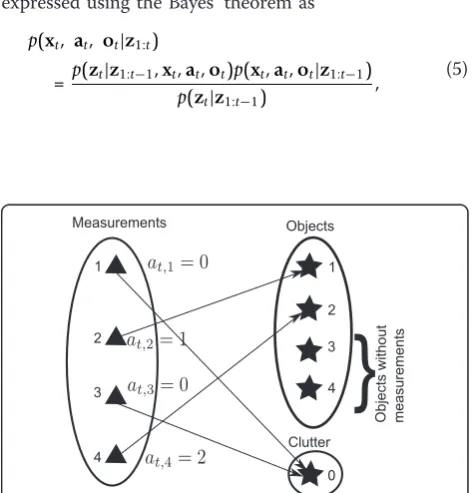
The detections at each time step are unordered and partially unlabeled. The object category of a detection is known, but its correspondence with a specific object inside a category is unknown. Consequently, the data association between detections and objects has to be estimated. The data association is modeled by the ran-dom variable
at={at,j|j= 1, . . . , Nms}, (2)
where the componentat, j specifies the association of
thejth detection zt, j. A detection can be associated to
one object or to the clutter, indicating in this last case
that it is a false alarm. The association of the jth detec-tion with the ith object is expressed as at, j =i, while
the association with the clutter is expressed as at, j= 0.
Figure 1 illustrates the data association process between detections and objects.
The prior knowledge about the object dynamics is used to improve the estimation of the object state as well as to reduce the ambiguity in the data association estimation. The proposed interacting dynamic model predicts different object behaviors depending on the events of occlusions. This fact implies that the object occlusions must be estimated. The object occlusions are modeled by the random variable
ot ={ot,i|i= 1, . . . , Nobj}, (3)
where each component stores the occlusion informa-tion of one object. To express that the ith object is occluded by the lth object, ot, i =l is written. And, if
the object is not occluded, it is expressed asot, i= 0.
The variables atand otare necessary to estimate the
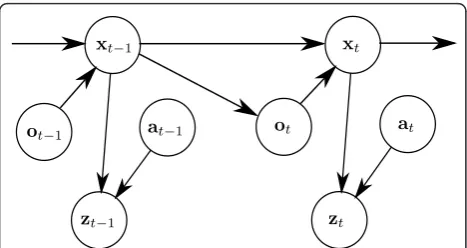
posterior pdf over the object trajectories. This fact can be observed in the graphical model of Figure 2, which shows the probabilistic dependencies among the differ-ent random variables involved in the tracking task. According to this, the posterior pdf is expressed as
p(xt|z1:t) =
at
ot
p(xt, at, ot|z1:t), (4)
where the joint posterior pdf can be recursively expressed using the Bayes’theorem as
p(xt, at, ot|z1:t)
= p(zt|z1:t−1,xt,at,ot)p(xt,at,ot|z1:t−1)
p(zt|z1:t−1)
, (5)
where the probability term in the denominator is just a normalization constant, and the other terms as explained as follows.
The termp(xt, at, ot|z1:t-1) is the prior pdf that
pre-dicts the evolution of {xt, at, ot} between consecutive
time steps using the joint posterior pdf at the previous time stepp(xt-1,at-1,ot-1|z1:t-1)
p(xt, at, ot|z1:t−1)
=
at−1
ot−1
p(xt, at, ot|z1:t−1, xt−1, at−1,ot−1)
.p(xt−1, at−1,ot−1|z1:t−1)dxt−1.
(6)
The transition termp(xt,at,ot|z1:t-1, xt-1,at-1,ot-1) can
be factorized as
p(xt, at, ot|z1:t−1,xt−1,at-1,ot-1)
=p(xt|xt−1,ot)p(at)p(ot|xt−1),
(7)
taking into account the conditional independence properties of the involved variables (see [27,28] for an explanation of how to derive and apply the conditional independence properties given a graphical model). From now on, the conditional independence properties will be applied whenever possible to simplify probabilities expressions. These properties expresses three different characteristics of the tracking problem: first,p(xt|xt-1,ot),
that models the dynamics of interacting objects, depends only on the previous object positions and possible occlu-sions; second, since the detections are unordered, pre-vious data associations and object positions are useless for the prediction of the current data associationp(at);
and last,p(ot|xt-1), that models the object occlusions,
depends only on the previous object positions.
Using the new set of available detections at the current time, the prediction on {xt,at,ot} is rectified by the
likeli-hood term of Equation 5, which can be simplified as p(zt|z1:t−1, xt, at, ot) =p(zt|xt, at). (8)
This expression reflects the fact that the data associa-tion between detecassocia-tions and objects is necessary for esti-mating the object trajectories.
Lastly, the object trajectories at the current time step are obtained by computing the maximum a posteriori (MAP) estimation ofp(xt|z1:t).
However,p(xt,at,ot|z1:t) cannot be analytically solved,
and therefore neither can p(xt|z1:t) be. This problem
arises from the fact that some of the stochastic pro-cesses involved in the multiple object tracking model are nonlinear or/and non-Gaussian [29]. To overcome this problem, an approximate inference technique is introduced in the next section that allows to obtain an accurate suboptimal solution.
4 Approximate inference based on a Rao-Blackwellized particle filtering
The variance reduction technique Rao-Blackwellization has been used to accurately approximatep(xt,at,ot|z1:t)
This technique assumes that the random variables have a special structure that allows to analytically marginalize out some of the variables conditioned to the rest ones, improving the estimation in high dimensional problems.
In the proposed Bayesian tracking model, the object statextcan be marginalized out conditioned to {at, ot}.
Thus, the Rao-Blackwellization technique can be applied to express the joint posterior pdf as
p(xt, at, ot|z1:t)
=pxt|z1:t, at, ot)p(at, ot|z1:t
, (9)
wherep(xt|z1:t, at,ot) is assumed to be conditionally
linear Gaussian, and therefore with an analytical expres-sion known as the Kalman filter. This assumption arises from the fact that the object dynamics can be acceptably simulated by a constant velocity model with Gaussian perturbations if the object occlusions and the data asso-ciation are known. That is, if the main sources of non-linearity and multimodality in the tracking problem are known. Section 5 derives the expression ofp(xt|z1:t, at, ot) using a dynamic model for interacting objects.
The other probability term in Equation 9 can be expressed using the Bayes’theorem as
p(at, ot|z1:t) =
p(zt|z1:t−1,at,ot)p(at,ot|z1:t−1) p(zt|z1:t−1)
. (10) The prior term p(at, ot|z1:t-1) can be recursively
expressed as p(at, ot|z1:t−1) =
at−1
ot−1
p(at, ot|z1:t−1, at−1,ot−1)
.p(at−1,ot−1|z1:t−1),
where the transition term can be factorized and sim-plified as
p(at, ot|z1:t−1, at−1,ot−1)
=p(at)p(ot|z1:t−1, at−1,ot−1).
(12)
The termp(at) is the prior pdf over the data
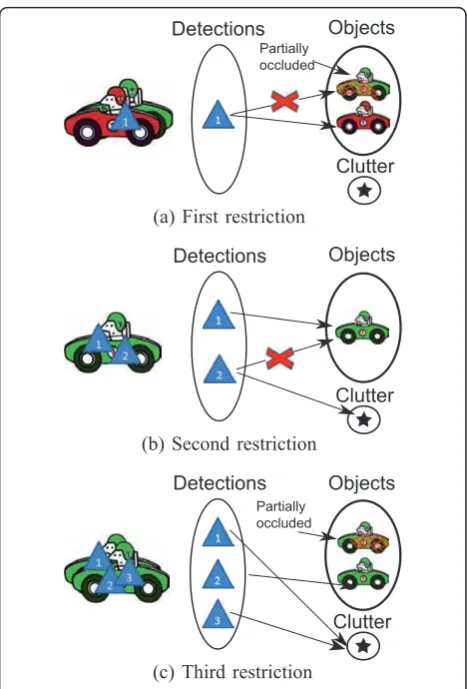
associa-tion and is used to restrict the possible associaassocia-tions between detections and objects. The first restriction establishes that one detection can be only associated with one object or to the clutter, since the region from which was extracted the detection can only belong to one object due to the occlusion phenomenon. The sec-ond restriction imposes that one object can be asso-ciated at most with one detection, although the clutter can be associated with several detections. This restric-tion results from the characteristics of the object detector, which does not allow split detections. The last restriction states that, given a group of detections that share common image regions, only one of them can be associated with an object, while the rest are associated to the clutter. This phenomenon happens because an image region could be potentially part of several object instances, and it is not possible to deter-mine the true one. Figure 3a illustrates the first restric-tion where there are two objects partially occluded and only one detection. This restriction avoids that the detection can be associated to both objects. Figure 3b shows the second restriction where there are only one object and two detections. This restriction ensures that only one detection can be associated with the object, whereas the other is associated with the clutter. Figure 3c illustrates the third restriction where there are two objects partially occluded and three detections. Since one of the objects is too occluded, only one detection should be ideally generated. But, two more are gener-ated from the combination of image regions belonging to both objects.
Mathematically,p(at) is expressed as
p(at) = Nms
j=1
p(at,j|at,1, . . ., at,j−1), (13)
where one association depends on the previous com-puted associations. If one detection fulfills the second and third restrictions, the object association probability isp(at, j=i|at,1, ...,at, j-1) =pobjthat expresses the prior
probability that one detection is associated with one object. In the same conditions, the clutter association probability is p(at, j= 0|at,1, ..., at, j-1) =pclu. If any of
the restrictions is not fulfilled, the detection is asso-ciated to the clutter.
The other term in Equation 12 can be factorized and simplified as
p(ot|z1:t−1, at−1,ot−1)
=
p(ot|xt−1)p(xt−1|z1:t−1, at−1, ot−1)dxt−1, (14)
where p(xt-1|z1:t-1, at-1,ot-1) is the conditional
poster-ior pdf over the object trajectories in the previous time step, and the termp(ot|xt-1) models the occlusion
phe-nomenon among objects. The occlusion model consid-ers that two or more objects are involved in an occlusion if they are enough close each other. Also, some restrictions are imposed. In an occlusion, only one object is considered to be in the foreground, while the rest are occluded behind it. This means that an occlud-ing object cannot be occluded by anyone, and that an occluded object cannot occlude others. Mathematically, this is formulated as
p(ot|xt−1) = Nobj
i=1
p(ot,i|xt−1,ot,1, . . ., ot,i−1), (15)
where an occlusion event depends on the previous computed occlusions. The probability that one object is
(a) First restriction
(b) Second restriction
(c) Third restriction
Detections
Detections
Detections Objects
Objects Objects
Clutter
Clutter
Clutter
Partially occluded
Partially occluded
occluded by another, providing that both objects have not been involved in previous occlusion events, is expressed by a Gaussian function that depends on the distance between the two considered objects. And in the same conditions, the probability that it is not occluded is determined by the probability densitydvis. In the case that any of the considered objects have been involved in previous occlusion events, the occlusion restrictions are applied to avoid non-realistic situations.
The likelihood term in Equation 10 models the data association process. It can be decomposed and simpli-fied as
p(zt|z1:t−1, at, ot)
=
p(zt|at, xt)p(xt|z1:t−1,ot)dxt,
(16)
where p(xt|z1:t-1, ot) is the prior pdf involved in the
conditional Kalman filter used to compute p(xt|z1:t,at, ot), and the other term estimates the data association
between detections and objects as
p(zt|xt, at) = Nms
j=1
p(zt,j|xt, at,j). (17)
Each factor computes the association likelihood of one detection as
p(zt,j|xt, at,j)
=
N(rzt,j;rxt,i, lh) if object association,
dclu if clutter association,
(18)
where i Î {1,..., Nobj},r
z
t,jandrxt,iare the positional information of the detection and the object, respectively, dcluis the clutter probability density, andΣlhis the cov-ariance matrix of the Gaussian function. The previous expression is only applicable between detections and objects of the same category, since the object association probability is zero otherwise.
The last probability term p(zt|z1:t-1) in Equation 10 is
just a normalization constant.
As occurred with p(xt, at,ot|z1:t), the posterior pdfp
(at, ot|z1:t) has not analytical form. To overcome this
problem, an approximate inference method based on a particle filtering framework is used to obtain a subopti-mal solution, which is described in Section 6.
5 Conditional Kalman filtering of object trajectories
The Kalman filter recursively computesp(xt|z1:t,at,ot) in
two steps: prediction and update. The prediction step esti-mates the object trajectories at the current time step according to a dynamic model for interacting objects. This model considers that an interacting behavior mainly
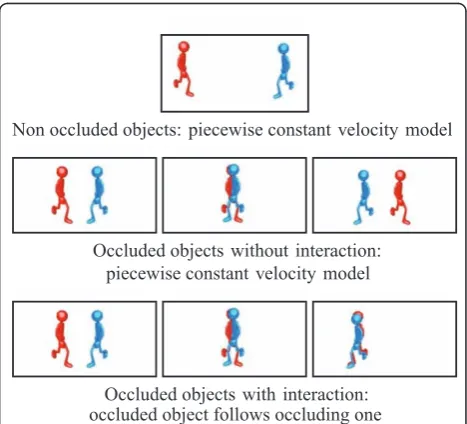
occurs when two or more objects are involved in an occlu-sion event. In case of interaction, one object remains totally or partially occluded behind the occluding object until the interaction ends. This behavior simulates a situa-tion where the occluded object seems to be following the occluding one, changing its trajectory. Another possibility is that the occluded object is not interacting with anyone. In this case, the occluded object keeps its trajectory con-stant according to a piecewise concon-stant velocity model. Since a priori it is not possible to know if an object is interacting or not in the presence of an occlusion, both hypotheses are propagated along the time. When the occlusion event has ended and there are new detections, these are used to determine which hypothesis was the cor-rect. On the other hand, objects that are not involved in an occlusion move independently according to a piecewise constant velocity model. This approach is very efficient since detections are used to rectify object trajectories, being able to locally approximate nonlinear behaviors. Fig-ure 4 illustrates the previous kinds of situations that the interacting dynamic model can handle.
According to the previous interacting dynamic model, and noting thatxtis conditionally independent ofat, the
prediction of the object trajectories is expressed by the multivariate Gaussian function
p(xt|z1:t−1,at,ot) =p(xt|z1:t−1,ot)
=N
xt;μtˆ ,ˆt ,
(19)
whereμtˆ is the mean, andˆt is the covariance matrix. If theith object is not occluded, determined byot, i= 0,
its mean is computed by μtˆ ,i=Aμt−1,i,where A is a
Non occluded objects: piecewise constant velocity model
Occluded objects without interaction: piecewise constant velocity model
matrix simulating a constant velocity model. In the case that the object is occluded, determined byot, i=l, there
are two different hypotheses
ˆ
μt,i=
Aμt−1,i+μt−1,l
2 if interaction,
Aμt−1,i if not interaction, (20)
depending if the object is assumed to undergo an interaction or not. The event of interaction is managed by a Bernoulli distribution, whose parameter can be adjusted according to the expected number of interac-tions per occlusion.
The covariance matrixˆtis computed using the standard equations of the Kalman filter, taking into account that the prior covariance for occluded objects should be higher than that for non-occluded ones, since the uncertainty in the tra-jectory of an occluded object is usually higher.
The second step uses the set of available detections at the current time step to update the previous prediction
p(xt|z1:t, at, ot) =N(xt;μt, t), (21) where the parameters of the Gaussian function are obtained using the standard expressions of the Kalman filter. The update step only is applied to those objects that have associated a detection, determined byat, j =i;
iÎ{1, ...,Nobj}.
6 Ancestral particle filtering of data association and object occlusions
The posterior pdf on {at, ot} is simulated by a set of
Nsamunweighted samples, also called particles, as
p(at, ot|z1:t)= Nsam
k=1
δat−akt, ot−okt , (22)
where δ (x) is a Kronecker delta function, and
ak
t, okt|k= 1, . . ., Nsam} are the samples, which are drawn from
p(at, ot|z1:t)∝p(zt|z1:t−1, at, ot)
·
Nsam
k=1
p(at, ot|z1:t−1, akt−1,okt−1),
(23)
where the sampled-based approximation of the poster-ior pdf in the previous time step has been used. All the probability terms have been already defined in previous sections, therefore substituting their expressions
p(at, ot|z1:t)∝p(at)
p(zt|at, xt)p(xt|z1:t−1,ot)dxt
·
Nsam
k=1
p(ot|xt−1)p(xt−1|z1:t−1, akt−1,otk−1)dxt−1. (24)
The process to draw samples from the previous prob-ability is based on a hierarchical Monte Carlo technique, called ancestral sampling [30]. This technique hierarchi-cally draws samples from the random variables accord-ing to their conditional dependencies. Thus, the process to obtain a new sample starts by drawing a sample
{ak
t−1,okt−1}from the sample-based approximation ofp (at-1, ot-1|z1:t-1) computed in the previous time step.
Conditioned on the previous sample, a sample okt is drawn from
okt ∼
p(ot|xt−1)p(xt−1|z1:t−1, akt−1,o k
t−1)dxt−1. (25) Since the previous integral has not analytical form, a suboptimal solution is computed. This consists in approximating the Gaussianp(xt−1|z1:t−1, akt−1,okt−1)by its mean, obtaining
okt ∼p(ot|μt−1), (26)
which is a discrete probability defined in Section 4. Lastly, a data association sample is drawn from
aktp(at)
p(zt|xt, at)p(xt|z1:t−1,okt)dxt (27) conditioned to the rest of sampled variables. The com-putation of the integral is based on the fact that the integral of any function f(x) proportional to a Gaussian is equal to maximum of that function f(x)* times a pro-portionality constant [24]. In this case,pxt|z1:t−1,okt is Gaussian since it is the prediction step of the Kalman filter, and the expression ofp(zt|xt,at) is proportional to
a Gaussian function. And as the product of Gaussian functions is another Gaussian function, the above inte-gral can be computed as
f(xt;at) =p(zt|xt, at)p(xt|z1:t−1,okt), (28)
f(xt;at)dxt=
det(2πΣf)f(xt;at)∗, (29) where atacts as a parameter off (xt;at), det() is the
determinant function, andΣfis the covariance matrix of
f(xt;at).
As a result, data association samples are drawn from
akt ∼p(at)
7 Results
The proposed Bayesian tracking model for interacting objects has been evaluated using the public database ‘VS-PETS 2003’ [31], which contains sequences of a football match. Given the great number and variety of player interactions, this dataset is very suitable for test-ing purposes.
Two different object detectors [26] are used to detect the players of each team, which characterize each object category by means of its color distribution. Although these detectors are not very complex, they are suitable for the detection of players in the considered dataset. Nonetheless, whatever visual object detector can be used with the presented tracking algorithm provided that at least positional information is given. In this sense, the use of more complex detectors would increase the tracking performance. Figures 5 and 6 show the out-put of every detector for an image of the dataset. Notice that there are missing and false detections due to object occlusions and clutter.
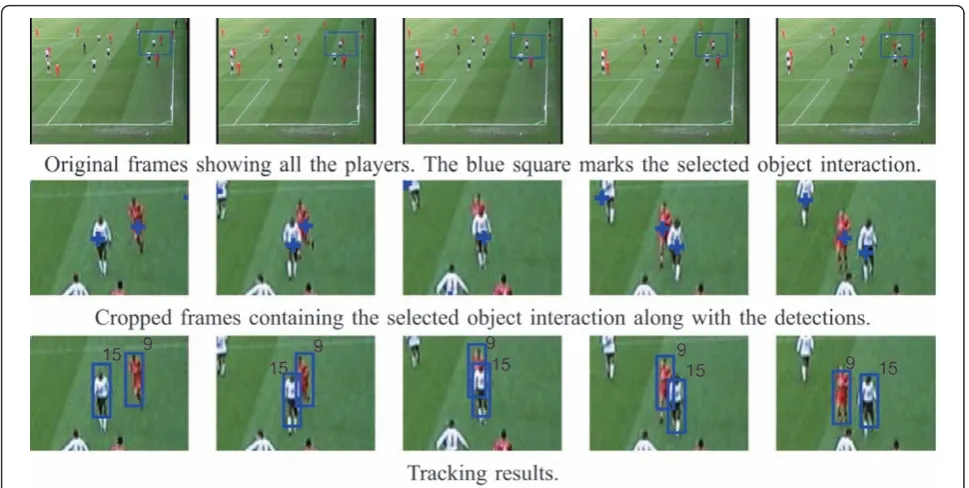
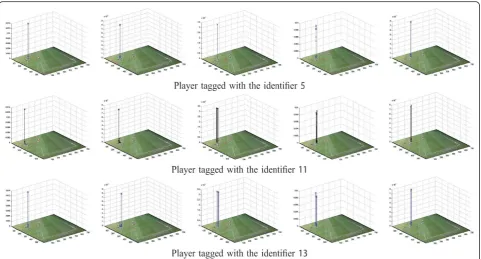
Figure 7 shows a simple cross between two rival players, who keep their trajectories along the occlusion event. The first row shows the original frames with a blue square that encloses the players involved in the simple cross. The second row shows the image regions inside the previous blue squares and the object detec-tions marked with crosses. In the last row, the com-puted tracked objects have been enclosed in rectangles and labeled with identifiers. Since the objects belong to different categories, the data association is simpler because the detections can be only associated to objects of the same category. A consequence is that the mar-ginal posterior pdfs of the trajectories of the involved objects are unimodal rather than multimodal. This fact can be observed in Figure 8, where the samples repre-sent the means of a mixture of Gaussians that approxi-mate every marginal posterior pdf.
In Figure 9, a complex cross involving three players, two of them from the same team, is shown. In this case, the object trajectories change their direction during the occlusion event. This situation is more complex than a simplex cross since there are several feasible hypotheses for the object dynamics and for the data association. The presented tracking model achieves to successfully track the objects because it is able to compute and man-age several hypotheses of object behaviors and data association. In this case, the marginal posterior pdfs of the involved object trajectories are multimodal, as it can be observed in Figure 10.
Figure 11 shows an overtaking action involving three players, two of them belonging to the same team. In this situation, the object trajectories keep their direction during the occlusion like in a simple cross. But, the duration of the occlusion is usually much longer than that for a simple cross. This fact implies more missing detections and a higher uncertainty in the object beha-vior, and consequently a greater complexity. This leads to multimodal marginal posterior pdfs, as shown in Fig-ure 12.
The proposed tracking algorithm has been compared with the Rao-Blackwellized Monte Carlo data associa-tion (RBMCDA) method [18], a state-of-the-art track-ing algorithm for multiple objects. Its main characteristics are the ability to handle false and miss-ing detections, and the use of the Rao-Blackwellization technique to achieve accurate estimation in high dimensional state space. The main difference with the algorithm proposed in this article is the lack of an interacting model, which limits its ability to handle object interactions.
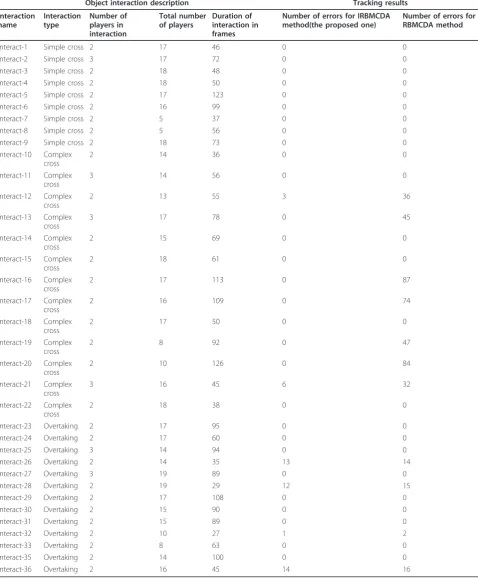
Table 1 shows the tracking results for both algorithms, the RBMCDA method and the one presented in this article, which will be called by analogy interacting Rao-Blackwellized Monte Carlo data association (IRBMCDA) method. The results show the number of tracking errors
x
x
x
x
x
x
x
x
Missing detection
Figure 5Detected players of the read team.
Clutter
x
x
x
x
x
xx
x
x x
x
xx
x
x
xx
in a set of interacting situations extracted from the cam-era 3 in the ‘VS-PETS 2003’ dataset. Situations not involving object interactions or occlusions are not con-sidered since they are handled almost perfectly, avoiding in this way that the good results obtained in non-acting situations obscure the real performance in inter-acting ones. A tracking error is considered to occur when the distance between the object positions of the estimation and the ground truth is greater than a speci-fic threshold determined by the object size. There is no tracking reinitialization in the case of tracking failure, which allows to test the failure recovery capability of the considered techniques.
The results show that the proposed algorithm clearly outperforms the RBMCDA method in complex crosses, which are the most challenging interactions. The reason is that the RBMCDA method cannot handle trajectory changes during occlusions, since it assumes that the involved objects keep invariable their trajectories. On the other hand, the proposed IRBMCDA method expli-citly considers this situation computing several object behavior hypotheses. In overtaking actions, the perfor-mance of the proposed method is slightly better, and the improvement is more noticeable when the duration of the interaction increases or the object velocities vary during the occlusion. In simple crosses, both algorithms Figure 7Tracking results for a simple cross between rival players.
correctly estimate the object trajectories since there are no changes in the object trajectories.
The main source of errors arises from situations invol-ving players of the same team, since there is not enough information to reliably estimate the data association. A
more sophisticated object detector would be needed, which provides richer information such as pose and shape. In spite of this fact, the tracking algorithm is able to iden-tify when the trajectory estimation is not very reliable, since its variance is significantly higher in these cases. Figure 9Tracking results for a complex cross involving three players.
8 Conclusions
A novel Bayesian tracking model for interacting objects has been presented. One of the main contribution is an object dynamic model that is able to simulate the object interactions using the predicted occlusion events among objects. The tracking algorithm is also able to handle
false and missing detections through a probabilistic data association stage. For the inference of object trajectories, a Rao-Blackwellized particle filtering technique has been used, which is able to obtain accurate estimations in the presence of a high number of tracked objects. In addi-tion, the presented tracking model can work with any Figure 11Tracking results for overtaking action involving three players.
Table 1 Tracking results for the proposed IRBMCDA algorithm and the RBMCDA algorithm used for comparison purposes
Object interaction description Tracking results Interaction
name
Interaction type
Number of players in interaction
Total number of players
Duration of interaction in frames
Number of errors for IRBMCDA method(the proposed one)
Number of errors for RBMCDA method
interact-1 Simple cross 2 17 46 0 0
interact-2 Simple cross 3 17 72 0 0
interact-3 Simple cross 2 18 48 0 0
interact-4 Simple cross 2 18 50 0 0
interact-5 Simple cross 2 17 123 0 0
interact-6 Simple cross 2 16 99 0 0
interact-7 Simple cross 2 5 37 0 0
interact-8 Simple cross 2 5 56 0 0
interact-9 Simple cross 2 18 73 0 0
interact-10 Complex cross
2 14 36 0 0
interact-11 Complex cross
3 14 56 0 0
interact-12 Complex cross
2 13 55 3 36
interact-13 Complex cross
3 17 78 0 45
interact-14 Complex cross
2 15 69 0 0
interact-15 Complex cross
2 18 61 0 0
interact-16 Complex cross
2 17 113 0 87
interact-17 Complex cross
2 16 109 0 74
interact-18 Complex cross
2 17 50 0 0
interact-19 Complex cross
2 8 92 0 47
interact-20 Complex cross
2 10 126 0 84
interact-21 Complex cross
3 16 45 6 32
interact-22 Complex cross
2 18 38 0 0
interact-23 Overtaking 2 17 95 0 0
interact-24 Overtaking 2 17 60 0 0
interact-25 Overtaking 3 14 94 0 0
interact-26 Overtaking 2 14 35 13 14
interact-27 Overtaking 3 19 89 0 0
interact-28 Overtaking 2 19 29 12 15
interact-29 Overtaking 2 17 108 0 0
interact-30 Overtaking 2 15 90 0 0
interact-31 Overtaking 2 15 89 0 0
interact-32 Overtaking 2 10 27 1 2
interact-33 Overtaking 2 8 63 0 0
interact-35 Overtaking 2 14 100 0 0
object detector that provides at least positional informa-tion. The performed experiments have shown a great efficiency and reliability, especially in situations invol-ving complex object interactions where the objects change their trajectories while they are occluded.
Acknowledgements
This study has been partially supported by the Ministerio de Ciencia e Innovación of the Spanish Government under the Project TEC2010-20412 (Enhanced 3DTV).
Competing interests
The authors declare that they have no competing interests.
Received: 14 May 2011 Accepted: 12 December 2011 Published: 12 December 2011
References
1. RE Bellman,Dynamic Programming(Courier Dover Publications, New York, 2003)
2. A Doucet, Nd Freitas, KP Murphy, SJ Russell, Rao-Blackwellised particle filtering for dynamic Bayesian networks, inProceedings of the Conference on Uncertainty in Artificial Intelligence, 176–183 (2000)
3. S Blackman,Multiple-target Tracking with Radar Applications(Artech House, Dedham, 1986)
4. D Reid, An algorithm for tracking multiple targets. IEEE Trans Automat Control.24(6), 843–854 (1979). doi:10.1109/TAC.1979.1102177
5. S Blackman, Multiple hypothesis tracking for multiple target tracking. IEEE Trans Aerospace Electronic Syst Mag.19(1), 5–18 (2004)
6. IJ Cox, A review of statistical data association for motion correspondence. Int J Comput Vis.10(1), 53–66 (1993). doi:10.1007/BF01440847
7. T Fortmann, Y Bar-Shalom, M Scheffe, Sonar tracking of multiple targets using joint probabilistic data association. IEEE J Oceanic Eng.8(3), 173–184 (1983). doi:10.1109/JOE.1983.1145560
8. LY Pao, Multisensor multitarget mixture reduction algorithms for tracking. J Guidance Control Dynamics17, 1205–1211 (1994). doi:10.2514/3.21334 9. D Salmond, Mixture reduction algorithms for target tracking in clutter, in
SPIE Signal and Data Processing of Small Targets 1990,1305(1), 434–445 (1990)
10. H Gauvrit, J Le Cadre, A formulation of multitarget tracking as an incomplete data problem. IEEE Trans Aerospace Electronic Syst.33, 1242–1257 (1997)
11. R Streit, T Luginbuhl, Maximum likelihood method for probabilistic multi-hypothesis tracking, inSPIE Proceedings of the Signal and Data Processing of Small Targets.2235, 394–405 (1994)
12. C Hue, J Le Cadre, P Perez, Tracking multiple objects with particle filtering. IEEE Trans Aerospace Electronic Syst.38(3), 791–812 (2002). doi:10.1109/ TAES.2002.1039400
13. Z Khan, T Balch, F Dellaert, Mcmc-based particle filtering for tracking a variable number of interacting targets. IEEE Trans Pattern Anal Mach Intell. 27, 1805–1918 (2005)
14. CR del Blanco, F Jaureguizar, N García, Robust tracking in aerial imagery based on an ego-motion Bayesian model. EURASIP J Adv Signal Process. 2010(30), 1–18 (2010)
15. N Gordon, A Doucet, Sequential Monte Carlo for maneuvering target tracking in clutter, inSPIE Proceedings of the Signal and Data Processing of Small Targets.3809, 493–500 (1999)
16. A Doucet, B Vo, C Andrieu, M Davy, Particle filtering for multi-target tracking and sensor management, inProceedings of the International Conference on Information Fusion.1, 474–481 (2002)
17. C Cuevas, CR del Blanco, N Garcia, F Jaureguizar, Segmentation-tracking feedback approach for high-performance video surveillance applications. in IEEE Proceedings of the Southwest Symposium on Image Analysis
Interpretation, 41–44 (2010)
18. S Särkkä, A Vehtari, J Lampinen, Rao-Blackwellized particle filter for multiple target tracking. J Inf Fusion8(1), 2–15 (2007). doi:10.1016/j.inffus.2005.09.009
19. E Maggio, M Taj, A Cavallaro, Efficient multitarget visual tracking using random finite sets. IEEE Trans Circuits Syst Video Technol.18(8), 1016–1027 (2008)
20. R Mahler, Phd filters of higher order in target number. IEEE Trans Aerospace Electronic Syst.43(4), 1523–1543 (2007)
21. B-N Vo, B-T Vo, N-T Pham, D Suter, Joint detection and estimation of multiple objects from image observations. IEEE Trans Signal Process.58(10), 5129–5141 (2010)
22. G Pulford, Taxonomy of multiple target tracking methods, inIEE Proceedings of the Radar Sonar and Navigation.152(5), 291–304 (2005). doi:10.1049/ip-rsn:20045064
23. Y Ma, Q Yu, I Cohen, Target tracking with incomplete detection. Comput Vision Image Understanding.113(4), 580–587 (2009). doi:10.1016/j. cviu.2009.01.002
24. Z Khan, T Balch, F Dellaert, Multitarget tracking with split and merged measurements. inIEEE Proceedings of the Conference on Computer Vision and Pattern Recognition.1, 605–610 (2005)
25. M Piccardi, Background subtraction techniques: a review, inIEEE Proceedings of the International Conference on Systems, Man and Cybernetics.4, 3099–3104 (2004)
26. CR del Blanco, F Jaureguizar, N Garcia, Visual tracking of multiple interacting objects through Rao-Blackwellized data association particle filtering, inIEEE Proceedings of the International Conference on Image Processing, 821–824 (2010)
27. CM Bishop,Pattern Recognition and Machine Learning (Information Science and Statistics)(Springer, Berlin, 2006)
28. S Lauritzen,Graphical Models, 1st edn. (Clarendon Press, Oxford, 1996) 29. S Arulampalam, S Maskell, N Gordon, A tutorial on particle filters for online
nonlinear/non-Gaussian Bayesian tracking. IEEE Trans Signal Process.50, 174–188 (2002). doi:10.1109/78.978374
30. D MacKay,Information Theory, Inference, and Learning Algorithms (Cambridge University Press, Cambridge, 2003)
31. PI INMOVE (2003) Vs-pets 2003 [Online]. Available: http://www.cvg.cs.rdg.ac. uk/VSPETS/vspets-db.html
doi:10.1186/1687-6180-2011-130
Cite this article as:del Blancoet al.:An advanced Bayesian model for
the visual tracking of multiple interacting objects.EURASIP Journal on
Advances in Signal Processing20112011:130.
Submit your manuscript to a
journal and benefi t from:
7 Convenient online submission
7 Rigorous peer review
7 Immediate publication on acceptance
7 Open access: articles freely available online
7 High visibility within the fi eld
7 Retaining the copyright to your article