Testing a Grammar Customization System with Sahaptin
Scott Drellishak University of Washington
Seattle, WA, USA [email protected]
Abstract
I briefly describe a system for automatically creating an implemented grammar of a natu-ral language based on answers to a web-based questionnaire, then present a grammar of Sa-haptin, a language of the Pacific Northwest with complex argument-marking and agree-ment patterns, that was developed to test the system. The development of this grammar has proved useful in three ways: (1) verifying the correct functioning of the grammar cus-tomization system, (2) motivating the addition of a new pattern of agreement to the system, and (3) making detailed predictions that un-covered gaps in the linguistic descriptions of Sahaptin.
1 Introduction
The LinGO Grammar Matrix
(Bender et al., 2002) is a resource for building im-plemented precision HPSG (Pollard and Sag, 1994) grammars of natural languages. Grammars based on the Matrix are expressed in the Type Description Language (TDL) (Krieger and Schäfer, 1994), are interpretable by the Linguistic Knowledge Building system (LKB) (Copestake, 2002) (a software tool for developing constraint-based grammars), and have semantic representations that are compat-ible with Minimal Recursion Semantics (MRS) (Copestake et al., 2005). The Grammar Matrix project, in particular the customization system described below, has drawn on the linguistics and linguistic typology literature during its develop-ment; the system is now complex enough that it is capable making contributions back to linguistics.
1.1 Matrix Customization System
In its earliest form, the Matrix provided a set of pre-defined types intended to give grammar engineers a head start, allowing them to avoid duplicating the effort required to develop analyses of linguistic structures thought to occur in all languages. How-ever, there exist many linguistic phenomena that are widespread, but not universal. If the Matrix were restricted to supporting only what is truly univer-sal, it would be a much less useful resource for grammar-writers working on languages containing such non-universal phenomena. Our solution has been to provide the Matrix customization system, which presents a linguist with a web-based typologi-cal questionnaire designed to elicit a description of a target language and, based on it, automatically pro-duce a grammar that parses and generates the target language.1 The grammars produced are not encum-bered by phenomena that do not occur in the target language; rather, they contain just enough complex-ity to model it as described. Although the grammars produced by the customization system are intended as a starting point for further grammar engineering, that starting point is now far enough along that even without enhancement the grammars can be used for interesting linguistic work.
The customization system is conceived of as con-sisting of a set of libraries, each of which sup-ports a particular linguistic phenomenon, and in-cludes a section of the questionnaire and a syntac-tic analysis of the target phenomenon that can be
1
A frozen version of the customization sys-tem as described here can be found on the Web at
depts.washington.edu/uwcl/matrix/sfddiss/.
customized and included in output grammars. Re-cently, I have added three new libraries to the sys-tem (Drellishak, 2009). A library for case-marking supports a variety of patterns for the marking of up to two mandatory verbal arguments, including the nominative-accusative, ergative-absolutive, and tri-partite patterns, as well as various split-ergative sys-tems and Austronesian alignment (see Blake (2001) for definitions of these terms). A library for agree-ment supports agreeagree-ment in syntactic and seman-tic features between verbs and their arguments. Fi-nally, a library for so-called direct-inverse argument marking supports languages in which the mark-ing of verbs and verbal arguments is conditioned on a grammatical scale—for example, languages in which clauses with a first person subject and a second person object are marked differently than clauses with a second person subject and a first per-son object. Languages can contain none, some, or all of these phenomena, and the customization system must produce consistent grammars for every combi-nation.
1.2 Testing the Customization System
Work to add new libraries to the customization sys-tem is ongoing. Since the grammatical analyses of different phenomena can interact in unexpected ways, we utilize a system of regression testing to verify that the implementation new libraries does not break older libraries.
A customization system regression test consists of three parts. First, each test includes a stored set of answers to the questionnaire describing a lan-guage that illustrates one or more linguistic phenom-ena; this can be fed into the customization system to create a grammar. Second, each test has a list of strings, some grammatical and some ungrammat-ical in the test’s language, that probe the behavior of the grammar with respect to the phenomena in question. Third, each test has the expected results, including semantic representations in the format of Oepen (2001), that are produced by the grammar when it parses the test sentences.
At the time of this writing, the regression test suite includes 112 tests that fall roughly into two cate-gories. The first category contains small artificial languages that illustrate a single phenomenon (e.g. nominative-accusative case marking or a particular
word order). The second category contains larger grammars based on natural languages that illustrate a wider range of phenomena, and therefore test the interaction of the associated libraries. The largest and most complex test in the latter category is the regression test for Sahaptin.
2 Sahaptin
Sahaptin [uma] (Penutian) is a family of closely re-lated dialects spoken in Washington, Idaho, and Ore-gon. The details of Sahaptin grammar are drawn primarily from a description of the language by Rigsby and Rude (1996) (henceforth R&R). It hap-pens that Sahaptin contains extremely complex ar-gument marking and agreement patterns that illus-trate, in a single grammar, a number of phenom-ena covered by my recently-implemented Matrix li-braries, including:
• Case marking on verbal arguments.
• Argument marking sensitive to a grammatical scale, including patterns analyzed here as prox-imate and obviative marking on third-person nominals.
• Two loci of agreement (a verbal prefix and a second-position enclitic) with both the subject and the object.
• A distinction in number between singular, dual, and plural on nominals, but only between sin-gular and plural on agreement morphology. • An inclusive/exclusive distinction in person
re-flected only in the second-position enclitic.
2.1 Sahaptin Grammar
This section contains a brief sketch of the structure of Sahaptin sentences. Consider the following sim-ple sentence:
(1) ín=aš á-tux
˙nana yáamaš-na I=1SG 3ABS-shot mule.deer-OBJ
‘I shot the mule deer.’ [uma] (Rigsby and Rude, 1996, 676)
R&R as 3ABS, but see §3.6 below for a different analysis) and the verb stem. The third word consists of the noun stem meaning ‘mule deer’ and a suffix marking the objective case.
R&R describe several cases in Sahaptin, includ-ing an unmarked “nominative” case, a marked jective” case, an “inverse ergative” case, and an “ob-viative ergative” case. In spite of their use of the term “ergative”, R&R make it clear that the sub-ject generally appears in the nominative case in both transitive and intransitive clauses, and that the object consistently appears in the objective case in transi-tive clauses. The “inverse ergatransi-tive” and “obviatransi-tive ergative” forms only occur with third person singu-lar nominals, both nouns and pronouns, in addition to the subject and object forms, and they are used to distinguish the subject from the object in transitive clauses.
In addition to case marking on nominals, Sahap-tin has two ways to cross-reference the arguments of verbs: a verbal prefix and a second-position enclitic that attaches to whichever word comes first in the sentence. R&R characterize the prefixes and encl-itics in two ways: first, they provide a general de-scription of the distribution of each; second, they provide detailed paradigms of intransitive and tran-sitive sentence patterns that cover most, but not all, of the logical combinations.
Enclitic Description
=naš∼=aš∼=š “first-person singular” =na “first-person plural
inclusive”
=nataš∼=ataš∼=taš “first-person plural exclusive”
=nam∼=am∼=m “second-person singular” =pam “second-person plural” =maš “second-person object
with first-person subject (both singular)”
=mataš “second-person object with first-person subject (one or both plural)”
Table 1: Sahaptin enclitics (Rigsby and Rude, 1996, 675)
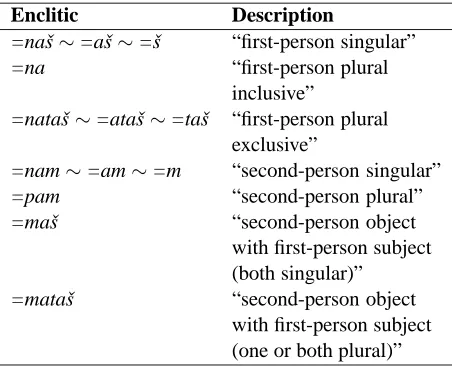
R&R describe Sahaptin’s second-position encli-tics as shown in Table 1. Notice in particular that several of the enclitics are associated with a
per-son and number, but R&R do not mention whether those values are associated with the subject or the object. The reason for this becomes clear when we examine the full paradigm of clauses. The enclitic =nataš, for example, occurs with first person plural exclusive subjects in intransitive clauses; in transi-tive clauses, however, it occurs when one argument is first person plural exclusive and the other is third person, regardless of which is the subject and which is the object. A similar pattern can be observed for =na and =naš. This variant of scale-sensitive ar-gument marking motivated an enhancement to the customization system described in §5 below.
Prefix Description
i- “third-person nominative” pa- “third-person plural nominative” á-∼áw- “third-person absolutive” pá- “inverse”
[image:3.612.75.301.454.637.2]patá-∼patáw- “third-person plural subject with third-person object”
Table 2: Sahaptin prefixes (Rigsby and Rude, 1996, 675)
As for Sahaptin’s verbal prefixes, R&R describe them as shown in Table 2.2 These descriptions are less straightforward than those for the enclitics. In particular, the description of á- ∼ áw- as “absolu-tive” is misleading. Regarding that prefix, R&R write, “...this pronominal marks subjects in intran-sitive clauses when they are possessors, and objects in transitive clauses when the subject is first or sec-ond person.” (675) In other words, it does not occur in all transitive clauses, and only in those intransi-tive clauses where the subject is possessive. Fur-thermore, all the prefixes above appear on the verb, not the nominal arguments, as one might expect for an “absolutive” affix. In spite of the use of the term “absolutive”, the distribution of the prefix á-∼ áw-does not give evidence of ergative alignment in Sa-haptin. Similarly, although there is evidence of argu-ment marking sensitive to a grammatical scale, the description of pá- as “inverse” is misleading, since that prefix does not appear if and only if the object outranks the subject.
2
3 Sahaptin Test Case
The phenomena described above make Sahaptin an excellent test case for demonstrating the flexibility and expressive power of the customization system. In this section, I will show how a significant frag-ment of Sahaptin can be described in the customiza-tion system quescustomiza-tionnaire, producing a grammar that correctly models some of the complexity of Sahap-tin morphosyntax.
It should be noted that some aspects of Sahap-tin are beyond the current capabilities of the cus-tomization system, so some simplifying assump-tions were necessary. For instance, the customiza-tion system models complex morphosyntax but not complex morphophonology. In effect, the grammars it outputs expect a morpheme-by-morpheme gloss as input rather than orthography, leaving the problem of morphological analysis to other systems.3 The Sahaptin test grammar therefore uses only a single spelling for each stem and morpheme, and the mor-phemes are separated by ‘-’ or ‘=’ characters. The facts of Sahaptin word order are also too complex for the customization system; in particular, it can-not model truly free word order (i.e., discontinuous noun phrases), and the attachment behavior of the second-position enclitic is similarly beyond its ca-pability. However, given these simplifying assump-tions, the customization system is capable of model-ing all the agreement and markmodel-ing patterns of Sa-haptin intransitive and transitive clauses shown in Tables 7 and 8 in R&R (1996, 676).
After the design and implementation of the li-braries for case, direct-inverse languages, and agree-ment were completed, the construction of the Sa-haptin test case took only about 80 hours of work, including the creation of test sentences (described in more detail in §4 below), a linguistic analysis of Sahaptin, filling out the questionnaire to reflect that analysis, and debugging the answers to the question-naire.
3.1 Word Order
In the test grammar, I treat Sahaptin as a VSO lan-guage, and the enclitic as a suffix on verbs. This
3
The construction of such systems is well-understood (Beesley and Karttunen, 2003), as is the method for hooking up such a system to theLKB.
means that the sentences recognized and generated by the grammar are in a legal word order—VSO sen-tences with the verb followed by the second-position enclitic are grammatical in Sahaptin—but there are other legal word orders that the test grammar will not accept. The analysis of the enclitic is therefore lim-ited by the current capabilities of the customization system’s word order library; however, if that library is enhanced in the future to support second-position clitics, the analysis presented below should transfer straightforwardly.
3.2 Number
I analyze Sahaptin as having three values of number: singular (sg), dual (du), and plural (pl). All three values are distinguished on pronouns, as shown in Table 3; however, agreement with enclitics and ver-bal prefixes only shows a singular/plural distinction (with dual pronouns agreeing with the plural mor-pheme). It will be necessary in several places for the grammar to refer to a non-singular category cover-ing du and pl. The questionnaire allows the explicit description of such a category; however, it also al-lows the user to select multiple values for a feature, and from those values infers the existence of cate-gories like non-singular. I have made use of the lat-ter mechanism in this grammar.
Table 3 shows the Sahaptin pronoun forms that distinguish singular, dual, and plural; in the ques-tionnaire, therefore, I specified a number value on each. So-called plural agreement morphemes, on the other hand, do not distinguish between the dual and plural so are simply specified as covering both val-ues.
3.3 Person
Sahaptin distinguishes three values of person: first, second, and third. The enclitics (but, interestingly, not the pronouns) further distinguish a first person inclusive and first person exclusive. I filled out the person section of the questionnaire with answers re-flecting the presence of an inclusive/exclusive dis-tinction.
3.4 Case
Singular Dual Plural
Subject Object Subject Object Subject Object
1 ín ináy napiiní napiinamanáy náma naamanáy 2 ím imanáy imiiní imiinamanáy imáy imaamanáy 3 p´(n paanáy piiní piinamanáy pmáy paamanáy
3 obv erg piiní 3 inv erg pn´(m
Table 3: Umatilla Sahaptin Pronouns (Rigsby and Rude, 1996, 682–683)
is the common nominative-accusative pattern, so in the case section of the questionnaire I describe it as such. Note that I do not analyze the inverse ergative and obviative ergative as case; see §3.6 for details.
3.5 Direct-Inverse
I analyze Sahaptin as a direct-inverse language— that is, a language whose argument marking is sen-sitive to a grammatical scale—though one that lacks clear direct or inverse forms of the verb, with the ex-ception of the pá- prefix. The scale I propose for Sahaptin is:
(2) 1P>2P>3P topic>3P non-topic
The customization system interprets this scale, creating a series of rules that constrain the value of a feature DIRECTION on verbs. This feature takes the values direct and inverse and can be used to con-strain the form either of verbs themselves or of their arguments.
3.6 Other Features
I use two additional features in my analysis of Sa-haptin: a semantic TOPICALITY feature and a syn-tacticPROXIMITY feature, both on nominals.
Marking of Sahaptin transitive clauses distin-guishes between topical and non-topical third person arguments. There is no overt marking of topicality on nominals, but clausal marking is conditioned on pragmatic distinctions that influence the felicity of the sentence in different discourse contexts. In order to systematically test this aspect of Sahaptin gram-mar in terms of string grammaticality, I introduced an artificial mark on topical noun phrases, the suffix -TOP. This suffix constrains the value of theTOPI
-CALITYfeature on nominal indices.
I use the syntactic PROXIMITY feature to model
the “inverse ergative” and “obviative ergative” forms
of nominals. In Sahaptin transitive clauses, the in-verse ergative occurs precisely when the subject is third person singular and the clause is inverse (that is, the object is higher on the scale). The obviative ergative occurs in exactly one case: when the sub-ject is third person singular and the obsub-ject is a top-ical third person singular. These “ergative” forms function very much like the so-called proximate and obviative forms in Algonquian languages. However, in contrast to those languages, I analyze Sahaptin as having three values of thePROXIMITY feature rather than two: proximate, corresponding to the inverse ergative -n´(m, which promotes the marked nominal
up the scale; obviative, corresponding to the obvia-tive ergaobvia-tive -in, which demotes the marked nomi-nal down the scale; and neutral, the unmarked form, which does not affect the nominal’s position on the scale.4
3.7 Lexicon
Having defined the necessary features and values, we can now describe the lexicon of the Sahaptin grammar, which includes lexical types and inflec-tional morphemes. In the questionnaire, inflecinflec-tional morphology is described as a series of slots, each at-taching to one or more lexical types or other slots, and each containing one or more morphemes, each of which in turn specifies features. In order to pre-vent spurious ambiguity, the features on each set of morphemes are specified in such a way that no mor-pheme overlaps another, but also so that no legal combination of features goes unexpressed.
The simplest grammars are those that do not re-sort to homophony—that is, they do not have mul-tiple lexical items or morphemes with the same
4
spelling but different semantics or features. It is of-ten possible to avoid homophony by adding com-plexity to feature hierarchies, but overly complex hierarchies can be as difficult to manage as exten-sive homophony. In the Sahaptin grammar, I have attempted to strike a balance between homophony and hierarchy complexity. For example, to make the grammar easier for users to understand, I segregated verbal prefixes and enclitics each into two classes: those attaching to intransitive stems and those at-taching to transitive stems. This produced two ho-mophonous variants of the prefixes i- and pa-, and of the enclitics =naš, =na, =nataš, =nam, and =pam. Furthermore, the distributions of two transitive pre-fixes (pá- and the null variant) and of three transi-tive enclitics (=nam, =pam, and =mataš) were eas-ier to model using homophonous variants. Finally, the third person singular obviative pronoun and the third person dual subject pronoun are both piiní (as shown in Table 3) and it seemed simplest to repre-sent these using two separate lexical entries. The grammar, then, contains 22 lexical items, of which only two are homophonous, and 24 non-null inflec-tional morphemes representing 12 distinctly spelled prefixes and enclitics.
A full description of the morphosyntactic details of the Sahaptin test grammar would be too long for this paper; instead, I will provide a summary.5 The lexicon of the test grammar contains six inflectional slots: a slot for the topic morpheme described above that attaches to nominals; a slot for verbal prefixes that attach to intransitive verbs; a slot for verbal pre-fixes that attach to transitive verbs; a slot for encl-itics that attach to intransitive verbs; a slot for en-clitics that attach to transitive verbs; and a slot that contains no overt morphemes, but is used to produce lexical rules that constrain the appearance of topic, proximate, and obviative on a verb’s nominal argu-ments. Each of these slots contains morphemes, on which are specified values for one or more features. To give an idea of what this looks like, Table 4 shows
5
The full details of the Sahaptin grammar can be found in my dissertation (Drellishak, 2009). How the ques-tionnaire can be filled out to model Sahaptin can be seen by visiting the customization system web site at
depts.washington.edu/uwcl/matrix/sfddiss/
and clicking the Umatilla Sahaptin link at the bottom of the main page, which fills out the questionnaire automatically.
the features that are defined for the most complex of these slots, the one that contains transitive prefixes.
4 Testing the Sahaptin Grammar
In order to test the correctness of the Sahaptin gram-mar, it was necessary to create a suite of test sen-tences, some grammatical and some not, that probe its expected lexical and grammatical coverage. I started with the sentence patterns in R&R’s Tables 7 and 8 (Rigsby and Rude, 1996, 676); from each, I created a sentence with the appropriate prefix, verb, enclitic, subject, and object. In every case where a plural argument was called for, I actually cre-ated two sentences, one with a dual argument—and in cases with two plural arguments, I created four: du/du, du/pl, pl/du, and pl/pl.
All these sentences were expected to be gram-matical based on the descriptions in R&R. To gen-erate ungrammatical sentences, I initially permuted the grammatical sentences in the following ways:
1. For each grammatical sentence with a prefix, I created an ungrammatical variant with the pre-fix missing.
2. For each grammatical sentence with an enclitic, I created an ungrammatical variant with the en-clitic missing.
3. For each grammatical sentence, I created vari-ants that contained every incorrect prefix and variants that contained every incorrect enclitic.
After duplicates were removed, this produced a list of 89 grammatical and 220 ungrammatical sen-tences, for a total of 309.
Transitive Subject Subject Object Object
prefix PERNUM TOPICALITY PERNUM TOPICALITY
i- 3sg non-topic
pa- 3du, 3pl non-topic
á- 1st, 2nd 3rd
pá- 2sg 1sg
pá- 3sg non-topic 3sg topic
patá- 3du, 3pl non-topic 3sg topic
∅ 1st 2nd
∅ 2du, 2pl 1st
[image:7.612.84.290.308.379.2]∅ 2sg 1du, 1pl
Table 4: Morphemes appearing in the transitive prefix slot
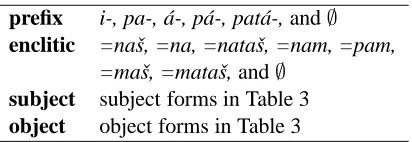
(3) prefix-q’ínun=enclitic subject object
The possible fillers for each position in (3) are shown in Table 5:
prefix i-, pa-, á-, pá-, patá-, and∅ enclitic =naš, =na, =nataš, =nam, =pam,
=maš, =mataš, and∅ subject subject forms in Table 3
object object forms in Table 3
Table 5: Fillers for positions in (3)
As mentioned above, the lexicon of the Sahaptin grammar, and consequently the test sentences, uses the various forms of the personal pronoun to rep-resent the possible person, number, case, and prox-imity values of subject and object noun phrases. In addition to plain case-marked pronouns, the subject and object positions may also contain third person pronouns marked as the topic with -TOP.
Generating every sentence that followed the pat-tern in (3) produced 6048 sentences, but some ad-ditional filtering was required. First, since it ap-pears that topic marking is only relevant when dis-ambiguating third person arguments, I removed all sentences where the -TOP suffix appeared with a first or second person pronoun. Second, 192 of the permutations of (3) are actually duplicates of the ungrammatical transitive test sentences created by hand above, so I removed those as well. After fil-tering, a total of 5856 programmatically-generated sentences remained. Added to the aforementioned 309 examples, this made 6165 unique test sentences. After using the customization system to generate
a grammar of Sahaptin, I used that grammar to at-tempt to parse every test sentence. All 89 sentences corresponding to R&R’s grammatical transitive and intransitive patterns parsed and were assigned ex-actly one analysis.6 Among the ungrammatical sen-tences, 5848 out of 5856 failed to parse, as expected. To my surprise, however, eight of the sentences did parse. These sentences were:
(4) a. i-q’ínun p´(n-TOP piinamanáy
3SG-see 3SG.NOM-TOP3DU.OBJ ‘He saw them (DU).’
b. i-q’ínun p´(n-TOP paamanáy
3SG-see 3SG.NOM-TOP3PL.OBJ ‘He saw them.’
c. pa-q’ínun piiní paanáy
3NONSG-see 3DU.NOM3SG.OBJ ‘They (DU) saw him.’
d. pa-q’ínun pmáy paanáy
3NONSG-see 3PL.NOM3SG.OBJ ‘They saw him.’
e. pa-q’ínun piiní-TOP piinamanáy
3NONSG-see 3DU.NOM-TOP3DU.OBJ ‘They (DU) saw them (DU).’
f. pa-q’ínun piiní-TOP paamanáy
3NONSG-see 3DU.NOM-TOP3PL.OBJ ‘They (DU) saw them.’
g. pa-q’ínun pmáy-TOP piinamanáy
3NONSG-see 3PL.NOM-TOP3DU.OBJ ‘They saw them (DU).’
h. pa-q’ínun pmáy-TOP paamanáy
3NONSG-see 3PL-TOP.NOM3PL.OBJ ‘They saw them.’
6
Notice that the eight sentences fall into three pat-terns. The first two sentences have a third person sin-gular topical subject and a third person non-sinsin-gular non-topical object, the next two have a third person non-singular non-topical subject and a third person singular non-topical object, and the last four have a third person non-singular topical subject and a third person non-topical object. These are precisely the patterns that are absent from R&R’s Table 8; corre-sponding sentences were therefore not included in the list of 89 grammatical sentences. In develop-ing the Sahaptin grammar, I had, without consider-ing these eight patterns, defined the prefixes in such a way that the grammar expected i- to appear in the first two sentences and pa- in the last six.
In order to determine whether this analysis was correct, Sharon Hargus presented the Yakima Sahap-tin equivalents of the sentences in (4) by telephone to Virginia Beavert, a native speaker of that dialect, who accepted all eight of them with the readings shown in (4). Note that, in order for these sentences to be acceptable, they had to be cast in the past tense, a feature not modeled in my Sahaptin grammar frag-ment. Note also that Dr. Beavert considered sen-tence (4c) somewhat less acceptable, saying that it is “[a] little awkward, but has meaning.”
The Sahaptin grammar, then, which was created using the customization system and based on its sup-port for case, direct-inverse languages, and agree-ment, correctly analysed all 6165 of the test sen-tences, including eight that fell outside of the pat-terns described in the linguistic literature.
5 Summary and Discussion
Based on these results, I conclude that even Sahap-tin, a language with extremely complex argument marking morphology, can be modeled using the cus-tomization system. Note that the system was not de-signed with the facts of Sahaptin in mind, and with two exceptions, the system did not need to be modi-fied to enable it to handle Sahaptin.
One of the exceptions was trivial: formerly, gram-mars produced by the system treated ‘=’ as punctua-tion, stripping it out and breaking words containing it. The other exception concerns an unusual agree-ment pattern I first encountered in Sahaptin: mor-phemes that agree, not with the subject or the object
of a verb, but with the nominal argument that is more highly ranked on the direct-inverse scale. Support-ing this agreement pattern proved worthwhile later, when it was used again in a test grammar for Plains Cree [crk] (Algonquian), another direct-inverse lan-guage. Although this latter change was a substan-tive one that allows grammars to be described more compactly, it did not increase the descriptive power of the system—languages showing that pattern of agreement could still be modeled using duplicated, homophonous morphemes. Such an enhancement to the system is an example of the feedback loop be-tween grammar engineering and customization sys-tem development, where new languages with new phenomena (or new variations of old phenomena) inform the design and, in some cases, the descrip-tive power of the system.
After constructing the Sahaptin grammar and test suite described here, it was natural to include it in two places in the customization system. First, it is now one of the regression tests that is regularly run to ensure that future enhancement of the system does not break earlier features. Second, Sahaptin has been added to the list of sample grammars ac-cessible from the main page of the questionnaire— by clicking on links in this list, users can see detailed examples of how the questionnaire can be filled out to model a target language.
The Sahaptin grammar, developed using the cus-tomization system, has proved itself useful—not only to the Grammar Matrix project, where it in-spired the addition of support for scale-sensitive agreement and serves as a regression test of the cor-rect functioning of the system, but also to the field of linguistics. By analyzing Sahaptin in the precise detail required by the customization system, I found unnoticed gaps in linguistic descriptions of the lan-guage, and in collaboration with linguists studying the language was able to help resolve those gaps.
Acknowledgments
References
[Beesley and Karttunen2003] Kenneth R. Beesley and Lauri Karttunen. 2003. Finite State Morphology.
CSLI, Stanford.
[Bender et al.2002] Emily M. Bender, Dan Flickinger, and Stephan Oepen. 2002. The grammar matrix. In
Proceedings of COLING 2002 Workshop on Grammar Engineering and Evaluation, Taipei, Taiwan.
[Blake2001] Barry J. Blake. 2001. Case, Second Edition. Cambridge University Press, Cambridge.
[Copestake et al.2005] Ann Copestake, Dan Flickinger, Carl Pollard, and Ivan A. Sag. 2005. Minimal re-cursion semantics: An introduction. Research on
Lan-guage & Computation, 3(2–3):281–332.
[Copestake2002] Ann Copestake. 2002. Implementing
Typed Feature Structure Grammars. CSLI, Stanford.
[Drellishak2009] Scott Drellishak. 2009. Widespread,
but Not Universal: Improving the Typological Cover-age of the Grammar Matrix. Ph.D. thesis, University
of Washington.
[Krieger and Schäfer1994] Hans-Ulrich Krieger and Ul-rich Schäfer. 1994. Tdl – a type description language for constraint-based grammars. In Proceedings of the
15th International Conference on Computational Lin-guistics, pages 893–899, Kyoto, Japan.
[Oepen2001] Stephan Oepen. 2001. [incr tsdb()] — Competence and performance laboratory. User man-ual. Technical report, Saarbrücken, Germany.
[Pollard and Sag1994] Carl Pollard and Ivan A. Sag. 1994. Head-Driven Phrase Structure Grammar.
CSLI, Stanford.