The
Connection Machine System
CM Fortran Utility Library
Reference Manual
... ... ::...
Preliminary Documentation for Version 2.0 Beta
January 1993
First printing, January 1993
PRELM-NARY DOCUMENTATION
The information in this document is subject to change without notice and should not be construed as a commitment by Thinking Machines Corporation. Thinking Machines assumes no liability for errors in this document.
This document does not describe any product that is currently available from Thinking Machines Corporation, and Thinking Machines does not commit to implement the contents of this document in any product.
Connection Machine® is a registered trademark of Thinking Machines Corporation.
CM, CM-2, CM-200, CM-5, CM-5 Scale 3, and DataVault are trademarks of Thinking Machines Corporation. CMosr, CMAX, and Prism are tmdemarks of Thinking Machines Corporation.
C* is a registered trademark of Thinking Machines Corporation.
Paris, *Lisp, and CM Fortran are trademarks of Thinking Machines Corporation. CMMD, CMSSL, and CMXll are trademarks of Thinidng Machines Corporation. Scalable Computing (SC) is a trademark of Thinking Machines Corporation. Thinking Machines is a registered trademark of Thinldng Machines Corporation. SPARC and SPARCstation are trademarks of SPARC International, Inc.
Sun, Sun-4, and Sun Workstation are trademarks of Sun Microsystems, Inc. UNIX is a registered trademark of UNIX System Laboratories, Inc.
Copyright C 1991-1993 by Thinking Machines Carporation. All rights reserved.
Thinking Machines Corporation 245 First Street
Cambridge, Massachusetts 02142-1264 (617) 234-1000
Contents
Field Test Support ... vi
About This Manual ... vii
Chapter 1 Introduction ...
11.1 Why a Utility Library? ... 1
1.2 Contents of the Utility Library ... 2
1.3 The Utility Library Header File ... 3
1.4 Restrictions on Utility Procedures ... 3
Chapter 2 Inquiries, Random Numbers,
and Dynamic Allocation ...
...
5
2.1 System Inquiry Functions ... 5
2.1.1 Language Comparison ... 6
2.2 Array Inquiry Subroutine ... 7
2.2.1 Language Comparison ... 7
2.3 Random Number Generation ... 8
2.3.1 Language Comparison ... 8
2.4 Dynamic Array Allocation ... 9
2.4.1 Allocation Example ... 10
2.4.2 Controlling Array Layout ... 11
2.4.3 Detailed-Layout Allocation Example ... 11
2.4.4 Restrictions ... 13
2.4.5 Language Comparison ... 13
Chapter 3 Data Motion ...
15
3.1 Array Transfers ... 15
3.1.1 Language Comparison ... 16
3.2 Scatters with Combining ... 17
3.2.1 Constructing Send Address Arrays ... 17
3.2.2 Address-Construction and Scatter Example ... 19
3.2.3 Language Comparison ... 20
Version 2.0 Beta, January 1993
iv CM Fortran Utility Library
3.3 Parallel Prefix Operations ... ... ... .... .. 21
3.3.1 Scan Segments ... 22
3.3.2 Scanning Example ... 23
3.3.3 Language Comparison .. ... 24
3.4 Ranking and Sorting . ... 25
3.4.1 Axis Segments ... 25
3.4.2 Ranking and Sorting Examples ... ... 27
3.5 Table Look-ups ... ... 28
3.5.1 Language Comparison ... 29
3.6 Gathers/Scatters on Serial Axes ... ... 30
3.6.1 Conditions for Fast Performance ... 30
3.6.2 Gather/Scatter Examples ... 32
3.6.3 Language Comparison ... 32
Chapter 4 Parallel 1/0 ...
33
4.1 CM File Operations ... ... 33
4.1.1 Opening, Closing, and Removing CM Files ... .. 34
4.1.2 Reading and Writing CM Files ... ... 35
4.1.3 Manipulating CM Files ... 39
4.1.4 Example of CM File Operations ... ... 42
4.2 Parallel I/O via Devices and Sockets ... 43
Appendix Dictionary of Utility Procedures ...
47
CMF ALLOCATE ARRAY ... 50
CMF ALLOCATE DETAILED ARRAY ... 53
CMF ALLOCATE LAYOUT ARRAY ... 57
CMF ALLOCATE TABLE ... 59
CMF ARCHITECTURE ... 61
CMF AREF 1D ... ... ... 62
CMF ASET 1D ... 64
CMF AVAILABLE MEMORY ... 66
CMF CM ARRAY FROM FILE ... 67
CMFCM ARRAY FROM FILE FMS ... 69
CMF CM ARRAY FROM FILE SO ... 71
CMF CM ARRAY TO FILE ... 73
CMF CM ARRAY TO FILE FMS ... 75
CMF CM ARRAY TO FILE SO ... 77
CMF DEALLOCATE ARRAY ... ... ... ... 79
Contents v
CMF DEALLOCATE TABLE ... 80
CMF DEPOSIT GRID COORDINATE ... 81
CMF DESCRIBE ARRAY ... 83
CMF FE ARRAY FROM CM ... 84
CMF FE ARRAY TO CM ... .. 85
CMF FILE CLOSE ... 86
CMFFILEFDOPEN ... 87
CMF FILE GET FD ... 88
CMFFILE LSEEK ... 89
CMFFILE LSEEK FMS ... 91
CMF FILE OPEN ... ... 93
CMFFILE REWIND ... 94
CMFFILE TRUNCATE ... 95
CMF FILE UNLINK ... 97
CMFGET GEOMETRY ID ... 98
CMF LOOKUP IN TABLE ... 99
CMF MAKE SEND ADDRESS ...
101
CMF MY SEND ADDRESS ... 103
CMF NUMBER OF PROCESSORS ... ....
105
CMFORDER ... 106
CMF RANDOM ... 107
CMF RANDOMIZE ... ... 109
CMF RANK ... 110
CMF SCAN ... 114
CMF SEND ... .. ... 119
CMF SIZEOF ARRAY ELEMENT ... 122
CMFSORT ... 123
Version 2.0 Beta, January 1993
Field Test Support
---- ---
r a r~a
sa
Field test software users are encouraged to communicate with Thinking
Machines Corporation as fully as possible throughout the test period. Please report any errors you may find in this software and suggest ways to improve it. When reporting an error, please provide as much information as possible to help us identify the problem. A code example that failed to execute, a session tran-script, the record of a backtrace, or other such information is extremely helpful in this regard.
If your site has an applications engineer or a local site coordinator, please contact that person directly for field test support. Otherwise, please contact Thinking Machines' home office customer support staff:
Internet
Electronic Mail:
uucp
Electronic Mail:
U.S. Mail:
Telephone:
customer-supportethink.com
ames! think! customer-support
Thinking Machines Corporation Customet Support
245 First Street
Cambridge, Massachusetts 02142-1264 (617) 234-4000
Version 2.0 Beta, January 1993
About This Manual
Objectives of This Manual
This manual provides reference and usage information about the procedures in the CM Fortran Utility Library.
Intended Audience
This manual assumes familiarity with CM Fortran programming.
Organization of This Manual
The chapters of this manual describe the functional categories of utility
procedures and suggest how to use them. The appendix is a dictionary of the individual procedures.
Revision Information
This is a preliminary draft of a new manual. The Utility Library was previously documented in an appendix to the CM Fortran User s Guide, Version 1.1.
Related Documents
* The CM Fortran Reference Manual defines the language; the CM Fortran User s Guide provides information about using the compiler.
* The dictionary entries in this manual are available on line as man pages. View them with the command man on CM-5 or caman on CM-2/200, specifying the utility procedure name in uppercase.
Version 2.0 Beta, January 1993
Chapter 1
Introduction
The Utility Library provides convenient access from CM Fortran to the capabili-ties of lower-level CM software. The purpose is typically to achieve functionality or performance beyond what is currently available from the compiler.
As the compiler continues to develop, some of the utility procedures become redundant with CM Fortran language features. This manual compares utility pro-cedures with the corresponding language features in the current release and notes any differences in behavior or performance.
1.1 Why a Utility Library?
CM Fortran programmers can use Utility Library procedures in situations where one is normally tempted to make explicit calls to lower-level software. There are several advantages to using the Utility Library instead in these situations:
* Convenience. The utility procedures take CM Fortran array names and other CM Fortran data objects as arguments. There is no need to convert CM Fortran objects into the data types used by lower-level software. * CM Portability. With the few exceptions noted, the utility procedures
sup-port all CM hardware configurations and execution models, regardless of the particular lower-level software involved. There is no need to recode these calls to port a program from one CM system to another, even though the underlying system software may be quite different.
* Support. The Utility Library is a supported part of the CM Fortran prod-uct. Unlike some of the underlying system software, the library remains
stable over time so that programs using it do not require maintenance.
Version 20Beta, January 1993
2
C Fotra Utlit Lirar1.2 Contents of the Utility Library
The chapters that follow describe the Utility Library procedures under these functional categories.
* Inquiries
* System inquiry · Array inquiry
· Random number generation * Dynamic array allocation · Data motion (interprocessor)
* Array transfers
* Scatters with combining (plus array address construction) * Parallel prefix operations * Ranking and sorting * Data motion (local)
· Table look-ups
· Gathers/scatters on serial axes
* Parallel I/O
* CM file operations
· CM I/O via devices or sockets
1.3 The Utility Library Header File
Each program unit that uses procedures from the Utility Library must include its header file:
INCLUDE '/usr/include/cm/CMF_defs.h'
The pathname of ClF_def s. h may be different if your system administrator has revised the CM directory structure.
The compiler command cmf links with the Utility Library automatically; no explicit linking is required.
Version 2.0 Beta, January 1993 Copyright 1991-1993 Thinking Machines Corporation
Refe
M---anua
3
1.4 Restrictions on Utility Procedures
*
Aligned arrays. The utility procedures do not operate on arrays that are aligned with other arrays of higher rank or aligned with non-zero dimen-sion offset(s) with any other array.*
Lower bounds. The utility procedures assume that all array dimensions have a lower bound of 1. Any other lower bound value is ignored. (An exception is the parallel I/O procedures, which accept arrays with any lower bound value.)A few restrictions apply only to particular procedures. These are noted both in the text discussing the functional categories and in the individual procedure descriptions in the appendix.
Version 20 Beta, January 1993
Copyright 1991-1993 Thinling Machines Corporation
Chapter 2
Inquiries, Random Numbers,
and Dynamic Allocation
2.1 System Inquiry Functions
Three functions report information about the CM system that is executing the program. They all take no arguments and return integer scalar results.
CFARCHITECTURE returns a predefined constant that identifies the CM
hard-ware platform and execution model:
ARCH - CMF_ARCHITECTURE( )
CMF_NaMBER_OF_PROCESSORS
reports the number of processing elements
available:NUM
-
CF NUMBER_OFPROCESSORS(
)
The table below shows the return values of these two inquiry functions. Notice that the CM system component that serves as the "processing element" is differ-ent for the various platforms and execution models.
Version 2.0 Beta, January 1993
6 .M Fortran UtilityLibrary
i;
CM Fortran hardware platforms and execution models.
Compiler CMF ARCHITECTURE CMF_NUMBER_OF_
options returns PROCESSORS returns
CM-5
Vector units -cm5 -vu CMF CM5 VU number of vector units
Nodes -cm5 -sparc CMF_CM5_SPARC number of nodes
CM-200
Slicewise -cm200 -slicewise CMF CM200 SLICEWISE number of nodes
Paris -cm200 -paris CMF_CM200_PARIS number of processors
CM-2
Slicewise -cm2 -slicewise CMF CM2 SLICEWISE number of nodes
Paris -cm2 -paris CMF_CM2_PARIS number of processors
CM Fortran
Simulator -cmsim CMF _CMSIM number of processors (1)
See the CM Fortran User Guide for more information on execution models and the hardware platforms they support.
A third inquiry function, CMF AVAILABLE_MEMOR reports the number of bytes
of memory still available in each processing element: MEM = CMF AVAILABLE MEMORY( )
NOTE: This function returns incorrect results for the vector unit model in Version 2.0 Beta.
2.1.1 Language Comparison
No comparable language feature.
Version 2.0 Beta, January 1993 Copyright © 1991-1993 Thinking Machines Corporation
9
R--efre-ce-Manua
2.2 Array Inquiry Subroutine
The subroutine CM DESCRIBE ARR AY prints information about a CM array to standard output:
CALL CMF_DESCRIBE_ARRAY( ARRAY )
The output includes the home, rank, and dimension extents of the array, as well as detailed information about its layout on the processing elements.
The Utility Library also provides two special-purpose array inquiry functions. * CMF_GET_GEOMETRY_ID is
used only in constructing destination
addresses for scatter operations; it is described in Section 3.2.1.
* CMF SIZEOF_ARRAY_ELEMENT is used only for certain operations on CM files; it is described in Section 4.1.3.
2.2.1 Language Comparison
No comparable language feature.
Version 2.0 Beta, January 1993
Copyright 0 1991-1993 7hinking Machines Corporation
2.3 Random Number Generation
Two subroutines serve to fill a CM array with pseudo random numbers:
CALL CIF RANDOMIZE( SEED ) CALL CMF_ ANDOM( DEST, LIMIT )
CMF_RANDOMIZE sets
a seed for the random number generator used by
CM_ RAINDOM. a_RANDOM uses the initialized random number generator to store a pseudo random number in each element of the DEST array.
The LIMIT argument should always be specified as 1.0 for floating-point values. For integers, the argument serves as the exclusive upper bound of the values gen-erated. If you do not want to set a limit for integer values, specify the LIMIT argument as 0.
The random number generator algorithm used by these routines is Wolfram's
Rule 30 Cellular Automaton, described in Stephen Wolfram, "Random
Sequence Generation by Cellular Automata," Advances in Applied Mathematics 7, pp. 123-69 (1986). This paper may be more readily available as a reprint in Stephen Wolfram, Theory and Application of Cellular Automata, World Scien-tific (1986).
The cellular automaton is run on a finite string of bits, i-0O,...,N-l, with periodic boundary conditions (so that site N is equivalent to site 0). In the CM
imple-mentation N = 59.
* For integer data the random numbers are generated by simply running the automaton for 32 generations.
* For real, double-precision real, complex, or double-precision complex data, the random numbers are generated by running the automaton for s generations (where s is the mantissa length), and setting the exponent bits and sign bit so that the result is uniformly distributed between 2.0 and 1.0. Then 1.0 is subtracted from the result to yield a number that is uniformly distributed between 0.0 and 1.0.
2.3.1 Language Comparison
No comparable language feature.
I ga
Version 2.0 Beta, January 1993 Copyright 1991-1993 Thinking Machines Corporation
CM Fortran Utility Library
Refe~B~ren
Manal-2.4 Dynamic Array Allocation
Three subroutines allocate CM arrays at run time, giving the programmer differ-ent levels of control over the array's layout. A fourth subroutine deallocates an
array created by any of the other three.
CALL CMF ALLOCATE ARRAY
& ( FE_ARRAY, EXTENTS, RANK, TYPE )
CALL CMF ALLOCATE LAYOUT ARRAY
e& ( FE_ARRAY, EXTENTS, RANK, TYPE, ORDERS, WEIGHTS )
CALL CMF ALLOCATE_DETAILED_ARRAY
& ( FE_ARRAY, EXTENTS, RANK, TYPE, ORDERS,
r& SUBGRIDS, PMASKS )
CALL CMF_DEALLOCATE_ARRAY( FE_ARRAY )
The FE_ARRAY argument is an integer front-end vector whose length is the pre-defined constant CMF_sIZEOF_DESCRIPTOR. This array is treated as the descriptor of a CM array; the remaining arguments specify information to be placed in the slots of the descriptor. All three variants take as arguments:
* EXTENTS a front-end vector that contains dimension extents
* RANI a scalar integer that indicates rank
· TYPE A pre-defined integer constant that indicates type:
CF_LOGICAL, CRF_S_INTEGER, CMF_FLOAT, CMF_DOUBLE,
CMFCOMPLEX, CMF_DOUBLE_COMPLEX
The FE_ARRAY argument cannot be used as a CM array within the program unit that calls the allocation subroutine, since that program unit treats it as a front-end array. Instead, you pass the FE_ARRAY argument (that is, the descriptor) to another program unit that explicitly declares it a CM array. This method is illus-trated in the following example.
Version 2.0 Beta, January 1993
Copyright 0 1991-1993 Thinking Machines Corporation
2.4.1 Allocation Example (Canonical Layout)
SUBROUTINE ALLOCATE() IMPLICIT NONE
INTEGER NEWARRAY(CMFSIZEOFDESCRIPTOR)
INTEGER EXTENTS(7), RANK, I PARAMETER (RANK=3)
INCLUDE '/usr/include/cm/CMF_defs.h'
DO I=1,RANK
EXTENTS(I) = I * 10
END DO
CALL CMFALLOCATEARRAY
& (NEW_ARRAY, EXTENTS, RANK, CMF S INTEGER)
CALL PRINTDIMS3D(NEWARRAY)
CALL CMF DEALLOCATE ARRAY(NEW ARRAY) END SUBROUTINE ALLOCATE
SUBROUTINE PRINTDIMS3D(IN) IMPLICIT NONE
INTEGER IN(:,:,:)
PRINT *,"Shape of DUMMY is (",DUBOUND(IN,1),
& -,",DUBOUND(IN,2),
& ", n,DUBOUND(IN,3),")"
END SUBROUTINE PRINT DIMS3D
'j; i
Version 2.0 Beta, January 1993 Copyright © 1991-1993 Thinking Machines Corporation
Refeene Mannal 11a~
2.4.2 Controlling Array Layout
The "layout" and "detailed" variants of the allocation procedures take additional front-end vector arguments that contain layout information for each of the array dimensions. The significance of these arguments is comparable to the various forms of the cmf compiler directive LAYoUT.
* ORDERS contains symbolic constants indicating the ordering of each dimension: Cma_SERIAL_ORDER, Ca_NEWS ORDER, or (for CM-2/200 only) C'F-SEhDORDER.
* WEIGHTs is a vector of integers indicating relative dimension weights. * sUBGRIDS is a vector of integers indicating the desired subgrid length for
each dimension (comparable to the BLOCK item in the detailed-layout directive).
* PAs5xs is a vector of integers that serve as bit-masks to indicate the desired processors (comparable to the: PDESC item in the detailed-layout directive). If ORDERS contains the value C'_SERIAL_ORDER for any
dimension, then Pmaxs must contain o for that dimension.
There is no form directly comparable to the: BLOCK : PROC form of the detailed LAYOUT directive. However, if maaxs contains all zeros, the system computes the number of processors for each axis as extent / subgrid-length, rounded if nec-essary to the next power of 2.
2.4.3 Allocation Example (Detailed Layout)
IMPLICIT NONE
INCLUDE '/usr/include/cm/CMF_defs.h' INTEGER NEWARRAY(CMF_SIZEOF_DESCRIPTOR)
INTEGER EXTENTS(7),ORDERS(7),SUBGRIDS(7),PMASKS(7) INTEGER RANK,I
INTEGER NPN,NPN_FRAC,FRAC,SG1,SG2 REAL A(200)
PARAMETER (RANK = 2) PARAMETER (FRAC = 4)
PARAMETER (SG1 = 5, SG2 = 40)
Version 2.0 Beta, January 1993
Copyright 0 1991-1993 Thinking Machines Corporation
2 CM.Fortran.Uility.Librar
A = 1.0 ! initialize if CM-2 running in auto-attach mode
NPN = CMFNUMBER OF PROCESSORS()
NPNFRAC = NPN/FRAC
PMASKS(1) = (NPN FRAC - 1) * FRAC PMASKS(2) 5 FRAC - 1
SUBGRIDS(1) = SG1 SUBGRIDS(2) = SG2
EXTENTS(1) = NPN FRAC * SG1 EXTENTS(2) = FRAC * SG2
DO I = 1,RANK
ORDERS(I). = CMF NEWS ORDER END DO
CALL CMF ALLOCATE DETAILED ARRAY
& (NEWARRAY,EXTENTS,RANK,CMF FLOAT,ORDERS,SUBGRIDS,PMASKS)
CALL USENEWARRAY(NEWARRAY, EXTENTS)
CALL CMFDEALLOCATE ARRAY(NEWARRAY) END
SUBROUTINE USENEWARRAY(A,EXT) INTEGER EXT(2)
REAL A(EXT(1),EXT(2)), B(EXT(1),EXT(2)) CMF$ LAYOUT A(:,:)
CMF$ ALIGN B(I,J) WITH A(I,J)
B - CSHIFT(A,DIM=1,SHIFT=l)
C Other operations on arrays A and B
RETURN END
Version 2.0 Beta, January 1993
Copyright 0D 1991-1993 Thinking Machines Corporation
Reference Manual 13
*
2.4.4 Restrictions
In addition to the general restrictions listed in Section 1.4, the following restric-tions apply only to the dynamic allocation utilities.
* All four dynamic allocation utilities are incompatible with run-time safety, including argument checking and NaN checking. Do not use -safety or -argument_checking to compile a program that uses these procedures. · The procedure CMF_ALLOCATE_DETAILEDARRAY is not supported
under the Paris execution model on CM-2 or CM-200.
2.4.5 Language Comparison
The dynamic allocation utility procedures are largely, but not completely, redun-dant with the CM Fortran statement ALLOCATE, which creates deferred-shape CM arrays. Some differences are:
Deferred-shape arrays cannot appear in COlON, so their names are not
s
Yavailableto all program units. In contrast, arrays created with
CMF ALLOCATE_ARRAY or
one of its variants can be
globallyavailable.
* Data types and ranks of deferred-shape arrays must be known at compile time. With CMF_ALLOCATE_ARRAY, they can be decided at run time (although used only in subroutines where the appropriate type and rank aredeclared).
* If a deferred-shape array is subject to a LAYOUT directive, the directive must appear in the specification part of the program unit (before any executable code). If you use the utility CM ALLOCATE _LAYOUTARRAY
or CWF_ALLOCATE DETAILED ARRAY instead, you can compute before the call to determine layout-related values, such as subgrid lengths. · The dynamic allocation utilities are incompatible with run-time safety, but
deferred-shape arrays can be used in programs compiled with -safety. Neither the Utility Library nor the CM Fortran language provides for dynamic allocation of front-end arrays or scalars. For this purpose, use the CM Fortran
subroutines
FMALLOCand
FFREE in libcmf 77 .a (described in
the CM Fortran User's Guide). These subroutines provide an interface to the standard malloc and free functionality that, together with the %vAL operator, enable you toman-&^
age front-end storage.Version 20 Beta, January 1993
Chapter 3
Data Motion
This chapter describes the utility procedures that perform three distinct kinds of data movement:
* Array transfers between the control processor and the parallel unit · Data communication among the parallel processing elements
· Scatters with combining · Parallel prefix operations * Ranking and sorting
* Data motion on serial (locally stored) array dimensions · Table look-ups
* Gathers/scatters on serial axes
3.1 Array Transfers
Two subroutines perform block transfers of array data between the serial control processor and the parallel processing unit:
CALL C FE ARRAY TO C( DEST, SOURCE )
CALL CF FE ARRAY FROM CM( DEST, SOURCE )
CMF_FEARRAY TOCM copies the contents of a front-end array soURCE into a
CM array DEST. CCM_F_ARRAY FROMCM performs the opposite procedure. The source and destination arrays must match in shape and type.
Version 20 Beta, January 1993
3.1.1 Language Comparison
The FORALL statement can express CM-FE array transfers, such as:
FORALL (I=1:N) FEARRAY(I) = CMARRAY(I)
However, in Version 2.0 this statement generates a DO loop with calls to
read-to-processor or write-from-processor; that is, it transfers array data between the system components one element at a time. For this release, the array-transfer utilities give better performance.
(,
Version 2.0 Beta, January 1993 Copyright © 1991-1993 Thinking Machines Corporation
CM Fortran Utility ibrary
Reference anua 17
3.2 Scatters with Combining
The caF_sm_ family of subroutines are used to scatter elements from a source array to specified locations in a destination array. If more than one value is sent to a single location, the values are combined according to the operation specified in the subroutine name:
CALL mF _SEND_combiner
& ( DEST, END ADDRESS, SOURCE, MASK )
The combiners are OVERWRITE, ADD, MAX, MIN, IOR, AND, and IEOR
* F SEND_OVERWRITE operates on CM arrays of any type. It arbitrarily chooses one of the colliding values to store in the destination location. * CF_SENDADD operates on any numeric type.
c* Q'_SENDMA and _MIN operate on integer and real arrays (single- or double-precision).
* CMFoENDIOR, _AND, and _IEOR operate on integer and logical arrays. They correspond to logical inclusive OR, logical AND, and logical exclusive OR, respectively. Integer operations are done on a bitwise basis. The MASK argument controls which elements of sooRCE are selected for the operation. The SEND_ADDRESS argument is a CM array of destination addresses, constructed with the procedures described below. It must be conformable with the souRcE array.
3.2.1 Constructing Send Address Arrays
A send address is an internal format for the linearized address of an n-dimen-sional coordinate. As such, it specifies an absolute location for a data element that is independent of its relative grid location.
Three procedures are used to convert grid coordinates (specifying the desired locations in the DEBST array) into send addresses for use with C_SENO_D
GEOMETRY CMF_GET_GEOMETRY_ID( ARRAY )
CALL CMF MAKEENDADDRESS ( ARRAY )
CALL CMF_DEPOSIT_GRIDCOORDINATE
& (GEOMETRY, SEND ADDRESS, AXIS, COORDINATE, MASK)
Version 2.0 Beta, January 1993
Copyright 1991-1993 Thinking Machines Corporation
(A related subroutine, CMF_MY SEND_ADDRESS (ARRAY), fills an array with the
send addresses of its own elements.)
To construct a send-address array for use with CMF_SEND_, perform the
follow-ing steps:
1. Declare an array to hold the send addresses. The array must have the same shape and layout as the SOURCE array with which it will be used.
REAL*8 SEND ADDRESS
DIMENSION SENDADDRESS( ...) ! same shape as source
NOTE: The SEND_ADDRESS array may be declared as INTEGER, or as
DOUBLE PRECISION or REAL*8. The CM-2/200 computes send addresses
as 4-byte values; the CM-5 uses 8-byte send addresses. Both platforms accept either 4-byte or 8-byte send-address arrays. However, there may be a performance penalty for using 4-byte addresses on the CM-5, as the sys-tem coerces the values to 8-byte length. There is no performance penalty for using 8-byte send-address arrays on the CM-2, although there is some waste of memory. For maximum portability, CM Fortran programs should
declare send-address arrays as DOUBLE PRECISION or REAL*8. INTEGER send-address arrays should only be used in programs to be run on the CM-2, and only when conserving memory is an issue.
2. Call CMF_MAKESEND _ADDRESS to initialize the send address array.
CALL CMFMAKESENDADDRESS( SENDADDRESS )
3. Use the function CMF_GET_GEOMETRY_ID to retrieve the geometry
iden-tifier of the DEST array:
GEOMETRY = CMF GET GEOMETRY ID( DEST )
A geometry contains information about the shape and layout of a CM
array, in this case, the array for which send addresses are being
constructed.
4. Call CMF DEPOSIT GRID COORDINATE on the coordinates for one axis.
CALL CMFDEPOSIT GRID COORDINATE
& (GEOMETRY, SEND_ADDRESS, AXIS, COORDINATE, MASK)
The subroutine CMF_DEPOSIT_GRID_COORDINATE incorporates the grid coordinates for one axis into the send addresses being constructed. The
COORDINATE array contains the grid coordinates for the axis of
GEOME-TRY specified by AXIS.
(9®
Version 2.0 Beta, January 1993 Copyright © 1991-1993 Thinking Machines Corporation
CM Fortran Utility Library
Referece Manual 19
NOTE: The grid coordinates passed to CMF_DEPOSIT GRIDCOORDI -NATE should be 1-based. If you have specified a lower bound other than
1 for an array, you must adjust the coordinates specified in COORDINATE
by subtracting 1 less than the lower bound.
5. Call CMF DEPOSIT_GRID COORDINATE again for each remaining axis of the DEST array, incorporating into the send address the COORDINATE
values for that axis.
6. Pass the array of send addresses to the desired casmD_ procedure.
3.2.2 Address-Construction and Scatter Example
The example below shows how to construct send addresses for a call to
CWF SEND ADD.
SUBROUTINE HISTOGRAM(OUT, IN, V1, V2) IMPLICIT NONE
REAL, ARRAY(:,:) :: OUT, IN INTEGER, ARRAY(:,:) :: V1,V2
REAL*8, ARRAY(DUBOUND(IN,1),DUBOUND(IN,2)) :: SADDR INTEGER GEOM
CMF$ ALIGN SADDR(I,J) WITH IN(I,J)
INCLUDE '/usr/include/cm/CMFdefs.h'
.C Get OUT array's geometry identifier GEOM = CMF GET GEOMETRY ID(OUT)
C Construct send addresses for OUT array
CALL CMFMAKESENDADDRESS(SADDR)
CALL CMF DEPOSIT GRID COORDINATE(GEOM, SADDR, 1,Vl,.TRUE.)
CALL CMFDEPOSITGRIDCOORDINATE(GEOM,SADDR,2,V2,.TRUE.)
C Perform send-with-add
CALL CMFSEND ADD(OUT, SADDR, IN, .TRUE.)
RETURN END
Version 2.0 Beta, January 1993
Copyright 0 1991-1993 Thinking Machines Corporation
3.2.3 Language Comparison
Beginning with Version 2.0, the FORALL statement generates parallel
send-with-combiner instructions for n-to-m-dimensional scatters when the possibility of data collisions exists. Except for arrays of high rank (as noted below), the perfor-mance of FORALL is comparable to that of C_ SENDm_combiner.
To express send-with-combiner operations with FORALL, supply an index array (conformable with the source array) for each dimension of the destination array. Then use a reduction function to combine multiple values being sent to the same destination element.
For example, a 1-to-l-dimensional send-with-add operation is written as:
FORALL(I=1:8) A(I)=SUM(B(1:1000),MASK=V(1:1000) .EQ.I)
where
A is A(8) of numeric type.
B is B(1000) of numeric type.
v is v ( lo0o ) of type integer.
A 1-to-i-dimensional send-with-add operation that adds in the original
destina-tion value is written as: %I
FORALL(I=1:N) A(I) = A(I) + SUM(B(:), MASK=V(:).EQ.I)
For a 2-to-2-dimensional send-with-add, use an index array (conformable with the source array) for each dimension of the destination array:
FORALL(I=1:N,J=-1:M)
& OUT(I,J) =
& SUM(IN(:,:),
& MASK=(X(:,:).EQ.I).AND.(Y(:,:).EQ.J))
A 1-to-2-dimensional send-with-add operation is written as:
FORALL(I=1:N,J=1:M)
& OUT(I,J)=
& SUM(IN(:), MASK=X(:).EQ.I .AND. Y(:).EQ.J)
A permanent restriction on this use of FORALL is that it generates parallel instructions only if the rank of OUT plus the rank of IN is below a certain thresh-old. The threshold in Version 2.0 is 7. For arrays of higher rank, use the utility procedure cF_smwD_combiner for best performance.
Version 2.0 Beta, January 1993 Copyright © 1991-1993 Thinking Machines Corporation
Reference
Man11
3.3 Parallel Prefix Operations
The subroutines in this section perform parallel prefix operations, or scans, on one axis of an array:
CALL CMF_SCAN_combiner ( DEST, SOURCE, SEGMENT, AXIS
& DIRECTION, INCLUSION, SEGMENT_MODE, MASK )
These subroutines apply a binary operator cumulatively over the elements of the SOURCE array AXIS, combining each value with the cumulative result from all the values that precede it. The result for each element is stored in the
correspond-ing element of the DEST array.
The combiners are COP, ADD, MAX, MIN, IOR, AND, and IEOR.
* _END_COPY operates on CM arrays of any type.
It
copies thefirst
element of an axis to all the other elements of that axis. * CsFSEND ADD operates on any numeric type.
* CMF_SEND_MAX and _MIN operate on integer and real arrays (single- or double-precision).
* cF_SEND_OR, _AND, and _IEOR operate on integer and logical arrays. They correspond to logical inclusive OR, logical AND, and logical exclusive OR, respectively. Integers operations are done on a bitwise basis.
DIRECTION can be CMF_ UPWARD or CMFDOWNWARD. If the value is
CMF_UPWARD, the values are combined from the lower numbered elements
toward the higher. If the value is CMF_DOWNWARD, the values are combined from higher numbered elements toward the lower.
The scan can be limited to selected elements of the array axis through the MaSK argument, a logical CM array conformable with SOURCE and DEST. Selected ele-ments are those that correspond to a .TRUE. element in the MASK array. Array elements that correspond to a .FALSE. value in MASi are excluded from the computation, and the corresponding element of DEST is not changed.
In addition, the array elements along the axis may be partitioned into distinct sets, called segments, through the use of the SEGMENT, SEGMENT MODE, and
INCLUSION arguments. Each segment is treated as a separate set of values. SEG-MENT is
a logical CM array conformable with
SOURCEand
DEST; SEGmENT_MODE and INCLUSION are predefined integer constants.Version 2.0 Beta, January 1993
Copyright Q 1991-1993 Thinking Machines Corporation
22
CM"
Forn Uiy,,,,,,.
brr,
3.3.1 Scan Segments
Each element of SEGMENT that contains .TRUE. marks the corresponding
ele-ment of SOURCE as a segment boundary (the start or end of a segment). Segments begin (or end) with an element in which the value of SEGMENT is .TRUE., and continue up (or down) the axis through all elements for which the value of SEG-MENT is .FALSE.. The effect of these boundaries depends on the value of SEGMENT MODE.
*
If SEGMENTMODE is CMF_NONE, the scan operation proceeds along the entire length of the array axis and the values in SEGMENT have no effect.*
If SEGMENT MODEisCMF SEGMENTBIT,then:
* The MASK argument does not affect the use of the SEGMENT array.
That is, elements containing . TRUE. in the SEGMENT array create a segment boundary even if the corresponding value of MASK is .FALSE.. (The MASK array still selects the elements of SOURCE to be included, as described above.)
*
A SEGMENT value of. TRUE. indicates the start of a segment forboth upward and downward scans.
t
* When
the INCLUSION argumentis
CMF_EXCLUSIVE, the firstDEST element in each segment is set to zero. (There is no scan result
value for this element because in exclusive mode the first element of each segment of SOURCE is excluded from the scan.)
*
If the value is CMF_START_BIT, then:*
The MASK argument applies to the SEGMENT array as well as to theSOURCE array. That is, elements containing .TRUE. in SEGMENT
array create a segment boundary only if the corresponding element
of MASK is also .TRUE..
*
A SEGMENT value of. TRUE. indicates the start of a segment forupward scans, but the end of a segment for downward scans. That is, the SOURCE element corresponding to a. TRUE. SEGMENT ele-ment is the first eleele-ment in a segele-ment for an upward scan, but the last element in a segment for a downward scan. In downward scans, the new segment begins with the first unmasked element following the segment boundary.
Version 2.0 Beta, January 1993 Copyright © 1991-1993 Thinking Machines Corporation
CM Fortran Utility Library
Refere-ce Manual- 3
*
When the INCLUSION argument is CMF_EXCLUSIVE, the firstDEST element in each segment (which is set to zero in
CMFSEG-MENT_BIT scans) is used to store the final scan result of the
preceding segment. Note that this result value does not contribute to the scan result for the segment in which it is stored.
3.3.2 Scanning Example
The table below shows the results for a single row along an axis being scanned by the subroutine CwU_SCAN_ADD. The soURCE argument is an integer array filled with the value 1. The MASK and sGMENT arguments are logical arrays with the values indicated at the top of the table (where T stands for .TRUE. and F
stands for
.FALSE.).The table shows scan results for both directions, both inclusion modes, and all three segmentation modes. The dots indicate masked elements; the underlining groups elements that are considered part of the same segment.
MASK
SEGMENT
SOURCE
TTTTFFFFTTFFTT TF
FF
TFFFTFF
FFFFTFF
1 1 1
1111
1
11111
1 1
SEGMENT-DIRECTION INCLUSION MODE DEST
upward
exclusive none
01
2 3 .... 4 5 . 6 7 8.downward exclusive none 8 7 6 5 . . . . 4 3 . 2 1 0 . upward inclusive none 1 2 3 4 . . . . 5 6 . 7 8 9 .
downward inclusive none 9 8 7 6 . . . . 5 4 . 3 2 1 .
upward exclusive
segment
0
1
0
1
....
0
1
2 01
.
downward exclusive segment 1 o 1o
.... 2 1 . . 0 1 0 . upward inclusive segment 1 2 1 2 .... 1 2 . . 3 1 2. downward inclusive segment 2 1 2 1 . . . . 3 2 . 1 2 1 .upward
exclusive start
0 1 2 1 . . .. 2 3 . 4 5 1 .downward exclusive start 2 1 5 4 . . . . 3 2 .. 1 1 0 .
upward
inclusive
start 1 2 1 2 . . . . 3 4 . . 5 1 2 .downward inclusive start 3 2 1 5 ... . . 2 11 .
Version 2.0 Beta, January 1993
Copyright 1991-1993 hinking Machines Corporation
24 CM Fortran Utility Library
3.3.3 Language Comparison
A scan operation is expressed with FORALL as:
FORALL (I=1:N) A(I) = SUM( B(1:I) )
In Version 2.0, this statement generates a sum of spread rather than a scan instruction. The utility procedure cmF_scAN_combiner gives better perfor-mance.
(
Version 2.0 Beta, January 1993 Copyright 1991-1993 Thinking Machines Corporation
CM Fortran Utility Library
Refernce anual 25
3.4 Ranking and Sorting
Two subroutines determine the numerical rank of the values along a dimension of a CM array; a third sorts the values by rank.
CMF_oRDER places the numerical rank of each element along the specified axis of a source array into the corresponding element of the destination array, under the control of a logical mask. The source, destination, and mask arguments must be conformable arrays.
CALL C F_ORDER (DEST, SOURCE, AXIS, MASK)
C2W_RANK performs the same operation, but it also enables you to break the axis into segments. The direction argument (either cw_P PWARD or CM_DOWWARD) determines whether the smallest or the largest value is given rank 1.
CALL CMFRAN (DEBST, SOURCE, SEGMENT, AXIS, & DIRECTION, SEGMENT_MODE, MASK)
CIF_SORT places the sorted values themselves in the destination array. It, too, enables you to control the direction of the sort and to segment the source axis.
CALL CF_ SORT (DEBST, SOURCE, SEGMENT, AXIS,
& DIRECTION, SEGMENT_MODE, MASK)
Language comparison: CM Fortran has no ranking or sorting functions.
3.4.1 Axis Segments
CMF_RANK and CMF_SORT take SEGMENT and SEGMENT_MODE arguments that partition the source array axis into distinct segments. Each segment is treated as a separate set of values for ranking purposes.
The SEGMENT argument is logical array that is conformable with SOURCE and DEST. Each element of SEGMENT that contains .TRUE. marks the cor-responding element of SOURCE as a segment boundary. The.effect of these boundaries depends on the value of SEGMENT_MODE.
Version 2.0 Beta, January 1993
Copyright 0 1991-1993 Thinking Machines Corporation
The SEGMENT_MODE
argument is a pre-defined integer constant, one of
CUFNONE, CEF -SEGMENT BIT, or CMFSTART_BIT.* If
SEGMEET_MODE is CIF_NONE, the elements are sorted along the entire length of the array axis and the values in SEGMENT have no effect.*
If SEGMENT_MODE is CM_SEGMENT _ BIT, then:* A SEGMENT value of . TRUE. indicates the start of a segment for both upward and downward sorts.
* The MASK argument does not affect the use of the SEGMENT array. That is, elements containing . TRu. in the SEGMENT array create a segment boundary even if the corresponding value of MAS is . FALSE.. (The MASK array still selects the elements of SOURCE to
be included.)
*
If SEGMENTODE is CmF_START_BIT, then:*
A SEGaMENT value of .TRUE. indicates the start of asegment for
upward sorts, but the end of a segment for downward sorts. That is, the souRCE element corresponding to a .TRUE. SEGMENT element
is the first element in a segment for an upward sort, but the last ele- q: ' ment in a segment for a downward sort. In downward sorts, the new
segment begins with the first unmasked element following the seg-ment boundary.
* The MASK argument applies to the SEGMENT array as well as to the
SOURCE array. That is, elements containing .TRUE. in the SEG-MENT array create a segment boundary only if the corresponding
element of
mauscis also
.
TRuz..Specific behavior of ClEF_RA and Cm,_SORT on segmented axes is illustrated in the examples shown below. Note that the segmentation is not carried over into the destination array:
* c m mRA ranks each element within its own segment, but the numbering of the elements is continuous along the entire length of the axis. In the finalexamplebelow, DEST is [xxx 1 3 2 ],not [XXX 1 2 1 ].
* CMFsoRT sorts each segment independently, but the values are placed in the destination without regard to segments. In the final example below,
DESTis [7.0, 2.0, 3.0, XXX],not 7.0, XXX, 2.0, 3.0]).
Version 2.0 Beta, January 1993 Copyright 0 1991-1993 Thinking Machines Corporation
Reference Manual ~~~ ~'~~ '""·' " -.'"~ : . ~:~ ~~i~.'.~~ ~"''"""' ~:-.~~. ~ i~5'~"~~''~ ~7''' ~, ' /~'~'~ "'~ .27"
3.4.2 Ranking and Sorting Examples
Upward sort and rank:
If SOURCE =
and SEGMENT =
then rank DEST = and sort DEST =
[1.0 7.0 3.0 2.0]
[T F F F I
[1 4 3 2]
[1.0 2.0 3.0 7.0]
Downward sort and rank:
If SOURCE =
and SEGMENT =
then rank DEST =
and sort
DEST =[1.0 7.0 3.0 2.0]
[T F F F ]
[4 1 2 3]
[7.0 3.0 2.0 1.0]
Upward sort and rank with mask:
If SOURCE =
and SEGMENT = and MASK =
then rank DEST =
and sort
DEST =[1.0
[T [T
7.0 3.0 2.0]
F F F ]
T F T ]
[1 3 XXX 2]
[1.0 2.0 7.0 XXX]
Segmented upward sort and rank:
If SOURCE =
and SEGMENT =
then
rank
DEST =and sort
DEST =[1.0 7.0 3.0 2.0]
[T F T -F ]
[1 2 4 3 ]
[1.0 7.0 2.0 3.0]
Segmented upward sort and rank with mask:
If SOURCE = and SEGMENT =
and MASK -=
then
rank DEST =and sort DEST =
[1.0 7.0 3.0
[T F T
[F T T
Version 2.0 Beta, January 1993
Copyright © 1991-1993 Thinking Machines Corporation
2.0]
F ]
T ]
[XXX 1 3 2 ]
[7.0 2.0 3.0 XXX]
28
M orra1UiltyLi brr3.5 Table Look-Ups
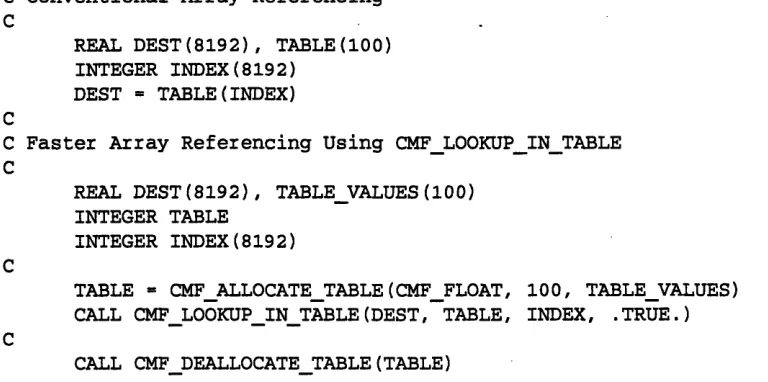
Three procedures are used to perform "table look-ups," that is, vector indirection on a serial dimension of a CM array. Under the conditions noted below, the look-up utility uses the indirect addressing hardware on the CM processing ele-ments to perform local memory accesses, rather than generating communication.
TABLE ID = CMF ALLOCATE TABLE
& ( TYPE, ELEMENT_COUNT, INITIALVALUES )
CALL CMFLOOKUPINTABLE
& ( DEST, TABLEID, INDEX, MASK )
CALL CMF_DEALLOCATE_TABLE (TABLE_ID)
The function ClF_ALLOCATETABLE allocates and initia]izes a look-up table, placing a copy in the memory of each processing element; it returns an integer that serves as a pointer to the table. TYPE is the type of data to be stored in the table; it is specified as one of:
CMF_LOGICAL, CMlF_S_INTEGER,
CMFFLOAT, C FDOUBLE,
CMF_COMPLEX, CMF_DOUBLECOMPLEX
The elements of INITIAL_VALUES must be of the appropriate type.
CeF_LOOKUP_IN_TABLE uses an array of (integer) indices to retrieve values from the look-up table, and stores them in a destination array of the same type.
CMF_DEALTLOCATE_TABLE deallocates a look-up table. For example,
REAL DEST(8192), TABLE VALUES(100) INTEGER TABLE
INTEGER INDEX(8192)
TABLE = CMF ALLOCATE TABLE
& (CMF_FLOAT, 100, TABLE_VALUES)
CALL CMF LOOKUP IN TABLE
& (DEST, TABLE, INDEX, .TRUE.)
CALL CMF DEALLOCATE TABLE(TABLE)
Version 2.0 Beta, January 1993 Copyright C 1991-1993 Thinking Machines Corporation
CM Fortran Utility Library
Refeenc Manual 29
9
3.5.1 Language Comparison
Under certain circumstances, the table look-up procedures are significantly faster than assignments of conventionally allocated arrays. The circumstances are:
* The contents of the look-up table rarely or never change.
* The look-up table is relatively small, that is, it fits into the memory of a single processing element. The size restriction by CM Fortran execution model is:
* CM-5 VU model:
· CM-5 nodes model:
* CM-2/200 slicewise model:
* CM-2/200 Paris model:
Table size is limited by the amount of memory on a vector unit. Table size is limited by the amount of memory on a SPARC node. Table size is limited by the amount of memory on a processing node (which corresponds to a unit of the 64-bit floating-point accelerator). Table size is limited by the amount of memory on a processing node
(which corresponds to 32 bit-serial processors).
Version 2.0 Beta, January 1993
Copyright 0 1991-1993 Thinking Machines Corporation
30
CM Forran Utiliy Librai3.6 Gathers/Scatters on Serial Axes
Two subroutines transfer array-indexed values between two CM arrays. Under the conditions noted below, these procedures use the special indirect addressing hardware for local transfers.
CALL CMF AREF_D (DEST, ARRAY, INDEX, MASK)
CALL CF_ASETID(ARRAY, SOURCE, INDEX, ASK)
The ARRAY argument can be multidimensional. The "D" in the procedure names refers to the fact that the indirect addressing occurs only on a single axis. CMF AREF_iD extracts array-indexed values from the serial axis of ARRAY. INDEX is an INTEGER array of the same shape and layout as DEBST. Each element of INDEX provides an index into ARRAY for the value to be stored in the corre-sponding element of DEBST.
CF ASET_1D performs the opposite operation. INDEX is an INTEGER array of the same shape and layout as SOURCE. In this operation, each element of INDEX
specifies the location in ARRAY at which to store the corresponding element of SOURCE.
3.6.1 Conditions for Fast Performance
These subroutines use the fast indirect addressing hardware when the ARRAY argument meets the following conditions:
* Its first dimension must be serially ordered (that is, local to a processing element).
* It must have one more dimension than the INDEX, MASK, and DEBT arrays.
* Excluding its first axis, its remaining axes must have the same shape and layout as the INDEX, MASx, and DEST arrays.
Version 2.0 Beta, January 1993 Copyright 0 1991-1993 Thinking Machines Corporation
Rerence.'Manual,: 1..'....
In addition, these subroutines are substantially faster when · the MASK argument is the scalar . TRUE..
* the product of the dimensions of the INDEX argument is an integer multi-ple of the number of processing elements executing the program. (This number is returned by the function CMF_NUMBER OFPROCESSORS.)
Two restrictions that affect the performance of these subroutines are:
* The subroutines do not use the indirect addressing hardware under the Paris execution model on CM-2/200, even if the other constraints are met. Their performance under the Paris model is therefore slower than under the other CM Fortran execution models.
* The serial dimension of ARRAY must fit into the memory of a single pro-cessing element. The size restriction by CM Fortran execution model is:
· CM-5 VU model:
* CM-5 nodes model:
* CM-2/200 slicewise model:
· CM-2/200 Paris model:
Serial dimension extent is limited by the amount of memory on a vector unit.
Serial dimension extent is limited by the amount of memory on a SPARC node.
Serial dimension extent is limited by the amount of memory on a proces-sing node (which corresponds to a unit of the 64-bit floating-point accel-erator).
Not applicable.
Version 2.0 Beta, January 1993
Copyright © 1991-1993 Thinking Machines Corporation
32 CM Fortran Utility Library
3.6.2 Gather/Scatter Examples
This call to CMF_AREF_ID is functionally equivalent to the DO loop shown: INTEGER I
INTEGER DEST(8192), ARRAY(10,8192), INDEX(8192) CMF$ LAYOUT ARRAY(:SERIAL, :NEWS)
LOGICAL MASK(8192)
DO I=1,8192
IF (MASK(I)) DEST(I) = ARRAY(INDEX(I),I) END DO
CALL CMFAREF 1D(DEST, ARRAY, INDEX, MASK)
This call to CMF_ASET_1D is functionally equivalent to the DO loop shown:
INTEGER I
INTEGER SOURCE(8192), ARRAY(10,8192), INDEX(8192) CMF$ LAYOUT ARRAY(:SERIAL, :NEWS)
LOGICAL MASK(8192)
DO I=1,8192
IF (MASK(I)) ARRAY(INDEX(I),I) = SOURCE(I)
END DO
CALL CMFASET_1D(ARRAY, SOURCE, INDEX, MASK)
3.6.3 Language Comparison
The FORALL statement expresses the operations shown in the examples above as
follows:
FORALL(I=1:8192, MASK(I)) DEST(I) = ARRAY(INDEX(I),I)
FORALL(I=1:8192, MASK(I)) ARRAY(INDEX(I),I) = SOURCE(I)
In Version 2.0, however, these statements generate send (scatter) or get (gather)
instructions rather than using the local indirect addressing hardware. As long as the stated constraints are met, the utility procedures CMF_AREF_1D and
CMF_ASET_1D give better performance.
Chapter 4
Parallel I/O
The Utility Library procedures in this chapter support CM parallel I/O. Parallel I/O refers to transferring data in multiple streams between the CM processing elements and an external device. The procedures fall into two categories:
* Operations on files of the CM file system
* /O via sockets and devices (including CM-HIPPI)
Language Comparison
The CM Fortran RmAD and WRITE statements perform serial I/O only. A CM array
is first moved to the control processor and then transferred in a single stream to a UNIX file on a storage device. For CM arrays, especially for large ones, the Utility Library I/O procedures give better performance.
4.1 CM File Operations
The CM file system - the destination of parallel write operations - resides on storage devices on the CMIO bus, such as the DataVault mass storage system. Operations on these files are supported by the CM File System library, CMFS. The utility procedures in this section provide a convenient interface to selected procedures in this library.
For more information on the CM file system and library, see the CM I/O docu-mentation for CM-5 or for CM-2/200. Note that support for the CM Scalable Disk Array and its Scalable File System (SFS) begins with CM Fortran Version 2.1.
Version 2.0 Beta, January 1993
34 MI--- CM Fortra- U
4.1.1 Opening, Closing, and Removing CM Files
The subroutines in this section open, close, or remove (unlink) CM files.
Opening a CM File
CXF_FILE_OPEN opens the CM file specified by PATH (a character string) and associates the file with the integer argument mNIT. The value returned in IOSTAT
indicates whether the operation succeeded.
CALL CMF_FILE_OPEN( UNIT, PATH, IOSTAT )
File Units
The I/O procedures currently support 29 simultaneously open file units. For each CM file to be opened, you choose a value in the range 1 through 29. The number becomes associated with a file when it is used as the UNIT argument (variable,
parameter, or literal constant) to
CMFJFILE_OPEN. Youthen supply the
appropriate unit number to other I/O procedures when you wish to operate on this file.
These parallel I/O unit numbers have no relation to standard CM Fortran unit numbers, as described in the CM Fortran Reference Manual for the RMD and
WRITE statements.
Error Status
All the parallel I/O procedures take an integer IOSTAT argument, into which the error status of the operation is placed:
* A positive value in IOSTAT indicates success. * A negative value in IOSTAT indicates failure.
* For the parallel read utilities only (see below), a zero value in IOSTAT
indicates an end-of-file condition.
Other than sign or zero, there is no significance to any of the particular values returned.
Version 2.0 Beta, January 1993 Copyright 1991-1993 Thinking Machines Corporation
Reference Manual 3
Closing a CM File
CMFFILE _CLOSE closes the file associated with UNIT. CALL CMF_FILE_CLOSE( UNIT, IOSTAT )
Removing a CM File
CIF_FILE_UNLINK removes the entry for the file specified by PATH from the file's directory.
CALL CMF_FILE_UNLINK( PATH, IOSTAT )
If this entry is the last link to the file and no process has the file open, then the file is deleted and all resources associated with it are reclaimed. If, however, the file is open in any process, the resource reclamation is delayed until the file is closed, even though the directory entry has disappeared.
4.1.2 Reading and Writing CM Files
The CM Fortran Utility Library provides procedures that read or write CM arrays in parallel, that is, in multiple streams directly between the memory of CM pro-cessors and a CM file on a storage device.
These procedures are available in three variants, reflecting different trade-offs between speed and flexibility. The variants are distinguished by suffix (or lack of): no-suffix or generic, FMS, or SO. They take the same arguments.
CALL CMF_CM ARRAY_TO_FILE (UNIT, ARRAY, IOSTAT)
CALL CMF_CM ARRAY_FROM_FILE (UNIT, ARRAY, IOSTAT)
CALL CMF_ CMARRAY_TOFILE_FMS ...
CALL CMF CM ARRAY FROM FILE_FMS ...
CALL CM CM ARRAY TO FILE SO CALL CMF CM ARRAY FROM FILE _ SO
Always read a file with the same variant that was used to write it.
Version 2.0 Beta, January 1993
Copyright C. 1991-1993 Thinking Machines Corporation
36
CM Fortran Utility LibrarArguments
UNIT Integer variable, parameter, or literal constant in the range 1:29. This is the unit number that became associated with a file by the initial call to CMF_FILE_OPEN (see Section 4.1.1).
ARRAY CM array of any type and layout. This array is the source or destina-tion of the 1O operadestina-tion.
IOSTAT Integer variable. The value returned in this argument indicates the error status of the operation:
· A positive value in IOSTAT indicates success. * A negative value in IOsTAT indicates failure.
· For the parallel read utilities only, a zero value in IOSTAT indicates an end-of-file condition.
NOTE
Like all procedures in the Utility Library, these 1/O procedures cannot be used with any array that is aligned with another array of higher rank or aligned with non-zero axis offset(s) with any other array.
Unlike other Utility Library procedures, these I/0 procedures do support arrays with lower bounds other than 1.
Behavior
The three sets of read/write procedures give different combinations of speed and portability. The FMS ("fixed machine size") routines are the fastest but the least flexible. The SO ("serial order") routines are slower but the most portable across CM configurations and execution models. The generic (no-suffix) routines are a compromise between the two for general-purpose use.
4-:; ;
Version 2.0 Beta, January 1993 Copyright 0 1991-1993 Thinking Machines Corporation
R-eference-
-Manul-3
The generic and FMS procedures treat file data in a parallel order, which we call the geometry of the file. File geometry reflects the shape and layout of the first array written to that file. In consequence:
* All subsequent writes to a parallel-ordered file must be of arrays of the same shape and layout as the first, and any read operation from the file must be to an array of the same shape and layout.
* Parallel-ordered files may contain extraneous data (padding) in scattered locations. As long as you observe the restrictions on using the FMS and generic routines (summarized in the table below), the padding is handled transparently when the file is read.
In the interest of speed, the FMS procedures impose the further restriction that write and read operations of a CM file must be from the same execution model, and the same machine size (number of processing elements). Hence the term "fixed machine size." These procedures are not portable from one CM model (CM-2/200 versus CM-5) to the other.
The generic procedures, in contrast, are limited only by array shape, layout, and CM model. They can write and then read from different execution models and machine sizes, although the following restrictions do apply on CM-2/200 only:
* An array written under one CM-2/200 execution model (Paris or slicewise) and read under the other execution model must have canonical layout. You can work around this restriction by assigning a non-canonical array to a canonical temporary before writing it to a file.
* An array written from one CM-2/200 machine size and read into a different machine size must be at least the size of the larger machine. That is, the array must have at least as many elements as the number of bit-serial pro-cessors in the larger machine (even under the slicewise execution model). The SO procedures treat file data in serial order. Serial ordering is the same as array-element ordering and the same as the output of the Fortran WRITE state-ment. For example, the SO utility stores the elements of array A (2,3) in the following order:
A(1,1)
A(2,1)
A(1,2)
A(2,2)
A(1,3)
A(2,3)
Version 2.0 Beta, January 1993
Copyright 1991-1993 Thinking Machines Corporation
38 CM Fortran Utility Librar
Unlike the generic and FMS variants, the SO procedures do not pad files. Because they read and write only the array elements, not any extraneous data, these utili-ties operate independently of array shape and layout, and are completely portable across CM hardware models, execution models, and machine sizes. The SO utili-ties are also compatible with parallel I/O via sockets and devices (Section 4.2).
The following table summarizes the behavior of the three variants of the parallel read/write utility procedures. The "portability" entry refers to restrictions on sub-sequent reads and writes of a CM file after the first array has been written to it.
Variants of CF CM ARRAY _TO/FROM FILE.
FMS Generic SO
CM-5
File order parallel parallel serial
Padding yes yes no
Portability CM-5 only CM-S only any CM or device
same partition size any partition size any partition or machine size same exec. model any exec. model any exec. model same array shape same array shape any array shape same array layout same array layout any array layout
CM-2/200
File order parallel parallel serial
Padding, if any yes yes no
Portability CM-2/200 only CM-2/200 only any CM or device same machine size any machine size* any machine
or partition size same exec. model any exec. model any exec. model same array shape same array shape any array shape same array layout same array layout** any array layout
* If written from one machine size and read into a different machine size, the array must be at least the size of the larger machine.
** If written from one execution model and read into the other execution model, the array must have canonical layout.
Version 2.0 Beta, January 1993 Copyright O 1991-1993 Thinking Machines Corporation
Reference Manual 1 --
3941181
4.1.3 Manipulating CM Files
The procedures in this section rewind, seek within, or truncate a CM file.
Determining File Geometry
All seek, rewind, and truncate operations on CM files must be preceded by a read or write operation. It is necessary first to determine the geometry of a newly opened file, even a serial-order file, by performing a read or write of the file. For the CM-5 only, a further restriction is that the element size in any file manipu-lation (rewind, seek, or truncate) must be the same as the element size in the read or write operation that initially determined the file's geometry in that session.
Rewinding a File
CUg FILE _RwIND moves the file pointer to the beginning of a CM file.
CALL CMF_FILE_REWIND( UNIT, IOSTAT )
Seeking within a File
Three procedures serve to reposition the file pointer in a CM file:
CALL CfF_FILE_LSEEK( UNIT, OFFSET, IOSTAT )
CALL CMF_FILE_LSEEK_FM ( UNIT, OFFSET, IOSTAT )
OFFSET - CF_SIZEOF_ARRAY_ELEMENT( ARRAY )
CMF_FILE _LSEE operates on files written with the generic and SO write
proce-dures; use
CMF_FILE_LSEEKEFMSon files
writtenwith the FMS write
procedure.
Version 20 Beta, Januwy 1993
Copyright 0 1991-1993 Thinking Machines Corporation
The seek utilities operate slightly differently on serial-ordered files (those written with the SO procedure), compared with parallel-ordered files (those written with the generic or FMS procedure).
* In serial-ordered files, CMF_FILE LSEEK can move the file pointer either
to an array boundary or to an arbitrary element (though not to an arbitrary bit or byte boundary). For the OFFSET argument, use the number of bytes in the array's element type times the number of elements to traverse.
* In parallel-ordered
files,
CMF_FILE_LSEEK and CMF_FILE_LSEEK_FMSmove the file pointer only from one array to another within a file. You cannot move it to an arbitrary element. To compute the offset, you need not specify the size of the array(s), since this information is contained in the file geometry. You need specify only the size of an array's elements,
using
CMF_SIZEOF_ARRAY ELEMENT.For example, suppose that a parallel-ordered file associated with unit 29 was created with three successive writes, of array A, then array B, then array c. To position the file pointer to the beginning of array B, use:
CALL CMFFILEREWIND( 29, IOSTAT )
SIZEOF_A = CMF_SIZEOF_ARRAY_ELEMENT( A ) CALL CMF FILE LSEEK( 29, SIZEOF A, IOSTAT )
To move the file pointer to the beginning of array c, add the return values of CMF_SIZEOF_ARRAY_ELEMENT for the two arrays to be traversed:
CMF FILE REWIND( 29, IOSTAT )
SIZEOFA = CMF SIZEOF ARRAY ELEMENT( A )
SIZEOFB = CMFSIZEOF ARRAYELEMENT( B )
CMF_FILE_LSEEK( 29, SIZEOF_A + SIZEOF_B, IOSTAT )
To read arrays A and c:
CALL CMFFILE REWIND( 29, IOSTAT )
CALL CMF_CM_ARRAY_FROM_FILE( 29, DEST_A, IOSTAT ) CALL CMF_FILE_LSEEK( 29, SIZEOF_B, IOSTAT )
CALL CMF_CM ARRAYFROM FILE( 29, DESTC, IOSTAT )
If these arrays had been written with CMF_CM_ARRAY_TO_FILE_FMS, you would have used the FMS variant of the seek and read procedures.
Version 2.0 Beta, January 1993 Copyright © 1991-1993 Thinking Machines Corporation
Reference ManualI41
Changing the Size of a File
CMF_FILE TRUNCATE increases or decreases the size of a CM file:
CALL CF_FILE_TRUNCATE( UNIT, LENGTH, IOSTAT )
LENGTH - CMF_SIZEOF ARRAY ELEMENT ( ARRAY )
This subroutine changes the size of the file specified by UNIT to LENGTH. If the file is smaller than LENGTH, it is extended to LENGTH. If the file is larger than
LENGTH, it is truncated and the extra data is lost. The file must be open when
ClF_FILE TRUNCATE is
called.
Like the seek procedures described above, CMF_FILE_TRUNCATz behaves slightly differently with serial-ordered and parallel-ordered files, and you com-pute the LENGTH argument differently for the two kinds of files.
* CEF FILE_TRUNCATE can extend or truncate a serial-ordered file either by whole arrays or by an arbitrary number of array elements (though not by an arbitrary number of bits or bytes). For the LENGTH argument, supply the number of bytes in the array's element type times the number of ele-ments desired.
* CIF_FILE_TRUNCATE can extend or truncate a parallel-ordered file only by whole arrays, not by an arbitrary number of array elements. To com-pute the LENGTH argument, you need not specify the size of the array(s), since this information is contained in the file geometry. Specify only the size of array elements, using CF_SXZEOFARRAY_ELEMENT.
You compute the LENGTH argument for parallel-ordered files in the same way as the OFFSET argument for the seek procedures, shown above. And, as with the seek procedures, you can extend or truncate a file by more than one array by
invoking CKF_IZEOF_ARRAY_ ELEMENT on several arrays in succession, adding the returned values, and supplying the result as the LENGTH argument.
Version 2.0 Beta, January 1993
Copyright © 1991-1993 Thinking Machines Carporation
42 CM Fortran-U--l--y-Library
4.1.4 Example of CM File Operations
The following program writes five arrays into a file and then reads the third one:
PROGRAM READ RECORD
INTEGER FILE UNIT, IOSTAT, RECORD REAL A(8192)
DOUBLE PRECISION B(8192) COMPLEX C(8192), DEST(8192) DOUBLE C