DISTRIBUTING INTELLIGENCE
WITHIN AN INDIVIDUAL
To appear in:
This research was supported by DARPA contract
and NIH contract and by gifts from Rockwell International, Inc. and FMC Corporation, Inc. The Palo Alto VAMC supports Dr. Adam Seiver's participation in the project. Mr. Reed Hastings and Mr. Nicholas Parlante worked on an earlier version of Guardian. We have had many discussions of the
intensive care monitoring task with our colleague, Dr. Lawrence and his students. We thank Dr. Edward Feigenbaum for
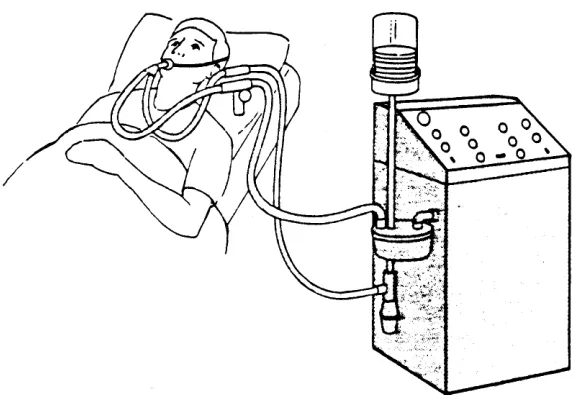
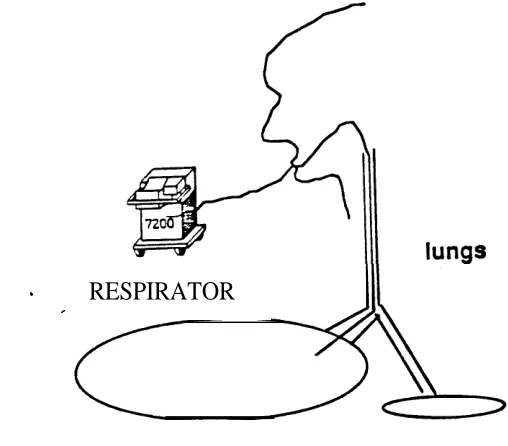
Figure 1: Patient Supported by a Ventilator.
best grasp of minute-to-minute details of the patient’s condition. Other consultants have the best understanding of particular aspects of the patient’s condition within their specialty. For . example, respirator therapists have detailed of the functioning and use of the respirator. Radiologists are expert at reading chest X-rays. High-quality patient monitoring requires cooperation among critical care team members to continuously interpret patient and determine therapeutic actions.
The team model of SICU monitoring reflects both organizational and economic considerations. As medical knowledge has grown, the profession has distributed that knowledge among increasingly specialized Each of these specialists is exceptionally well prepared to handle a part of the SICU monitoring task, but none is adequately prepared to handle the entire task. In addition, physician specialists are too valuable to take responsibility for the routine 80% of monitoring activities.
Nonetheless, the team model of STCU monitoring has serious limitations. Given the distribution of knowledge and skills among different experts with multiple responsibilities, , these experts are rarely present in the SICU at precisely the moment their expertise is required.
5
replan the patient’s therapy.
3. Guardian must a range of strategies. It contextual information to focus its search among plausible diagnoses. It must use “quick and . dirty” reasoning methods when more precise methods exceed the available time. It must fall back on first principles when faced with that fall outside its clinical knowledge.
4. Guardian must perform multiple tasks concurrently. ‘For example, it must continue to interpret newly perceived patient data while diagnosing previously perceived signs and symptoms. In general, it must be prepared to perform variable subsets of its several tasks, as required by the SICU situation.
5. Guardian must an orderly and explainable reasoning process. It must establish goals and either pursue them to a satisfactory and timely conclusion or determine that they are no longer worth pursuing. It must produce persuasive explanations of its reasoning behavior and associated conclusions.
6. Guardian must coordinate loosely coupled reasoning activities. It must reconcile the results of related reasoning activities to produce an internally consistent patient model and treatment plan.
7. Guardian must produce globally coherent behavior. It must coordinate its perception and cognition to focus dynamically on the most critical aspects of the changing patient situation. It must coordinate its cognition and actions to address the most critical aspects of the patient situation in a timely fashion.
3.1. System Overview
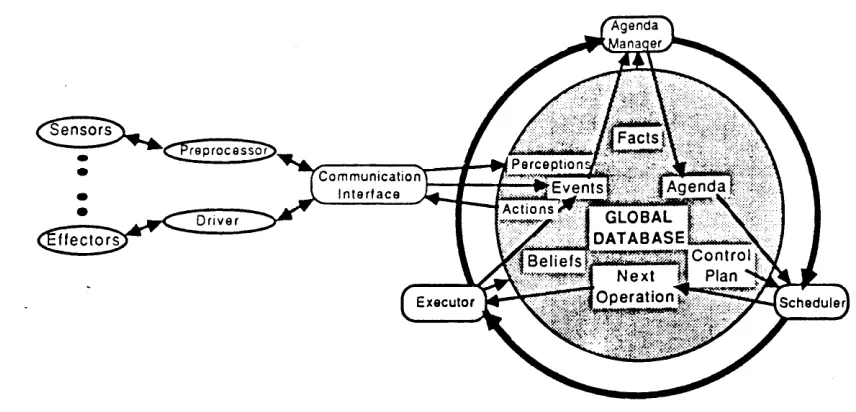
Figure 3-l: A Generic Architecture.
We begin with the generic architecture for a individual put forth in 8, The architecture provides three general categories of function: (a) perception to acquire information from the environment; (b) action to affect entities in the environment: and (c) cognition to interpret perceived information, solve problems, make decisions, and plan actions. As illustrated in Figure the architecture distributes the intelligence underlying these functions among three corresponding categories of agents: (a) multiple locally controlled perception agents; (b) multiple locally controlled action agents; and (c) a centrally controlled system of diverse cognitive agents.
.
7
its own limited resources among competing cognitive agents. It imposes attentional parameters on perception agents, which they incorporate in their own local control. It imposes task demands and performance parameters on action agents, which they incorporate in their own local control. To support interactions among cognitive, perception, and action agents, the model provides asynchronous communications along the paths indicated in Figure 3-1.
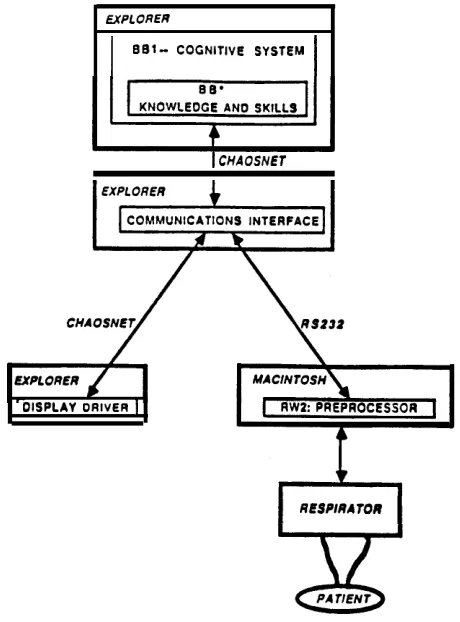
Figure 3-2: Guardian System Organization.
8
The following sections describe generic subsystems for cognition, perception, and action and their instantiations in the current Guardian system
3.2. The Cognitive System
The cognitive system, which is framed within the architecture is responsible for all knowledge-based reasoning required to perform the overall task. In Guardian’s case, it must interpret, diagnose, predict, and explain the patient’s condition, and plan therapeutic actions. It must dynamically focus its own limited computational resources on the most important and urgent of these tasks and it must focus its subordinate perception and action agents on important patient data and therapeutic actions.
:
blackboard :
Figure 3-3: Some of Guardian’s Knowledge of the
Anatomy and Physiology of the Human Respiratory System
9
facts, cognitive skills, etc. It also provides an editor for building application-specific modules representing factual knowledge and cognitive skills. For example, Figure 3-3 illustrates some of Guardian’s knowledge of the anatomy and physiology of the human respiratory system.
Although represents all knowledge declaratively, cognitive skills embody performance knowledge for particular tasks and may be viewed as agents in the model. In fact, each cognitive skill may include a number of knowledge sources, each of which defines the triggering conditions for one of the operations involved performing in the associated task. Each knowledge source may be viewed as a smaller-grained
The current Guardian system includes these factual knowledge modules and cognitive skills modules:
Bio-Facts contains factual knowledge of the normal and abnormal anatomy and physiology of the respiratory, circulatory, pulmonary exchange, tissue exchange, and tissue systems (see Figure 3-3).
l Cljnical-Facts contains Bayesian belief networks relating common respiratory signs
and symptoms to likely underlying faults and relating likely faults to standard treatments.
. l Generic-Systems-Facts contains factual knowledge of the normal and abnormal
structure and function of generic flow, diffusion, production, and consumption system models.
l Classify-Skill contains performance knowledge for classifying input data as
instances of known categories of normal/abnormal parameters and parsing them into appropriate temporal episodes.
l Assoc-Skill contains performance knowledge for using belief networks to diagnose
observed signs and symptoms.
l ICE-Skill contains performance knowledge for using generic system models to
10
React-Skill contains performance knowledge for using association networks to generate standard treatments for commonly diagnosed faults.
l contains performance knowledge for managing dynamic imbalances in
input data rates and cognitive load.
As these descriptions su,, none of the knowledge modules is specific to Guardian or the SICU monitoring For example, Bio-Facts and Clinical-Facts could be used in a variety of medical and biological applications. Generic-Systems-Facts could be used in any domain involving the designated types of systems. All of the skills modules are
independent.
respiratory-structur respiratory-structur
continues
Figure 3-4: Integration of Knowledge from Two Modules: Bio-Facts and Generic-Systems-Facts.
allows the user to construct knowledge modules independently, load them in different
13
4. Guardian’s Performance
on a Typical
SICU Scenario
4.1. Monitoring a Stable Ventilator-Assisted Patient
RESPIRATOR
Figure 1: Stable Ventilator-Assisted Patient.
The scenario begins with a stable ventilator-assisted patient. (As shown in Figure 3-2, we simulate the patient and ventilator for development purposes.) As illustrated in Figure 4-1, the ventilator delivers a prescribed volume of air to the patient’s two lungs on each breath. Two important measured parameters are the peak pressure applied by the ventilator and the tidal
volume of air actually received by the patient on each breath. In the normal situation, these two parameters vary normally about the prescribed values.
As illustrated in Figure 4-2, Guardian’s Mediator asynchronously receives every sensed data point for peak pressure and tidal volume. The Mediator applies “threshold filters” specified by Backlog and relays only data points that differ from their predecessors by the specified percentage. These data points are marked by vertical bars in Figure 4-2. The communications interface receives relayed data points and inserts them into appropriate logical input buffers, as illustrated Figure 4-3, where they are available to Guardian’s cognitive skills. Thus, Guardian’s sensors, perceptual preprocessor, and communications interface function in parallel to provide selective perception of asynchronously occurring patient data.
14
4-3: Input Buffers and Associated Filters Managed by Backlog
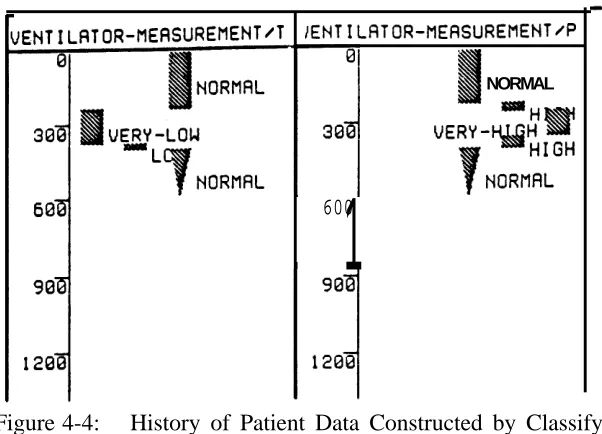
data points of a given value category to model continuous temporal episodes (see Figure 4-4). Thus, Guardian incrementally builds a history of asynchronously perceived patient data.
15
NORMAL
600
1
Figure 4-4: History of Patient Data Constructed by Classify
side of Figure 4-3 indicates a filter threshold for each input buffer, as established by Backlog.
C l a s s i f v d a t a
M a n a g e p e r c e p t u a l b a c k l o g
A s s o c i a t i v e l y d i a g n o s e h i g h p e a k p r e s s u r e
A s s o c i a t i v e l y d i a g n o s e l o w t i d a l v o l u m e
f r o m f i r s t - p r i n c i p l e s m o d e l
T I M E
Figure 4-5: Illustrative Control Plan
16
4.2. Diagnosing and Explaining Time-Varying
After a period of monitoring a stable patient, Guardian notices that something has gone wrong. Classify notices abnormally high value; for the parameter peak pressure (see the right side of Figure triggering both and ICE. TO diagnose this sign quickly, however,
Guardian makes a control decision to apply ASSOC’S highly efficient (but less explicit and less
complete) associative reasoning, in favor of computationally expensive model-based reasoning.
RESPIRATOR
Figure 4-6: Increased Peak Pressure Caused by One-Sided Intubation
Assoc diagnoses “one-sided in tubation.” As illustrated in Figure 4-6, when the respirator tube slips into one of the patient’s bronchi, the ventilator delivers the prescribed volume of air to only one lung, causing peak pressure to rise.
Because SICU monitoring is a dynamic situation, Guardian must continue to monitor new patient data and keep the patient model up to date while it performs its diagnosis. In fact, it must-be prepared to revise its diagnosis in light of new patient data. Accordingly, as illustrated in Figure 4-5, Guardian decides to perform Classify and Assoc tasks concurrently. It so happens that, while Assoc is diagnosing intubation,” Classify records a new sign, low tidal volume. This new sign triggers both Assoc and ICE and, again, Guardian prefers the more efficient Assoc method.
Taking into account the new sign, Assoc revises its diagnosis in favor of “kinked tube.” As illustrated in Figure 4-7, a kinked tube prevents the ventilator from delivering air past the
RESPIRATOR
Figure 4-7: Increased Peak Pressure and Decreased Tidal Volume
Caused by a Kinked Tube
4.3. Falling Back on First Principles
of the
CE
21
Hayes-Roth, B., Hayes-Roth, F., Rosenschein, and Cammarata, S. Modelling planning as an incremental, opportunistic process.
Proceedings of International Joint Conference on Artificial Intelligence
1979.
Hayes-Roth, B.
A blackboard architecture for control.
Artificial Intelligence Journal 1985.
Hewett, M., and Hayes-Roth, B.
Real-Time in Knowledge-Based Systems.
In Proceedings of the on Blackboard 1988.
Hewitt, C.
Viewing control structures as patterns of passing messages.
Artificial Intelligence 1077.
W.A., Draper, E.A., Wagner, D.P., and Zimmerman, J.E.
An evaluation of outcome from intensive care in major medical centers.
l
Rosenschein, J.S., and Genesereth, M.R. Deals among rational agents.
Proceedings of the Ninth International Joint Conference on Artificial Intelligence ,
1985.
Shastri, L.
A connectionist encoding of semantic networks.
In Huhns, M. N. (editor), Distributed Artificial . London: 1987.
Smith, R.G., and Davis, R.
Distributed problem solving: The contract net approach.