of emotional speech.
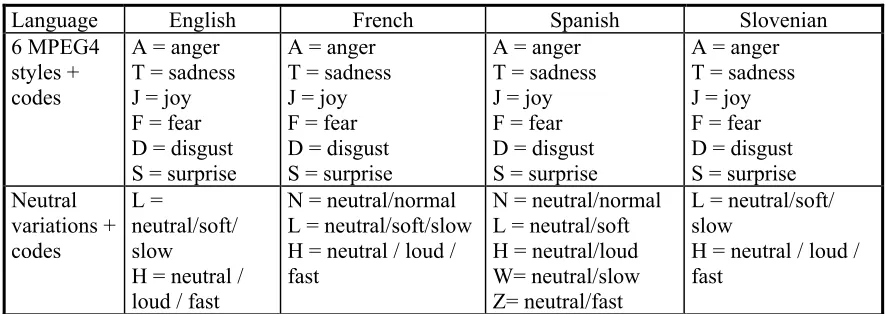
The neutral styles were also defined as a reference to emotional speech. Additional variations on neutral style have been proposed: slow-soft and fast-loud neutral styles for the French, Slovenian and English databases, and slow, soft, loud, and fast neutral styles for the Spanish one.
For each language, one male speaker and one female speaker have been recorded except for English language where two male and one female speaker were recorded. All speakers were actors.
2.1. Directory structure
The definition of the directory structure is the same for all languages and is presented in table 2.
2.2. File nomenclature
File names follow the ISO 9660 file name conventions (8 plus 3 characters) according to the main CD ROM standard. The template shown in the table 3 is used. \<database>\<spk>\<session>
<database> Defined as: <dbName><#><language code> i.e. INTER1FR Where:
<dbName> is INTER
<#> is 1 for Synthesis database
<LL> is the ISO 2-letters code FR for French, EN for English, SI for Slovenian, SP for Spanish
<spk > Defined as: <n>
where <n> is M(male) or F(female) speaker. <session > Defined as: SESS<s><00n>
Where :
<s> is a character standing for the emotional style performed by the professional actor. See table 3 for details.
<00n> gives the session number (n = 1, 2).
Table 2: Definition of directory structure for all languages.
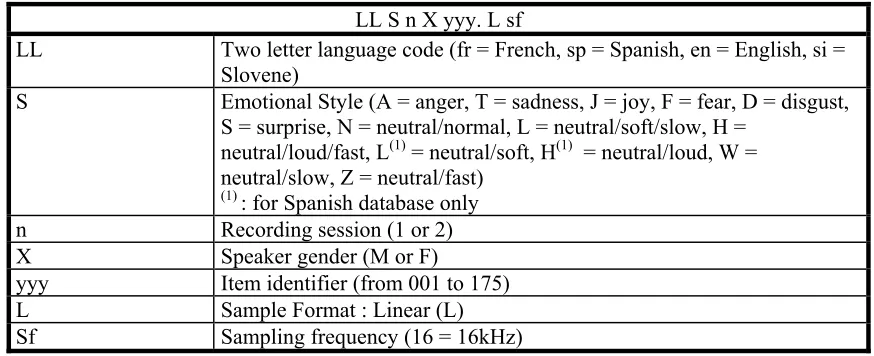
LL S n X yyy. L sf
LL Two letter language code (fr = French, sp = Spanish, en = English, si = Slovene)
S Emotional Style (A = anger, T = sadness, J = joy, F = fear, D = disgust, S = surprise, N = neutral/normal, L = neutral/soft/slow, H =
neutral/loud/fast, L(1) = neutral/soft, H(1) = neutral/loud, W =
neutral/slow, Z = neutral/fast)
(1) : for Spanish database only
n Recording session (1 or 2) X Speaker gender (M or F)
yyy Item identifier (from 001 to 175) L Sample Format : Linear (L) Sf Sampling frequency (16 = 16kHz)
Table 3: Definition of file nomenclature of Interface databases for all languages.
Item identifier Sentence type
English Slovenian Spanish French
Digits and numbers 1 to 15 1 to 15 151 to 160 1 to 25 Isolated words 16 to 35 16 to 35 161 to 184 26 to 36 Short sentences 36 to 55 36 to 55
Middle long sentences 56 to 115 56 to 115 Long sentences 116 to 135 116 to 135
Paragraph text 136 to 186 136 to 190 135 to 150
Affirmative sentences 1 to 100 37 to 155
Interrogative sentences 101 to 134 156 to 175
3.
Corpuses
The corpuses consist of 175-190 sentences for each language. They include isolated words, sentences, and a text passage. Sentences have been chosen with different length (short, medium, and long) including affirmative and interrogative forms. The table 4 show the definitions of the corpuses for each language.
Short sentences are composed from five to eight words, middle long sentences are composed from nine to thirteen words and long sentences are composed from fourteen to eighteen words.
The sentences of the corpus were selected from large collection of text that should contain emotionally neutral context. The sentences were selected in a way to achieve
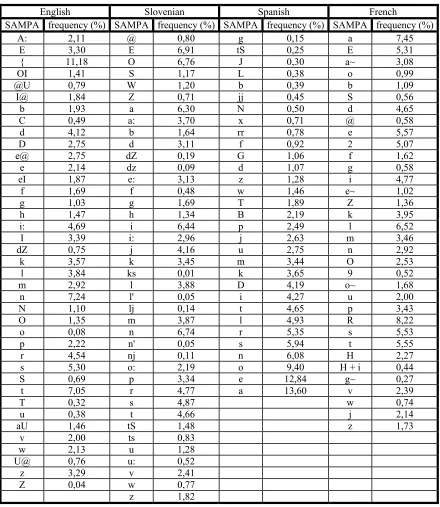
phonetically balanced corpuses. Table 5 shows the frequencies of phonemes for each language.
4.
Recording condition
The recordings have been performed in silent rooms using a high quality condenser microphones. The speakers have read the sentences either from prompt sheet or from the display of the PC, which has been placed on the other side of a glass window. Except for the French database, two channels were recorded simultaneously, one for the microphone and the other for the laryngograph signal.
Recordings of the English and the Slovenian database have been made using a condenser microphone, AKG 3000B and Portable Laryngograph from Laryngograph Ltd. Recordings of Spanish database have been made
English Slovenian Spanish French
SAMPA frequency (%) SAMPA frequency (%) SAMPA frequency (%) SAMPA frequency (%)
A: 2,11 @ 0,80 g 0,15 a 7,45
E 3,30 E 6,91 tS 0,25 E 5,31
{ 11,18 O 6,76 J 0,30 a~ 3,08
OI 1,41 S 1,17 L 0,38 o 0,99
@U 0,79 W 1,20 b 0,39 b 1,09
I@ 1,84 Z 0,71 jj 0,45 S 0,56
b 1,93 a 6,30 N 0,50 d 4,65
C 0,49 a: 3,70 x 0,71 @ 0,58
d 4,12 b 1,64 rr 0,78 e 5,57
D 2,75 d 3,11 f 0,92 2 5,07
e@ 2,75 dZ 0,19 G 1,06 f 1,62
e 2,14 dz 0,09 d 1,07 g 0,58
eI 1,87 e: 3,13 z 1,28 i 4,77
f 1,69 f 0,48 w 1,46 e~ 1,02
g 1,03 g 1,69 T 1,89 Z 1,36
h 1,47 h 1,34 B 2,19 k 3,95
i: 4,69 i 6,44 p 2,49 l 6,52
I 3,39 i: 2,96 j 2,63 m 3,46
dZ 0,75 j 4,16 u 2,75 n 2,92
k 3,57 k 3,45 m 3,44 O 2,53
l 3,84 ks 0,01 k 3,65 9 0,52
m 2,92 l 3,88 D 4,19 o~ 1,68
n 7,24 l' 0,05 i 4,27 u 2,00
N 1,10 lj 0,14 t 4,65 p 3,43
O 1,35 m 3,87 l 4,93 R 8,22
o 0,08 n 6,74 r 5,35 s 5,53
p 2,22 n' 0,05 s 5,94 t 5,55
r 4,54 nj 0,11 n 6,08 H 2,27
s 5,30 o: 2,19 o 9,40 H + i 0,44
S 0,69 p 3,34 e 12,84 g~ 0,27
t 7,05 r 4,77 a 13,60 v 2,39
T 0,32 s 4,87 w 0,74
u 0,38 t 4,66 j 2,14
aU 1,46 tS 1,48 z 1,73
v 2,00 ts 0,83
w 2,13 u 1,28
U@ 0,76 u: 0,52
z 3,29 v 2,41
Z 0,04 w 0,77
z 1,82
that are multilingual and based on common specifications. These databases could be also used for comparison of emotions between different languages.
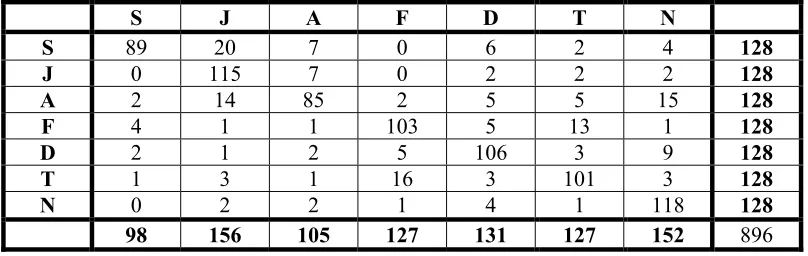
Slovenian and Spanish subjective evaluation tests showed comparable results to other subjective tests of emotional speech databases (Tickle, 2000). Furthermore, the database is used to develop a multilingual emotion classifier and will be used for multilingual emotion modelling for speech synthesis.
The database is produced and owned by the different speech partners within the Interface project and has been sponsored by the European Commission in the scope of the Interface project IST-1999-10036.
8.
References
Anscobe E. and Geach P. (1970). Descartes Philosophical Writing, Nelson: The Open University
Cornelius R. (1996). The Science of Emotion. New Jersey: Prentice-Hall..
Johnstone I. T. (1996). Emotional speech elicited using computer games. Proceedings of the 4th International Conference on Spoken Language Processing, 3, 1985-1988.
Kramer E., (1963). Judgment of Personal Characteristics and Emotions from Nonverbal Propertiesof Speech.
Psychological Bulletin, 60.
Tickle A. (2000). English and Japanese Speakers' emotion vocalisation and recognition: A comparision highlighting vowel quality. Proc. from ISCA Workshop on speech and emotion.
AKG Acoustics inc., (1999), AKG 3000B Condenser microphone datasheet