ü. ." 0!0#2)" !.1)" # / #0*0 10 .2. 1*01" 3&".
(‘ine ‘enas erevnitik’os organism’os pu /ul’evi se ’emata s’inesis fon’is / It is a research organization working on speech synthesis issues).
In order to achieve variable bit rates, we varied
lfr
for CSE and have created different code books. Below, the choices of all the parameters used in this experiment as well as the resulting bit rate are presented in tabular form (see Table 2).In Figure 3, the magnitude spectrum of a selected part of the reference incoming signal in(3500:4000) is presented in solid line along with its respective reconstructed CELP spectrum (dashed line) and the proposed method’s result (dotted line). The spectrum is presented for the frequency range between 0 and 1200 Hz, while all signals are normalised. Note that both techniques attempt to model the spectrum of the signal as accurately as possible. For this particular case the third peak of the spectrum is better modeled by the new method than CELP.
In Figure 4, the same quantities are depicted for a part of the second test incoming signal (Greek sentence)
in(8200:8700), where the magnitude spectrum is
presented in solid line along with its respective reconstructed spectrum at 2400 bps (dashed line) and the reconstructed spectrum at 1200 bps (dotted line), for the normalized signals. In (a) the Frequency range between 0 and 700 Hz is depicted while in (b) between 1300 and 2100 Hz.
Note that despite the similar behavior of the new method at low frequencies for both rates 2400 bps and 1200 bps, the high frequency content at 1200 bps is rather poor. This
also explains the drop of the quality of the reconstructed signal at 1200 bps compared to that at 2400 bps.
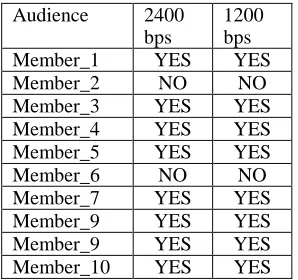
A new perceptual evaluation procedure had been adopted using the same audience as in the previous experiment. They were asked to indicate whether the sentences listened to, were intelligible or not. At this stage, no need for marking of the best result in terms of quality is required, since it is pretty obvious that the quality of reproduction is analogous to the bit rate used. In Table 3, the subjects’ answers are depicted. The majority of the evaluators (80%) indicated that both techniques provide intelligible reconstruction.
Audience CELP Method’s Intelli-gibility
NEW methods’ Intelli-gibility
Best Quality
Member_1 YES YES CELP
Member_2 YES YES CELP
Member_3 YES YES CELP
Member_4 YES YES CELP
Member_5 YES YES CELP
Member_6 YES YES CELP
Member_7 YES YES CELP
Member_8 YES YES NEW
Member_9 YES YES NEW
Member_10 YES YES CELP
Table 1. Intelligibility Evaluation for CELP standard and the new system at 4800 bps
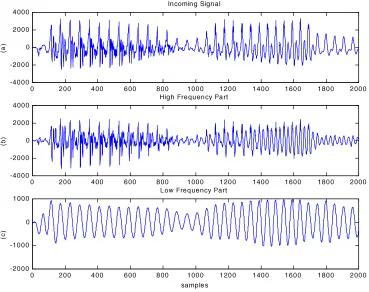
0 200 400 600 800 1000 1200 1400 1600 1800 2000
-4000 -2000 0 2000
4000 Incoming Signal
0 200 400 600 800 1000 1200 1400 1600 1800 2000
-4000 -2000 0 2000
4000 High Frequency Part
0 200 400 600 800 1000 1200 1400 1600 1800 2000
-2000 -1000 0
1000 Low Frequency Part
samples
Figure 3: The magnitude spectrum of a selected part of the incoming signal in(3500:4000) (solid line) along with its respective reconstructed CELP spectrum (dashed line) and the proposed method’s result (dotted line).
Figure 4: The magnitude spectrum of a selected part of the second test incoming signal in(8200:8700) (solid line) along with its respective reconstructed spectrum at 2400 bps (dashed line) and 1200 bps (dotted line).
Frequency ranges: (a) between 0 and 700 Hz and (b) between 1300 and 2100 Hz.
0 200 400 600 800 1000 1200
0 2 4 6 8 10
Frequency (Hz)
0 100 200 300 400 500 600 700
0 2 4 6
1300 1400 1500 1600 1700 1800 1900 2000 2100
-2 0 2 4 6
LF part HF part
Number of Sinusoids
frame length
CodeBook size
CodeBook
dimension Achieved Segmental
Nsin lfr w N Bit Rate SNR
3 500 9 70 2400 bps 7.5 dB
3 1000 9 200 1200 bps 3.9 dB
Table 2. Parameter Choice and their corresponding Segmental SNR’s and approximate Bit Rates for the new method.
Audience 2400 bps
1200 bps
Member_1 YES YES
Member_2 NO NO
Member_3 YES YES
Member_4 YES YES
Member_5 YES YES
Member_6 NO NO
Member_7 YES YES
Member_9 YES YES
Member_9 YES YES
Member_10 YES YES
Table 3. Intelligibility Evaluation for the new system at variable bit rates.
Conclusion
In this paper we have presented a new low rate speech coding algorithm, based on a subband approach.
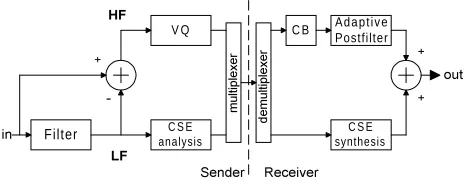
A frame of the incoming signal is first fed to a low pass filter, thus yielding the low frequent (LF) part, while a non-smoothed high frequency (HF) part results by subtraction of the LF from the incoming signal. The HF part is modeled using waveform vector quantisation (VQ), while the LF one via sinusoidal modeling based on SVD (CSE method). At the receiver side, an adaptive postfiltering based on SVD is performed to the HF part and a CSE resynthesis is performed to the LF part, before the two components are added in order to produce the reconstructed signal.
With the appropriate selection of the frame size for CSE and the dimension for the code book, the proposed algorithm results in progressive speech compression and makes therefore possible a variable bit rate scheme. The new method compared to the CELP algorithm at 4800 bps, was proven of similar quality in terms of segmental SNR. Moreover, perceptual evaluation tests proved the new method equally intelligible, while the majority of the evaluators preferred CELP quality. Further perceptual evaluation tests were conducted for the new method at different bit rates and the majority of the evaluators proved it intelligible from this point downward to 1200 bps.
Further research will consist of fine tuning the different parameters involved, namely cut-off frequency, CSE based coding (frame length, number of exponentials), size and dimensions of the code book, aiming at enhancing the speech quality for various bit rates.
References
Campbell, Joseph P.Jr., Thomas E. Tremain and Vanoy C. Welch (1991). “The Federal Standard 1016 4800 bps CELP Voice Coder”, Digital Signal Processing, Academic Press, Vol. 1, No.3, pp.145-155.
Doclo, S., Dologlou, I. And Moonen, M. (1998). A novel iterative signal enhancement algorithm for noise reduction in speech. In Proceedings of the ICSLP 1998.
Dendrinos, M., Bakamidis, S. and Carayannis, G. (1991). Speech enhancement from noise: A regenerative approach. Speech Communication, vol.10, no.2, pp.45-47.
Fotinea, S-E., Dologlou, I., Hatzigeorgiu, N. and Carayannis, G. (2000). Spectral Estimation based on the eigenanalysis of companion-like matrices. Accepted for for ICASSP2000, June 5-9, Istanbul, Turkey.
Gersho, A. and Gray, R. (1992). Vector Quantization and Signal Compression, Kluwer Academic Publishers, Boston.