Resources for multilingual text generation in three Slavic languages
John Bateman
Linguistics and Literature, University of Bremen [email protected]
Serge Sharoff
Russian Research Institute for Artifi-cial Inteligence
Elke Teich
Institute for Applied Linguistics, Translation and Interpretation,
University of the Saarland [email protected]
Geert-Jan Kruijff
Ivana Kruijff-Korbayová
Institute of Formal and Applied Linguistics,
Charles University {gj, korbay}@ufal.mff.cuni.cz
Hana Skoumalová
Institute of Theoretical and Computa-tional Linguistics,
Charles University [email protected]
Abstract
The paper discusses the methods followed to re-use a large-scale, broad-coverage English grammar for constructing similar scale grammars for Bulgarian, Czech and Russian for the fast prototyping of a multilingual generation system. We present (1) the theoretical and methodological basis for resource sharing across languages, (2) the use of a corpus-based contrastive register analysis, in particu-lar, contrastive analysis of mood and agency. Because the study concerns reuse of the grammar of a language that is typologically quite different from the languages treated, the issues addressed in this paper appear relevant to a wider range of researchers in need of large-scale grammars for less-researched languages.
1.
Introduction
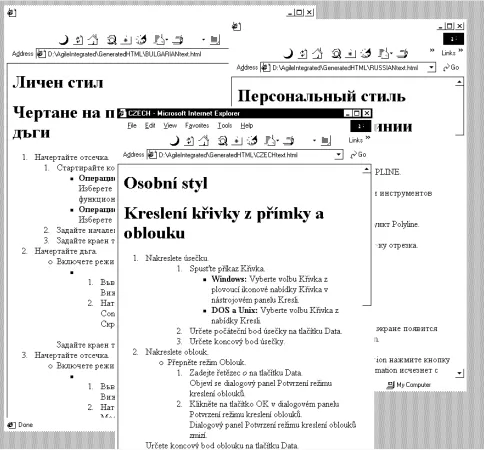
In this paper, we report about our experience in re-using a large-scale, broad-coverage English grammar for building similar scale grammars for Bulgarian, Czech, and Russian. These grammars have been developed for a multilingual text generation system that aims at automatic generation of instructional texts starting from a specification of their meaning.
We used a naturally occurring corpus of software manu-als, from which we adapted a small number of texts as target texts on which to test the incremental development of the generators. The target texts exhibit a wide range of grammatical phenomena and made it clear that large-scale generation grammars would be required for the system to be able to produce texts appropriate for the envisioned application. For languages like Czech, Bulgarian and Russian, however, there were at the time we started no large descriptive grammars available that could readily support natural language generation. The choice was therefore made to re-use an existing large-scale grammar for a different language, and to develop on the basis of that grammar three individual grammars for the Slavic languages. This methodology has been claimed effective in several previous developments (cf. (Rayner et al.1996; Bateman et al, 1999)) and avoids the necessity of building three large-scale grammars from scratch. Our approach can therefore be seen as additional evidence for (or against) this development strategy.
More specifically, the motivation for adopting this ap-proach lies in three rather strong constraints:
1. New resources for three languages had to be devel-oped. For none of them large-scale computational grammars aimed at generation exist.
2. Resource development had to be fast. The time frame for an integrated intermediate prototype was a year, where grammar development was only one compo-nent task.
3. The resources to be built should themselves be re-usable, i.e., be general-language accounts of the
lan-guages besides covering the sublanguage of the CAD/CAM domain.
Given these constraints, it was necessary to adopt a meth-odology of resource development which supports resource sharing with existing accounts of languages other than the ones that are treated here, and to gear resource develop-ment in such a way that a fairly general linguistic account was achieved.
The grammar we have used as our basis is the Nigel grammar. This grammar has been under development since the early 1980s, when it was used within the Penman text generation project for English. It was mainly devel-oped by Matthiessen on the foundation of work by Halli-day (Mann and Matthiessen, 1985). Many people have since contributed to various parts of its coverage, making Nigel into a large-scale grammar of English that covers a very broad range of grammatical phenomena.
The most important reason for choosing Nigel as starting point was that it has been claimed to be particularly ame-nable for re-use and multilingual development. According to SFL theory, the organization of the grammar separates specifications of syntactic structures from a description of the communicative functions of those syntactic structures. (Bateman et al, 1991) argue that this functional descrip-tion varies less across languages than does the syntactic description and, since it is precisely the latter functional component of the description that provides the overall organization of the grammar, the result is a grammatical account that can serve as a general guideline for the grammatical description of a wide range of languages without enforcing artificial uniformity. The development of generation grammars on this basis is now also sup-ported by an extensive grammar development environ-ment and multilingual sentence generator: Komet-Penman Multilingual system (KPML; (Bateman, 1997)) which, like Nigel, is available free of charge (see the URL at (Bateman, 1999)).
the subject (name in example (2) Figure 4) is put after the verb. Thus, the systems, for example, for Russian include: AGENCY: (transitivity-unit) →
[middle] (Process::intransitive-verb), [middle-transitive] (Process::middle-verb,
Process:::reflexive-form), [effective] (Process::transitive-verb).
AGENTIVITY: (effective) → [nonagentive], (Medium/Subject) [agentive].
EFFECTIVE-VOICE: (agentive) → [operative], (Medium/Directcomplement)
[receptive] (Medium/Subject), (Agent:::Instr-case)
MEDIO-PASSIVE-VOICE: (nonagentive, middle-transitive) → [medio-passive-process] (Finite^Subject).
3.
Conclusions
The approach advocated here combines two methods of computational grammar implementation for the purpose of a fast prototyping of computational linguistic resources. The approach builds upon one particular interpretation of re-usable resource, which is the idea of resource sharing
across languages. We called this a system-oriented
method of creating computational resources for new lan-guages. Complementary to this method, we have been guided by a corpus-based contrastive register analysis of Bulgarian, Czech and Russian instructional texts, i.e., an
instance-oriented method of computational resource
de-velopment. Proceeding this way, basic general-language grammars and sublanguage grammars for CAD/CAM instructional texts have been created. Due to the system-orientation, these grammars are less restricted than sub-language grammars of a particular domain; and due to the instance-orientation, these grammars are adequate for the domain at hand as well. Also, this two-tiered resource development method allowed us to practice a contrastive-linguistic approach and a maximal sharing of efforts, not only working from English, but also sharing among the three Slavic languages.
Acknowledgements
The authors thank all the members of the AGILE team, especially to Donia Scott, Tony Hartley, Jit +DQD and Kamenka Staykova. The work reported in this paper has been supported by the INCO-COPERNICUS Programme of the European Commission, Grant No. PL961104.
References
Bateman J.A., Matthiessen C.M.I.M., Nanri K, Zeng L. (1991) The re-use of linguistic resources across lan-guages in multilingual generation components. In
Pro-ceedings of the 1991 International Joint Conference on Artificial Intelligence, Sydney, Australia, volume 2, (pp. 966—971). Morgan Kaufmann Publishers.
Bateman J.A. (1997) Enabling technology for multilingual natural language generation: the KPML development environment. Journal of Natural Language
Engineer-ing, 3(1):15—55.
Bateman J.A. (1999) The KPML multilingual natural language generation system, development environment and tools. At: http://purl.org/net/kpml
Bateman J.A., Matthiessen C.M.I.M., Zeng L.. (1999) Multilingual natural language generation for multilin-gual software: a functional linguistic approach. Applied
Artificial Intelligence, 13:607—639.
Cahill L.J. & Gazdar G. (1995) Multilingual lexicons for related languages. In Proceedings of the 2nd DTI Lan-guage Engineering Conference (pp. 169—176), Lon-don, Department of Trade and Industry.
Dorr B.J. (1994). Machine translation divergences: a formal description and proposed solution.
Computa-tional Linguistics, 20(4):597—634.
Halliday M.A.K. (1985). An Introduction to Functional
Grammar. Edward Arnold, London.
Halliday M.A.K. & Matthiessen C.M.I.M. (1999)
Con-struing experience through meaning: a language-based approach to cognition. Cassell Academic, London and
New Work.
Hartley A., & Paris C., (1996) Two sources of control over the generation of software instructions. Informa-tion Technology Institute Technical Report Series, ITRI-96-02. Also published in Proc. ACL, Santa Cruz, California, June 1996. (pp 192—199).
Kittredge R. (1987). The significance of sublanguage for automatic translation. In: Nirenburg S. (ed.) Machine
Translation: Theoretical and Methodological Issues.
Mann W. & Matthiessen C.M.I.M.. (1985) A demonstra-tion of the Nigel text generademonstra-tion computer program. In James D. Benson and William S. Greaves, editors,
Sys-temic Perspectives on Discourse, vol 1. Ablex,
Nor-wood, N.J.
Netter, K. et al. (1998) DiET - Diagnostic and Evaluation Tools for natural language processing applications. In: Proceedings of the first international conference on Language Resources and Evaluation (pp. 573—579), Granada.
Rayner M., Carter D., Bouillon P. (1996). Adapting the Core Language Engine to French and Spanish. In: Pro-ceedings of NLP-IA-96, Moncton, New Brunswick. Teich E., Degand L., Bateman J.A. (1996) Multilingual
textuality: Experiences from multilingual text genera-tion. In: G. Adorni and M. Zock, editors, Trends in
Natural Language Generation: an artificial intelligence perspective, No. 1036 in Lecture Notes in Artificial