Improving Entity Linking using Surface Form Refinement
Eric Charton
1, Marie-Jean Meurs
2, Ludovic Jean-Louis
1, Michel Gagnon
11Polytechnique Montreal,2Concordia University
Montreal, QC, Canada
{eric.charton, ludovic.jean-louis, michel.gagnon}@polymtl.ca, [email protected]
Abstract
In this paper, we present an algorithm for improving named entity resolution and entity linking by using surface form generation and rewriting. Surface forms consist of a word or a group of words that matches lexical units likeParisor New York City. Used as matching sequences to select candidate entries in a knowledge base, they contribute to the disambiguation of those candidates through similarity measures. In this context, misspelled textual sequences (entities) can be impossible to identify due to the lack of available matching surface forms. To address this problem, we propose an algorithm for surface form refinement based on Wikipedia resources. The approach extends the surface form coverage of our entity linking system, and rewrites or reformulates misspelled mentions (entities) prior to starting the annotation process. The algorithm is evaluated on the corpus associated with the monolingual English entity linking task of NIST KBP 2013. We show that the algorithm improves the entity linking system performance.
Keywords:Entity Linking, Named Entity Resolution, SemLinker
1.
Introduction
The Entity Linking (EL) task consists in linking name
mentionsof named entities (NEs) found in a document to their corresponding entities in a reference Knowledge Base (KB). The entities are usually represented by a key number or Uniform Resource Identifier (URI). Dealing with ambi-guity is one of the key difficulties of this task, since men-tions are often highly polysemous, and potentially related to many different KB entries. Various algorithms and meth-ods have been proposed to address the ambiguity problem. Most of them involve the use of surface forms extracted from Wikipedia.
Surface forms consist of a word or a group of words that match lexical units likeParisorNew York City. They are used as matching sequences to locate corresponding candi-date entries in the reference KB, and then to disambiguate those candidates using similarity measures. In this context, misspelled textual sequences can be impossible to identify due to the lack of available matching surface forms. This results in missing or wrong identification of KB entries by EL systems, since accurate candidates are not submitted to the disambiguation process.
This problem is specifically difficult in the context of noisy documents, as for instance forum posts that contain lots of spelling mistakes, nicknames, and puns.
This paper proposes a method to correct named enti-ties mentions of proper names (persons, organizations or geographically-related entities) according to their possible sources of variations and errors. Proper names found in such context have characteristics that makes them different to general text. While there is only one correct spelling for many common words, it is usual to find several spelling variations for proper names. For example, writers, specif-ically in noisy context like online forums frequently use nicknames or surnames. It is also common to observe evo-lution of surface forms over time, or influence of people’s cultural background or usage. For instance, numerous lex-ical and spelling variations of geographic names appear
when these names are transcribed from an alphabet to an-other (like Chinese or Cyrillic to Latin alphabet). These issues make matching of proper names often more chal-lenging compared to matching of general text.
To solve this problem, we propose an algorithm for surface form refinement based on Wikipedia resources. The approach extends the surface form coverage of our EL system, and rewrites or reformulates misspelled mentions prior to starting the annotation process. We applied our algorithm on the EL task corpus from the NIST TAC-KBP (Ji et al., 2010) evaluation campaign. This approach improves the EL process accuracy.
This paper is structured as follows. Section 2. reports on previous works related to the EL problem. The Surface form matching problem is investigated in Section 3. We then describe our Surface Form Refinement algorithm in Section 4. In Section 5. we present the SemLinker system that implements the algorithm. Section 6. describes the ap-plication of the proposed algorithm on a standard evalua-tion corpus from the TAC-KBP evaluaevalua-tion campaign1. We
present the experiments, discuss the obtained results, and conclude.
2.
Related Work
Linking textual mentions to KB entities is related to the
Word Sense Disambiguation (WSD)problem. WSD (Nav-igli, 2009) consists in determining which sense of an ex-pression is used when it appears in a particular context. Disambiguation resources must be included in annotation systems to handle the WSD problem. For the named entity recognition task, this resource can be generic and generative. For instance, statistical labeling classifiers can be trained on labeled corpora (see for instance works from (Kazama and Torisawa, 2007) and (B´echet and Char-ton, 2010) using CRF, SVM, or HMM classifiers). Such
1http://www.nist.gov/tac/2013/KBP/data.
classifiers are able to infer a named entity class from a lim-ited set of contexts.
This generative approach does not apply to the EL task where each entity to be linked to a semantic description has a specific word context, marker of its exact identity. Deal-ing with ambiguity is one of the key difficulties in this task, since entities are often highly polysemous, and potentially related to many different KB entries.
Many propositions have been made to solve the named entity disambiguation problem, as for instance the KIM system (Popov et al., 2003). More recently, several sys-tems have been launched as web services dedicated to EL tasks. Most of them are compliant with new emer-gent semantic web standards like LinkedData network. AIDA (Hoffart et al., 2011b) is a system that relies on the Wikipedia-derived YAGO2 (Hoffart et al., 2011a) knowl-edge base. It proposes a disambiguation method that com-bines popularity-based priors, similarity measures, and co-herence. Wikimeta (Charton and Gagnon, 2012) is another system relying on DBpedia. It uses a set of bags of words to disambiguate semantic entities according to a cosine simi-larity algorithm. The common architecture of those systems consists in a first step of mention detection in sentences. This step detects surface forms that may indicate textual se-quences linkable to KB entries. Each of these surface forms is used to extract a set of candidates from the KB. Then, in the disambiguation step, the word context surrounding the detected mention in the text is used to measure its similarity with the bag of words provided by the KB for each candi-date. Finally, the KB entry that gets the highest score is considered as potentially reflecting the exact identity of the entity to link.
Those systems have been compared with commercial ones like AlchemyAPI, Zemanta or Open Calais in (Gangemi, 2013). The study showed that they perform differently on various essential aspects of EL tasks (mention detection, linking, disambiguation). This suggests a wide range of potential improvements on many aspects of the EL task, specially on mention detection accuracy.
3.
The Surface Form Matching Problem
The surface form matching problem is related to the ability of a system to identify an entity, according to its surface form variability.
3.1.
Problem Definition
The generic problem of surface form matching is related to the edit distance problem. Numerous studies have been conducted on the edit distance problem (Navarro, 2001). Initially called the String-to-String Correction Problem (Wagner and Fischer, 1974), it is a well known field of investigation for natural language processing appli-cations. The task of matching strings has been explored by many research communities. Various studies can be found in literature related to statistics, databases, artificial intelligence, bioinformatics or language. Each community formulates the problem according to its own needs, and numerous techniques have been proposed (Cohen et al., 2003).
In natural language processing context, the problem is usu-ally designated as edit distance task. It can be considered as a way of quantifying how dissimilar two strings are to one another, for example by counting the minimum number of operations required to transform one string into another, according to their lexical and orthographic differences. A classical application of edit distance in natural language processing is the automatic spelling correction used to de-termine candidate corrections for a misspelled word. Usu-ally, the selection of the correct word involves the use of a dictionary that contains a correct form, and implies the computation of the distance between the word to correct and its canonical form.
Finding and matching proper names, personal names or named entities (including lexical units related to surface forms of more than one word, like International Business Machine) is a specific and difficult problem. An increasing number of information extraction and retrieval applications (text and Web mining, search engine query reformulation, data linkage systems) makes this problem crucial to solve. According to (Lait and Randell, 1996) comment-ing (Bouchard and Pouyez, 1980) the followcomment-ing common person name variations can be inventoried:
• Spelling variations, including interchanged, mis-placed, substituted, added or omitted letters. Exam-ple of spelling variations are found inGuo-feng and Kuo-Feng (from the name Hua Guofeng), additional letters inBarackwrittenBarrac, and an omission sam-ple could beBarac.
• Phonetic variations, when the phonemes of the name are modified or the structure of the name is substan-tially altered, sometimes using truncation. Phonetic variations in first names can be very large like in the case of shortening ofBarthelemyinBart.
• Reduction of double names, when surnames are com-posed of two elements but only one is kept by usage. For example, a double surname such as Du Pont-De Nemoursmay be given in full, asDuPont.
• Double first names, not common in the English lan-guage, but more frequent in French or Spanish, for ex-ample, names such asJuan-Manuelmay be given in full, or asJuanorManuel.
• Alternate first names is another case that occurs when individuals change their names during their life. In this case, an algorithm must be associated with a knowl-edge base to identify the variations.
All those possible variations also apply to other named en-tity classes like organizations or geopolitical entities. For example:
• Spelling variations of city names like inPekin some-times romanized inPeking.
• Double names exist frequently for company names likeMicrosoft Corporation, commonly designated by
• Reduction is very common for city names likeSainte Cecile Les Vignes, commonly shortened toSainte Ce-cileorRio De Janeiro, reduced toRio.
• Alternate names are very common for city names like
PekinandBeijingreferring to the same city.
To address the surface form matching problem, state-of-the-art techniques are mostly based on pattern match-ing (Bartolini et al., 2002), sometimes usmatch-ing approximation methods (Hall and Dowling, 1980), phonetic encoding (Zo-bel and Dart, 1996), or a combination of these approaches. Authors like (Christen, 2006) have concluded that due to variations and errors in names, exact string matching re-mains problematic. Experimental comparisons of various techniques on standardized corpora indicate that there is still no clear best technique.
3.2.
Surface Form Matching for Entity Linking
In EL systems, availability of an exhaustive resource of surface form candidates is of critical interest for detecting mentions. String to string matching methods described in Section 3. do not solve the surface form identification prob-lem. In EL context, the problem is not only to correct or reformulate a mention, but also to associate the mention to appropriate candidate entities to be linked. Those candi-dates will be used to conduct the disambiguation process and later to establish the link between the mention and the KB. For this reason in EL systems, a resource of valid sur-face forms according to a giving entity is commonly used. The higher the coverage of this resource, the more can-didate entities are detected. Wikipedia-based corpora are generally used as their internal structure allow them to pro-vide valuable correction, misspelling and alternative writ-ing forms accordwrit-ing to a given entity to link.
Recent TAC-KBP evaluation campaigns have been engi-neered to emphasize the surface form matching problem: the evaluation framework of the EL tasks makes increas-ing uses of noisy and misspelled mentions that have to be linked. In the TAC-KBP 2013 evaluation corpus, we identi-fied three main cases of mentions to annotate for which no surface form exists in Wikipedia-based resources:
1. An abbreviation which refers to a named entity does not exist in any Wikipedia redirection, disambiguation or interwiki page. For example, a named entity is de-noted by an abbreviation like JGL, which stands for
Joseph Gordon-Levit2.
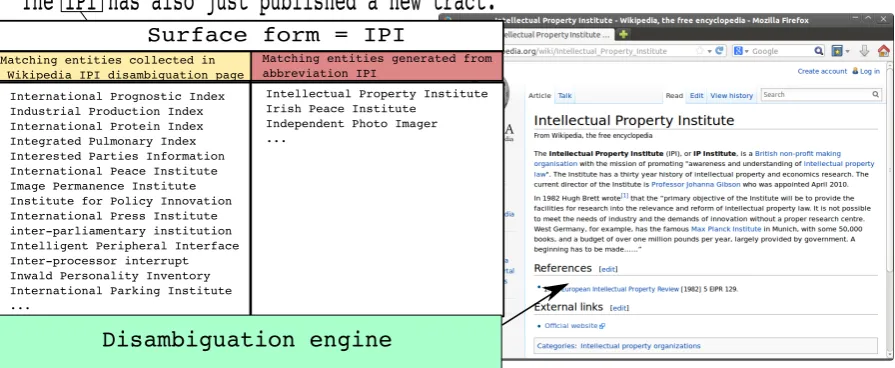
2. An abbreviation which refers to a named entity exists in Wikipedia, but is redirected to another entity. An example is given by theIPI3surface form, that refers
toIntellectual Property Institute. AnIPI disambigua-tion page exists in Wikipedia, and allows to collect several full names for this abbreviation (see Figure 1) but does not refer to theIntellectual Property Institute
page.
2
Example from query EL13 ENG 0319 of KBP 2013 corpus
3
Example from query EL13 ENG 1604 of KBP 2013 corpus
3. A mention is misspelled or provided under an un-common or unconventional surface form, and exists in Wikipedia under a slightly different lexical descrip-tion. This is the case of queryBagdahd, that should refer to theBagdadpage in Wikipedia4.
These three cases cannot be handled by state-of-the-art ap-proaches based on Wikipedia derived content only, since the surface forms collected from the encyclopedia do not match the ones expressing named entities in the document. The algorithm we propose empowers EL systems to handle such cases, and thus improves their performance.
4.
Surface Form Refinement Algorithm
We propose a Surface Form Refinement algorithm involv-ing two strategies to improve surface form coverage of EL systems. The first strategy consists in automatically adding additional surface forms generated by heuristics to an exist-ing resource of surface forms. The second strategy involves the introduction of a lexical correction step in the surface form detection process.
4.1.
Algorithm Description
Let us consider a candidate mention that we want to link to a KB entry. To find a set of candidate entries in the KB according to its surface form, the proposed algorithm runs as follows:
• Step 1: The candidate mention is submitted to the Im-proved Surface Form Detection Module. If matching surface form candidates are returned, the algorithm proceeds to step 3; else to step 2.
• Step 2: If no candidate is provided by theImproved Surface Form Detection Module, the candidate men-tion is submitted to theSurface Form Correction Mod-ule.
- If this module returns suggestions of alternative surface forms, step 1 is repeated using those sug-gestions to collect candidates.
- Else the algorithm returns no suggestion and exits.
• Step 3: Disambiguation of candidates and selection of entity link.
We describe below the two components of this algorithm, theImproved Surface Form Detection Moduleand the Sur-face Form Correction module.
4.2.
Improved Surface Form Detection Module
TheImproved Surface Form Detection Modulerelies on an enriched set of surface forms. This set is obtained by col-lecting every Wikipedia internal link that points to an ency-clopedic document. This can beredirection links,interwiki links(directing to the same document in another language edition) and, finally, every disambiguation page link that points to encyclopedic documents. To improve the cover-age of the resource, the surface forms are collected from
4
The IPI has also just published a new tract.
International Prognostic Index Industrial Production Index International Protein Index Integrated Pulmonary Index Interested Parties Information International Peace Institute Image Permanence Institute Institute for Policy Innovation International Press Institute inter-parliamentary institution Intelligent Peripheral Interface Inter-processor interrupt Inwald Personality Inventory International Parking Institute ...
Matching entities collected in Wikipedia IPI disambiguation page
Matching entities generated from abbreviation IPI
Intellectual Property Institute Irish Peace Institute
Independent Photo Imager ...
Surface form = IPI
Disambiguation engine
Figure 1: All the abbreviated surface forms of a given entity are not necessarily present in Wikipedia. Generating some complementary matching (here for the IPI abbreviation) improves the detection capabilities of an Entity Linking System.
six language editions of Wikipedia (English, German, Ital-ian, Spanish, Polish and French). Cross-language resources are extremely useful as in some cases, a surface form only appears in a given language edition of Wikipedia, though it could be used in other languages. Good examples of such cases are the surface formsRenault-DaciaorRNUR
related to an organization that can only be collected from the Polish edition of Wikipedia. Over 10 million surface forms are collected. They allow matching numerous al-ternate spelling suggestions, including the misspelled ones (usually found in redirection pages of Wikipedia). How-ever, this resource does not cover all the cases encountered in the TAC-KBP corpus.
Hence, additional surface forms are automatically gener-ated with various heuristics like following ones:
• Automatic generation of abbreviations: for example, for a surface form likeJoseph Gordon-Levitt, we gen-erate the surface formJGL.
• Automatic generation of alternative surface forms (like adding “s” at the end of forms)
• Re-ordering n-grams: for example, for a person name like Barack Obama, the system generates Obama Barack.
We finally obtain 4 millions of additional generated surface forms for a total of 14 millions, each of these related to one or more Wikipedia documents.
According to step 1 of the algorithm described in Section 4.1., for a given word sequence in a text, this resource is utilized to first check if a matching surface form exists. If it exists, all related candidates are collected, and disambigua-tion is applied to rank them. If no match is provided the
Surface Form Correction Moduleis invoked.
4.3.
Surface Form Correction Module
TheSurface Form Correction Moduleconsists of a database of potential spelling errors built from a Wikipedia dump, and a set of rules used to validate the suggested corrections.
The database engine generates a set of variations for each existing surface form. The Lucene-Wiki software generates this database5, which includes about 1 billion entries.
According to step 2 of the algorithm (see Section 4.1.), the
Surface Form Correction module is called when the Im-proved Surface Form Detection Module does not provide any candidate. If the database engine suggests a rewriting, this refined surface form is submitted to a set of selection rules intended to check if the suggestion is relevant. The rules described below are sequentially applied:
• Rule A :mcommon word(s). Let us suppose,m= 1, and the original surface form is“hitlery clinton”6: if the system suggests “Hillary Rodham Clinton”, the rule selects the suggested refined surface form because it has at least one common word with the original one.
• Rule B : Lexical distance ofnletter(s). Ifn= 1, the original surface form is“Michicgan”7, and the system
suggests “Michigan“, the rule selects the suggested form.
• Rule C: Edit-distance between mention and sugges-tion. The rule verifies if the original and corrected mentions start with the same character and calculate theirl Levenshtein distance. It accepts the suggested form ifl < twheretis a threshold value.
If the suggested refined form is accepted, it is submitted to theImproved Surface Form Resourceto obtain a list of candidates. The disambiguation algorithm is then used to get the first ranked candidate, and then to select a link.
5.
Algorithm implementation
The Surface Form Refinement algorithm was integrated in the SemLinker system, presented in the TAC-KBP 2013 evaluation campaign.
5https://www.mediawiki.org/wiki/Extension:Lucene-search 6
Example from query EL13 ENG 0895 of KBP 2013 corpus
7
5.1.
SemLinker System
SemLinker is a Java library designed to experiment various applications of text mining and annotations. Using an exter-nal annotator (currently www.wikimeta.com), SemLinker can apply various annotation layers and information extrac-tion processes to textual documents. The SemLinker sys-tem is detailed in (Charton et al., 2013). The SemLinker system handles a query according to the TAC-KBP format, processes it through a pipeline architecture as follows (see Figure 2 for an architecture overview):
1. Reformulate the query if necessary using the Surface Form Refinement algorithm.
2. Annotate each entity in the document with a ranked set of Wikipedia URIs (the candidates) using an external annotator compliant with Wikipedia URIs. NE labels and Part Of Speech (POS) tags are also provided.
3. Re-rank candidates for each entity in the document us-ing all the annotation layers.
4. Extract the best entity link in the document using the query definition and query expansion.
5. Cluster the detected entities with no corresponding KB entries (NILs), and convert the Wikipedia URIs format to TAC-KBP node identifiers.
Four main modules are dedicated to these tasks:
1. Query Reformulation module(using Surface Form Re-finement algorithm).
2. Mutual Disambiguation module. 3. Link Extraction module. 4. Clustering module.
Wikimeta
Annotated
document object
Wikipedia links Named Entities Part Of Speech
Mutual
Disambiguation
based reranking
Coreferences
NIL Clustering
Query
Wikipedia URI
Document
Annotation
Document with reranked Wikipedia
links
Correction processes
Named Entities
Link extraction
KB Nodes & NIL answers
SemLinker
Reranking
Query expansion
1. NLGbAse
2. Wiki Lucene Spell Checker
Query reformulation
Figure 2: SemLinker architecture.
5.2.
NLGbAse lexical resource
The original surface form resource used in this study is NL-GbAse, a set of metadata derived from Wikipedia (Char-ton and Torres-Moreno, 2010). NLGbAse is a multilin-gual linguistic resource composed of metadata, and built from the Wikipedia encyclopedic content. The structure of Wikipedia, and the sequential process for building metadata (like these recorded in NLGbAse), have been described in (Bunescu and Pasca, 2006). The process is applied in (Charton and Torres-Moreno, 2010).
Currently, this resource contains about 3 millions of En-glish metadata, each of them describing a unique concept. For each concept, a metadata unit contains a bag of words with pre-calculated TF.IDF and possible surface forms of the concept (ieNew-York, NYC, Big Apple).
For each document in Wikipedia, NLGbAse provides a set of metadata, composed of three elements: (i) a set of sur-face forms, (ii) all the words contained in the document, where a TF.IDF weight (Salton and Buckley, 1988) is as-signed to each word, (iii) a NE class tag (person, org...) obtained through a classification process.
The set of surface forms is obtained through the collection of every Wikipedia internal link that points to an encyclope-dic document. For instance, the surface form set for the NE
Paris (France)8 contains 39 elements, (eg. Ville Lumi`ere,
Ville de Paris, Paname, Capitale de la France, D´epartement de Paris). NLGbAse is involved in SemLinker as a resource for the Surface Form Refinement algorithm in the Query Reformulation module.
6.
Experiments and Results
The proposed algorithm has been evaluated on the TAC-KBP EL task. The basic principle of TAC-KBP task is to provide a query for a given document. This query contains a sur-face form related to an entity to annotate, a reference of the document and the exact position of the surface form in the document. For a given query, the task is to determine the correct node in the reference KB for the entity, and to add a new node for the entity if it is not already in the reference knowledge base (KB). The reference KB is derived from an October 2008 dump of English Wikipedia, which includes 818,741 nodes. Entities can be of type person (PER), or-ganization (ORG), or geopolitical entity (GPE). The doc-ument collection built for previous KBP evaluation cam-paigns contains a combination of newswire articles (News), posts to blogs and newsgroups (Web). In 2013, discussion fora were added to the previous categories. Table 1 pro-vides a breakdown of the queries per categories of entities, and per type of documents.
Category All PER ORG GPE News Web Forum # queries 2190 686 701 803 1134 343 713
Table 1: Breakdown of the TAC-KBP 2013 test corpus queries according to entity types, and document categories.
8
Figure 3: In this example, surface forms for a county name are collected from several language editions of Wikipedia.
refSF QR
Category B3+F
1 B3+F1
Overall 0.574 0.596
KB (in KB) 0.494 0.535
NIL (not in KB) 0.665 0.662 NW (news doc) 0.645 0.649 WEB (web doc) 0.579 0.592 DF (forum doc) 0.454 0.508
PER (person) 0.695 0.708 ORG (organization) 0.604 0.607 GPE (geopolitical entity) 0.440 0.486
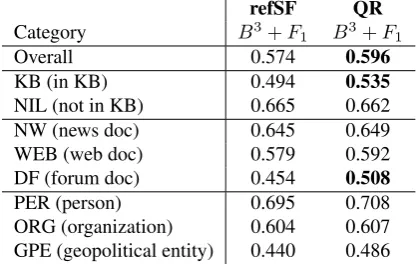
Table 2: System performance on test corpus of KBP2013 task with reference surface form resource (refSF) and im-proved surface form detection algorithm (QR). The B3+F1
metric used is the official one from KBP evaluation frame-work, and is derived from B3metric used to evaluate
coref-erence resolution systems.
The algorithm was tested with the TAC-KBP 2013 English queries9 according to the evaluation protocol of the TAC-KBP task evaluation framework. The B3 metric evaluates the EL process using the clusters of queries provided by the system for each KB link. We submitted the queries to a version of our EL system with the surface form correction algorithm disabled (refSF system in Table 2), and enabled (QR system in Table 2). With QR system, when a refined surface form is proposed, each of its occurrences in the doc-ument is rewritten according to the new form, prior to be submitted to the semantic annotation engine. Our system obtained the results reported in Table 2.
The Surface Form Refinement algorithm improves the per-formance for KB link detection (KB line of Table 2), and does not significantly reduce the performance for NIL KB (surface form with no matching KB link). We can con-clude that the selection rules of theSurface Form Correc-tion Module accurately rejects most of the wrong correc-tions of surface forms. Improvement of performance ob-tained on the noisiest documents (DF docs of the KBP task are web forum transcripts) also shows that the Surface Form Refinement algorithm is efficient with noisy text content.
9
http://www.nist.gov/tac/2013/KBP/data.html
7.
Conclusion and Future Work
In this paper, we introduced a Surface Form Refinement al-gorithm to improve EL systems. In the context of a standard evaluation based on NIST TAC-KBP resources, the system using the proposed Surface Form Refinement method out-performs the EL system only based on Wikipedia derived resource for surface form matching.
We have discussed the characteristics of named entity sur-face form variations in the TAC-KBP evaluation corpus and the potential sources of variations and errors in them. We presented a system for addressing the problem of surface form variations with both pattern matching and distance measure techniques, based on an extensive use of lexical resources generated from Wikipedia encyclopedic content. Experimental results on this data set have shown that the combination of those techniques and resources can improve the performance of a standard EL system. However, named entity matching in the context of the EL task remains a very challenging research field. This work is focused on very specific proper names. While our approach obtains promis-ing results in this context, how it would perform on more specialized entities like common names or specific named entities like biological ones is still to evaluate. An interest-ing future work could be to study the performance of the proposed algorithm on other topic oriented tasks, like for example biological annotation tasks.
Reproducibility
The system presented in this paper has been submitted to the NIST-TAC KBP 2013 evaluation campaign under the system referencepolymtl. The presented results are the of-ficial ones from this campaign. All the experiments pre-sented in this paper are fully reproducible on NIST KBP data using the SemLinker software, publicly released at
https://code.google.com/p/semlinker/.
Acknowledgments
8.
References
Bartolini, I., Ciaccia, P., and Patella, M. (2002). String matching with metric trees using an approximate dis-tance. In String Processing and Information Retrieval, pages 271–283. Springer.
B´echet, F. and Charton, E. (2010). Unsupervised knowl-edge acquisition for extracting named entities from speech. In Acoustics Speech and Signal Processing (ICASSP), 2010 IEEE International Conference on, pages 5338–5341. IEEE.
Bouchard, G. and Pouyez, C. (1980). Name variations and computerised record linkage.Historical Methods. Bunescu, R. C. and Pasca, M. (2006). Using
encyclope-dic knowledge for named entity disambiguation. In Pro-ceedings of the Conference of the European Chapter of the Association for Computational Linguistics (EACL). ACL.
Charton, E. and Gagnon, M. (2012). A disambiguation resource extracted from Wikipedia for semantic annota-tion. InProceedings of LREC 2012.
Charton, E. and Torres-Moreno, J. (2010). NLGbAse: a free linguistic resource for Natural Language Processing systems. InProceedings of LREC 2010.
Charton, E., Meurs, M.-J., Jean-Louis, L., and Gagnon, M. (2013). SemLinker system for KBP2013: A disam-biguation algorithm based on mutual relations of seman-tic annotations inside a document. InText Analysis Con-ference KBP. U.S. National Institute of Standards and Technology (NIST).
Christen, P. (2006). A comparison of personal name matching: Techniques and practical issues. In Sixth IEEE International Conference on Data Mining (ICDM) Workshops, pages 290–294. IEEE.
Cohen, W., Ravikumar, P., and Fienberg, S. (2003). A comparison of string metrics for matching names and records. InKDD Workshop on Data Cleaning and Ob-ject Consolidation, volume 3, pages 73–78.
Gangemi, A. (2013). A Comparison of Knowledge Extrac-tion Tools for the Semantic Web. InThe 10th Extended Semantic Web Conference (ESWC) 2013.
Hall, P. A. and Dowling, G. R. (1980). Approximate string matching. ACM computing surveys (CSUR), 12(4):381– 402.
Hoffart, J., Suchanek, F. M., Berberich, K., Lewis-Kelham, E., De Melo, G., and Weikum, G. (2011a). Yago2: ex-ploring and querying world knowledge in time, space, context, and many languages. InProceedings of the 20th international conference companion on World wide web, pages 229–232. ACM.
Hoffart, J., Yosef, M. A., Bordino, I., F¨urstenau, H., Pinkal, M., Spaniol, M., Taneva, B., Thater, S., and Weikum, G. (2011b). Robust disambiguation of named entities in text. InProceedings of the Conference on Empirical Methods in Natural Language Processing, pages 782– 792. Association for Computational Linguistics. Ji, H., Grishman, R., Dang, H., and Griffitt, K. (2010).
Overview of the TAC 2010 knowledge base population track.Proceedings of TAC 2010.
Kazama, J. and Torisawa, K. (2007). Exploiting Wikipedia
as external knowledge for named entity recognition. In
Proceedings of the 2007 EMNLP-CoNLL, pages 698– 707.
Lait, A. and Randell, B. (1996). An assessment of name matching algorithms. Technical Report Series-University of Newcastle Upon Tyne Computing Science. Navarro, G. (2001). A guided tour to approximate string matching. ACM computing surveys (CSUR), 33(1):31– 88, March.
Navigli, R. (2009). Word sense disambiguation: A survey.
ACM Computing Surveys (CSUR), 41(2):10.
Popov, B., Kiryakov, A., Kirilov, A., Manov, D., Ognyanoff, D., and Goranov, M. (2003). KIM – Seman-tic annotation platform. Lecture Notes in Computer Sci-ence, pages 834–849.
Salton, G. and Buckley, C. (1988). Term-weighting ap-proaches in automatic text retrieval. Information pro-cessing & management.
Wagner, R. A. and Fischer, M. J. (1974). The string-to-string correction problem. Journal of the ACM (JACM), 21(1):168–173.