A Tool for Extracting Conversational Implicatures
Marta Tatu
and
Dan Moldovan
Lymba Corporation Richardson, TX, United States [email protected], [email protected]
Abstract
Explicitly conveyed knowledge represents only a portion of the information communicated by a text snippet. Automated mechanisms for deriving explicit information exist; however, the implicit assumptions and default inferences that capture our intuitions about a normal interpretation of a communication remain hidden for automated systems, despite the communication participants’ ease of grasping thecompletemeaning of the communication. In this paper, we describe a reasoning framework for the automatic identification ofconversational implicaturesconveyed by real-world English and Arabic conversations carried via twitter.com. Our system transforms given utterances into deep semantic logical forms. It produces a variety of axioms that identify lexical connections between concepts, define rules of combining semantic relations, capture common-sense world knowledge, and encode Grice’s Conversational Maxims. By exploiting this rich body of knowledge and reasoning within the context of the conversation, our system produces entailments and implicatures conveyed by analyzed utterances with an F-measure of 70.42% for English conversations.
Keywords:Conversational implicature, Knowledge representation, Natural language reasoning
1.
Introduction
The termimplicaturewas coined by Grice in 1975 to de-note the aspects of meaning that are communicated by an utterance in a conversational context without being part of the literal meaning of the utterance (Grice, 1975).
It is useful to distinguish between explicit and implicit in-formation, and between implicit and implicated informa-tion. Explicit information is what a reader gathers only from the strict meaning of words. It rarely reflects the meaning of an utterance. Implicit information is built up from the explicit content of the utterance by conceptual strengthening or “enrichment”, which yields what would have been made fully explicit if lexical extensions had been included in the utterance. Implicated information, called implicature, goes beyond what is said (“the coded con-tent” (Grice, 1975)). It is heavily dependent on the context of the situation.
For example, within the following conversation held be-tween two users of twitter.com,
A:Dinner’s ready! prawns, grouper in some sauce, veg-etables, rice and shark’s fin melon soup! Still waiting for lotus root soup this week!
B:Eeeeeee lotus root?
A:so what you having for dinner?
several facts are stated explicitly and their logical infer-ences can easily be identified (the dinner is ready, a list of dishes where the ingredients of the soup include shark’s fin and melon, lotus root soup for later in the week, A’s question about what B will have for dinner). However, a rich body of implicated information is conveyed as well (A has prepared a dinner which includes the list of mentioned dishes; A is excited of having prepared this gourmet din-ner, B dislikes lotus root and cannot believe that A would choose to eat it; A has a poor opinion of B’s gastronomic knowledge).
These conversational implicatures are derived from cultural contexts. They go beyond the communication’s semantic content, contrasting with its logical implications. In or-der to recognize them, communication participants rely on common sense knowledge gathered by observation of suc-cessful social interactions. More specifically, they make use of world knowledge about one’s culture, about what is socially or ethically allowed in general as well as what are the expected reactions in a particular situation, and the use of language for cooperative interactions.
Communication participants have an inherent understand-ing of language and its use and are able to make certain inferences based on implicit assumptions rather than what is explicitly stated. Language philosophers analyzed these phenomena and put forward principles of rational human communication behavior (Grice, 1975; Gazdar, 1979; Mc-Cafferty, 1987; Grice, 1989; Hirschberg, 1991; Kasher, 1998; Levinson, 2000). For instance, Grice proposed a Co-operative Principle with associated Maxims of Conversa-tion, which he used to explain how implicatures arise dur-ing conversations.
• Maxim of Quality: be truthful
• Maxim of Quantity: make your contribution as infor-mative as is required, but not more inforinfor-mative than is required
• Maxim of Relation: be relevant
• Maxim of Manner: be clear, by avoiding obscurity of expression and ambiguity and being brief and orderly
abductive natural language reasoner is able to derive default inferences that link the analyzed utterance to the conversa-tional context, making explicit the speaker’s implicatures.
2.
Model for Conversational Implicatures
Without any means to represent and store derived implica-tures, their automatic identification is impracticable. There-fore, we created an implicature model that captures not only the implicit information conveyed by the speaker but also the explicit information transmitted to the hearer. The 8-tuple{SU, SI, HT M, HT E, HI, C, GM, K}, where• the speaker S is characterized by his utterance (SU)
and his intentions (SI),
• the hearer H’s characterization captures his under-standing of the utterance (HT M), its entailments
(HT E) and conveyed implicatures (HI),
• the C component captures the context
• Grice Maxims (GM) indicates whether there was no maxim violation, a clash between maxims has oc-curred or one or more maxims have been flouted, and
• K denotes the common sense knowledge needed by H to derive S’s implicatures
establishes a standard semantic representation for conversa-tional implicatures that facilitates the consumption of im-plicatures. Our model captures thecomplete meaning of an utterance, thus enabling advanced application systems to make use of extracted implicatures and produce highly accurate results.
3.
Data Sets
Implicatures are prevalent in conversations. We used the Microsoft Research Conversation (MRC)1 corpus for our
analysis of implicatures conveyed by English conversa-tions. It consists of 1.3 million open-domain co-operative conversations gathered from twitter.com (Twitter) (Ritter et al., 2010). Their linguistic styles vary greatly from spoken language, which often includes misspelled words, short-hands, interjections, context describing words, emoticons, etc. to more formal language.
For Arabic, we followed the main steps of the MRC gener-ation process and created a similar corpus of conversgener-ations held among Arabic Twitter users. Our goal was to be able to easily compare our findings across languages and cultures. We identified a set of Arabic native speakers that tweet in Arabic by searching Twitter for various Arabic words and used their most recent tweets that were posted as replies to other tweets to build conversation threads. Iteratively, if the tweet that was replied to was itself a reply to another tweet, the conversation was augmented accordingly, more specifically, built in reverse chronological order, one tweet at a time. Our Arabic conversation corpus contains 4,000 conversations involving 2,067 Twitter users.
1
http://research.microsoft.com/en-us/downloads/8f8d5323-0732-4ba0-8c6d-a5304967cc3f/default.aspx
In order to be able to evaluate our approach, we an-notated implicatures conveyed by real-data examples ex-tracted from these datasets. We manually identified the components of implicature models for 253 English utter-ances and 75 Arabic utterutter-ances. Most implicatures exploit the Relevance Maxim. Floutings of the Manner Maxim are also an important source of implicatures.
4.
Reasoning for Implicatures
Implicatures exhibit certain properties that must be taken into account when attempting to select the best rea-soning framework for identifying implicatures. More specifically, implicatures are cancelable, non-detachable,
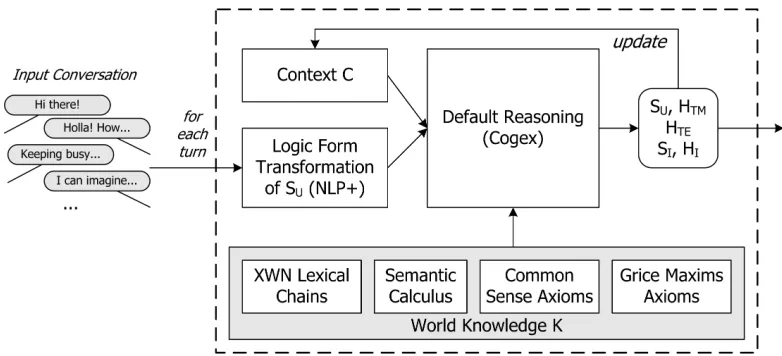
calculable, non-conventional, reinforceable, and univer-sal(Grice, 1975; Gazdar, 1979; Levinson, 1983; Levinson, 2000; Horn, 2004). Therefore, non-monotonic (defeasible) reasoning frameworks that support a default mode of rea-soning, such as induction, abduction, practical rearea-soning, and default logics, are the best candidates for automatic im-plicature derivation (McCafferty, 1987; Hobbs et al., 1990; Wainer, 1991; Harnish, 1991; Green and Carberry, 1993; Green and Carberry, 1994; Levinson, 2000; Allan, 2000). The solution presented in this paper makes use of abduc-tion as well as default knowledge to identify implicatures. Our system processes the natural language of a conversa-tion one turn at a time and derives the logical implicaconversa-tions and implicatures communicated by each speaker utterance, updating the conversation’s common ground after each in-dividual analysis. In Figure 1, we show the architecture of the system, highlighting the roles and interactions of our implicature model components ({SU, SI, HT M, HT E, HI, C, GM, K}).
Our implicature derivation engine was implemented on top of Lymba’s natural language reasoner, COGEX (Tatu and Moldovan, 2006; Tatu and Moldovan, 2007; Moldovan et al., 2010). The series of modifications needed to trans-form COGEXfrom a recognizing textual entailment (RTE) system into an automated system that derives the implica-tures conveyed by natural language conversations focus on (1) developing an accurate knowledge representation of di-alogs for both English and Arabic, (2) generating semantic axioms to be used during the reasoning process, and (3) altering the existing reasoning framework to allow for non-monotonicity.
4.1. Logical form transformation
Our first order logical representation of text captures the rich semantic information extracted by Lymba’s NLP pipeline (Moldovan et al., 2010). Unlike natural language texts, conversations are rich in indexicals, such as I and you, which are resolved to their cor-responding references, before being represented in logical form. Therefore, I like pizza is represented as speaker USER(x1) & human NE(x1)
& like VB(e1) & pizza NN(x2) &
EXP SR(x1,e1) & THM SR(x2,e1)2, where the name of the predicate speaker USER(x1) will be
2EXP SR(x
1,e1)denotes thatx1 is the experiencer ofe1.
Figure 1: System architecture
replaced with the appropriate value of the speaker given by the analyzed turn. We note that the values of speaker and hearer change with each conversation turn.
Furthermore, we enhanced our logical form representation with several special predicates that describe the utterance being represented (e.g., type: question TYPE, statement TYPE, or a capitalized words flag:
capitalized CHARS). These predicates are needed to ensure that our reasoning engine will be able to make use of certain types of axioms that use similar predicates.
4.2. Axioms for implicatures
Various types of axioms are needed to identify implicatures. Each axiom uses logical predicates that match the semantic representation of the conversation language.
4.2.1. XWN lexical chain axioms
The XWN lexical chain axioms link WordNet concepts by exploiting the semantic relationships present in the eX-tended WordNet (XWN) (Tatu and Moldovan, 2006; Tatu and Moldovan, 2007; Moldovan et al., 2010). This valu-able resource stores semantic representations of WordNet’s plain text glosses, which can be mined for their world knowledge. For Arabic, lexical chain axioms are generated using the Arabic WordNet relations only.
Within our system, these axioms are used to link a speaker utterance (SU) to the established common ground (the con-text C). This is particularly important for apparent floutings of the Relation Maxim, where there exists a semantic dis-connect between the two. The XWN lexical chain axioms are generated on demand and derive concepts semantically related with “source” concepts mentioned in the speaker ut-terance currently under analysis. Examples include:
• sauce NN(x1) → dish NN(x2) &
PW SR(x1,x2) [WordNet’s PART-WHOLE (sauce,dish) relation]
• praise VB(e1) & AGT SR(x1,e2) &
THM SR(x2,e1) → express VB(e2) &
ISA SR(e1,e2) & approval NN(x3)
& THM SR(x3,e2) & AGT SR(x1,e2) &
THM SR(x2,x3)[WordNet gloss forpraise: express
approval of]
• asay 1 NN(x1) → salobiy 1 JJ(x2)
& ueuwr 1 NN(x3) & VAL SR(x2,x3)
& ISA SR(x1,x3) [English translation:
sorrow NN(x1) → negative JJ(x2)
& feeling NN(x3) & VAL SR(x2,x3) &
ISA SR(x1,x3)]
4.2.2. Semantic calculus
Semantic calculus axioms identify the semantic relation-ship (R0) that defines the combination of two semantic re-lations (R1 and R2) (Tatu and Moldovan, 2006; Tatu and Moldovan, 2007; Moldovan et al., 2010) (i.e.,R1(c1,c3)
& R2(c3,c2) → R0(c1,c2)). These axioms greatly increase the semantic connectivity between concepts. This is particularly important when no immediate semantic link can be found between two concepts of interest.
The 86 semantic calculus axioms used within our system were manually derived on empirical observations. The ac-curacy of each axiom was measured on a large corpus. These axioms are language independent. Examples in-clude:
• PW SR(x1,x2) & PW SR(x2,x3) →
PW SR(x1,x3)[PART-WHOLEis transitive]
• PW SR(x1,x2) & LOC SR(x3,x2) →
LOC SR(x3,x1) [if x2 is located at x3, then its parts,x1, are also located atx3]
• QNT SR(x1,x2) & INS SR(x2,x3) →
QNT SR(x1,x3) [frequency x1 of x3’s instru-mentx2becomes the frequency ofx3]
4.2.3. Common sense world knowledge
domain-specific and open-domain ontologies built to com-plement WordNet (first axiom shown below), (2) seman-tic associations (selectional restrictions) learned from large corpora by generalizing the arguments of semantic relation instances extracted from text (second sample axiom), and (3) manual encoding (third axiom shown below). Exam-ples include:
• lotus root NN(x1) → lotus NN(x2)
& root NN(x3) & PW SR(x3,x2) &
ISA SR(x1,x3) [lotus root is the root of the lotus]
• meal NN(x1) :→ cook VB(e1) &
THM SR(x1,e1)[meals are usually cooked]
• create VB(e1) & THM SR(x1,e1) &
PW SR(x2,x1) → THM SR(x2,e1) [if one creates a whole, then one creates its parts]
We are currently using 482 common sense knowledge ax-ioms during the processing of English conversations and 251 axioms for Arabic dialogs.
4.2.4. Grice maxims axioms
These axioms act as macro rules that capture the essence of Grice’s Maxims. The 63 axioms currently used by the system exploit the components of the model we defined for conversational implicatures (Section 2.). Before being used by an automated system for the analysis of a particular ut-terance, each Gricean maxim axiom must be instantiated with the actual values of the various components of the cur-rent conversational model. This set of axioms was manu-ally derived. They describe implicatures conveyed both by obeying the maxims as well as by apparent floutings (ex-ploitation) of the conversational maxims. Although most axioms are language independent, they needed to be re-written to use the logical predicates corresponding to the analyzed language.
Examples of Relevance Maxim axioms include
RELEVANCE GM → (predicatei(xj)∈LF(SU)
& predicatei(xk)∈LF(C) :→ xj = xk) [there must be at least one common predicate between the (enhanced) logical forms of SU and C, given that the speaker’s utterance must be relevant to the established common ground]. In the case of floutings of the Relevance Maxim, this axiom can be used to assume the unification of two identically named predicates from SU and C. The Quality Maxim dictates a certain degree of sincerity from the speaker. Thus, our Quality Maxim axioms exploit the type of the speaker’s utterance. Examples include:
• QUALITY GM & SU(x1) &
exclamation(x1) → S(x2) &
show VB(e1) & AGT SR(x2,e1) &
strong JJ(x3) & feeling NN(x4) &
VAL SR(x3,x4) & THM SR(x4,e1) [speak-ers show strong feelings with exclamations]
• QUALITY GM & SU(x1) & question(x1)
→ S(x2) & -(know VB(e1) &
EXP SR(x2,e1) & THM SR(x1,e1)) [speakers do not know the answer to their questions]
Other Quality Maxim axioms exploit the type of speech act performed by the speaker and his utterance. For instance, by uttering an apology, the speaker implicates that he regrets having caused trouble for someone. Floutings of the Quality Maxim can be identified using the axiom
QUALITY GM & (SU(x1) → $F) → S(x2) &
ironic JJ(x3) & VAL SR(x3,x2) [if the speaker’s utterance is (blatantly) false, S is ironic].
Manner implicatures conveyed by utterances assumed to be respecting the Manner sub-Maxim “be orderly” can be derived using the axiom MANNER GM & predicate1(e1)∈SU & predicate2(e2)∈SU
& syntactically coordinated(e1,e2)
→ (BEFORE SR(e1,e2) |
IMMEDIATELY BEFORE SR(e1,e2)) [within a speaker utterance, events are recounted in the order in which they happened].
Floutings of Grice’s Manner Maxim and their correspond-ing implicatures are captured by various axioms, includcorrespond-ing
• MANNER GM → (( capitalized chars(x1)
& SU(x1)) :→ (S(x2) & excited JJ(x3)
& VAL SR(x3,x2))) [capitalized texts within speaker utterances indicate the speaker’s excitement]
• MANNER GM & SU(x1) &
statement repetition(x1) :→ S(x2)
& show VB(e1) & AGT SR(x2,e1) &
strong JJ(x3) & feeling NN(x4) &
VAL SR(x3,x4) & THM SR(x4,e1) &
TPC SR(x1,x4) [the repetition of a statement within the speaker utterance indicates the speaker’s strong feelings about the statement]
Implicatures derived from the speaker’s observance of the Quantity Maxim are identified using a macro axiom that ex-ploits implicational scales and contrasting sets (Levinson, 2000): QUANTITY GM → (predicatei(xi)∈SU
& predicate0(x0) & SCALE GM(x0,xi) →
-SU(x0,xi)) [if the speaker utterance contains a pred-icate that is part of an informational scale and there is a stronger item part of the same scale, then the negation of the modified speaker utterance where the “weaker” predicate is replaced by the stronger one holds]. If the speaker utterance mentions a term/expression found to be weaker than others with respect to its informativeness, then the speaker was not in the position to state the strong term/expression and implicates that the alternate utterance is not true.
Grice’s Quality Maxim is flouted when a speaker is utter-ing tautologies (SU → $T), which, by being necessarily true, should lack informativeness. However, depending on the form of the speaker utterance, certain implicatures are conveyed:
• QUANTITY GM & SU:(P(xi) &
=(xi,xi)) → predicate0(x0)∈LF(C)
& (PRO SR(x0,xi) | VAL SR(x0,xi)) &
always TMP(x0) & -(predicatex(xx) →
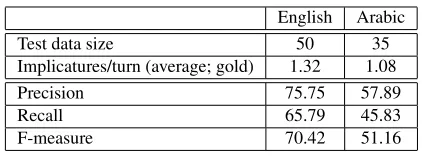
their corresponding components of human annotated mod-els. Although, in our current evaluation, these components are not taken into account, they should influence the overall performance of the system.
English Arabic
Test data size 50 35
Implicatures/turn (average; gold) 1.32 1.08
Precision 75.75 57.89
Recall 65.79 45.83
F-measure 70.42 51.16
Table 1: System performance
Our system derived many of the implicatures identified by human annotators (Table 1). We attribute its high preci-sion to the various axioms it employs, mainly Grice Maxim axioms as well as common sense knowledge rules that are employed by its reasoning mechanism when deriving new inferences. The automatically identified implicatures that were deemed incorrect were not utterly wrong, but highly unlikely for the given speaker utterance in the given con-text.
4.4.1. Error analysis
As noted above, the system relies heavily on the set of axioms it uses to derive implicatures. Our current set of Grice Maxim axioms produces novel and interesting im-plicatures. However, more axioms must be created to ac-count for various floutings of the Manner Maxim. The lack of sufficient common sense knowledge caused the highest number of errors, 66% of the unidentified conversational implicatures conveyed by English conversations.
For Arabic conversations, most errors are caused by the lack of a complete understanding of the speaker utterance. Lymba’s NLP pipeline for the Arabic language is not as rich as the suite of tools we developed for English and, al-tough, the reasoning engine’s entailment and implicature clause generation process is highly accurate, the quality of its output depends on the accuracy of its inputs, the log-ical representation of the speaker utterance as well as the knowledge-representing axioms.
4.4.2. Example
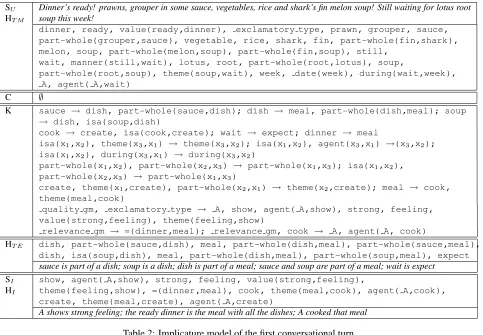
Let us consider the sample dialog showed in Section 1. The implicature models generated by the analysis of the first and second conversational turns are shown in Tables 2 and 3, which display a simplified logical representation of the model components (as returned by our implicature derivation system) together with a simple natural language conversion of the logical predicates (manually derived). The semantic representation of A’s utterance (SU/HT M – Dinner’s ready! prawns, grouper in some sauce, veg-etables, rice and shark’s fin melon soup! Still waiting for lotus root soup this week!) captures the statement’s explicit meaning (e.g., value(ready,dinner), part-whole(grouper,sauce), etc.). The unifica-tion and resoluunifica-tion of these logical clauses with some of K’s lexical chain and Semantic Calculus axioms produces logical clauses that make explicit the entailments carried by A’s utterance. For instance, sauce(part of SU) and
sauce → dish, part-whole(sauce,dish),
dish → meal, part-whole(dish,meal)
(lexical chain axioms) and part-whole(x1,x2),
part-whole(x2,x3) → part-whole(x1,x3) (Semantic Calculus axiom) generate the
entail-ments dish, part-whole(sauce,dish),
meal, part-whole(dish,meal),
part-whole(sauce,meal), which show that, since there is some sauce, a dish as well as a meal, which include that sauce, must exist.
Assuming A is rational, the list of dishes and ingredients mentioned in A’s second sentence is relevant to his/her first sentence (Dinner’s ready!). The link found between the two statements is a conversational implicature given by the Relevance Maxim macro axiom shown in Section 4.2.4., which indicates that the meal described by its various dishes is the ready dinner (=(dinner,meal), since WordNet’s ISA(dinner,meal) is converted into the axiom dinner → meal, or, more specifically dinner NN(x1) →
meal NN(x1)).
We note that the GM component of the implicature model is derived based on the set of Grice Maxim axioms used dur-ing the reasondur-ing process (e.g., Quality Maxim; Relevance Maxim flouting, for the first conversational turn).
5.
Conclusion
Our findings provide useful insights into the problem of conversational implicature identification. We have defined a conversational implicature model that captures the im-plicit information conveyed by the speaker as well as the explicit information transmitted to the hearer. Based on previous research and analysis of real-world conversations, we implemented an automated system that performs well on this task. The knowledge that humans use to fully under-stand an utterance is captured within the rich set of axioms used by our system. Furthermore, we identified and anno-tated real-world conversations that convey implicatures for both English and Arabic languages.
5.1. Future work
The broad scope of this difficult task requires more ef-fort from computational linguists that aim to automatically identify conversational implicatures conveyed by natural language texts. Possible extensions of the work presented in this paper include:
• Politeness. Polite utterances conversationally impli-cate the bald on record contribution (where no sooth-ing layer exists),
• Clarifications. Clarification requests provide good ev-idence of implicatures because they make implicatures explicit,
• Figures of speech(e.g., metaphor, scarcasm, irony),
SU
HT M
Dinner’s ready! prawns, grouper in some sauce, vegetables, rice and shark’s fin melon soup! Still waiting for lotus root soup this week!
dinner, ready, value(ready,dinner), exclamatory type, prawn, grouper, sauce, part-whole(grouper,sauce), vegetable, rice, shark, fin, part-whole(fin,shark), melon, soup, part-whole(melon,soup), part-whole(fin,soup), still,
wait, manner(still,wait), lotus, root, part-whole(root,lotus), soup,
part-whole(root,soup), theme(soup,wait), week, date(week), during(wait,week), A, agent( A,wait)
C ∅
K sauce → dish, part-whole(sauce,dish); dish → meal, part-whole(dish,meal); soup
→ dish, isa(soup,dish)
cook → create, isa(cook,create); wait → expect; dinner → meal
isa(x1,x2), theme(x3,x1) → theme(x3,x2); isa(x1,x2), agent(x3,x1) →(x3,x2);
isa(x1,x2), during(x3,x1) → during(x3,x2)
part-whole(x1,x2), part-whole(x2,x3) → part-whole(x1,x3); isa(x1,x2),
part-whole(x2,x3) → part-whole(x1,x3)
create, theme(x1,create), part-whole(x2,x1) → theme(x2,create); meal → cook,
theme(meal,cook)
quality gm, exclamatory type → A, show, agent( A,show), strong, feeling, value(strong,feeling), theme(feeling,show)
relevance gm → =(dinner,meal); relevance gm, cook → A, agent( A, cook)
HT E dish, part-whole(sauce,dish), meal, part-whole(dish,meal), part-whole(sauce,meal),
dish, isa(soup,dish), meal, part-whole(dish,meal), part-whole(soup,meal), expect sauce is part of a dish; soup is a dish; dish is part of a meal; sauce and soup are part of a meal; wait is expect
SI
HI
show, agent( A,show), strong, feeling, value(strong,feeling),
theme(feeling,show), =(dinner,meal), cook, theme(meal,cook), agent( A,cook), create, theme(meal,create), agent( A,create)
A shows strong feeling; the ready dinner is the meal with all the dishes; A cooked that meal
Table 2: Implicature model of the first conversational turn
SU Eeeeeee lotus root?
HT M eeeeeee, lotus, root, part-whole(root,lotus), question type
C dinner, ready, value(ready,dinner), exclamatory type, prawn, grouper, sauce, part-whole(grouper,sauce), vegetable, rice, shark, fin, part-whole(fin,shark), melon, soup, part-whole(melon,soup), part-whole(fin,soup), still,
wait, manner(still,wait), lotus, root, part-whole(root,lotus), soup, part-whole(root,soup), theme(soup,wait), week, date(week),
during(wait,week), A, agent( A,wait); dish, part-whole(sauce,dish), dinner, part-whole(dish,dinner), part-whole(sauce,dinner), dish, isa(soup,dish), dinner, part-whole(dish,dinner), part-whole(soup,dinner), meal, expect; show, agent( A,show), strong, feeling, value(strong,feeling), theme(feeling,show), =(dinner,dinner), cook, theme(meal,cook), agent( A,cook), create,
theme(meal,create), agent( A,create)
a dinner made by A is ready; this dinner includes prawns, grouper in some sauce, vegetables, rice and shark’s fin melon soup; A is expecting to make lotus root soup this week; A is showing strong feelings
K eeeeeee → interjection type; interjection type → exclamatory type eeeeeee → disgust, value(eeeeeee,disgust); disgust → dislike; dislike →
feeling
quality gm, question type → B, -believe, experiencer( B,believe), theme( question type,believe)
relevance gm → =(feeling,feeling); relevance gm → =(root,root)
quality gm, exclamatory type → B, show, agent( B,show), strong, feeling, value(strong,feeling), theme(feeling,show)
HT E interjection type, exclamatory type, disgust, value(eeeeeee,disgust), dislike,
feeling
eeeeeee is interjection, which indicates exclamation, and value of disgust; disgust is dislike, which is a feeling SI
HI
show, agent( B,show), strong, feeling, value(strong,feeling), theme(feeling,show), =(feeling,feeling), =(root,root), -believe, experiencer( B,believe), theme( question type,believe)
B shows a strong feeling of dislike; B does not believe A will create soup
These aspects are used by humans when interpreting an utterance and should be exploited by automated systems as well.
• Social utterance. Written discussions lack the ex-presiveness of oral dialogues where participants may use non-verbal communicative actions, e.g., winking, laughing, coughing, etc. as well as various speech at-tributes, such as, tone, pitch, accent, stress, volume, etc. The identification and representation of such fea-tures as part of the SUmodel component is vital for the automatic derivation of Relevance, Manner and Qual-ity implicatures.
• Parallel interpretations. Given that a hearer cannot be 100% sure of the speaker’s implicatures (these are only implicated and may be retracted ar any time) and because clarifications interfere with politeness, a hearer will allow the conversation to continue while maintaining a set of likely analyses in hopes of dis-ambiguating past speaker utterances based on future statements. A similar mechanism is desired for au-tomated systems that derive contradicting competing implicatures from a given speaker utterance.
Extensions to other languages depend on the implementa-tion of (1) natural language understanding tools that derive the referential meaning of an utterance in the native lan-guage (not by translating to another lanlan-guage); (2) mech-anisms of converting the meaning into logical forms that can be manipulated by a default reasoning engine; and (3) methods for generating the various types of natural lan-guage axioms described above.
6.
References
Keith Allan, 2000. Quantity Implicatures and the Lexicon, pages 169–218. Amsterdam:Elsevier.
G. Gazdar. 1979. Pragmatics: Implicature, Presupposi-tion, and Logic Form. New York: Academic.
Nancy Green and Sandra Carberry. 1993. A Discourse Plan-Based Approach to a Class of Particularized Con-versational Implicature. InProceedings of the 10th An-nual Meeting of the Eastern States Conference on Lin-guistics, pages 117–128.
Nancy L. Green and Sandra Carberry. 1994. A Hybrid Reasoning Model for Indirect Answers. In James Puste-jovsky, editor,Proceedings of the Thirty-Second Meeting of the Association for Computational Linguistics, pages 58–65, San Francisco. Association for Computational Linguistics, Morgan Kaufmann.
H. P. Grice. 1975. Logic and Conversation. InSyntax and Semantics: Speech Acts. Volume 3.
H. P. Grice. 1989. Studies in the Way of Words. Harvard University Press, Cambridge, MA.
Robert M. Harnish. 1991. Logical Form and Implicature. In Steven Davis, editor, Pragmatics: A Reader, pages 316–364. Oxford University Press, Oxford.
Julia Hirschberg. 1991. A Theory of Scalar Implicature. Garland Publishing Company, New York.
J. Hobbs, M. Stickel, D. Appelt, and P. Martin. 1990. In-terpretation as Abduction.Artificial Intelligence.
L. R. Horn. 2004. Implicature. InThe Handbook of Prag-matics.
Asa Kasher, editor. 1998. Pragmatics: Critical Concepts. Volume IV: Presupposition, Implicature, and Indirect Speech Acts. Routledge, London.
S. C. Levinson. 1983. Pragmatics. Cambridge, England: Cambridge University.
S. C. Levinson. 2000.Presumptive Meanings: The Theory of Generalized Conversational Implicature. Cambridge, MA: MIT Press.
A. S. McCafferty. 1987. Reasoning about Implicature: a Plan-based Approach. UMI.
D. Moldovan, M. Tatu, and C. Clark. 2010. Role of Se-mantics in Question Answering. In Semantic Comput-ing, pages 373–419. John Wiley & Sons, Inc.
A. Ritter, C. Cherry, and B. Dolan. 2010. Unsupervised Modeling of Twitter Conversations. In Proceedings of NAACL.
M. Tatu and D. Moldovan. 2006. A Logic-based Semantic Approach to Recognizing Textual Entailment. In Pro-ceedings of COLING/ACL 2006.
M. Tatu and D. Moldovan. 2007. COGEX at RTE3. In
Proceedings of the ACL-PASCAL Workshop on Textual Entailment and Paraphrasing.