Evaluation of a Complex Information Extraction Application in Specific
Domain
Romaric Besanc¸on, Olivier Ferret, Ludovic Jean-Louis
CEA, LIST, Vision and and Content Engineering Laboratory CEA Saclay Nano-INNOV, 91191 Gif-sur-Yvette, France
Abstract
Operational intelligence applications in specific domains are developed using numerous natural language processing technologies and tools. A challenge for this integration is to take into account the limitations of each of these technologies in the global evaluation of the application. We present in this article a complex intelligence application for the gathering of information from the Web about recent seismic events. We present the different components needed for the development of such system, including Information Extraction, Filtering and Clustering, and the technologies behind each component. We also propose an independent evaluation of each component and an insight of their influence in the overall performance of the system.
Keywords: Information Extraction, Evaluation, Filtering
1.
Introduction
Information Extraction (IE) deals with the identification of structured information from unstructured text. It cov-ers various tasks from Named Entity Recognition (NER) up to scenario template construction (Cunningham, 2005). For these different tasks, numerous approaches have been proposed and evaluated in general frameworks and eval-uation campaigns such as MUC (Message Understanding conference) (Grishman and Sundheim, 1996), ACE (Au-tomatic Content Extraction) or, more recently, TAC (Text Analysis Conference). These campaigns give the bench-marks needed to evaluate different tasks of IE, but when it comes to operational applications, intelligence tools for information extraction in specific domains are developed using numerous natural language processing technologies, that cover different tasks of IE, along with other modules for information filtering, retrieval or clustering.
Such systems can be evaluated directly using a end-user evaluation. However, this kind of evaluation is costly and cannot be used repeatedly during the development and tun-ing of the system. Furthermore, end-user evaluation also relies on the evaluation of ergonomic aspects through the quality of the user interface and not only on the quality of the results produced by the system. End-users evaluation should then be used for final evaluation of the system more than during the development, in order to improve the qual-ity of the IE tools.
On another hand, the automatic evaluation of such complex frameworks is difficult because of the diversity of the inte-grated modules. A challenge for this evaluation is to take into account the limitations of each of these technologies in the global evaluation of the application. We present in this article an evaluation of an intelligence application in spe-cialized domain that combines the independent evaluation of each component of the application, comparing various strategies for each component, and an error analysis that gives an insight on the influence of each component on the overall performance of the system. We present in section 2 the general architecture of the application, whose aim is
to gather information from the Web about recent seismic events. Then, in section 3, we present the different compo-nents needed for the development of such system, for each component, the different methods tested and their evalua-tion. Finally, in section 4, we present an evaluation of the influence of each component on the global process and their contribution to the overall perceived quality of the system.
2.
Presentation of the Information
Extraction application
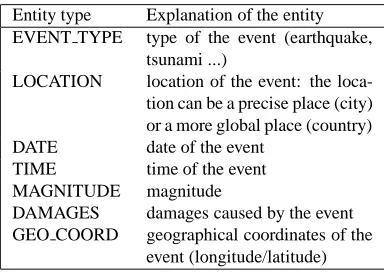
The Information Extraction application we evaluate in this article is designed to help analysts for the surveillance of seismic events. In this domain, the detection of new events is generally performed using signals from seismic and hydro-acoustic stations, treated with specialized anal-ysis tools. The analysts also gather information from the Web to corroborate and complement the interpretation of the signals. The purpose of the application is to assist these analysts in linking the seismic information from the seis-mometers to information published on the Web, by identi-fying specific entities in the texts (locations, dates, magni-tudes) and to structure these entities into event templates in order to present them to the user.
In the domain of seismic event surveillance, other works have been done to enrich the direct detection from sensors using texts (Sakaki et al., 2010; Earle et al., 2010) but these studies use more particularly Twitter as a source and rely on the information stream, treating temporal and spatial char-acterization of the tweets, and using the number of tweets rather than a sophisticated analysis of the content: in this case, Twitter itself is seen as another kind of sensor. In our approach, we use a deeper linguistic analysis of the texts, that is less adapted to a real-time detection of seismic events but is designed to provide a complement of information (the confirmation of a detection, how the people describes the event, the damages caused, etc.).
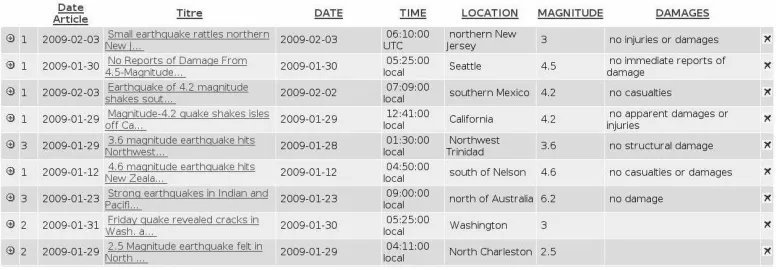
asso-Figure 1: Output of the application: synthetic presentation of the analyzed content in a dashboard
ciated information. The different modules involved in this application are the following:
• a collecting tool, that gathers texts from the chosen sources of information and extracts content-bearing text from their original format;
• a linguistic tool, that performs the linguistic analysis of the extracted text, and in particular the named entity recognition for the specific domain entities;
• an event identifier, that recognizes event mentions and link them with the relevant entities. This treatment is performed in two steps: first, a segmentation of the text separates the parts that are related to differ-ent evdiffer-ents; second, a slot filling step chooses the inter-esting entities to attach to the event in the main event segment;
• a filtering tool, to filter out the non-relevant texts. This filtering uses two criteria: the first one is the detection of an event by the previous module, the second one uses a statistical classifier;
• a clustering tool, gathering the texts relative to the same event, in order to provide the user with a more synthetic view of the information.
Finally, the results of the information extraction process are presented in a synthetic dashboard where each line contains the different entities associated with an event, as presented in Figure 1. The application works on both English and French documents, but the evaluation presented in this pa-per only reports results on the French reference corpus.
3.
Methods and Evaluation
All the evaluations presented in this paper have been per-formed on a corpus of French news articles concerning seismic events that have been collected between April and September 2008, on the French Agence France Presse (AFP) newswire (one third of the corpus) and from Google News (two thirds). The total corpus contains 501 relevant texts mentioning at least one seismic event. Other non-relevant texts have also been used to train the filtering tool.
3.1. Textual Content Extraction
The documents used for an IE application can come from different sources, such as newswires or news published on the Web. In the first case, the documents are generally well formatted and the content easy to extract (for instance, the news collected for this application from the AFP newswire are formatted using the XML format NewsML1 from the IPTC). In the second case, we need to extract the interesting textual content from the HTML page. Otherwise, the sur-rounding text can add noise to the IE process (for instance, another event can be cited in the headline of a different ar-ticle that is linked in the page).
Some works use machine learning techniques (for instance (Cai et al., 2003) uses the visual appearance of a Web page) that are dependent of the sites from which the pages are taken. We are in a context where we do not want to re-stricted ourselves to a given number of sites. Other ap-proaches have been proposed, in particular in the context of the CLEANEVAL evaluation campaign on Web page clean-ing (Baroni et al., 2008), but some strategies that achieve good performance in terms of coverage, such as N-cleaner (Evert, 2008), do not guarantee the readability of the result, which is fine when you want to use the extracted texts as a corpus to build language models, but is a problem in our application where the extracted text is presented to the end-users. An approach such as boilerpipe (Kohlsch¨utter et al., 2010) combines shallow text features and text density fea-tures to identify the textual content and proposes a readable output.
We tested, in our application, two simple strategies for tex-tual content extraction from Web pages:
• a first strategy, called density-cleaner, uses a text dump of the HTML page (using Lynx) and a measure of text density changes in the page, to spot the text borders. More precisely, we search for the strongest density changes in a similar way as (Hearst, 1997) for topic segmentation: we use lines of text as units and a sliding window on these units. The first most impor-tant increase of density indicates the beginning of the informative content part, the next most important de-crease of density indicates the end of the informative zone. We also use additional indicators such as the presence of the title (when available as metadata) and
1
complete 50 partial 500 entity type Precision Recall F-measure Recall
EVENT TYPE 93.9% 93.0% 93.4% 97.4%
LOCATION 90.5% 66.5% 76.6% 84.4%
DATE 88.2% 86.3% 87.2% 98.7%
TIME 82.6% 86.5% 84.5% 96.5%
MAGNITUDE 93.8% 83.3% 88.2% 94.0%
DAMAGES 83.5% 63.9% 72.4% 62.7%
GEO COORD 100.0% 66.7% 80.0% 86.7%
All 89.8% 77.4% 83.2% 72.9%
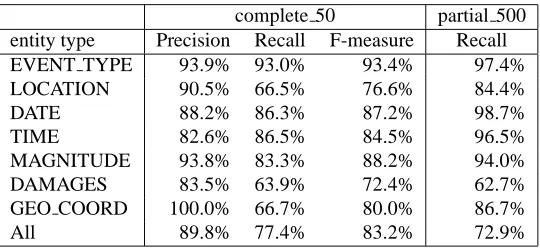
Table 3: Evaluation of named entity recognition on 50 texts with complete annotation and 500 texts with partial annotation
Two methods have been tested. The first one is based on a heuristic temporal segmentation based on the presence and values of dates, with the following principles: dates with different values2correspond to different segments and the limit between two different segments is chosen between two different dates based on the structure of the text in sen-tences and paragraphs, along with the presence of other entities that are characteristic of the domain. The second method tested is based on a machine learning model, using temporal cues as features (verb tenses, presence of dates and temporal expressions) and a Conditional Random Field (CRF) model to take into account the sequence of the tem-poral information. This machine learning method aims at classifying each sentence of the text into one of the fol-lowing classes: “main event” “secondary event”, “back-ground”. This segmentation method is described in more details in (Jean-Louis et al., 2010). The results of the two
heuristic CRF
event type Recall Precision Recall Precision main event 82.8% 64.7% 98.7% 87.4% sec. event 23.5% 43.4% 52.7% 95.8% background 16.9% 21.7% 69.3% 92.7%
Table 4: Results of event-based segmentation
methods are presented in Table 4, on a subset of the corpus containing 140 documents, manually annotated into seg-ments. Most documents contain at least two events. The results show that the CRF model outperforms the heuristic method.
3.3.2. Slot Filling
For the slot filling part, we tested several strategies. The first method, called Position is a simple heuristic consisting in taking, for each entity needed to characterize the event, the first entity of the required type in the segment of text as-sociated with the main event. A second set of strategies is composed of graph-based techniques based on the graph of relations between entities. This entity graph is built using statistic classifiers trained to indicate the presence or ab-sence of a relation between two entities. A selection of the entities associated with the event mention in the this graph is performed using the connections in the graph and their weights. More specifically, we tested a selection method
2Values of relative dates are normalized.
simply based on the weight of the relations (Confidence), a method based on the PageRank algorithm (PageRank) and a hybrid method combining the different selections ac-cording to the type of the entity (Hybrid). These strategies are described in more details in (Jean-Louis et al., 2011). The results, presented in Table 5, show that the simplistic heuristic already gives good results but can be improved using the more sophisticated techniques, the hybrid method giving the best results.
Recall Precision F-measure
Position 73.4% 73.1% 73.2%
Confidence 74.9% 74.2% 74.5%
PageRank 72.4% 71.7% 72.0%
Hybrid 77.6% 76.9% 77.2%
Table 5: Evaluation of the association of entities to events for the 501 annotated documents
3.4. Filtering
Document filtering allows to keep only relevant news in the synthetic dashboard. For the documents collected from the Web, a first pre-filtering step can be integrated if we use a search engine to acquire the documents by defining a spe-cific query relative to the domain. But it is generally dif-ficult to have a non-ambiguous query. Furthermore, this pre-filtering step cannot be applied on documents collected blindly from a newswire, except if we decide to index all documents using a local search engine, which can be costly. A second straightforward criterion for this filtering is the ef-fective discovery of an event by the previous module. But in practice, this filtering is not sufficient: we measured that, after this first filtering, 60% of documents are still non rel-evant. Among non-relevant documents, some use domain-related terms figuratively (“political earthquake”); others refer to an actual event but only anecdotally. A second fil-tering step has been integrated, using a statistical classifier trained on an annotated corpus made of texts selected af-ter the first filaf-tering step3. Following the existing work in the domain of text classification (Lewis et al., 2004), we
3
Precision Recall F-measure Accuracy original training corpus
words / presence / threshold = 0 94.3% 72.5% 82.0% 88.7% words / presence / threshold optimal 80.6% 91.2% 85.6% 89.1% words / tf.idf / threshold = 0 97.1% 72.5% 83.0% 89.5% words / tf.idf / threshold optimal 93.5% 79.1% 85.7% 90.7% lemmas / presence / threshold = 0 98.5% 71.1% 82.6% 89.5% lemmas / presence / threshold optimal 84.5% 91.1% 87.7% 91.0% lemmas / tf.idf / threshold = 0 98.5% 72.2% 83.3% 89.8% lemmas / tf.idf / threshold optimal 93.6% 81.1% 86.9% 91.4%
words / presence / threshold = 0 94.3% 72.5% 82.0% 88.7% words / tf.idf / threshold = 0 97.1% 72.5% 83.0% 89.5% lemmas / presence / threshold = 0 98.5% 71.1% 82.6% 89.5% lemmas / tf.idf / threshold = 0 98.5% 72.2% 83.3% 89.8% modified training corpus
lemmas / presence / threshold = 0 97.1% 75.6% 85.0% 90.6% lemmas / presence / threshold optimal 85.9% 87.8% 86.8% 90.6%
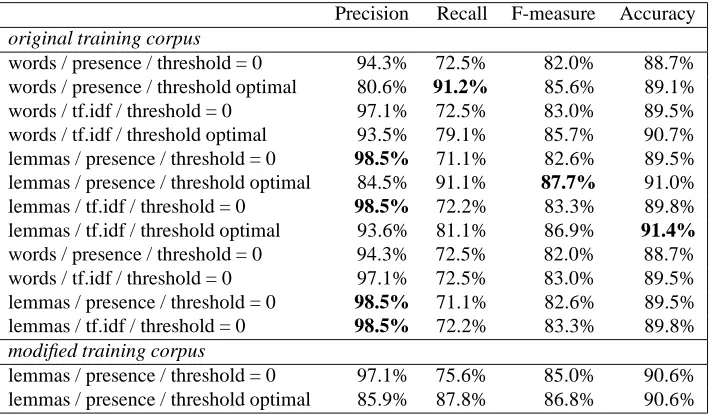
Table 6: Evaluation of different parameters for the SVM filtering classifier
used a standard SVM (Support Vector Machine) classifier (Joachims, 1998) trained with 501 relevant documents and 711 non-relevant documents. A distinct test corpus of 91 relevant documents and 166 non-relevant documents was also built. As an implementation, we used the SVMLight tool. A study of various parameters has been performed in order to optimize the performance of the classifier: in par-ticular, the following parameters have been tested:
• the units used to represent the text: either the inflected forms of the words or their normalized forms (lem-mas), obtained after the linguistic analysis of the texts (in this case, the specific entities have also been con-sidered as units);
• the weighting of these units: we tested a simple binary weight indicating the presence/absence of the units in the text and a frequency based tf.idf weighting scheme (combining the frequency of the term in the document and the inverse document frequency of the term in the training set);
• an optimization of the decision threshold of the SVM: previous studies have shown that the default thresh-old of the model (= 0) is not always the optimal solu-tion (Shanahan and Roma, 2003). Thus, we have set the threshold from the training corpus by optimizing a given criterion on a varying scale of thresholds (we used the F-measure as this criterion);
• a modification of the training corpus: the optimal fil-tering threshold is used to separate the training cor-pus into positive and negative examples and re-learn the model. By integrating more heterogeneity into the examples, this method allows the models to be more general (and should thus increase recall).
Table 6 shows that the best balance between precision and recall is obtained using lemmas with a binary weighting and an optimized threshold. The option lemmas-tf.idf gives bet-ter accuracy, but in this case, the recall has been considered
too low by the end-users. The modification of the training corpus did not achieve better results.
3.5. Clustering
On the basis of the information gathered by the IE module, we can group the documents relative to the same event to provide the user with a more synthetic view of the infor-mation. More precisely, we used the dates and locations of the events as core information (considering the other enti-ties or their evaluation may vary in different documents for the same event). These core entities were integrated using various methods:
• evt(...): we simply use the equality of dates and loca-tions of the event, supposing that other related infor-mation (magnitude, damages) may change in time;
• section(...): in order to increase the coverage of the clustering, this method is designed to correct possible mistakes in the event identification step. The values used for the clustering are all entity values from the segment of the main event and a majority vote is used on all common entities;
• document(...): following the same idea, we extend the majority vote to all common entities in the document to correct the errors from the segmentation step.
Furthermore, these entities are subject of an additional nor-malization. The relative dates are normalized according to the publication date of the documents, such that every date in the text has an associated form month/day/year. The lo-cations are also normalized using a geographical database built from the Geonames4 database and containing links of spatial inclusion. Location names are often ambiguous (for instance, there are more than 70 places called Paris in Geonames) and we first disambiguate the location names using an algorithm inspired from (Pouliquen et al., 2006)
Precision Recall F-measure NMI
evt(DATE,LOC) 87.8% 23.8% 37.4% 0.84
section(DATE,LOC) 59.8% 43.8% 50.5% 0.80
document(DATE,LOC) 39.0% 53.8% 45.2% 0.79
evt(DATE,COUNTRY) 86.8% 56.7% 68.6% 0.90
section(DATE,COUNTRY) 42.8% 62.7% 50.1% 0.81
document(DATE,COUNTRY) 38.6% 55.1% 45.4% 0.79
Markov Clustering 50.3% 33.7% 40.4% 0.72
DBSCAN 67.5% 17.4% 27.6% 0.82
KMeans 53.5% 8.9% 15.3% 0.78
Table 7: Evaluation of different strategies for the event-based clustering
that uses, on one hand, probabilities associated with lo-cation types and importance (Paris is more probably the capital of France than a smaller place in another region of the world) and, on the other hand, measures of spatial con-sistence on the global text, based on the geographical dis-tance of places spotted in the text (Paris may refer to a city in Texas if all the other places in the text are associated with Texas or the United States). The previous clustering techniques may then use either directly the location name (LOC) or the country associated with this location (COUN-TRY), to have a more flexible matching between locations. We compare these clustering approaches to standard clus-tering algorithms, including the standard K-Means, Markov Clustering (van Dongen, 2000) and DBSCAN (Ester et al., 1996). The last two have the interest of not requiring an a priori fixed number of clusters. We tested these algorithms using either the titles only or the full texts, with inflected forms or lemmas. The best results were obtained on full texts with lemmas and are the only ones presented in the results.
The evaluation has been performed on the 501 news of our corpus, manually clustered into 142 different clusters (with 59 clusters containing more than 1 document), using Pre-cision, Recall and F-measure on document pairs (a pair of documents is considered as correct is the two documents are part of the same cluster in reference and in test) and Normalized Mutual Information (Strehl and Ghosh, 2003). In Table 7, we see that the simple clustering gives good pre-cision but poor recall. With the location name normaliza-tion, the improvement of coverage is obtained without an important loss in precision (only one point) and F-measure is then largely improved. These results also show that the quality of the results obtained by previous steps is sufficient to obtain good clustering results with a simple heuristic, better than with a standard clustering algorithm on full text.
4.
Influence of Components in Global
Performance
The output of the application is the synthesized informa-tion presented to the end-user in the dashboard. The overall quality of the application will then be assessed from this dashboard. All the components of the overall system may influence this quality. Actually, the most important com-ponent in this respect is the filtering. Indeed, its impact on the final IE result is quite straightforward and important, since each non-relevant document occupies a line in the
ta-ble, contributing to a general impression of mistakes in the page. As we indicated in section 3.4, we noted that without the statistical filtering, there was around 60% documents kept for the IE process that were not relevant. We indeed measured that for the same IE method, the overall quality of the dashboard doubled when adding the statistical filtering step.
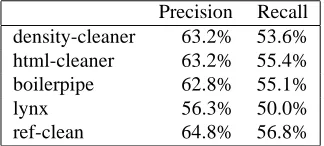
The quality of the textual context extraction may also influ-ence the information extraction process. Table 8 presents the results of the information extraction on the 50 doc-uments used for cleaning evaluation, using the different cleaning techniques presented in section 3.1 and compar-ing them with the results obtained with no textual content extraction (using only the dump produced by the Lynx text browser) and the results obtained using the reference of manually cleaned pages (ref-clean). Results are a bit
in-Precision Recall density-cleaner 63.2% 53.6% html-cleaner 63.2% 55.4%
boilerpipe 62.8% 55.1%
lynx 56.3% 50.0%
ref-clean 64.8% 56.8%
Table 8: Evaluation of the influence of the quality of the textual content extraction on the IE process
ferior to the results presented in the rest of the paper be-cause the IE reference was produced on a particular page cleaning result (which may induce a bias). However, we see that the quality of the textual content extraction does have an influence of the results: the results of the different techniques are mostly comparable, even if the html-cleaner performs a bit better, but all these results are better than the one obtained on the whole page, which confirms the need to clean the page. The improvement observed when using the text from the reference cleaning is relatively limited, which show that the cleaning strategies used are sufficient to get most of the relevant information.
on machine learning performs a bit better, but the two re-sults are comparable.
Recall Precision without segmentation 66.6% 63.5%
heuristic 71.0% 68.6%
CRF 71.7% 68.8%
reference segmentation 87.5% 86.3%
Table 9: Impact of the segmentation on the slot-filling task
A complementary error analysis has been performed in or-der to determine the contribution of the various modules of the IE system. In this analysis, errors correspond to incor-rect entities for an event, i.e. a line of the dashboard. They are characterized as follows:
• at least one entity of the reference for a given type has been identified in the main event segment, i.e. the error comes from the slot filling module;
• at least one entity of the reference of a given type has been identified in another segment, i.e. the error comes from the segmentation module;
• none of the reference entities has been identified in the text, i.e. the error comes from the named entity recognition module.
The distribution of the errors on these three types is given in Table 10, cumulated for all entity types, for the two segmentation strategies considered and the Position slot-filling strategy. This analysis shows that while the
segmen-heuristic CRF correct entities 71.6% 72.2% slot filling errors 18.6% 20.6% segmentation errors 6.2% 3.8%
NER errors 3.6% 3.4%
Table 10: Analysis of the different error types in the event template construction
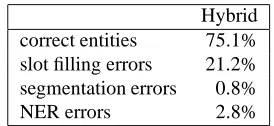
tation errors are divided by two with the CRF segmentation method, the global percentage of correct entities is quite similar for the two systems, mostly because the segmenta-tion errors are partially turned into slot filling errors in t he main event segment. Table 11 gives the error analysis with the CRF-based segmentation and the Hybrid strategy pre-sented in section 3.3.2. It demonstrates that these errors can be partially corrected using advanced slot-filling techniques but that there is still room for improvement. By the way, it confirms that the slot filling task is still the most difficult task of an IE system5.
5
The segmentation errors in this table are less important than in previous table because this error analysis has been performed with an different (improved) CRF segmenter.
Hybrid correct entities 75.1% slot filling errors 21.2% segmentation errors 0.8%
NER errors 2.8%
Table 11: Analysis of the different error types in the event template construction
5.
Conclusion
We have presented in this paper an evaluation of an Infor-mation Extraction application in specialized domain, de-signed for the identification of events in news articles. This application deals with some difficult problems of IE: for instance, the texts in this domain usually mention several events, which adds ambiguity in the event identification and makes the event template construction more delicate. Moreover, this application, in order to be operational, in-tegrates several components of natural language process-ing, text classification and clustering. The evaluation of the global application is difficult since each component has its own limitations and weaknesses. The evaluation we per-formed mainly relies on the independent quantitative evalu-ation of each component of the applicevalu-ation but also includes a global error analysis to understand the part of the errors in the final output of the system that are due to each com-ponent. Such dual evaluation is particularly useful during the development of the application.
The next steps in the development of the application are fo-cused on the information extraction part, and more specif-ically on the slot-filling task, where most of the errors are now occurring. The first perspective is the use of proxim-ity and linguistic criteria in the event template construction (including syntactic relations). The document clustering is also a component where there is room for improvement, for instance by integrating the structured information extracted from the event in a more generic clustering environment (using a standard clustering model). From a more general perspective, we are interested in the possibility to overcome the specificities of the target domain for the IE application and to be able to build a more generic model that could be adapted to different domains using only limited supervi-sion.
6.
Acknowledgments
The research leading to these results has received funding from the European Union’s Seventh Framework Program (FP7/2007-2013) under grant agreement no SEC-GA-2009-242352.
7.
References
Arc90. 2009. Readability - An Arc90 Lab Experiment. http://lab.arc90.com/experiments/readability/.
Marco Baroni, Francis Chantree, Adam Kilgarriff, and Serge Sharoff. 2008. Cleaneval: a Competition for Cleaning Web Pages. In Proceedings of LREC’08, Mar-rakech, Morocco, may.
for Linguistic Analysis and Linguistic Resources Devel-opment and Evaluation. In Proceedings of LREC’10, Valletta, Malta, may.
Deng Cai, Shipeng Yu, Ji rong Wen, and Wei ying Ma. 2003. Extracting content structure for web pages based on visual representation. In Proceedings of the 5th Asia Pacific Web Conference, pages 406–417.
Hamish Cunningham, 2005. Encyclopedia of Language and Linguistics, chapter Information extraction, auto-matic. Elsevier.
Paul Earle, Michelle Guy, Richard Buckmaster, Chris Os-trum, Scott Horvath, and Amy Vaughan. 2010. OMG Earthquake! Can Twitter Improve Earthquake Re-sponse? Seismological Research Letters, 81(2):246– 251.
Martin Ester, Hans-Peter Kriegel, Jrg Sander, and Xiaowei Xu. 1996. A Density-Based Algorithm for Discovering Clusters in Large Spatial Databases with Noise. In Evan-gelos Simoudis, Jiawei Han, and Usama M. Fayyad, ed-itors, Proceedings of the Second International Confer-ence on Knowledge Discovery and Data Mining (KDD-96), pages 226–231. AAAI Press.
Stefan Evert. 2008. A Lightweight and Efficient Tool for Cleaning Web Pages. In Proceedings of LREC’08, Mar-rakech, Morocco, may. European Language Resources Association (ELRA).
Ralph Grishman and Beth Sundheim. 1996. Message Un-derstanding Conference-6: a brief history. In Proceed-ings of the 16th conference on Computational linguistics, pages 466–471, Morristown, NJ, USA.
Marti A. Hearst. 1997. Texttiling: Segmenting text into multi-paragraph subtopic passages. Computational Lin-guistics, 23(1):33–64.
Ludovic Jean-Louis, Romaric Besanon, and Olivier Fer-ret. 2010. Using Temporal Cues for Segmenting Texts into Events. In Hrafn Loftsson, Eirkur Rgnvaldsson, and Sigrn Helgadttir, editors, 7th International Conference on Natural Language Processing (IceTAL 2010), volume 6233 of Lecture Notes in Computer Science, pages 150– 161. Springer Berlin / Heidelberg.
Ludovic Jean-Louis, Romaric Besanon, and Olivier Ferret. 2011. Text Segmentation and Graph-based Method for Template Filling in Information Extraction. In 5th Inter-national Joint Conference on Natural Language Process-ing (IJCNLP 2011), pages 723–731, Chiang Mai, Thai-land.
Thorsten Joachims. 1998. Text Categorization with Sup-port Vector Machines: Learning with Many Relevant Features. In 10th European Conference on Machine Learning (ECML’98), pages 137–142, Berlin. Springer. Christian Kohlsch ¨utter, Peter Fankhauser, and Wolfgang
Nejdl. 2010. Boilerplate detection using shallow text features. In Proceedings of the third ACM international conference on Web search and data mining (WSDM’10), pages 441–450, New York, NY, USA. ACM.
David D. Lewis, Yiming Yang, Tony G. Rose, and Fan Li. 2004. RCV1: A New Benchmark Collection for Text Categorization Research. Journal of Machine Learning Research, 5:361–397.
Bruno Pouliquen, Marco Kimler, Ralf Steinberger, Camelia Ignat, Tamara Oellinger, Flavio Fluart, Wajdi Zaghouani, Anna Widiger, Ann charlotte Forslund, and Clive Best. 2006. Geocoding multilingual texts: Recognition, dis-ambiguation and visualisation. In Proceedings of LREC 2006, Głnes, Italie.
Takeshi Sakaki, Makoto Okazaki, and Yutaka Matsuo. 2010. Earthquake shakes Twitter users: real-time event detection by social sensors. In Proceedings of WWW’10, pages 851–860. ACM.
James G. Shanahan and Norbert Roma. 2003. Improving SVM Text Classification Performance through Thresh-old Adjustment. In Proceedings of ECML’2003, pages 361–372.
Alexander Strehl and Joydeep Ghosh. 2003. Cluster en-sembles — a knowledge reuse framework for combin-ing multiple partitions. Journal of Machine Learncombin-ing Re-search, 3:583–617, March.