U
nderstanding and communicating risk, such as the magnitude or effect size of the benefits and harms associated with preventive screening and other health care management interventions, is fundamental to evidence-based decision making by physicians and shared decision making with patients. Family physicians encounter several different measures of outcome and of magnitude or effect size that are used to describe benefits and harms. Some of these measures might be inappropri-ate to describe the benefits of screening, and others might be difficult for patients and physicians to understand.1,2Effective communication of harms and benefits with patients can be challenging owing to limited basic numeracy and health literacy skills among many patients. Numeracy refers to an individual’s ability to understand basic numerical concepts.2-4 For example,
patients might have difficulty understanding basic prob-ability or converting between percentage and rate.4 This
issue has been described as “collective statistical illit-eracy” and has been identified as an important barrier to patients’ understanding of the benefits and harms associated with health decision making.2,3 In Canada in
2014, 55% of Canadian adults were found to have inad-equate numeracy skills.5Health literacy has been defined
as “the ability to access, understand, evaluate and com-municate information as a way to promote, maintain and improve health in a variety of settings across the life-course.”6 Similar to numeracy, a 2008 report from
the Canadian Public Health Association found 55% or 11.7 million adults were estimated to have less than
adequate health literacy skills.6
Physicians might also have challenges in understand-ing statistical measures. A recent survey of physicians from 8 countries, with various levels of training and specialty backgrounds, found that most had difficulty understanding commonly used measures of magnitude, such as relative risk (RR).7 Physicians also had difficulty
understanding basic concepts of risk and probability that are important in understanding and communicating the benefits and harms associated with preventive health care.2 A 2012 study conducted in the United States found
that most primary care practitioners had difficulty cor-rectly interpreting the results of cancer screening stud-ies and misinterpreted the measures used to describe the benefits of screening.8 In spite of increased training
in evidence-based medicine, statistics, and probabilis-tic reasoning in medical school curriculums, the level of physician statistical literacy does not appear to have increased during the past 40 years.9,10
This article will review and discuss the appropriate-ness, advantages, and disadvantages of commonly used measures of outcome (overall and disease-specific mor-tality, incidence or number of new cases, and 5- and 10-year survival) and magnitude or effect size (RR,
abso-lute risk [AR], natural frequency, and number needed to screen [NNS]) that family physicians encounter when interpreting and communicating the harms and benefits of screening. The choice of outcome and magnitude or effect size measures and the format or frame used to present the information can result in different levels of understanding of the same probabilistic information by physicians and patients.1,2
Understanding and communicating risk
Measures of outcome and the magnitude of benefits and harms
Neil R. Bell MD SM CCFP FCFP James A. Dickinson MB BS PhD CCFP FRACGP Roland Grad MD CM MSc CCFP FCFP Harminder Singh MD MPH FRCPC Danielle Kasperavicius MPH Brett D. Thombs PhDKey points
Overall or disease-specific mortality demonstrated in a randomized clinical trial provides the highest-quality evidence for
estimates of the benefits of preventive screening. Improved 5- or 10-year survival provides exaggerated estimates of the benefits of preventive screening owing to lead-time, length-time, and overdiagnosis bias. Increased disease detection (incidence or number of new cases) provides exaggerated estimates of the benefits of preventive screening owing to overdiagnosis.
More than 50% of Canadians have inadequate numeracy and health literacy skills. Communicating the harms and benefits of
preventive screening might be challenging with these patients.
Patient and physician understanding of the magnitude or effect size of benefits and harms is improved when they are
expressed as natural frequencies or in absolute terms such as absolute risk reduction with baseline risk. Visual displays of measures of magnitude or effect size such as 1000-person diagrams increase understanding for both physicians and patients.
Proportionate measures of magnitude or effect size, such as relative risk, can lead patients and physicians to overestimate
In a previous article11 in this Prevention in Practice
series, we introduced a clinical case on screening for lung cancer with low-dose computed tomography (CT). Let’s briefly review the case.
John is a 66-year-old man with a more than 30 pack-year history of smoking. John is a candidate for screen-ing for lung cancer with low-dose CT based on recom-mendations from the Canadian Task Force on Preventive Health Care (CTFPHC). At a previous visit, John decided not to proceed with screening. After reading a news article on screening, John’s wife asked him to reconsider his decision. At this visit, John and his wife are asking for additional information about screening for lung cancer. How could you best describe the potential benefits and harms of screening to John and his wife?
Outcome measures encountered
in preventive screening
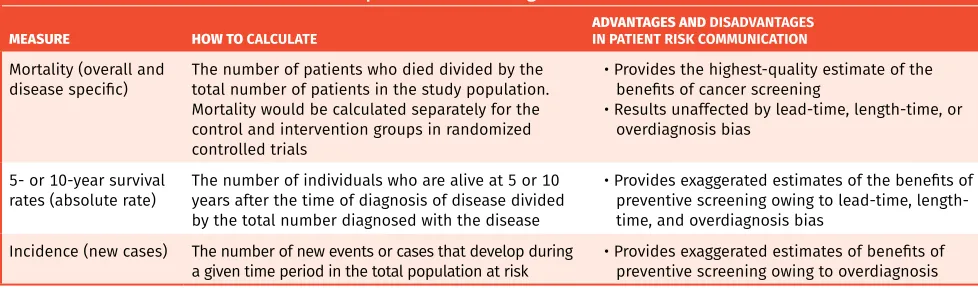
Outcome measures of preventive screening that are fre-quently encountered by family physicians in information provided by government agencies, guideline developers, and advocacy groups on the benefits or harms of screen-ing are outlined in Table 1. These measures include overall and disease-specific mortality, 5- or 10-year sur-vival rates, and increased detection of disease (inci-dence or number of new cases).
Overall and disease-specific mortality. Reduced overall or disease-specific mortality in a randomized controlled trial provides the highest-quality evidence for estimates of the benefit of cancer screening.2,12-18 Mortality rates in
randomized controlled trials are unaffected by lead-time, length-time, or overdiagnosis bias. Mortality statistics are not affected by timing of disease diagnosis because all deaths that occur in the study population would be included in the overall or disease-specific mortality.2,12-18
The main limitation of overall mortality is the require-ment for very large sample sizes, while the limitations of disease-specific mortality relate to assignment of the cause of death and the potential difficulty in measuring harms related to screening.13
Five- or 10-year survival rates. Five- or 10-year sur-vival rates are common sursur-vival statistics that consider patients diagnosed with a disease. Physicians will be aware of the frequent use of 5- and 10-year survival rates in cancer to describe the benefits of treatment and prognosis with different stages of disease.2,12,19 However,
physicians must be cautious in the use of 5- or 10-year survival rates to describe the benefits of preventive screening.2,14,15,20 This occurs because of the increasing
sensitivity of screening tests to identify smaller lesions and the heterogeneity of cancer progression where there is variability in the rates of cancer progression, with some cancers destined to fail to progress or grow so slowly that the patient will die of other causes.2,18,20
Under these circumstances, 5- and 10-year survival can provide exaggerated estimates of the benefits of cancer screening.2,14,15 Lead-time, length-time, and
overdiag-nosis bias describe how these factors could artificially increase 5- and 10-year survival rates.2,14,15
Lead-time bias is the earlier identification of patients with a disease owing to screening, but who have no change in the actual time of death owing to screening. Five- or 10-year survival rates are increased by early diagnosis because of the increased time from diagno-sis to death in screened compared with unscreened patients. In both groups, there would be no change in the time of death.2,14,15
Length-time bias is the tendency for screening to iden-tify more indolent or slower-growing cancers. Faster-growing, more aggressive tumours are more likely to become symptomatic and detected clinically rather than through screening; therefore, patients with screen-detected cancers have longer survival compared with those with clinically detected cancers. This apparent improvement in survival is incorrectly attributed to screening.2,14,15
Overdiagnosis is the detection of an “abnormality” or a “condition” that would ultimately not go on to cause symptoms or death.18,20 In overdiagnosis bias, survival
rates are increased because of the detection of patients with nonprogressive cancers (overdiagnosed patients) with screening. The overall number of patients who die of cancer would be unchanged but the 5- or 10-year
Table 1. Outcome measures encountered in preventive screening
MEASURE HOW TO CALCULATE ADVANTAGES ANDIN PATIENT RISK COMMUNICATION DISADVANTAGES
Mortality (overall and
disease specific) The number of patients who died divided by the total number of patients in the study population. Mortality would be calculated separately for the control and intervention groups in randomized controlled trials
• Provides the highest-quality estimate of the benefits of cancer screening
• Results unaffected by lead-time, length-time, or overdiagnosis bias
5- or 10-year survival
rates (absolute rate) The number of individuals who are alive at 5 or 10 years after the time of diagnosis of disease divided by the total number diagnosed with the disease
• Provides exaggerated estimates of the benefits of preventive screening owing to lead-time, length-time, and overdiagnosis bias
Incidence (new cases) The number of new events or cases that develop during
survival rate is increased because of the inclusion of patients with nonprogressive or overdiagnosed cancer in the survival estimates of screened patients.2,15,18,20
Incidence. Incidence is the number of new cases or events that develop in a population at risk during a specified time interval. In screening, incidence can be increased owing to the detection of patients with dis-ease that could progress to cause symptoms or death, or the detection of patients who are overdiagnosed.18
Patients overdiagnosed and treated would be considered “survivors” of the disease, although if undiagnosed they would not have experienced symptoms or died of the disease.18 Incidence provides exaggerated estimates of
the benefits of preventive screening owing to overdiag-nosis. Thyroid cancer provides an example of a disease where an increased incidence of disease was observed from screening.21-23 In Canada21 and other countries,22,23
the increased detection or incidence of thyroid cancer
was found to have almost no effect on thyroid cancer mortality owing to overdiagnosis.
Measures of magnitude or effect size
encountered in preventive screening
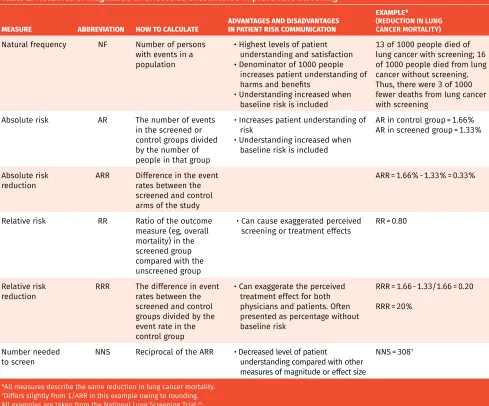
Table 2 outlines the commonly used measures of mag-nitude or effect size that are used to describe outcome measures of screening and highlights the advantages and disadvantages of each measure. All examples in this table are taken from the National Lung Screening Trial.24-26
Natural frequencies. Natural frequencies can be defined as the number of persons with events juxtaposed with a baseline denominator of persons at risk.1,2,27 In
preven-tive screening, it is common to present the expected probabilities of outcomes in a population of 1000 per-sons undergoing screening compared with an equiva-lent population that is not being screened. Presentation of the results of screening trials in natural frequency
Table 2. Measures of magnitude or effect size encountered in preventive screening
MEASURE ABBREVIATION HOW TO CALCULATE ADVANTAGES AND DISADVANTAGES IN PATIENT RISK COMMUNICATION
EXAMPLE*
(REDUCTION IN LUNG CANCER MORTALITY)
Natural frequency NF Number of persons with events in a population
• Highest levels of patient understanding and satisfaction • Denominator of 1000 people
increases patient understanding of harms and benefits
• Understanding increased when baseline risk is included
13 of 1000 people died of lung cancer with screening; 16 of 1000 people died from lung cancer without screening. Thus, there were 3 of 1000 fewer deaths from lung cancer with screening
Absolute risk AR The number of events in the screened or control groups divided by the number of people in that group
• Increases patient understanding of risk
• Understanding increased when baseline risk is included
AR in control group = 1.66% AR in screened group = 1.33%
Absolute risk
reduction ARR Difference in the event rates between the screened and control arms of the study
ARR = 1.66% - 1.33% = 0.33%
Relative risk RR Ratio of the outcome measure (eg, overall mortality) in the screened group compared with the unscreened group
• Can cause exaggerated perceived
screening or treatment effects RR = 0.80
Relative risk
reduction RRR The difference in event rates between the screened and control groups divided by the event rate in the control group
• Can exaggerate the perceived treatment effect for both physicians and patients. Often presented as percentage without baseline risk
RRR = 1.66 - 1.33/1.66 = 0.20
RRR = 20%
Number needed
to screen NNS Reciprocal of the ARR • Decreased level of patient understanding compared with other measures of magnitude or effect size
NNS = 308†
*All measures describe the same reduction in lung cancer mortality.
†Differs slightly from 1/ARR in this example owing to rounding.
All examples are taken from the National Lung Screening Trial.24
formats has been found to improve the understanding of magnitude or effect size on benefits and harms by patients.1,2 Patient understanding is increased with the
inclusion of information on the baseline risk.1,2
Absolute risk and absolute risk reduction (ARR). The AR is the number of events in the screened or control groups divided by the number of people in that group. The ARR is the difference in the event rates between the control and treatment groups. Physicians and patients have greater understanding of risk differences when the results are presented as ARR compared with RR.1,2
Relative risk and relative risk reduction (RRR). The RR is the event rate in the screened group divided by the event rate in the control group. The RRR is the dif-ference in event rates between the screened and control groups divided by the event rate in the control group. Presentation of risk in the form of RR or RRR can cause exaggerated perceived screening or treatment effects.1,2
This is particularly problematic when the base rate is very low, in which case small changes in ARR can lead to a large change in RRR. This effect is shown in the example in Table 2 of lung cancer screening.24-26
Number needed to screen. The NNS is the number of patients who must be screened in order to prevent 1 adverse event. The NNS is similar to the number needed to treat. The NNS is calculated as the reciprocal of the ARR. Although it has been advocated as a more eas-ily understood measure of the benefits of an interven-tion, the presentation of results in this format resulted in lower levels of understanding by patients compared with other formats, such as natural frequencies.1
Visual aids
The addition of visual aids to numerical information on risk improves the accuracy and comprehension of numeri-cal data on risk by patients and physicians. Visual dis-plays are better understood when they include both the “sick” and “healthy” populations. Commonly used formats include icon arrays, such as 1000-person diagrams and bar graphs. Examples of 1000-person diagrams developed by the CTFPHC on screening for breast, prostate, and lung cancer can be found on the CTFPHC website (www.canad iantaskforce.ca) and in previous articles in this series.28
Framing of risk information
Framing is the expression of logically equivalent infor-mation (whether numerical or verbal) in different ways. Positive and negative frames refer to whether an out-come is described as a chance of survival (positive) or a chance of death (negative). Evidence suggests that positive framing is more effective than negative framing in persuading people to choose risky treatment options such as high-risk surgery.1,27,29 Presenting information as
RR as opposed to ARR increased perceptions of treat-ment or screening benefit.1,2,29
Bottom line
Overall or disease-specific mortality from randomized clinical trials provides the highest-quality evidence for the estimates of the benefits of preventive screening, while other measures of outcomes, such as 5- or 10-year survival rates or incidence, can result in exaggerated estimates of the benefits of screening. In presenting the magnitude or effect size of benefits and harms to patients, physicians should consider using measures of magnitude or effect size that are most effective in improving the understanding of patients. The most eas-ily understood measure of magnitude or effect size is natural frequency supported by the use of knowl-edge translation tools, such as decision aids that fea-ture 1000-person diagrams. Shared decision making and communication of the magnitude of benefits and harms might be challenging with some patients owing to inad-equate health literacy and numeracy skills.
Back to John
You take the opportunity to review the CTFPHC 1000-person diagram on lung cancer screening with John and his wife. This diagram is a visual representa-tion of natural frequencies. After clarifying what the colours in the diagram indicate, John and his wife leave with a good understanding of the potential harms and benefits of screening and plan to discuss further before making a decision. John indicates that he will follow up if he wishes to proceed with the low-dose CT scan.
Dr Bell is Professor in the Department of Family Medicine at the University of Alberta in Edmonton. Dr Dickinson is Professor in the Department of Family Medicine and the Department of Community Health Sciences at the University of Calgary in Alberta. Dr Grad is Associate Professor in the Department of Family Medicine at McGill University and Senior Investigator at the Lady Davis Institute in Montreal, Que. Dr Singh is Associate Professor in the Department of Internal Medicine and the Department of Community Health Sciences at the University of Manitoba in Winnipeg and the Department of Hematology and Oncology for CancerCare Manitoba. Ms Kasperavicius is Research Coordinator for the Knowledge Translation Program at St Michael’s Hospital in Toronto, Ont. Dr Thombs is Professor and William Dawson Scholar in the Faculty of Medicine at McGill University and Chair of the Canadian Task Force on Preventive Health Care.
Competing interests
All authors have completed the International Committee of Medical Journal Editors’ Unified Competing Interest form (available on request from the corresponding author). Dr Singh reports grants from Merck Canada, personal fees from Pendopharm, and personal fees from Ferring Canada, outside the submitted work. The other authors declare that they have no competing interests. For additional information on the conflict of interests of the Canadian Task Force on Preventive Health Care, please visit www.canadiantaskforce.ca.
Correspondence
Dr Neil R. Bell; e-mail [email protected] References
1. Zipkin DA, Umscheid CA, Keating N, Allen E, Aung K, Beyth R, et al. Evidence-based risk communication: a systematic review. Ann Intern Med 2014;161(14):270-80. 2. Gegerenzer G, Gaissmaier W, Kurz-Milcke E, Schwarz L, Woloshin S. Helping doctors and
patients make sense of health statistics. Psychol Sci Public Interest 2007;8(2):53-96. 3. Peters E, Hibbard J, Slovic P, Dieckmann N. Numeracy skill and the communication,
comprehension, and use of risk-benefit information. Health Affairs 2007;26(3):741-8. 4. Schwarts LM, Woloshin S, Black WC, Welch GH. The role of numeracy in
understand-ing the benefits of screenunderstand-ing mammography. Ann Intern Med 1997;127(11):966-72. 5. The Conference Board of Canada. How Canada performs. Educational provincial
Board of Canada; 2014. Available from: www.conferenceboard.ca/hcp/provincial/ education/adlt-lownum.aspx. Accessed 2017 Dec 6.
6. Rootman I, Gordon-El-Bihbety D. A vision for a health literate Canada: report of the
Expert Panel on Health Literacy. Ottawa, ON: Canadian Public Health Association; 2008.
7. Johnston BC, Alonso-Coello P, Fredrich JO, Mustafa RA, Tikkinen KA, Neumann I, et al. Do clinicians understand the size of treatment effects? A randomized survey across 8 countries. CMAJ 2016;188(1):25-32.
8. Wegwarth O, Schwartz LM, Woloshin S, Gaissmaier W, Gigerenzer G. Do physicians understand cancer screening statistics? A national survey of primary care physi-cians in the United States. Ann Intern Med 2012;156(5):340-49.
9. Martyn C. Risky business: doctors’ understanding of statistics. BMJ 2014;349:g5619. 10. Bartlett G, Gagnon J. Physicians and knowledge translation of statistics: mind the
gap. CMAJ 2016;188(1):11-12. Epub 2015 Nov 30.
11. Grad R, Légaré F, Bell NR, Dickinson JA, Singh H, Moore AE, et al. Shared decision making in preventive health care. What it is; what it is not. Can Fam Physician
2017;63:682-84 (Eng), e377-80 (Fr).
12. Measurement of progress against cancer. Extramural Committee to Assess Measures of Progress Against Cancer. J Natl Cancer Inst 1990;82(10):825-35.
13. Kasperavicius D, Bell NR, Grad R, Dickinson JA, Moore AE, Singh H, et al. Response to using disease-specific mortality in discussion with patients [Letters]. Can Fam
Physician 2017;63:828-30.
14. Welch HG, Schwartz LM, Woloshin S. Are increasing 5-year survival rates evidence of success against cancer? JAMA 2000;283(22):2975-8.
15. Welch HG, Woloshin S, Schwarz LM, Gordis L, Gøtzsche PC, Harris R, et al. Overstat-ing the evidence for lung cancer screenOverstat-ing: the International Early Lung Cancer Action Program (I-ELCAP) study. Arch Intern Med 2007;167(21):2289-95.
16. Alibhai SM. Cancer screening: the importance of outcome measures. Crit Rev Oncol
Hematol 2006;57(3):215-24. Epub 2005 Dec 20.
17. Croswell JM, Ransohoff DF, Kramer BS. Principles of cancer screening: lessons from history and study design issues. Semin Oncol 2010;37(3):202-15.
18. Welch HG, Black WC. Overdiagnosis in cancer. J Natl Cancer Inst 2010;102(9):605-13. Epub 2010 Apr 22.
19. Mahoney J. Survival rates increase for Canadians with cancer: Statscan. The Globe
and Mail 2010 Sep 12. Available from:
www.theglobeandmail.com/life/health-and-fitness/survival-rates-increase-for-canadians-with-cancer-statscan/article556422/. Accessed 2017 Dec 6.
20. Moynihan R, Doust J, Henry D. Preventing overdiagnosis: how to stop harming the healthy. BMJ 2012;344:e3502.
21. Topstad D, Dickinsion JA. Thyroid cancer incidence in Canada: a national cancer registry analysis. CMAJ Open 2017;5(3):E612-6.
22. Vaccarella S, Franceschi S, Bray F, Wild C, Plummer M, Dal Maso L. Worldwide thyroid-cancer epidemic? The increasing impact of overdiagnosis. N Engl J Med
2016;375(7):614-7.
23. Ahn HS, Kim HJ, Welch HG. Korea’s thyroid-cancer “epidemic”—screening and over-diagnosis. N Engl J Med 2014;371(19):1765-7.
24. National Lung Screening Trial Research Team; Aberle DR, Adams AM, Berg CD, Black WC, Clapp JD, et al. Reduced lung-cancer mortality with low-dose computed tomo-graphic screening. N Engl J Med 2011;365(5):395-409. Epub 2011 Jun 29.
25. McMaster Evidence Review and Synthesis Centre Team. Screening for lung cancer:
sys-tematic review and meta-analyses. Calgary, AB: Canadian Task Force on Preventive Health
Care; 2015. Available from: https://canadiantaskforce.ca/wp-content/uploads/2016/03/ lung-cancer-screening-systematic-reviewfinal-2.pdf. Accessed 2017 Dec 13.
26. Usman Ali M, Miller J, Peirson L, Fitzpatrick-Lewis D, Kenny M, Sherifali D, et al. Screening for lung cancer: a systematic review and meta-analysis. Prev Med
2016;89:301-14. Epub 2016 Apr 26.
27. Gigerenzer G, Edwards A. Simple tools for understanding risks: from innumeracy to insight. BMJ 2003;327(7417):741-4.
28. Moore AE, Straus SE, Kasperavicius D, Bell NR, Dickinson JA, Grad R, et al. Knowledge translation tools in preventive health care. Can Fam Physician 2017;63:853-8 (Eng), e466-72 (Fr).
29. Moxey A, Dip G, O’Connell, McGettigan P, Henry D. Describing treatment ef-fects to patients. How they are expressed makes a difference. J Gen Intern Med
2003;18(11):948-59.
This article is eligible for Mainpro+ certified Self-Learning credits. To earn credits, go to www.cfp.ca and click on the Mainpro+ link.
Cet article se trouve aussi en français à la page 186.
Suggested additional reading
1. Gigerenzer G, Gaissmaier W, Kurtz-Milcke E, Schwartz LM, Woloshin S. Helping doctors and patients make sense of health statistics. Psychol Sci Public Interest 2007;8(2):53-96. 2. Zipkin DA, Umscheid CA, Keating N, Allen E, Aung K, Beyth