O R I G I N A L R E S E A R C H
Time to colonoscopy, cancer probability, and
precursor lesions in the Danish colorectal cancer
screening program
This article was published in the following Dove Press journal: Clinical Epidemiology
Lasse Kaalby 1,2
Morten Rasmussen 3
Erik Zimmermann-Nielsen 1
Magdalena Maria Buijs 1
Gunnar Baatrup 1,2
1Department of Surgery, Odense
University Hospital, Odense, Denmark; 2Department of Clinical Science,
University of Southern Denmark, Odense, Denmark;3Department of Digestive Diseases K, Bispebjerg Hospital, Copenhagen, Denmark
Purpose:The aim of this study was to investigate the effect of response time from the Fecal Immunochemical Test (FIT) based screening invitation to the conclusive screening Optical Colonoscopy (OC) on the risk of detecting colorectal cancer (CRC), advanced stage disease and precursor lesions.
Patients and methods:We used a cross-sectional study design and included all 62,554 screening participants registered in the Danish Colorectal Cancer Screening Database who tested FIT-positive between March 2014 and December 2016. The main exposure was response time, measured as the time from initial invitation to the conclusive OC. Our main outcomes were the probability of being diagnosed with CRC, advanced stage disease or precursor lesions.
Results:Of the 62,554 FIT-positive participants, 53,171 (85%) received an OC and were eligible for analysis (median age 63.7 years, 56% men). In this group, 3,639 cancers were registered, 2,890 of which were registered with a defined stage of disease (79%), and 1,042 (36%) of these were advanced stage (UICC III & IV). In addition, 17,732 high-risk and 10,605 low-risk adenomas were identified. Compared to participants receiving the conclusive examination within 30 days, those receiving the examination more than 90 days after initial invitation were 3.49 times more likely to be diagnosed with any CRC (OR 3.49 [95% CI, 3.13–3.89]) and 2.10 times more likely to have advanced stage disease (OR 2.10 [95% CI, 1.73–2.56]). Those waiting for the longest were also more likely to have one or more high-risk adenomas (OR 1.59 [95% CI, 1.50–1.68]).
Conclusion:Increased screening response time was associated with a higher probability of detecting high-risk adenomas, any stage CRC and advanced stage cancer. More research is needed to explain what causes these associations.
Keywords: colorectal cancer screening, screening response time, delayed participation, screening uptake
Introduction
Colorectal cancer (CRC) is a common malignancy in both Denmark and the
Western world.1 Screening has shown to reduce the CRC-specific mortality.2–5
The use of fecal occult blood test (FOBT) is recommended as the primary tool of screening by the European Guidelines for Quality Assurance in CRC screening and
diagnosis.6In case of a positive FOBT, participants subsequently receive a colonic
examination which is generally an Optical Colonoscopy (OC).
The Danish screening program was initiated in March 2014. Participation is free of charge and citizens aging from 50 to 74 years are invited on equal terms. The
Correspondence: Lasse Kaalby House of Research, Svendborg Hospital, Baagøes Alle 15, 5700 Svendborg, Denmark
Tel +45 2 877 7610 Email [email protected]
Clinical Epidemiology
Dove
press
open access to scientific and medical researchOpen Access Full Text Article
Clinical Epidemiology downloaded from https://www.dovepress.com/ by 118.70.13.36 on 20-Aug-2020
screening program uses (Fecal Immunochemical Test [FIT]; OC Sensor System; Eiken Chemical Company, Tokyo, Japan) to detect traces of blood in stool samples as the primary tool of inclusion. The cut-off value in Denmark is established at 100 ng hemoglobin/mL buffer
(equal to 20 µg hgb./g feces).7 In the Dutch screening
program, the cut-off value was increased from 15 to 47 µg hgb./g feces due to higher participation rate and lower
positive predictive value (PPV) than predicted.8Brenner et
al, argue that a cut-off value of 15 µg hgb./g feces would
ensure a specificity of 95% and a PPV of 47% for the
detection of advanced neoplasia during subsequent
diag-nostic OC.9
The FIT is characterized by a higher sensitivity com-pared to earlier tests such as the Guaiac-based FOBT, low
costs, and simple distribution options.10 Imperiale et al,
reported a sensitivity for detecting CRC at 73.8% and
23.8% for advanced precursor lesions with a specificity
at nearly 95% in 9,989 persons investigated by OC, who had submitted a FIT test with a cut-off value equal to the
one used in the Danish CRC screening program.11
In Denmark, OC is offered to all FIT-positive partici-pants. FIT and OC uptake, both in screening and in general, is known to be affected by a number of factors, including age,
gender, and social deprivation.12–16Both FIT and OC
perfor-mance may have consequences for the success of the screen-ing program. A delay in uptake might hold potential for
neoplastic progression, as suggested by Corley et al.17 A
few other studies addressed this problem, however small
samples limited the power.18,19Furthermore, all these studies
examined the time from positive FOBT result tofinal OC,
and do not include the time from initial screening invitation
tofinal OC. The causes and consequences of prolonged time
from the initial screening invite to a positive FOBT have, to our knowledge not yet been investigated. The objective of this study was to evaluate whether extended response time to the conclusive screening examination impacts the probability of being diagnosed with CRC or precursor lesions.
Materials and methods
We conducted a cross-sectional study using a register-based approach. All individual-level data were linked using the Danish civil registration number, a unique
iden-tifier given at birth or immigration to all residents by the
Civil Registration System. The study population consisted of all FIT-positive screening participants in Denmark between March 2014 and December 2016. Invitations were sent to all citizens between 50 and 74 years of age,
resulting in a total of 1,437,836 invitations in this period. 899,411 (62.6%) accepted the invitation by submitting a
fecal sample, of which 62,554 tested FIT-positive (6.9%).7
All screening invitees receive a FIT-kit containing sample tubes and stool collection tools, along with a written invitation in the mail, followed by two reminders. A positive FIT is followed by a written invitation to OC within two weeks sent both electronically to a secure personal inbox and by mail. The invitation contains an appointment for OC as well as patient information regard-ing the procedure. The results are discussed with the participant after OC. Participants with an incomplete OC are referred to CT colonography. Detection of polyps, cancer, or stenosis will result in a second OC in propofol sedation or general anesthesia. All pathology results will
be sent by letter, in case of unexpectedfindings the
parti-cipant will be invited to the out-patient clinic. Depending
on the findings, participants are contacted either
electro-nically or by phone after pathology results are obtained. Known factors of incomplete OC investigations include
poor bowel cleansing, inflammatory bowel disease, female
gender, and history of abdominal or pelvic surgery.20,21
A positive CT colonography will be followed up by a second OC in propofol sedation or general anesthesia.
From 2014 till 2017 the national screening program was rolled out, and now invites all citizens in the desig-nated age-group biannually.
Cancer outcomes and time to conclusive
examination
Four different outcomes were analyzed separately: detection of any CRC, advanced stage CRC, high-risk adenomas, and
low-risk adenomas. Screen-detected CRC was defined as
pathologically confirmed cancer in the colon or rectum
detected during a screening examination. The CRC stage
was registered according to the TNM classification (UICC
8th edition). Advanced stage CRC was defined as UICC
stage III and IV. High-risk adenomas were defined as one
adenoma ≥10 mm in diameter, three or more adenomas,
tubulovillous/villous histology, and/or high-grade dysplasia.
Low-risk adenomas were defined as fewer than three
adeno-mas, <10 mm in diameter and tubular histology with low-grade dysplasia. All participants were registered once, by
their most“severe”pathology.
The exposure in this study was defined as time elapsing
from invitation to conclusive OC. Elapsed time was trea-ted as a continuous variable divided into four intervals:
Clinical Epidemiology downloaded from https://www.dovepress.com/ by 118.70.13.36 on 20-Aug-2020
The reference was≤30 days and categories of comparison
were 31–60 days, 61–90 days, and >90 days, respectively.
These intervals were chosen to balance sample sizes on outcome distributions and to meet monthly intervals as practical cut-offs. The year of invitation was added as a variable containing the categories 2014, 2015, and 2016.
The results were adjusted for age (50–54, 55–59, 60–
64, 65–69, and 70–75), gender and year of invitation were
included in the analysis.
Data sources
All data were obtained from the Danish Colorectal Cancer Screening Database (DCCSD), a clinical quality assess-ment database established to monitor the program. The database merges data from other registers: The Danish
National Patient Registry, The National Pathology
Registry, The Danish Colorectal Cancer Group, and The Invitation and Administration Module for the screening program. All data are gathered electronically, and no man-ual entering of data is performed directly into the DCCSD. No data concerning cancer location, ie, rectal or colonic, or synchronisms were available. Data from 2017 were not obtainable at the time of data extraction (05-02-2018).
Statistical methods
A multivariable logistic regression was used to assess the outcome probability and to adjust for confounding effects.
Adjusted odds ratios (ORs) and 95% confidence intervals
were used to present estimates. Observations with missing data were excluded from the main analysis, but were not excluded from the study.
The latest available date of the conclusive examination was chosen to ensure that the registered procedure was completed. The sensitivity analysis included changing the groups of exposure to different response times, so that expo-sure was either the time from invitation to positive-FIT result (the date the lab received the sample) or the time from a positive FIT (lab-date) to the latest performed OC.
Analyses were performed in STATA version 15.0. (StataCorp LLC, College Station, Texas, USA).
Ethics
Due to the register-based approach, no approval was required from the National Committee on Health Research Ethics. The study has been reported to the Danish Data Protection Agency, journal 18/2913. All data were stored in accordance with Danish legislation and were pseudo-anonymized before analysis.
Results
From 2014 to 2016, 62,554 screening participants tested FIT-positive (6.9%), of these 57,370 (91.7%) participants
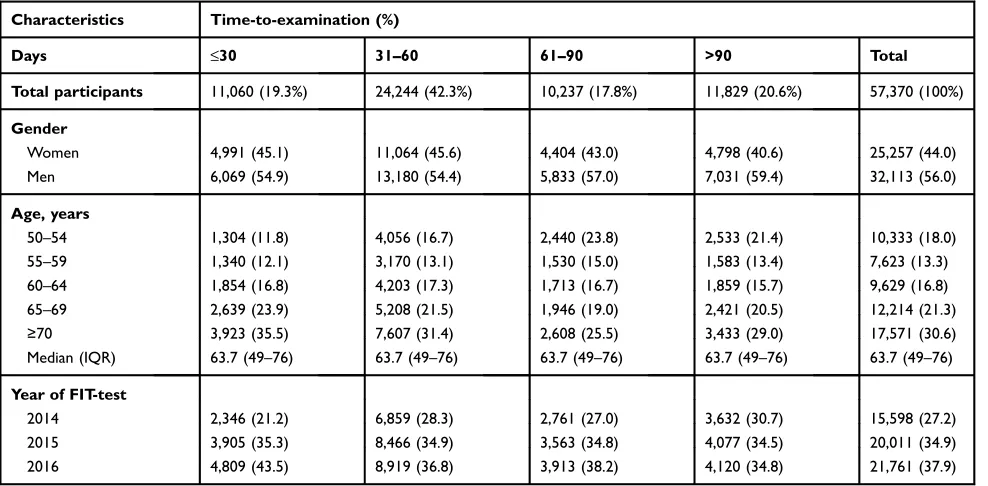
accepted the invitation for OC (Table 1). A total of 4,100
(6.6%) participants were registered without a conclusive
Table 1Characteristics among screening participants testing FIT-positive followed by OC (N=57,370)
Characteristics Time-to-examination (%)
Days ≤30 31–60 61–90 >90 Total
Total participants 11,060 (19.3%) 24,244 (42.3%) 10,237 (17.8%) 11,829 (20.6%) 57,370 (100%)
Gender
Women 4,991 (45.1) 11,064 (45.6) 4,404 (43.0) 4,798 (40.6) 25,257 (44.0)
Men 6,069 (54.9) 13,180 (54.4) 5,833 (57.0) 7,031 (59.4) 32,113 (56.0)
Age, years
50–54 1,304 (11.8) 4,056 (16.7) 2,440 (23.8) 2,533 (21.4) 10,333 (18.0)
55–59 1,340 (12.1) 3,170 (13.1) 1,530 (15.0) 1,583 (13.4) 7,623 (13.3)
60–64 1,854 (16.8) 4,203 (17.3) 1,713 (16.7) 1,859 (15.7) 9,629 (16.8)
65–69 2,639 (23.9) 5,208 (21.5) 1,946 (19.0) 2,421 (20.5) 12,214 (21.3)
≥70 3,923 (35.5) 7,607 (31.4) 2,608 (25.5) 3,433 (29.0) 17,571 (30.6)
Median (IQR) 63.7 (49–76) 63.7 (49–76) 63.7 (49–76) 63.7 (49–76) 63.7 (49–76)
Year of FIT-test
2014 2,346 (21.2) 6,859 (28.3) 2,761 (27.0) 3,632 (30.7) 15,598 (27.2)
2015 3,905 (35.3) 8,466 (34.9) 3,563 (34.8) 4,077 (34.5) 20,011 (34.9)
2016 4,809 (43.5) 8,919 (36.8) 3,913 (38.2) 4,120 (34.8) 21,761 (37.9)
Abbreviations:IQR, interquartile range; FIT, Fecal Immunochemical Test; OC, Optical Colonoscopy.
Clinical Epidemiology downloaded from https://www.dovepress.com/ by 118.70.13.36 on 20-Aug-2020
outcome for OC and 99 (0.2%) participants were
regis-tered with inconclusive examinations (Figure 1). This
resulted in a population of 53,171 (85.0%) participants eligible for analysis in this study.
A conclusive investigation was performed within 30
days in 11,060 (19.3%) participants, within 31–60 days in
24,244 (42.3%) participants, within 61–90 days in 10,237
(17.8%) participants, and after 90 days in 11,829 (20.6%). The median age was 63.7 years (Interquartile Range
[IQR], 49–76 years), 25,257 (44.0%) of participants were
female and 79.4% underwent a conclusive investigation within 90 days of their initial invitation. The mean time
from invitation tofinal OC in the group >90 days was 174
days (IQR, 91–1,348 days) and for the entire population
72.2 days (IQR, 10–1,348 days).
An increasing number of participants were over time receiving OC as the screening program was rolled out: 15,598 (27.2%) in 2014, 20,011 (34.9%) in 2015, and 21,761 (37.9%) in 2016.
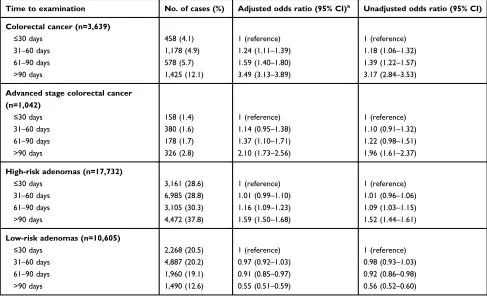
CRC was detected in 3,639 participants (Table 2). In
addition, 17,732 participants with high-risk adenomas and 10,605 participants with low-risk adenomas were
identi-fied during screening. Of the 5,184 participants who did
not receive further investigations, age and gender distribu-tions were similar to the remaining population.
Compared to participants receiving the conclusive screening examination within 30 days after the initial invite,
those receiving the examination after 31–60 days were 1.24
times more likely to be diagnosed with CRC (OR 1.24
[95% CI, 1.11–1.39]) (Table 2). Those receiving the
con-clusive screening examination 31–60 days after invitation
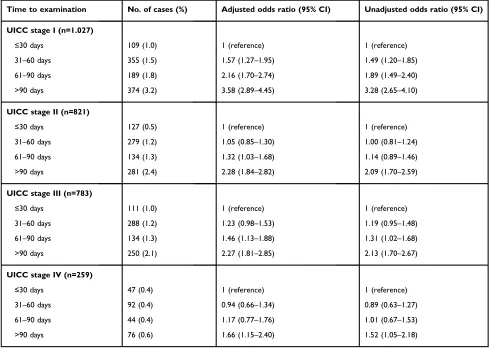
were also 1.57 times more likely to have a stage I CRC compared to the reference group (OR 1.57 [95% CI,
1.27-1.96]) (Table S1). The probability of detecting advanced
stage disease, high-risk adenomas, or low-risk adenomas were not associated with recieving a conclusive screening
examination 31–60 days after initial invitation.
The group receiving a conclusive investigation 61–90
days after invitation had a significant higher probability of
having CRC (OR 1.59 [95% CI, 1.40–1.80]), advanced
stage disease (OR 1.37 [95% CI, 1.10–1.71]), and
high-risk adenomas (OR 1.16 [95% CI, 1.09–1.23]) compared to
the reference group (<30 days). The 61–90 days group had
a lower probability for low-risk adenomas (OR 0.91 [95%
CI, 0.85–0.97)]. In the same group, the probability of stage
I, II, and III CRC was higher than in the reference group
(OR 2.16 [95% CI, 1.70–2.74], OR 1.32 [95% CI, 1.03–
1.68], and OR 1.46 [95% CI, 1.13–1.88], respectively).
In the group receiving the conclusive screening
exam-ination after 90 days, the same trend is seen as in the 61–90
days group. Participants were more likely to be diagnosed
with CRC (OR 3.49 [95% CI, 3.13–3.89]), advanced stage
CRC (OR 2.10 [95% CI, 1.73–2.56]), and high-risk
adeno-mas (OR 1.59 [95% CI, 1.50–1.68]). As in the 61–90 days,
group participants were less likely to be diagnosed with a
low-risk adenoma (OR 0.55 [95% CI, 0.51–0.59]).
In the >90 days, group participants were more likely to be diagnosed with any-stage of CRC, varying from a 3.58 OR for stage I (OR 3.58 [95% CI, 2.89-4.45]) to a 1.66 OR in stage IV (OR 1.66 [95% CI, 1.15-2.40]).
Accounting for gender, year of screening, and age moderately reduced the strength of the association, but did not change the direction of the results.
In the sensitivity analysis, the associations were tested for the elapsed time from both initial screening invitation and positive FIT to conclusive OC. The elapsed time from
posi-tive FIT to conclusive OC was found to influence the odds of
being diagnosed with CRC by up to 5.32 (OR 5.32 [95% CI,
4.89–5.79]) times among those receiving the investigation
more than 90 days after positive FIT (Table S2). The time
from initial invitation to positive FIT did not influence the
probability of being diagnosed with CRC.
Discussion
In this FIT-positive screening population, the time from initial invitation to conclusive OC correlated positively to the probability of detecting CRC, advanced stage disease and high-risk adenomas. For low-risk adenomas, a reverse trend was found. The time from initial invite to positive FIT did not appear to affect the probability of CRC in the sensitivity analysis, and cannot be ascribed a role to the increase in odds. In this study, the mean time from invita-tion to conclusive examinainvita-tion was 72.2 days, of which the mean time from invitation to positive sample was 38.9 days and the mean time from positive sample to OC was 33.3 days. Nearly 80% of all screening participants
under-went thefinal examination within 90 days. The European
guidelines for CRC screening recommend OC being
per-formed within 31 days after a positive FIT.6Our findings
suggest that high-risk individuals appear to have a delay to the conclusive screening examination, which might lead to
neoplastic progression of the disease and thus influence the
possibility of curative treatment.
The reason why there is an increase in neoplasticfi
nd-ings with increasing time to conclusive examination in this study is unclear. A possible explanation is that the different
Clinical Epidemiology downloaded from https://www.dovepress.com/ by 118.70.13.36 on 20-Aug-2020
groups of participants are likely to have a different demo-graphic composition, rather than different neoplastic growth. A lower socioeconomic status, gender, and increased age have been found to negatively affect CRC
screening uptake12–14and might explain the delay presented
in our population as well.
Personal factors of the participants might also cause a delay in uptake, such as psychological impact (per-ceived susceptibility and severity), structural issues (eg, distance to hospital, OC capacity), or attitude toward
screening.22,23
Corley et al, performed a similar study focusing mainly
on time from positive FIT to conclusive OC.17They
con-cluded that an OC after more than 10 months was associated
with a higher risk of CRC and advanced stage disease. Our
findings are consistent with thesefindings and support their
argument that elapsed time to screening should be consid-ered as a variable in future studies.
Strengths of this study are a large and diverse study population extracted from the Danish national databases, a large number of pathologically validated neoplasia out-comes, and absence of selection-bias since all citizens in the designated age-group were invited.
A limitation of this study is the validity of the data from the DCCSD, especially due to errors in registration and the pooling-process from other databases. It is of concern that 4,100 screening participants are not registered in the database
with a conclusivefinding. This may be caused by errors in the
1,437,836 citizens invited to screening
2014-2016
53,171 had complete investigation after
positive FIT
898,634 accepted the invitation
62,552 positive FIT’s eligible for analysis
5,184 excluded,no OC performed
57,370 recieved OC
4,199 excluded from analysis
99 examinations were incomplete and
not followed up 4,100 had lack of
registration of findings 49,532 did not have
cancer 3,639 participants
diagnosed with colorectal cancer
836,090 negative FIT (excluded from this
round)
Figure 1Flow of screening participants.
Abbreviations:FIT, Fecal Immunochemical Test; OC, Optical Colonoscopy.
Clinical Epidemiology downloaded from https://www.dovepress.com/ by 118.70.13.36 on 20-Aug-2020
registration from the hospitals or in the merging process from the DCCSD with other databases.
Another limitation is that the UICC stage of 21% of the cancers was not registered in the DCCSD. A likely explana-tion is that this stage is dependent on pathologic evaluaexplana-tion, which can be complicated in case of piecemeal resections of large polyps, and complete response after chemo- or radio-therapy in rectal cancers. Therefore, it is possible that the group with missing stage registration differs from our study population, which should be considered in follow-up studies. Our group is planning further studies examining the composition of the study population in more detail in order to detect which factors contribute to a delay of conclusive OC and should be addressed in CRC screening programs.
Conclusion
There is an association between elapsed time from initial screening invitation to conclusive examination and an increased overall probability of being diagnosed with CRC, advanced stage disease, and high-risk adenomas in the Danish screening program. Explanations for this asso-ciation will be investigated in follow-up studies.
Acknowledgments
Odense Patient data Explorative Network (OPEN) has assisted in the making of this article by providing storage and support for the data management. This project has been funded by the Danish Cancer Society under Grant R100-A6747.
Disclosure
The authors report no conflicts of interest in this work.
References
1. Iversen LH, Green A, Ingeholm P, Osterlind K, Gogenur I. Improved survival of colorectal cancer in Denmark during 2001-2012 – the efforts of several national initiatives. Acta Oncol. 2016;55(Suppl 2):10–23. doi:10.3109/0284186X.2015.1131331
2. Fitzpatrick-Lewis D, Ali MU, Warren R, Kenny M, Sherifali D, Raina P. Screening for colorectal cancer: a systematic review and meta-analysis. Clin Colorectal Cancer. 2016;15(4):298–313. doi:10. 1016/j.clcc.2016.03.003
3. Kronborg O, Fenger C, Olsen J, Jorgensen OD, Sondergaard O. Randomised study of screening for colorectal cancer with faecal-occult-blood test.Lancet (London, England).1996;348(9040):1467– 1471. doi:10.1016/S0140-6736(96)03430-7
4. Shaukat A, Mongin SJ, Geisser MS, et al. Long-term mortality after screening for colorectal cancer.N Engl J Med. 2013;369(12):1106– 1114. doi:10.1056/NEJMoa1300720
Table 2Odds ratios of OC-outcomes as time to conclusive examination increases in screening participants
Time to examination No. of cases (%) Adjusted odds ratio (95% CI)a Unadjusted odds ratio (95% CI)
Colorectal cancer (n=3,639)
≤30 days 458 (4.1) 1 (reference) 1 (reference)
31–60 days 1,178 (4.9) 1.24 (1.11–1.39) 1.18 (1.06–1.32)
61–90 days 578 (5.7) 1.59 (1.40–1.80) 1.39 (1.22–1.57)
>90 days 1,425 (12.1) 3.49 (3.13–3.89) 3.17 (2.84–3.53)
Advanced stage colorectal cancer (n=1,042)
≤30 days 158 (1.4) 1 (reference) 1 (reference)
31–60 days 380 (1.6) 1.14 (0.95–1.38) 1.10 (0.91–1.32)
61–90 days 178 (1.7) 1.37 (1.10–1.71) 1.22 (0.98–1.51)
>90 days 326 (2.8) 2.10 (1.73–2.56) 1.96 (1.61–2.37)
High-risk adenomas (n=17,732)
≤30 days 3,161 (28.6) 1 (reference) 1 (reference)
31–60 days 6,985 (28.8) 1.01 (0.99–1.10) 1.01 (0.96–1.06)
61–90 days 3,105 (30.3) 1.16 (1.09–1.23) 1.09 (1.03–1.15)
>90 days 4,472 (37.8) 1.59 (1.50–1.68) 1.52 (1.44–1.61)
Low-risk adenomas (n=10,605)
≤30 days 2,268 (20.5) 1 (reference) 1 (reference)
31–60 days 4,887 (20.2) 0.97 (0.92–1.03) 0.98 (0.93–1.03)
61–90 days 1,960 (19.1) 0.91 (0.85–0.97) 0.92 (0.86–0.98)
>90 days 1,490 (12.6) 0.55 (0.51–0.59) 0.56 (0.52–0.60)
Note:aAdjusted for gender, year and age. Abbreviation:OC, Optical Colonoscopy.
Clinical Epidemiology downloaded from https://www.dovepress.com/ by 118.70.13.36 on 20-Aug-2020
5. Scholefield JH, Moss SM, Mangham CM, Whynes DK, Hardcastle JD. Nottingham trial of faecal occult blood testing for colorectal cancer: a 20-year follow-up. Gut. 2012;61(7):1036–1040. doi:10.1136/gutjnl-2011-300774
6. von Karsa L, Patnick J, Segnan N, et al. European guidelines for quality assurance in colorectal cancer screening and diagnosis: over-view and introduction to the full supplement publication.Endoscopy.
2013;45(1):51. doi:10.1055/s-0032-1325997
7. Danish Colorectal Cancer Screening Database. Dansk
Tarmkræftscreeningsdatabase Årsrapport 2016 [Annual Report of the Danish Colorectal Cancer Screening Database 2016]. København: Dansk tarmkræftscreeningsdatabase (DTS); December2017. 8. Toes-Zoutendijk E, van Leerdam ME, Dekker E, et al. Real-time
monitoring of results duringfirst year of dutch colorectal cancer screening program and optimization by altering fecal immunochem-ical test cut-off levels.Gastroenterology.2017;152(4):767–775.e762. doi:10.1053/j.gastro.2016.11.022
9. Brenner H, Werner S. Selecting a cut-off for colorectal cancer screen-ing with a fecal immunochemical test. Clin Transl Gastroenterol.
2017;8(8):e111. doi:10.1038/ctg.2017.37
10. Stracci F, Zorzi M, Grazzini G. Colorectal cancer screening: tests, strategies, and perspectives. Front Public Health. 2014;2:210. doi:10.3389/fpubh.2014.00210
11. Imperiale TF, Ransohoff DF, Itzkowitz SH, et al. Multitarget stool DNA testing for colorectal-cancer screening. N Engl J Med.
2014;370(14):1287–1297. doi:10.1056/NEJMoa1311194
12. Steele RJ, Kostourou I, McClements P, et al. Effect of gender, age and deprivation on key performance indicators in a FOBT-based colorectal screening programme.J Med Screen. 2010;17(2):68–74. doi:10.1258/jms.2010.009120
13. Morris S, Baio G, Kendall E, et al. Socioeconomic variation in uptake of colonoscopy following a positive faecal occult blood test result: a retro-spective analysis of the NHS Bowel Cancer Screening Programme.Br J Cancer.2012;107(5):765–771. doi:10.1038/bjc.2012.303
14. Ferrat E, Le Breton J, Veerabudun K, et al. Colorectal cancer screening: factors associated with colonoscopy after a positive faecal occult blood test.Br J Cancer.2013;109(6):1437–1444. doi:10.1038/bjc.2013.476
15. Deding U, Henig AS, Salling A, Torp-Pedersen C, Boggild H. Sociodemographic predictors of participation in colorectal cancer screening.Int J Colorectal Dis.2017;32(8):1117–1124. doi:10.1007/ s00384-017-2832-6
16. Deding U, Henig AS, Hindersson P, Torp-Pedersen C, Bøggild H. Determinants of non-participation in colon examination following positive stool sample in colorectal cancer screening.Eur J Public Health.2019. doi:10.1093/eurpub/ckz072
17. Corley DA, Jensen CD, Quinn VP, et al. Association between time to colonoscopy after a positive fecal test result and risk of colorectal cancer and cancer stage at diagnosis. JAMA. 2017;317(16):1631– 1641. doi:10.1001/jama.2017.3634
18. Gellad ZF, Almirall D, Provenzale D, Fisher DA. Time from positive screening fecal occult blood test to colonoscopy and risk of neoplasia. Dig Dis Sci.2009;54(11):2497–2502. doi:10.1007/s10620-008-0653-8 19. Peterson K, Carson S, Humphrey L, Helfand M. Patients with
Positive Screening Fecal Occult Blood Tests: Evidence Brief on the Relationship between Time Delay to Colonoscopy and Colorectal Cancer Outcomes. Clin Gastroenterol Hepatol. 2016;14(10):1445– 1451.e8.
20. Shah HA, Paszat LF, Saskin R, Stukel TA, Rabeneck L. Factors associated with incomplete colonoscopy: a population-based study. Gastroenterology. 2007;132(7):2297–2303. doi:10.1053/j.gastro. 2007.03.032
21. Koido S, Ohkusa T, Nakae K, et al. Factors associated with incom-plete colonoscopy at a Japanese academic hospital. World J Gastroenterol. 2014;20(22):6961–6967. doi:10.3748/wjg.v20.i22. 6961
22. Palmer CK, Thomas MC, von Wagner C, Raine R. Reasons for non-uptake and subsequent participation in the NHS Bowel Cancer Screening Programme: a qualitative study.Br J Cancer. 2014;110 (7):1705–1711. doi:10.1038/bjc.2014.125
23. Jones RM, Devers KJ, Kuzel AJ, Woolf SH. Patient-reported barriers to colorectal cancer screening: a mixed-methods analysis.Am J Prev Med.2010;38(5):508–516. doi:10.1016/j.amepre.2010.01.021
Clinical Epidemiology downloaded from https://www.dovepress.com/ by 118.70.13.36 on 20-Aug-2020
Supplementary materials
Table S1Different stages of colorectal cancer at different response times among screening participants
Time to examination No. of cases (%) Adjusted odds ratio (95% CI) Unadjusted odds ratio (95% CI)
UICC stage I (n=1.027)
≤30 days 109 (1.0) 1 (reference) 1 (reference)
31–60 days 355 (1.5) 1.57 (1.27–1.95) 1.49 (1.20–1.85)
61–90 days 189 (1.8) 2.16 (1.70–2.74) 1.89 (1.49–2.40)
>90 days 374 (3.2) 3.58 (2.89–4.45) 3.28 (2.65–4.10)
UICC stage II (n=821)
≤30 days 127 (0.5) 1 (reference) 1 (reference)
31–60 days 279 (1.2) 1.05 (0.85–1.30) 1.00 (0.81–1.24)
61–90 days 134 (1.3) 1.32 (1.03–1.68) 1.14 (0.89–1.46)
>90 days 281 (2.4) 2.28 (1.84–2.82) 2.09 (1.70–2.59)
UICC stage III (n=783)
≤30 days 111 (1.0) 1 (reference) 1 (reference)
31–60 days 288 (1.2) 1.23 (0.98–1.53) 1.19 (0.95–1.48)
61–90 days 134 (1.3) 1.46 (1.13–1.88) 1.31 (1.02–1.68)
>90 days 250 (2.1) 2.27 (1.81–2.85) 2.13 (1.70–2.67)
UICC stage IV (n=259)
≤30 days 47 (0.4) 1 (reference) 1 (reference)
31–60 days 92 (0.4) 0.94 (0.66–1.34) 0.89 (0.63–1.27)
61–90 days 44 (0.4) 1.17 (0.77–1.76) 1.01 (0.67–1.53)
>90 days 76 (0.6) 1.66 (1.15–2.40) 1.52 (1.05–2.18)
Note:Adjusted for gender, year and age.
Abbreviation:UICC, Union for International Cancer Control.
Table S2Sensitivity analysis on time and odds offinding cancer on conclusive examination
Time to FIT from invite Any colorectal cancer Advanced stage colorectal cancer
No. of cases (%) Odds ratio (95% CI) No. of cases (%) Odds ratio (95% CI)
≤30 days 2,412 (6.3) 1 (reference) 698 (1.8) 1 (reference)
31–60 days 821 (5.5) 0.99 (0.91–1.07) 231 (1.5) 0.96 (0.82–1.12)
61–90 days 315 (5.8) 1.06 (0.94–1.20) 103 (1.9) 1.19 (0.97–1.47)
>90 days 184 (5.2) 1.05 (0.90–1.23) 51 (1.4) 0.99 (0.74–1.32)
Time to OC from pos. FIT-test
≤30 days 1,868 (4.2) 1 (reference) 635 (1.4) 1 (reference)
31–60 days 579 (10.1) 2.49 (2.56–2.75) 161 (2.8) 1.93 (1.62–2.30)
61–90 days 220 (11.1) 2.68 (2.31–3.10) 57 (2.9) 1.92 (1.46–2.53)
>90 days 972 (20.1) 5.32 (4.89–5.79) 189 (3.9) 2.59 (2.19–3.06)
Note:Adjusted for gender, year, and age.
Abbreviations:FIT, Fecal Immunochemical Test; OC, Optical Colonoscopy.
Clinical Epidemiology downloaded from https://www.dovepress.com/ by 118.70.13.36 on 20-Aug-2020
Clinical Epidemiology
Dove
press
Publish your work in this journal
Clinical Epidemiology is an international, peer-reviewed, open access, online journal focusing on disease and drug epidemiology, identifi ca-tion of risk factors and screening procedures to develop optimal pre-ventative initiatives and programs. Specific topics include: diagnosis, prognosis, treatment, screening, prevention, risk factor modification,
systematic reviews, risk & safety of medical interventions, epidemiol-ogy & biostatistical methods, and evaluation of guidelines, translational medicine, health policies & economic evaluations. The manuscript management system is completely online and includes a very quick and fair peer-review system, which is all easy to use.
Submit your manuscript here:https://www.dovepress.com/clinical-epidemiology-journal
Clinical Epidemiology downloaded from https://www.dovepress.com/ by 118.70.13.36 on 20-Aug-2020