JOURNN OF
fMNGE MNWGEMENl=
Published bimonthly-January, March, May,
TABLE OF CONTENTS:
Vol. 31, No. 2, March 1978
July, September, November-by theSociety for Range Management
2760 West Fifth Avenue ARTICLES
Denver, Colorado 80204 Copyright @ 1978 by the Society for Range Management Managing Editor
DAVID A. SMITH 2760 West Fifth Avenue
a4 87
92 Denver, Colo. 80204
Editor REX D. PIEPER
Dep. Animal and Range Science New Mexico State Univeristy Las Cruces, N. Mex. 88003 Book Review Editor PAT 0. CURRIE
Rocky Mountain Forest and Range Experiment Station 240 West Prospect Street Fort Collins, Colo. 80521 Copy Editor
PATRICIA G. SMITH 2760 West Fifth Avenue Denver, Colo. 80204 Editorial Board 1978-78
RAYMOND EVANS, Reno, Nev. CLIFFORD E. LEWIS, Marianna, Fla. JOHN MALECHEK, Logan, Utah C. J. SCIFRES, College Station, Tex. 1977-79
JAMES 0. KLEMMEDSON, Tucson, Ariz. GEORGE W. SCOTTER, Edmonton, Alta. M. JOE TRLICA, Fort Collins, Colo. J. ROSS WIGHT, Logan, Utah 1978-80
101
105
111
115
118
I21
123
125
129
Food, Fiber, Fuel, and Fun from Rangelands by Thadis W . Box
Taxonomic Determination, Distribution, and Ecological Indicator Values of Sage- brush within the Pinyon-Juniper Woodlands of the Great Basin by N. E. West, R. J. Tausch, K. H. Rea, and P. T. Tueller
Nutrition and Production of Domestic Sheep Managed as Manipulators of Big Game Habitat by John C. Malechek, Kurt J. Kotter, and Charles H. Jensen
Vegetation Response to Contour Furrowing by J. Ross Wight, E. L. Neff, and R. J. Soiseth
DONALD A. KLEBENOW, Reno, Nev. 132
JAMES T. NICHOLS, North Platte, Neb. MICHAEL D. PITT, Vancouver, B.C.
RONALD E. SOSEBEE, Lubbock, Tex. 134 INDIVIDUAL SUBSCRIPTION is by membership in the. 137 Society for Range Management.
LIBRARY or other INSTITUTIONAL SUBSCRIPTIONS, on a calendar year basis, are $22.00 postpaid to all countries. Payment from outside the United States should be remitted in US dollars by international money order or draft on a New York bank.
CHANGE OF ADDRESS notices should be sent to the Managing Editor, 2760 West Fifth Ave., Denver, CO 80204, no later than the first day of the month of issue. Copies lost due to a change of address cannot be replaced unless adequate notice is given. To assure uninterrupted service, provide your local postmaster with a Change of Address Order (POD Form 3575), indicating thereon to guarantee forwarding postage for second class mail. POSTOFFICE: Please return entire journal with address change. BUSINESS CORRESPONDENCE, concerning subscrip- tions, advertising, reprints, back issues, and related mat- ters, should be addressed to the Managing Editor, 2760 West Fifth Ave., Denver, CO 80204.
EDITORIAL CORRESPONDENCE, concerning manu- scripts or other editorial matters, should be addressed to the Editor, Dep. Animal and Range Sciences, New Mexico State Univ., Las Cruces 88003.
INSTRUCTIONS FOR AUTHORS appear each year in the March issue; copies of these instructions are available from the editor.
SECOND CLASS POSTAGE paid at Denver, Colorado. 141
145
Distribution of Food Reserves in Snowberry (Symphoricarpus oreophilus) by Melvin R. George and C. M. McKell
Factors Influencing Productivity of Two Mule Deer Herds in Utah by Jordan C. Pederson and K. T. Harper
Predation on Range Sheep with No Predator Control by J. Kent McAdoo and Donald A. Klebenow
Use of Infiltration Equation Coefficients as an Aid in Defining Hydrologic Impacts of Range Management Schemes by Gerald F. Gifford
Estimation of Plant Biomass from Quadrit Data Using the Lognormal Distri- bution by Gary C. White
Effects of Removal of Standing Dead Material on Growth of Agropyron spicufum by Ronald H. Sauer
Germination Responses of Three Forage Grasses to Different Concentrations of Six Salts by T. R. Miller and S. R. Chapman
An Economic Analysis of Retention of Yearlings on Range and Potential Effects on Beef Production by David B. Hewlett and John P. Workman
Will Mesquite Control with 2,4,5-T Enhance Grass Production? by B. E. Dahl, R. E. Sosebee, J. P. Goen, and C. S. Brumley
Relationships of Soil Salinity, Ash, and Crude Protein in Atripkx canescens by Bruce L. Welch
Food Habits of the Black-tailed Prairie Dog in Western South Dakota by Carol A. Summers and Raymond L. Linder
Longevity of Leafy Spurge Seeds in the Soil Following Various Control Programs
by G. G. Bowes and A. G. Thomas
Sprouting and Carbohydrate Reserves of Two Wildland Shrubs Following Partial Defoliation by E. Earl Willard and Cyrus M. McKell
Elemental Concentrations in Native Range Grasses from the Northern Great Plains of Montana by Frank F. Munshower and Dennis E. Neuman
TECHNICAL NOTES
149 Frequency of Endomycorrhizal Infection in Grazed and Ungrazed Blue Grama
Plants by Patrick E. Reece and Charles D. Bonham
151 Development and Evaluation of Anti-coyote Electric Fencing by N. L. Gates, J. E. Rich, D. D. Godtel, and C. V. Hulet
VIEWPOINT
154 The State Land Trust, Its Retention or Elimination by G. Wesley Burnett BOOK REVIEWS
156 Wildjlowers across the Prairie by F. R. Vance, J. R. Jowsey , and J. S. McLean; Soil Erosion: Prediction and Control edited by George R. Foster; A Manual oj Ghana Grasses by R. Rose Innes.
THESES
158 Range Management Theses 1968-1975 edited by Rex D. Pieper
Food, Fiber, Fuel, and
from
Rangelands
THADIS M’. BOX
It has been a pleasure to serve as the thirtieth president of the Society for Range Management. In the beginning our Society was a small collection of dedicated people trained in forestry, animal science, agronomy, and ecology, and bound together only by a concern for and dedication to the management of the country’s rangelands. In three brief decades it has developed into a group of well over 5,000 people with varying degrees of training in the field of range management. We, as a Society, speak for about 40% of the earth’s surface. We are the major professional group that must produce the food, fiber, fuel, fun, all the goods and services that society wants from rangelands.
It may seem ludicrous that the thirtieth president of the Society for Range Management should begin his discussion with a definition of rangelands. However that may be, the concepts of rangelands are changing so radically today that a brief discussion is necessary.
The terms “range” and “rangelands” are of relatively recent origin. When John Wesley Powell (1878) wrote his treatise on the western rangelands, he did not even use the term, but talked of “pasturage lands.” Soon after the turn of the century, descriptions of rangeland began to appear. The one included in the Senate report on the western range (U.S. Senate 1936) was typical:
The western range is largely open and unfenced, with control stock by herding; when fenced, relatively large units are enclosed. It supports with few exceptions only native grasses and other forage plants, is never fertilized or cultivated, and can in the main be restored and maintained only through control of grazing. It consists almost exclusively of lands which, because of relatively meager precipitation and other adverse climatic conditions, or rough topography or lack of water for irrigation, cannot successfully be used for any other form of agriculture.
In contrast the improved pastures of the East and Middlewest receive an abundant precipitation, are ordinarily fenced, utilize introduced forage species, . . cultivation for other crops, and are often fertilized to increase productivity, and are renewed following deterioration.
This was the prevailing concept of rangelands prior to the formation of the Society for Range Management.
Several authors gave definitions of range management in the early years of our Society. Rangeland was called “the land upon which the animals graze” (Clawson 1950). Sampson (1952) described range as “large, naturally vegetated, mostly unfenced lands of low rainfall areas that are grazed by domestic livestock and game mammals.” Dyksterhuis in 1955 stated that a satisfactory definition of range appeared to be “native pasture on natural grazing land.” Stoddart and Smith (1955) did not define rangeland but chose instead to define range management. They called it the science and art of obtaining maximum livestock production from rangeland consistent with the con- servation of natural resources.
}‘l~,l~cntl:~l A&Ire\\ 1 ronl the 3 I \I Annual Meetmg ofthe Society for Range Management, Ln Antonlo. Tcxuh. February 8. 1978.
Fun
These definitions stressing livestock production and grazing from rangelands were the standard concept and definition of mnge until about the late 1950’s and early 1960’s. At that time rangeland began to be discussed as a particular classification of land with equivalent standings to that of forests or cropland. Most authors admitted that there were no specific characteristics that differentiated rangelands from either croplands or forests. Rangelands were described as being not suitable for croplands or intensive forests, their use being limited by aridity, rocks, shallow soils, rough topography, poor drainage, cold tem- peratures, and other physical features. Intensively managed pastures were also considered as range. Although most authors were reluctant to define rangelands, their descriptions were all similar. Range was recognized as a kind of land that can produce many goods and services. It is managed most effectively using principles of ecology rather than intensive agriculture or agro- nomic techniques (Stoddart, Smith, and Box 1975; Blaisdell et al. 1970; Colbert 1977).
The definition of range management has also changed over the years. When I was a student the definition I learned was from Stoddart and Smith (1955). Range management meant ob- taining maximum livestock production from native vegetation. We were trained to produce a forage crop-native plants-and harvest it with animals-cattle, sheep, or goats. Range manage- ment today is defined as the science and art of optimizing the returns from rangeland in those combinations most desired by and suitable to society through the manipulation of range ecosystems (Stoddart, Smith, and Box 1975). Range manage- ment is involved in the production of many different goods and services, of which only one may be livestock products.
Unfortunately, many people still consider range as a use of land and not land itself. They equate range with livestock grazing. Even some agencies managing rangelands discuss the multiple uses of the land as timber, water, range, recreation, etc. Timber, water, and recreation are all goods or services and outputs of land. Range is the land itself. It can be used for the production of timber, forage, water, etc. Francis Colbert once said:
I want to emphasize in the strongest possible way that range-or range- land or range ecosystems-is a kind of land. It is not a land use. I must admit that the word “range” has always been associated with live- stock grazing (a specific use) on uncultivated lands, and this is the connota- tion that is still prevalent, especially to the general public (if, in fact, the general public thinks of it as anything else than the kitchen stove!). Never- theless, rangeland comprises at least 40 percent of the total land area, not only in this country but in the entire world, so I believe it’s time that we made a serious effort to recognize range for what it really is: a kind of land-a major land resource-from which there is, and can be, obtained a wide variety of products and values, of goods and services.
If range is a particular kind of land, distinguished from crop- land and forest, what are the goods and services that can be expected from rangelands now and in the future?
Food from Rangelands
The traditional product most often considered when range- land is discussed is food-red meat. Although many of the outputs of ranges are measured in animal unit months, the ultimate product that society desires is meat for the table. American is a land that has for many decades been blessed with food surpluses. We are now in one of those cycles when we are embarrassed by high food production and low food prices. One has only to look at the world population growth to see that this embarrassing surplus of food is ephemeral and that shortages are bound to occur in the future.
As the human population grows, more and more cropland will be used to produce food for direct human consumption. The amount of meat in the diets may decrease but it will still be the desired source of high quality protein when it is available. Livestock will be raised on crop aftermath and on native plants. The rangelands of the world will surely become more important, although many people in our affluent society find it hard to accept. The current attitude toward grazing on public lands, for instance, will change when food is in short supply. A few years ago a major western newspaper carried two articles on a single page. One was an article dealing with the suit of the Natural Resource Defense Council against the Bureau of Land Manage- ment. The Council, and apparently a large part of the U.S. public, wanted to ban grazing from the public rangelands. On the same page was an article from Japan. Japan, for the first time in its history, had opened its national forests and national parks to grazing. Because it was short on meat, Japan was willing to allow a new use for its lands. Our country, with its abundance, was trying to restrict grazing. My point is that attitudes change as the situation changes, and I predict that the attitude toward grazing of livestock on public lands will change rapidly in this country. Food production will be a major goal for rangelands in only a few decades.
Grazing of domestic livestock for food production will be the major economic use of rangelands. Rangelands, as we have dis- cussed earlier, are usually vegetated with shrubs, forbs, and grasses. They are vastly different from the succulent, irrigated pStUreS of the farming regions. If we develop criteria for using tangeland as an engineer would if he were to design a harvesting machine, we would probably not design a cow to graze the rangelands. We want an animal that can breed, have young, and the young reach market weight within one year on the scant forage of rangelands, go for long periods of time without water, and withstand the rigorous climate of range areas. That animal probably would be a sheep or goat, not a cow. The preferred red meat of most Americans is beef. However, if rangelands are called upon to produce meat most efficiently, the ranges will probably be grazed by something other than a cow beast.
Fiber and Rangelands
Rangelands will be called upon to produce additional fiber in the future. It takes about twice as much energy to produce a synthetic fiber as it does a natural one (Thomas, Curl, and Bennett 1976). If my estimates are correct, it will take most of our arable land to produce food for direct human consumption. Our clothing will be produced from synthetic fibers and from
fibers from rangelands. Wool and mohair are already a standard crop from many of the range areas of the world. If we accept my criteria for the kind of animal that will graze rangelands, then it follows that not only will sheep and goats become more prevalent for food production but many of them will be dual-
purpose animals, producing fiber as well.
It is not unlikely that industries producing fiber from native range plants may also develop. There are today a number of cottage industries in developing nations throughout the world that use yuccas, euphorbias, sisal, etc., to produce local fibers for baskets, ropes, and other useful materials. If efficient harvesting techniques could be developed, it is entirely possible that we may see fiber production from range plants become more important, at least locally.
An even greater possibility exists that wood fiber from low- value range plants could be used for the paper industry or for other products where wood cellulose is a building block. Literally thousands of tons of cellulose are left to rot each year after range improvement projects. Although such techniques are not economically feasible today, we may see the time when mesquite, piiion-juniper, sagebrush, and other low-value range plants are harvested during range-improvement projects and then processed into some other product useful to mankind. Although they are fiber plants, such range plants as guayle and jojoba, are now being studied for production of rubber and oil. If these industries develop on rangelands, they would release petro chemicals that could be used for the production of fiber.
Fuel from Rangelands
Many scientists now think that energy supply will be the ultimate limiting factor in the deveopment of the world. Regardless of the validity of that statement, it is apparent that an increasing energy shortage will develop in the next two or three decades until alternate sources of energy are found (Cook 1976). Until that alternate source of energy is developed, our nation will be dependent on fossil fuels. As the most desirable fossil fuels, oil and gas, are gradually reduced in availability, we will shift to the more abundant coal. Much of the nation’s low-sulphur coal occurs under western rangeland, as does the uranium for nuclear energy, and as do valuable geothermal sites, etc. It is inevitable that the rangelands of America will fill a key role in supplying the energy for this country.
In order to extract the materials from which energy is ultimately developed, it will become necessary to disturb much of the rangelands. These lands are costly to rehabilitate, often requiring thousands of dollars per acre to reclaim land that has a surface value of only a few hundred dollars per acre (National Academy of Sciences 1974). However, when the cost of rehabilitation is related to the product removed, it is seldom more than a few cents per ton of coal removed to rehabilitate the land.
We as a society for range management have a two-fold responsibility in the rehabilitation of western energy lands. First, we must provide the necessary scientific research and professional expertise. Second, we must insist that options be kept open for future generations and that rangelands be re- habilitated on the basis of their value to society for the energy rather than the surface value of the rehabilitated land for farming or ranching.
Proposals for the development of energy plantations are now under study in several of the forested regions of our country, the theory being that a renewable resource, trees, can produce fuel for the heat generation of electricity. If such fuel plantations are feasible in forested areas, it seems logical that the waste products from range-improvement projects could be burned to produce electricity. The main problem would be in harvesting and transporting the wood products to generating sites. No one would suggest such a scheme under the current economic
conditions. However, conditions could change.
Fun from Rangelands
Many range areas contain strikingly beautiful scenery. They produce wildlife herds that are valuable for viewing or recre- ational hunting and provide the basis for a growing recreation business.
Our cities are becoming more crowded and more unlivable. The search for solitude is a major goal of many people in the developed countries of the world.
The opening day of deer season each year finds hunters occupying almost every single acre of rangeland in the western states. In private land states such as Texas, hunting is already a business. The income derived from hunting leases may rival that from livestock or any other range product.
Hunting fees are not charged on public land, but the public demands that the land be managed for the production of wildlife. Anyone who has ever witnessed the opening day of deer season in Montana, Colorado, or Utah will agree that the production of wildlife is one of the most desired uses of rangeland. Although direct monetary return usually does not come to the land management agency from hunting, the restaurant owners, shopkeepers, and guides throughout the West have a direct economic return. The demand for hunting is likely to continue, even though the nationwide reaction against sport hunting is becoming stronger each year. The population continues to grow and Westerners are not likely to voluntarily give up the sport of hunting.
Picnickers, backpackers, campers, and others are finding that rangelands offer open spaces and a chance to get away from it all. Rock hounds now visit even the most remote and desolate areas of the public rangelands. Organized groups such as motorcycle racers or four-wheel-drive-vehicle clubs find range- lands a place to practice their sport, with the result that the uncontrolled use of off-road vehicles is now a major problem in range management.
Solitude remains one of the majorobjectives of many outdoor recreationists. The vast open spaces, deep canyons, and un- developed areas of rangeland are also desirable for recreation- ists. Many range areas have high wilderness values and the conflict between wilderness users and other range users is likely to increase.
Other Rangeland Products
There will be products other than food, fiber, fuel, and fun produced from rangelands. Water will be increasingly more important. Timber, mining props, fence posts, and other wood products will be locally important.
Other uses may develop that we cannot predict at the present time. The point that I want to make is that rangelands will continue to produce a wide array of products, although in the foreseeable future the main product will continue to be animals and animal products. Grazing, though only a single range use, will probably be as important to range as timber production is to forest lands. The nature of the land and ecological principles dictate that rangelands are grazing lands. They evolved con- comitantly with grazing and browsing animals and, for the fore- seeable future, grazing land they will remain. If these pre- dictions are true, what will be the role of the Society for Range Management in the next 30 years?
The SRM’s Role in the Next 30 Years
The Society for Range Management has done well in the first
30 years. We have given birth to a new profession and raised it through adolescence. During the next 30 years we will nurture it in its early adult years. A major role will be leadership in the continuously changing definition of rangelands and range management. We will develop new concepts and apply know- ledge gained in the past. On the one hand we will work toward applying the body of knowledge that has been developed in the first 30 years. On the other, we must push forward to new frontiers and pioneer new research. We as a professional Society should not simply react to the demands of the public. We must set the standards under which rangelands of the world will be used.
To do this we need to develop and constantly maintain a professional image. We must at all times be scientifically credible. We must speak from a position of strength backed by sound data and research. This will be difficult, because we have as a policy accepted all those into our Society who have an interest in rangeland. We have never claimed to be an exclusive or elitist group. We accept people on the basis of their concern for the condition of rangelands of the world. One of our major strengths has been the diversity of people and our mutual acceptance. This open attitude we must somehow keep. but at the same time we must become judgmental, especially of those in our midst who do not keep our code. This year we have begun a program of certification of consultants. Its standards are high. Not all who belong to the Society for Range Management will qualify, but those who do will have the stamp of approval of this Society. We have also initiated a program of accreditation of range schools. Again, not all will qualify, but those that do will meet a certain standard of excellence that we as a Society think is desirable for the management of rangelands. I
more such actions will be necessary in the future.
predict that
Our ability to balance love and judgment-accept all people on confession of faith but endorse their actions on stringent professional criteria-will determine how successful we will be in the next 30 years. It has been a pleasure being your president.
It is inevitable that the demands placed on the rangelands of the world will change and change rapidly in the next few years. If our Society can anticipate and direct those changes, then we will be succ&sful. If we-only react to them, we will slowly fade
itw ay ,
one.
and my guess is that our absence will be noticed by no
Literature Cited
Blaisdell, J. P., Vincent L. Duvall, Robert W. Harris, R. Duane Lloyd, and
Elbert H. Reid. 1970. Range research to meet new challenges and goals.
J. Range Manage. 231227-234.
Colbert, Francis T. 1977. Land use planning: a summary from a rangeman’s
point of view. Rangeman’s J. 4:74-76.
Cook, Earl. 1976. Man, Energy, Society. W. H. Freeman Co., San Francisco. 478 p.
Clawson, Marion. 1950. The Western Range Livestock Industry. McGraw-
Hill Book Co., New York. 401 p.
Dyksterhuis, E. J. 1955. What is range management? J. Range Manage.
8:193-196.
Ford Foundation. 1974. A Time to Choose, America’s Energy Future.
Ballinger Press. Cambridge, Mass. 512 p.
National Academy of Sciences. 1974. Rehabilitation Potential of Western Coal
Lands. Ballinger Publishing Co., Cambridge, Mass. 197 p.
Sampson, Arthur W. 1952. Range Management, Principles and Practice.
John Wiley and Sons, Inc., New York. 570 p.
Stoddart, Laurence A., and Arthur D. Smith. 1955. Range Management,
2nd Ed. McGraw-Hill Book Co., New York. 433 p.
Stoddart, L. A., Arthur D. Smith, and Thadis W. Box. 1975. Range Man-
agement, 3rd Ed. McGraw-HI11 Book Co., New York. 532 p.
Thomas, Gerald W ., Samuel E. Curl, and William F. Bennett, Jr. 1976.
Food and Fiber for a Changing World. The Interstate Printers and Publishers Inc., Danville, Ill. 225 p.
Taxonomic Determination, Distribution, and
Ecological
Indicator Values of Sagebrush
within the Pinyon-Juniper Woodlands of the
Great Basin
N. E. WEST, R. J. TAUSCH, K. H. REA, AND P. T. TUELLER
Highlight: Various sagebrush taxa are major understory com- ponents of most Great Basin pinyon-juniper woodlands. Improved understanding of their identification, distribution, and ecological indicator significance is necessary to interpret site differences for these ranges. Morphology within sagebrush taxa is so variable that chromatographic determination is more easily and objectively relied upon for identification. Big sagebrush is so widespread and likely genetically diverse that sub-specific designations are more helpful in reading site conditions. The various sagebrush taxa are found in particular situations in Great Basin woodlands. Climatic differences explain the basin-wide distributions much more than geologic, landform, or soil conditions. Soils and exposure become more important on the local scale. Presence of a particular sagebrush taxon within pinyon-juniper woodlands can be used for comparisons of site favorableness provided one understands the general distribution of the other sagebrush taxa.
gations in the woodlands and not to define the overall distri- bution of sagebrushes in the Great Basin. Additional sampling would be necessary to accomplish such broad goals.
Methods Field Collection
Data were taken from a random selection of 66 of the approximately 200 mountain ranges of the Great Basin (West et al. 1978). We had three levels of sampling: rapid for 46 mountain ranges, intermediate for 17, and intensive for two.
On all mountain ranges we followed a strategy of locating stands on broad, even slopes falling in cardinal directions, and elevationally placing them at regular intervals up and down the slope from the 2,000-meter contour which is common to nearly all woodland belts. This technique was used to allow for direct gradient analysis (Whittaker 1973) of the data.
Pinyon-juniper woodlands occupy about 7.1 million ha (17.6 In establishing the upper and lower type boundaries, we determined
million acres) within the Great Basin (Beeson 1974). It has been
that a stand had to have at least 25 pinyon and/or juniper trees per hectare (I O/acre). and that. of these. at least one tree had to be of the difficult to classify these woodlands into smaller units of land- mature form-size-age class (Blackbum and Tueller 1970). These xape designed to satisfy management needs. One of the major criteria kept the sampling from extending too far into ecotones, yet problems that has impeded progress toward more detailed allowed for a good coverage of the main woodland belt.
synecological classifications is the very low floristic diversity in The sampling plot was 20 X SO meters, oriented perpendicular to these woodlands (West et al. 1978). The major species appear to the contour. We recorded data on land form, soils, vegetation, and be nearly ubiquitous. A search for discriminatory species forces land use. Details of the data collected varied with different intensities one to look at the less abundant taxa. Less abundant taxa pose of sampling (Beeson 1974; Nabi 1978); however, taxonomic vouchers considerable sampling problems. Woody sagebrush (Artemi- of sagebrush were collected at each site.
siu), however, constitutes one major understory genus offering Data Analysis
possibilities as differential indicators if sub-species of big Sagebrush specimens were segregated morphologically following sagebrush are distinguished. By relating sagebrush taxa, in- the work of Winward (1969) and Brunner (1973). However, chro- &ding the big sagebrush sub-species, to site similarities and matographic differentiation was also done following the methods and differences, there seems to be some hope of including a major
interpretations developed by Hanks et al. (1973) and Stevens and McArthur( 1974). Specimens were numbercoded and the morphologic understory genus in synecological classifications that managers and chromatographic methods of determination were applied indepen-
can use. dently without knowledge of the taxonomic placement by the other
This report summarizes our current understanding of the method. Tabular comparisons of the results were then made. Chro- geographic distribution of sagebrush taxa and their relationships rnatographic determinations were used as the most objective and to environmental factors within Great Basin pinyon-juniper repeatable identification of the taxa involved.
woodlands. Our objective was to further synecological investi- the plot data. Distributions and environmental relationships were derived from ~-
Authors are. reawctivelv, professor, graduate research assistant. and former research Results and Discussion technician, Depat’ment oi R&ge S&&e, Utah State University, Logan 84322; and
Drofeuor. Renewable Resource Center. Universitv of Nevada. Rena X9507. Rea ic Overall Occurrence &ently research ecologist, Univerwy of California, Loa Alamos Scientific Laboratory,
Envtronmental Studies Section, Los Alamos. New Mexico 87544. Of the 375 pinyon-juniper woodland plots on 66 mountain This work was panially supported by the Intermountain Forest and Range Experiment ranges from which we obtained data, 97% had at least trace Station, Forest Service, U.S. Department of Agriculture This paper is approved as Utah
Agr. Exp. St?.. Tech. Paper No. 2230. The technical assistance of Lynne Smith and Robert
amounts of some sagebrush. Only the McCullough Range in
Bayn is gratefully acknowledged. extreme southern Nevada failed to have sagebrush associated
Manuscript received August 24, 1977. with the woodlands we sampled there. In 83% of the inter-
mediate and intensively studied plots, sagebrush was found to be the dominant shrub in terms of relative shrub cover. (The rapid sampling utilized only cover abundance scales.) Thus, sagebrush taxa are both widespread and important under Great Basin pinyon-juniper woodlands.
Nine Artemisia taxa have been found as woodland understory components: mountain big sagebrush [Artemisia tridentata vaseyana Rydb.) Beetle]; basin big sagebrush [A. tridentata tridentata (Nutt.) Ward]; Wyoming big sagebrush (A. tridentata wyomingensis Beetle); black sagebrush (A. nova A. Nels.); low sagebrush (A. arbuscula Nutt.); silver sagebrush (A. cana Pursh); Louisiana sagebrush (A. ludoviciana Nutt.); pigmy sagebrush (A. pygmaea A. Gray); and fringed sagewort (A. jrigida Willd.). The latter four species are only occasional
components of Great Basin pinyon-juniper woodlands and will not be considered further.
We found that 8 1% of the plots which had sagebrush present had only one species or sub-species of sagebrush (Table 1). Conversely, 19% had more than one Artemisia taxon present. The relative abundances of the various taxa can be read from the diagonals of matrix in Table 1. Most of the co-occurrences involved two taxa. Only two plots we sampled had more than two sagebrush taxa represented. The different taxa, although often existing on adjacent sites, seem to have fairly closely circumscribed environmental requirements. Competitive ex- clusion of one taxa or the other from the “sagebrush niche” at each site is probably intense since there seem to be abundant opportunities for the light seed to be windblown across con- siderable distances.
Influence of Taxonomic Definitions and Methods
There is much dispute about the existence and identification of specific and sub-specific taxa in the genus Artemisia. The five most important taxa were once considered sub-species of A. tridentata (Hall and Clements 1923). These five taxa are placed in two species in some more modem taxonomic treatments (Holmgren and Reveal 1966). If more precise indicator values are to be developed for sagebrushes, plants must be delineated at the sub-specific level because species are so widely distributed, occupy a variety of sites, and probably possess considerable ecotypic variation.
The genus Artemisia is a polyploid complex with con- siderable morphological variability (Stebbins 1975). The neces- sity of going to the more objective chromatographic means of taxonomic placement is illustrated in Table 2, where morpho- logical and chromatographic identifications are compared. Using chromatography as the final arbiter, we correctly identi- fied to sub-species only 42.8% of the specimens when using morphological criteria. Only 78% of the species were apparent- ly identified to morphologically based species designations. A. arbuscufa was misidentified most often. At one time or another,
a
Table 1. Percentage occurrence and co-occurrence of various Arfemisiu
taxa in Great Basin pinyon-juniper plots having at least one Artemisia
plant. Principal diagonal of the matrix indicates the percentages of plots
that have only one taxon present. Abbreviations su6h as A .t.t. =
Artemisiu tridentuta tridentutu, etc., correspond to the full names given in
the left hand column.
T&a A. t. t. A. t. w. A.t.v. A.n. A.u.
A. t. tridentata 19.9 1.5 2.5 2.3 0.3 A. t. wyomingensis 13.6 1.8 3.0 0.8 A. t. vaseyana 32.4 3.8 2.8 A. nova 13.8 0.8 A. arbusculu ’ 1.0
38
Relatwe Constancy > 50% v
\ /I
.___---’
&f vldentata
&\,
v
\
\ AL!GE&YB.Ei E! “\\\\ I Relative Constancy> 50% ‘\ i
.__-__A /
Fii. 1. Portions of the Great Basin where various Artemisia taxu occur in greater than 50% of the pinyon-juniper plots sampled per mountain range:
(a) A. nova, A. arbuscula, and A. t. wyomingensis; (b) A. t. tridentata and
A. t. vaseyana.
it was morphologically determined to belong in every other taxon. The overall “correct” placement of A. tridentata by morphological criteria at the species level, was 80%.
more restricted than morphological determinations of that taxon. The overall “correct” placement by morphological criteria of A. tridentata, at the species level, was 80%.
The biggest problems were encountered in determining the correct sub-species of Artemisia triderztata (Table 2). Only 32.6% of the specimens were correctly placed by morphological characteristics alone. The biggest problem was the identifi- cation of A. t. tridentata as A. nova or A. t. vaseyana.
We felt that our use of morphologically based taxonomy was as proficient as most range scientists could apply. It is likely that
Table 2. Matrix comparing Artemisia determinations by morphologic and chromatographic means (numbers of specimens identified to same taxon by
the two different methods).
Morphological determinations
A. arbuscula A. nova A. t. tridentata A. t. wyomingensis A. t. vaseyana Column totals p (agreement)
A. arbuscula A. nova
6 4
8 76
2 1
2 1
7 2
25 84
.24 .90
Chromatographic determinations A. t. tridentata A. t. wyomingensis
1 6
40 17
12 22
57 3’:
61
112 163
.ll .35
t
V 371 p= .80
A. t. vaseyana 4 7 20 13 52 96 .54 1
Row totals
- 21 148 57 % 311 158 > 480
Agreement at species level = 378; subspecies level = 203.
p = (percentage agreement) at species level = 64.5%; subspecies level = 42.8%.
phenotypic variation is so overwhelming as to defy writing a morphologic key that will allow correct identification of 90% or more of the specimens encountered. Chromatography as a taxonomic criterion is very easy to apply to this group and can be used with accuracy. Distributional analysis based on morphologically determined specimens was done as outlined in the following. The distributions obtained were much less ecologically explainable than when the chromatographically determined designations were used.
Artemisia identifications in studies where chromatography has not been used must be viewed with considerable caution. Chromatography is not a panacea, however, since hybridization creates individuals and populations that are hard to place in categories by any criteria. How greatly the concentration of the plant substances being separated varies from year to year and with different sites where the same genotype is involved is unknown.
Distribution
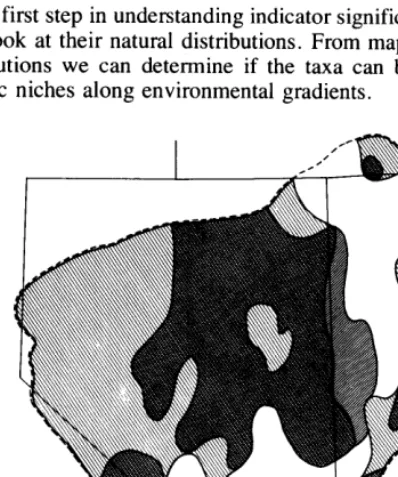
The first step in understanding indicator significance of taxa is to look at their natural distributions. From maps of current distributions we can determine if the taxa can be related to specific niches along environmental gradients.
Presence or absence of each taxon within sampled woodlands of a given mountain range offers little explanation by itself. All we could see from such maps was that greatest overlap of taxa occurs in the middle of the Great Basin. However, mapping the high relative frequencies (~50%) (Fig. 1) and the presence and absence (Fig. 2) of various combinations of taxa allows some generalizations to begin emerging.
Artemisia tridentatu vaseyana, although the most common sagebrush in the Great Basin pinyon-juniper woodlands, is lacking in most western Utah woodlands (Fig. 2a). Only the higher and larger masses of mountains have A. tridentutu vuseyana in their pinyon-juniper woodlands. Artemisia nova is generally absent in the woodlands of the southern Great Basin, in western Nevada and in western Utah (Fig. 2a). The excep- tions involve mountains of higher and larger masses. Artemisia arbuscula is found widely scattered over the Great Basin, but only in the woodlands that reach higher elevations (Fig. 2b). Artemisia tridentata tridentata is generally absent in the wood- lands of the southern Great Basin. Artemisia tridentutu wyomingensis is absent from woodlands in the north and high central Nevada ranges (Fig. 2b).
Basin-wide variations in woodland composition is not strong- ly related to geology or landform (Beeson 1974; West et al.
a
Fig. 2. Portions of the Great Basin where various Artemisia taxa are present or absent in the pinyon-juniper woodlands on the mountain ranges sampled.
Specific shading indicates the presence of a taxon: (a) A. nova and A. t. vaseyana; (b) A. arbuscula, A. t. tridentata, and A. t. wyomingensis.
1978). Floristic variations in vegetation considered at a coarse focus are also not strongly related to soils over the basin as a whole. Analysis of basin-wide occurrences of the major Artemisia taxa in relation to higher level soil taxonomic categories showed no close correlation between sagebrush taxa and particular kinds of soils when the total set of data is looked at together.
General patterns of vegetation, soils and distribution of Arternisia taxa in woodlands seem to be more closely related to patterns of moisture and temperature (Beeson 1974; West et al. 1977). These aspects of climate in turn are influenced by physiography and storm systems (Houghton 1969). Cross- sections of the Great Basin show low, dry areas in the west, south, and east. The central plateau of eastern Nevada had a wetter and colder climate than elsewhere within the Basin (Wemstedt 1960; Houghton 1969).
Fii. 3. Map locations sampledjor elevational scaling of Artemisia occurrence in pinyon-juniper woodlands of the Great Basin.
List of Mountain Ranges in Figure 3: I. Virginia Range, 2. Pine Nut Range, 3. Wassuk Range, 4. Clan Alpine Range, 5. Desatoya Range, 6. Shoshone Range, 7. Toiyabe Range, 8. Toquima Range, 9. Simpson Park Range, IO. Fish Creek Range, I I. White Pine Mountains, 12. Lower Egan Range, 13. Schell Creek Mountains, 14. Lower Snake Range, 15. Conjusion Range, 16. House Range, 17. Sheeprock Mountains, 18. West Tintic Mountains, 19. East
2q R. 22 23 2.
MEAN STAND ELEVATION v n\ 2200
A nova & t trldentata
Fii. 4. Elevation distribution of major Artemisia taxa in pinyon-juniper wood- lands oj the Great Basin: (a) south-north cross section of the Great Basin; (b) west-east cross section in the central Great Basin; (c) west-east cross section in the southern Great Basin. Numbers arrayed across the top of
graphs are locations shown in Figure 3. Vertical scales are elevations (m).
Basin, have A. tridentata vaseyana. To the north and west, A.
tridentata vaseyana increases in dominance until at the north- western limits of the type it is the only woodland sagebrush present. A. arbusculu is widely scattered on cold, dry sites with shallow soils on the higher mountains all across the Great Basin. A. tridentuta tridentutu is lacking in the woodlands of the
southern Great Basin. Where this taxon occurs on the northern ranges, it is on the relatively warmer, wetter sites wth deeper
a
00%
80
60
40
20
0%
Tintic Mountains, 20. Panamint Mountains, 2 1. Spring Range, 22. Sheep Range, 23. Beaver Dam Mountains, 24. Pine Valley Mountains, 25. Wilson Creek Range, 27. Fortification Range, 28. Upper Egan Range, 29. Cherry Creek Range, 30. Spruce Mountains, 3 I. Pequop Mountains, 32. Toana Range, 33. Goose Creek Range, 34. Albion Mountains.
80
60
40
Relationships of Artemisia to environment, especially cli- mate, are further illustrated by elevational considerations. Figure 3 indicates the locations of samples taken to examine these relationships. The first series (Fig. 4) is graphed by actual elevations and distances. The second series (Fig. 5) has simpli- lied the patterns by graphing the percentage of plots where various sagebrush taxa occur. The relative elevational position of each has been maintained on the vfrtical scales. In both series the figures may be interpreted as cross-sections through a
20
0% 00%
A.arbuscula 80
&nQ!La 60
40
B fYa.zYana 20
a. L WYQmingkxlxi
0% response surface to which the total data set could be fitted.
Because data are available from very few climatic stations in the
woodland belts, we must infer from elevations, slopes, and Fig. 5. various sagebrush taxa in the pinyon-juniper woodlands of the Great Basin: Relative altitudinal arrangement oj percentage of plots occupied by
exposures that climatic relationships to Artemisia occurrences (a) south-north cross-section oj the central Great Basin; (b) west-east cross-
are likely. section oj the central Great Basin; (c) west-east cross-section of the Southern Generally, the higher and larger mountains, and thus wettest
Great Basin. Numbers arrayed across the top of the graphs are locations and coolest of pinyon-juniper woodland sites in the central Great
shown in Figure 3. Vertical scale is percentage of stands occupied, from lowest to highest elevations possessing woodlands.
A. ARBUSCU LA A. TRIOENTATA VASEY ANA
I
COLDDRY WET
Ii’ii. 6. Generalized occurrences oj major woodland sagebrush taxa in relation to relative gradients oj temperature and moisture over the Great Basin as a whole.
soils. A. tridentata wyomingensis is lacking in the woodlands of the northern Great Basin and high central Nevada ranges. It occurs in the driest, warmest woodland sites in the more southerly portions of the Great Basin. A. nova is generally absent from the more arid portions of the Great Basin in both western Nevada and western Utah, but occupies sites of
intermediate favorableness elsewhere.
Ecological Indicator Values
The primary relationships of sagebrush taxa to effective moisture and temperature for the Great Basin woodland sites studied are summarized in Figure 6. A. tridentata wyomingensis occurs in the warmest and driest types of pinyon-juniper woodland. A. nova occurs in drier conditions where tempera- tures are intermediate. A. arbuscula is restricted to the coldest, driest woodland sites. A. tridentata tridentata occurs pre- dominantly on the wetter, but still relatively warm woodland sites. A. tridentata vaseyana dominates woodland understory on the wettest, coldest sites.
The foregoing relationships characterize the coarse focus basin-wide patterns which appear to be largely responses to climate. In applying these generalizations, one must realize that environment is a complex of many interacting variables. Aspect may compensate for elevation in changing effective temperature and moisture. Slope, landform, and soils also alter the effective soil moisture levels. On particular mountain ranges and sites,
1
Shoshone Range av (I)&
(:I
(‘;)
av (2) (2) ntw (2) Etvw
(4)
&
W
&
atvw (6) ntvw(5) (7, S
1
Hlghland Range
26-
24-
an (I)
tv (I) ;I
nvw nv (I) (1)
;; :: A arbuscula
A nova
N E W S Fig. 7. Distribution oj major Artemisia taxa in relation to elevation (m,
vertical scale) on the Shoshone (No. 6, Fig. 3) and Highland (No. 25, Fig. 3) Ranges and exposure (direction, horizontal scale).
JOURNAL OF RANGE MANAGEMENT 31(2), March 1978 91
Table 3. Mean (X) depth (cm) and standard deviation (s) of soil A horizon
as related to taxa of Artemisia found in pinyon-juniper woodlands of
Shoshone Mountains, Nevada, n=sample size.
A. horizon depth (cm)
Taxa x S n
A. arbuscula 25.6 12.2 11
A. t. vaseyana 32.2 17.2 42 A. t. tridentata 22.3 6.2 7 A. t. wyomingensis 19.3 5.6 9 A. nova 21.5 2.1 2
No differences are statistically significant.
geologic, micro-climatic, edaphic, or pyric factors definitely influence distribution of Artemisia. These kinds of interactions and site-to-site differences are illustrated and compared in the distribution patterns of Artemisia taxa found on the Shoshone Range of west-central Nevada and the Highland Range of east-central Nevada (Fig. 7). The Shoshone Mountains are typical of ranges located near the southwestern limits of pinyon- juniper woodlands. The Highland Range is located near the’ center of the Great Basin pinyon-juniper woodlands and borders the high central plateau region on its north and east sides and the Great Basin-Mojave Desert transition on its west and south slope. There is a 200 m elevational difference between the valley floors on the northeast and on the west.
Except on the lowest elevations and driest aspects, the sagebrush in the Shoshone Mountains is primarily Artemisia t. vaseyana with an occasional A. arbuscula (Fig. 7). A. arbuscula is generally on shallower soils than A. t. vaseyana (Table 3).
The Highland Range occurs in a warmer but climatically more complex region (West et al. 1978). Maximum precipita- tion occurs on the east slope. The north slope has been disturbed
by mining activity. All A. t. vaseyana and all A. nova, except for one stand on the east slope, occur above 2,100 m (Fig. 7). Except for the climatically complex east slope, all A. t. tridentata and A. t. wyomingensis occur below 2,100 m (Fig. 7).
On both ranges there appear to be definite elevational and aspect controls on the distribution of sagebrush taxa. However, because of differences in the location of these ranges in the Great Basin and, as a result, differences in their general climates, the specific details of their distributions differ.
We conclude that one must understand the broader picture before precise indicator significance of each taxon can be worked out for local areas. In the absence of past climatic
records, soils information and other inventory data on these ecosystems, we have to let plants tell us something of the effective environments on the wildlands they occupy. Sage- brush taxa, if identified by chromatography, appear to offer a major set of plant indicators that can be used to compare site favorableness within pinyon-juniper woodlands.
Literature Cited
Beeson, D. W. 1974. The distribution and synecology of Great Basin pinyon- juniper. MS Thesis, Univ. of Nevada, Reno. 95 p.
Blackburn, W. H., and P. T. Tueller. 1970. Pinyon and juniper invasion in
black sagebrush communities in east-central Nevada. Ecology 5 1:84 l-848.
Brunner, J. R. 1972. Observations on Artemisia in Nevada. J. Range Manage.
25:205-208.
Hall, H. M., and F. C. Clements. 1923. The phylogenetic method in taxono-
my: The North American species of Artemisia, Chrysothamnus and Atriplex.
Carnegie Inst., Washington. Pub. No. 326. 355 p.
Hanks, D. L., E. D. McArthur, R. Stevens, and A. P. Plummer. 1973.
Hohugren, A. H., and J. L. Reveal. 1966. Checklist of the vascular plants of the Intermountain Region. U.S. Dep. Agr., Forest Serv. Res. Pap. INT-32. 160 p.
Houghton, J. G. 1969. Characteristics of rainfall in the Great Basin. Desert Research Institute, Univ. Nevada System, Reno. 205 p.
Nabi, A. A. 1978. Variation in successional status of pinyon-juniper woodlands in the Great Basin. MS Thesis, Utah State Univ., Logan. 127 p.
Stevens, R., and E. D. McArthur. 1974. A simple technique for identification of some sagebrush taxa. J. Range Manage. 27:325-326.
Stebbins, G. L., Jr. 1975. Shrubs as centers of adaptive radiation and evolu- tion. p. 120-140. In: H. C. Stutz (ed.) Proc. Symposium and Workshop on Wildland Shrubs. Brigham Young Univ. Press, Provo, Utah.
Wernstedt, F. L. 1960. Climatic fluctuations in the Great Basin 1931-1956. J. Range Manage. 13:173-178.
West, N. E., R. J. Tausch, K. H. Rea, and P. T. Tueller. 1978. Phyto- geographical variation within juniper-pinyon woodlands of the Great Basin. In: K. ‘1’. Harper (ed.) Intermountain biogeography: An interpretive syn- thesis. Great Basin Nat. Memoir (In press).
Whittaker,R.H.1973.Directgradientanalyses.p.71-74.In:R.H. Whittaker (ed.) Ordination and classification of communities. Vol. 5 Handbook of Vegetation Science. W. Junk, The Hague, Netherlands.
Holmgren, A. H., and J. L. Reveal. 1966. Checklist of the vascular plants of the Intermountain Region. U.S. Dep. Agr., Forest Serv. Res. Pap. INT-32. 160 p.
Houghton, J. G. 1969. Characteristics of rainfall in the Great Basin. Desert Research Institute, Univ. Nevada System, Reno. 205 p.
Nahi, A. A. 1978. Variation in successional status of pinyon-juniper woodlands in the Great Basin. MS Thesis, Utah State Univ., Logan. 127 p.
Stevens, R., and E. D. McArthur. 1974. A simple technique for identification of some sagebrush taxa. J. Range Manage. 27:325-326.
Stebbins, G. L., Jr. 1975. Shrubs as centers of adaptive radiation and evolu- tion. p. 120-140. In: H. C. Stutz (ed.) Proc. Symposium and Workshop on Wildland Shrubs. Brigham Young Univ. Press, Provo, Utah.
Wernstedt, F. L. 1960. Climatic fluctuations in the Great Basin 1931-1956. J. Range Manage. 13:173-178.
West, N. E., R. J. Taosch, K. H. Rea, and P. T. Tueller. 1978. Phyto- geographical variation within juniper-pinyon woodlands of the Great Basin. IX K. 1‘. Harper (ed.) Intermountam biogeography: An interpretive syn- thesis. Great Basin Nat. Memoir (In press).
Whittaker, R. H. 1973. Direct gradient analyses. p. 7 l-74. In: R. H. Whittaker (ed.) Ordination and classification of communities. Vol. 5 Handbook of Vegetation Science. W. Junk, The Hague, Netherlands.
Winward, A. H. 1969. Taxonomic and ecological relationships of the big sage- brush complex in Idaho. PhD Diss., Univ. Idaho, Moscow. Univ. Micro- films, Ann Arbor, Mich. 80 p.
Nutrition and Production of Domestic Sheep
Managed as Manipulators of Big Game Habitat
JOHN C. MALECHEK, KURT J. KOTTER, AND CHARLES
H. JENSEN
Highlight: Weight gains of ewes and lambs, forage intake, and dietary quality of ewes were evaluated from mid-May to early July on foothill ranges under two intensities and durations of grazing management. Dietary quality was poorer and forage intake was lower under heavy than under moderate stocking. Individual lambs gained somewhat less weight under heavy stocking but ewes were not affected. A short-term, rotational grazing scheme, as compared to season-long grazing, did not appear either beneficial or detrimental to sheep. Response of the plant community will be a major factor determining which grazing system provides the best winter range for big game, but heavy stocking was decidedly superior when lamb production was considered on a land area basis.
The concept of controlling livestock grazing for the specific purpose of directing plant community succession in a manipula- tive sense is well recognized (Lewis 1969). Applications have generally been in the realm of specialized grazing systems aimed primarily at increasing range carrying capacity for livestock (reviewed by Herbel 1974), and to a smaller extent in the control of undesirable woody plants (DeToit 1974) and as a tool in forest management (reviewed by Adams 1975).
Recent research indicates an additional potential for using controlled livestock grazing in management of wildlife habitat. For example, Anderson and Scherzinger (1975) reported a three-fold increase in winter elk (Cervus canadensis) numbers following implementation of planned cattle grazing on pine- bunchgrass range in Oregon. In other studies, Jensen et al. (1972) suggested that judiciously applied sheep grazing during spring could effectively increase yields of important shrub species for subsequent winter use by big game animals.
Unlike the direct and immediate cost outlays for plant community manipulation by conventional means (e.g. mechan- ical, chemical, or controlled burning), use of the grazing animal as a management tool is generally expected to yield a return (from livestock products) while the manipulation program is in progress. Thus, productivity aspects of the manipulator animal population must be considered in the overall evaluation. The research described in this paper was designed to evaluate possible nutritional limitations to production of domestic sheep managed under grazing regimes designed to benefit winter habitat of mule deer (Odocoileus hemionus) and elk. The major treatment variables were intensity and duration of grazing by sheep.
Authors are associate professor, Department of Range Science, Utah State University,
A’preliminary assessment of plant community responses to
Logan 84322; wildlife biologtst. Bureau of Land Management, Burley, Idaho; and game the grazing treatments imposed has been presented by Jensen et biologist, Utah Division of Wildlife Resources, Logan 84321. al. (1976). Additionally, Smith (1976) and Fulgham et al.
Submitted as Journal Paper No. 2185 of the Utah Agricultural Experiment Station.
Authors wish to acknowledge the Utah Agricultural Experiment Station for financial and (I 977) have reported iniiial data on the winter diets ind nutrition physical support of this research and the Utah Divisiop of Wddlife Resources (Federal Aid of mule deer in response to one of the sheep grazing treatments. Project W-105-R) for allowing us to use their experimental pastures. Thanks are also due
Dr. Arthur D. Smith, Department of Range Science, Utah State University, for his assistance in designing the grazing experiment, and Mr Kenneth 0. Fulgham, Depart- nxnt of Animal and Range Sciences, New Mexico State University, and Dr. Michael A.
Smith. Derwtment
of
Animal Science, Angelo State University, for their generous help in Study SiteMethods and Materials
various asbcts of data collection and analysis. A special note of appreciation is extended
to Dr. Farid D Iskander, Range and Pasture Admimstration, Democratic Republic of Field research was conducted at Hardware Ranch, located approxi- Sudan, for providing samples for nutritional analysis from his related study. Mr. David K. mately 40 km southeast of Logan, Utah. The area, situated at approxi- Mann, Utah Divtsion of Wildlife Resources, did much of the laboratory analysis, and Dr.
Don D Dwyer and Dr. Philip J. Umess, Department of Ra nge Science, Utah State Uni- mately 1,750 m elevation, is typical of much of the intermediate ve ” wry, prowaeu I > ~I AL,. -1. “a,“aDle CUllVl ,a, COllllllClll> _...., ____^_.^ “II ,llF r,,‘wuscript. ^_ .L^ _..^ elevation foothill range type found throughout Utah and much of the
Manuscript received May 5. 1977. Intermountain West.